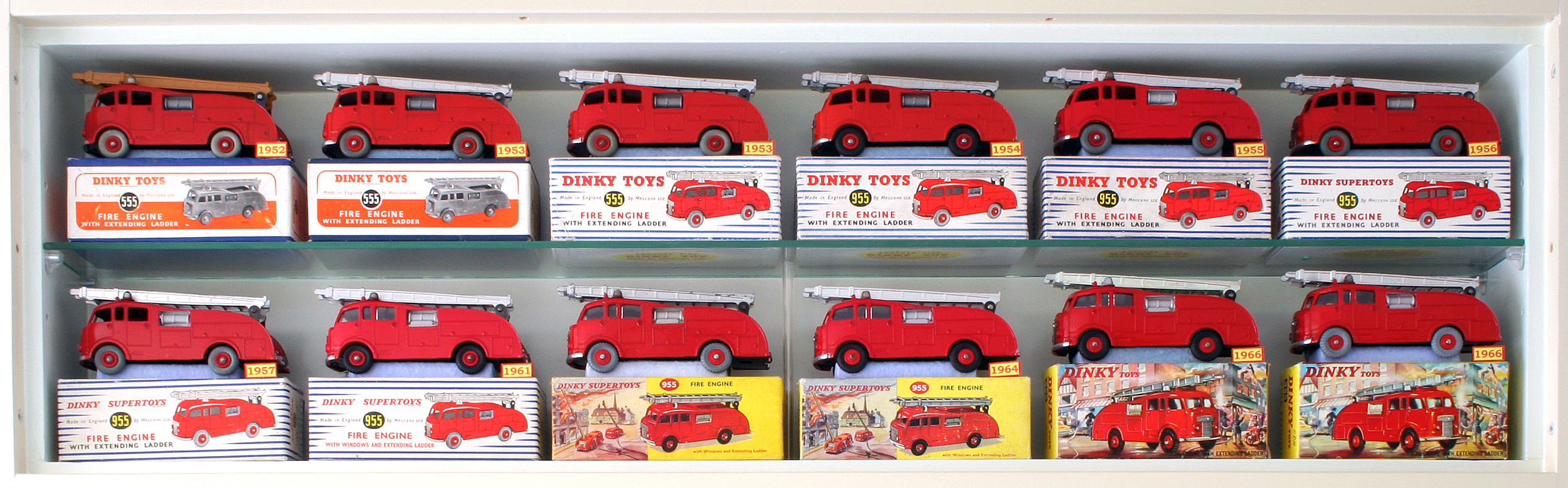
The 555/955 Fire Engine sub-collection
Many of us will agree that the (Commer) Fire Engine with Extending Ladder is one of the most iconic Dinky Toys ever. It lasted for about eighteen years in the post-war Dinky Toys range, which is not the longest available Dinky (Super)Toy, but in the rapidly changing 1950s and 1960s it’s a miracle that it succeeded in having a lasting appeal to its youthful admirers. And to be honest, it continues to appeal to the adult collector even half a century later. Even overseas, where similar Commer Fire Engines were virtually unknown in reality, this model managed to get into numerous little children’s minds as the quintessential prototype of a fire truck.
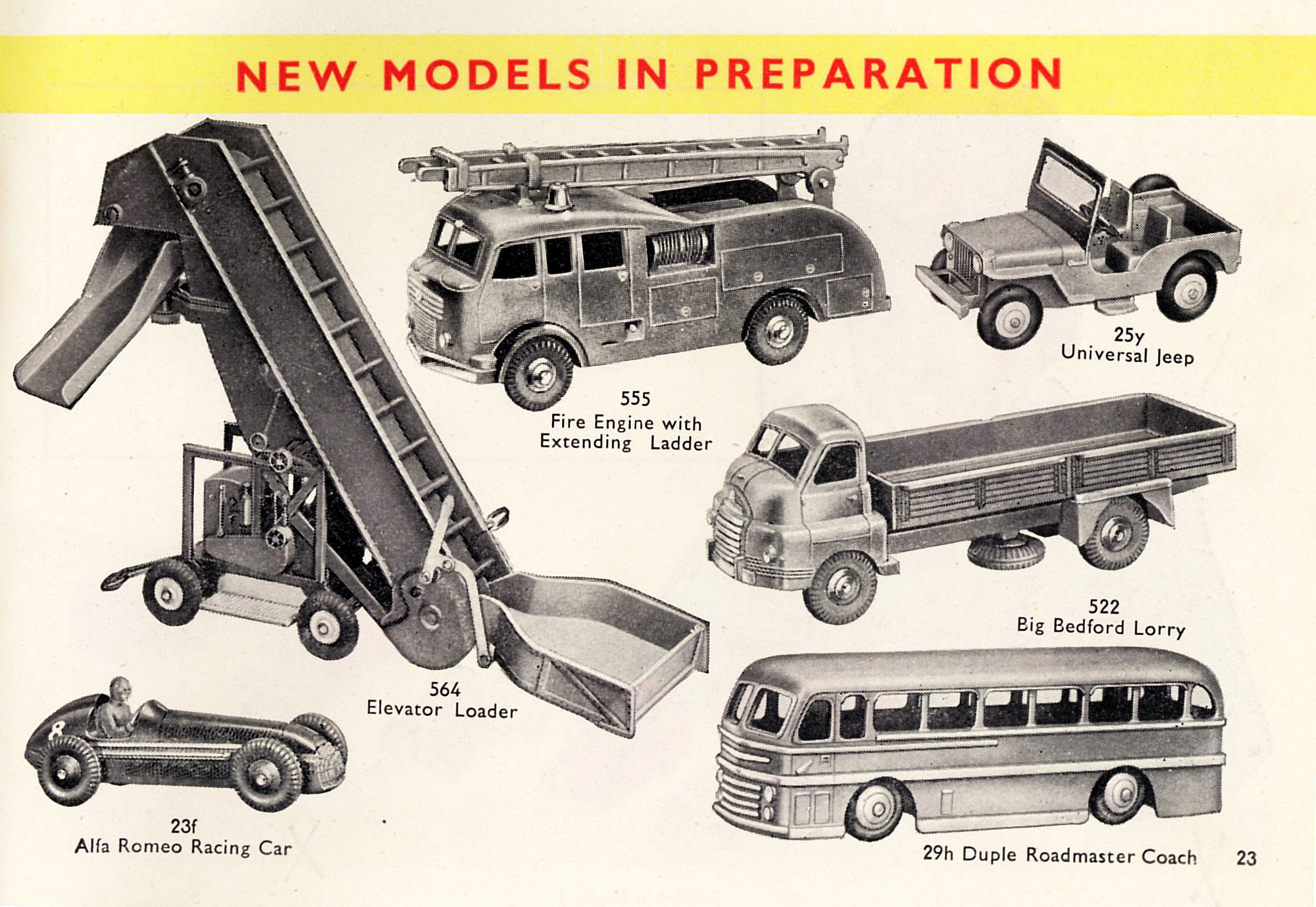
Dinky Toys May 1952 catalog “in preparation”
It must have been a surprising and exciting moment for young readers of the May 1952 Dinky Toys general catalog (“New models in preparation”) and the November 1952 issue of Meccano Magazine (“New models ready during November”) when they first made acquaintance with this sturdy model, so much bigger and more versatile than the “oldie but goldie” Streamlined Fire Engine of the 1930s!

The subsequent December issue of Meccano Magazine commented, “It is a miniature of one built by Hampshire Car Bodies Ltd., and is very modern in type with every detail represented in a realistic manner, from reels of hose to the pumps. There is accommodation for the firemen in a special compartment behind the driver, and the ladder, which is hinged at the rear, can easily be raised into position for effecting rescues, extended, and swung round at any angle in order to make it useful in all situations.”

Introduced as early as 1952 as Dinky Toys 555, this model could of course not have remained unchanged during a lifetime that spanned almost two decades. While the basic casting remained the same, many secondary characteristics of this model were altered over time due to changes in tooling, wear and repair of the die components, and new features introduced in response to a changing market and fashions.
One change that never occurred was the move from ridged to grooved wheel hubs, a change that is suggested by the earliest B&W pictures of the model in the abovementioned May 1952 Dinky Toys catalogue (13/552/130, Eng./Univ.) and the early issues of Meccano Magazines, which both show ridged Dinky Toys hubs. Indeed, the Commer was released in the nick of time past the mid 1952 transition to the newly introduced grooved Dinky Supertoys hubs, and was without exception fitted with only the latter. However, one cannot exclude the possibility that such a pre-production prototype does or did exist and served as a model for this early picture representation.
All the other (and often very subtle) changes that followed must have triggered in me a desire to collect more than just one or two examples of this model — in fact, a dozen to be specific! And with each new version in hand, more differences were detected and more questions answered — or raised.
I started in the 1980s with the addition of a rather “regular” example of the later 1950s model, which was in fact a higher quality improvement, a replacement for a previous example in my collection. Many years later a less common example of the very first 1952 issue with a brown ladder crossed my path, and I couldn’t resist buying that as well. That find was the reason for me writing an article about this rather exceptional early brown ladder in the Dutch “Auto in Miniatuur” bimonthly. One of the conclusions was that the change from the brown to silver ladder must have virtually coincided with the change of the red to silver ladder of its older cousin, the Dinky 25H/250 Streamlined Fire Engine.
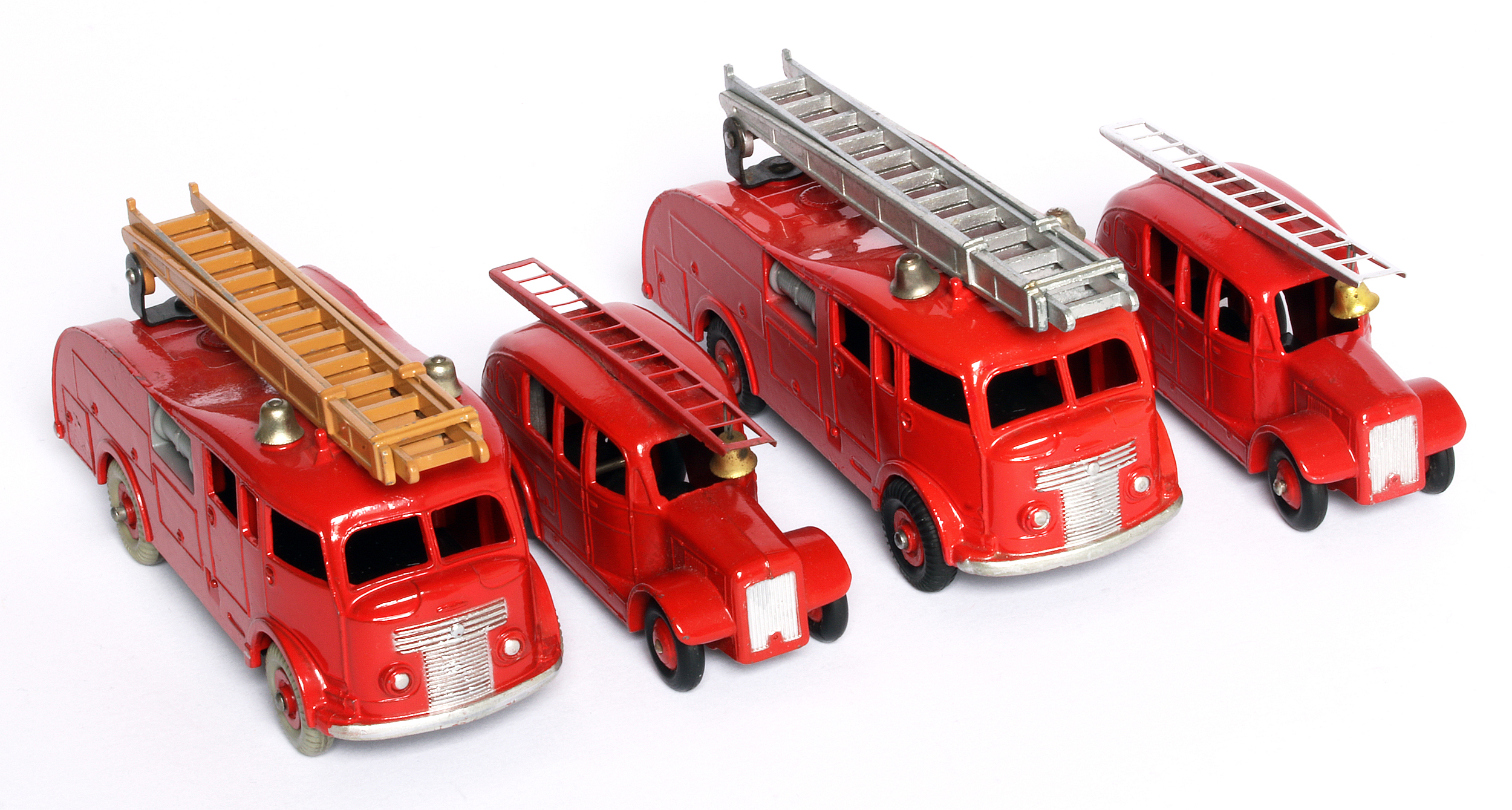
Contemporary ladder finish changes
On the other hand, when the very late 1960s example (the final issue) was subsequently added, this would turn out to be the start of a quest for as many variants in between as possible. Upon collecting more variations, it became obvious that during the 1950s the grey rectangular hose reel recesses and the larger hoses at the rear turned from darker grey to a definitely brighter grey. This change coincided somewhat with the renumbering of the model from 555 to 955. Another interesting point about these recesses, in particular the right hand one, is the practical problem that apparently arose with casting that area.
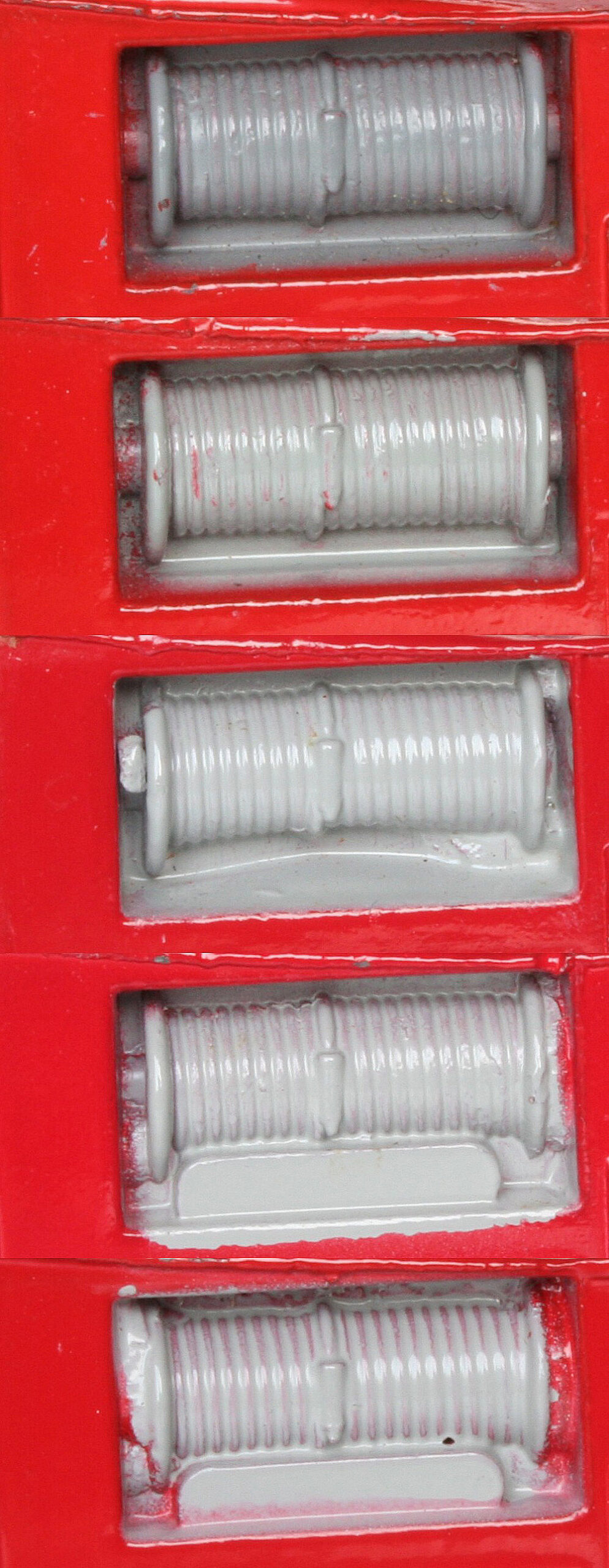
Evolution of the right hose reel recess over two decades
At first, details in that area were crisp but in a few years they gradually started to deteriorate by the second half of the 1950s. The space under the reel tended to “silt up”. When this problem became more prominent and untenable, not long before plastic windows were introduced, it was apparently decided to fill this area with an undefinable shim, in order to address, or better, mask the problem. In order to keep things symmetrical, this shim was applied to the other, less problematic side as well. This “fake” addition to the model was officially “acknowledged” in the mid-1960s, this shim then being added to the second last and the final box design pictures; their realistic representations even suggesting that incidental addition existed in reality.
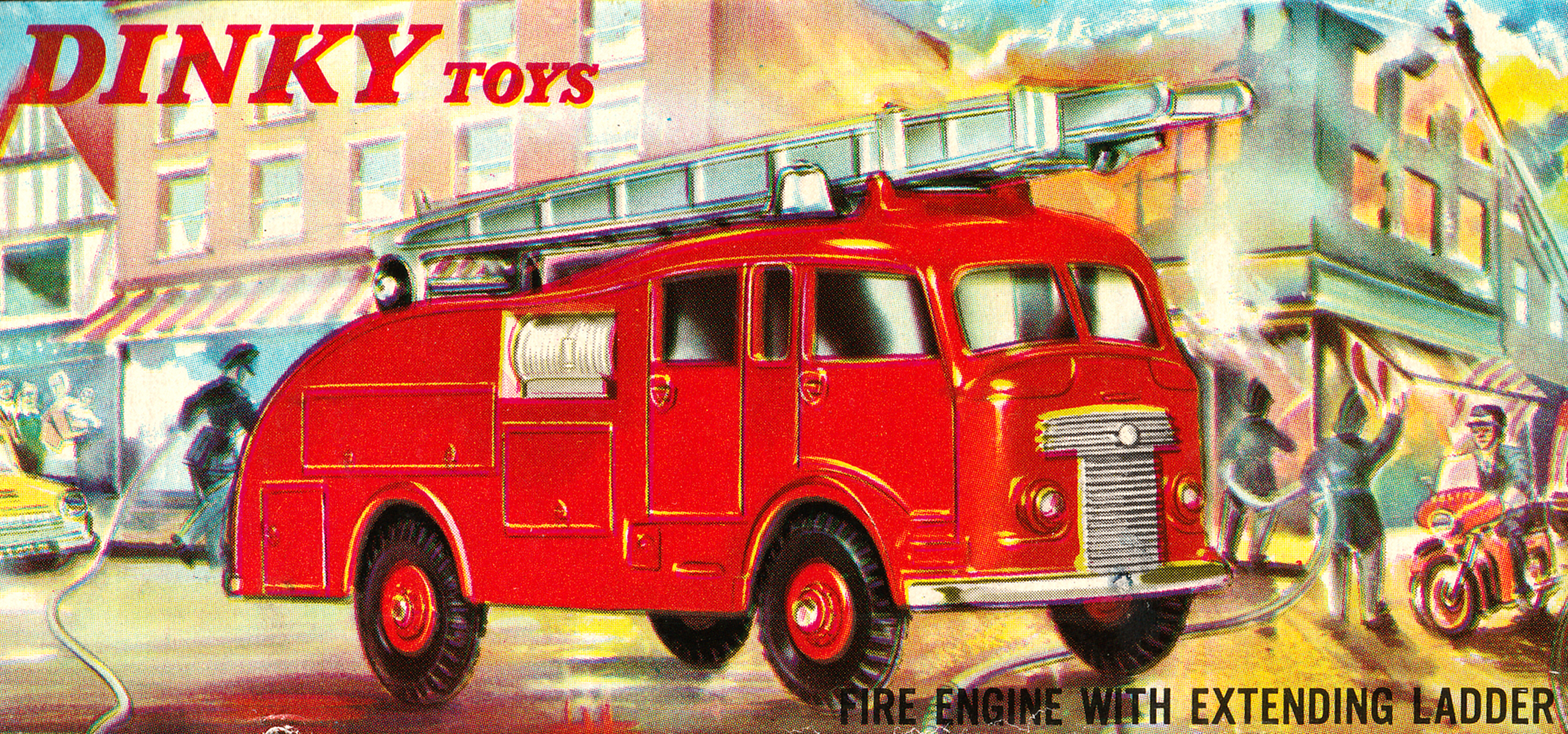
Latest box illustration with shim represented as being authentic
Many years ago I found an enquiry document in the Meccano Business Archive in Liverpool, prepared by Meccano historian Kenneth Brown. One of the respondents complained about the practical casting difficulties caused by the die of the Fire Engine. Whether this may have had to do with this very problem cannot be traced any more. Apparently the problem was ongoing and persistent, because the deterioration continued to occur even after the above mentioned provisional repair had taken place.
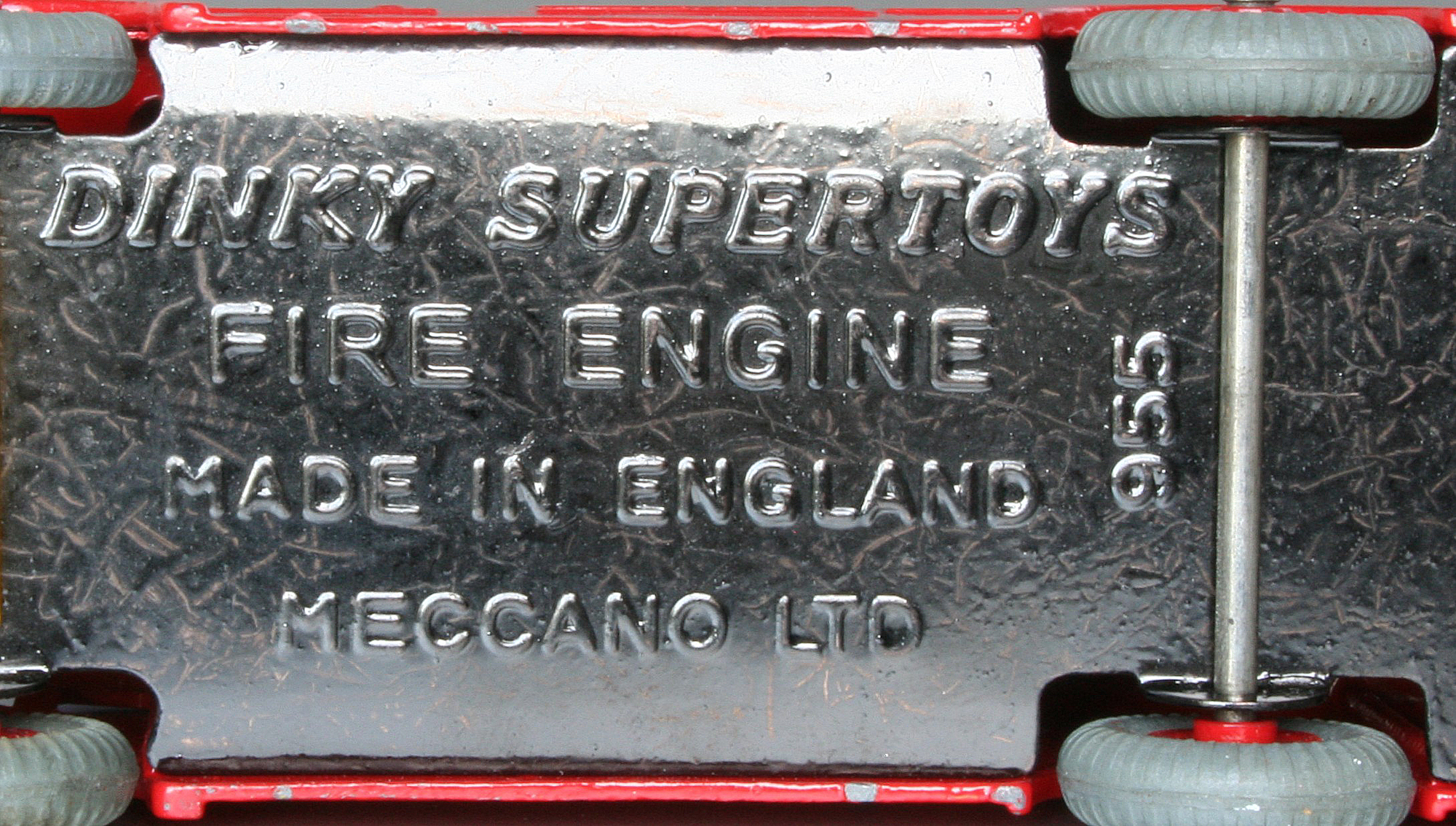
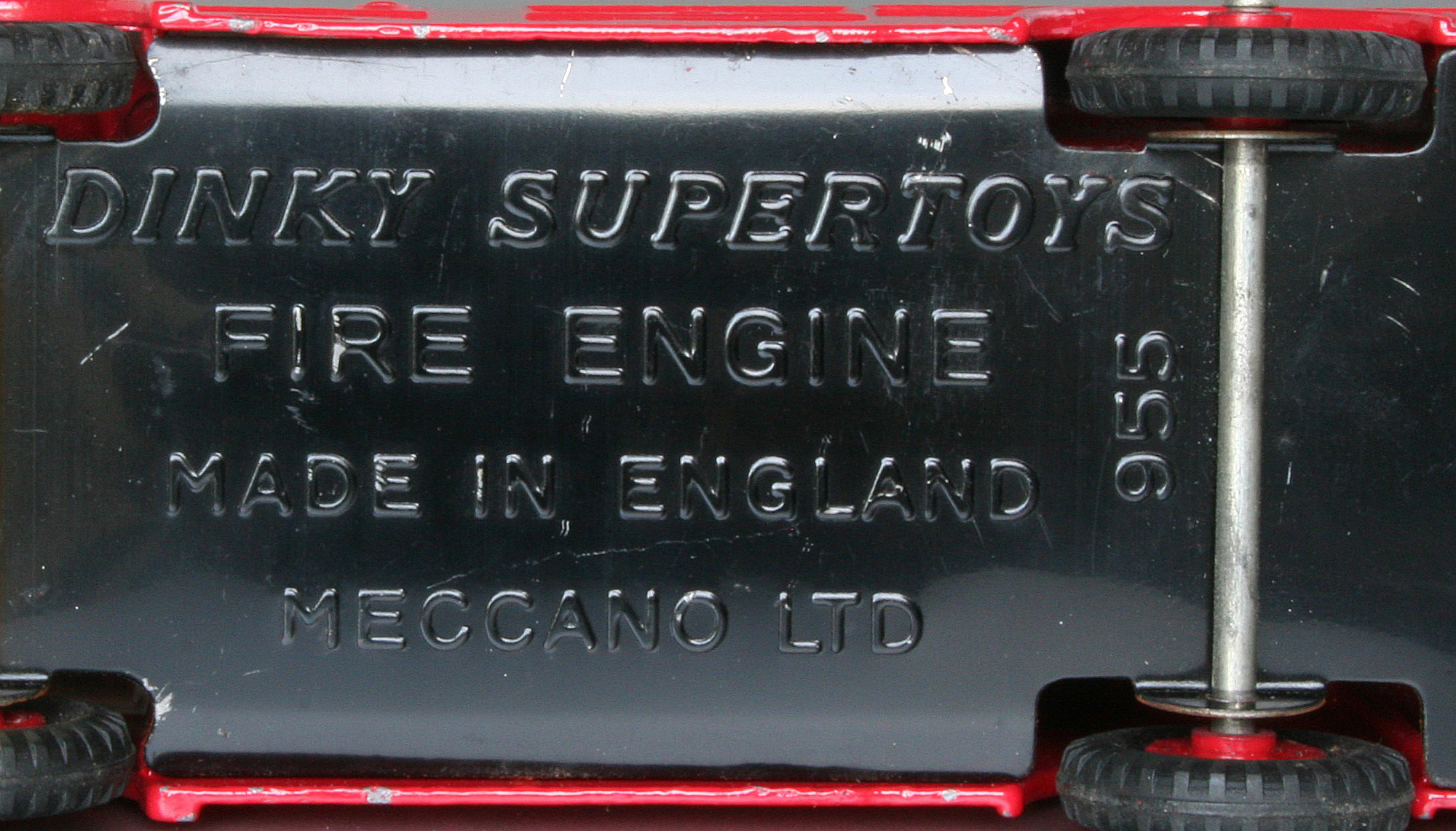
Other changes will be more obvious and familiar, in line with general Dinky Toys practice. We all know the early “mottled” base plates that made way for the gloss black painted ones near the end of the 1950s, and a matte black finish in the early 1960s that was replaced by a gloss black finish during the rest of its career. Meanwhile, the embossed model number 555 changed to 955 in 1954 and the Dinky Toys brand reference on the base plate changed to Dinky Supertoys.
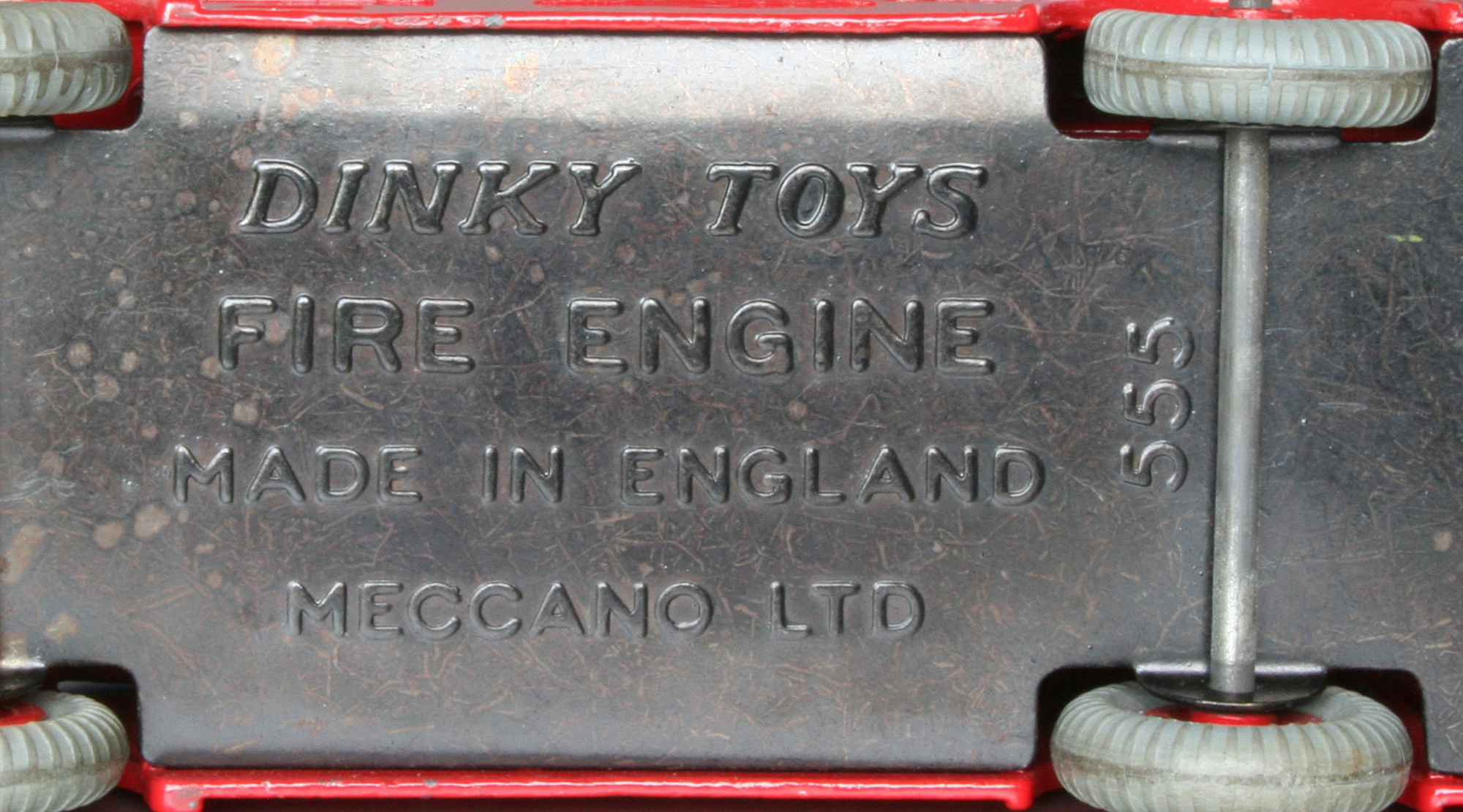
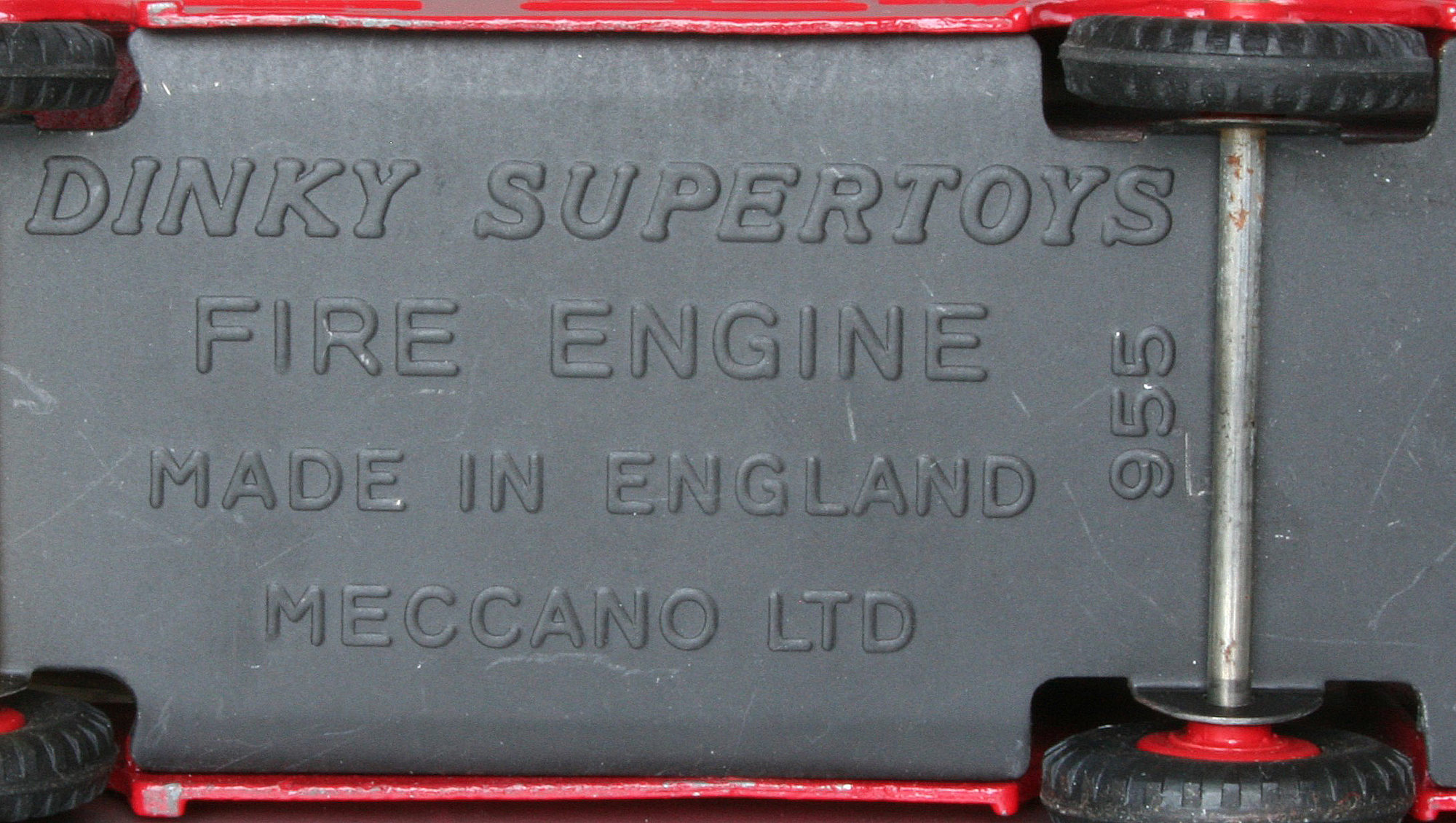
1 : First base plate, Dinky Toys 555 (1952–54)
2 : Second base plate, Dinky Supertoys 955 (1955–61)
3 : Shiny black finished base plate (1961 onward)
4 : Matte black finished base plate (1964)
The introduction of plastic windows in 1960 meant that the two bells had to be fixed on top and inside slightly differently, resulting in a lower position with the bells now resting on the cab’s roof. Some other less conspicuous details like the position of the towing hook and the inside attachment of the rotating ladder changed as well. This may well have had to do with some newly introduced tools in the factory towards the mid 1960s.
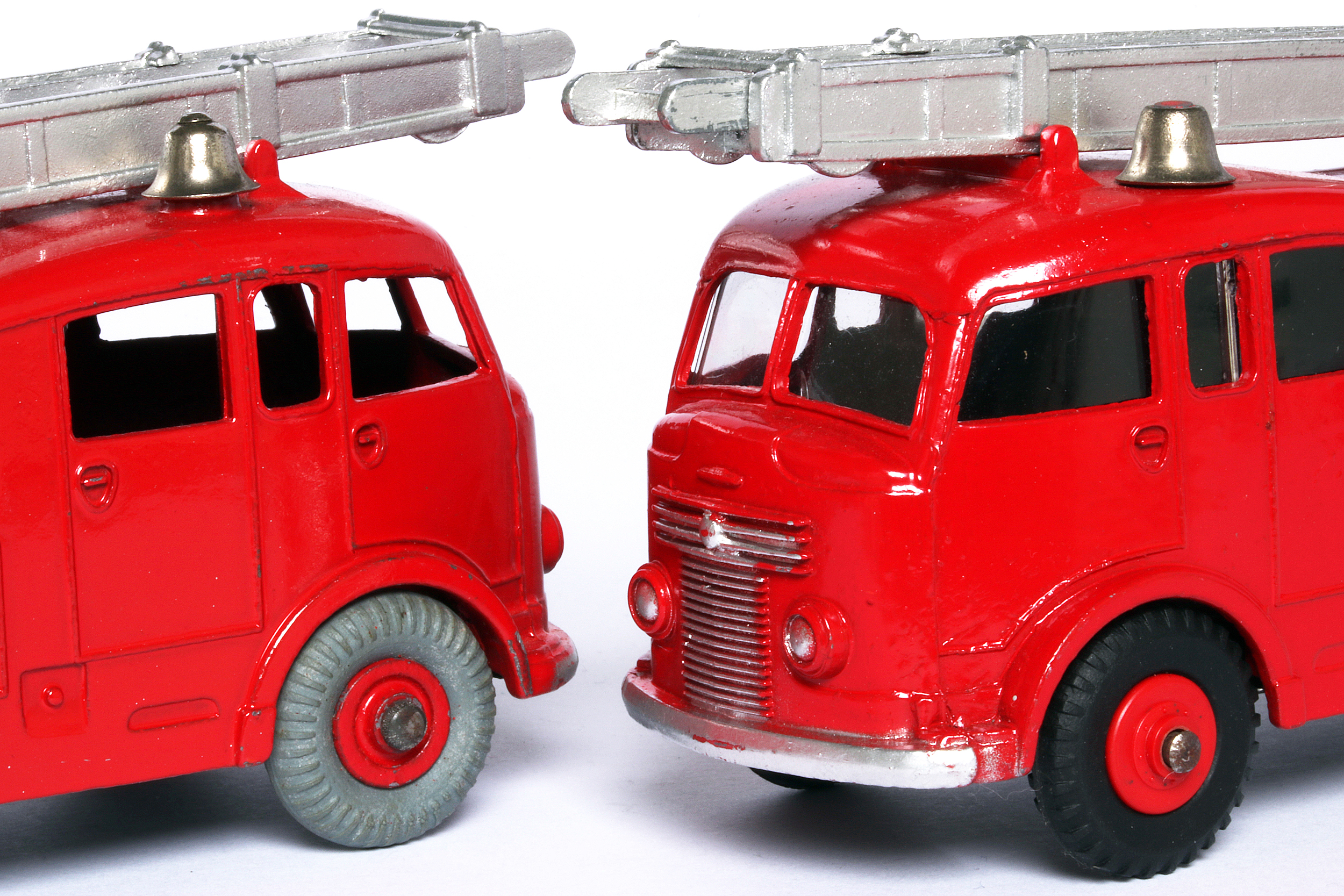
Windows added and bell mounting changed
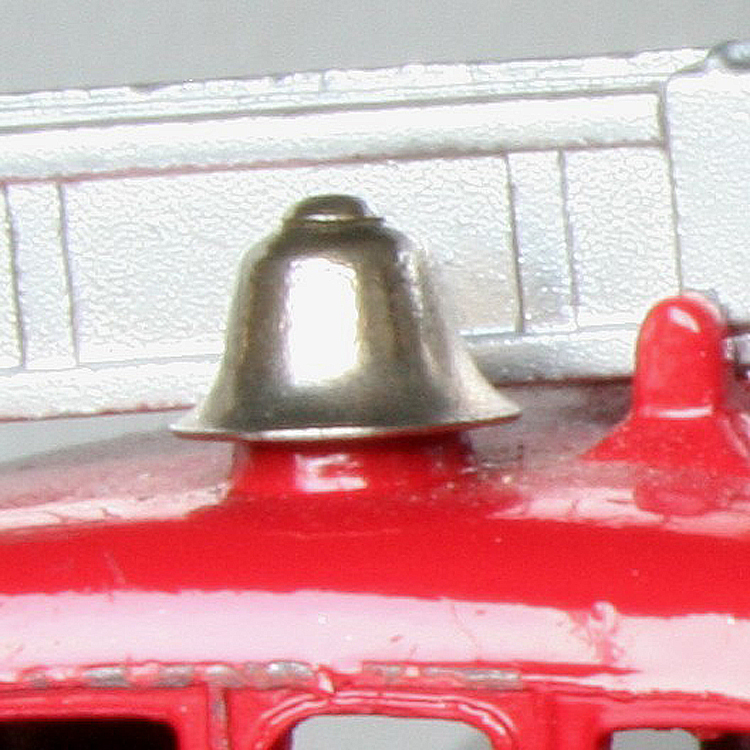
Bell mounting pre windows
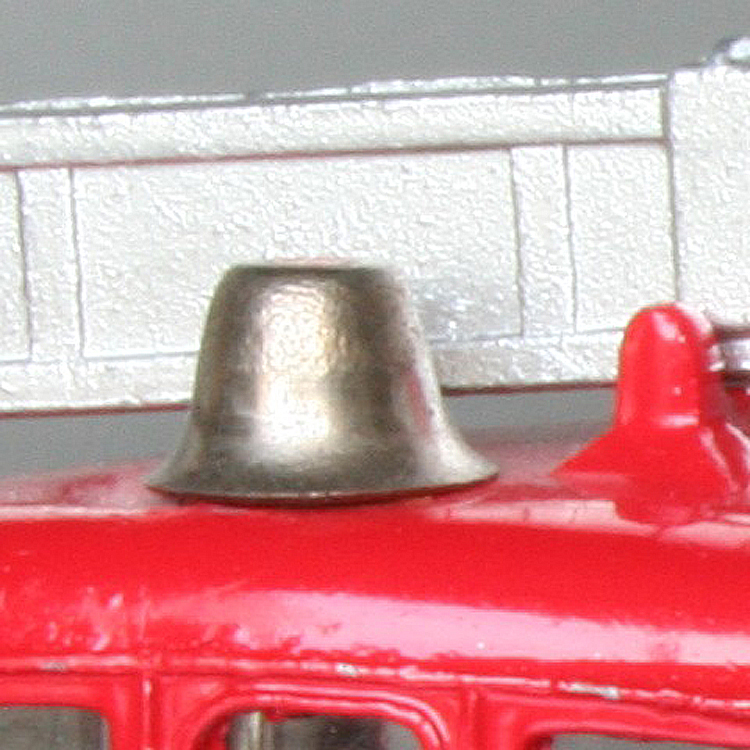
Bell mounting post windows

Simplified mask spraying (on right) for the Streamlined Fire Engine and Fire Engine with Extending Ladder
The lovely, detailed mask spraying of the pumps system at the rear was simplified towards 1963, resulting in an all-silver panel. Like the previously mentioned change to the finish of the ladder, this also coincided with a similar simplification of the Streamlined Fire Engine’s rear instruments. This happened during the final stage of the Streamlined Fire Engine’s production.

The apparent similarity of boxes and plastic hubs
Like many other continued earlier Dinkys, the Fire Engine was fitted with plastic wheels from 1963 and even these may show a different structure. For instance, the models on the similar later yellow lid boxes (see above image) have different plastic hubs, one type visibly smoother than the other. Even the boxes aren’t exactly the same; the one the right shows the new yellow underbox while the one on the left is the traditional blue one. The boxes have their own story, as demonstrated in this article.

Silver painted ladder (top) and nickel plated ladder (below)
I was surprised to find an example of the Commer with a nickel plated (not silver painted) ladder from a reliable dealer in the United States, twelve years ago. It is a model with all the characteristics of the later Fire Engine, and it’s not clear to me whether this was a temporary experiment or the final design. I have never seen a reference to this exceptional kind of finish, let alone a possible explanation for this choice. It isn’t easy to catch the shine of the mirror like finish in a photography, but I hope I succeeded in doing so.
Because the Commer had such a long run, it’s also interesting to see the development of its boxes, from the early blue ones with a label pasted on the lid, through the various striped blue boxes, the lavishly illustrated yellow lidded ones, and later the abundantly colored sturdy end flap boxes. Various styles, reference numbers and brand designations can be identified. The only one still wanting in my overview is an example packed in the yellow visipac export box. It was listed by Keith Harvie in his unfortunately short-lived Binns Road Gazette (Vol 1/5, Sept/Oct 1999, p. 19–21). They are rarely seen, but Adrian Nash, from Australia, showed his example on the Forum of the DTCA website and is still visible there. These boxes with their flimsy see through ‘windows’ are so vulnerable that even his fine example needed some careful repair.

The idea of compiling a collage of the present state of my 555/955 collection arose when I found a nice Dinky 957 Fire Service Set in March 2020, as a kind of natural way to end to my long search of variations. I remember it well, for it was at the start of the Covid explosion, when “Covid paranoia” gripped everyone. In those confusing and uncertain early weeks, I wasn’t sure the set would arrive safely from the UK.
But it did, I couldn’t be happier in those dull days of isolation. Beholding my Fire Engine collection, now virtually completed with this Gift Set, it occurred to me that it might be nice to produce an overall photographic presentation, a ‘state portrait’. After all, I had plenty of time to spend at home! Some time before, I had already photographed each item individually on their boxes, so now I only had to take some good photos of the new Gift Set and choose the best one as the middle scene for the collage.
The “stitch operation” that soon followed turned out to be a challenging. I had to organize the individual pictures of my twelve single fire trucks in logical order and calculate what dimensions they all had to be reduced to in order to fit them exactly along the sides of the middle scene, as a colorful, decorative frame. After a few hours of fitting and measuring the puzzle was complete, resulting in a huge digital file, suitable for any kind of application.
The first trial included ordering a popular mug from my online photo service. After that I boldly tried a poster which turned out to be quite nice in its 50 cm x 70 cm size. I also used the collage for the cover of one of my photobooks that I periodically make, and finally I present it here as an article for everyone to enjoy!
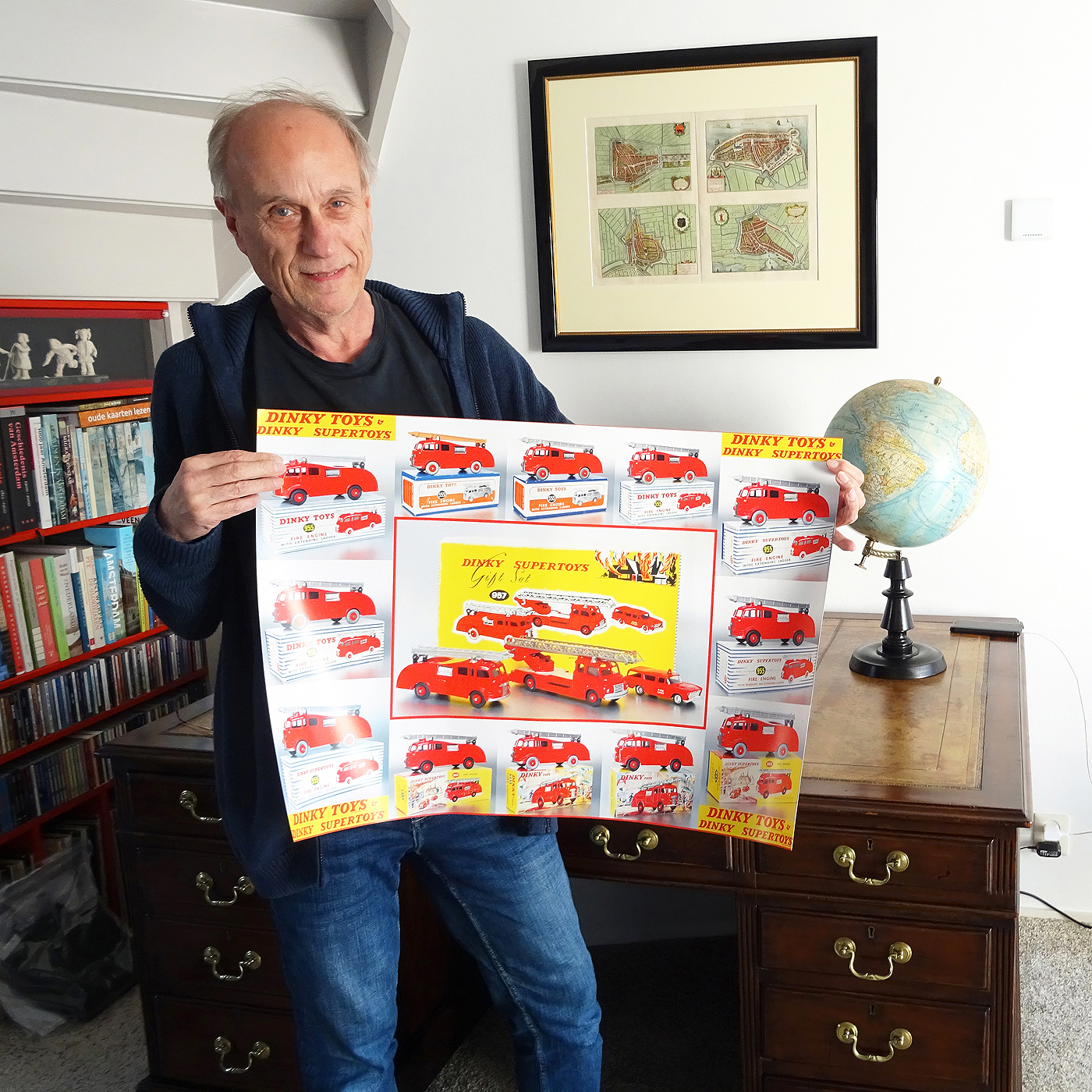
The photographer with his printed poster

Photo album cover and coffee mug with a reduced version of the scene

The Dinky 555, 597 collage
Author’s note
An earlier article of mine on the Dinky 555/955 was published in the July 2009 issue of Model Collector (p. 46–51). There has also been considerable discussion about this model at the DTCA website. This article was first published in The Journal of the DTCA, issue 94 (July 2024).