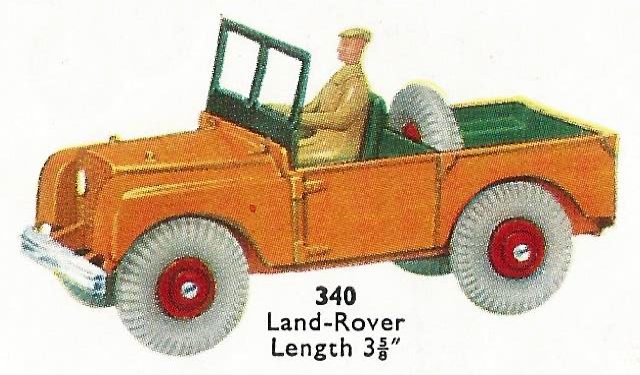
The legendary Dinky Toys Land Rover made its debut in the April 1950 issue of Meccano Magazine.

It was originally part of the 27 Series, dedicated to agricultural models, and carried the model number 27D. In 1954, it was renumbered to 340, a reference it kept until the end of its production in 1971. With a remarkable 21 year run, the Land Rover was one of the longest lasting models in the Dinky Toys lineup.

The Boxes: From Retail Packs to Collectable Treasures
When the Land Rover was first released in 1950, it was packaged in simple yellow or plain trade boxes. Each box held four vehicles and was marked with the 27D reference number.

Image: Vectis Auctions

Image: Vectis Auctions
In 1954, when Dinky Toys introduced a new numbering system, these trade boxes began showing both 27D and 340 numbers during the transitional phase.

Image: Lacy Scott & Knight Auctioneers
But then came a game-changer: Dinky realized that individual packaging would appeal more to buyers — and sales soared. The now iconic yellow individual boxes were introduced, each featuring a charming illustration of the Land Rover on the box. A colored dot on the top of the lid of the box identified the color of the car inside, a small but clever detail.

Image: Vectis Auctions
During the transition from 27D to 340, both numbers were printed on the individual boxes (around 1954). However, once the original 27D stock was phased out, Dinky shifted to using just the 340 reference on the packaging — likely around 1955.

At the end of the model’s production, only the red/orange Land Rover was made and the dot was on the box but uncolored. Eventually the dot was removed.


Images: Vectis Auctions
Ministry of Agriculture promotional version
A promotional version of the Land Rover made in very small numbers for the Ministry of Agriculture and given to sales reps who visited farms and promoted the real vehicle. You can read more about the MOA promotional version in Vincent Espinasse’s article Land Rover Dinky Toys promotionnelle.

Image: Phil Silvester (Diecast Gems)
The model was finished in dark gloss olive green with a standard deep beige interior and had an early brown metal driver. It was enhanced at the factory with silver highlights to the front and rear bumpers and also to the windscreen, top edges, bonnet hinges and door handles and hinges. The model had matching ridged wheels, grey ST tires and spare, and an unpainted rear tow hook.