Dinky’s Brinks Truck (275) has been one of my favorite models ever since it was released, both for its accuracy and its “play value.” As I now know, it also has a unique history among Dinky Toys.
Namely, Dinky’s Brinks Truck:
- was first issued in 1964, followed several years later by a subtly different promo version;
- included accessories made by Meccano France;
- got deleted in 1969, then temporarily resurrected as a limited-production Mexican promo in the mid ’70s;
- rejoined the Dinky range in 1979, sixteen years after its debut. The last gasp version never made it into any catalog, and was painted and assembled in Texas.
All this was thanks to the Brink’s Company, known for its bullet-resistant armored trucks for transporting money and other valuables. Brink’s was founded in 1859 and boasts of being one of the oldest commercial brands in the world. In the U.S., “Brink’s Truck” is often used as a proprietary eponym for every armored truck, no matter whose name is on them.
Armored trucks make great toys because of their potential for being “robbed.” But it seems that in 1964, no accurate diecast model of one bearing the Brink’s name had ever been made. (There were some crude predecessors, such as a cast-iron Brink’s truck with a coin slot, and a plastic battery-powered Brink’s truck with a remote control.)
Brink’s, which had been acquired in 1959 by Pittston, a transportation and mining conglomerate, apparently decided it was time for a detailed model — one that, while still a toy, could be presented to bankers and other clients without apologies. It agreed to pay Meccano Ltd. for the tooling, also committing to purchase a large quantity of models.
Disclaimer: No records of this deal exist, but given the extensive use Brink’s would make of the resulting Dinky, it seems irrefutable. Besides, the Brink’s name is cast into the toy’s baseplate, sealing the deal and ensuring that the model could not be sold with someone else’s livery. The 275 Brinks Truck was announced in the December 1964 issue of the Meccano Magazine by Chris Jelley, who wrote the following:
Before space runs out on me, I must move on to the very last Dinky Toy due to appear in 1964 — the Brink’s Armoured Car (No. 275). Brink’s are a private security company who do the same sort of job in America that a firm such as Securicor do in Britain. One of their main duties is to transport money and gold for banks or to carry large payrolls for industrial concerns, etc. To do this they use strong armoured vans, and it is one of these, made by General Motors, that we have produced in miniature.
Features of the Dinky model embrace opening cab and rear doors, interior fittings, and windows. Inside the cab ... are a driver and guard in semiofficial uniform. The vehicle is finished in grey, decorated with authentic transfers. The windscreen and windows are tinted, and the model comes complete with two opening chests, each containing eight ‘gold’ ingots.
A small picture of the prototype truck appeared in the Meccano Magazine article. An artist’s rendition of the Dinky, meanwhile, was in an advertisement on the back cover.

The Brinks prototype in the Meccano Magazine.

The Dinky Brinks Truck advertised on the back cover of the Meccano Magazine, December 1964.
Two things are notable in Jelley’s writeup. First, he obviously was not sure where to put the apostrophe in Brink’s. Dinky would solve that conundrum by dropping the apostrophe entirely on the model’s boxes and all subsequent publicity! (In this article, I have followed their lead, using the apostrophe when referring to the company and omitting it when referring to the Dinky itself.)
The second is his mention of General Motors (GMC). The 275 Brinks Truck is a detailed model of a GMC vehicle, yet the GMC logo is not present and that company would never again be mentioned by Meccano.
It’s possible there were licensing difficulties with GMC. Previously in 1961, Meccano had modeled a GMC “Cannonball” tractor for its 948 Tractor-Trailer McLean, known to have been financed by the trucking company. In that case too, the GMC label did not appear on the toy and was nowhere referenced.
It’s also possible that Brink’s simply didn’t want to share the spotlight with GMC. After all, it didn’t use only GMC trucks for its armored cars; it also used trucks from Ford and International, as shown below.

Two period Brink’s trucks, GMC (left) and International (right).
In any case, the prototype for Dinky’s armored “car” (as Meccano first called it) was a 1962 or 1963 GMC medium-duty C‑Series, either a 2‑ton 3500 or a 2½-ton 4000 model. It was equipped with a gasoline-powered V‑6 (304.7 cu. in., 5.0L) offering 165 horsepower, or, optionally a 351.2 cu. in. (5.7L) version with 180 horsepower.
Every one of those horses would have been needed to drag the weighty vehicle around. According to the website coachbuilt.com, Brink’s had been the first in the industry to reinforce its cars with armor and weapons. Brink’s vehicles could be equipped with .38 caliber revolvers, .44 caliber repeating rifles, 12-gauge shotguns, gas riot guns, and sub-machine guns.
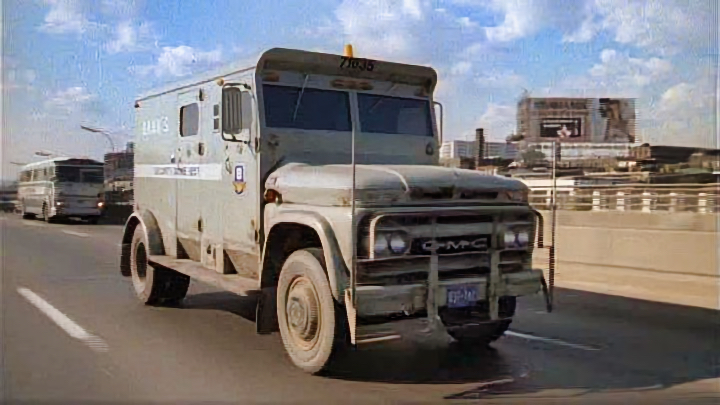
A GMC Brink’s truck in “The Kidnapping of the President” (1980).
The GMCs were sent in the form of a naked chassis with only a front cowl to longtime Brink’s contractor J. Tom Moore and Sons of Memphis, Tennessee, where an armored body was fitted. Exact details of the armor were kept secret, but might have been revealed years after the fact in a 1980 movie, The Kidnapping of the President (starring Hal Holbrook and William Shatner), where a 1962–66 GMC Brinks Truck not only stars but is blown up for art’s sake.
In the movie, a supposed Brink’s official states that the truck’s walls were of sandwich construction: a quarter inch of steel, an inch of cotton batting to stop bullets, and then a second layer of steel. Meanwhile, the truck’s floor was said to be two inches of solid steel.
Brink’s truck armor discussed with William Shatner in “The Kidnapping of the President “(1980).
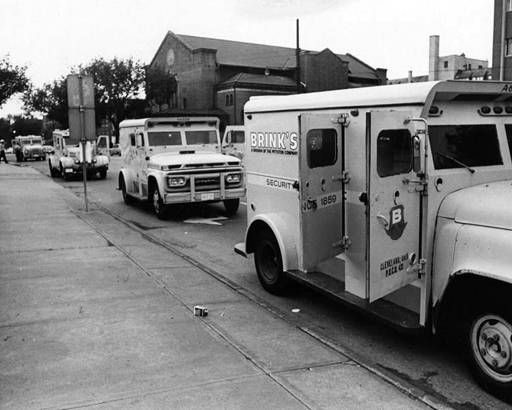
Brink’s Trucks used to shelter police during 1968 riots in Cleveland.
Returning to the Dinky Toy itself, the model was initially released in a Visi-Pac box, priced at 12 shillings 11 pence (65p) in Britain, $2.98 in Canada, and $3.98 in the U.S. After a year or two, Meccano switched to a more-durable picture box, showing a Brink’s truck parked in front of a bank in an obviously American setting.
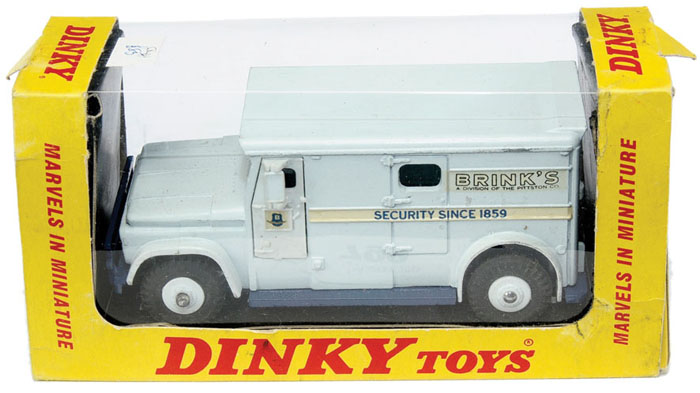
The first Brinks Truck in a Visi-Pac box.
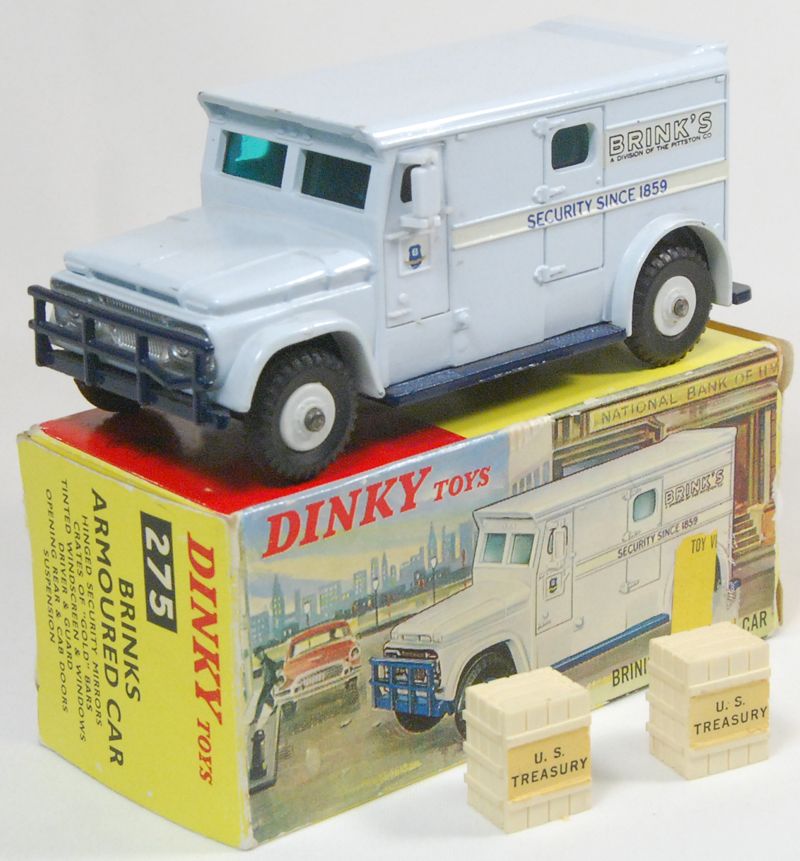
The first Brinks Truck in a picture box.
The Dinky is a very faithful replica, except that both the GMC logo and a piece of trim that ran between the headlights have been removed. The doors, which were one of the more intensive uses of plastic in a Dinky to date, are nicely molded but tend to flop open.

GMC trim deleted from the Dinky.
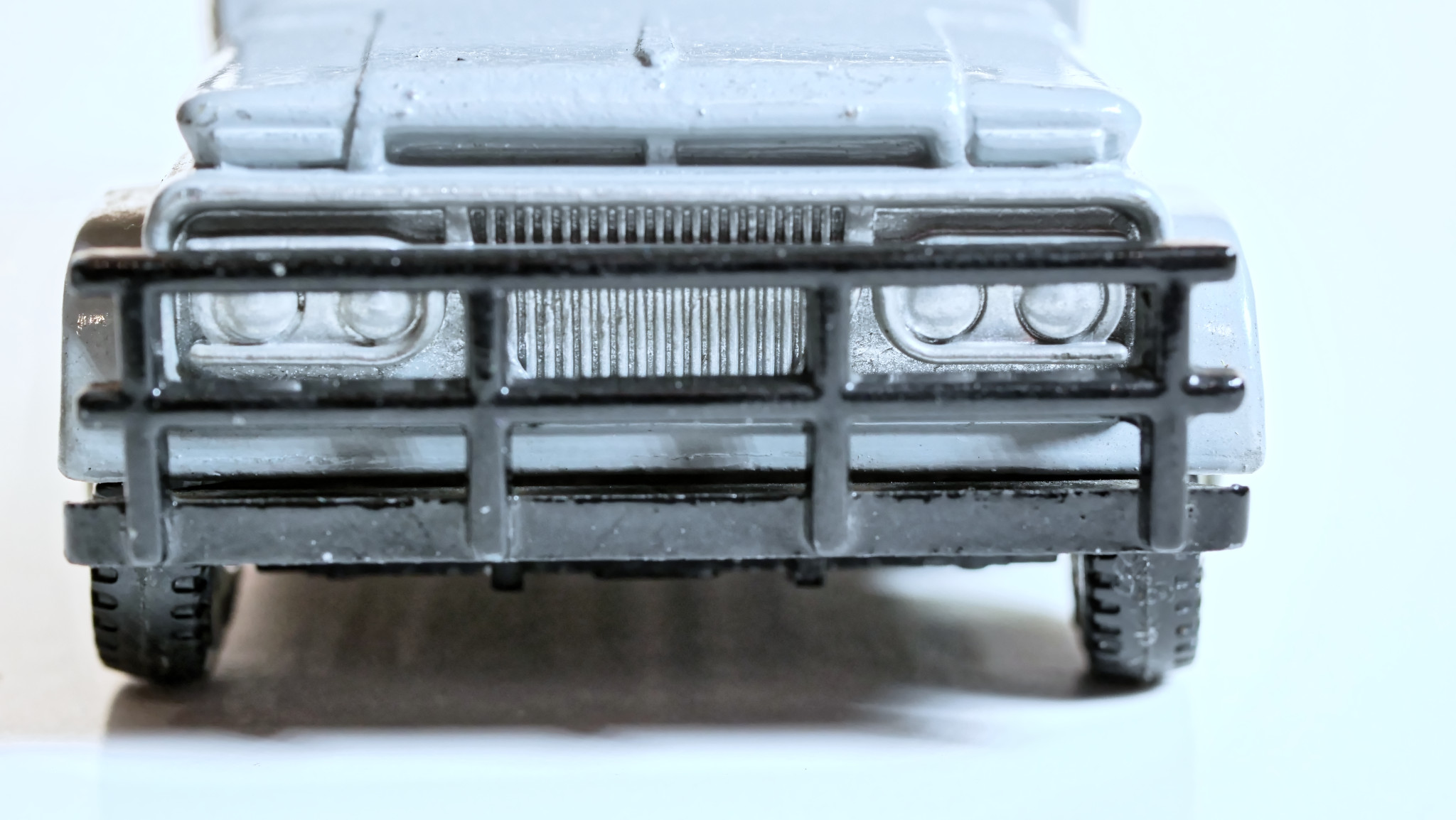
The Brinks Truck’s grille.
The “gold” crates supplied with the model are especially interesting. Apart from their contents, they are identical to the 849 Caisses sold as an accessory by Meccano France since 1959. (One of these crates, containing “radioactive material,” would later be used in the 105 Maximum Security Vehicle too.)
The Brink’s Company likely made use of the standard Dinky Toys, but within a few years it ordered a special run of promo versions. Still supplied with the two crates, the promos are different in that the plastic doors are now a darker grey, the chassis is a brighter blue, and the wheels are black.
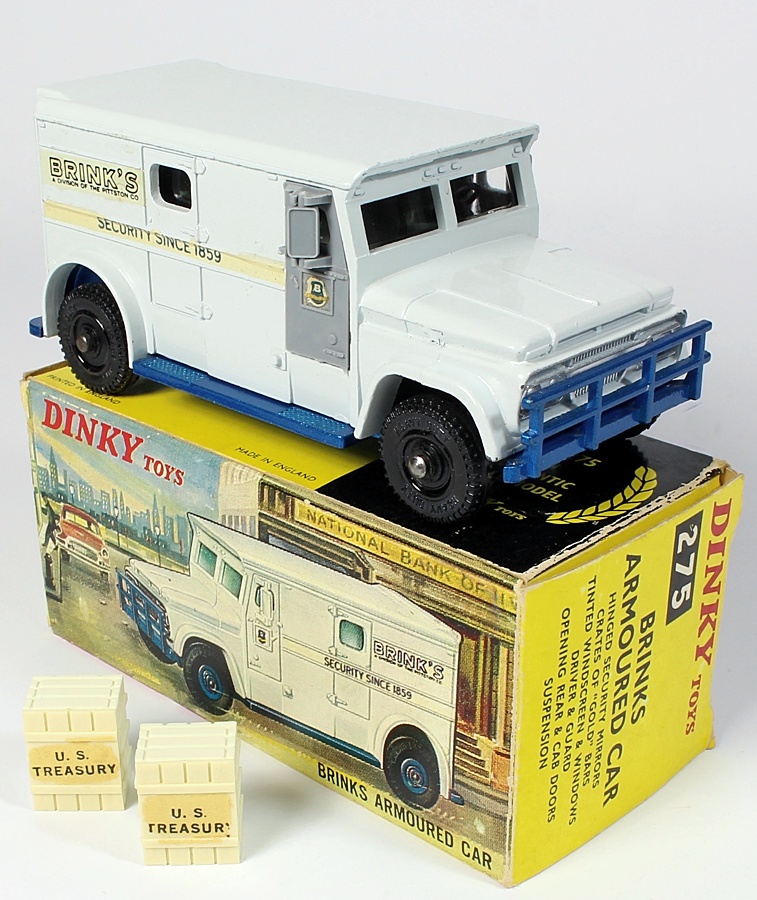
The promo version of the first Brinks Truck.
A more subtle change took place beneath. The representation of the exhaust pipe at the truck’s left rear has for some reason been deleted. Also at the rear, two square boxes possibly representing chassis reinforcements have been added. Presumably made at Brink’s behest, these tooling changes were of course permanent.
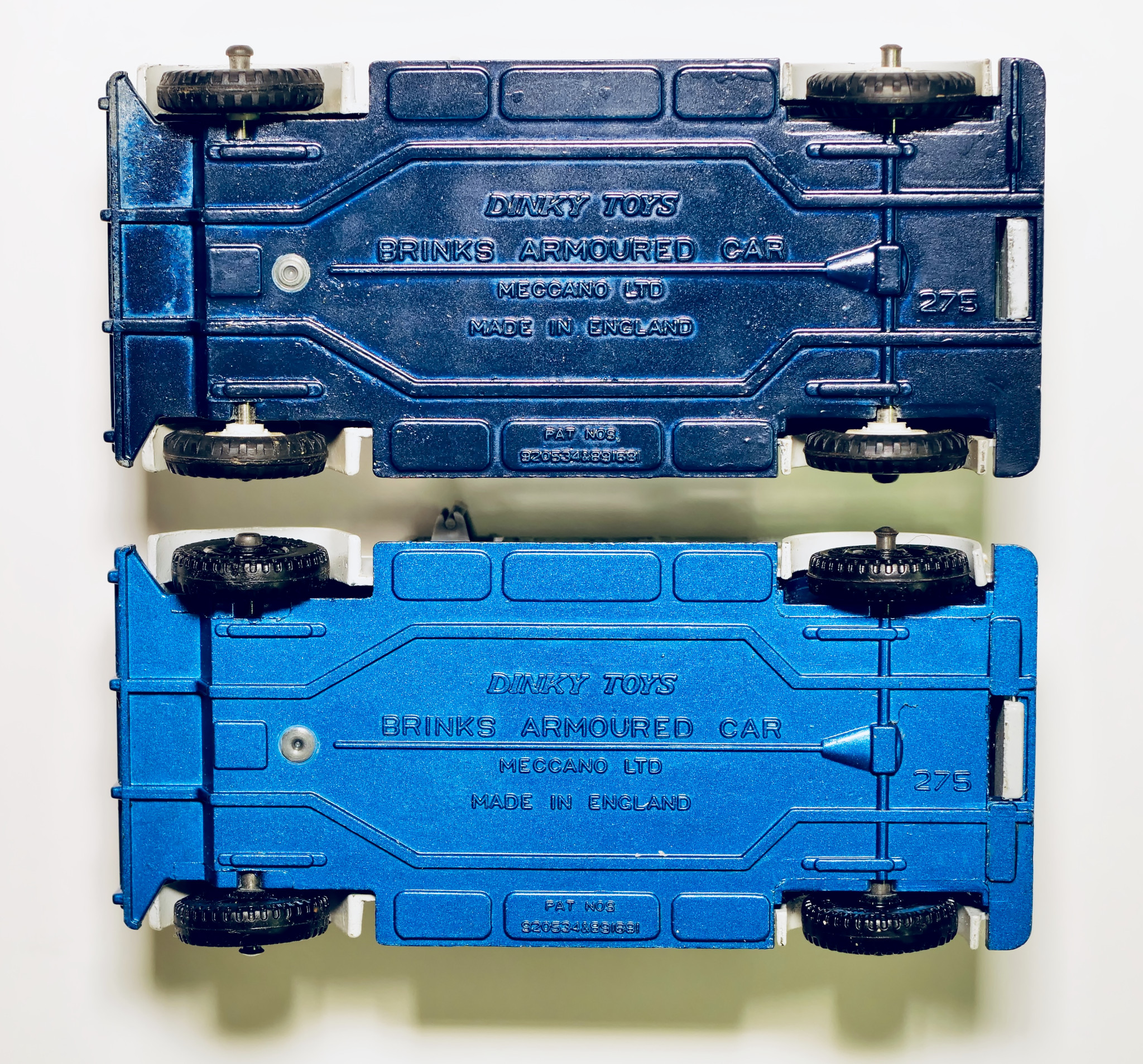
The exhaust pipe (top right) was deleted on the second version (bottom) for an unknown reason.
Brink’s gave its promo versions to employees — I purchased my sample on eBay from a retired Brinks guard — and prospective clients. It appears that most came in the standard picture box.
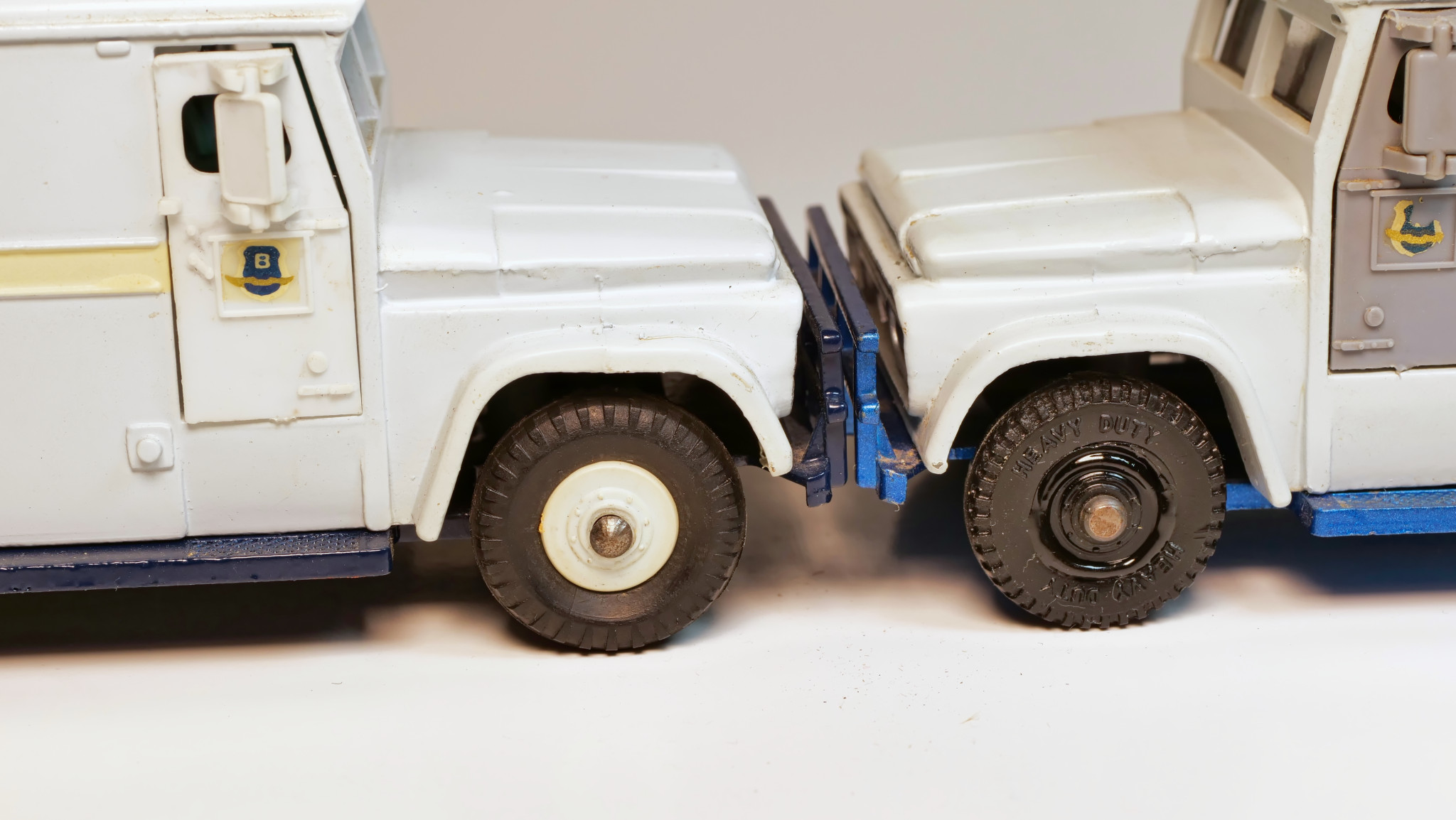
Tires and wheels on the first Brinks Truck (left) and the promo version (right).
I have never seen a definite date for this first promo version, but it always sports the plastic tires labeled Heavy Duty that started appearing on Dinkys around 1968, so it cannot be earlier. Meanwhile, the standard version appeared in a catalog for the last time in 1969. However, that was far from the end of the model!
In approximately 1976 (no definite date is documented), a limited quantity of Dinky trucks was ordered from Liverpool by a Mexican company, Servicio Pan Americano de Proteccion (SPP). At the time, Brink’s owned a 21% stake in SPP; it acquired the rest of that company in 2010.
Supplied in an unmarked white box, the Pan Americano Dinky is finished in a darker all-over grey with a black base, and no longer includes the crates or figures of previous versions. Unfortunately, the plastic tires almost always have glued themselves to the plastic wheels via a messy chemical reaction.

The Pan Americano version.
Incidentally some price guides refer to the Pan Americano Dinky as the “Luis R. Picaso Manriquez” truck. This is a misconception picked up from a photo that appeared in Mike and Sue Richardson’s history of Dinky Toys. In fact, Sr. Manriquez was a Pan Americano official who might have been responsible for ordering the Dinky. About 20 years ago, I was lucky enough to purchase two of the models directly from a former assistant of his.
These models always sport the flying horse logo of Pan Americano, but a number have turned up in UK auctions without the company name decals. I’m guessing these samples “leaked” to collectors from Binns Road directly, and that the others got decorated with the fiddly name decals in Mexico.
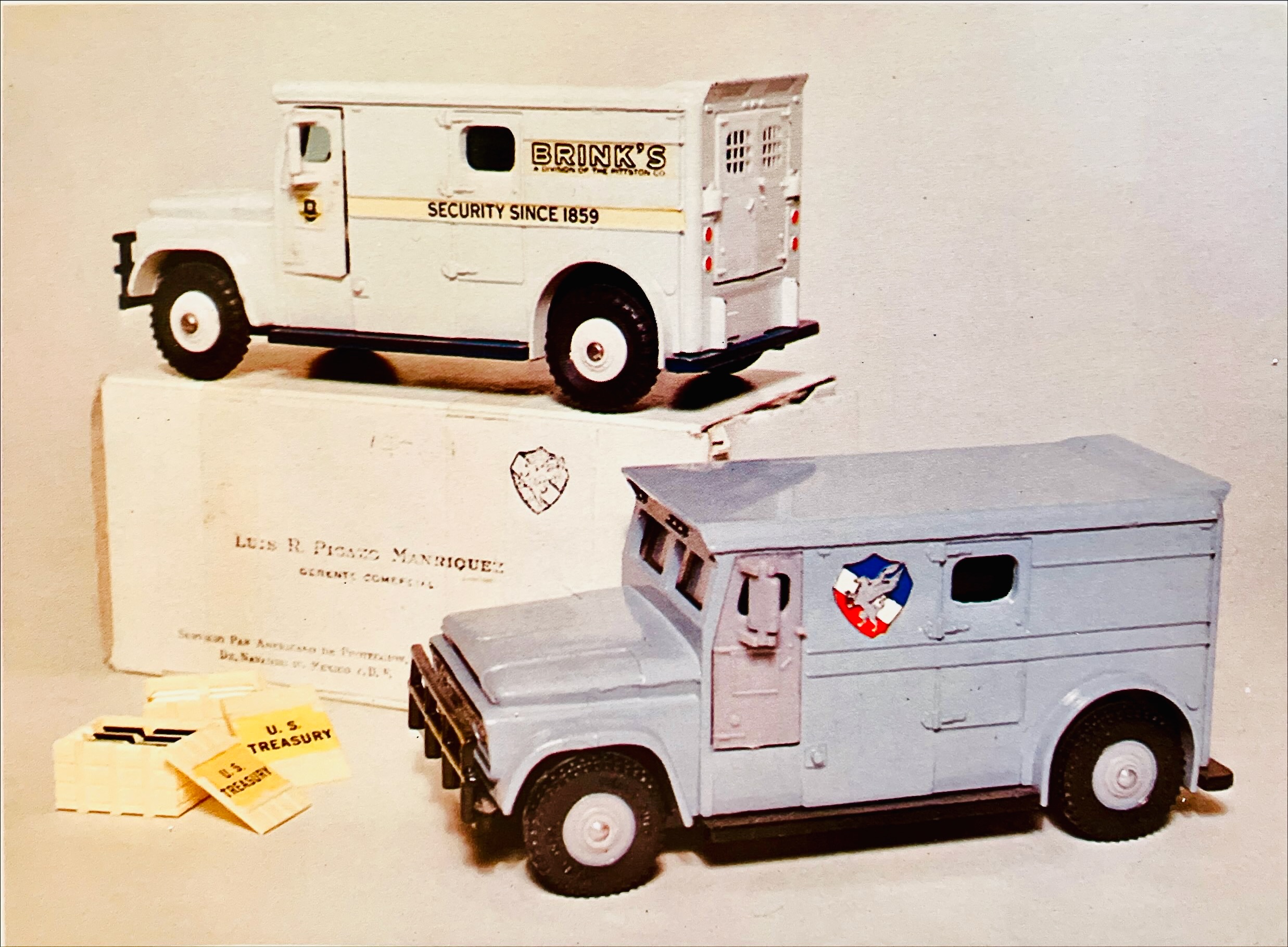
This photo in the Richardsons book led to naming confusion. It shows a sample of the Pan Americano truck without its company name decals.
The end of the story came in 1979, when Brink’s had obviously run out of its stocks of the Dinky truck and wanted more. Unfortunately, Binns Road — soon to be closed — was in disarray. They were having trouble meeting demand for the Dinkys that retailers had already ordered. There was little time for production of a “zombie” model that the Americans wanted. What to do?
According to both contemporary accounts and recollections on websites devoted to plastic kits, Meccano owner Airfix had made a series of increasing investments in AVA International, its U.S. distributor. Some time in 1979, AVA’s name was changed to USAirfix. Since the main business of Airfix was plastic kits, tooling was imported from England and sent to an injection-molding facility in Dallas. Imported kits were also placed into larger U.S.-specific boxes “for greater shelf appeal.”
The Americans were apparently not set up for die casting, so when the order came for a “repop” of the Brinks Truck, there was only one solution. Cast the model at Binns Road, then send the naked parts to Texas for painting, assembly, and packaging. (The same was also done with Dinky’s pocket-size Star Trek models, the 802 Klingon Cruiser and 803 Enterprise.)
The finish on the U.S. Brinks Truck has been criticized (it is even worse on the 802 and 803) but the model did have one improvement compared to the Pan Americano version: metal wheels which no longer react with the tires. The finish is now gray for the body and doors, blue for the chassis, and white for the roof. The roof color is not sufficiently distinct from the body and stands out only in the most sympathetic light. Hardly worth the trouble.

The U.S.-assembled Brinks Truck.
The Brink’s labels are similar to before, but unfortunately they are now stickers rather than decals. Binns Road could not or would not alter the casting, so the ribs on the sides of the truck that had helped line up decals now meant that the stickers don’t stay in place. With its injection-molding capabilities, USAirfix did remove ribs from the plastic doors in order to accommodate a larger Brink’s label, but these don’t adhere well either.
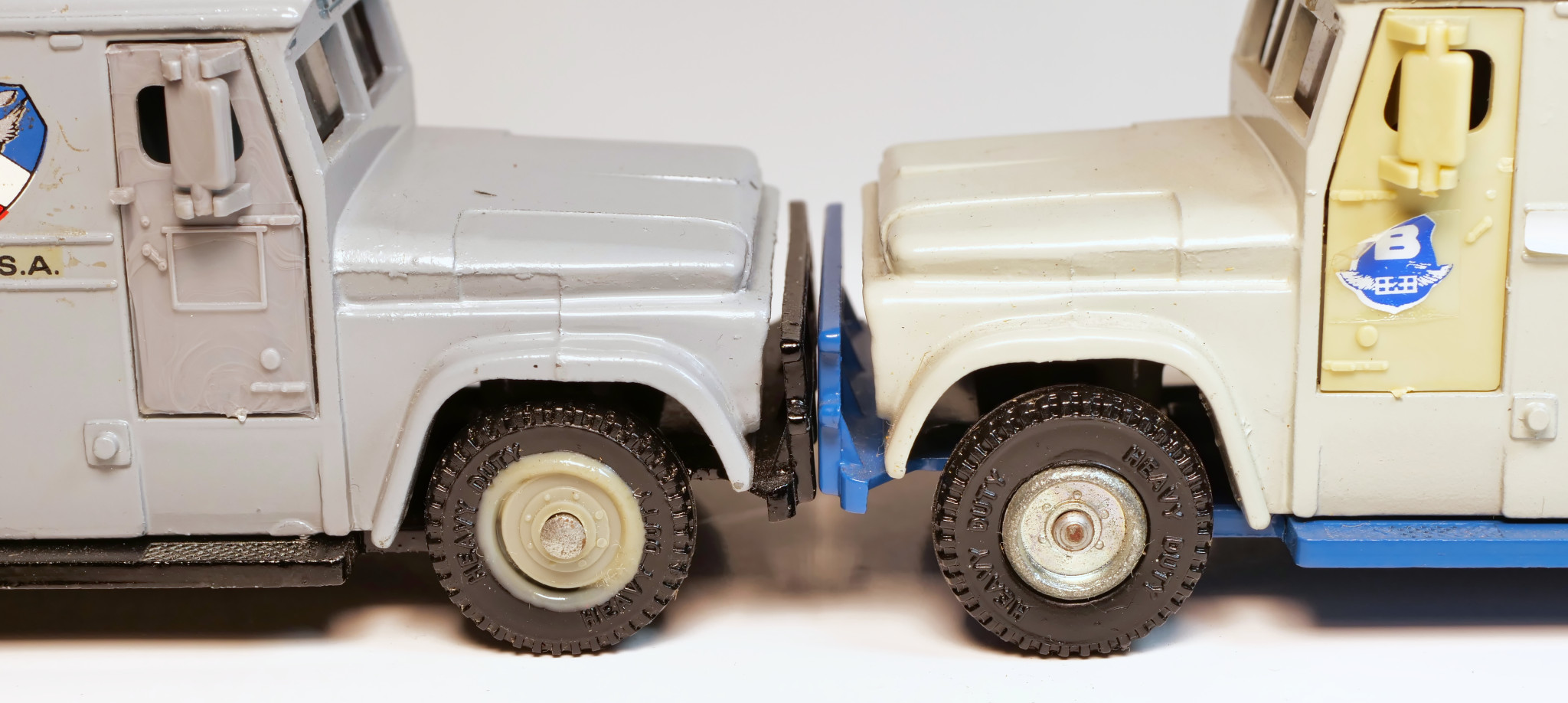
Wheels on the Pan Americano truck (left) compared to those on the final U.S. version (right).
For years, I thought U.S. assembly of the final 275 Brinks Truck had to be a myth, because the model is so commonly found on U.K. auction sites. But now I know that not only was it U.S.-finished, it was also (re)imported and sold in Britain. In those innocent days before bar codes, the unaltered American packaging was employed, complete with AVA and USAirfix mentions on the back.

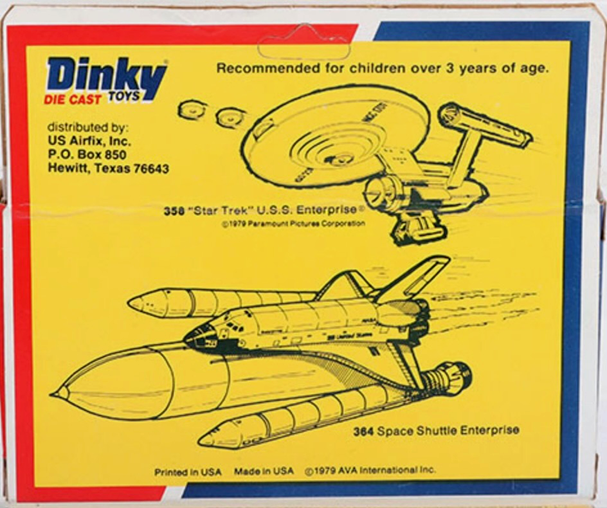
The U.S.-assembled Brinks Truck came in a hanging window box (left) that mentioned both AVA and USAirfix on the back (right).
The versions supplied to Brink’s were no different from those sold in stores, but Brink’s printed its own box, featuring a lift-off lid and a Brink’s logo. Particularly favored customers also received a set of branded cufflinks and a book called “The Money Movers” which had first been published in 1959.

Brink’s gave out the final version in a white box with lift-off lid.
Having Brinks Truck castings cross the Atlantic twice seems an inefficient way of doing business. But in that fraught year of 1979, Airfix also experimented by having the 180 Rover 3500 and 219 Big Cat Jaguar made in Hong Kong, and the 122 Volvo Estate and 361 Missile Firing War Chariot made in Italy.
Anyhow, U.K. purchasers of the Brinks Truck helped defray shipping costs. When I queried several Facebook groups devoted to Dinky Toys, two different users recalled paying £5 apiece for the trucks at their local toy shops. That was a high price for a Dinky at the time. The well-known toy store Hamley’s of London charged even more: £7.25!

Hamley’s marked the final Brink Truck up to £7.25.
Today, the final version of the Brinks Truck is easy to find from both U.S. and U.K. sellers for around $50. In 1983, one could have gotten one for free by writing Brink’s, which the first image below can attest to!

Brink’s still had Dinky trucks in stock in 1983.

All four Dinky Brinks Trucks.
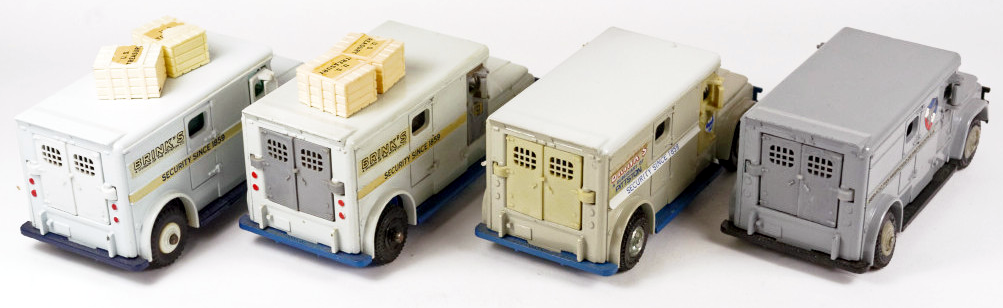
Only the first two Brinks Trucks had painted taillights.
Acknowledgement
Many sources contributed bits of information to this article. They include 6066gmcguy.com, Coachbuilt.com, Rowland Hill, Peter Hinks, Partholan Joyce-Fenlon, Quality Diecast Toys (QDT), Nigel Robertshaw, Mark Simiele, Vectis Auctions, Andy Wakeford, and Mark Woodford.