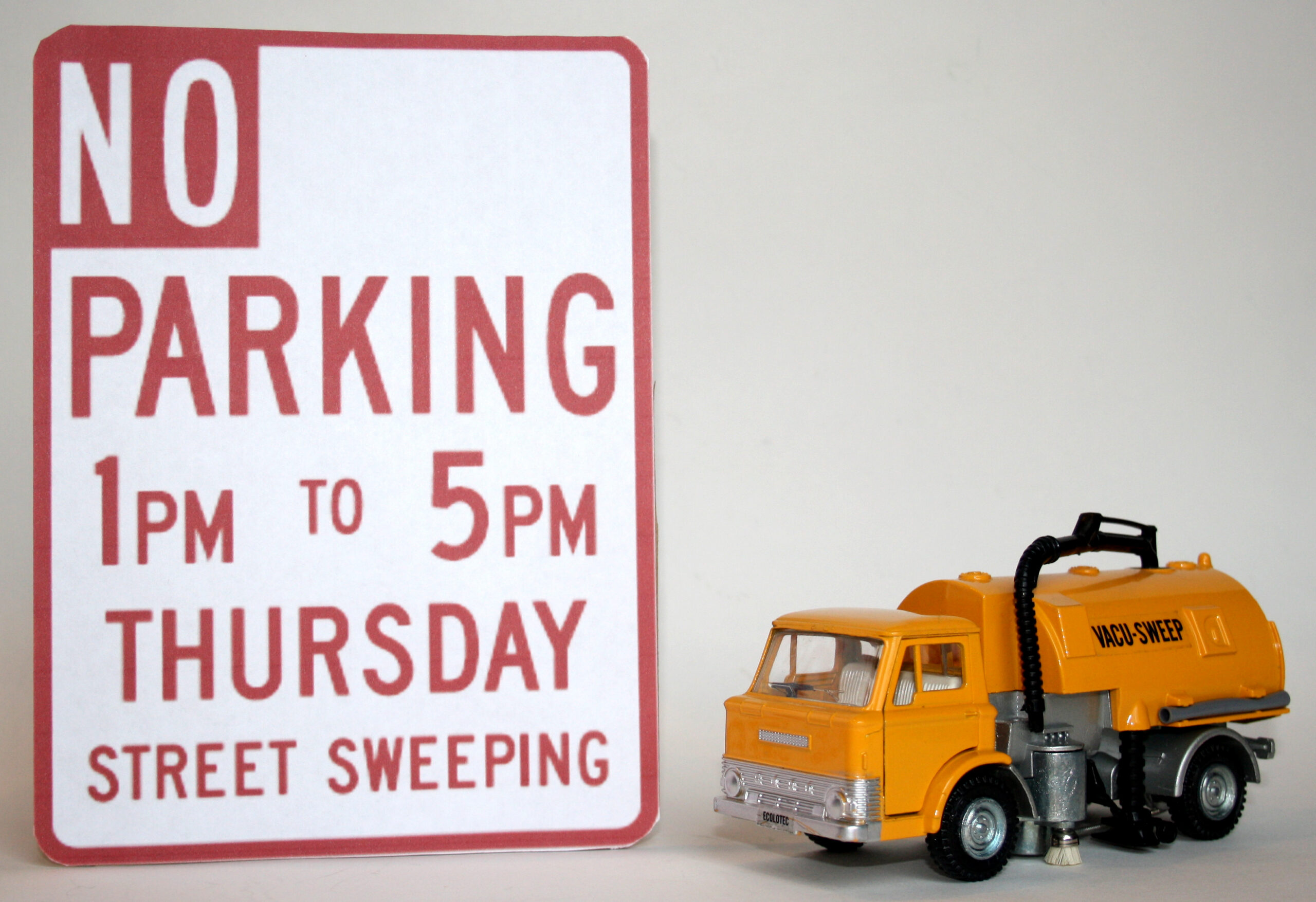
The Dinky Toys Vacu-Sweep version of their 451 Johnston Road Sweeper was released sometime in 1972 to coincide with the introduction of the actual machine in the US in late 1971. The no parking street sweeping sign in the above photo makes the perfect companion for the model in this photo.

Background of My Interest in Road Sweepers and Dinky Toys
Commercial vehicles have been a lifelong interest of mine since I was about three years old. Some of my favorites are municipal vehicles such as garbage trucks, snow removal trucks, and street sweepers. This fascination got me addicted to collecting the toy versions of their real-life counterparts. The two hobbies go hand in hand in for me.
One of the first Dinky Toys I ever received from my mom was the 451 Johnston Road Sweeper, I was about five years old. It came from Five Corners Toy and Gift shop in Westwood, NJ. This almost model-like toy had immense play value with its functioning brushes, opening cab doors and catch basin cleaner attachment. It swept many miles of imaginary roads and vacuumed pretend storm drains on my living room floor when I was a kid. Having my “own” street sweeper was a real treat, and if we passed by a real one in action my parents would often stop to let me watch it. During the fall, sweepers would be especially busy with leaf-removal duties, and spring would have them out clearing the streets of the sand and grit left over from the winter snow.

The Dinky Vacu-Sweep promotional model was based on the new for 1971 451 Johnston Road Sweeper. Image: Dinky Toys 1971 catalog.
During the late 1970s and early 1980s, my childhood hometown of Emerson, NJ had a truck-based street sweeper that looked just like the Dinky Johnston model. What truck-crazed kid wouldn’t like to have a toy version of the actual machine? This truck replaced an old Elgin Pelican mechanical sweeper Emerson had. The truck was confusing to me, though, and would be for decades. It clearly was an International Cargostar (a very popular cab-over engine truck during the 1960s into the 1990s in North America), but it had a large black plaque on the front of the cab in place of the International badging that read ECOLOTEC.
The mudflaps also had Ecolotec stamped on them as well as VACU-SWEEP. The Emerson truck had a red cab and white sweeper body. I saw it in operation occasionally and always wanted to get a photo of it.

Dennis Trucks made this brochure in 1968 to promote what appears to be a Dennis Dominant chassis for use with the Johnston 200 sweeper.
Later, when I turned 12 in 1982, my Aunt Jill gave me a Kodak disc camera that enabled me to take photos of trucks I liked. I had friends that lived near the Emerson Department of Public Works (DPW). The DPW yard was bordered by train tracks and woods at the rear. There was a hole in the fence at the back of the yard, and it was fun to run in there and take some photos — and even climb on the trucks. Sneaking into the DPW yard was probably not the most socially correct thing to do, but we never damaged anything and we had fun. To my disappointment, the sweeper was never outside; it was kept in the garage. I could see the big Ecolotec badge through the window panes of the garage doors. The derelict Elgin Pelican it replaced was outside; I took a photo of that machine, but I was never able to get a photo of the Ecolotec sweeper or find out more about why an International had its name replaced with Ecolotec. It was sold around 1987 and replaced by a Tymco sweeper.

Mechanical sweepers like this early 1970’s Elgin Pelican have dominated the American market for decades and still do. This example was owned by Emerson, NJ and a Vacu-Sweep replaced it in 1977. I photographed it in 1983 when I was 12 years old.
While at a traffic light in the early 1990s, I saw the sweeper again. It was in the service of a paving company; it had badly degraded, and it was very rusty. It was sad to see the truck that had been so similar to one of my favorite Dinky toys as a child, and the one that I had always hoped to photograph, in such poor shape. This truck would always be remembered by me as the International that had the strange name on the front.
Johnston Sweepers, Ecolotec and My Dinky Vacu-Sweep
Fast forward to 2017... One day while perusing eBay, I ran across a mint boxed Dinky 451 Vacu-Sweep version that I never knew existed. While examining the pictures in the listing, I saw that the front of the truck had an Ecolotec decal. I couldn’t believe what I saw; here was the sweeper with the odd name that had been a mystery to me growing up. I was positively elated. I won the auction a few days later.
When it arrived, it was even better than described. The first issue all-card box was pristine, as was the model. It appeared to have been just put away for years. I asked the seller if they had background on where it came from, and the only history they could provide was the model had come from the estate of an equipment dealer. Things were beginning to make sense now regarding the basically identical looks of the Ecolotec sweeper and the Dinky Johnston model I had as a child. The Ecolotec Vacu-Sweep was obviously a Johnston product, so I emailed Buchen Municipal (Johnston Sweepers) to ask for information on Ecolotec sweepers. To my amazement, I received a reply. It seemed that my email had been bounced around Buchen, as most respondents on the email chain replied with question marks. My inquiry was about a sweeper that was ancient history by 2017, but eventually my email found its way to a knowledgeable gentleman named Clive Offley. Clive is the engineering director of truck-mounted sweepers at Buchen Municipal and was very kind to share what he knew about Ecolotec.
Before I dive into the Ecolotec story, I do have to mention the history on Johnston Sweepers and how Ecolotec was the beginning of their modern day North American presence. Johnston, a British company, was founded in 1904 by JM Johnston and his two brothers. They imported Blenheim stone and constructed roads. As the years progressed, they started producing the related machinery for building and maintaining roads. In 1937 they made their first mechanical sweeper, and in 1959 the Dorking-based company developed the first truck-mounted vacuum sweeper that swept and vacuumed. This unique machine was patented, and Johnston became a builder of sweepers that were exported all over the world. There were dealers in the Middle East, Australia, and Europe. Sales were brisk and the machine was a commercial success. In 1968 the advanced Model 200 (the model the Dinky toy was based on) made its debut, and the next 11 years would see 3,956 sold. This sweeper was also fitted with a “wandering hose,” which was a top-mounted, fully-maneuverable (up to 180 degrees hose) that could be used for suctioning out catch basins and storm drains. It was a state-of-the-art machine for its day.
Now, onto the Ecolotec story. In 1971 Johnston wanted to enter the huge American market, which at that time was dominated by mechanical sweepers (non-suction) like the Elgin Pelican and the then-prolific Wayne sweepers. A joint-venture company, Ecolotec Inc., was established between Johnston Brothers and the Kenilworth, NJ, based Newark Brush Company to market the Model 200 under the Vacu-Sweep name. The Newark Brush Company was founded in 1894 (still in business today) as a manufacturer of brushes for the brewing industry and then later, of brushes for the textile, automotive, metal working industries, and for industrial uses such as street sweeping. Through my research—courtesy of the Clark and Newark, NJ Public Libraries —I discovered that Newark Brush was owned by a gentleman named John P. Horton, who also owned Danline, which was a line of street sweeper brushes. Danline opened a factory in North Wales in 1964 to serve the UK and European markets. I couldn’t confirm through my research, but I would have to assume that Danline was a brush supplier for Johnston, thus the connection with Newark Brush, which was the genesis for the Ecolotec joint venture.

Dandy Lion was the sharp-dressed king of the streets and kept Litterbug Lane clean thanks to a Danline sweeper brush. Danline was a Newark Brush brand; it opened a factory in North Wales in 1964 and was most likely the connection with Johnston and Newark Brush. This whimsical ad dates back to 1963.
The first sweeper was sent from Johnston to New Jersey in January 1971 for demo purposes. Clive added that his old boss — and previous technical director — Anthony Duthie was sent to oversee the machine. The sweeper was the first export skid unit put together by Johnston that was comprised of the whole sweeper body with the brush gear and other ancillary equipment stowed in the debris hopper. The body was then mounted on an International Cargostar chassis. It had its first public appearance in Philadelphia, PA at the annual Public Works Congress and Equipment show in September 1971.
In April 1972 Ecolotec, Inc. filed for three trademarks. The Ecolotec trademark was defined as a vehicle for street pollution control, equipped with vacuum sweepers and suction attachments. The Vacu-Sweep trademark was defined as vehicle mounted vacuum sweepers. The Wanderlead was defined as a suction attachment for vehicle mounted sweepers. In that same year, an assembly plant was set up in Clark, NJ, on 45 Walnut Avenue and a business office was shared with the Newark Brush company in nearby Kenilworth, NJ, on 260 Michigan Avenue. We Dinky fans know Kenilworth as the home of H. Hudson Dobson, the famous US importer of Dinky toys.

The Ecolotec Company’s rotating arrows logo came from the Newark Brush company logo; shown here on a trade show pin.
The sweeper bodies were exported from the UK in groups of three, loaded on special trailers on the then new Roll-on/Roll-off (Ro/Ro) ships. The journey in those days took eight days to reach Port Newark, NJ. The trailers would be picked up by a semi-tractor for the short ride to the Clark facility. They would then be assembled, mounted on the truck chassis, and painted to customers’ specifications. It appears that the preferred chassis used by Ecolotec was the International Cargostar though I have seen a Mack Mid Liner demo unit. Options included air conditioning and right, left side or dual steering. Most, if not all, were diesel powered and they carried approximately 200 gallons of water.


The Ecolotec prototype in late 1971 and 1972 production models were fitted on the early narrow cab International Cargostar chassis, and from 1973 to 1982 the updated wider cab models were utilized.

This Vacu Sweep was fitted on a Mack Midliner chassis. It’s the only non ‑International utilized by Ecolotec I have ever seen. It has the Ecolotec demo paint scheme with the stripes and was featured on a Mack calendar.
More Ecolotec and Johnston Company History
Throughout the 1970s the machines proved to be a commercial success in a market that was, and still is, dominated by mechanical drive sweepers. In 1976 Ecolotec commissioned a study, published by the American Public Works Administration, entitled “Street Cleaning Effectiveness: Vacuum Sweepers.” It read, “Tests show that in normal city operations overall removal effectiveness of the dirt and debris fraction of street refuse by mechanical sweeping is between 11 and 62 percent. The removal effectiveness on the five particle sizes (less than 43 microns) is highly ineffective. A synthetic type of street debris was developed and evaluation tests were conducted using an Ecolotec Mark IV Vacu-Sweep. Three different simulant loadings were tested and the results showed that any sweeping speed from 1 to 6mph, overall dirt removal effectiveness over the test area was at least over 90 percent. The removal of fine particles (less than 43 microns) exceeded 75 percent in all cases and could be as high as 90 percent with heavier dirt loadings.”

The Smithtown NY highway department purchased this 1973 Vacu Sweep used for $15,936 in 1974. It’s shown here being inspected by town officials and the man holding the roll of paper is highway superintendent James Dowling. The Ecolotec ID plaque is clearly visible on the rear.
After this article was published, Ecolotec used these findings in their advertising to promote the then-new 400 series machines as one that “Outcleans, Outspeeds and Outperforms” any sweeper.

One of the first advertisements for the Vacu Sweep dating from 1972. Note the early model Cargostar shown.
By 1977 over 5,000 machines had been sold. Dealers were quickly being established all over the US, and by the late 1970s there was at least one dealer in all 50 states. By the early 1980s Ecolotec became a wholly-owned subsidiary of Johnston and was renamed Johnston Environmental, Inc. (JEI).

The cobblestone streets along the Mississippi river waterfront in Memphis Tennessee were being swept by this 1973 Vacu Sweep which was one of three machines owned by the city. Cobblestone roads are notoriously difficult to sweep clean due to the crevices and uneven nature of the stones. The suction of the Vacu Sweep made them ideal for this task. Memphis would purchase additional units in later years as well.
In 1987 they had outgrown the Clark facility and leased 25,000 square feet of space in nearby Springfield, NJ. They also opened a Canadian division in Mississauga near Toronto, and that was called Johnston Environmental Equipment.

“Proven Best from East to West” was a novel catchphrase ad that listed cities that were operating the machines.
Around 1992 Johnston acquired the assets of the California-based FMC sweeper company. With this acquisition the company closed the two East Coast operations and moved production to a new facility in Chino, CA. This new company was called the Johnston Sweeper Company. In 2000 the acquisition of Madvac, a sweeper company in Montreal, Canada had all operations move to that facility. A management buyout occurred in 2005, and the company ceased trading in 2011.

This rare photo taken was taken sometime in the 1970’s at a trade show in New Orleans, Louisiana. Note the optional air conditioner. Photo courtesy of Clive Offley and Buchen Municipal.
Johnston then set up a new company, Johnston North America, located in Mooresville, NC, where it remains today. Johnston is currently owned by the Swiss Company Bucher International. What started in 1971 to enter the lucrative American market as a joint venture to manufacture exported Model 200 sweepers for Ecolotec Vacu-Sweep has evolved tremendously over the past 51 plus years for Johnston (Buchen Municipal).


This 1976 model was owned by the Alyeska Pipeline Company in Anchorage, Alaska. It was photographed in 2015 at auction when it was being sold. Note the Ecolotec ID plaque at the rear.
Details on my Dinky Vacu-Sweep Promo Model
The Vacu-Sweep promotional models made for Ecolotec had perfect timing with the release of the 451 Dinky Johnston Road sweeper in 1971. With Ecolotec in operation by 1972, the Vacu-Sweep versions were supplied as promotional models to the then new expanding company. The British Ford D model truck chassis that the Dinky was based on was not sold in North America, but this was never an issue as it bore a very similar resemblance to the International Cargostar chassis used by Ecolotec.

Note the Ecolotec decal on the license plate area of the front bumper on my example. The placement is incorrect as the real machines had the Ecolotec badging right below the wind shield of the cab.
My 451 in the all-card box is a good example of one of the early versions that were given out when the company was started. The Vacu-Sweep models were easy models to produce for Dinky as they are in the same promotional yellow I recall that was used for the other two promotional 451 sweepers, the Johnston version and the Go Plant Ltd version. Most of the Vacu-Sweep models appear to have silver grills, though I have seen one in white. Some had yellow plastic sweeping gear and Wanderlead instead of the more common black.


Side views of the model.
It’s not known who applied the unique Vacu-Sweep and Ecolotec decals. The Johnston versions were shipped to Johnston by Dinky and apparently had the decals applied by Johnston employees. It is possible the Vacu-Sweep model decals were also installed by Johnston employees since it was a Johnston product or, perhaps shipped to Ecolotec in NJ and the decals installed there. The example I have has the Ecolotec decal placed on the front lower area of the bumper where a license plate would be, but it is not the same as the location on the real machines. The actual vehicles had the large, black cast aluminum Ecolotec plaque on the front of the cab below the cab’s windshield. I have seen other Vacu-Sweep models with this decal in this correct area and one without any decal. This paper sticker is very small and perhaps some were never applied or lost with age, as the small area of adhesive backing dries up over time.

The brushes were operated by pushing the model and were driven with a cable from the rear axle. Lots of play value here!
Out of the seven or so boxed examples I have seen when I started my research on this model, all were in the last issue hanging box. One of the hanging boxes had a unique Vacu Sweep decal on the box. The 1973 and up bubble type boxes must have been utilized as well, but I have never seen one for a Vacu Sweep version. I have also never seen the cost cutting non-opening cab doors 449 version utilized for Vacu Sweep but they certainty could exist. Though, I have seen the 449 numbered box with the 451 model inside on some. It’s also unknown how many Vacu Sweep models were ever produced and when production ceased.

With the Wanderlead and extension out, the Vacu-Sweep is ready for some catch basin cleaning.
Since joining the DTCA and reading the posts on the Vacu-Sweep version, there were questions about who and what Vacu-Sweep was just as it was to me since I was child. Even one of the auction houses had mistakenly described it as possibly a promotional made for a Chicago based sweeping firm some years back. The lack of heavy interest most Dinky collectors have for the final decade of Dinky toy production has contributed to the lack of knowledge on this unique model. If it had been produced in the golden era of the 1950’s and early 1960’s, I bet this story would have been told a long time ago.

This last issue hanging box has a unique Vacu Sweep decal. Note the yellow Wanderlead and sweeper gear in place of the usual black. Dinky also must have exhausted the supply of 451 boxes as this model comes with a 449 box. Photo courtesy of Vectis Auctions.
With regard to the 451 Johnston Road sweeper Dinky Toy on which the Vacu-Sweep promotional was based, this was a very detailed model for its time, perhaps the best ever die cast toy made of a truck-based sweeper. The functioning brushes, opening cab doors and moveable Wanderlead with catch basin hose extension really set the standard for a street sweeper model in 1971, and it had great play value. Let’s not forget this was a toy before it was a promotional, and Dinky was first and foremost in the business of selling toys. The only features it lacked was a tipping mechanism to eject the sweeping debris, and a tilt cab. Its large scale and hefty all die cast metal construction naturally lent itself to being a promotional model for a rough and dirty business.
Conclusions and Acknowlegments
Since discovering this version in 2017, I have been trying to obtain some factory literature and photos on Ecolotec and would have liked to feature it here, but they are apparently extremely uncommon. I also reached out to the Newark Brush Company hoping for archival material to include in the article, but I never received a reply. I had also wanted to include photos of the Clark Ecolotec facility, but the property has since been redeveloped into high density housing.

1982 would be the last year for Ecolotec advertising as going forward all machines would be Johnston badged.
However, I was very fortunate to find the large identification plaque that was fitted to upper right-side rear of all Vacu-Sweep machines. These cast aluminum plaques measure about 22 inches by 7 inches and weigh almost six pounds. Can you imagine a plaque this heavy being fitted today to a modern truck?

Weighing over six pounds, these large cast aluminum plaques were fitted to the rear of all Vacu-Sweep machines. My example shown here was painted red, white, and blue and could have been used for trade show décor during the 1976 bicentennial. Note the serial and model numbers were never stamped.
This article is a special one for me as it explained all the unanswered questions behind the real Ecolotec Vacu-Sweep machine I remember fondly from my childhood, and the 451 Johnston it was based on was one of the first Dinky toys I received as a child that gave me much enjoyment.

My terrific 451 trio. The first model sans doors and other pieces but well-loved is what remains of my childhood Johnston, the middle model is a mint/boxed example that was acquired from Memorable Things in 1990 and my Vacu-Sweep promotional.
Writing an article like this is never a one-person endeavor so very special thanks go Clive Offley of Buchen Municipal, David Flynn, Mark A. Redman, The American Public Works Administration, Perry Solimando, Superintendent, Emerson NJ DPW, The Newark NJ Public Library, The Newark Star Ledger, and Robert Martinez San Juan of the Clark NJ Public Library.