Golden Slumbers fill my eyes – when dreaming about my now 75 year old favorite, the Guy Van “Slumberland” of December 1949.
When you ask a Dinky Toys enthusiast to choose a favorite from the great 1950s Guy vans, the answer will likely be the “Lyons” or “Weetabix” vans, and often the one with “Golden Shred” livery. The “Slumberland” van will usually be rated lower. This may be because a “Slumberland”, if it has lost its original bright red factory fresh finish or if its transfers have faded or been damaged, often loses much of its glory and appeal.
But if it has retained its fresh appearance, this 75 year old red and gold beauty is my unassailable favorite among the Guy vans. And in this respect I’m in good company with the well respected late Cecil Gibson who, in his “History of British Dinky Toys” wrote “This van appeared later in various finishes, and re-numberings, but I find this the most attractive...” Indeed, the “Slumberland” offered the first opportunity to make acquaintance with what was to become the respectable and famous family of Guy vans. Not only was it the first Guy van to be issued, it was also the first regular post-war van with advertising. Many additional decorated vans like the other Guys (5), the Big Bedford (1), the smaller Trojans (6), the Austins (3) and the Bedfords (3) were to follow in the golden decade of the 1950s.

The proud Guy Van “Slumberland” in bright red, adorned with majestic golden lettering.

“NEW, ready during the month” in the December 1949 issue of Meccano Magazine.
It was a brand new and expensive Dinky Supertoy of the early post-war years! The “Slumberland” van was advertised in Meccano Magazine of the festive presents month of December 1949 for the first time: “Ready during the month” and with “Large capacity van body”. It was subsequently reviewed in next year’s January issue along with the Coles Mobile Crane, a firm classic with high play value, and the odd three-wheeled Motocart.

Motocart, Coles Mobile Crane and “Slumberland” van, the new Dinky models that were reviewed simultaneously in the January 1950 issue of Meccano Magazine.
Surprisingly, the comment that accompanies this new lovely van was modest compared to the often long-winded elaborate comments of newly introduced Dinky Toys.
Our third new product this month is the Guy Van, Dinky Supertoys no. 514. The basis of this is the now well-known Dinky Supertoys Guy chassis, on which a van body of large dimensions with rear opening doors, has been fitted. Each van will bear the name of some well-known British firm, and the result is a really beautiful miniature road vehicle.

The January 1950 issue of Meccano Magazine, double review page.
These mere 60 to 70 words appear to have been included at the last minute, in the midst of virtually endless praise about the Motocart and especially the Coles Mobile Crane, which dominate the illustrated double text page. The neutral caption “Guy Van”, that accompanies the “Slumberland” illustration in both the December and January issues, seems to allow for any livery. As implied in the text, Meccano had definite plans to not limit the production to a single van, but instead intended produce several sponsored liveries right from the start. One can assume that’s why the catalog number wasn’t cast or embossed on the model itself, even though the first vans all shared the same reference number: 514. They were more precisely defined by the addition of the letters “S” (Slumberland), “L” (Lyons) and “W” (Weetabix) on their respective boxes. The “Slumberland” simply happened to be the first issue, and the specific picture of that model was accordingly selected for inclusion in the review by Meccano Magazine.

The “COMPLETE” drawing (job 13010) of five Guy van liveries dating from 4 October 1948, with later additions (Christie’s South Kensington).
In internal factory documents, the Guy van was also known as “Guy Covered Van” or “Guy 4‑ton Truck Van”. Designed on the 1:48 scale cab/chassis combination of one of the first Dinky Supertoys types of August 1947, it had an unprecedented size and complexity, compared to previous vans. The general (i.e. complete) assembly drawing for all Guy vans was job number 13010, dated 4 October 1948 and signed by “D.L.M.” On the drawing, the letters “A” to “E” were attributed to the transfers of the various subsequent liveries: “A” for “Lyons” and “B” for “Slumberland”. In November 1954, the following jobs were added: “C” for “Weetabix”, “D” for “Spratts” and “E” for “Exide Batteries”. “F” for “Golden Shred” was still missing, apparently not yet envisaged in this, the surviving final stage of the drawing. With this letter sequence in mind, the “Lyons” variant may have been meant to be issued first in the initial production. Regardless, the “Slumberland” and “Lyons” vans may be thought to have been close contemporaries, issued at virtually the same time in late 1949 or early 1950.

The scarcer “Slumberland” van’s contemporary: Guy Van “Lyons”, ca. 1951–52 (former Rob van der Hoort Collection).
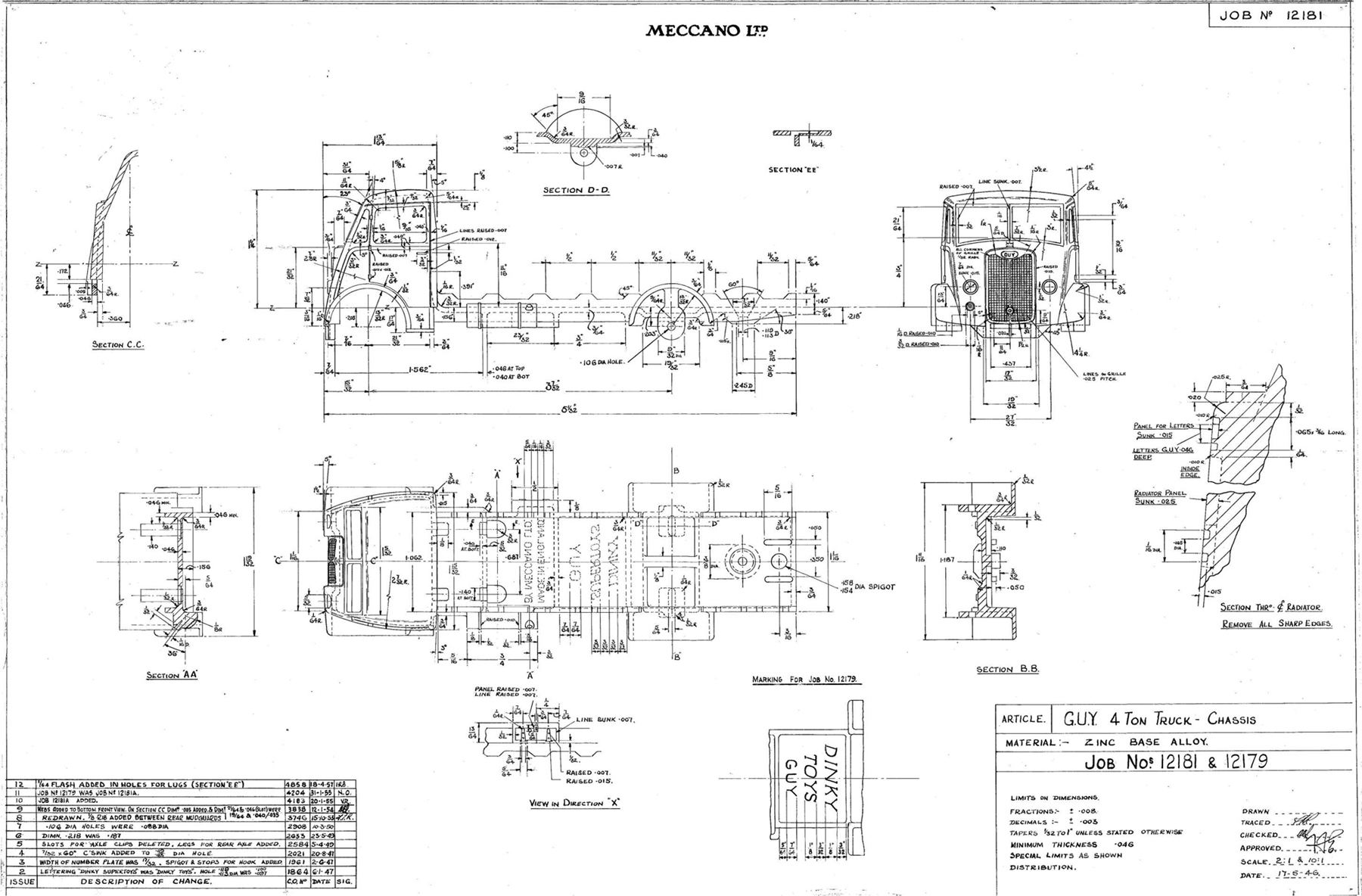
Cab and chassis drawing, jobs 12181 and 12179 (former Peter Golden Collection).
New large scale design drawings weren’t necessary for the creation of the cab and chassis casting of this van. This basic component had already been drawn at an earlier stage in May 1946, developed for the three Guy truck versions.

Body drawing, job 13011 (former Peter Golden Collection).
The body of course was new and its design was approved on 28th January 1948. It had its own tinplate floor. The two rear doors could be opened and closed and they could be unlocked by lifting them slightly using the door handles. Early Guy vans have straight door handles while later ones have them angled downwards at 50 degrees.

Guy van doors drawing, jobs 13012 and 13013, with detail showing the downward angled handles, as applied on 6th March 1952 (former Peter Golden Collection).

The adjustment to the actual door handles: 1950 “Slumberland” (straight), 1953 “Spratt’s” (angled downwards).
This change of 6th March 1952 is documented in the drawing of the doors, comprising job numbers 13012 and 13013. This modification, a bending action to be performed after casting, is one of the many interesting and subtle detail changes that weren’t recorded by Mike & Sue Richardson as a “significant change” in their Great Book of Dinky Toys. As a novelty, the movable doors were held in place by hinges of thin wire, thinner than regular wheel axles, and crimped at the lower ends only. This construction was used repeatedly in the 1950s, for instance by the Big Bedford Van, the Military Ambulance, the Pallet Jekta Van and others. The towing hook, present on Guy trucks, was omitted.

The early square versus later triangle shaped details in the front license plate area.
Being the first one, the “Slumberland” van’s components had all the technical characteristics of the early trucks: the first version of the die (with the square lower front line edges instead of the later triangle shaped supports next to the registration plate), the early rear axle clamps, and the early ridged “Dinky Toys” hubs.

Washer for chassis and spare wheel mounting in the “Slumberland” van’s body.
By comparing the mounting of the spare wheel with an early version of the Guy Lorry No. 511, it will be noticed that no screw or nut were used to attach the spare wheel of the van; instead a small washer was used. This solution was probably chosen because the top of a bolt, inside the van body, would be inaccessible for assembly with a conventional screwdriver.

The magnified details of the “Slumberland” van’s lettering showing their hand written origin.
I’m particularly struck by those splendid golden letters, especially in an undamaged, shiny model. Even through the eyes of a foreigner, the “Golden Slumbers” legend is very attractive, unique and characteristic for British typography on vehicles of this period. A magnifying glass or high resolution scan reveals several minute details: the smaller black letters turn out to have been designed by drawing them manually. Although irregular, they don’t appear to be so when observed with the naked eye. The overall typography is tasteful and crisp.

The model’s box, marked “S” for “Slumberland”.
Whereas the ‘Slumberland’, ‘Lyons’ and ‘Weetabix’ vans share the same catalog number, the model shown on the box was – though small and in grey-scale – not generic. It was definitely the ‘Slumberland’ van. It is remarkable that the ‘Slumberland’, like the ‘Lyons’, unfortunately has never been advertised in color, neither on the box, nor in any catalog or in other advertising material. In contrast to their contents, and compared with the later bright blue striped lid boxes with colorful pictures of the models inside, the boxes of this early trio were uniform and dull. They were all blue with two-tone black and orange labels pasted over the lid. The matt blue of this period is very susceptible to fading due to its high sensitivity to light.
At first glance, it seems the “Slumberland” van didn’t have any variations in casting or finish. The only difference that’s mentioned is in the the shine of the gold lettering. This may have been caused by variations in the printing of transfers and also the effect of exposure to the elements over time, thereby affecting the resulting look. Despite the seemingly stable general layout outlined above, there are some lesser known and seldom observed subtle differences in the appearance of the “Slumberland” van to which I’d like to draw attention. My 11th edition of Ramsay’s British Diecast Model Toys Catalog and several other reference works mention the existence of a first type cab only which I concede. But they also mention a “ridged” (Dinky Toys) hubs only model whose existence I challenge.

The scarcer later grooved hub version on the right (former Rob van der Hoort collection).
Although scarce, there are also “Slumberland” vans with “grooved” Dinky Supertoys hubs in existence. These may have been overlooked because they appear to not have been sold in the U.K. and many other countries to which Dinky Toys were commonly exported. This complies with the commonly mentioned final year of 1951 for this livery, because this change in hubs didn’t occur before 1952. My 1951 Dutch catalog shows the “Slumberland”, followed by the “Weetabix” picture and caption in 1952. The same goes for the British catalog of 1952, which neither shows nor mentions the “Slumberland”. However, the “Weetabix” is presented there. 1952 is often referred as the final year of the “Slumberland”. The first mentioned year is justified more or less by the familiar catalogs. But almost all of the very few “Slumberland” examples with grooved hubs that have came up for auction in past decades had a Hudson-Dobson sticker on their boxes, revealing their U.S. provenance. An example from a Vectis “Simply Dinky” auction catalog of 5th November 1997 was qualified by the auction house as “with super toy wheels, this is an extremely scarce item issued for the US market only”.

Still available in the USA: page from the 1952 Hudson-Dobson catalog featuring the “Slumberland” van.
This is confirmed by the 1952 Hudson-Dobson U.S. catalog that indeed includes the “Slumberland”, albeit with an obsolete picture showing ridged hubs! As stated earlier, the grooved Supertoys hubs had been introduced during 1952.

The scarcer grooved hub version of the 1952 mode on its box showing the downward angled door handles and the Hudson-Dobson sticker, along with the more common early issue model in the foreground with the straight handles (former Rob van der Hoort Collection).
Although not recorded in similar auction catalog descriptions, the one of a kind shown here is provided with the new downward angled door handles. So I presume that all instances of the final “grooved hubs” batch of models also sport the later angled door handles. This makes sense and the puzzle starts to fit.
Why were they available in the USA only, and not on the “older side” of the Atlantic, or in British Commonwealth countries? Without access to other documentation, I can only make an educated guess. While the final batch with grooved hubs was in production, probably in the first half of 1952, the “Slumberland” van’s advertising text was suddenly outdated. It likely read “...bedding manufacturers to H.M. the KING”. But meanwhile King George VI had died in February 1952 and there was now a female monarch! This batch could not have been large in number, because the “Lyons” and “Weetabix” models were also available early that year. But what to do with this late, outdated “Slumberland” production run? Although this text may not have been of overwhelming importance, at least not in the eyes of young children, King George’s death may have led to some embarrassment and contributed to the earlier discontinuation of the “Slumberland” van in the U.K. and in countries other than the United States.
In the United States, obsolete Dinky Toys like the present “Slumberland” van with its outdated text, grooved hubs and downward angled rear door handles, found a hospitable market without serious competition. For Meccano, the marketing of the new “Weetabix” van apparently took priority in 1952, as this newcomer appears in the May and September 1952 U.K. catalogs, with no mention of the previous ‘Slumberland’ and under advertised ‘Lyons’ models.

The very rare black hub version, this example (lot 2184) sold at the Vectis “Simply Dinky 15” auction of May 2009, shown along with a pair of contemporary first issue 1948–1949 Bedford Articulated Lorry models with the same black hubs. (Image: Vectis Auctions)
In 2009 another unknown version of the Guy “Slumberland” came to light. The 15th Vectis Simply Dinky auction of May 2009 featured a “Slumberland” van with black painted ridged hubs, a most surprising item in a stunning anonymous “single owner collection”. Contrary to the late version with the grooved hubs, this example must have belonged to the very earliest batch of “Slumberland” vans to leave the Binns Road factory in the latter months of 1949.
Apparently some of the very first Guy vans have surprisingly been fitted with the characteristic satin finished black hubs of the 1940s. Compare, for example, related early Dinky Supertoys of the period, like the Guy trucks and also the Bedford Articulated Lorry with their black hubs. Indeed this hub color change took place at the end of 1949, during the birth of the “Slumberland” van. I’ve never seen a reference to this variant before. But that’s just me; it may be more convincing that Vectis stated in their catalog, “...Extremely rare with black ridged hubs, one that Vectis Auctions has never seen before.’ Isn’t it amazing that even after so many years, never before seen variants of otherwise well known Dinkys still turn up?
The only mystery I haven’t yet discussed is the obvious two or even multi-tone (albeit grey scale) representation of the “Slumberland” van, both in Meccano magazines and on the box as shown above. The front wings seem to be dark or even black, the cab and chassis are of a medium shade, and the body of the van is apparently finished in a brighter color. I can hardly imagine that such a colorful early bird would show up by surprise. It’s more likely that only a provisional mock up was available to the picture artist, a van box with “Slumberland” design mounted on an easily available Guy truck cab/chassis unit, in its early finish with mudguards in contrasting color, and darker or possibly even black hubs.

The Corgi Toys Thames van “Slumberland’.
We conclude our “Slumberland” story by touching for a moment on some modern versions, inspired by or directly based on the Dinky Supertoy. First, the modern Corgi Toys version of the “Slumberland” van that was introduced in 1996. On closer look, it seems Corgi retained the royal coat of arms but left out the “manufacturers to H.M. the KING” (or “Queen”?) text. A safe and timeless solution! Although well done, it’s hard for me to not think that Corgi’s main intent was to satisfy a nostalgic sentiment for the Dinky Toy by almost copying the Dinky model in every respect. The only obvious difference was the choice of a newer 1960s Thames Trader cab truck.

The Promod Commer van “Slumberland’.
This also applies to the Promod model, this time using a Commer C‑series cab. The old “Slumberland” in modern disguise. A dedicated Dinky collector will however see through this and would likely prefer the honest vintage character and solid quality of the one and only real Dinky Guy van “Slumberland”!

The modern DAN-Toys replica.
There’s also the modern replica of the Dinky, the DAN-Toys issue. This is a very nice replacement for those who interested in owning an affordable version of the original, but not in a harder to find and more expensive perfect original Dinky. For them, there’s no objection to the small differences that would annoy a purist Dinky Toys collector: the unjustified triangular supports next to the license plate, the slightly oversized high gloss axle ends, and the overly perfectly produced lettering. But that’s a problem for the nitpicker.
Author’s Note
This article was first published in the Christmas 2009 issue (volume 7, number 5) of The Journal of the DTCA. It has since been extended and brought up-to-date for publication at DinkyFans.com, with the inclusion of several new and higher quality images.