Dinky’s Routemaster bus has already been covered in a previous article at DinkyFans, offering an excellent overview of the prototype double-decker and the standard models sold by Meccano Ltd. This follow-up discusses the Routemaster promotional model made in November 1973, as well as some other Routemaster liveries that came before and after.
It is irresistible to start with the 1973 promotional, since I was recently able to add a sample to my collection after long years of searching. This is not only the rarest Dinky Routemaster, but — unless a cache of more turns up in some British loft — also the rarest Dinky bus ever made.
The model’s story begins with Meccano’s decision to commission an “all-over advertising” Routemaster bus that would promote its products while running on various London routes. In 1973, changing the iconic London Transport (LT) double-deckers from their well-known red was expensive and not very common. Because modern vinyl wraps didn’t yet exist, would-be advertisers had to pay for special paint as well as hand-painted logos and other decorations. LT also had to be compensated for the time the bus spent off the road, not only when the advertising was applied but also when the bus was repainted in its original red.
According to the London Transport Museum, the first Routemaster with all-over advertising appeared in 1969. Its livery displayed various London scenes and the legend “Silexine Paints welcomes you to London.”
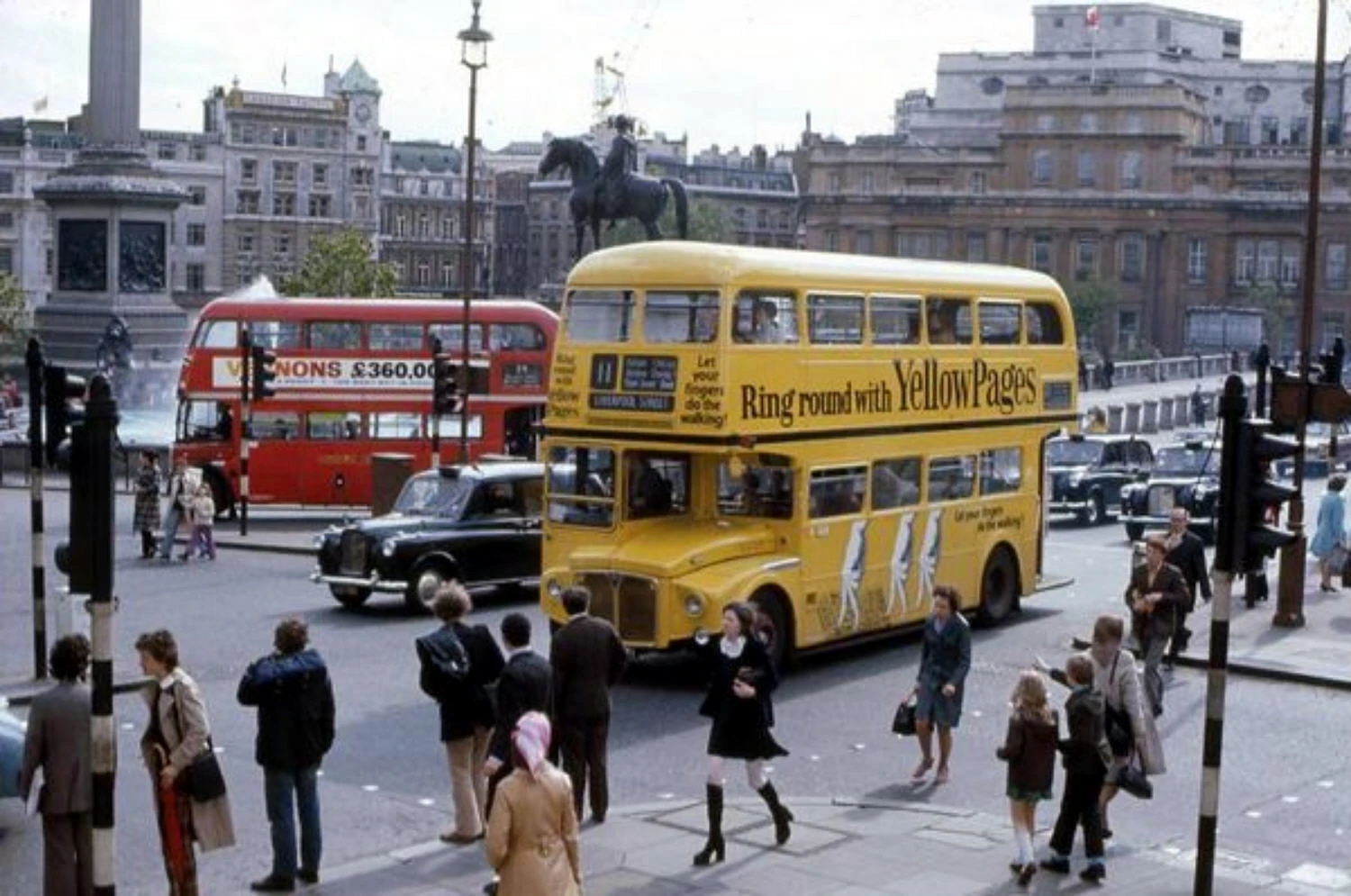
A little later, but more well-known, was the Yellow Pages Routemaster, which was on London roads from 1971 until 1973. In July of the latter year Dinky released its own version, on an Atlantean base (not unrealistic since by then the livery had spread to other bus models and cities).
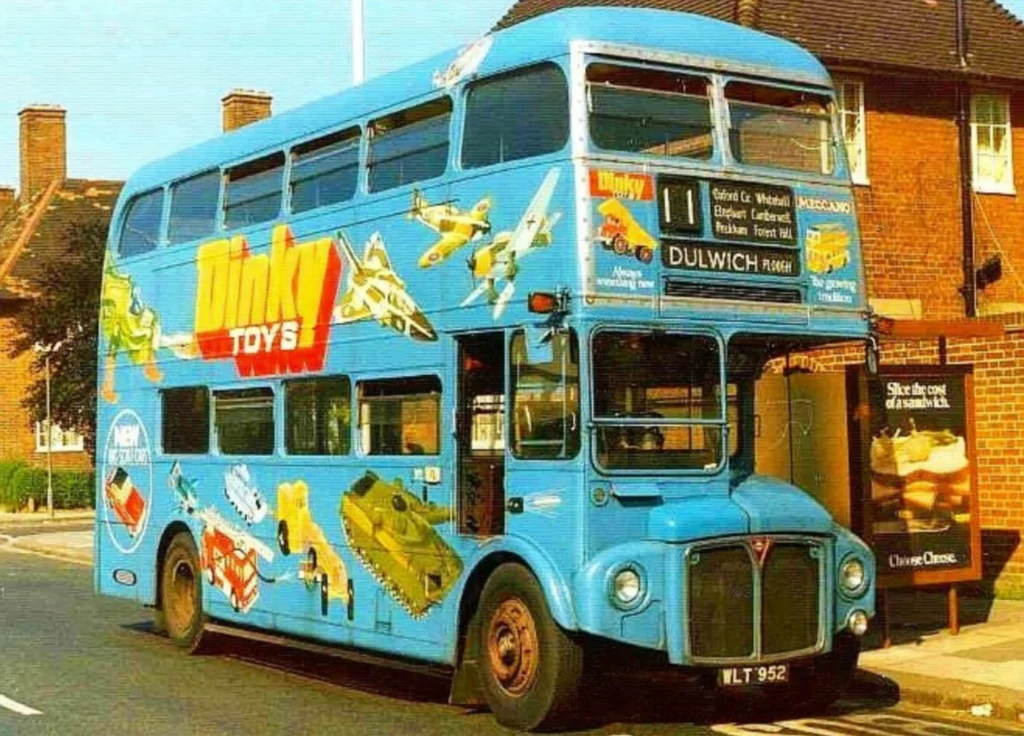
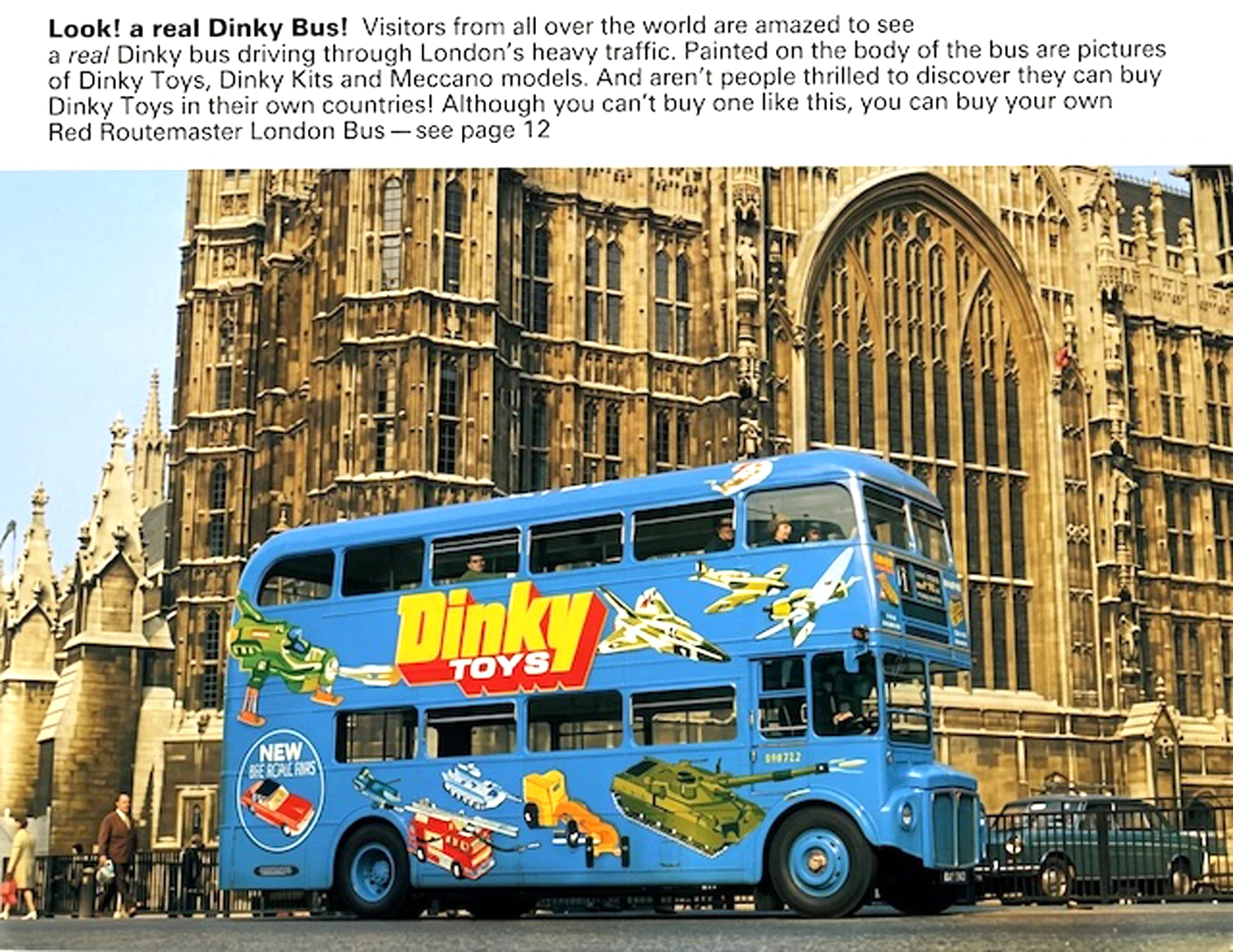
Perhaps it was the renown of the Yellow Pages bus that inspired Meccano Ltd. to commission a Routemaster of its own. Whatever the case, Meccano “went for broke” with a particularly elaborate design. The bus was finished in blue overall, with the right side promoting Dinky Toys. The left side, easily viewed by passengers stepping on or off the open platform, promoted Meccano as “The growing tradition.” It even had silver strips to make the bus look like a giant Meccano creation.
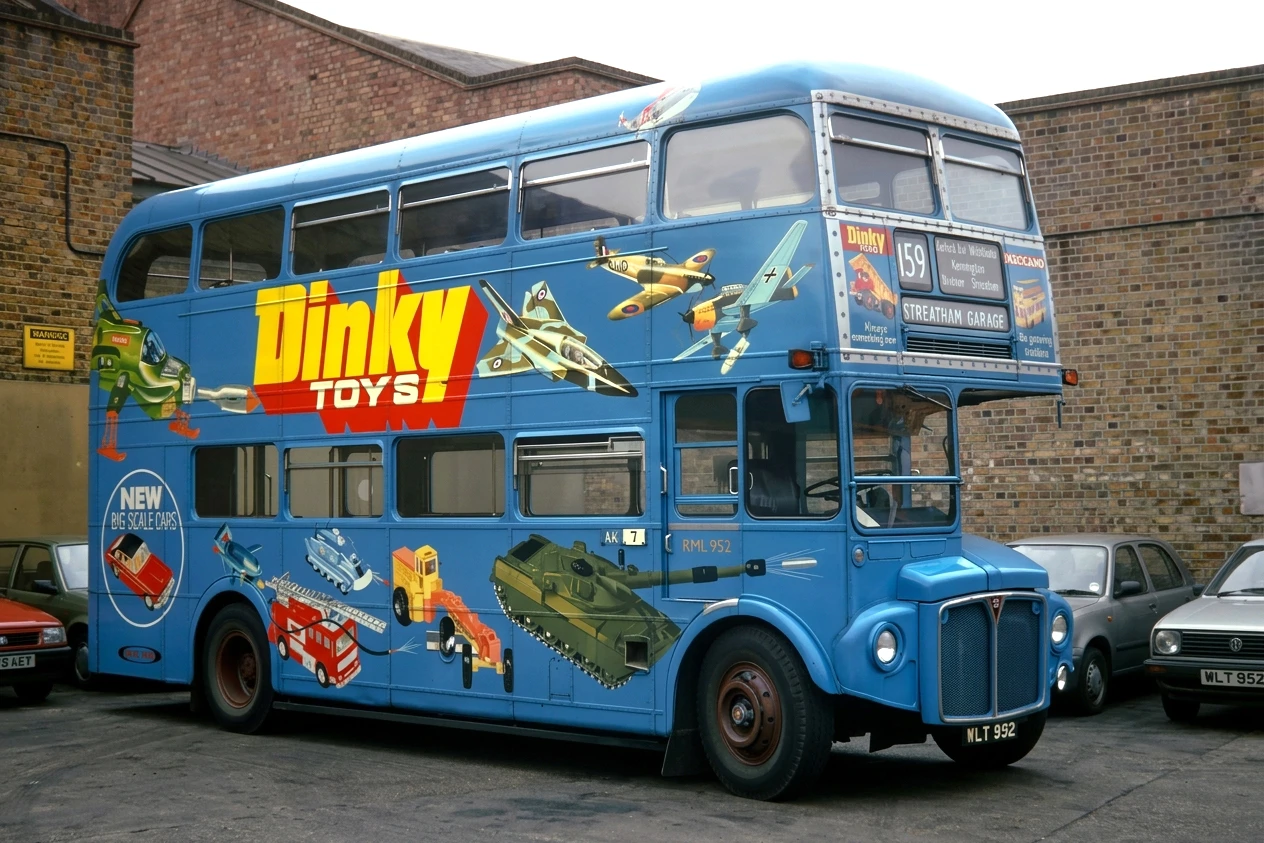
RML 952 (the fleet number which is similar but not identical to the license plate number) first showed its Meccano plumage in the fall of 1973 and as following photos show, was driven on several London routes (11, 12, 45, 59, and 159 at least). It’s unknown how long it stayed in its special livery, but definitely long enough to be driven down to Brighton for the January 1974 British Toy Fair, during which it was photographed in front of the Metropole Hotel.
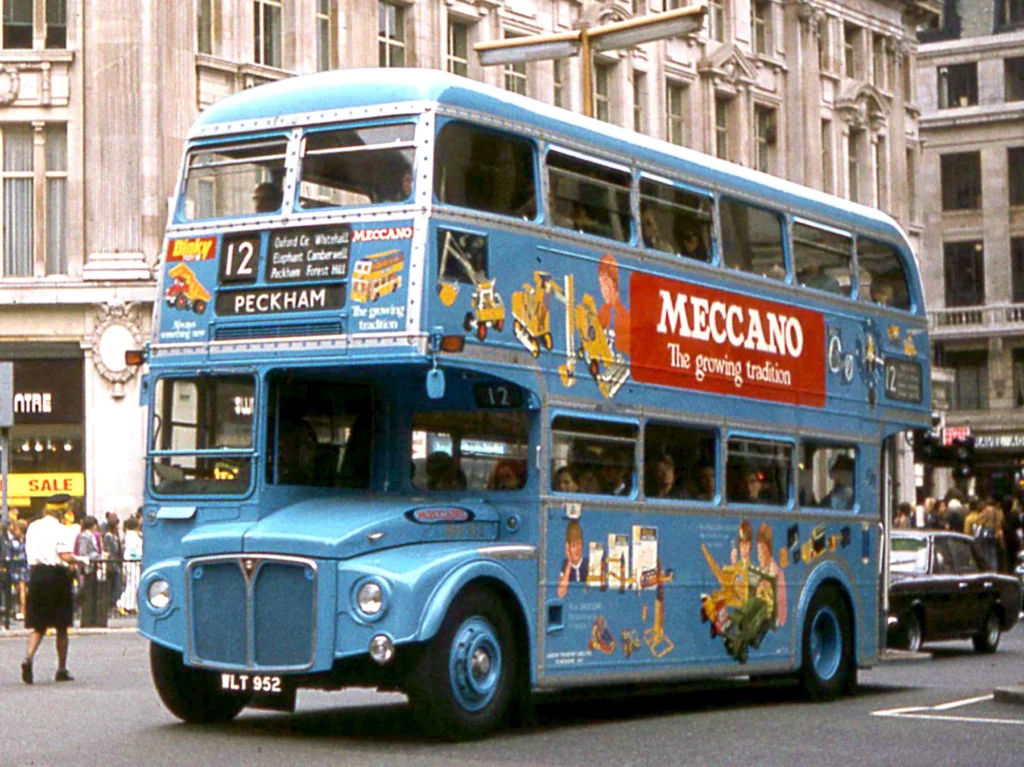
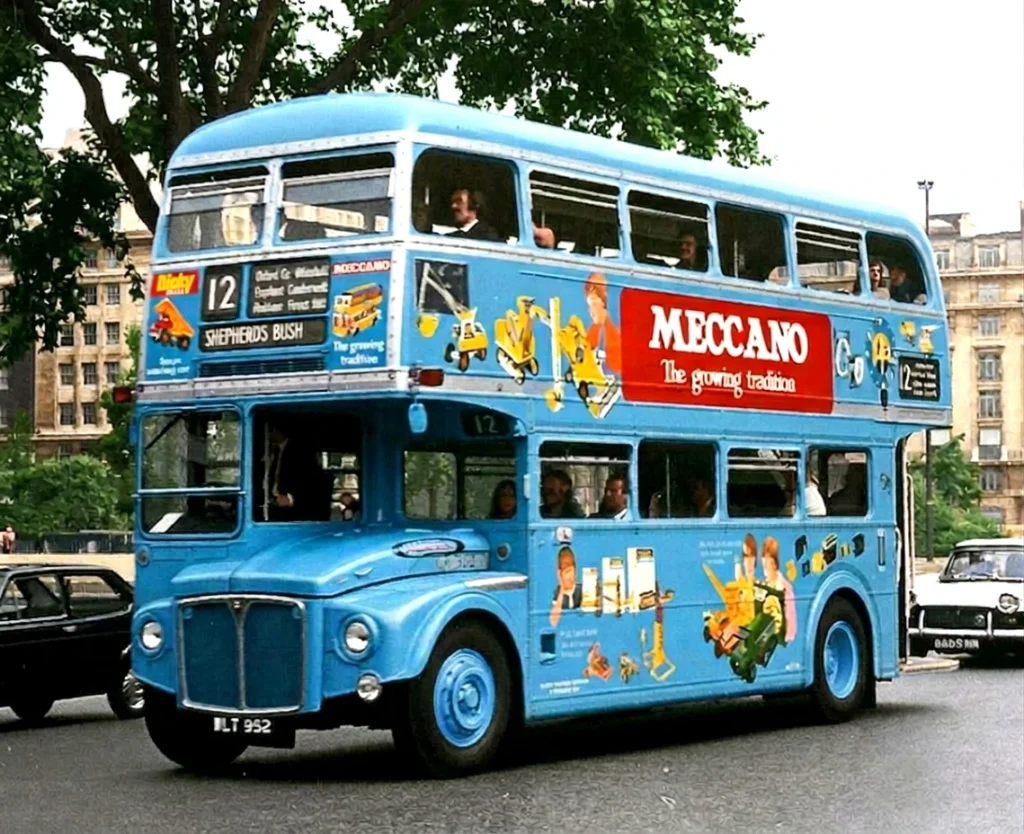
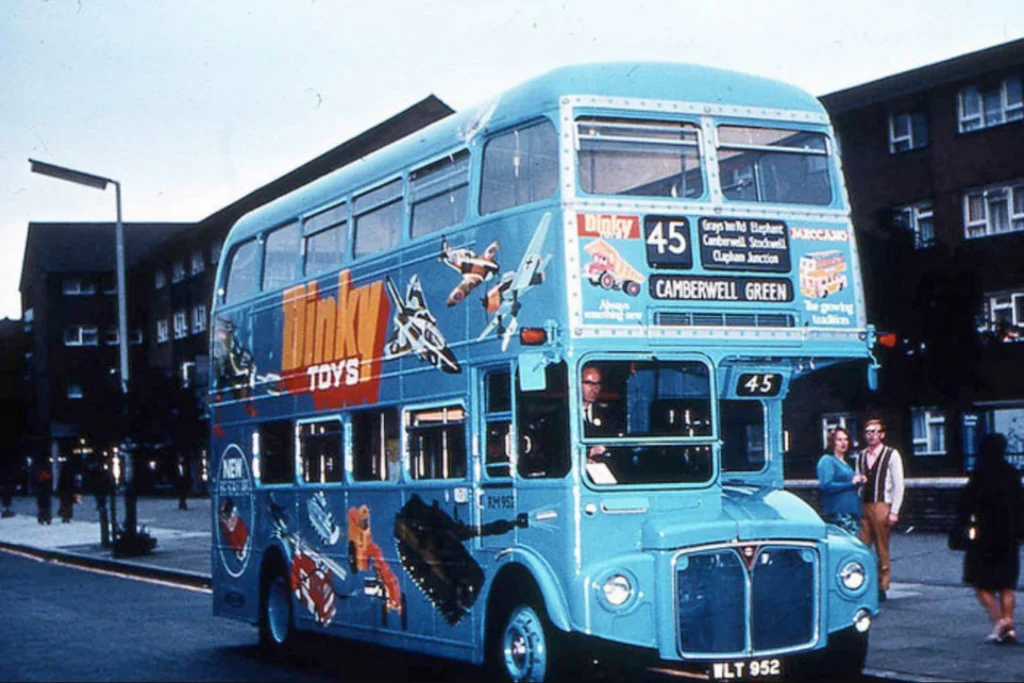
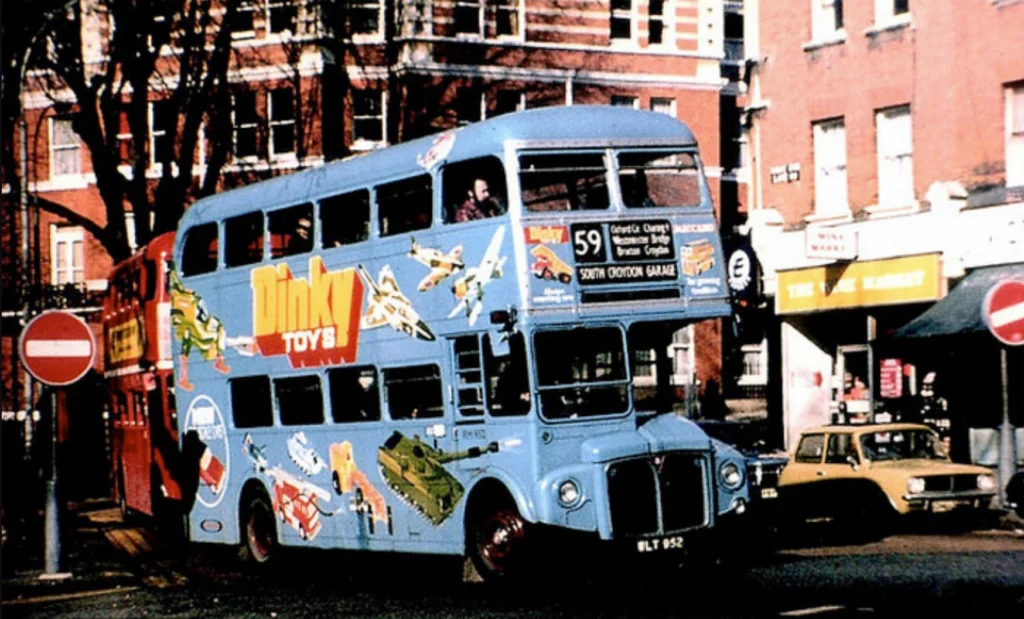
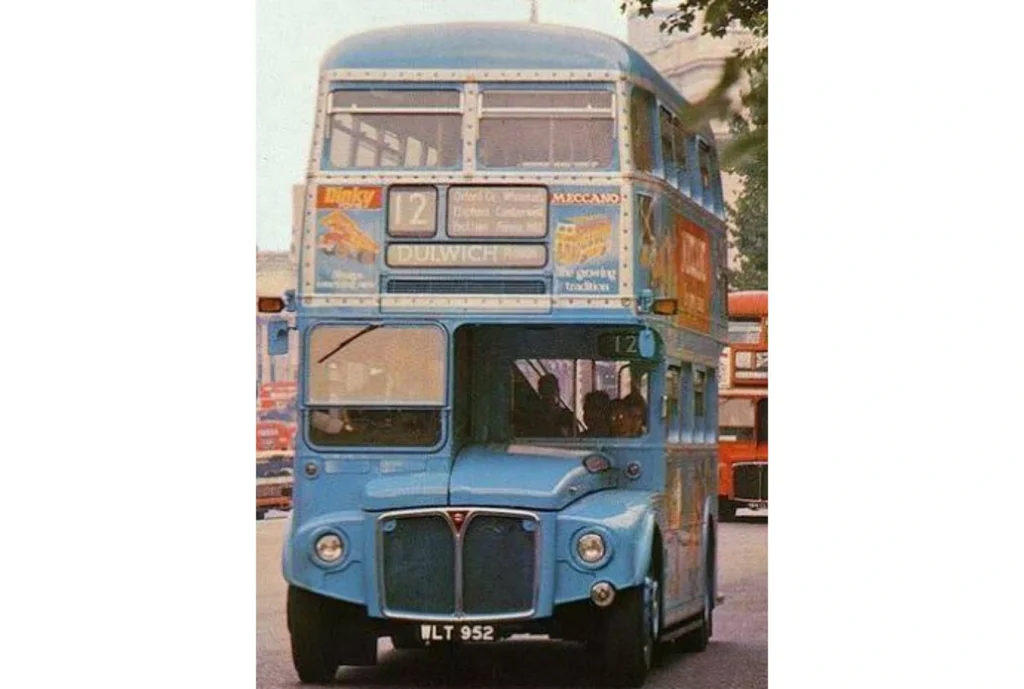
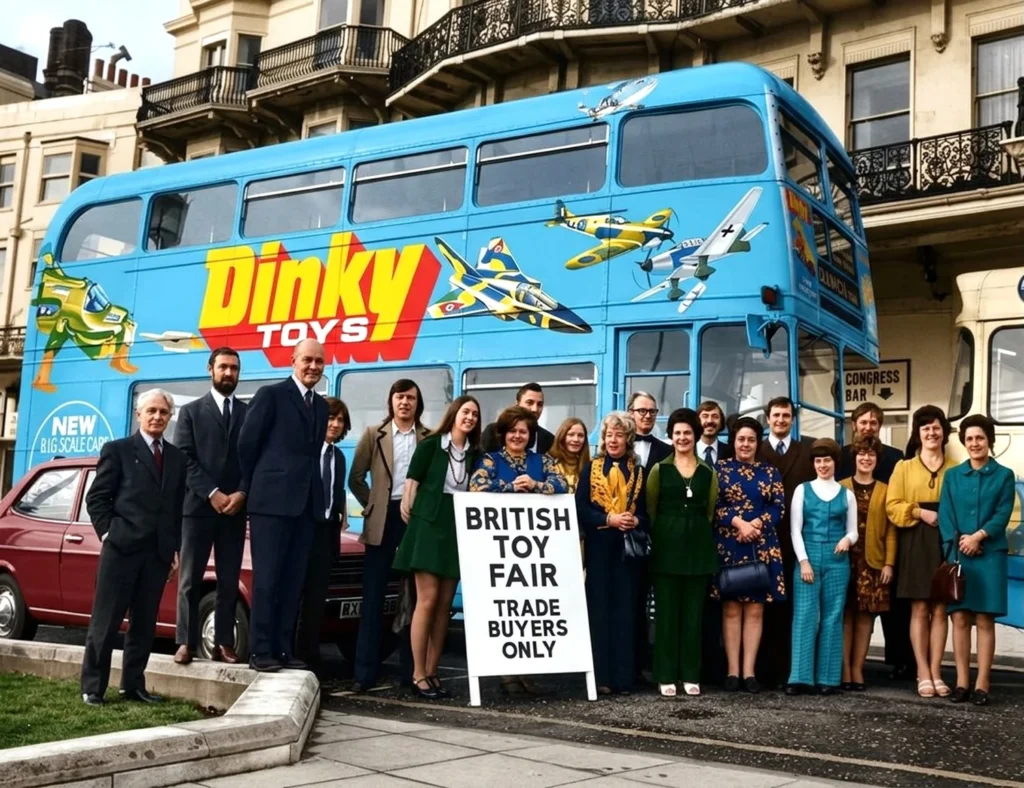
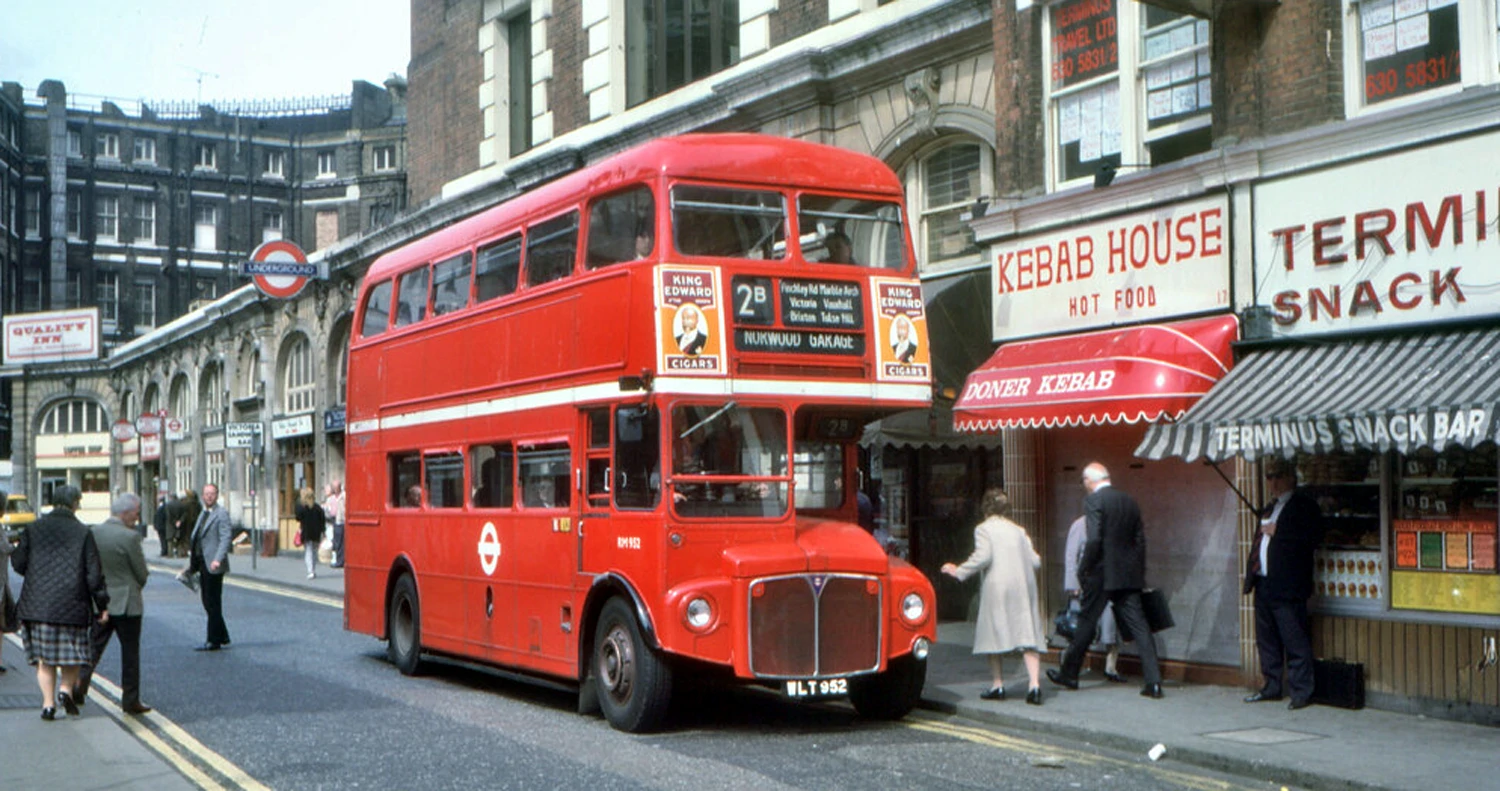
The photo above documents that RML 952 was later returned to its standard red color. Naturally, the vast majority of Dinky collectors never got the chance to see this bus in person. However, we all learned of it thanks to the tantalizing photo that appeared on page 3 of the 1974 Dinky catalog
In advance of the British Toy Fair and the Christmas selling season, Meccano held a November 1973 press conference to promote the Routemaster. Attendees — probably not more than several dozen, though the number is unknown — were given specially decorated Dinky buses.
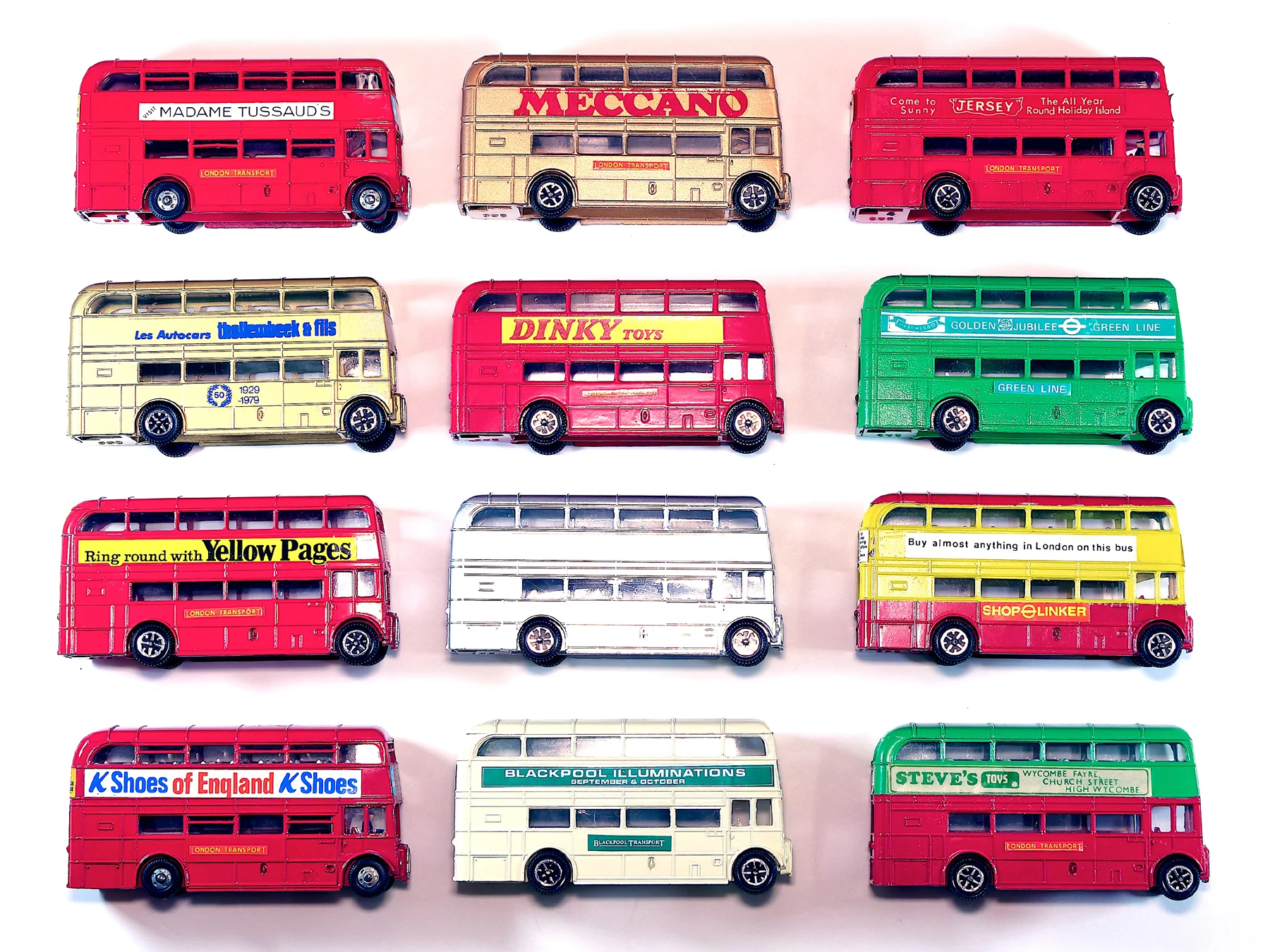
Sadly, the toys were finished in metallic gold instead of blue. This upheld the Dinky tradition of using inappropriate colors, but it might also have been because these models were a rush job. (I recall from my own ham-handed efforts at model-building that metallic gold is particularly quick-drying.) In advance of the press conference, they were decorated by hand using advertising that looks to have been cut from catalogs.
Possibly because the assembled “hacks” were more interested in whatever drinks Meccano was serving than toys — I am entitled to this jibe because ten years later I was among their number in London — the promotional Routemaster is exceptionally rare today. My sample came from an Australian collector who had acquired it (along with a chrome-plated Captain Scarlet vehicle and other items) from a retired Meccano employee.
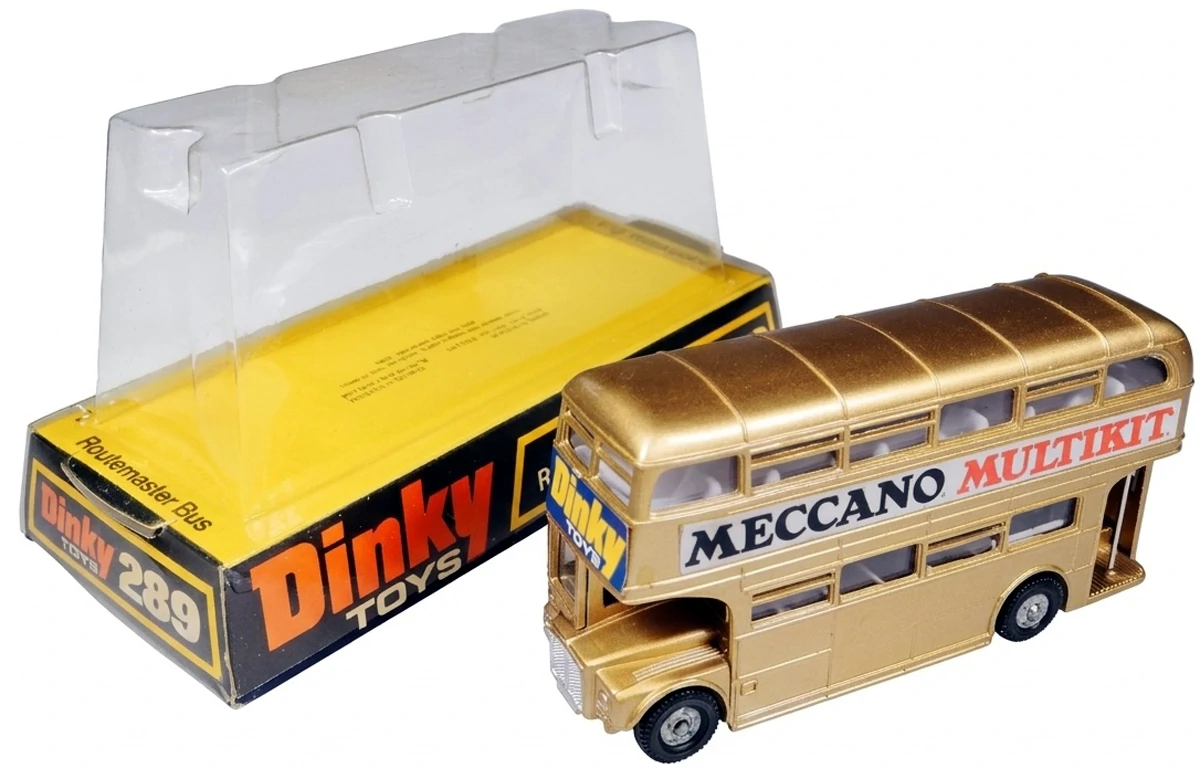
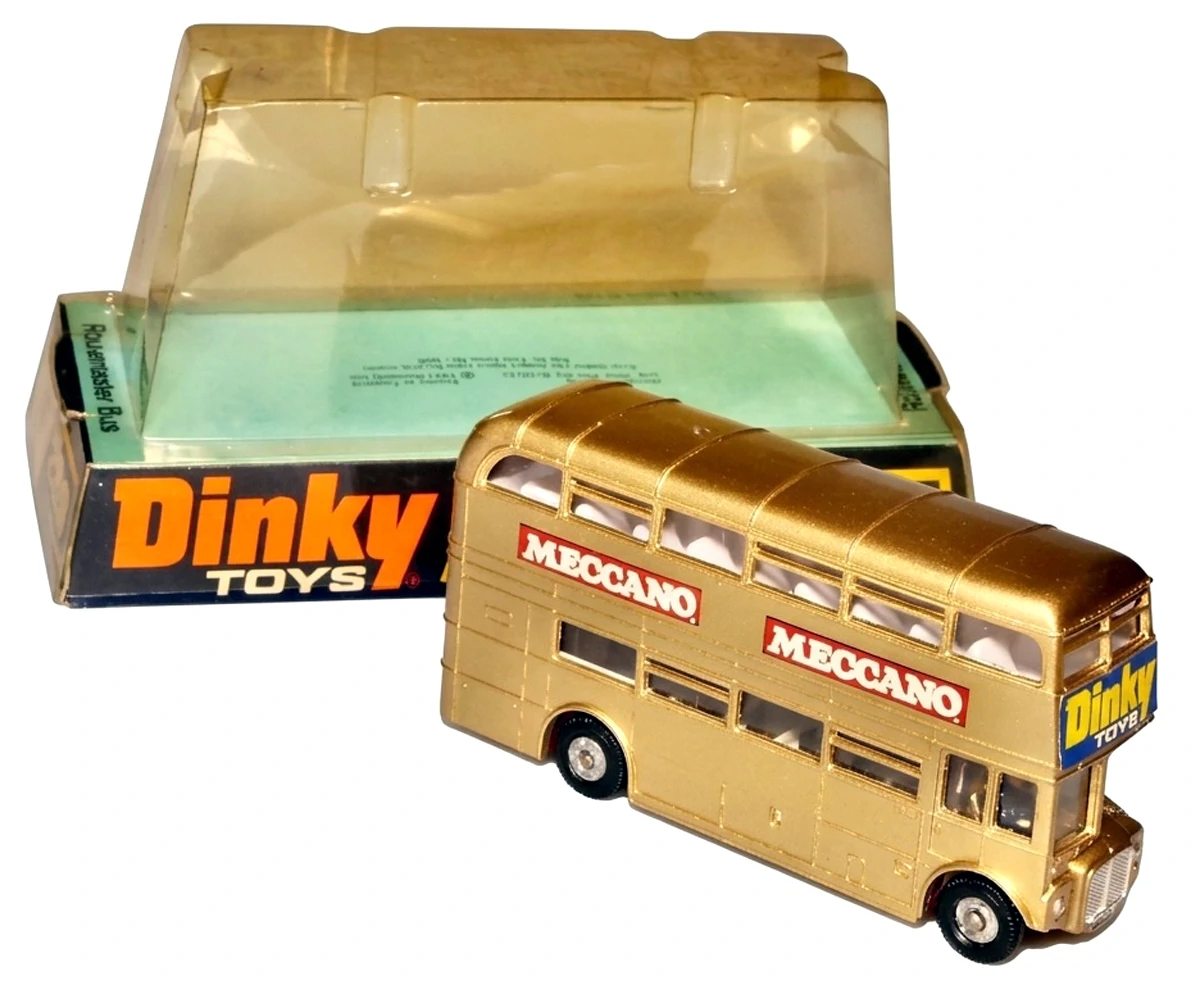
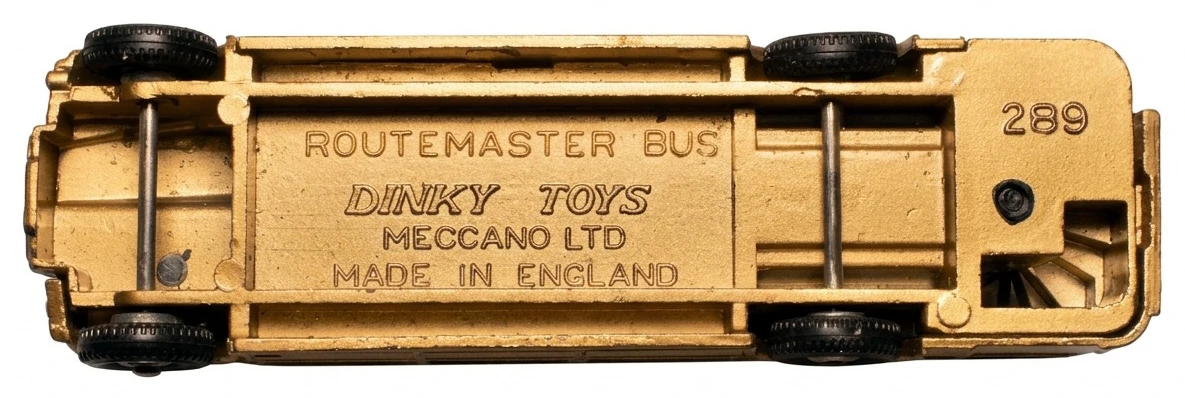
Other than my sample, I am aware of only two survivors. In 2008, QDT sold one like mine, though it was in tatty condition and without a box. Vectis sold a presumably authentic sample ten years later that came in an opened Action Kit box and has the wheels associated with that version.
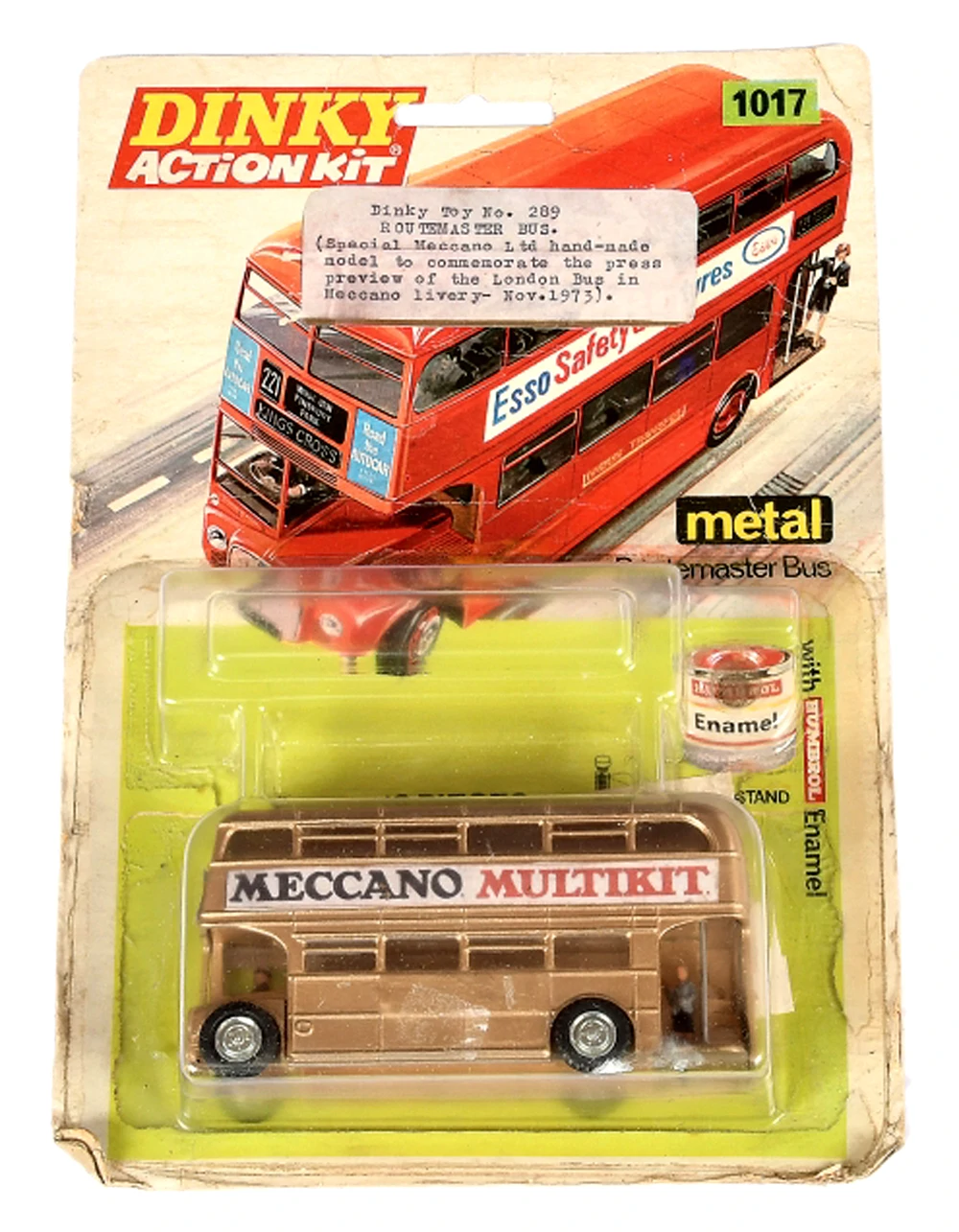
During my extended search, I came across two others on eBay that seemed promising. They came with bubble boxes like mine, and also had typed labels similar to the one with the Vectis sample. However, the seller honestly disclosed that both were replicas he had created. A blurry seller photo is all I have to remember these copies by, so I can’t tell what type of wheels they had. In case someone less candid tries to resell them, buyer beware!
Other promotional Routemasters
By today’s standards, it took Meccano Ltd. a long time to realize the Routemaster’s potential for promotional issues. As Jan Oldenhuis wrote in his previous article, there were three standard versions of the bus: Tern Shirts (1964–1965); Schweppes (1965–1969); and Esso SafetyGrip Tyres (1969–1979). We can imagine that Meccano got paid something by each of the companies advertised, but as far as I know, no records of such payments have been found.
The SafetyGrip version is rather puzzling for its longevity. Esso introduced its SafetyGrip Tyres in 1969, but they were phased out a few years later, and by the mid-1970s Esso had retired its house-brand tire program entirely.
In any event, the first promotional Routemaster that wasn’t part of the standard Dinky range appeared in 1968, advertising the Festival of London Stores. This was a half-hearted effort — it may even have been a Code 2 (painted at Binns Road, but completed elsewhere) — since it merely sported a gold sticker covering up the standard Schweppes decal.
At around the same time, however, a Routemaster appeared with Madame Tussaud’s advertising. Still commonly found today, this version first had a white decal with blue lettering, and later a later blue sticker with white lettering.
Continuing all the way until Binns Road closed down in 1979, the Tussaud’s bus suffered the progressive cheapening of the model. For example: decals became stickers; bars indicating where the prototype’s windows could be opened were progressively removed (likely to avoid issues with flash on the castings); the driver and conductress figures were pensioned off; and the invidious plastic wheels were fitted.
Another promotional, also relatively early since the model had not yet been simplified, promoted K Shoes. This version can be found loose, but it was intended to be mounted on a silver plinth that was displayed in shoe stores.
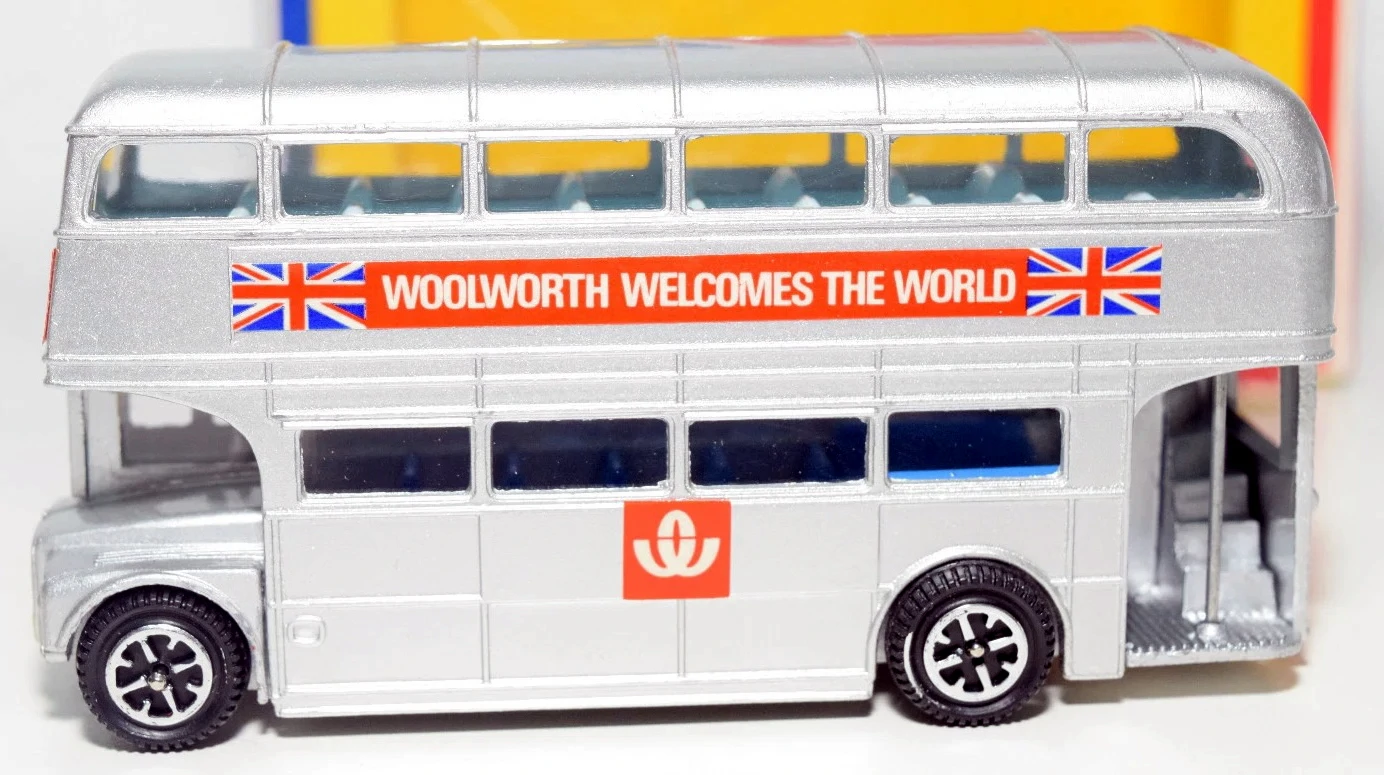
For the Queen’s Silver Jubilee in 1977, Meccano produced a metallic silver Routemaster, mirroring the several dozen full-size buses that appeared on London roads at the time. Featuring Woolworth’s advertising, this toy is much harder to find today than the similarly decorated Dinky Atlantean.
Metallic gold made its reappearance in 1979 on a Dinky Routemaster celebrating the 50th. anniversary of the Belgian bus operator Thollembeek and Fils. This reportedly was inspired by a full-size Routemaster, owned and run by Thollembeek for promotional purposes.
Then later in that final year, the floodgates seem to have opened when it came to Routemaster variants. A relaxation of inhibitions at Binns Road, or just the need to use up spare parts? There are oddities such as a Routemaster with the Yellow Pages stickers usually found on the Atalantean, Routemasters in unadorned metallic silver or gold, and many more.
Also that year, John Gay entered the picture. This Kent-based toy dealer was already well known for his price lists aimed at collectors and his vast range of Code 2 410 Bedford Vans. He now pursued the same strategy with the 289 Routemasters, ordering a variety of color schemes from Binns Road.
Gay ordered so many Dinky buses that he was able to keep decorating and selling them for years after the factory had closed. For example, he offered a gold Routemaster celebrating the 1983 Golden Jubilee of London Transport. Unfortunately, whoever had supplied the many various decals for the 410 Bedford Vans was apparently no longer available: The John Gay Routemasters are mostly marred by crude-looking stickers. (For example, Gay’s Shop Linker bus has nice two-tone paint, but it’s easily outclassed by versions that were made by Corgi and others.)
Acknowledgement
Thanks are due to Terry Gosling, Jan Oldenhuis, and to the nameless bus enthusiasts who had the foresight to photograph RML 952 in its special livery on London roads. The image of the bus at the British Toy Fair was a Meccano press photo that I plead guilty to colorizing.