In the years after World War 2, more and more trucks were used to collect full milk cans from farmers and transport them to dairies. Milk truck drivers did heavy work. Strength and dexterity were required to hoist the 40 liter milk cans onto a truck’s loading platform.
Soon after the war, Meccano France restarted production and began to look for new models to introduce to the market. The production of new civilian French car and truck models had been delayed by the war and many old French Dinky Toy models were still being produced by Meccano France. A completely new range of models was found in the very nice Series 25 Studebaker and Ford trucks. These were very successful and became highly sought after by collectors. This article covers the Dinky 25o Studebaker Milk Truck “Nestlé”.
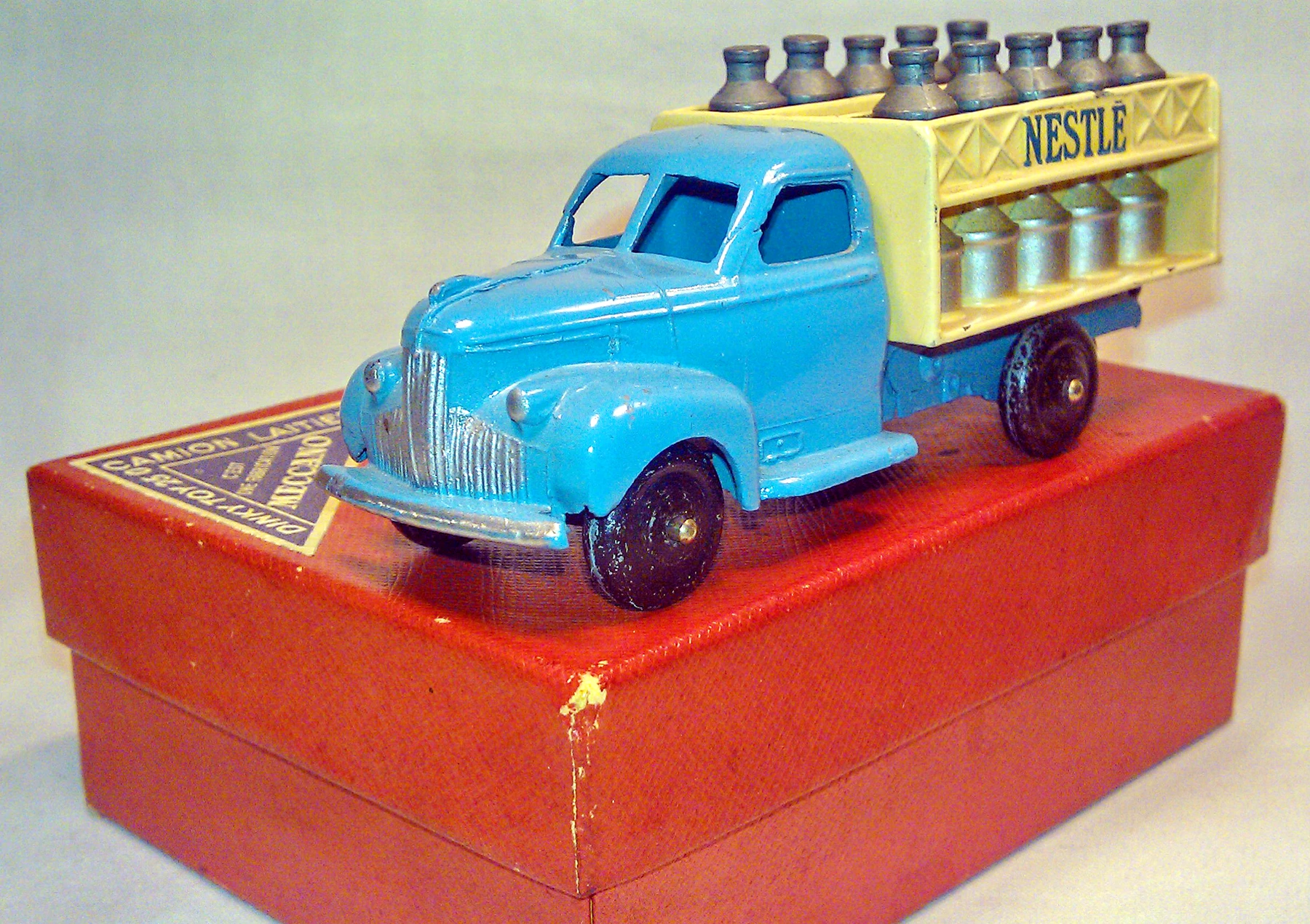
The first version of the 25O Studebaker Milk Truck “Nestlé” in its first type luxury French box.
Brief history of the Studebaker M series trucks
The real Studebaker truck on which the Dinky 25O is modelled was made in the United States in South Bend, Indiana. The prototype of the Studebaker milk truck is based on Studebaker’s M Series trucks that were built during 1941–1948. Like most truck lines, the Studebaker M Series trucks could be had in several body styles. The M Series range included the ½‑ton M5, 1‑ton M15 and M15A, 1½-ton M16 and 2‑ton M17.
Shortly after the attack on Pearl Harbor in December 1941, the United States government shut down passenger car production, although trucks continued to be produced well into 1942. As with most other American industries, Studebaker began producing military systems under contract to the U.S. government in 1941. Its two most famous wartime products were the Weasel tracked vehicle and the US6 2½-ton military truck which went into production in South Bend in June 1941.
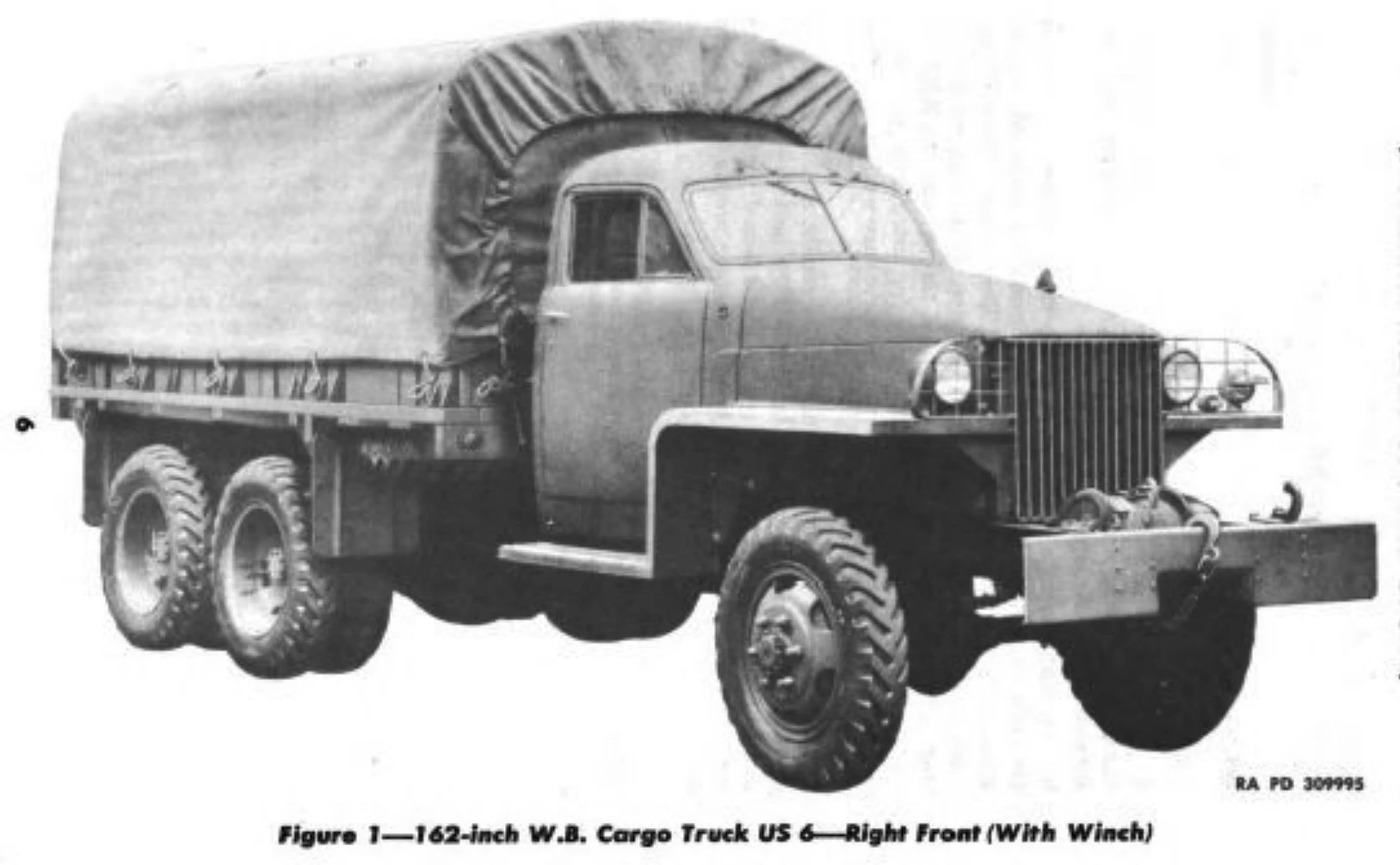
Studebaker WWII military truck US6 based on the M16 box.
After the war in the spring of 1945, Studebaker resumed production of M15 1‑ton trucks: an M15-20 pickup with a 120-inch wheelbase, and a M15-28 truck with dual rear wheels and 128-inch wheelbase. Because the US6 was still in production, these 1945 M15s were built with the military truck’s model C9 cab with a swing-out windshield, metal interior panels, and painted bumpers. All other 1941–1948 M Series trucks were built with a C2 cab with fixed windshield glass and cowl-mounted windshield wipers.
Full production of 1946 M Series trucks began with 367 M5s that were built in December 1945. The model lineup was the same as in 1941, along with a new M17 2‑ton export model. The new M15s were distinguished from the 1945 models with a C9 cab by designating them as M15A. The stainless steel grill trim and some other deluxe features were no longer available, but others were made standard equipment.
All M5s now had body color fenders, while larger models continued to be equipped with black fenders. M Series truck production continued with the same drive trains throughout 1946 and 1947 and into March 1948. A few running changes were made in 1947, one of which was the introduction of a massive painted front bumper on the M15-28, M16, and M17 models.
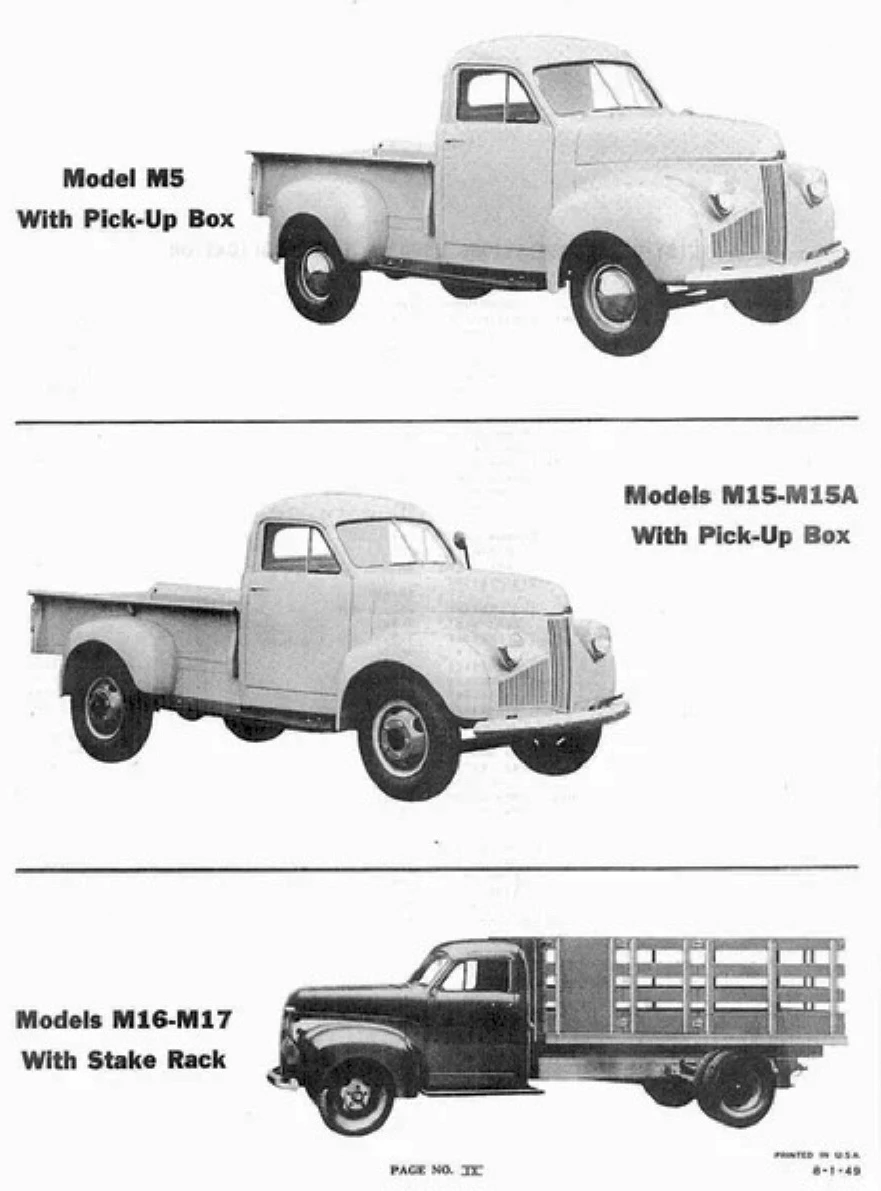
Studebaker M Series truck models.
Prototype 25O Studebaker milk truck
I wasn’t able to find a prototype of the 25O Studebaker Milk Truck with all the features of the Dinky Toys model. I’ve included some pictures of the real Studebaker M16 that was built during 1947 and 1948.
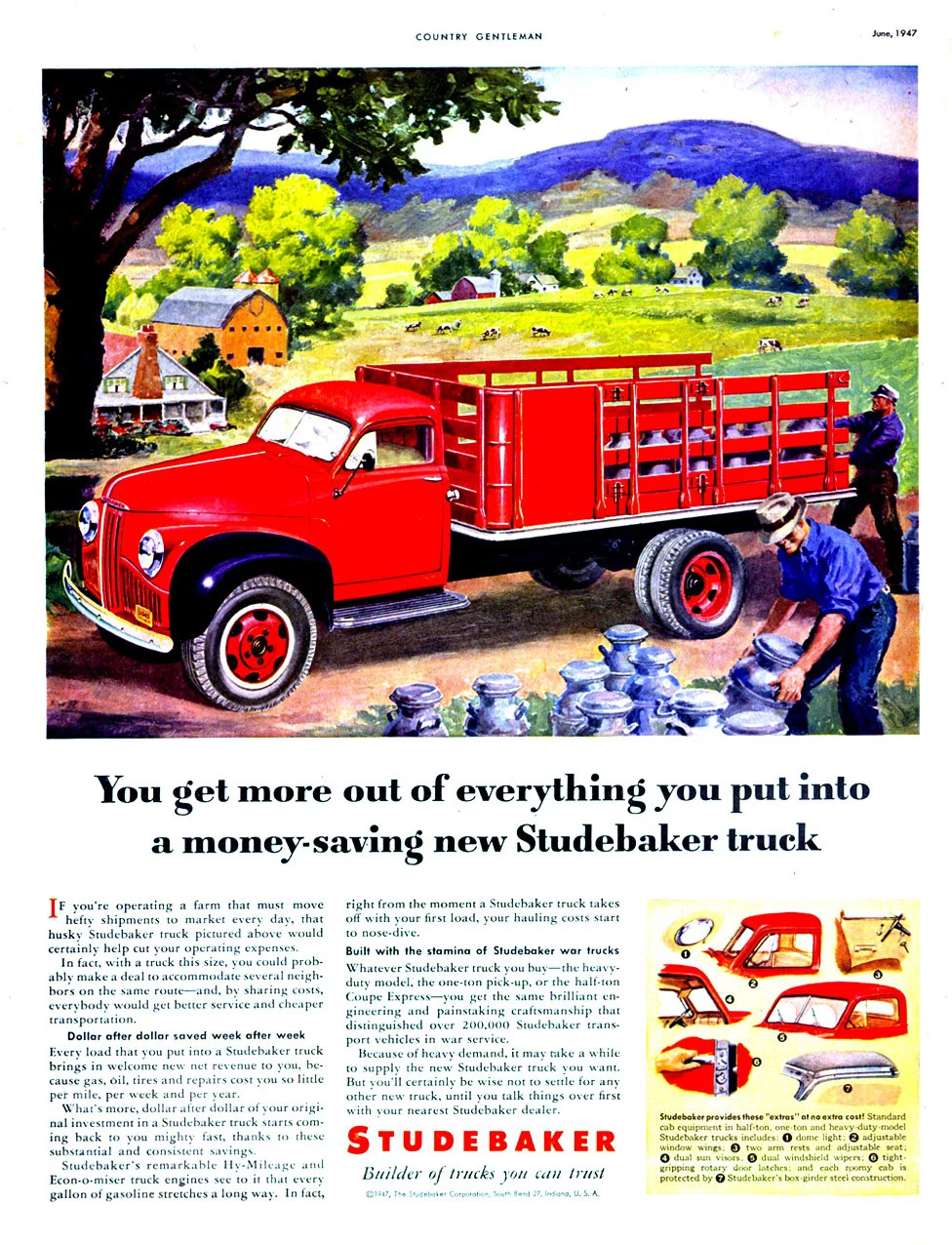
Studebaker truck advertisement from June 1947
Image: OldCarAdvertising.com
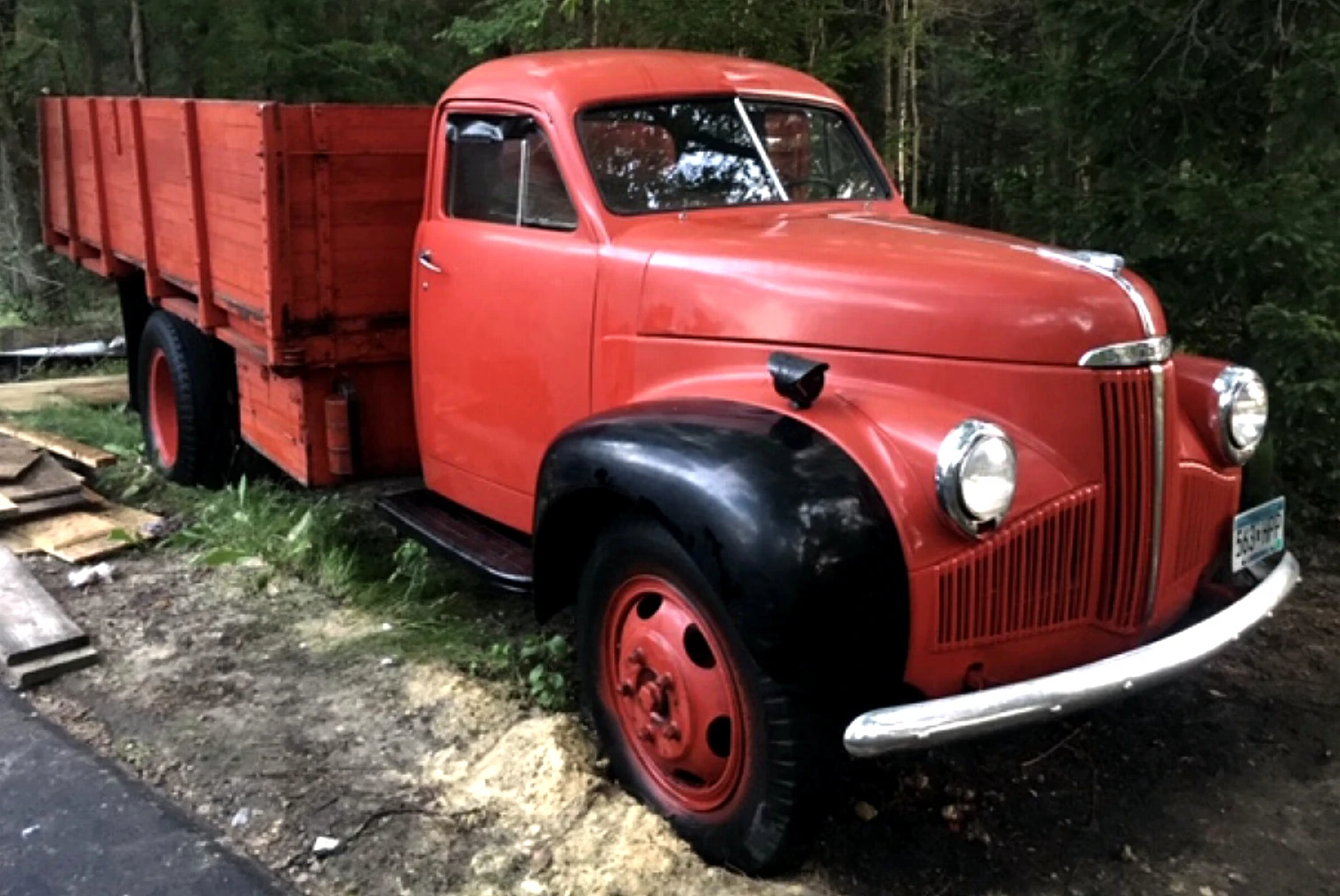
1947 Studebaker M16
Image: curbsideclassic.com
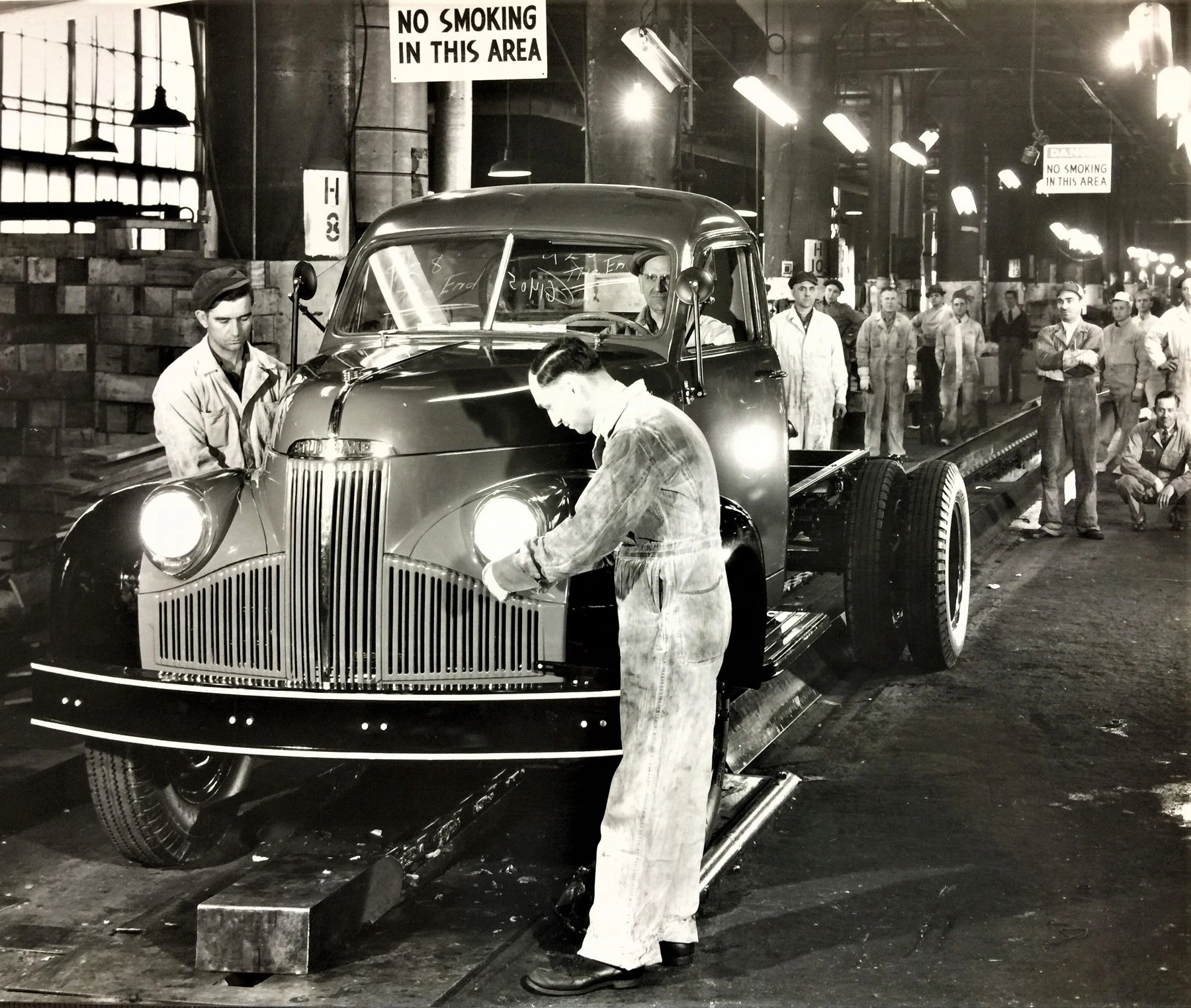
The last M Series truck coming off the assembly line in 1948.
Image: Facebook
Show above is the very last M Series truck (an M16-52) coming off the assembly line in March 1948. Studebaker built 145,800 M Series trucks from 1941 to 1948 which included 52,541 1/2‑ton M5’s, 22,923 1‑ton M15 & M15A’s, 61,339 1–1/2‑ton M16’s and 8997 2‑ton M‑17’s. In 1947, a few running changes were made, one of which was the introduction of a massive painted front bumper on the M15-28, M16, and M17 models.
Dinky Toys Series 25 model range
The chassis of Studebaker and Ford trucks provided Meccano France with the opportunity to produce many different models with the same basic chassis as a welcome addition to the French model range. In the series 25 Studebaker, 7 different models were produced of which the 25O is the only one with advertising (“Nestlé”).
Series 25 Ford trucks comprise 9 body variants, of which a total of 12 different models were produced, including 6 models with attractive advertising, including a 25O Ford Milk Truck “Nestlé”. In the Dinky Toys 1949 French catalog, the Series 25 Studebaker appeared for the first time with 7 models, and Ford with 3 models.
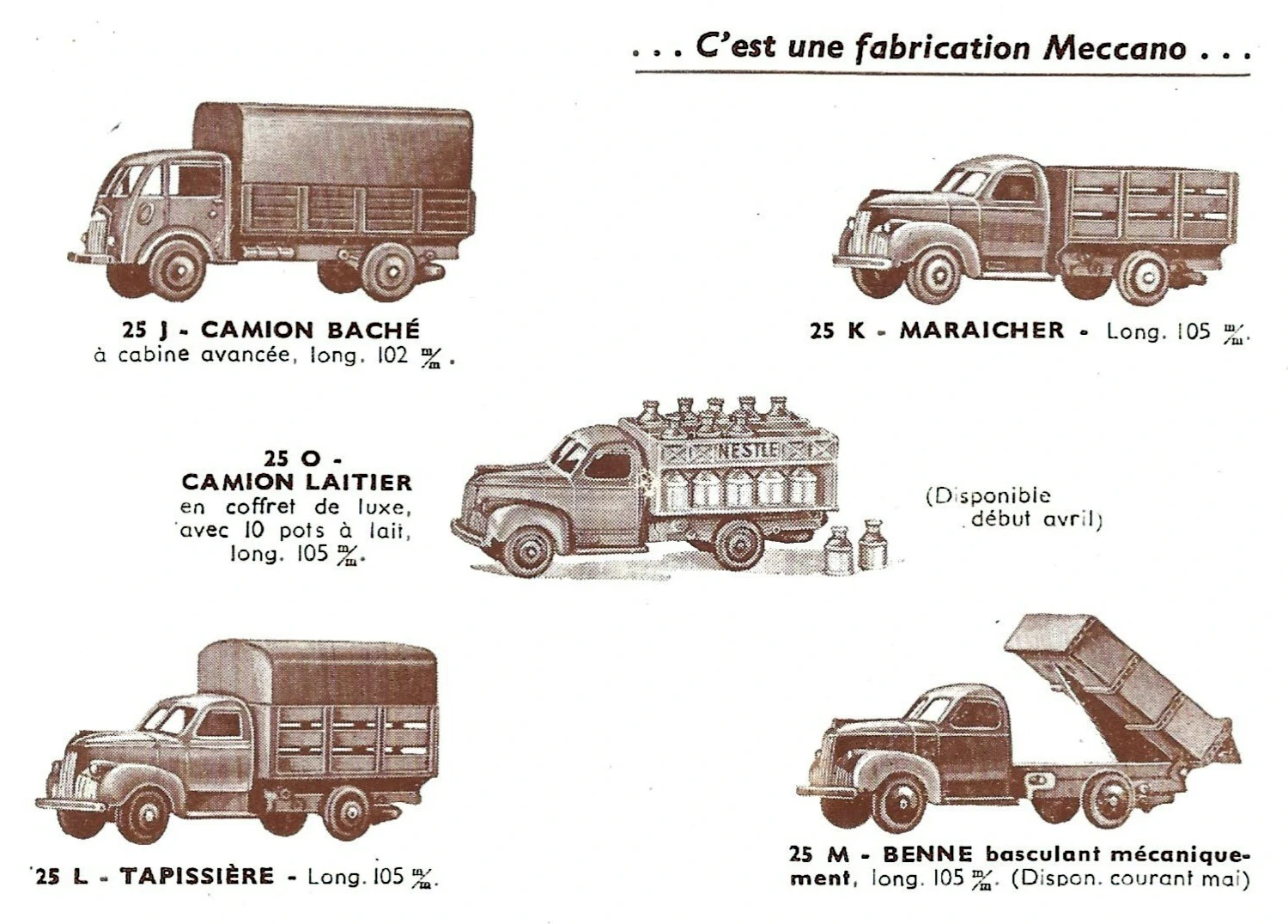
The Dinky 25O Studebaker Milk Truck “Nestlé” in 1949 French Dinky Toys catalog. Note the four different Studebaker models on the same basic chassis.
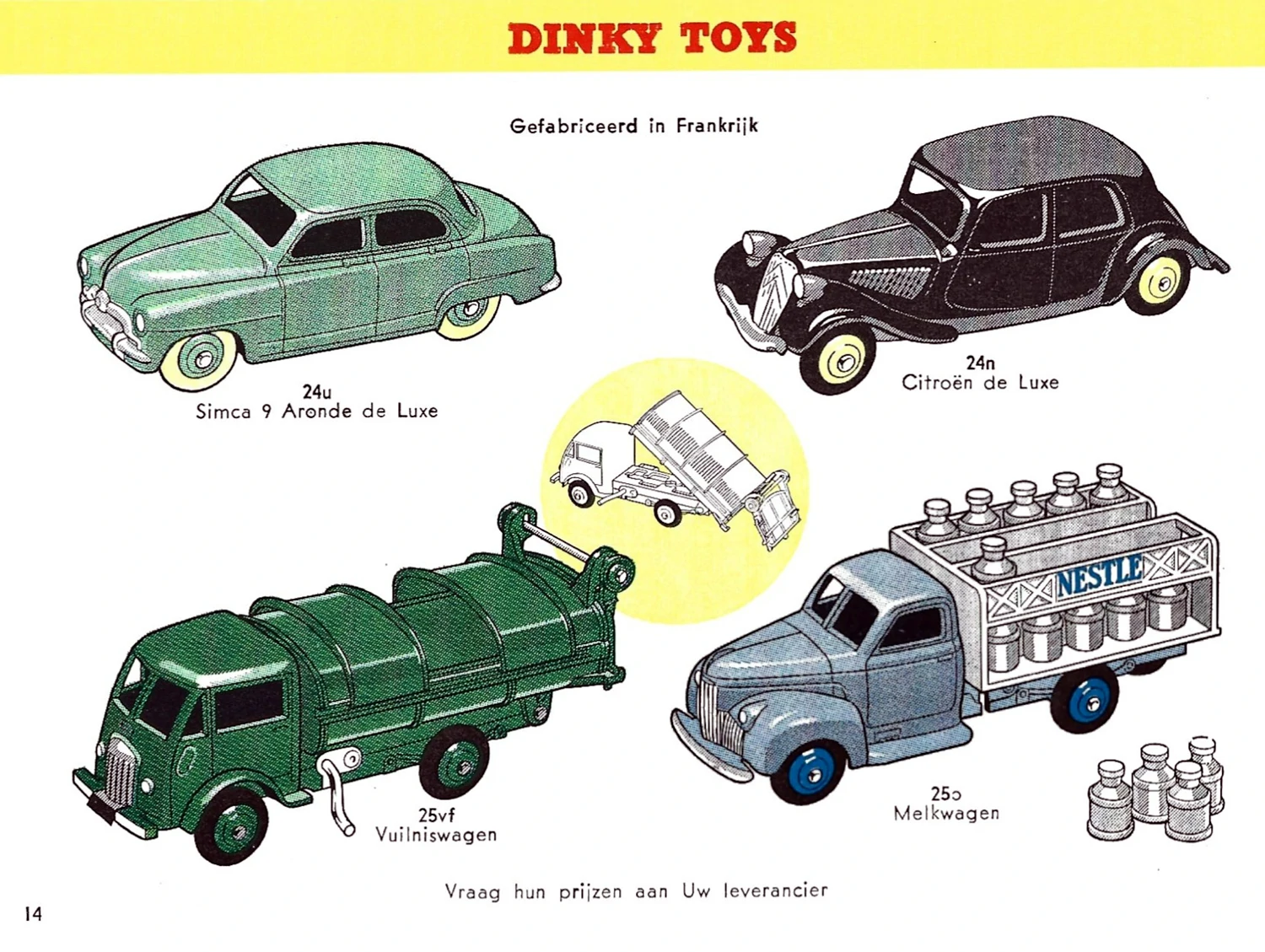
The Dinky 25O Studebaker Milk Truck “Nestlé” in the 1953 Dinky Toys Dutch color catalog.
The main versions
The Dinky 25O Studebaker Milk Truck with “Nestlé” advertising was produced from 1949 to 1954, of which I’ve collected the three main versions. This model was released before the Dinky 25O Ford Milk Truck that has the same milk can loading bed. It’s one of my favorites and I’ve done a lot of research on it. It has many interesting casting details and differences that I describe and show in the pictures that follow. The first versions in particular are a bit roughly finished, but despite that, I find it to be a rather nice and interesting model.
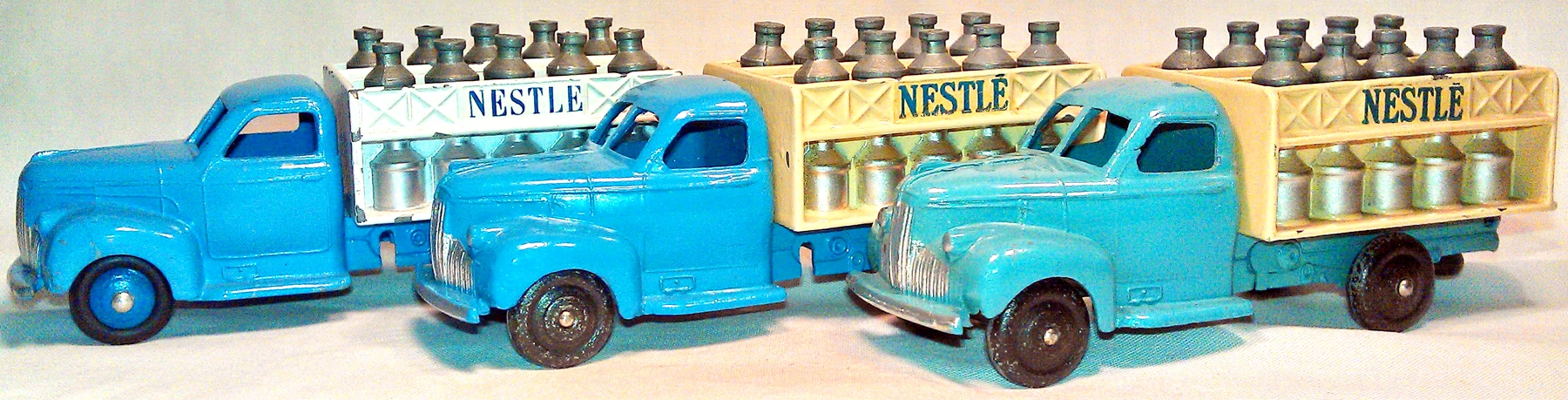
The three main versions of the Dinky 25O Studebaker Milk Truck
Shown above are my three main versions of the Dinky 25O Studebaker Milk Truck. From right to left are the first, second and third versions.
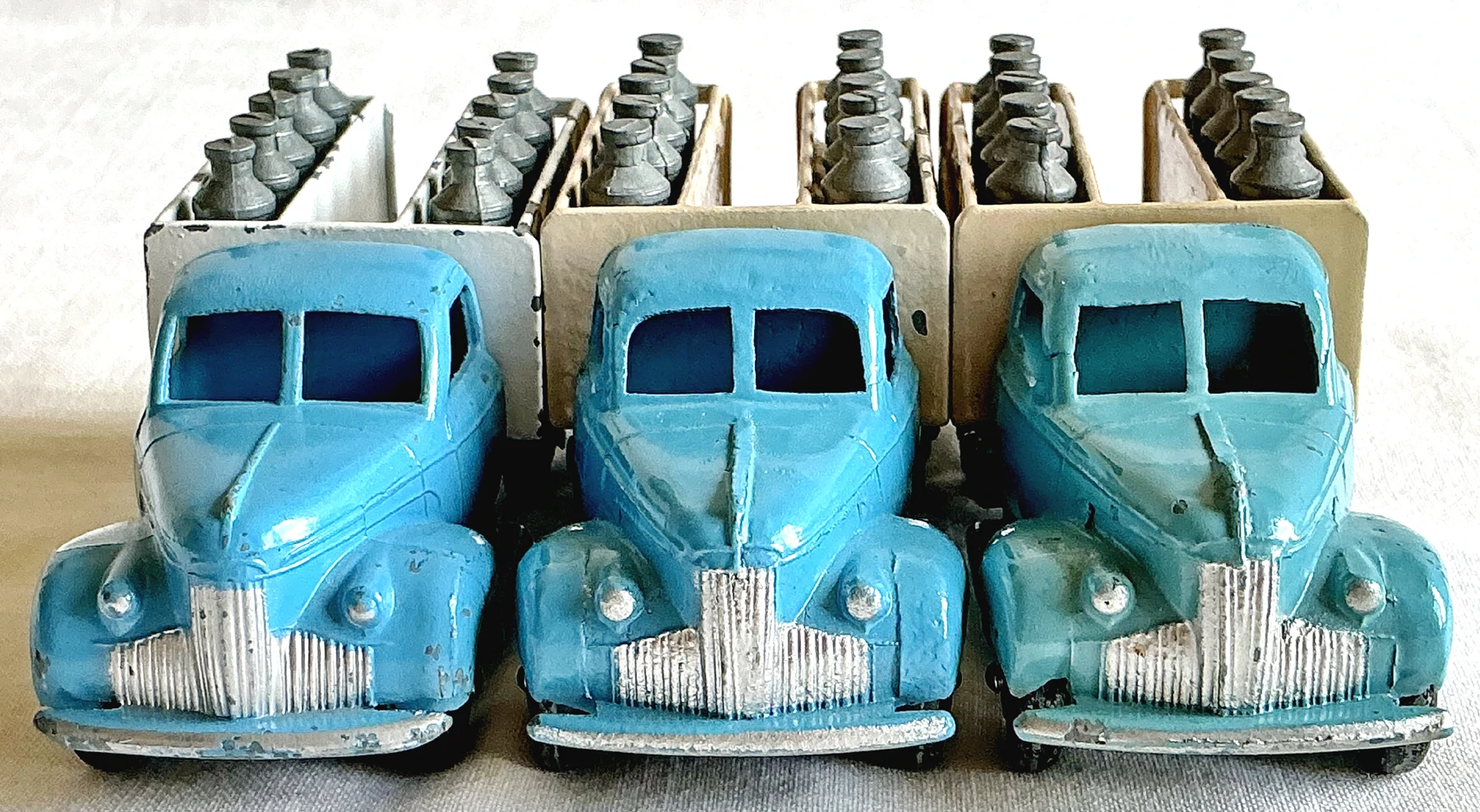
Front view of the Dinky 25O Studebaker Milk Truck
Shown above is the front view of my 25O models. From right to left are the first, second and third versions. Note the different cutouts for the windows. I like the design of the cab with its robust nose and many interesting details such as the prominent headlights, hood ornaments, moldings, chrome grills, headlights and bumpers.
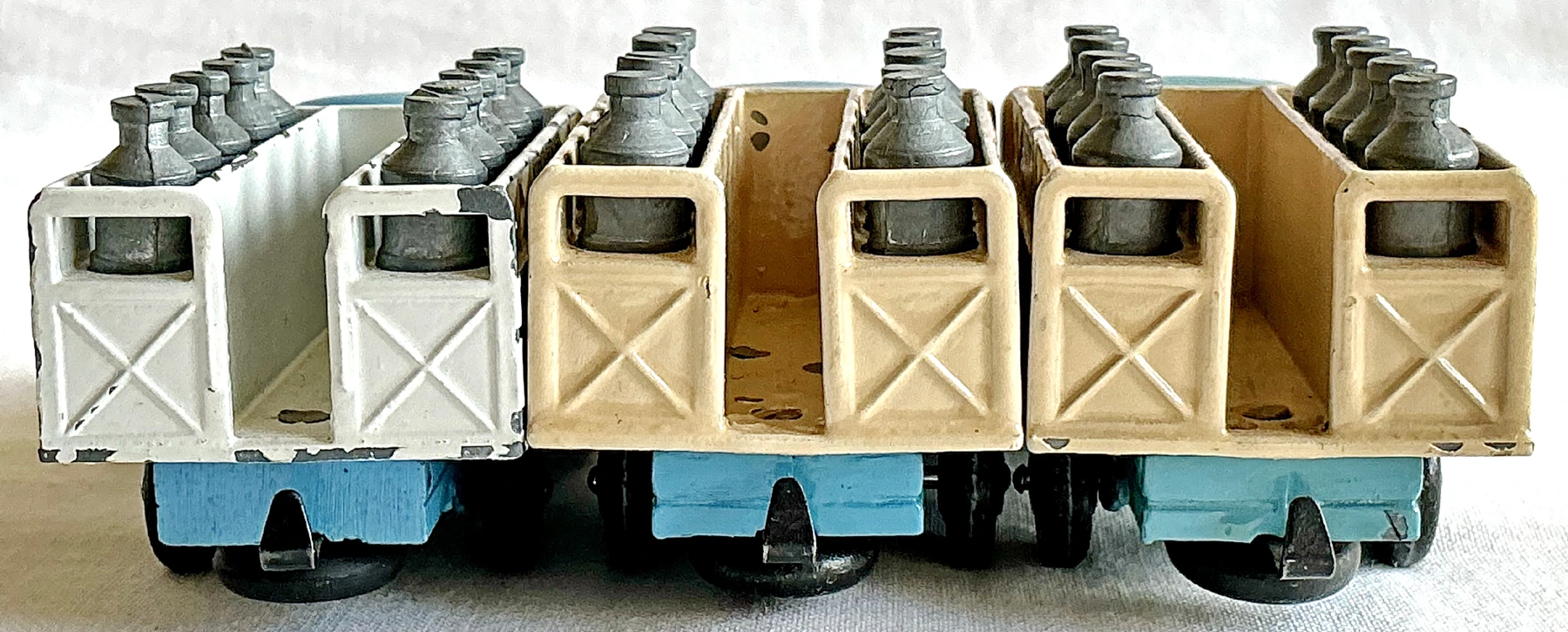
Rear view of the three main versions of the Dinky 25O Studebaker Milk Truck with cast crosses embossed on the rear wall
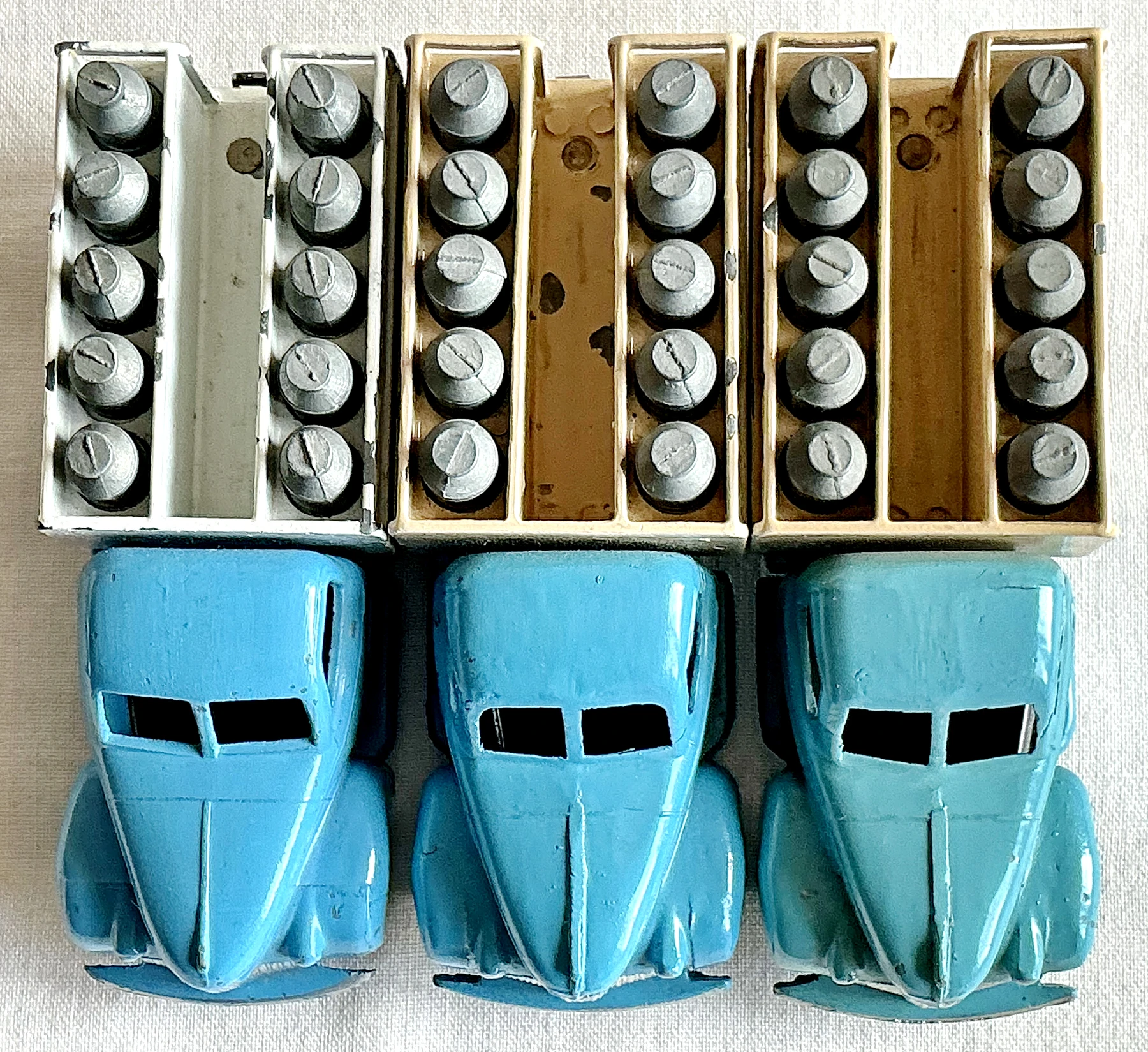
Top view of the three main versions of the Dinky 25O Studebaker Milk Truck
Casting details
The Dinky 25O Studebaker Milk Truck was released with two types of cabs, three different chassis and a body that was always light blue. The cargo bed was initially beige, then appeared in different shades of ivory and white, and was specially designed for the transport of milk cans. It features a “Nestlé” logo on the top of both sides applied with a sticker or stamp.
The model comes with ten loose milk cans. On both sides of the bottom row of the loading platform, five milk cans are beautifully cast in relief into the sidewall. They are meticulously painted silver using mask spraying techniques and look rather nice. Above that, on the upper row of the divided loading floor, five milk cans can be placed for a total of ten cans.
A round recess is present on the bottom of the loading floor for each milk can, into which the can can be placed as shown on pictures above. The “NESTLÉ” logo is applied in bold blue capital letters at the top of the outer sidewalls, with two embossed cast crosses on either side At the rear of the loading platform is cast a cross in relief on each of the two separate loading floors. All these details enhance the appearance of the model and make it very attractive.
Early versions of the model had all black metal wheels. Around November 1949 they were adorned with convex light blue hubs with black “M” rubber tires. The model is equipped with a towing hook which is riveted to the chassis along with a spare wheel and the loading platform.
Casting differences
The two types of cabs have interesting casting differences which are fun to discover and share with fellow Dinky collectors.
The body of the very first model was issued in lighter blue and the chassis was equipped with a closed crank hole. It’s quite remarkable that for a very short time the first version of this model was equipped with a plate with a hole for the crank, which was then omitted from later models. This version is very scarce and hard to find in complete and good condition with all the milk cans and box. I was lucky enough to acquire this version in good condition.
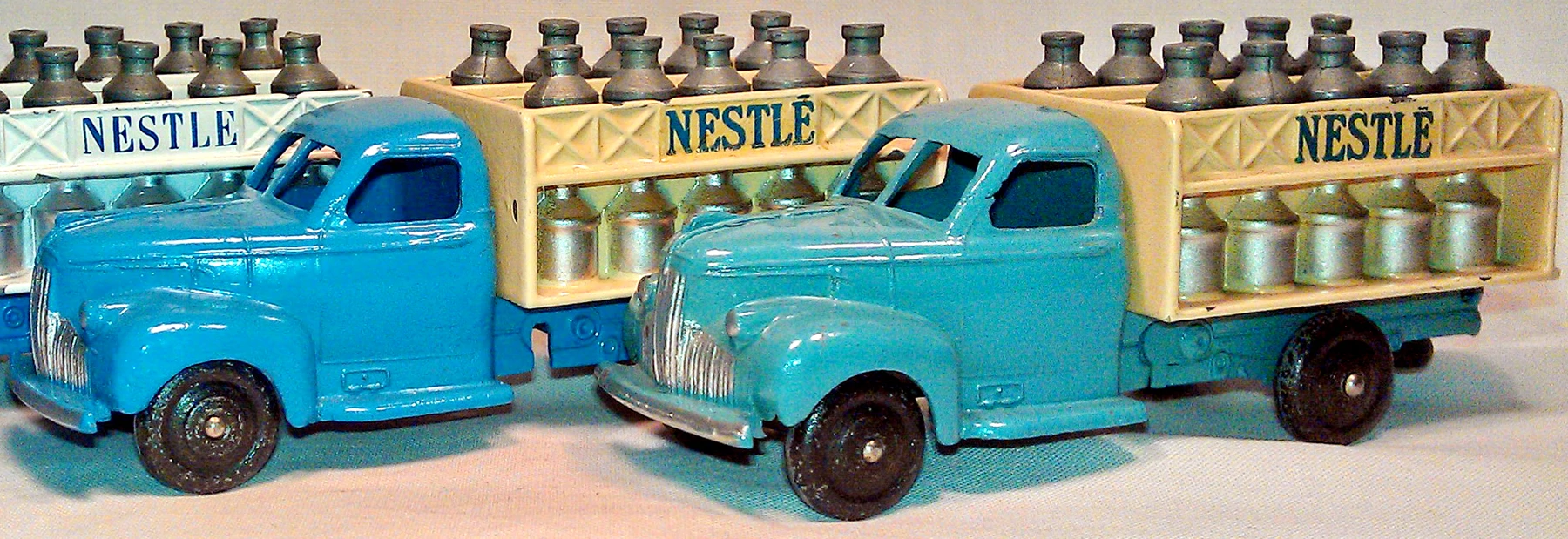
R: First version in lighter blue with closed crank hole.
L: Second version with open crank hole.
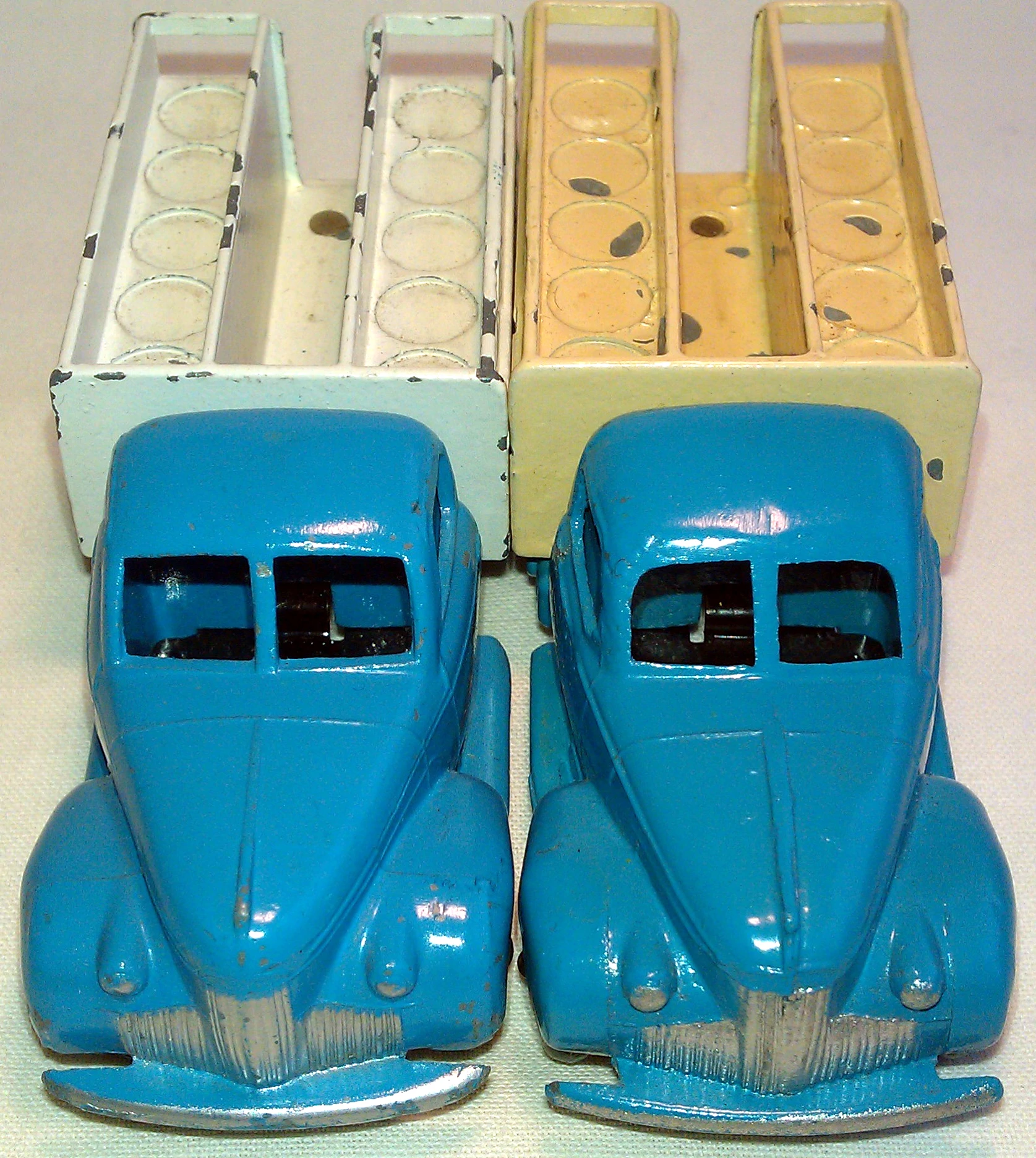
Shown above are the first (right) and second (left) type cabs. Note the differences in the cut out windows, the thickness of the center hood moldings, the hood ornament and the cut out bumpers. The round recesses at the bottom of the loading bed for each milk can are visible in the picture above. The right loading bed is beige in color while the left one is more ivory.
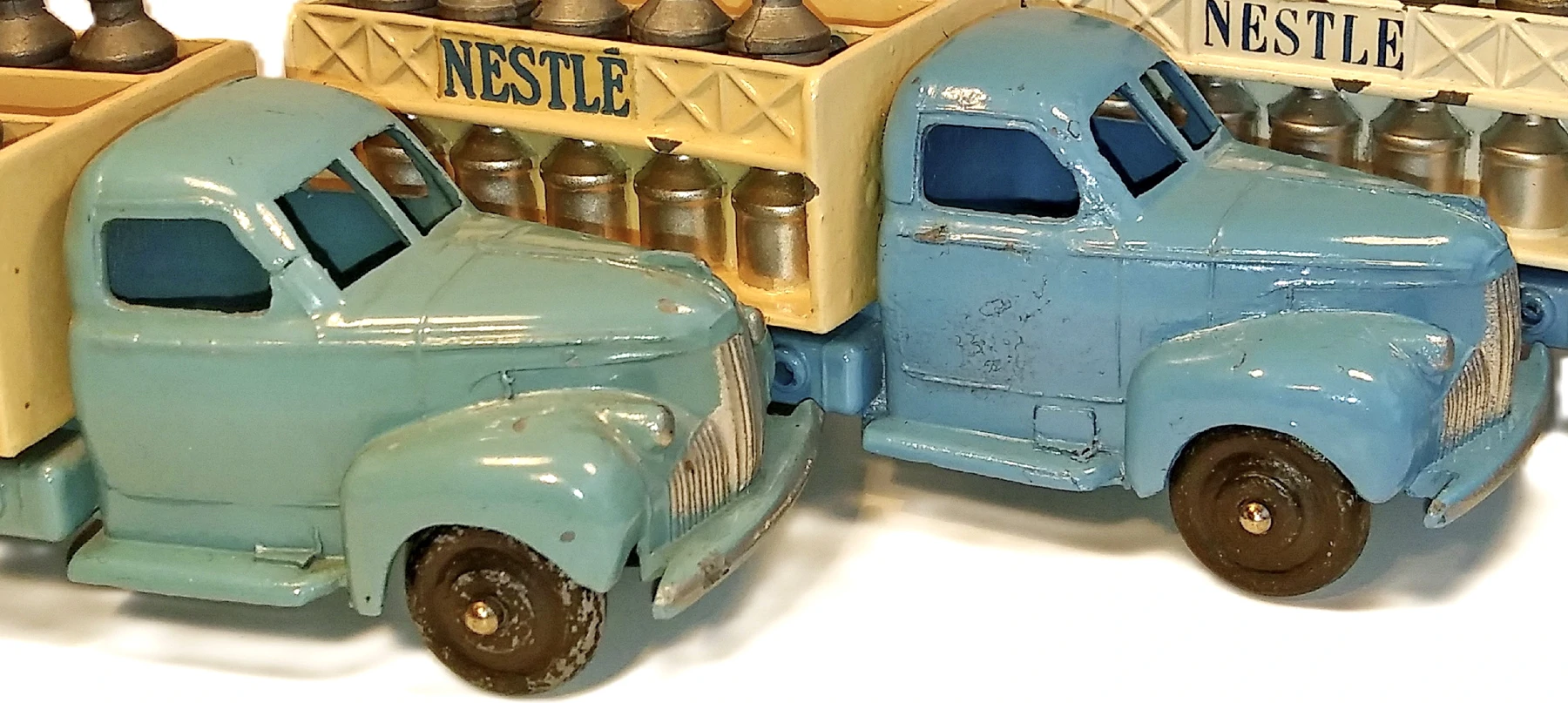
Shown here are type 1 cabs with different toolboxes embossed on the running board and different short side moldings on the hood. On the left is the lighter blue first version and on the right, the second version.
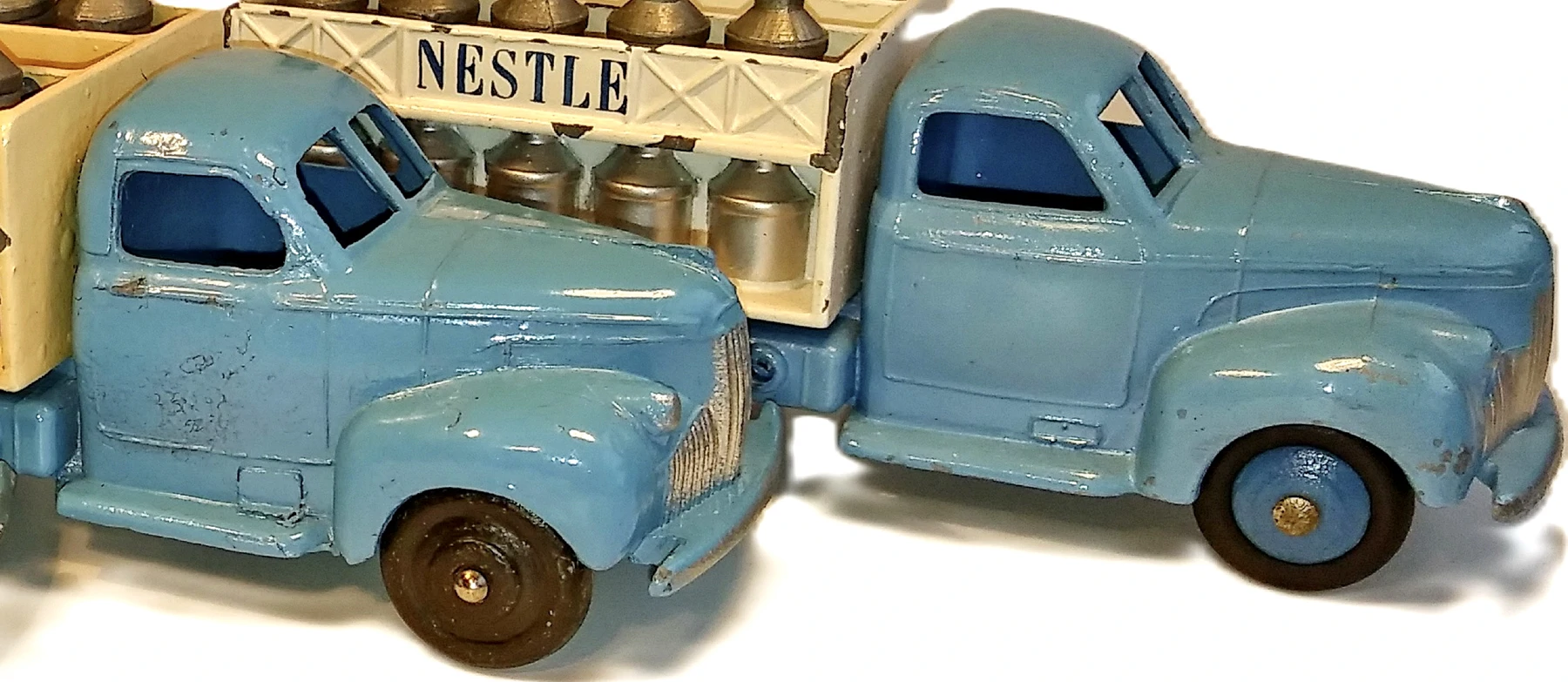
Shown above (on the left) is the second version of the model with a type 1 cab with a large toolbox and short side moldings on the hood and (on the right) the third version with a type 2 cab with a smaller toolbox and longer curved side moldings on the hood, as well as larger side windows. I couldn’t find a real Studebaker M series truck equipped with a toolbox on the running board under the door, so its presence on the model is a mystery to me.
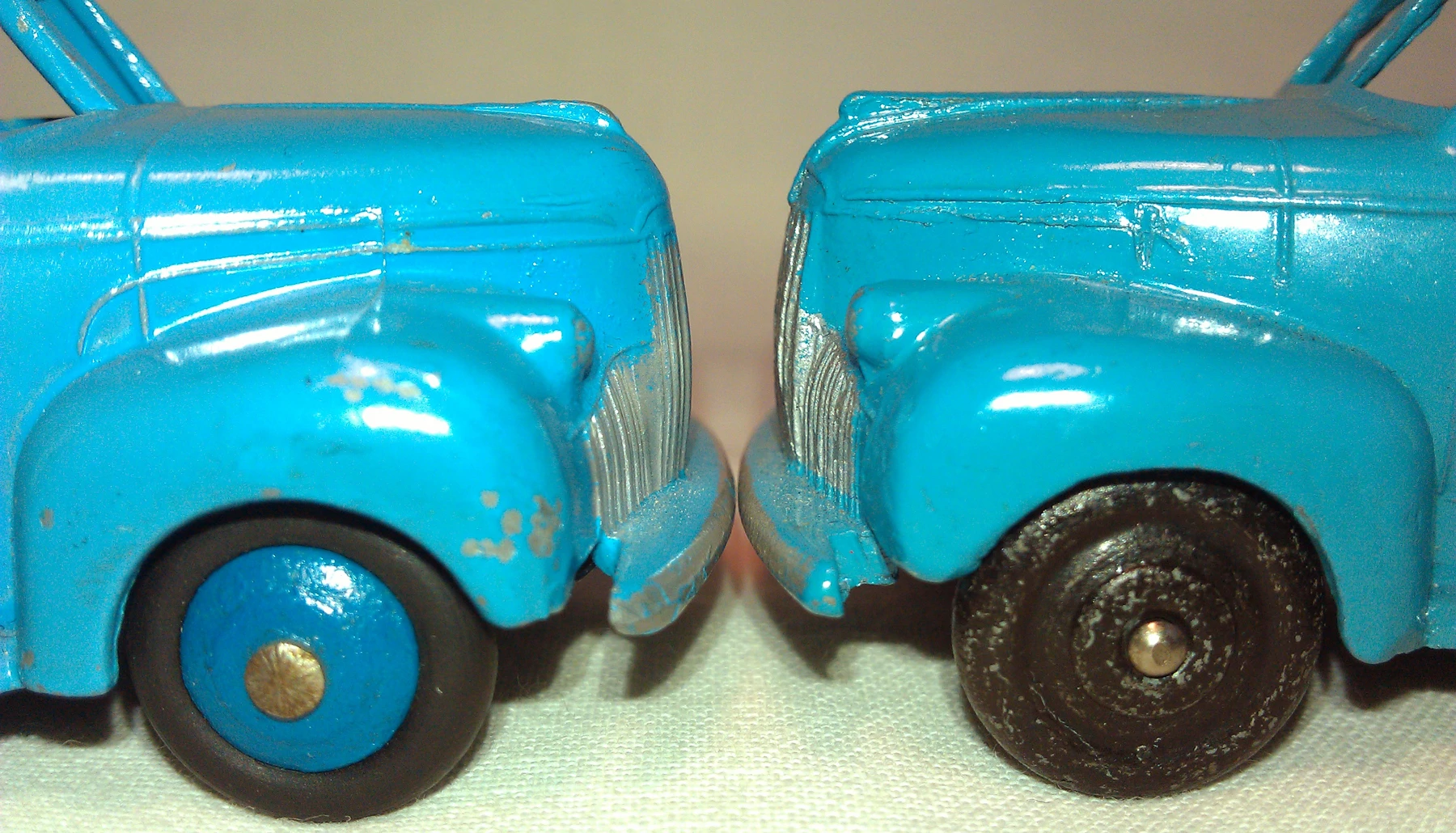
Here’s a close up front side view of the Dinky 25O Studebaker Milk Truck. On the right is the type 1 cab with a short curved side hood molding and a large hood ornament, and on the left a type 2 cab with a longer curved side hood molding and smaller hood ornament. I was also unable to locate a real Studebaker M series truck with side moldings, which makes for yet another mystery.
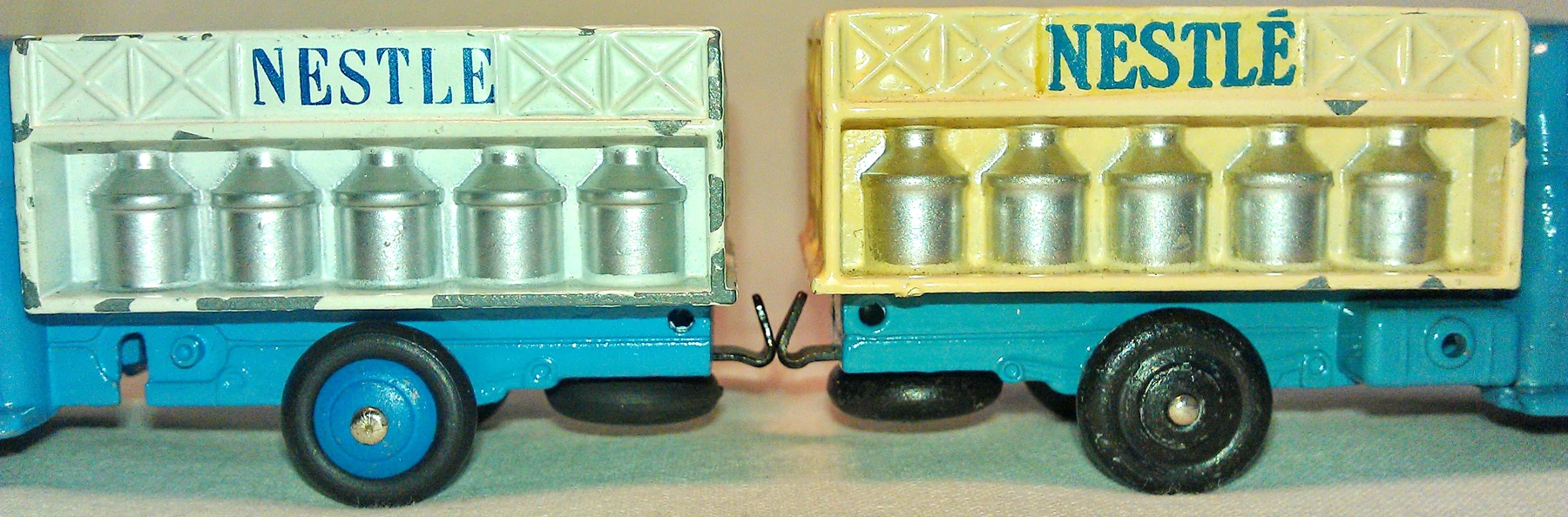
This picture shows differences in the “NESTLÉ” logo and colors of the loading platform between the first version (on right) and third version (on left). Also note the differences in wheels and the “M” tires on the model on the left. Both versions include milk cans in attractive relief on the lower sides of the platform.
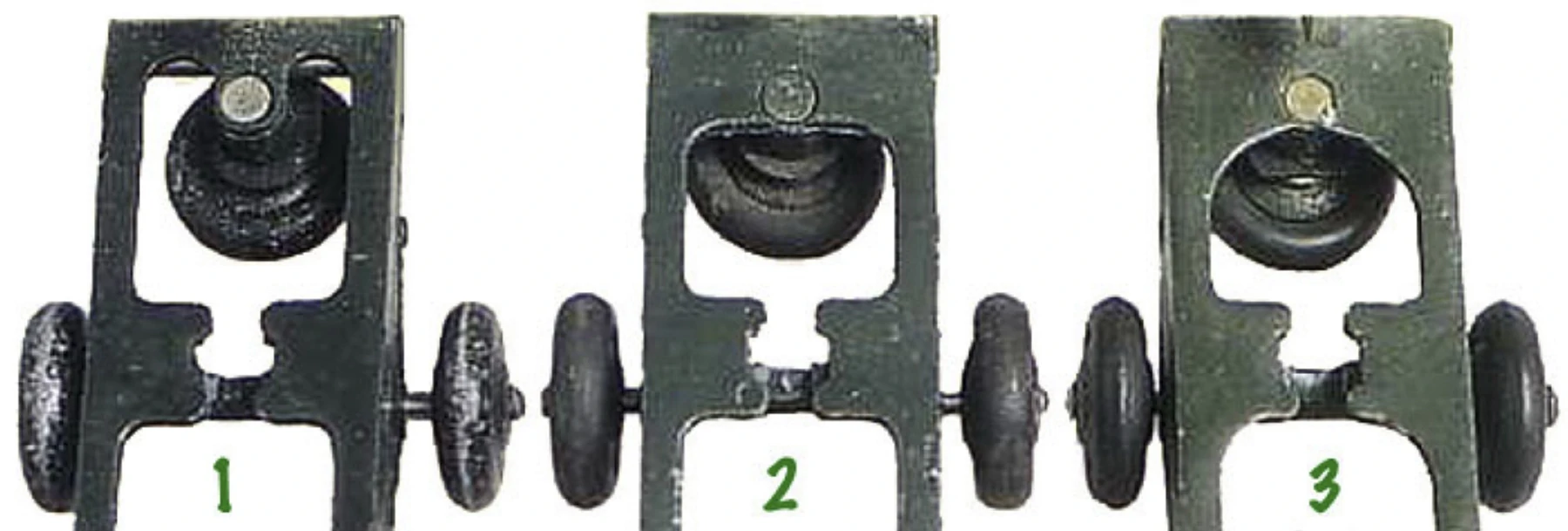
Top view of open chassis.
Image: Jacques Dujardin (DTCA)
In the above picture we see the top view of three versions of the open chassis of the Dinky 25O Studebaker Milk Truck, with the first and second versions using a type 1 cab and the third version a type 2 cab.
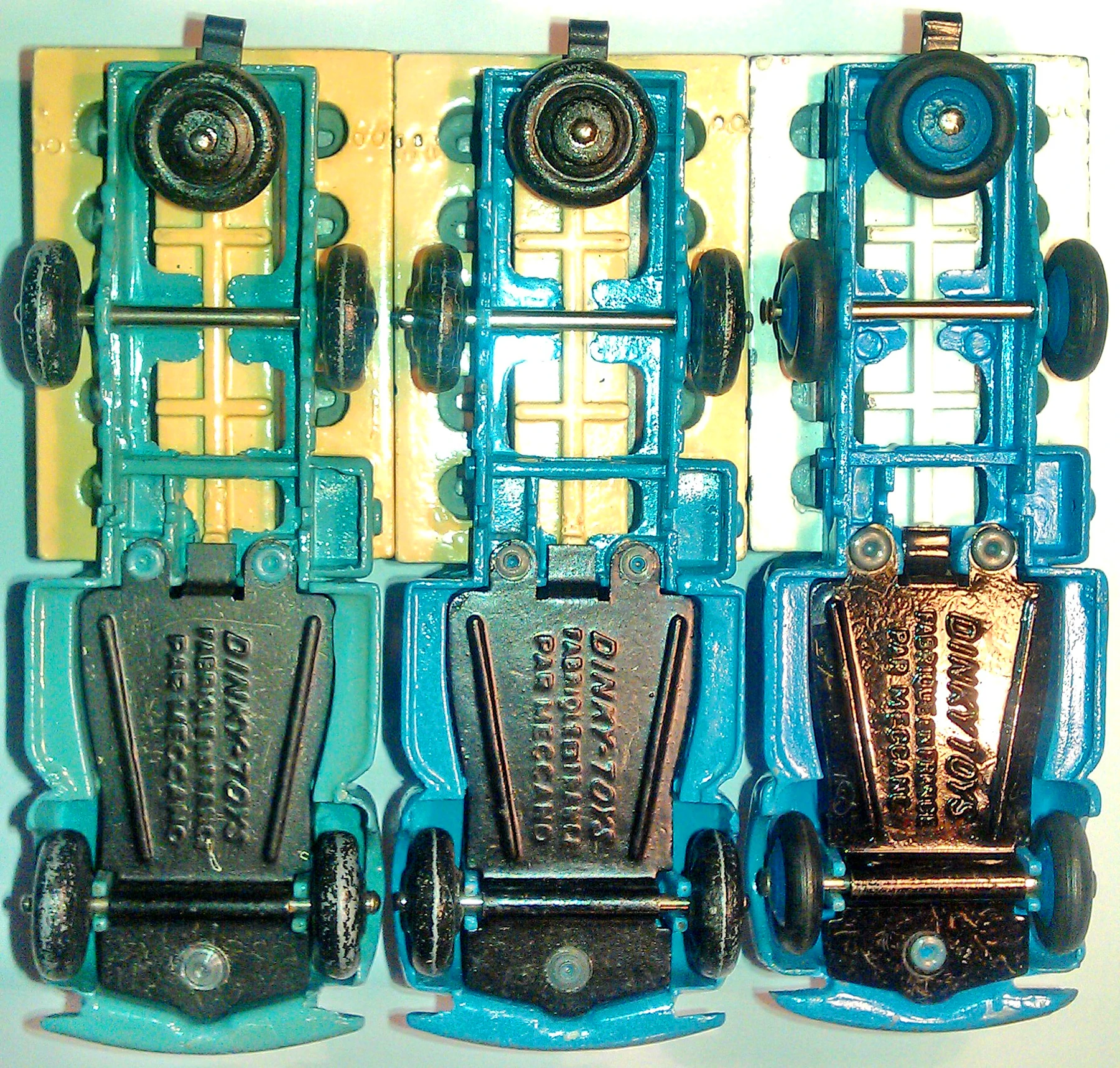
The picture above shows the bottom view of the three versions in order from left to right. The first two baseplates have a hyphen between DINKY and TOYS, which is missing in the third version. And only the third version has a pair of ejection markings below the rear axle.
More variants
Although this article describes the three main versions of the Dinky 25O Studebaker Milk Van, there are more variants. For example, my second version chassis with type 1 cab has black metal wheels and an open crank hole, but this version also exists with a closed crank hole. I also have a model with a second version chassis with open crank hole, but light blue ridged hubs and black rubber “M” tires as shown below. This version represents the transition from black metal wheels to light blue ridged hubs and black “M” tires that occurred around November 1949.
For the sake of completeness I should also mention the following curiosity:
- Versions 1 and 2 have a smooth interior roof with three ribs.
- Version 3 has a completely smooth interior roof without ribs, but these features aren’t really necessary to determine the main versions.
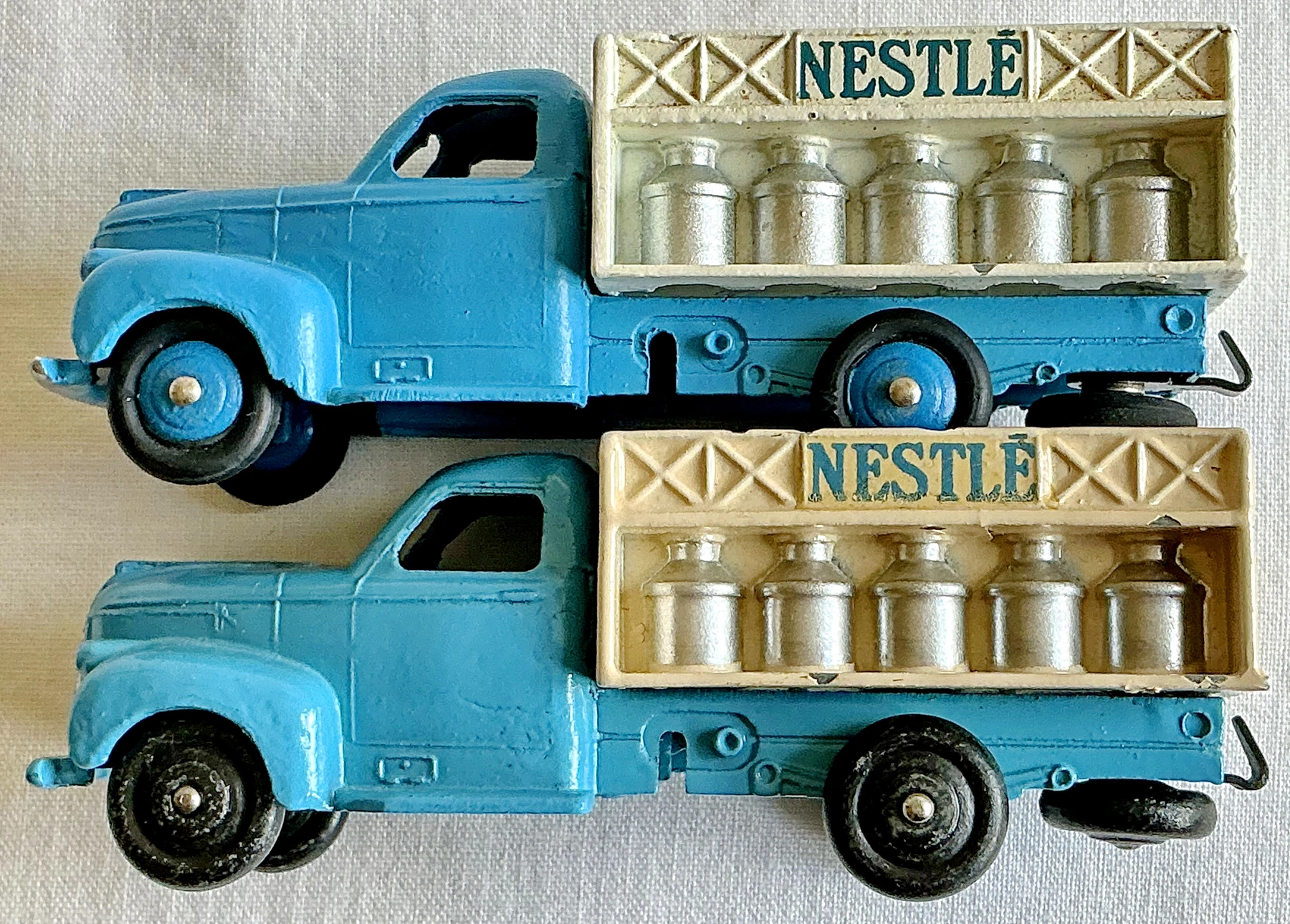
The second version with light blue ridged hubs and “M” tires (top) and black metal wheels (bottom).
French luxury 25O boxes
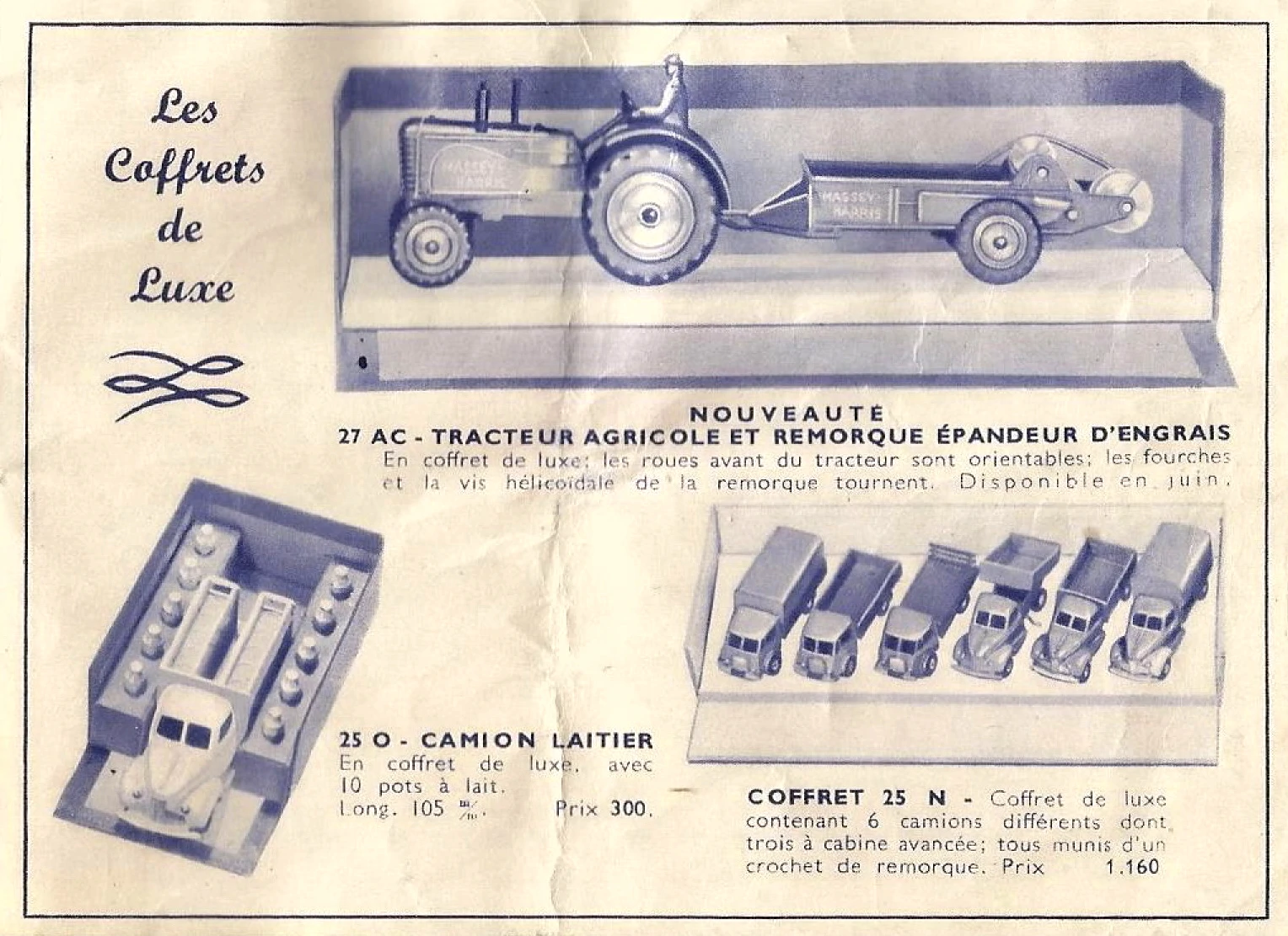
The Dinky 25O Studebaker Milk Truck was issued in a unique luxury box, shown in the 1950 Dinky Toys French catalog. Note the other two unique luxury French boxes, each also sporting a single flexible flap.
The Dinky 25O Studebaker Milk Truck was delivered in a unique luxury sturdy red plasticized cardboard lid box with a beautiful, fine and shiny checkered pattern. The box has an ingenious three piece cardboard inner packaging in which to store the truck and ten milk cans.
A yellow cardboard packing piece bent into shape covers the floor, with space in the middle to store the truck. In each of the two side supports, five removable milk cans can be stored. A pair of loose inner boxes under the sides of the packing piece serve as support for the cardboard containing the milk cans, and are laminated red on the front.
The front of the box has a flexible flap that can be lowered, allowing the truck to be driven in and out of the box between the two side boxes as if it were driving in and out of a garage. This, along with the removable milk cans, provides high play value.
A round red French quality control stamp is placed on the inside lid of the box. The first box was issued with a unique blue triangular label on a corner of the top of the lid, on which “DINKY TOY (without the S) 25o CAMION LAITIER c’est une fabrication MECCANO” is printed in white. The second box had a rectangular yellow label on the front lid on which the name “DINKY TOYS” is printed correctly.
The Dinky 25O Studebaker and Ford were the only models in the 25 series issued in individual luxury boxes. All other Studebaker and Ford models in the 25 series were issued in a trade box of 6 units. The only other models assigned these French luxury boxes are the Dinky 27AC Tracteur Massey-Harris avec épandeur d’engraisand and the Dinky 14C Chariot à fourche Coventry Climax which were both imported from England. These boxes are described in my article 6 UK Dinky Toys repackaged by Meccano Paris for the French market (1950–1951).
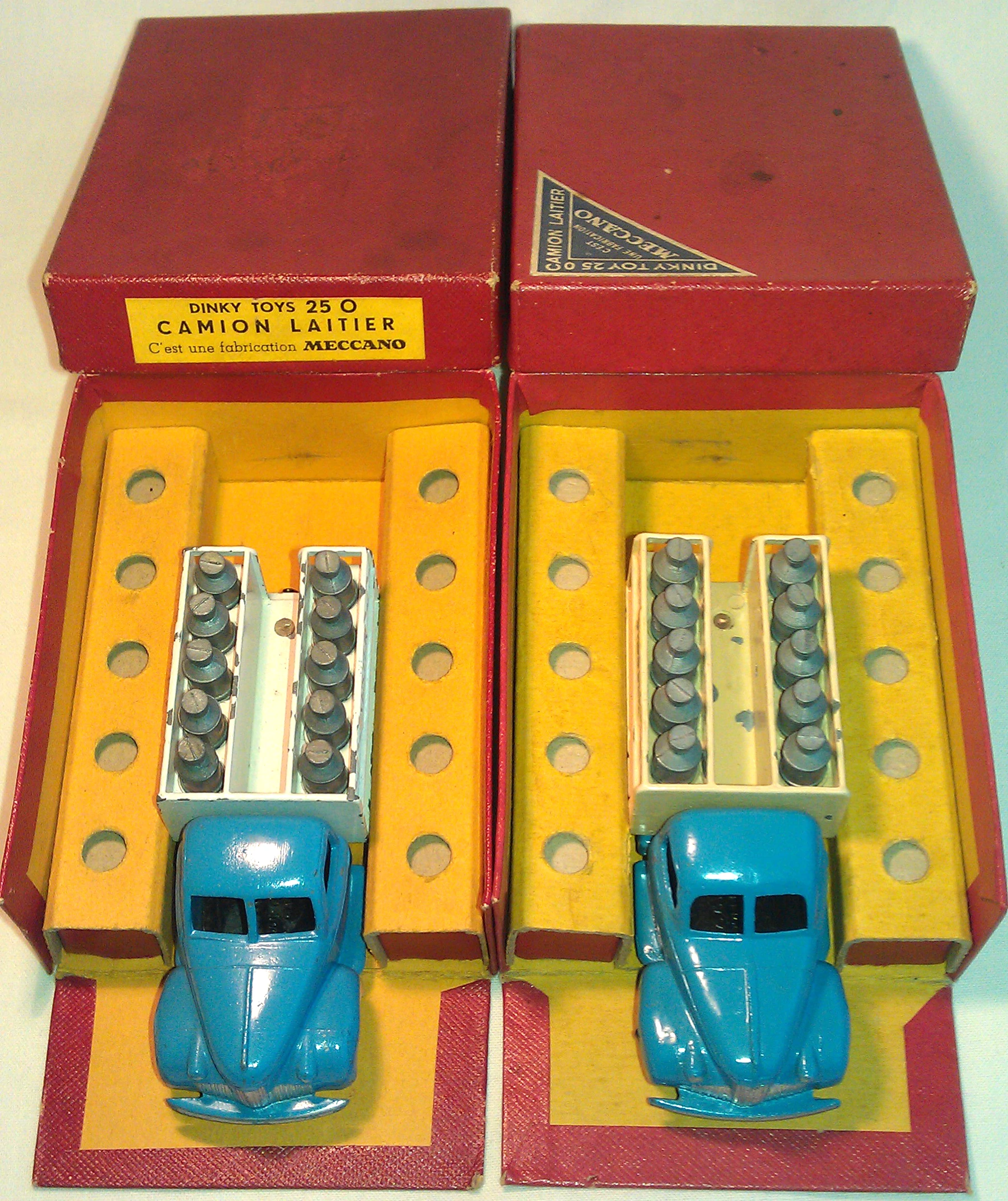
Dinky 25O Studebaker in luxury French box.
R: First version in type 1 box with triangular label.
L: Third version in type 2 box with rectangular label.
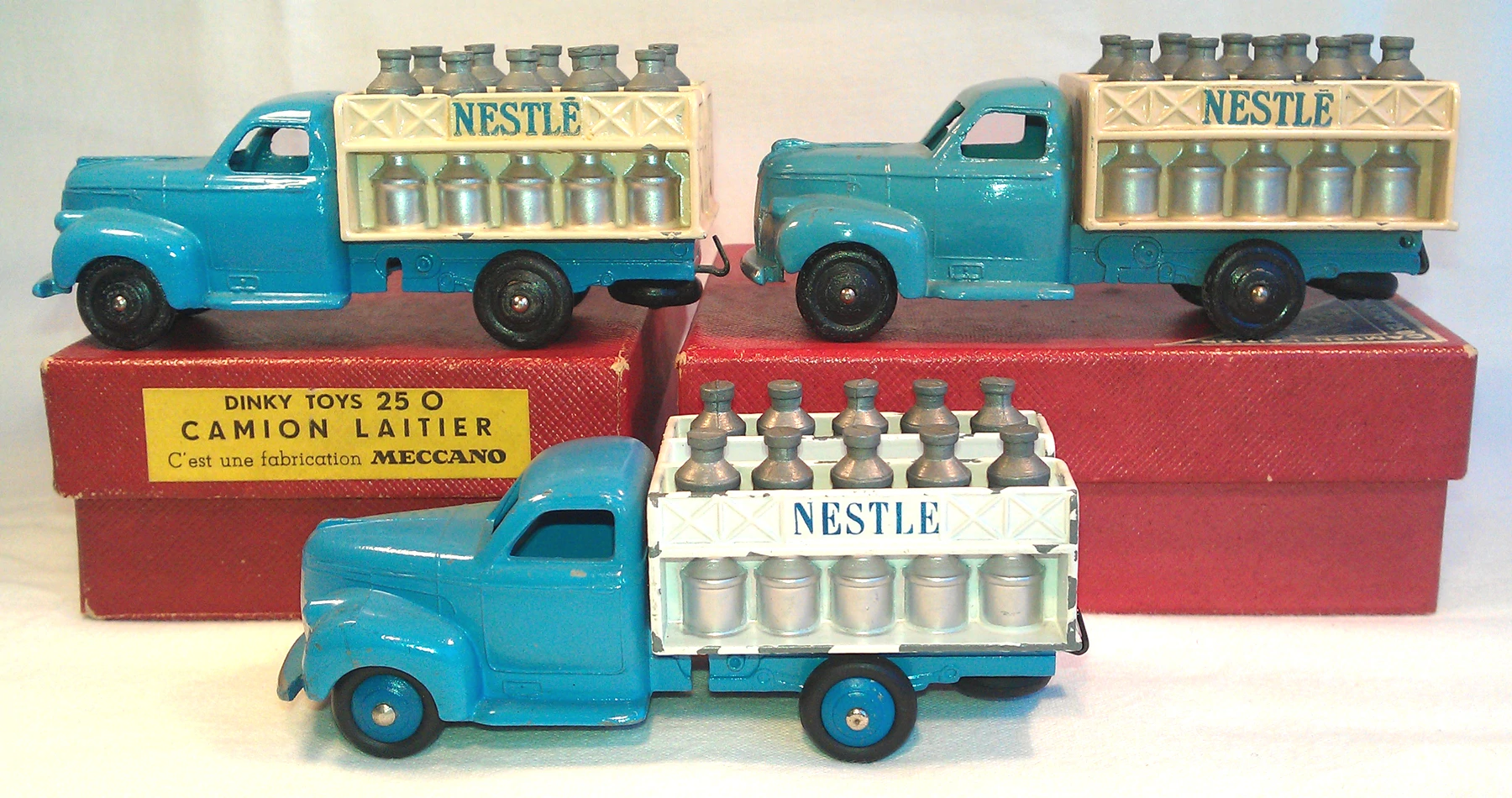
Shown above are my three main versions of the Dinky 25O Studebaker Milk Truck “Nestlé”. The one at the top right is the very first version in lighter blue with a closed crank hole.
References
- Dinky Toys en Franse Dinky Supertoys 1933–1981 by Jean-Michel Roulet (in Dutch language, but also available in French).
- Les Dinky Toys et Dinky Supertoys Francais 1934–1981 Jean-Michel Roulet editions Atlas.
- Dinky Toys Series 25 et 500 Thierry Redempt et Claude Wagner edition Drivers.
- The Fabulous Dinky Toys Encyclopaedia by Jacques Dujardin.