When the Meccano factory decided to expand operations overseas in the mid 1920’s, it opened agencies in South American cities such as Bogota (Colombia), Buenos Aires (Argentina) and Iquitos (Peru). The last one is puzzling, as this city was not a capital like the other two, but a medium-sized regional city located in the heart of the Amazon jungle in the Great Plains of the Amazon Basin. It was probably chosen because it was a major inland river port, where ships carried goods to between Peru and Europe via Brazil.
Basic raw materials such as rubber, precious woods and tropical fruit were fundamental to the industrial development of European countries, including the United Kingdom. There were numerous British import/export firms and companies operating in Iquitos, which gave rise to a small market for finished products such as Meccano toys, for the children of expat families who lived there. Another reason could have been that it is the South American continent’s most centrally located city, from where distribution of goods was possible through an important waterway that was the Amazon River.
From 1920 until 1928, the Meccano company had started a North American subsidiary, with a factory located in Elizabeth, New Jersey, where Meccano sets and Hornby trains were essentially manufactured for the US market.
This production was short lived due to litigation by the A.C. Gilbert Company, which produced American Flyer trains and Erector sets, which were similar toys. Also, the effects of the Depression era were being felt, and the company was forced to close and was sold to its rival, which curiously enough, made Meccano parts for the US market until the early 1930’s. Canada was still part of the British Commonwealth, and Meccano had a warehouse and offices in Toronto, its market possibly a part of the distribution of this operation.
Nonetheless, South America offered a great manufacturing possibility after the closing of the N.J. factory, and Buenos Aires, Argentina, was chosen over the other two cities because it was more cosmopolitan and had strong links to Europe via the Atlantic Ocean and to the rest of South America. Industrial activity was at a high level of development, and specialized labor and lower taxes were a good incentive to open a new factory there. Buenos Aires had also a Harrod’s department store subsidiary, which was an additional venue for selling toys.
Meccano parts started being manufactured from the mid 1930’s under license, including special Hornby trains, boats and aircraft. It’s not known if Dinky Toys were also made or assembled there. Later after the war, Exacto S.R.L., continued producing 75% of the Liverpool range as well as some special parts from the mid 1960’s to the mid 1980’s.
Pre-War Spanish Dinky Toys Literature
Following the demise of the North American factory and the start of operations in South America, there was a need to market Meccano products to Spanish speaking countries. Thus, the Meccano general catalog of the times needed to be translated based on existing U.K. issues.
The first Dinky Toys had appeared as “modeled miniatures” in the general catalog of August 1933, and “Meccano Dinky Toys” were officially renamed in April 1934. These were done as accessories to Hornby train layouts, and to compete with the famous “Tootsietoy” range of products.
Meccano 1937 catalog
Like their British counterparts, the South American exports were shown first in the general catalog, the earliest known one being the 1937 issue.
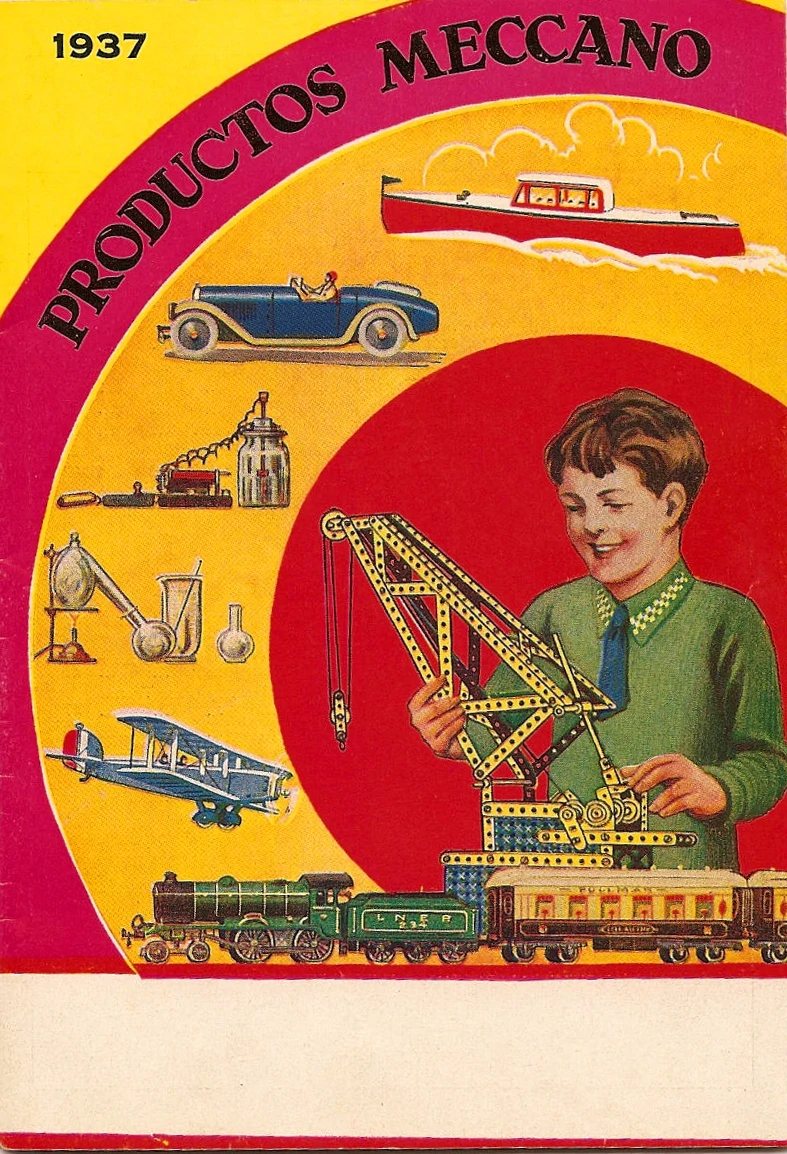
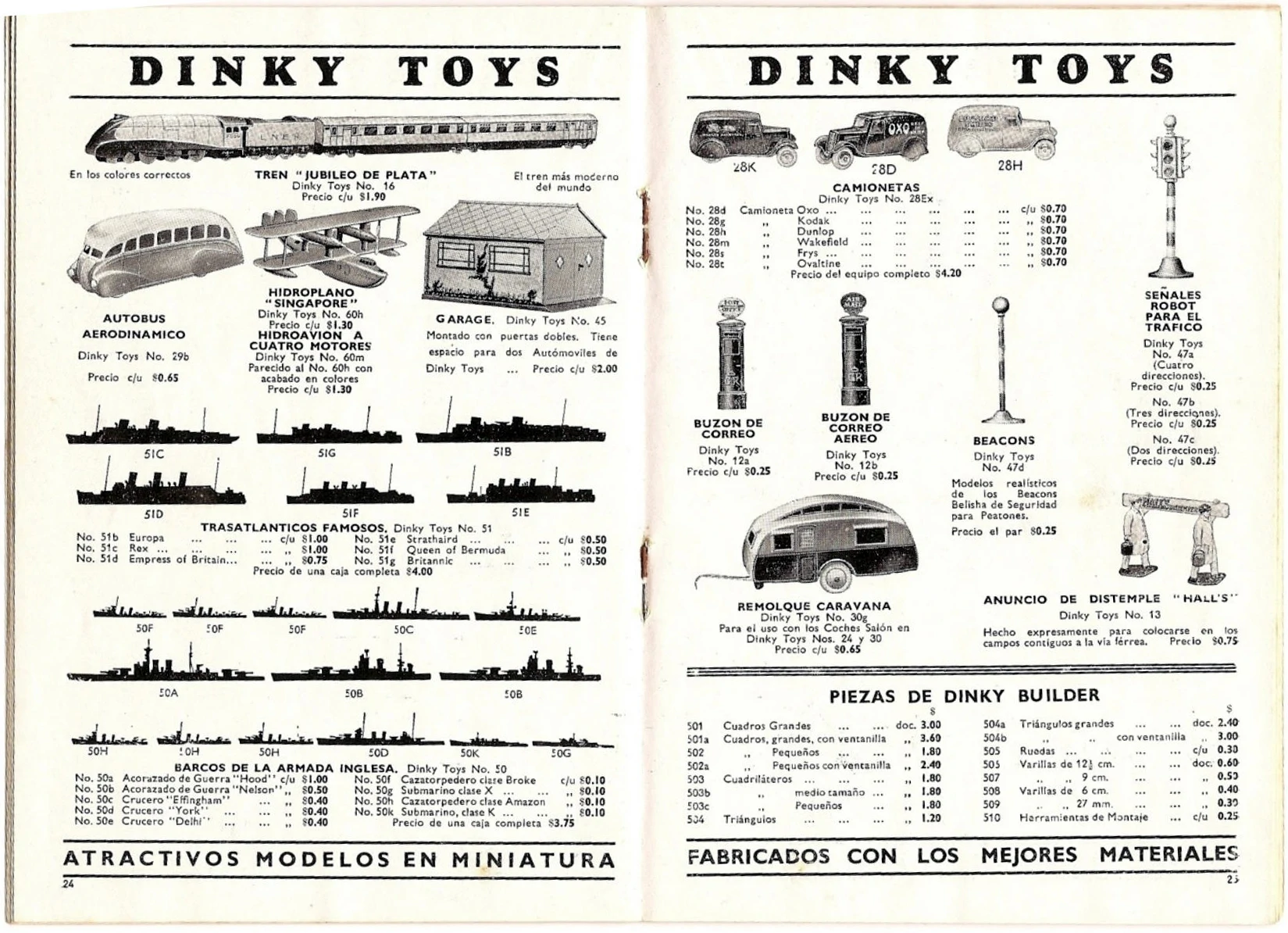
1937 Meccano catalog
The range of Dinky Toys was similar to those of the previous or same year UK issue catalog, with Spanish descriptions and prices in Argentine pesos. The cover was in full color and printed on glossy paper, and the rest of the catalog was generally black and white with an extra color added if necessary.
The 1937 catalog has 50 pages including the covers, and has one page devoted to the Dinky Builder, two pages to Dolly Varden dollhouses and furniture, and six pages of Dinky Toys. It measures 5” x 7”. As can be seen in the pictures above, some of the highly sought after van liveries are shown.
It’s interesting to note that certain Hornby train locomotives and rolling stock were made specially for the Argentine market in red or green colors, with painted lettering of local railroad systems. These items are very rare and much sought after by Hornby collectors.
Meccano 1938 catalog
The 1938 catalog has 56 pages, including covers; one page dedicated to Dinky Builder models, two pages of Dolly Varden dollhouse and furniture and seven pages of Dinky Toys, the new additions being military models. Its size is 4¾” x 7”.
Again, there are special Hornby train issues, this time an addition of a metropolitan locomotive with the lettering F.C.S. (Ferro Carril Sur) or South Central Railways. The other letterings available were F.C.O. (Ferro Carril Oeste) or West Central Railways and F.C.C.A. (Ferro Carril Central Argentino) as shown in the pictures below.
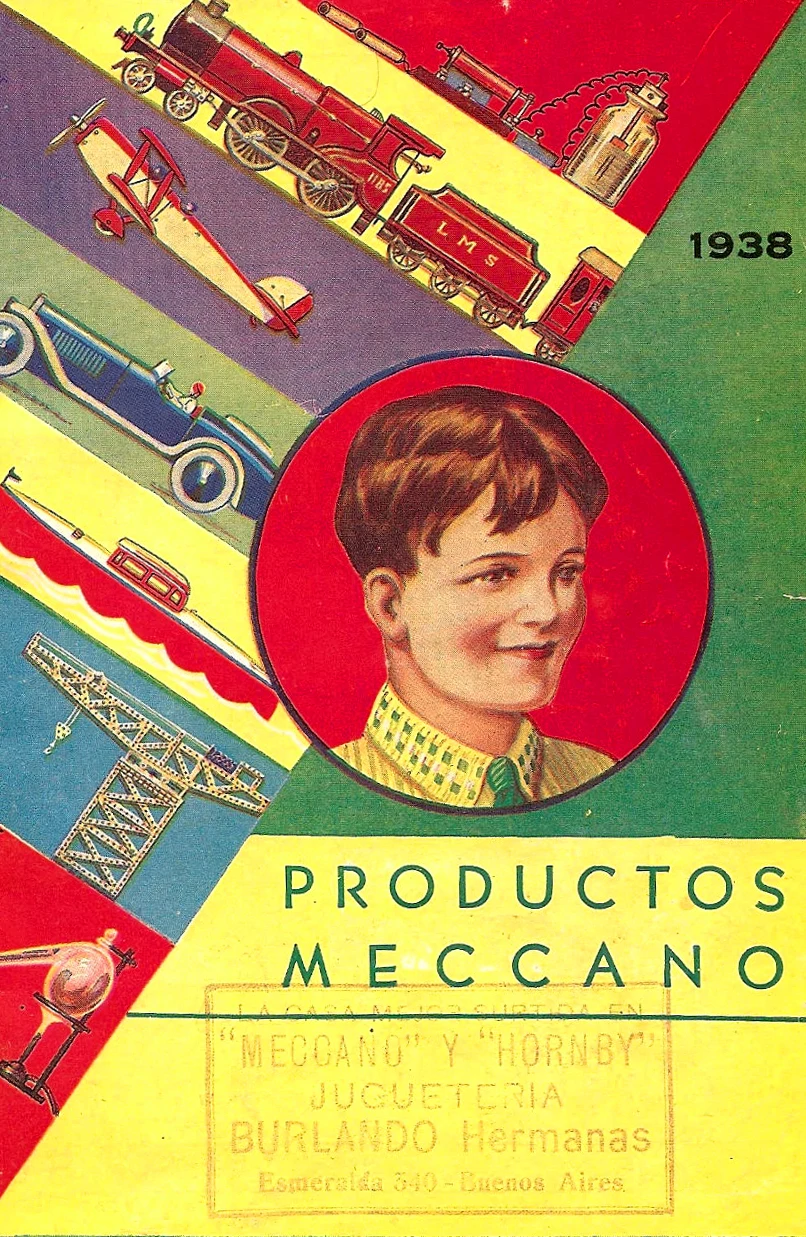
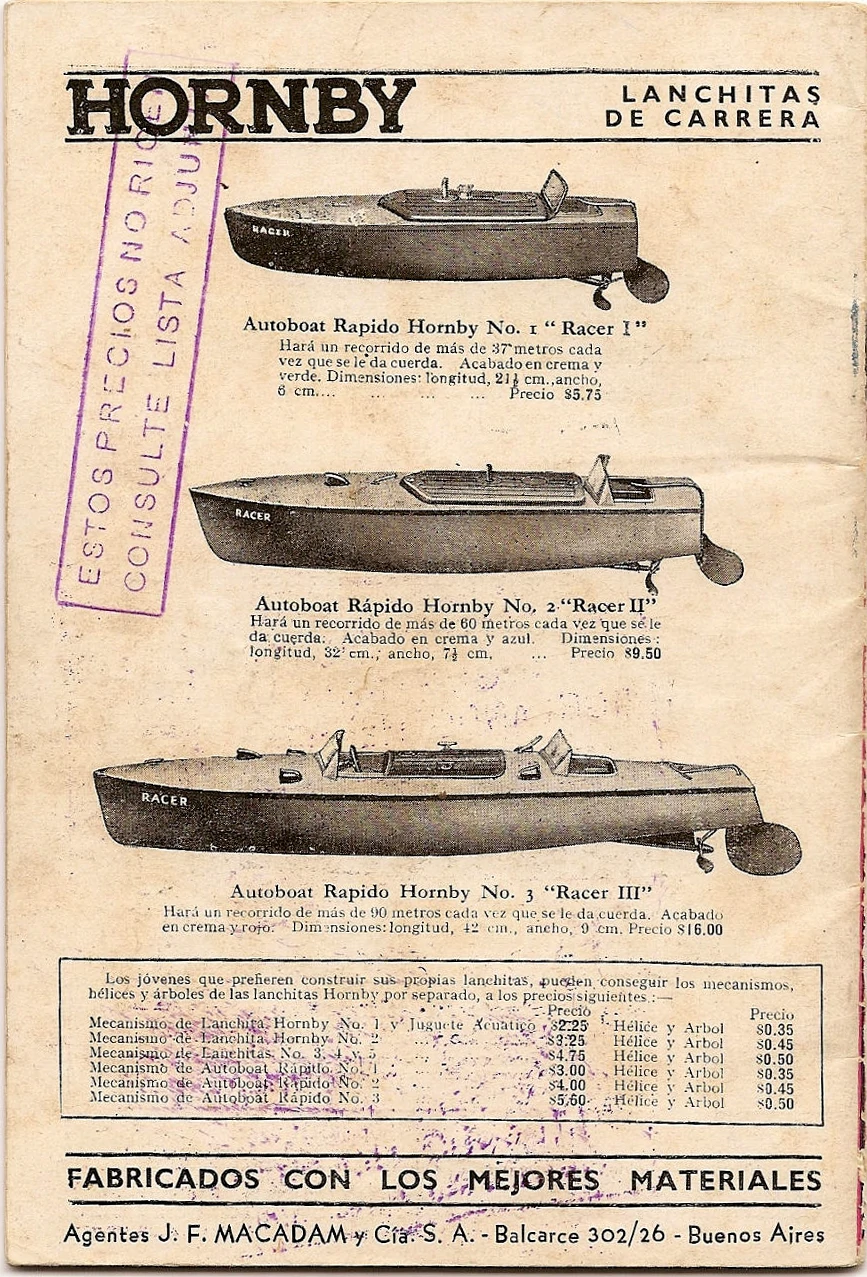
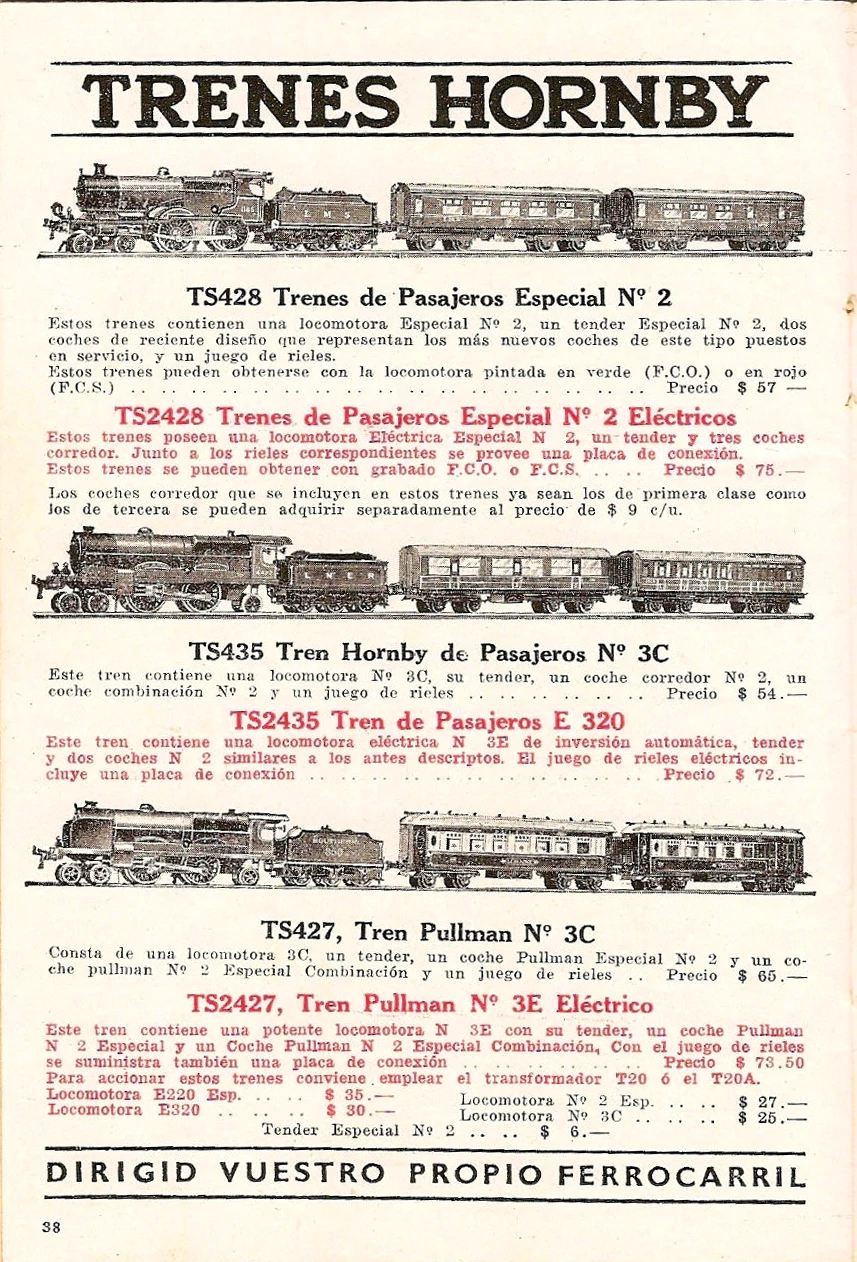
1938 Meccano catalog
Meccano 1939 catalog
The 1939 catalog has 66 pages, including covers; one page for the Dinky Builder, two pages of Dolly Varden dollhouse and furniture, and nine pages devoted to Dinky Toys. The catalog measures 5½” x 8½”.
The new issues were some products of the French Meccano factory followed by a “z” to distinguish them from the British models:
- 60z Airplane set 60z
- 60az Arc-en-ciel
- 16z Diesel train 16z
- 26z Diesel autocar
- 14z Triporteur
- 53az Battleship Dunquerque
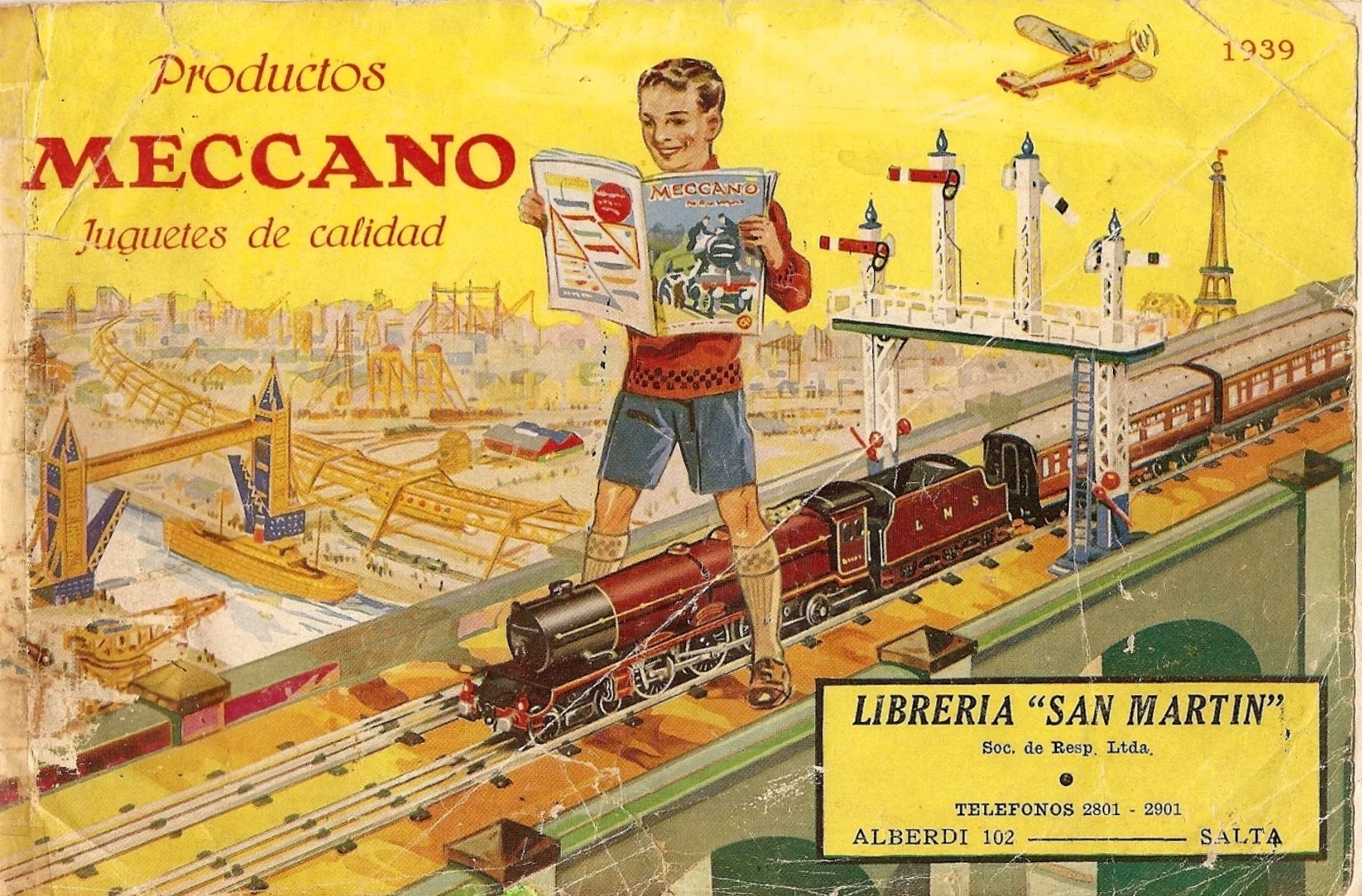
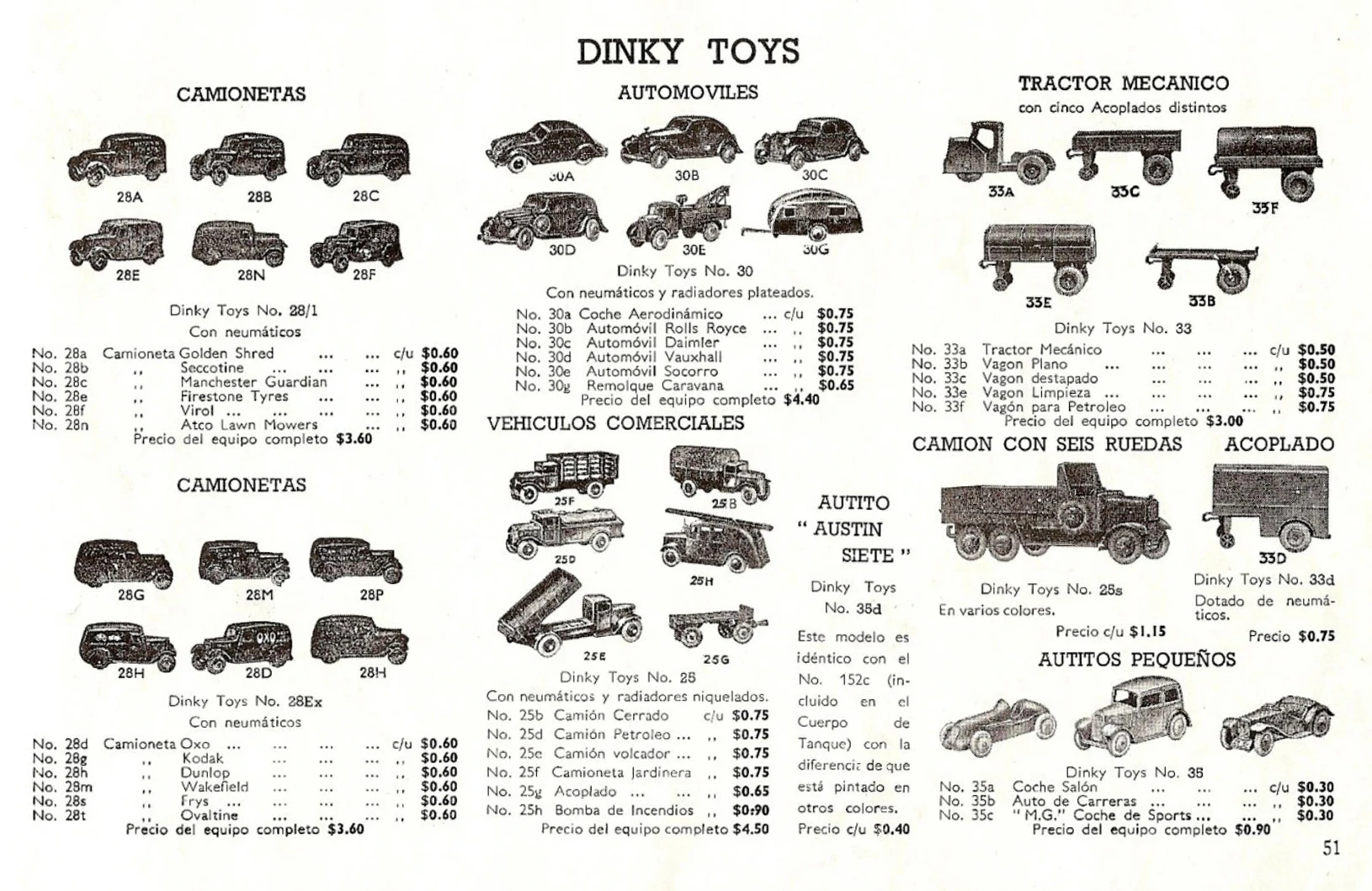
1939 Meccano catalog
Meccano 1940 brochure
In 1940, Meccano issued a separate brochure exclusively for marketing Dinky Toys, as they had increased in number and popularity. This was printed only in black and white duotone, following the 1939 famous U.K. issue. It was designed as a foldout like the 1940 U.K. issue, with 12 pages including covers. Its size when closed is 6” x 9” and 9” x 36” when fully opened. The new items were mostly military models, camouflaged aircraft and vehicles.
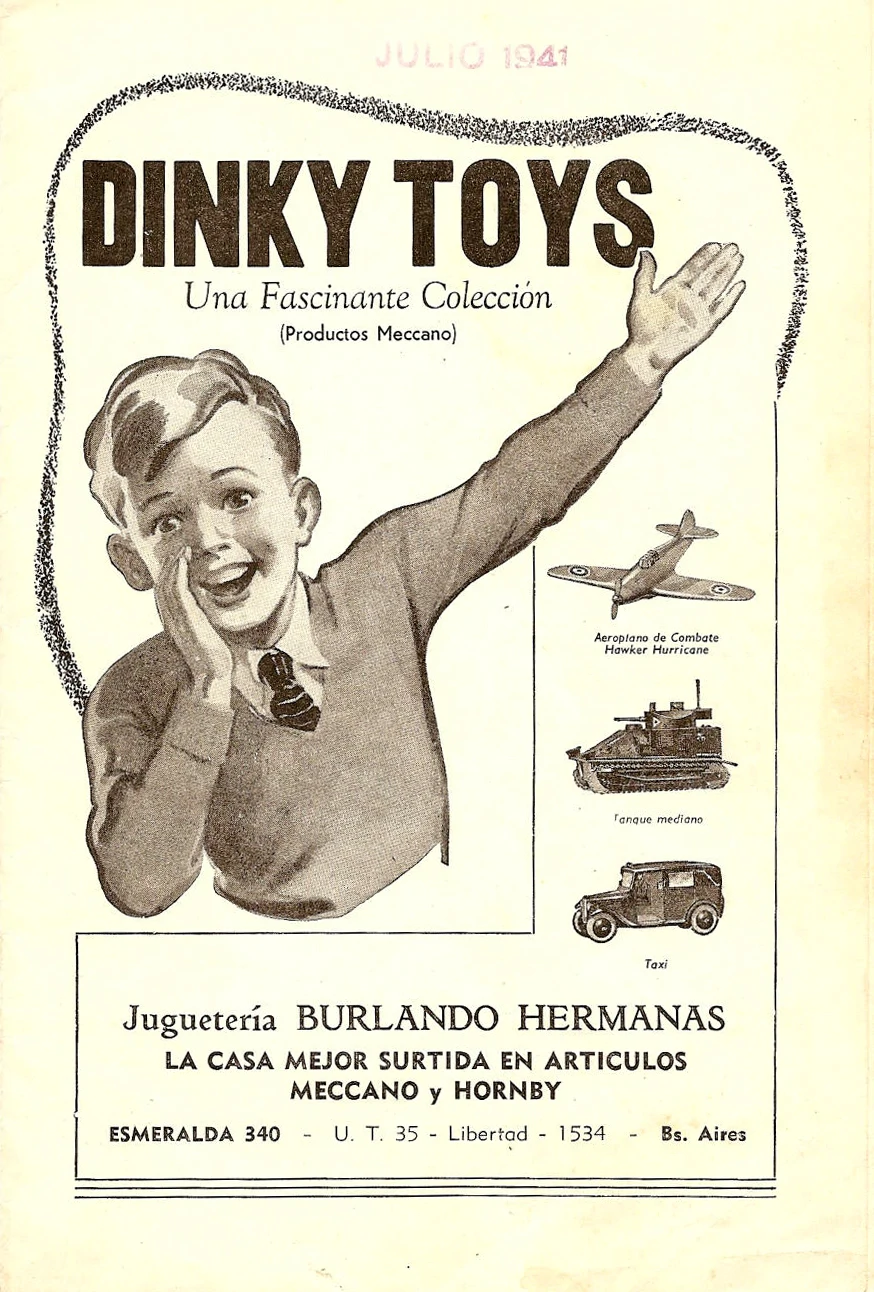
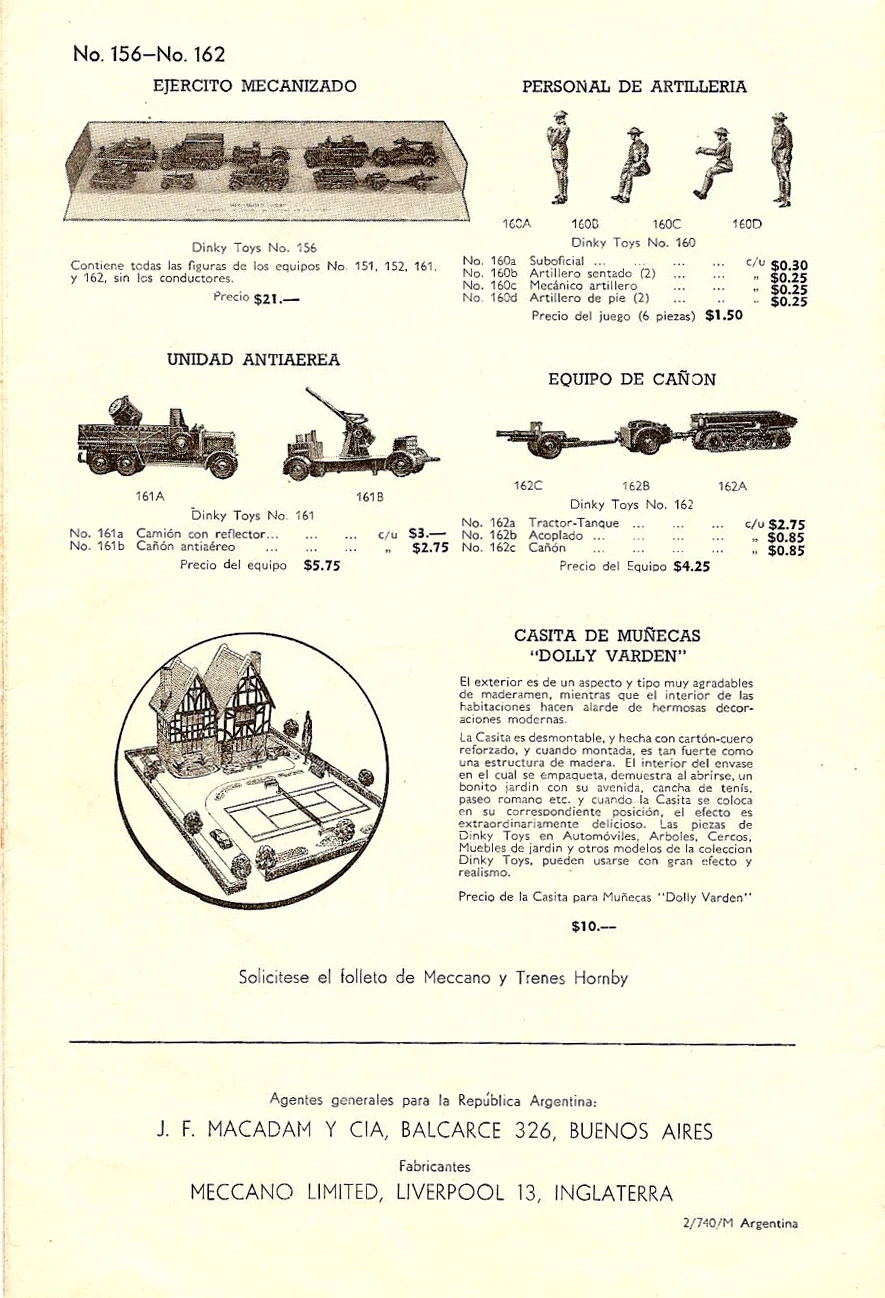
1940 Meccano brochure
The start of World War II stopped production and exports in 1941, as well as literature. It should be noted that the agents for Argentina were J. F. Macadam and Co., located in Buenos Aires. The most well known toy store that specialized in Meccano products and Hornby trains was Burlando Hermanas (“Burlando Sisters”), now defunct.
| Year | Title | Catalog type | Ref. number |
| 1937 | Productos Meccano | General | N/A |
| 1938 | Productos Meccano | General | N/A |
| 1939 | Productos Meccano Juguetes de Calidad | General | 17/738/M Argentine |
| 1940 | Dinky Toys Una Fascinante Colección | Brochure | 2/740/M Argentina |
List of pre-war South American Meccano Dinky Toys literature
About the author
José Heraud is a retired architect who was born in Peru and now lives in the USA. His interests include Dinky Toys models produced during 1945–1963, rare issues, and Dinky Toys research. José has written several articles for many model magazines.