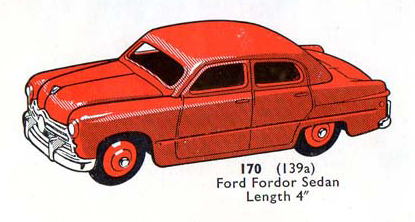
The Dinky Ford Fordor Sedan was produced from 1949 to 1959 in a large assortment of body and wheel colors, initially as #139A and later renumbered #170.
Reproduction of period catalog entry
The humble red model which was produced with maroon (and later red) hubs has always intrigued me because of the well documented factory error variation that sported both maroon and red hubs. I believe this is the hardest variation to find. Here are all three versions of the red Ford Fordor shown from left to right with maroon hubs, red hubs and the factory error model with front maroon and rear red hubs.
Ford Fordor in red with maroon hubs
Ford Fordor in red with red hubs
Ford Fordor factory error in red with maroon front hubs and red rear hubs
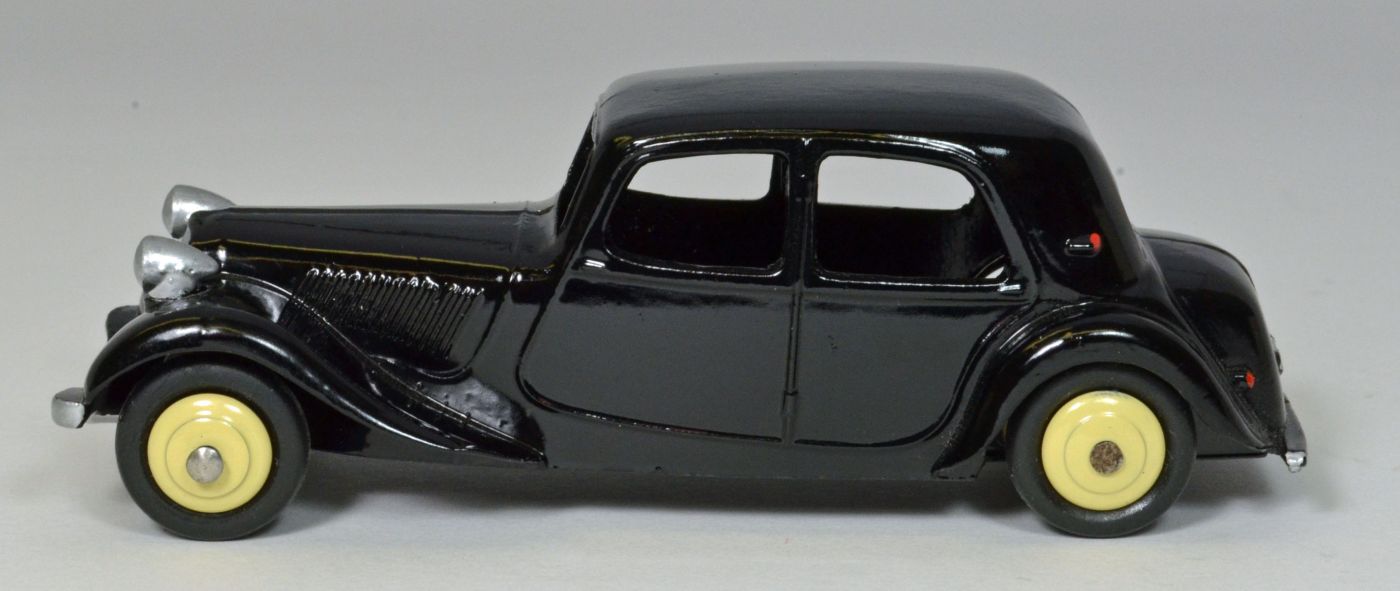
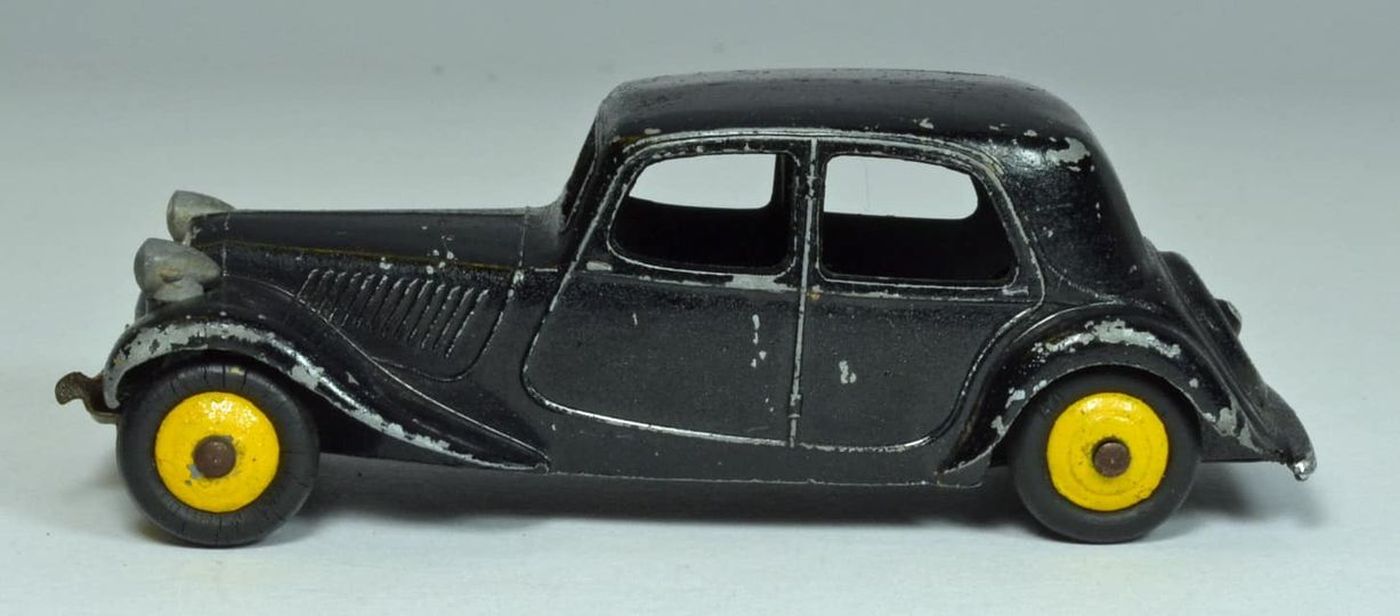
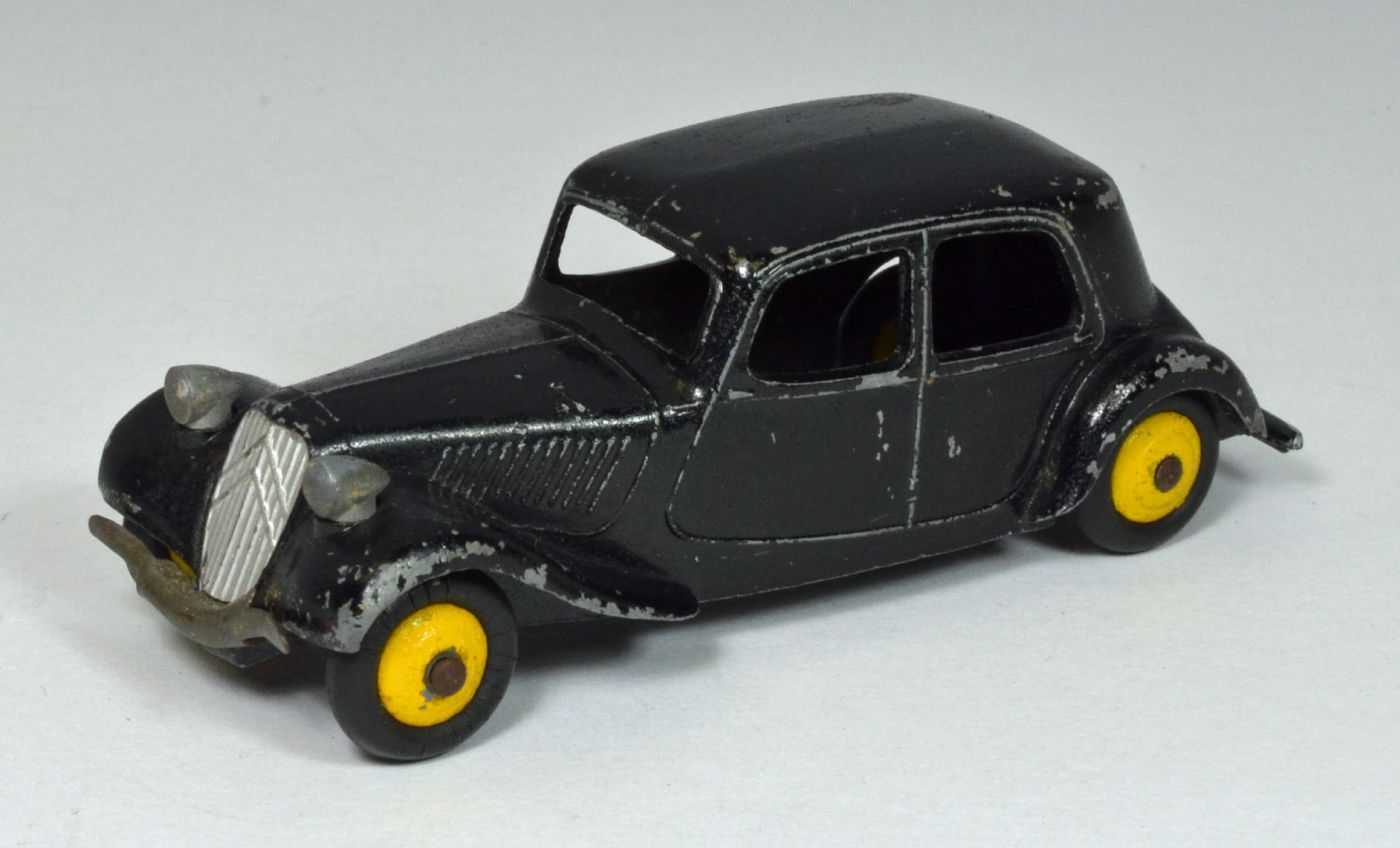
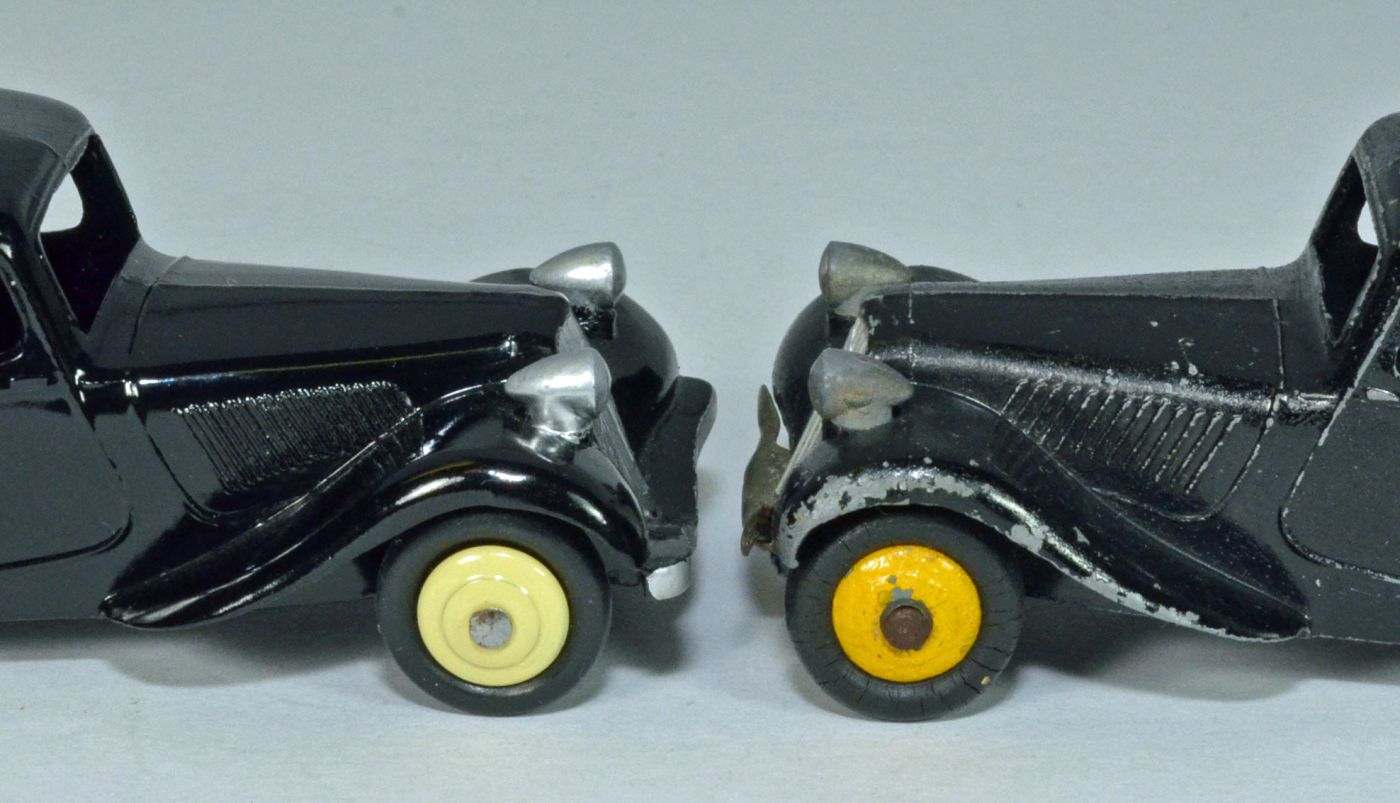
My very first French Dinky Toy was this 24N Citroen 11BL Traction Avant. It wasn’t easy buying it, as I saw it in a local toy store in Southern California, in 1956, and I wanted it right away, but this black beauty was the only one they had left, and it was securely mounted in place on one of those old tiered wooden displays. I asked about buying it off of the display, but they declined, saying it was firmly attached and would be damaged.
I went home and thought about it. I was only 11 years old at the time, and decided I would offer them a plan: I would bring along my dad’s pliers and screwdriver, and offer to remove it myself, and pay the listed price. They agreed to that, and after some fussing, I had my model, albeit with some slight damage due to it being wired down to the display, but I was very happy, as I loved this black Citroen.
Over many years, it became a bit scratched up, so many years ago I treated it to a professional restoration, which turned out quite nice. Unfortunately, the restorer decided to paint those headlight shells silver instead of leaving them plain cast finish, as was original. But no matter, I still love it, and it is a most handsome model in glossy black, and it’s a dear piece from my early Dinky collecting days.
Fortunately, that toy store was really a bookstore in downtown Santa Ana, Ca, that had a basement where they sold the Dinky’s. As a youngster, I frequented them often enough that they got to know me. One of the sales ladies would even let me come behind the counter, open the door to the storage cabinet, and look through their stock of new Dinky’s. I still have my 1953 Dinky Toys catalog from that store. So that store and that model have a great sentimental value to me.
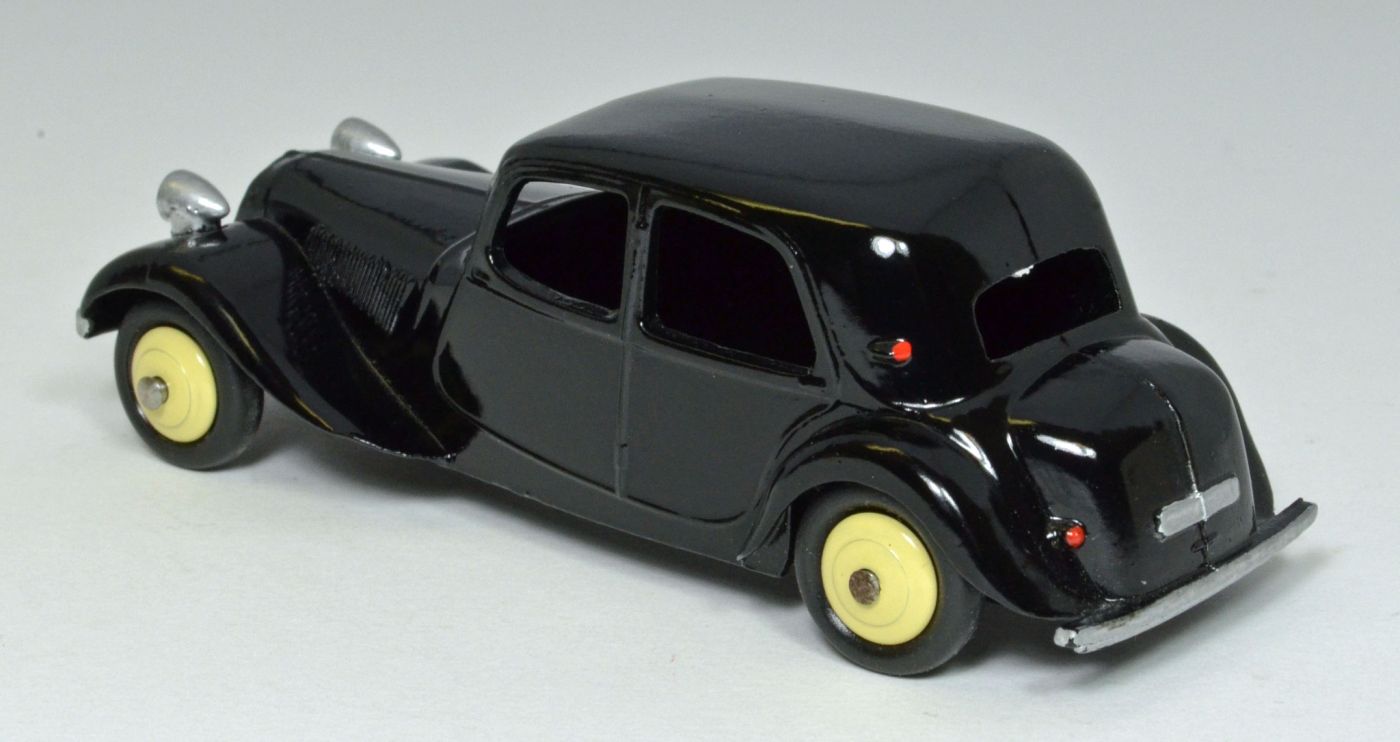
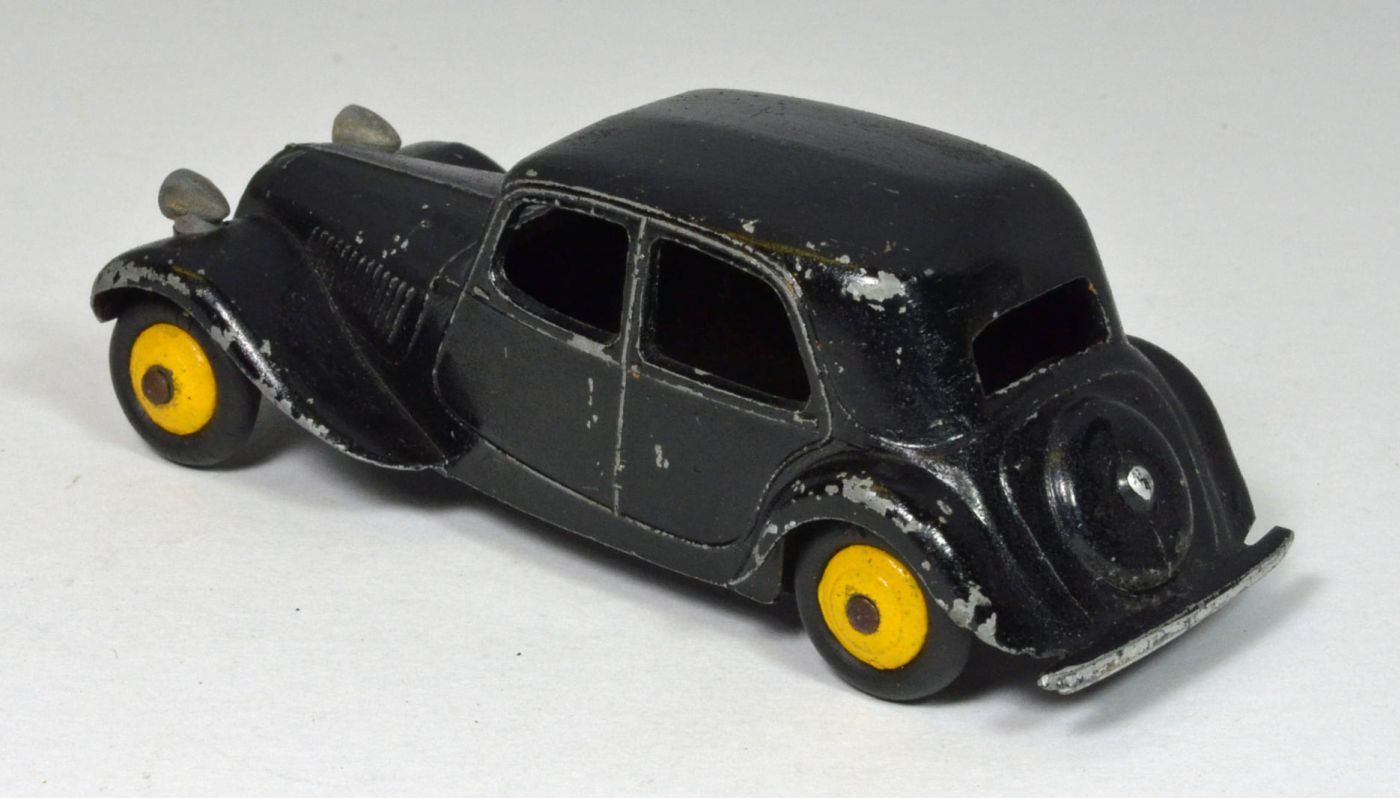
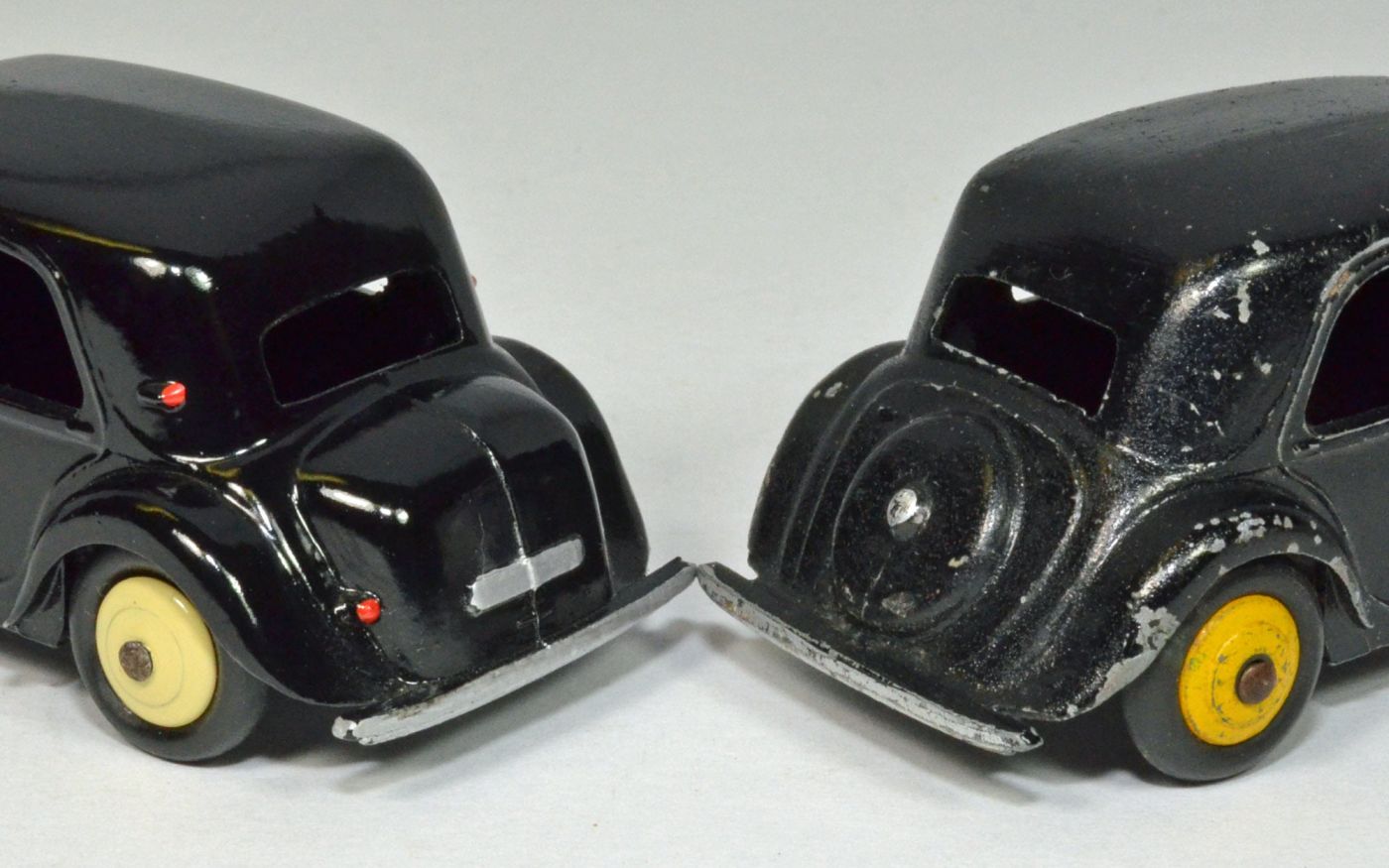
A few years ago, I purchased one of the early, first versions of the Citroen 11BL , in just average condition. This shows the rear boot or trunk area with the raised holder for the spare tire.
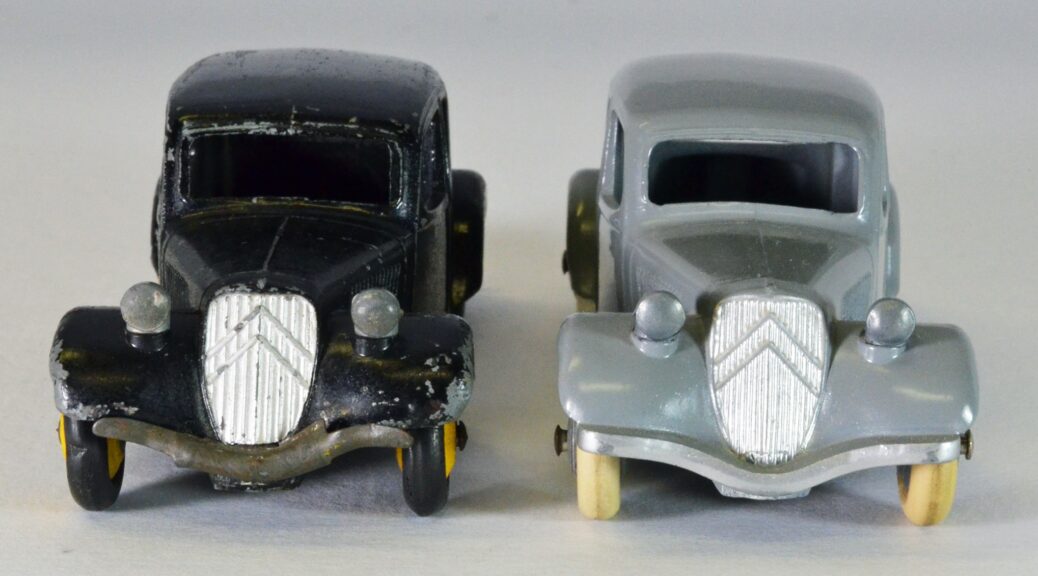
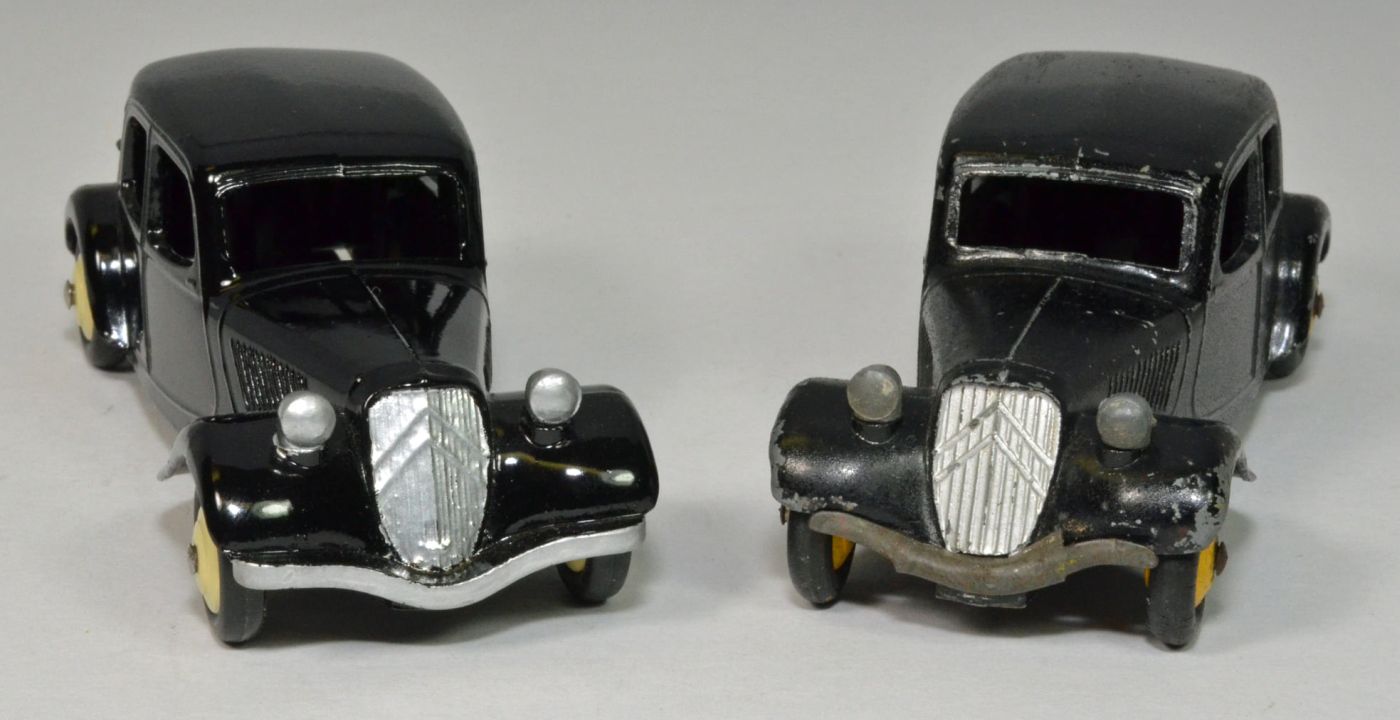
Here are some comparison photos, one showing the different rear boot or trunk areas.
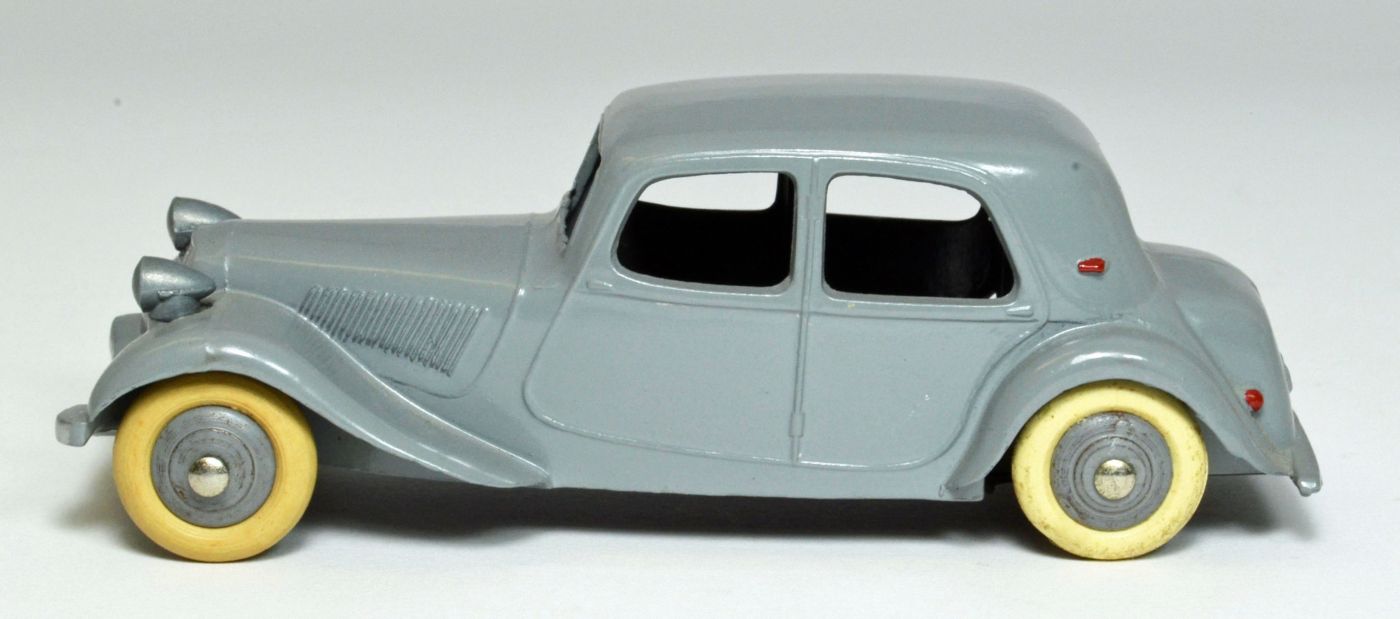
And here is my slightly later grey version: this was the last version made of the Citroen, from the late 1950’s. I bought this one new in 1959, in San Diego. I spotted this one that I had never seen before, and immediately liked it. It was the last version they made, in grey, and I bought it right away, and was also rewarded with the then empty trade box it came in. So I have had this little gem 62 years now, and I still love it, and the French Meccano folks made a lovely casting of it.
Baseplates
One thing that caught my eye in those early days was the baseplates on Dinky cars: they had an interesting finish. Besides the neat stamped lettering on them, they had a curious finish I had never seen before. It looked slightly streaked with lighter strands scattered across a darker background. Years later I learned more about this finish, and also noticed they quit using it around 1957 or so, when they went to a glossy black finish, followed a few years later by a flat black finish.
I did some research and found out that the early mottled/streaky looking finish was called Brunofix, and was a type of blueing applied to metal to provide a protective finish that would resist rusting. Both the English and French factories used this, and it’s impossible to duplicate, so if someone disassembles a Dinky model to refinish it, they often also re-paint the baseplates… which will usually be some form of black paint. So inspecting the baseplate is one quick way to determine if a Dinky model has been re-finished and no longer original.
The image below shows one of these Citroen 11BL baseplates in good detail from my grey version, along with another rear trunk comparison.
Some Historical Background
The real Citroen Traction Avant was designed and introduced in Paris in 1934 and remained in production a very long time, with occasional small changes, being produced again after WWII. In 1949, the French Meccano factory was eager to produce some all-new models, so this famous Citroen 11BL was launched by them in 1949 as well.
In 1952, the Citroen folks made some design changes: the major one being to enlarge the rear boot, or trunk, and place the spare tire inside of it. Dinky apparently knew of this design change pretty early and decided they needed to stay current, so they recreated this most successful model. In doing so, they decided it best to design and make an all-new die.
This new die looks very much like the original, but upon close inspection one will see they not only added the enlarged rear boot, but they also did away with the awkward tinplate bumper, now using diecast, and they also took the time and effort to redesign the front radiator grill, adding more and narrower slats, and also the louvers on each side of the engine compartment were made much small and more numerous, more like the real car.
This new, revised Dinky model was launched in 1953, but used the same model number, 24N. In its new form, this model remained in the French Dinky Toys lineup until the late 1950’s, with colors being mostly black, with grey being used in later models. This model never appeared in a separate yellow box, but was always in trade boxes of six.
Very early on I noticed some of the subtle differences between the French and English Dinkys, but it wasn’t until years later that I learned more about them. However, I did know that I really loved this shiny black French sedan. After 68 years of ownership and being restored, I still love it.
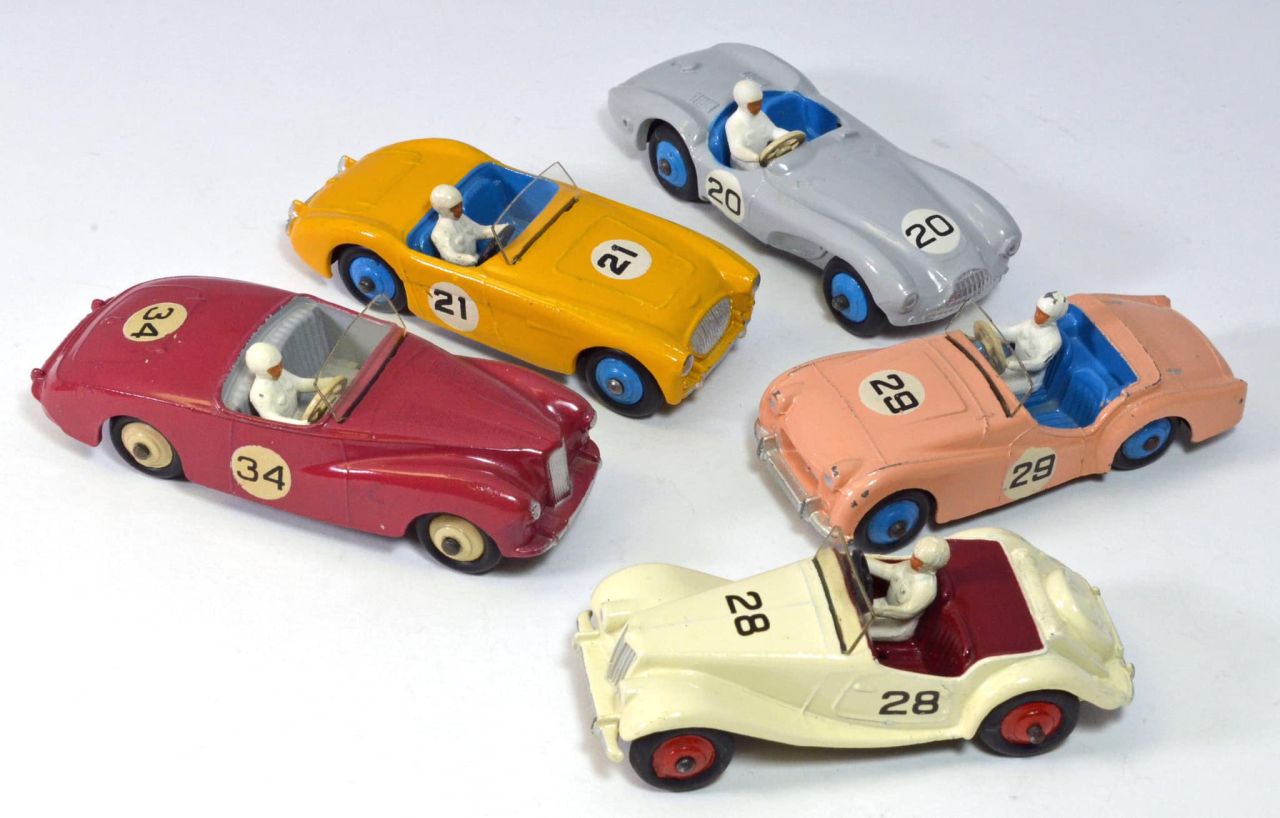
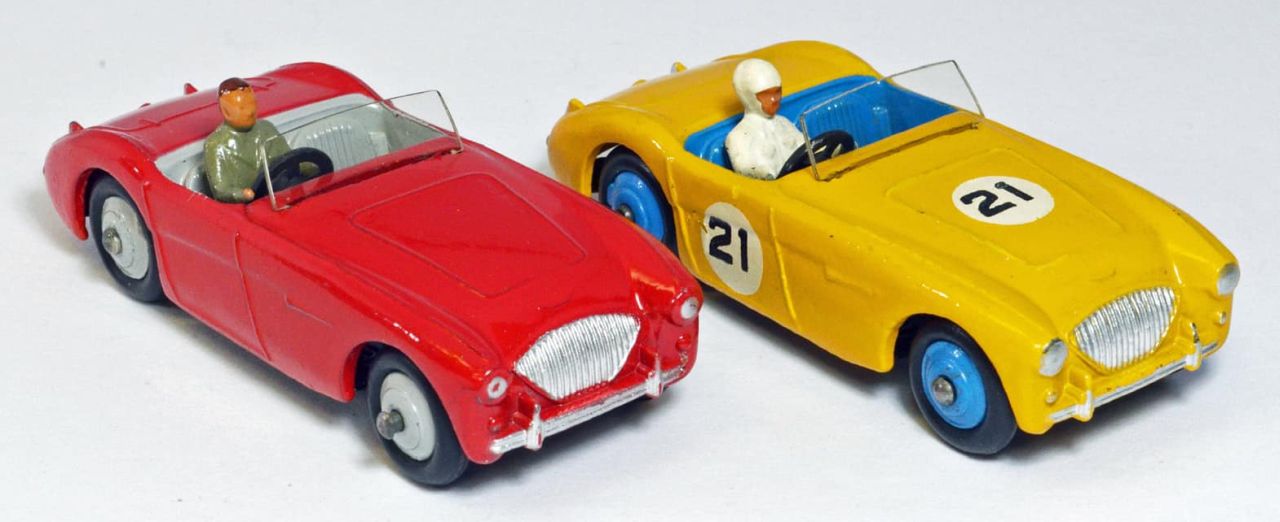
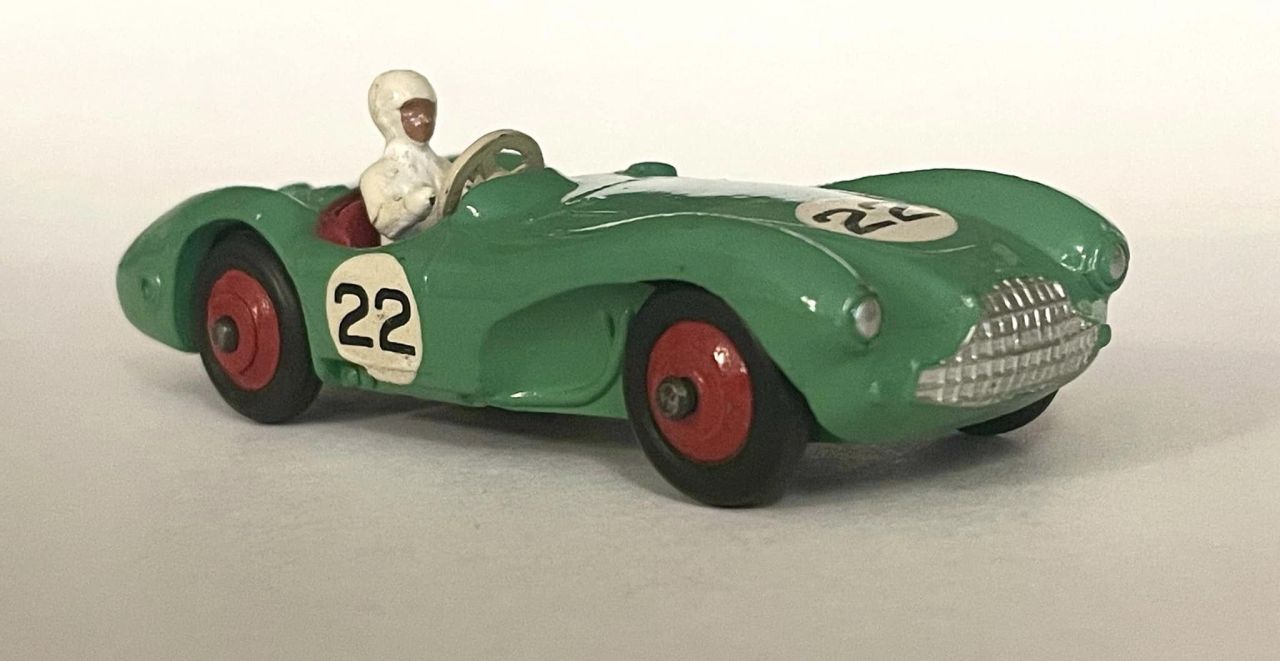
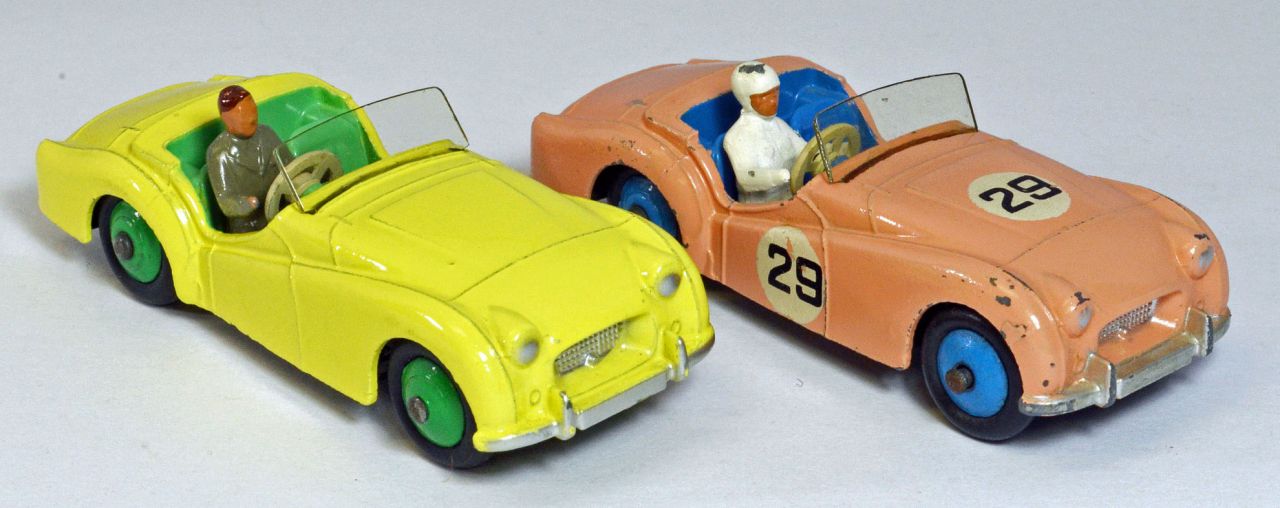
In 1955, Meccano Ltd introduced a new series of Dinky Toys English sports cars, which would prove highly popular, very collectable, and much loved. These would be the 100 series, which at first were modeled as competition cars, complete with racing numerals and drivers clad in a white competition suit. In 1957, they wisely decided to extend the series by offering the same models as “touring” versions without the numerals, and with a civilian driver. These touring versions were : 101 Sunbeam Alpine; 102 MG Midget; 103 Austin Healey 100; 104 Aston Martin DB3S; and 105 Triumph TR2.
These were all offered in two different paint schemes for each model, and were extremely popular. An outlier in this group, and a bit of an oddity, is the 129 MG Sports Car. This was also introduced in 1955, but only as an export model, and it was really an early touring model, created simply by deleting the numerals and the driver, but using the same two paint colors that the competition version came in: white or red. This was only made in 1955 and 1956; in 1957 a new touring version was introduced: the 102 MG Midget, now with a civilian driver, and in a choice of two new colors.
This was a very nice group of English cars, but the inclusion of the Aston Martin DB3S was an odd choice, as it was not a sports or touring car, but an all-out race car. It made sense as a competition model, so when it was decided to offer touring versions, it had to stay in. A more appropriate touring car would have been the Jaguar XK140 Roadster, but Dinky had already introduced the Jaguar XK120 Coupe earlier, so that wasn’t going to happen. These touring models were discontinued in 1960.
In this group photo of the touring versions, I am also showing the red 129 MG Sports Car which was acquired a few years ago with no driver in it.
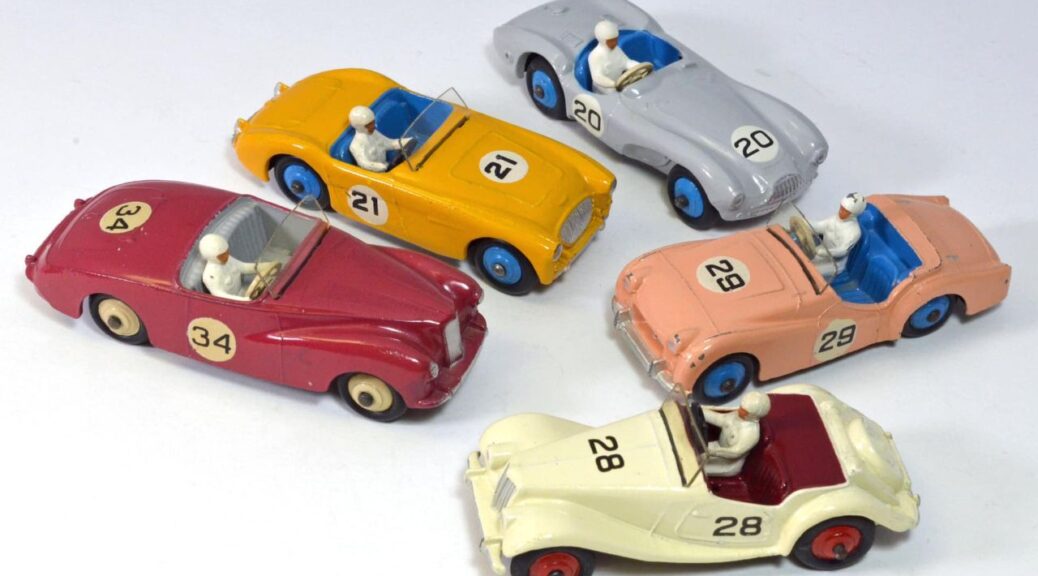
However, I really wanted to show you the original competition cars, made from 1955/6 to 1959, so here they are! All include race drivers and race numbers.
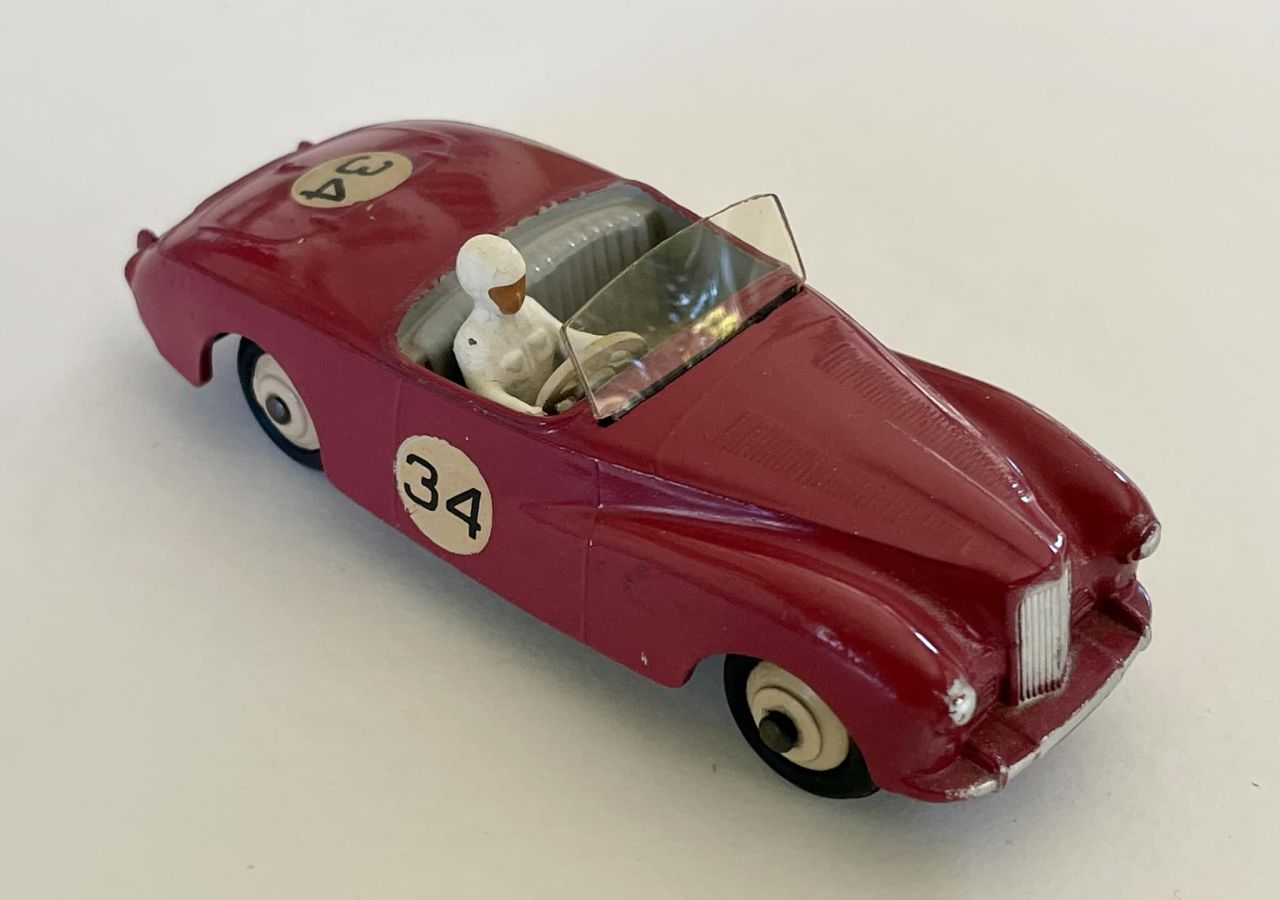
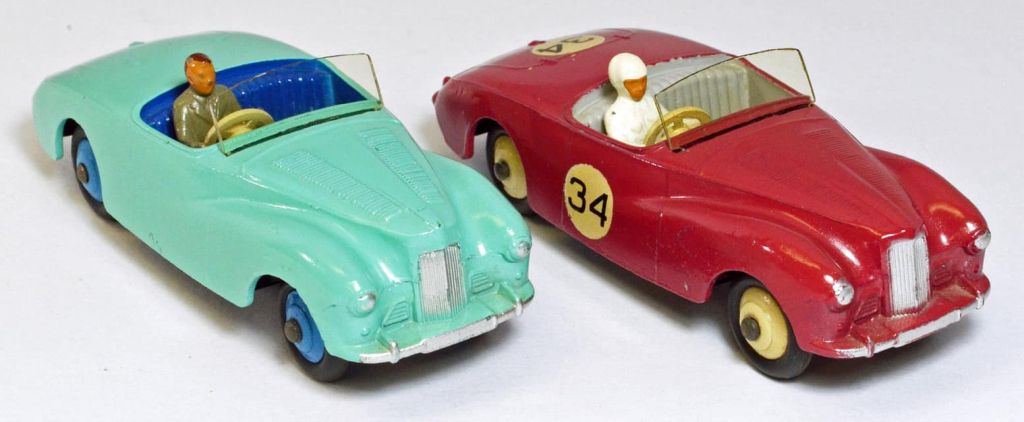
107 Sunbeam Alpine
The Sunbeam was introduced in 1955 and made through 1959. This competition version was also made in light blue. The real car was quite attractive but not made in large numbers. To me, the Dinky model was just ok capturing the charm of the real one, but still a very nice model for the mid to late 1950’s.
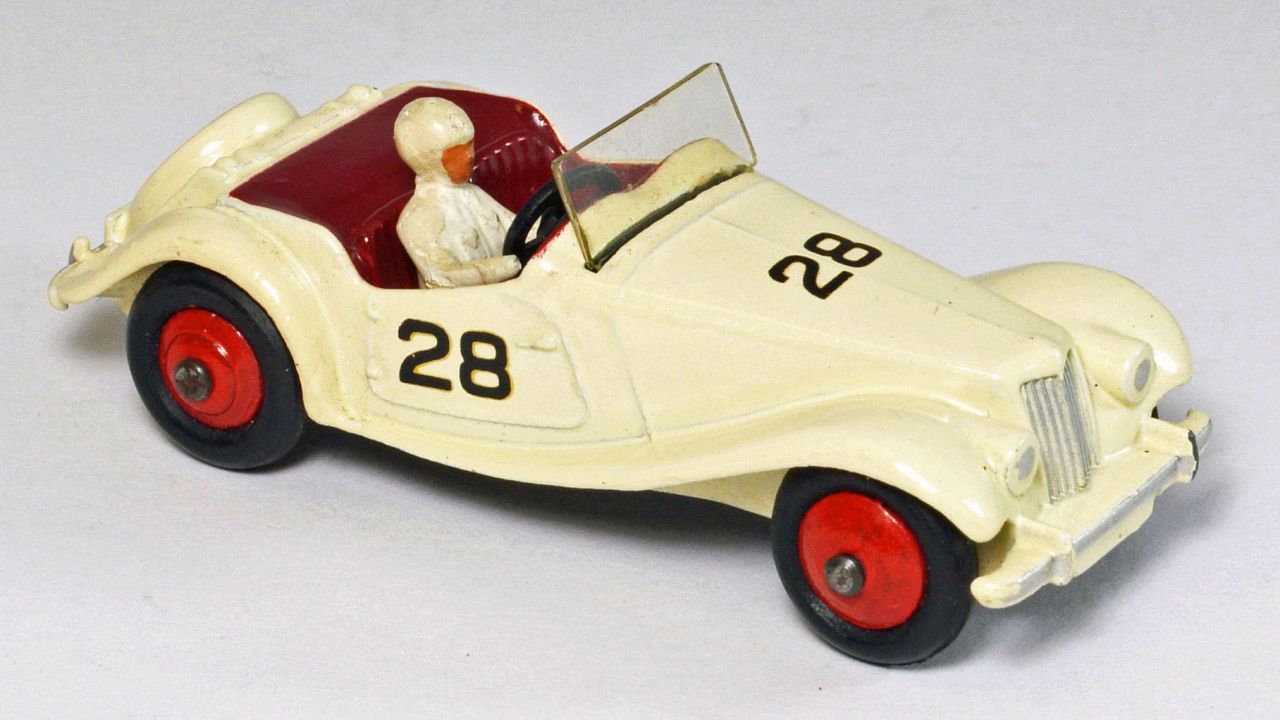
108 MG Midget
This car was also called an MG TF. And this was such a classic English sports car, a descendant of the early post war MG TC, then the MG TD, followed by this one, the MG TF. So this was a perfect model for Dinky Toys to make, and I am quite sure it was a popular model and sold well. I got my first example around 1957, and it was just like the one I am showing: the white competition model. But that one got a bit scratched up, so as a young boy, I decided to paint it a dark blue. It stayed that way until about 10 years ago, when I decided to have it painted one of the touring colors.
109 Austin Healey 100
One of my favorites in this series. Dinky did a masterful job with replicating this well known and popular English sports car. Note that the touring driver is really a completely different casting.
110 Aston Martin DB3S
When the DB3S was first introduced as part of the competition series, that made sense, as the Aston Martin was being campaigned in sports car races all over the world, and was very well known and highly regarded. When Dinky chose to reissue all of these cars as touring models, this became a bit of reality stretch, as it was really an all-out racing car, and few, if any, were ever driven as tourers. Nonetheless, it made a nice model, and Dinky did a nice job with it. I happen to have three of them: one tourer, and the two competition versions.
110 Triumph TR2
The TR2 was a very popular imported sports car to the USA in the mid-1950’s, and a very nice sport car in its own right. My pink one shown here dates from around 1959, and shows a bit of play and handling wear. I have to admit this pink color isn’t my favorite for the Triumph.
A year of two after the introduction of the competition cars, Meccano wisely decided to broaden the series by offering the same models in new colors as touring cars. Both these sets of cars proved to be very popular then, and even now they are favorite collectibles for many people.
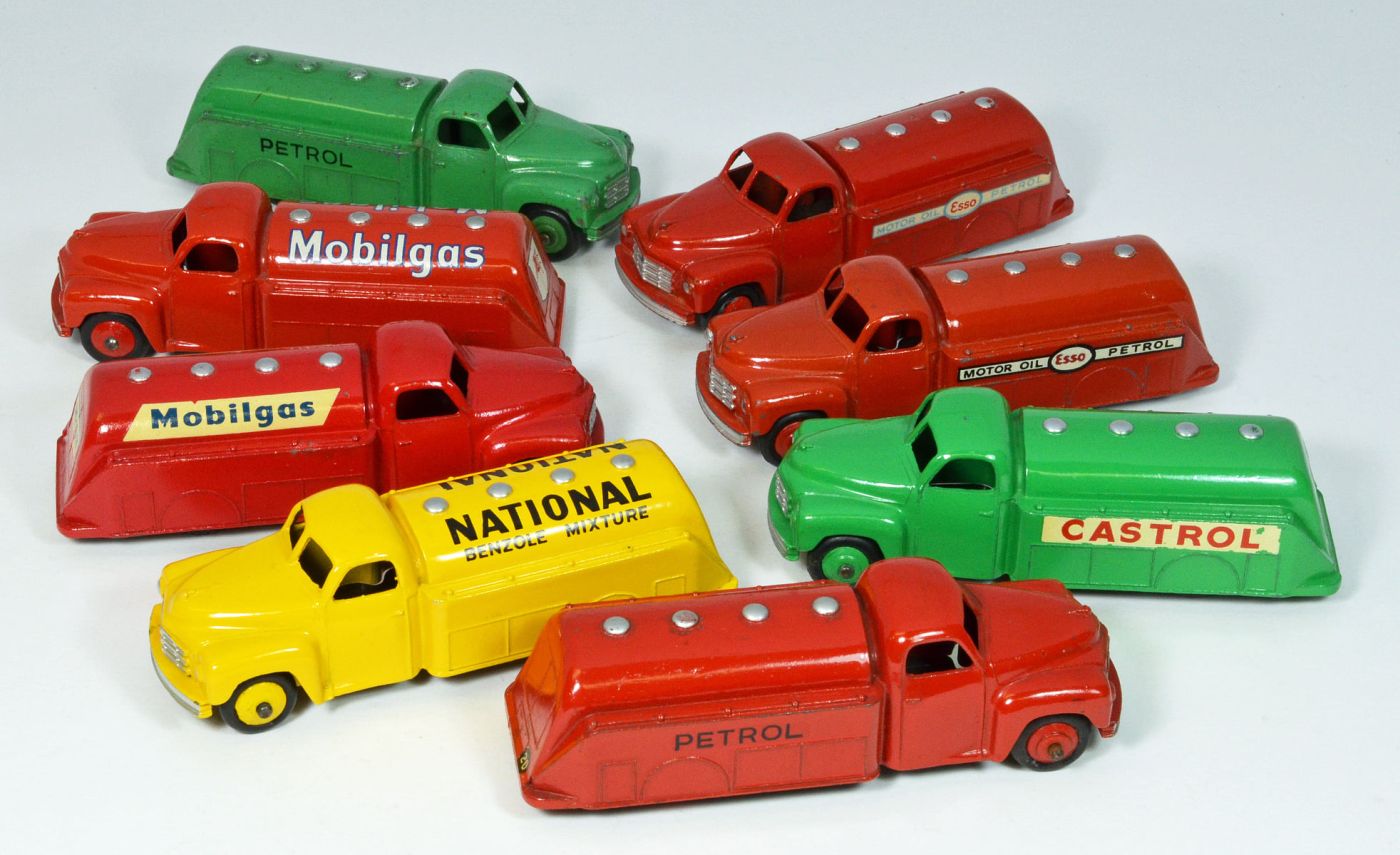
The Dinky Toys Studebaker Tanker was extremely popular, and made for a very long time, in a variety of liveries. This model was based on the newly introduced Studebaker truck line in 1949, and Meccano brought out the first Dinky Toys version in 1950. The first edition 30p was only labeled Petrol, followed by the very popular Mobilgas in 1952.
Subsequent liveries were Castrol, Esso, and National Benzole, which followed the later numbering system of 440/441/442/443. The last one made was the modernized Mobilgas livery, which was made through 1961 or 62, so another very long run of production.
This was an extremely well done model, and due to its small size, very easy for young boys to carry around in their pocket. Due to its very long life, lots of these were made, and should be somewhat available even today. Here are all the various versions made.
Not seen very often is the first version, released in 1950 as 30p, in the plain Petrol livery. Made until 1952, it was available in both red and green colors. I happen to prefer this nice red version.
Starting in 1952 the Castrol and Mobilgas versions appeared. These little trucks were very popular, and remained until 1960, using the later Mobilgas decal. One of the earlier ones, in Castrol livery, is resplendent here in a nice shade of green.
The early Mobilgas version was my first one, and still a favorite. Dinky did a very nice job replicating this one, from around 1955.
Shown below is the later version of the tanker Mobilgas. In many ways, Dinky tried to stay current and made changes over time. Thus, Dinky chose to update the graphics. This was quietly put into the marketplace and was never shown in a catalog, nor was the illustration changed on the box. Probably made from 1958–1960, when it was finally discontinued. These later models also came with treaded tires instead of the original smooth type.
Here is the Esso livery with light blue “robin’s egg blue” color on the logo surround. Its companion version has the darker blue logo surround.
It proved quite a challenge trying to find a photograph of a real Studebaker 2R Tanker, but I did manage to acquire a brochure of their truck line, which has a nice illustration of the tanker. You will notice that the tank area on the rear is a little different: the tank on the Dinky doesn’t appear to be as tall as the real one.
One of the last versions was the National Benzole Mixture tanker, finished in bright yellow. Like all yellow painted Dinky Toys, the yellow paint is subject to easy chipping and clearly shows those too, so finding a real nice one is great. Most of the yellow paint seems applied heavier, so it will cover the casting. Heavy coats of paint, when dry, seem more vulnerable to chipping.
Meccano experimented with using aluminum in the 1950’s, and they did make some of the Studebaker tankers out of it. In 1951 after this tanker came out, Dinky switched over to aluminum for some of the Castrol and Esso versions (David Busfield, Model Collector, February 2018). Aluminum did not work out and they switched back to diecast zamak (mazac).
Model Collector, Feb 2018
Aluminum was also used on other Dinky Toys: for the trailer of the Pullmore Transporter and also the Horse Box, plus the well known Avro Vulcan jet. I seem to remember reading using aluminum was hard on the dies, due to the higher melting point.
Some time ago fellow collector, Steven Ira Goodstein, lamented the lack of more recognizable liveries with the Studebaker Tanker. Well, some time ago I had a friend who did restorations take a spare model (it had quite a bit of wear) and used his imagination to create a Shell version. So here it is, a Code 3 Dinky that never was.
Why do we collect? Of course there are many reasons, but I think a prime motivator is being able, as a “grownup”, to obtain something that was scarce when you were a child.
Maybe you grew up in early postwar Britain, when “export or die” meant there weren’t many Dinkys in the shops. Maybe your family just couldn’t afford relatively costly toys. Or, horribly, maybe your parents gave away your Dinky Toys when you left home.
Born in 1956 in San Francisco, I got hooked on Dinky Toys at a young age. Dinky models just seemed more “crisp” and durable to me than their upstart competitors such as Corgi. At that time, however, I had no inkling of the fact that Dinky Toys would become steadily harder to get in the United States, eventually becoming almost unobtainable.
Dinky Toys had been distributed in the U.S. since 1938 by H. Hudson Dobson, which most readers will already be familiar with. (See Terry Hardgrave’s article at this site). H.H.D. did its utmost to contribute to the great postwar export push. Famously, various prewar models were reissued especially for the U.S. market, others were recolored for the U.S., and — most important — Dinky Toys were freely available in the States. Thanks to a great performance by H.H.D. salespeople, Dinkys could be found not only in toy and hobby stores, but also in department stores, gift shops, and even bookshops.
While Dinky never quite became the household name that it was in England, it dominated the diecast market, at least until Matchbox and pre-Corgi models made their appearance. Dinky Toys were advertised in national publications such as Life and Boys Life (the latter a magazine received by U.S. Boy Scouts). And I have attached a screen capture I made from the introduction to “Gumby,” a popular children’s program from the 1950s: this was not an early example of “product placement,” but simply a reflection of what toy cars the producers readily found in a local shop.
At the end of 1960, unfortunately, H. Hudson Dobson closed down. Exactly why is unknown, but at this time, its founder would have been of retirement age. Whatever the reason, Meccano Ltd. stumbled badly as a result: Rather than again finding a reliable national distributor (as Matchbox and Corgi had done), it appointed five different regional distributors for 1961.
Further increased to eight in 1961, these regional distributors did a poor job, probably because Dinky was only a minor sideline for most of them. The Northern California distributor, for example, was Keyston Brothers, a venerable supplier of upholstery supplies that still exists today.
I’ll never forget when, as an already committed Dinky collector at the age of five, I was told by my local toy shop in Palo Alto that they just could no longer get Dinky Toys. Giving my mother and me a 1961 catalogue, they could only suggest that we appeal to Keyston Brothers directly.
Image: Vectis Auctions
During this bleak time, Dinky Toys were “closed out” by many shops, since they could no longer get supplies. For my sixth or seventh birthday party, each guest received an unboxed Dinky — these were the final stocks that one shop had sold my mother out of their display case. And while Dinky Toys were never intended to be discounted, shops slashed prices to clear out their leftovers; this explains why collectors today find models from this period whose boxes are marked with dollar amounts lower than the official price.
Eventually, in 1963, Meccano Ltd. contracted with A. C. Gilbert to distribute Dinky Toys in the U.S. Display cases bearing the Gilbert logo and Dinky name were created, and a pared down range appeared primarily in department stores such as Sears, Roebuck, Inc. My illustration shows a Gilbert display case that I own today and have populated with the entire 1963 product line.
To enhance the time-travel qualities of this display, which originated in a family-run toy shop in Illinois, I provided each model with a price tag showing its 1963 price.
This display case is from the year 1963, when Gilbert briefly distributed Dinky Toys in the U.S.A. They offered a reduced range of models — strangely omitting some that would have done well, including the U.S. school bus — and as you will see from the price list, I have loaded the display with each one (except for two small airplanes, one of which I do not own).
In practice, of course, a given toy shop may not have stocked every model, or they may have had additional Dinky Toys in stock obtained from previous distributors. But this makes for an interesting look at the Dinky range in the year before the Lines Brothers takeover (and gradual introduction of bloated 1/42nd-scale models).
But, just like Meccano Ltd. itself, A.C. Gilbert was financially troubled, so the arrangement did not last long. U.S. distribution was taken over by Lines Brothers after it purchased Meccano Ltd. in 1964. Relics of this time include special four-page U.S. catalogue leaflets, new-style store displays, and the hated (by me, at least) “VisiPak” boxes (first in gold and then in yellow).
Unlike H. Hudson Dobson, Lines Brothers did quite a poor job of selling models to independent toy and hobby shops. Probably because of a reduced sales force, it preferred to deal mostly with the buyers for large department stores such as Macy’s, Marshall Fields, J.C. Penney, and Frederick and Nelson. That may have been fine if you lived near one of these establishments, but even then frustration could ensue. (I grew up bicycling distance from a Macy’s at Stanford, Calif. that never had any Dinkys, whereas another Macy’s in San Mateo had them but was frustratingly out of reach 13 miles away.)
Meanwhile there was a parallel distribution effort for Mini-Dinky and the “big six” American cars produced in Hong Kong. Some shops had these models but no other Dinky Toys. (Of course, these products would presumably have come directly to the U.S. without ever passing through Liverpool.)
Dwindling availability and the Visi-Paks made the phrase “Lines Brothers” an epithet to me and my best friend, another avid Dinky enthusiast. They made less and less effort to sell Dinky Toys in the U.S.A., and the 1966 Dinky catalogue was the last to be printed in a specific U.S. edition until 1973.
In 1968, Lines Brothers did succeed in selling six different Dinky Toys in quantity to Post Cereals. Tantalizing an otherwise Dinky-starved public, the models were made available for $1.00 each, provided mothers could be persuaded to purchase two boxes of sugar-laden cereal. (This is how I obtained the Saab 96 I still have today.)
In Northern California during these bleak years, acquiring new Dinky Toys required a pilgrimage to the San Francisco branch of F.A.O. Schwarz (a chain that, I suspect, purchased its offerings directly from Meccano Ltd.), which had just a few models. I was also able to buy Dinky Toys during two different, fondly remembered family visits to British Columbia.
Of course, I was fortunate enough to have plenty of other toys in my life to play with, such as Matchbox models, Marklin model trains, and G.I Joe dolls (Action Men) — all freely available during the 1960s. But since Dinkys were so hard to find, each one I could find was put on a pedestal – or at least a secure bookshelf.
Dinky Toys would gradually return to the U.S. market following the 1971 collapse of Lines Brothers, thanks to new national distributors — Covell Management and then AVA International. However, their availability would only ever be a pale echo of the marque’s 1950s heyday. (As a result, if you find a Yank who has even heard of Dinky or had any of the toys as a child, he is likely to be well over 60.)
Also in the early 70s, my personal horizons widened in the form of my first visit to the U.K., plus the discovery of “Memorable Things,” a mail-order shop in Maryland whose owner obtained Dinky Toys directly from Liverpool and Bobigny. The latter would lead to fascinating discoveries of unknown Dinky Toys, since Lines Brothers had not imported French models to the States.
Eventually, I’d be able to study in Britain and even to visit Binns Road itself. But by then, the die had long since been cast (sorry!). Dinky Toys had gained a holy grail status that, for me, they’ve never lost.
My Ten Best Dinky Toys
I appreciate almost all Dinky Toys, but here is my selection of ten favorite models. You’ll notice a certain American bias, as well as the fact that most of them hail from the early 60s. These for me were Dinky’s golden years, because the models had become more detailed — with features such as suspension and steering — but hadn’t yet bloated into 1/42nd scale.
1 — 178 Plymouth Plaza
Released in 1959, this is the model that made me a Dinky collector. My family had moved to Oak Park, a Chicago suburb where one of the local taxi companies was Blue Cab (it still exists today). They employed Plymouth Plaza cars in — yes — two-tone blue.
When I saw the Dinky in a shop, by chance replicating the exact car and color scheme, I naturally had to have it. My mother kindly fashioned a taxi sign to glue to the roof.
On one of our mother-son walks, this time on State Street downtown, I spied a mobile billboard advertising a burlesque show. It consisted of a slowly-driving truck fitted with picture windows at the back, behind which stood two or three scantily-clad women. I cannot even find a Google image to prove that such a thing existed, but it did — and as family legend has it, I threw a tantrum, demanding “I want a Dinky of that!” My mum did not, however, find me any bathing beauties to glue to my Guy Warrior flat truck, another early acquisition!
Image: Vectis Auctions
2 — 265 Plymouth USA Taxi
Meccano Ltd. itself soon realized that the Plymouth Plaza would make a fine taxi, and I have to lavish another choice on the result. Nicely updated in 1960 with interior and suspension, this model is beautifully finished, and takes one right back to the New York of “Breakfast at Tiffany’s.”
Image: Vectis Auctions
3 — 258 Ford Fairlane Police Car
If in 1962 you were an American child with any Dinky Toys at all, you probably had one of these. I know I and several of my friends did. With its shiny finish, antenna, and red beacon, it was just about perfect. The fingertip steering made it easier to chase the bad guys around the floor.
My only complaint was the two-door body style, since all the police cars I had seen featured four. I was unaware of the earlier De Soto and Dodge Royal versions of #258, since they had already disappeared from the shops.
Image: Vectis Auctions
4 — 181 Volkswagen Beetle
An older, simpler model — but again, I had to have one early on, since the Beetle was America’s most popular imported car. The Dinky version was affordable and durable, just like the real thing. No wonder the model was produced until 1969 – perhaps it would have endured even longer if Meccano Ltd. had been able to enlarge the rear window (as Wolfsburg had done in 1958).
Image: Vectis Auctions
5 — 949 Wayne School Bus
Based in Indiana, Wayne was one of America’s leading manufacturers of school bus bodies. It probably paid Meccano Ltd. to produce this extremely accurate model, which represents the company’s “Super Custom” body installed on a rear-engine “pusher” chassis.
Once again this was one of my earliest Dinky Toys, and I still consider it one of the most pleasing and accurate ever made. But perhaps many children did not want to be reminded of school, and avoided the model? It was only made from 1961 to 1964, and Gilbert did not offer it as part of its pared-down 1963 range.
The later “Dinky Continental Tours” version seems particularly unrealistic, since these school buses were spartan and not geared for high speeds. However, vintage illustrations show that Wayne at least tried to market a luxury version.
Image: Vectis Auctions
6 — 275 Brinks Armored Car
Meccano Ltd. collaborated with the Brinks company to produce this model, which was eventually produced in U.S. and Mexican promotional versions as well as the standard article. I consider it “peak Dinky” because it offers both realism and play value, yet it is still in scale with older models.
Yes, the opening side and rear doors are a little flimsy. But along with the two crates of “gold” that were included, they provided the ideal means for the Armored Car to be “robbed” over and over.
Image: Vectis Auctions
7 — 448 El Camino Pickup and Trailers
Here, Meccano Ltd. missed an opportunity to work with one of the big American hire companies such as U‑Haul. Perhaps they had a deal planned and it fell through. “Acme” was a feeble name to apply to the box trailer, since it inevitably reminded children of the fictitious products used by Wile E. Coyote to attack the Road Runner on Saturday morning cartoons.
Despite the unrealistic branding, I badly wanted one of these sets, since trailers like the ones modelled were so common on American highways. I never found one as a child, but have made up for it since!
Image: Vectis Auctions
8 — 137 Plymouth Fury Convertible
In the early 60s, the American automotive scene featured huge V‑8s, convertible tops – and drastic styling chances every fall. Meccano Ltd. released this model of a 1963 Plymouth Fury Sports in October of the same year, at which time the 1964 versions were already appearing in U.S. showrooms.
It hardly mattered, though, because the Dinky – mercifully still very close to 1/43 scale – is so evocative and cheerful, with its removable top. It comes in several different colors, of which I like the pink best. (I’ve never cared much for the revamped #115 version, however, because its white color is bland and the wheels seem too large.)
Image: Vectis Auctions
9 — 263 Superior Criterion Ambulance
An ambulance is a key part of any child’s collection. My first Dinky ambulance was actually the French #556 Citroen; I also had the Corgi #437 Cadillac, which had pipped Dinky to the post in 1962 (by a few months at least) by including working flashing lights.
My favorite ambulance, however – and in my opinion one of the top Dinky Toys ever – is the Superior Criterion. This is an exceptionally accurate model of a 1961 Pontiac with its customized body, so different from the ordinary vans that are used as ambulances today. Meanwhile, the opening rear door, driver and passenger, and patient-equipped stretcher provide a textbook example of “play value.”
For the variations collector, this model is one of the most challenging Dinky Toys. The plastic interior was made in five different colors, while the sides can be marked by one thick red stripe, two thin stripes, or no red paint at all. Also, the “bullet” lights at the front and rear became joined up as the result of tooling wear.
10 — 434 Bedford TK Wrecker
Everyone also needs to have a tow truck. My first was actually the classic #430 Commer, but this was replaced in 1964 by the more modern-looking Bedford TK, which I have preferred for my top ten because it represents the time period when Dinky Toys were becoming so hard to find – and also because it acts as a stand-in for the other excellent TK models Liverpool produced.
Lines Brothers does seem to have imported the first “Top Rank” version to the U.S., since these turn up in the gold or yellow Visi-Pac export boxes. As a child I was unaware of it, however, and had only the more generic “Auto Services” version.
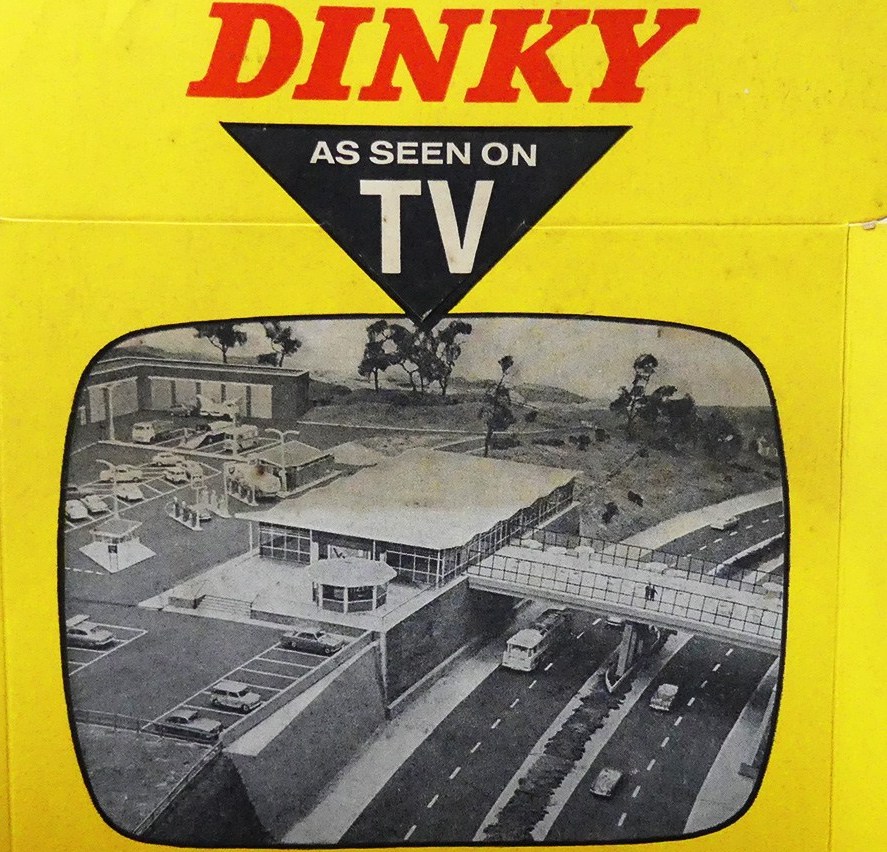
Today I much prefer the “Top Rank” livery, so evocative of the early days when motorway travel seemed exotic and glamorous. Incidentally Dinky used this model for a miniature motorway services area, created for one of its only advertisements. This advert was never seen in the States – do any UK readers remember it?
It is common for us collectors to look back on our favorite Dinky Toys, as I did elsewhere on this site with my own “top ten” list. Not so happily remembered, though, are the Dinkys that never should have come out of Binns Road.
Over its long history, Meccano Ltd. produced such a wide range of models that not all of them can please everybody. Personally, for example, I don’t really collect airplanes, boats, dolls house furniture, garden implements, the Gerry Anderson space toys, or even military models, since none of these would blend with ordinary cars and trucks on my tabletop layouts (real or imagined).
But all of the above ranges deservedly have their fans, and they all have “play value.” Even Dinky’s Ogle-designed “Convoy” trucks that collectors dislike were a well-meaning effort to produce affordable pocket-money toys for young children.
In contrast, there are Dinky Toys that in my opinion never should have been made. They are low in play value, they mostly represent vehicles that did not exist in real life, or they were pathetic attempts to wring more sales out of existing tooling.
Sadly, it is no coincidence that these models began to appear after the takeover of Meccano Ltd. by Lines Brothers in 1964. They multiplied after the sale to Airfix in 1971.
Ultimately, enough “never shoulda” Dinky Toys appeared that it was difficult to keep this list of stinkers down to a mere ten. When you look at any of these, you’ll ask yourself “what were they thinking?”
In the order of their release, here’s my selection:
1 — 485 Santa Special Model T Ford (1964)
By the standards of what would follow in later years, this model is a masterpiece. But it belongs in the “hall of shame” because it is the first Dinky Toy that was a fantasy model, with no real-world counterpart.
Image: Internet
Dinky’s 475 Model T Ford was a belated attempt to complete with Lesney’s Models of Yesteryear and Corgi’s Classics. Judging by the number of mint-and-boxed samples that survive today (in their horrible VisiPak boxes), it does not seem to have been a good seller.
Poor initial sales of the Model T may have been why Meccano Ltd. quickly enlisted Father Christmas and his plastic bag of toys for a redecorated version. The Meccano Magazine suggested that the model would become “the centerpiece of not a few table decorations.” Perhaps so, but this unfortunate confection certainly never appeared on any self-respecting model highways or railroads!
2 — 617 V.W. K.D.F. with P.A.K. Anti-Tank Gun (1967)
I’ll concede that this Dinky Toy is an acceptable model of a vehicle that actually existed, though it is a Kubelwagen, not a KdF (the latter was actually an early Beetle). But the key to why I despise it can be found engraved on the base: “Battle Lines.”
Image: Vectis Auctions
This model – along with its companion, the 615 U.S. Jeep with 105mm Howitzer – was designed as part of a separate range of 1/32nd scale military models. I’m guessing the Battle Lines toys were originally created at Lines Brothers’ offices in London, then forced on Binns Road to be awkwardly incorporated into the Dinky line.
While the 1/32nd scale had plenty of precedent for military models, it made for oversized, ugly Dinky Toys. In my opinion, Dinky’s latter-day military offerings were spoiled by the confusion of different scales offered, making these Battle Lines models an ugly sign of things to come.
3 — 157 BMW 2000 Tilux (1968)
I wavered over this selection because I think the idea of creating a model car with working indicators was a great idea, with lots of play value. (BMW was an odd marque to choose, though: Real BMWs don’t actually have working indicators, do they?)
Image: Vectis Auctions
Unfortunately, in its haste to make room for a battery and light bulb – these were the years of the ongoing “first again” battle with Corgi – Dinky created a painfully bloated model. (The Mercedes 250 they produced with working stop lights is almost as bad.)
The body’s being cast in two halves is awkward and just adds to the bulk. The two-tone paint merely emphasises the split. I think the model might have looked slightly better in the all-over blue and red colours that were advertised but not issued.
Regardless, they should have gone back to the drawing board on this one. The French Dinky 534 BMW 1500 shows how a model of this same basic car should have looked.
4 — 111 Cinderella’s Coach (1976)
Not to mince words, the Cinderella’s Coach is in my opinion the worst Dinky Toy ever made. Even the Happy Cab (see later) isn’t quite this bad.
Image: Vectis Auctions
This is a model of a “real” vehicle, but its merits end there. The coach appeared in The Slipper and the Rose, a musical version of the Cinderella story that was a Royal Variety Command Performance selection in March 1976.
Apparently the Queen Mother was (per Wikipedia) a particular fan of the film’s music. Meanwhile, Meccano Ltd. had prepared its model in advance and was somehow convinced it would be a big success. (Were there drugs in the Liverpool water?)
The coach was on the cover of the 1976 Dinky catalogue and treated to a full page inside. Further, the back of the model’s special box featured stills from the movie as well as the storyline.
The model itself is almost all plastic, with a few ugly dabs of paint (either green or gold) on the horses. Unlike most models of a coach and horses, the nags stand on a piece of plastic “pavement” that has little supports underneath. It’s a very strange design.
It would be interesting to know what sales figures were achieved for this model!
What goes for the Coastguard Amphibious Missile Launch also goes for its sister model, the 677 Armored Command Vehicle — I simply dislike the boat the most! Both toys were designed in early 1973 as models of vehicles that were supposed to appear in a new Gerry Anderson TV series called The Investigator.
Image: Vectis Auctions
Dinky had a lot of success with other Gerry Anderson vehicles (Thunderbirds, UFO, etc.), so it rushed to create the Investigator Car and Investigator Boat so they could be released as soon as the program aired. Unfortunately, The Investigator, which was about two American children who were miniaturized by an alien in order to fight crime on Earth, was never broadcast.
Left holding the bag, Meccano Ltd. decided to recoup its investment in the tooling by releasing the Investigator models in a generic form. The Armoured Command Vehicle would be released in 1976 and promoted by Dinky as having been designed by Gerry Anderson (it was actually designed by Reg Hill). The Coastguard Missile Launch was released later, without mention of any Anderson connection.
The pilot film for The Investigator — seen only decades later via home video — featured a jet powered boat that featured wheels, but not any obvious weapons. Dinky added a missile launcher to the front of its model anyway, obviously anticipating plot developments that were never to take place.
For its revamped Coastguard Amphibious Missile Launch, Dinky simply changed the colors of the previously planned toy, adding “Coastguard” labels and a driver figure. I guess the end result does have play value, but shorn of any Anderson context, it’s an unrealistic and absurd model.
6 — 354 Pink Panther’s Jet Car (1977)
Dinky’s Pink Panther car is a plastic monstrosity, but that alone wouldn’t have earned it a place in the hall of shame. After all, this was a model of an actual, fully functional car that was used in the opening credits to the Pink Panther TV show (shown on the BBC in the UK). Apart from not having a flywheel protruding from the roof, the car really did look like this.
Image: Vectis Auctions
As Chris Jelley conceded in his Meccano Magazine writeup, the flywheel motor was not calculated to please “a few of the older, serious Dinky collectors.” But, it had plenty of play value and made this the fastest Dinky ever. (It’s fortunate for shins and skirting boards that the model wasn’t made of metal, as originally considered.)
So why then did Meccano Ltd. delete the flywheel in 1977, taking away most of the model’s appeal? The resulting miniature was shaped more like its prototype, but Binns Road ruined it by adding decals with a cartoon figure on the roof and Pink Panther labels on the sides.
Adding insult to injury, packaging for this later version called the toy a Jet Car — confusingly, a trademark used by Norev for its own diecasts at the time — and omitted any mention of Dinky. The Dinky Toys name was also deleted from the base of the model. It would be interesting to know why these branding changes occurred.
7 — 361 Galactic/Zygon/Space/Missile Firing War Chariot (1978/1979)
During its mercifully short life, this vehicle really did have four different names. it was first known as the Galactic War Chariot, then morphed into Zygon, Space and Missile-Firing War Chariot versions.
Image: Vectis Auctions
Meccano Ltd. cobbled this model together from a variety of existing parts, which I am indebted to Kevin O’Neil for detailing. For example, the Galactic War Chariot uses a modified 355 Lunar Rover chassis, repainted astronauts, 102’s Joe’s Car turbines reversed as jet engines, wheels from the 226 Ferrari Racing Car, and the missile firing mechanism of the 363 Shado Mobile!
In 1979, Dinky adopted the name “Zygon” for its space toys, claiming it as a trademark even though it had previously been used as the name of an alien race in Doctor Who episodes. The Galactic War Chariot, now fitted with plastic wheels and a different missile firing mechanism, became the Zygon War Chariot.
According to O’Neil’s Dinkytvspace.com website, there are seven known variants of the Zygon War Chariot, since it can have different colours for the chassis, astronauts, missile launcher, and jet engines. However, in my opinion even one variant is more than enough for any collection!
A rare third version of this model — known as the Space War Chariot, according to O’Neil — was released during the dire last days, after Binns Road had run out of proper boxes for its toys. Supplied in a plain brown box, it has a blue and white chassis, and either two white spacemen, or one white one and one red one.
Finally, the tooling was shipped to Italy, where the model was made in the blue-and-white colour scheme and featured miscellaneous types of spacemen (or sometimes none at all). Mysteriously, this final Missile Firing War Chariot version was supplied on the same type of flimsy blister pack as the Hong Kong-produced Big Cat Jaguar. Both have the same odd “Dinky Toy” logo and no further trademark or manufacturer information.
To say the least, it is an odd business practice to produce toys in Italy, then have them shipped all the way to Hong Kong for packaging. It’s no wonder that Airfix would wind up going into receivership in 1981!
8 — 201 Plymouth Stock Car (1979)
During its last year, Dinky was desperately trying to create “new” models with a minimum of investment. With its range of “customized” toys existing tooling was dressed up with larger wheels, stickers, and plastic add-ons.
Image: DB Collectables
All the customized Dinkys are pretty dire, but at least the Corvette, Ford Transit, Land Rover, and Range Rover could have existed in real life. But this use of the Plymouth Gran Fury casting, which like the others was treated to oversized wheels and tires, is completely unrealistic because no NASCAR stock car ever had four doors.
Either Meccano Ltd. thought (wrongly) that children wouldn’t notice, or they were simply beyond caring at this point. Either way, this model is just embarrassing.
9 — 367 Space Battle Cruiser (1979)
“Space is big, big business,” or so a 1979 trade fair leaflet for Dinky proclaimed. But – maybe partly because of The Investigator debacle – Meccano Ltd. did not see the need to keep paying licensing fees to Gerry Anderson. Instead, the cash-strapped toymaker decided to create its own generic space models.
Image: Vectis Auctions
The first of a series was the Space Battle Cruiser, capable of firing two rather oversize “Trygon” missiles. This bears a strong resemblance to Gerry Anderson designs but is not identical to them.
As noted on DinkyTVSpace.com, a plastic “Starcruiser 1” kit released by Airfix around the same time did credit Anderson. It included an Interceptor model quite reminiscent of the Space Battle Cruiser.
The Space Battle Cruiser’s nicely illustrated box touted as a foe the 362 Trident Starfighter. This black lump of metal had one spring-loaded “Stellar” missile at the front and two more dummy missiles on its wings.
The Trident Starfighter deserves special infamy because a special gold-finished version was produced as a gift for attendees at an Airfix Group dinner dance. This event was held at the London Hilton on 18th September 1979 – mere weeks before Binns Road closed.
During its last year, Dinky would manage to release several other space ships, including two “Cosmic” variants marketed by Marks and Spencer. All were created with a variety of recycled parts, including the chassis from the 729 Panavia Multi Role Combat Aircraft.
10 — 120 Happy Cab (1979)
Also during its final annus horribilis, Dinky produced the 115 U.B. Taxi, a caricature of an old-time cab that featured an overly tall roof. This model was created using the chassis of the 475 Model T Ford and also its wheel tooling, though the spokes have been filled in and the wheels mounted inside out.
Image: Vectis Auctions
The U.B. Taxi reportedly came about after Meccano Ltd. hired a marketing manager who’d worked at United Biscuits, one of its neighbors on Binns Road. The model was designed to promote Taxi biscuits, chocolate-coated wafers that came in blue and yellow wrappers.
In theory, the U.B. Taxi was only available from United Biscuits by sending in biscuit wrappers and a small amount of money. Oddly, however, it was also featured in Dinky catalogues. Large quantities of the model obviously left the factory through alternative channels, since it’s very easy to find in mint-and-boxed form today.
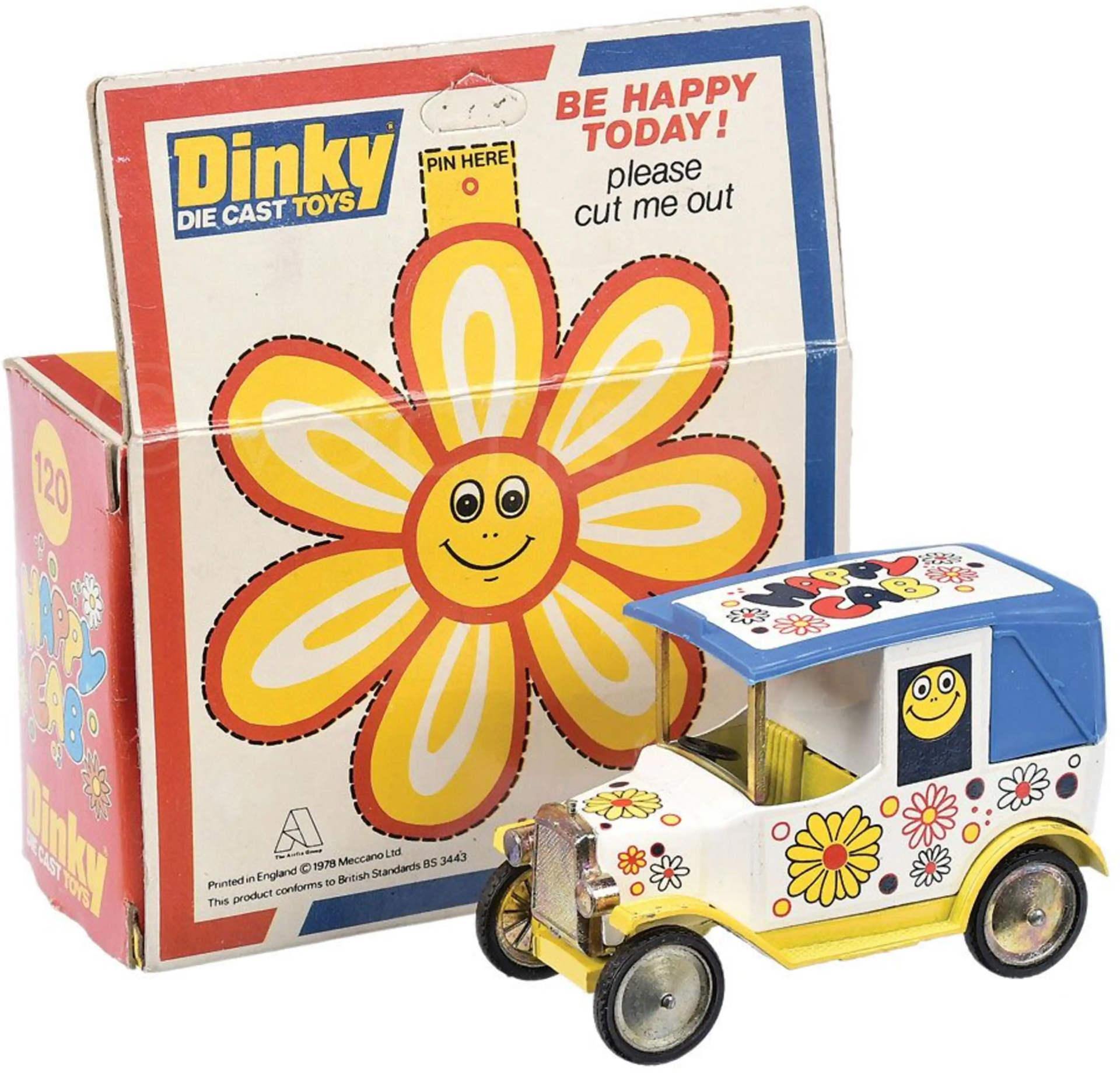
Regardless, the U.B. Taxi’s color scheme gave it a certain elegance. Not so for the alternative version I’m giving my “ten worst” award, the 120 Happy Cab. The decorations on this model are indescribably awful and would insult the intelligence of a three-year-old.
Some samples were released without the roof sticker after the factory ran out of them — an unintentional improvement!
In the 1950’s as a young Dinky Toys collector, I built my own list of what had been made in both the English and French factories. At that time, there were no books or magazines for diecast. I started the list using Dinky catalogs and Meccano magazines.
Ever since, this list has grown up until the internet started, and I met digitally dozens of collectors, at about the same time digital cameras appeared making the price of photos acceptable. I added large color photos to my list which I made look like a web site with links to surf around, I was also able to transfer my typed list to my computer and this slowly developed into the present Fabulous Dinky Toys Encyclopaediawhich I sold on a CD to share my knowledge of Dinky Toys with other collectors.
I did not know what I had put my foot into, but I discovered hundreds of casting and color variations, mock-ups, pre-production models, all the different types of boxes, and a load of information about Dinky Toys.
Now, the Encyclopaedia contains almost everything about these models. It is written in both English and French and is an absolute must for any Dinky Toys collector. It had grown so much from that original CD that I had to use DVDs, and later double layer DVDs. When I reached the capacity of DVDs, I switched to large USB memory sticks; this is how the Encyclopaedia is now distributed. Today it contains more than 3300 pages and more than 12000 large color photos.
For information and orders, please email:
dinkycollect [at] gmail [dot] com
The Dinky Encyclopaedia home page
Table of contents
Dinky Toys Encyclopaedia pages about the Dinky 110 Aston Martin DB 5
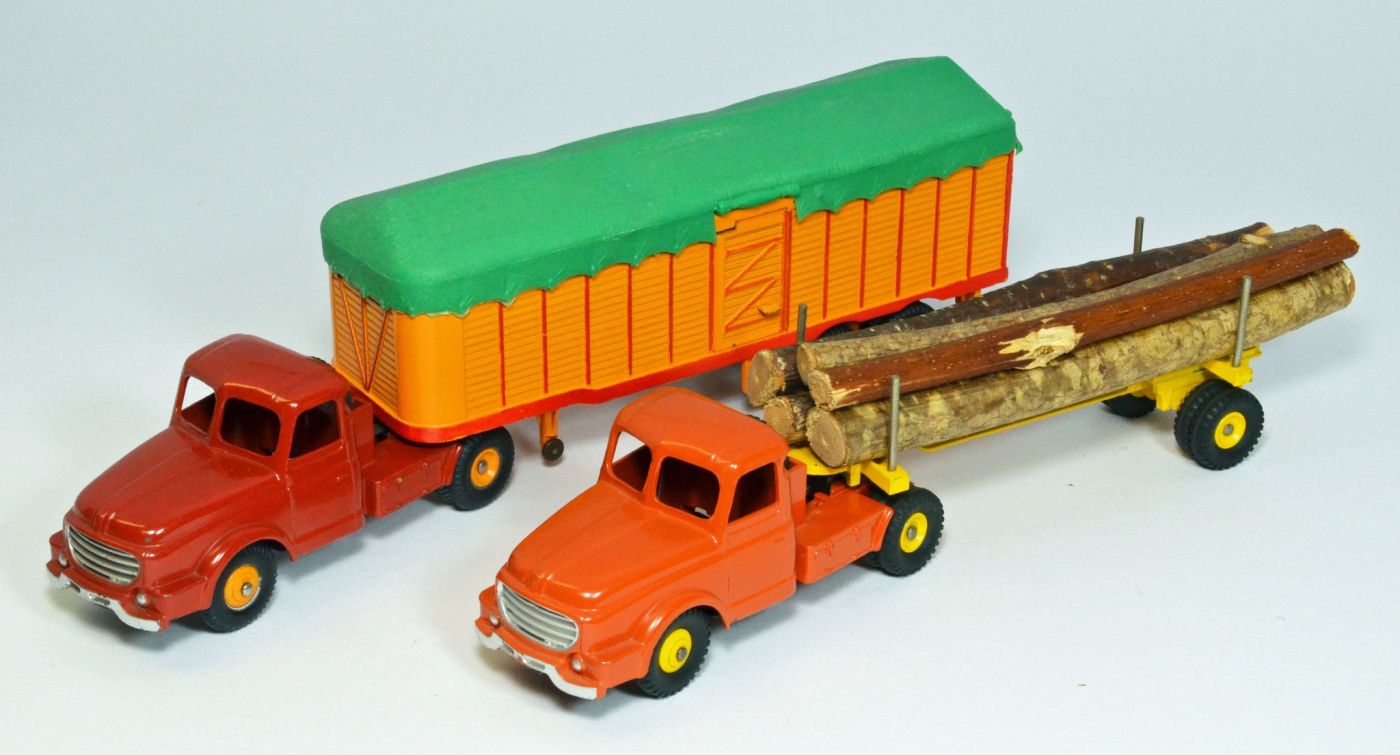
The French Dinky Supertoys 36b/896 Willeme Articulated Covered Truck was introduced in late 1958, making its first catalog appearance in 1959. It followed the wonderful 36a/897 Willeme Log Truck, from 1956, using the same cab, but painted a darker shade of red.
One of my very favorite large French Dinky Toys was the Willeme Log Carrier. I purchased this new from the US distributor, H. Hudson Dobson around 1958, and I was impressed from the moment I opened the box. This was one of the first Dinky Toys trucks to feature realistic dual tires and wheels, something their English cousins were much later in adapting. As usual, this truck is wonderfully finished with gleaming paint and full of detail, complete with a spare tire and wheel behind the cab. The articulated trailer is a little jewel, with an underneath center webbed beam running the full length. And for several years, this beam was featured with realistic openings, just like the real thing. Later models had these filled in.
Another very neat feature was the use of real wood “logs”: in this case carefully cut and trimmed twigs, of just the right size, which yielded a very realistic looking load of logs. and one can only imagine the trouble this must have caused, sourcing the tiny bits of real wood, then cutting them to length, etc. And they had to be a compatible size to work. Of course Meccano did not do this themselves; I am quite sure these were sourced from someone, but it helps show the lengths that Meccano could and did go to sometimes on their models. If this was made today, they would undoubtedly be made of plastic.
The French Meccano factory was at the top of their model making game when they produced these models in the late 1950’s. After 65 years of ownership, I’m still impressed with it! These were made from 1956 through 1971, in three versions, all with minor differences. I certainly encourage you to find one, if you don’t already have it in your collection!
The brother to the Willem Log Truck: the Willeme Articulated Truck, with the Covered Fruehauf Trailer. The trailer is an amazingly complex casting, composed of many pieces, along with an amazing number of tires and wheels. Another delightful model by Meccano France!
The Articulated Truck used the same Willeme tractor unit that the earlier log truck had used, but had a Fruehauf trailer in back, complete with side and rear opening doors. I did not buy one of these until a few years ago, and after getting it, was quite impressed. The trailer is a very complicated casting, with those sides, the moving doors, and the intricate layout of the ribs on the bottom.
The Willeme tractor was also one of the first trucks to get true dual wheels and tires, as does the trailer unit… lots of tires and wheels on this one!
Look at how exquisitely done the Willeme cab was. The contouring of the casting, the level of detail, they bright finish, the real dual tires and wheels. All showcasing just how well the late 1950’s French Dinky trucks were designed and made.
A closeup study of two French trucks that Dinky used in the late 1950’s‑through early 1960’s. One the left is the Willeme and on the right the UNIC. Both of these appeared on other models over the years. Notice, that in this case, both are hauling the same basic trailer, with the Willeme being used for logs, and the UNIC for steel pipes destined for the Sahara oil fields. Dinky was smart to re-use some of its components, by carrying different loads and using different colors.