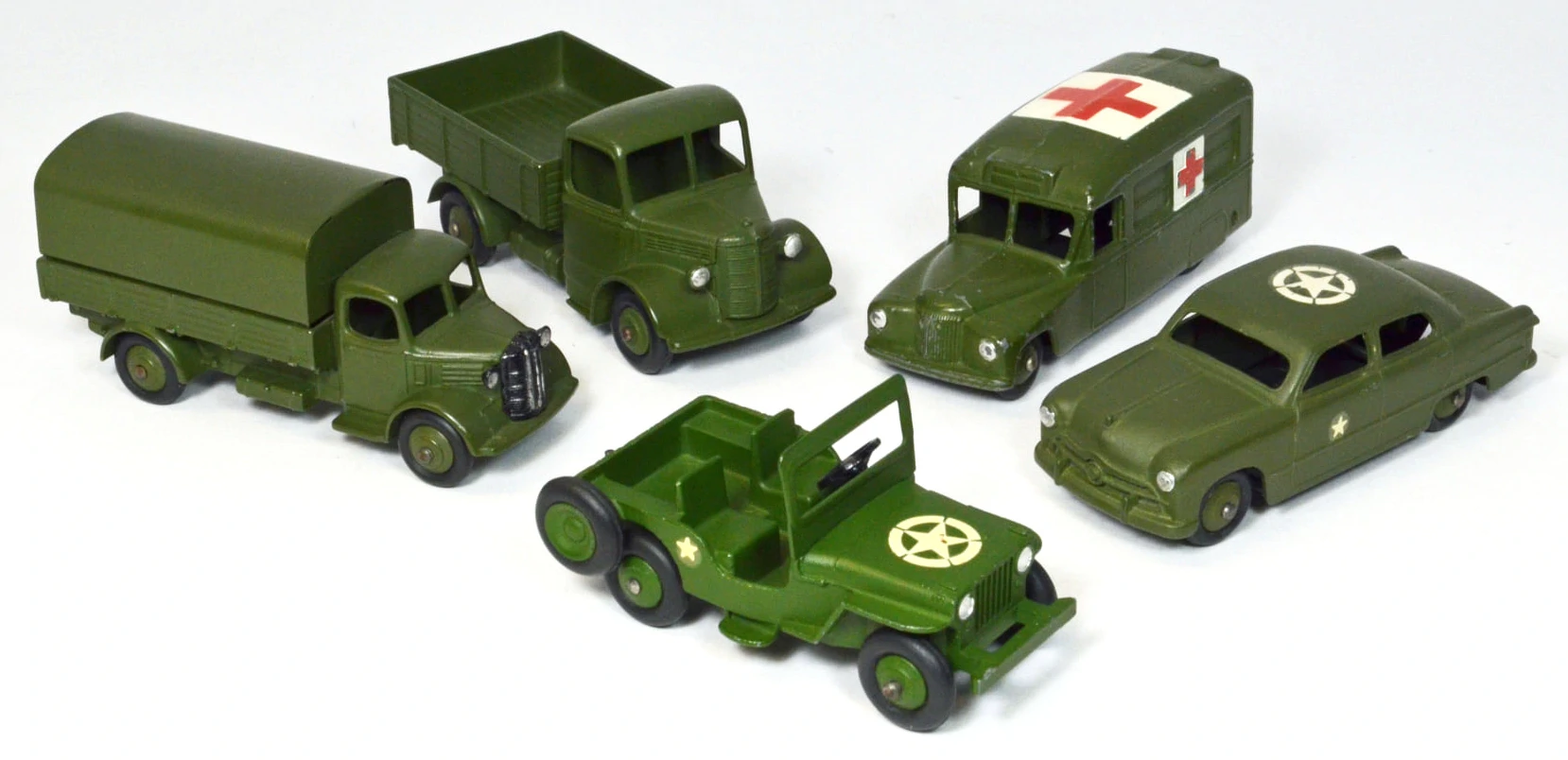
In the early to mid-1950’s military vehicle toys were in big demand, following both WWII and the Korean War. Demand was especially high in the U.S., and Meccano hadn’t issued many new Dinky Toys, so the range was a bit limited. Although I’m not certain, I think it’s likely that U.S. distributor H. Hudson Dobson informed Meccano that he could use more military vehicles. The easiest and quickest way to do that was to convert existing civilian models to military use. All that was required was the use of a different paint and is some cases, a few decals.
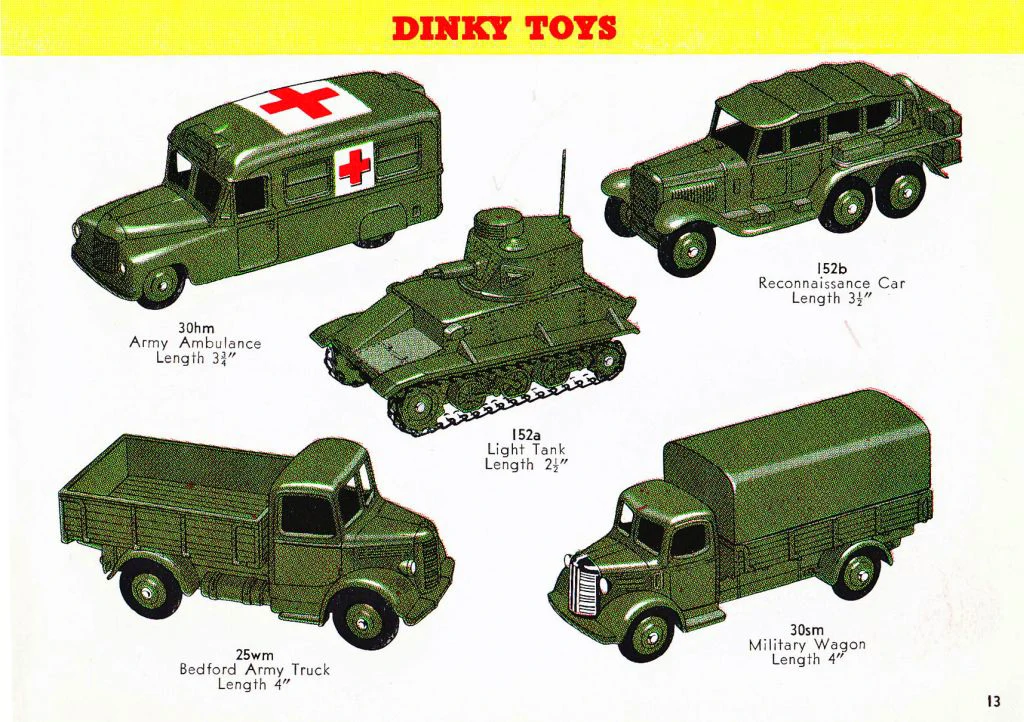
Here are the five models that Dinky converted to military guise, intended for export to the U.S. Clockwise from the right:
675 Ford Army Staff Car, 1952–59
669 US Army Jeep, 1955–57
30SM Austin Covered Wagon, 1952–54
25WM/640 Bedford Army Truck, 1952–54
30HM/624 Daimler Army Ambulance, 1952–55
And here are their civilian counterparts, in the same pose.
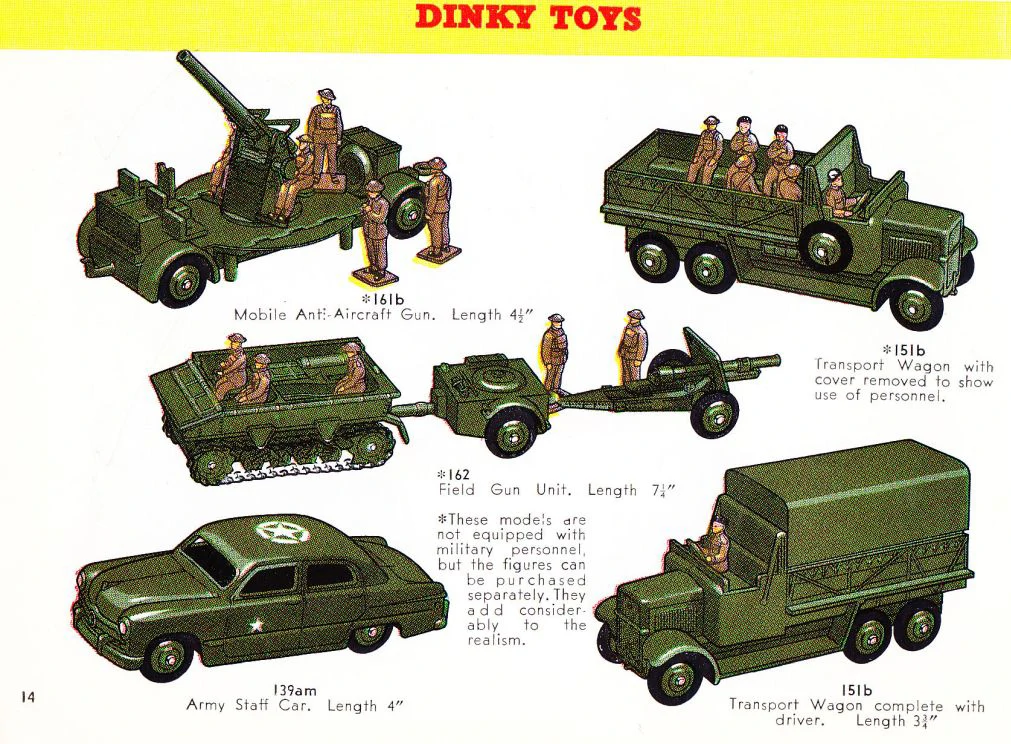
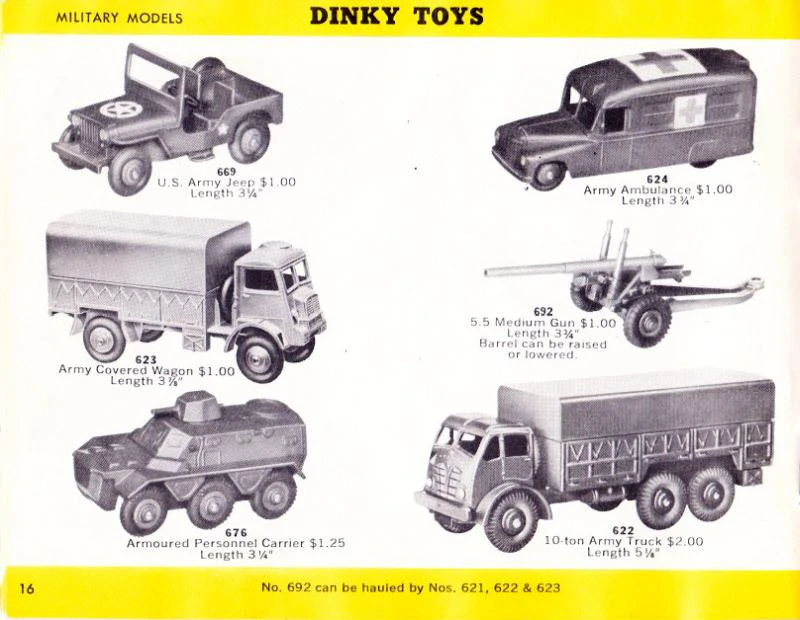
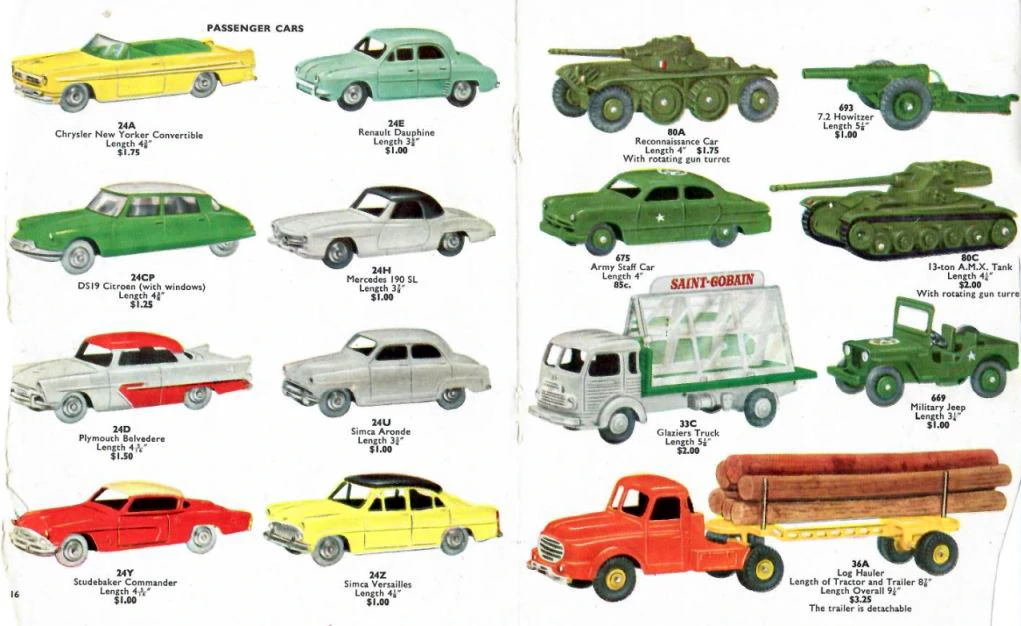
Here are some of the 1950s U.S. catalog pages that show these export models.
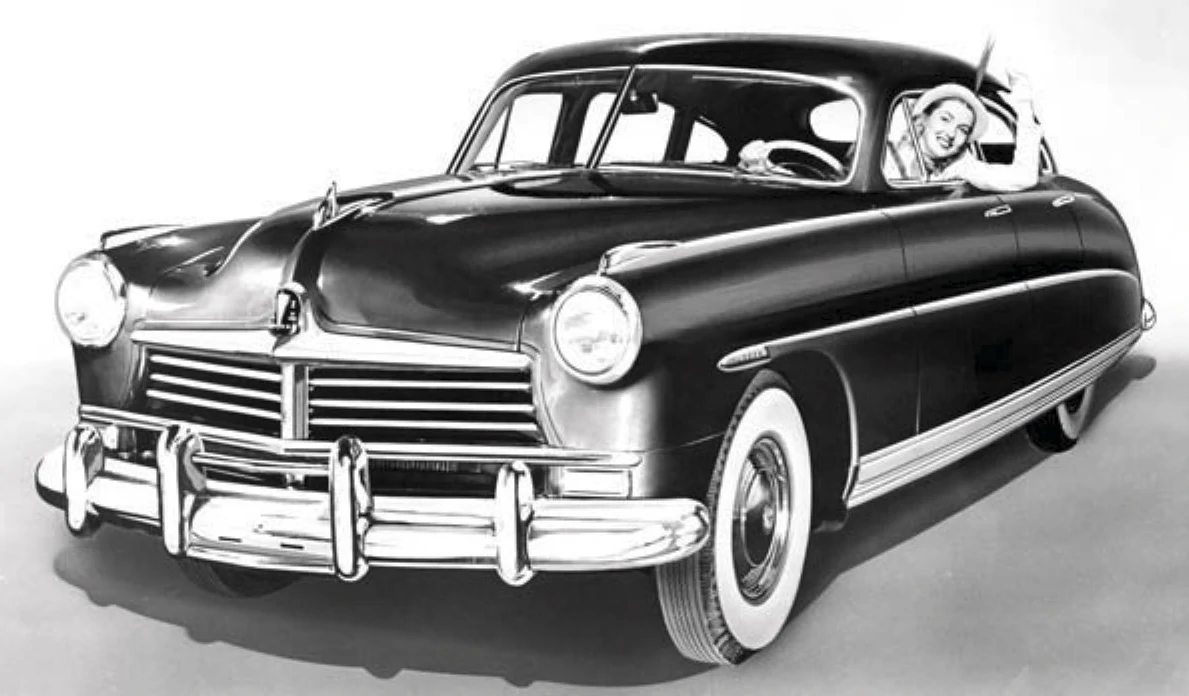
The 1948 new Hudson Commodore Sedan was a revolutionary design when it was introduced. The construction of this car was entirely new and very surprising. Meccano Liverpool reproduced the American Hudson Commodore Sedan in 1950 as model 139B. Compared to other Dinky models of that period, the streamlined, aerodynamic lines of this model are immediately striking.
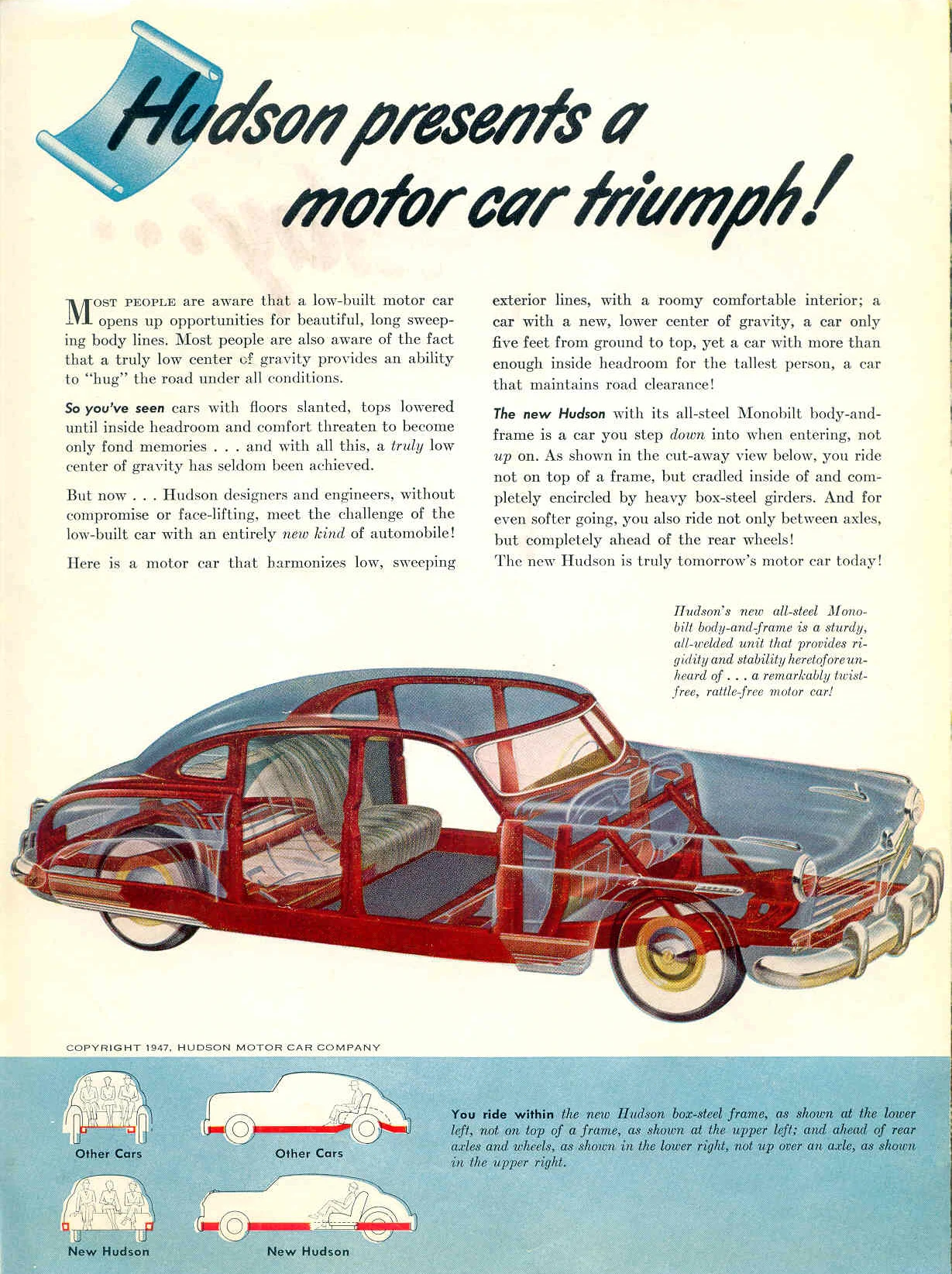
Hudson’s new Monobilt construction with step down design
1947 Hudson Commodore Sedan original factory press photo Image: eBay
The Hudson Monobilt was a revolutionary “step-down” unit-body construction introduced by the Hudson Motor Car Company in 1948. It integrated the body and frame into one welded structure, lowering the floor pan, and giving cars like the legendary Hudson Commodore an incredibly low center of gravity and unmatched handling
The result was a car that was only 158 cm. (62 in.) high. This was low compared to Ford, Chevrolet, and Chrysler, whose cars had heights of 180 (71 in.), 170 (67 in.) and 171 cm (67.3 in.) respectively. In 1948, Hudson surprised the car world with the new Step-Down design. Compared to these cars, those of the competition seemed distinctly old fashioned. The Hudson was a hit with the public. The total production of the Commodore for 1948 was 62,474 of which 35,315 were I8 units.
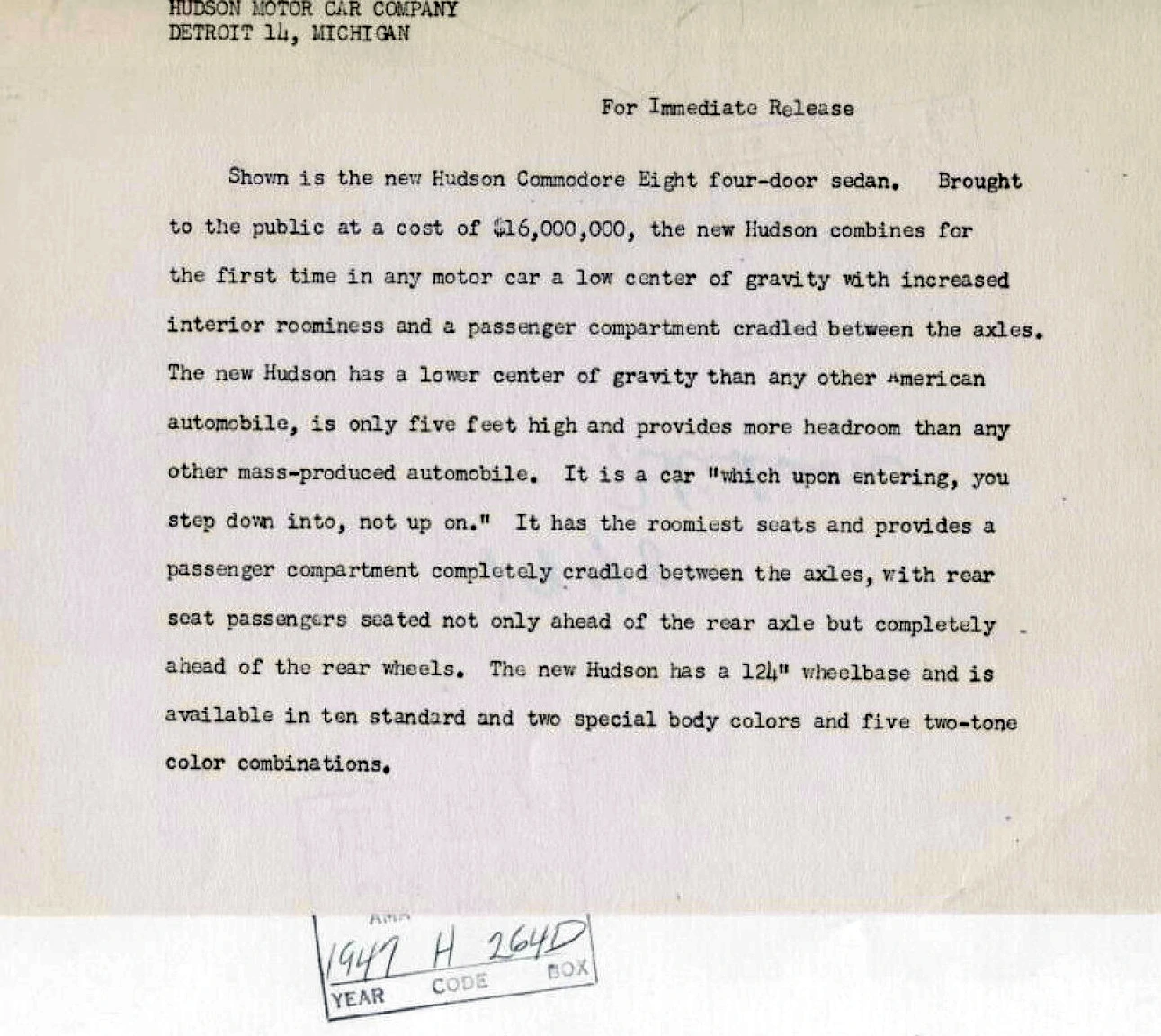
Shown above is typewritten press release from 1947 on the reverse of the factory photo of the Hudson Commodore Eight Sedan. As stated in the release, Hudson Motor Car Company invested $16,000,000 in the new 1948 Hudson.
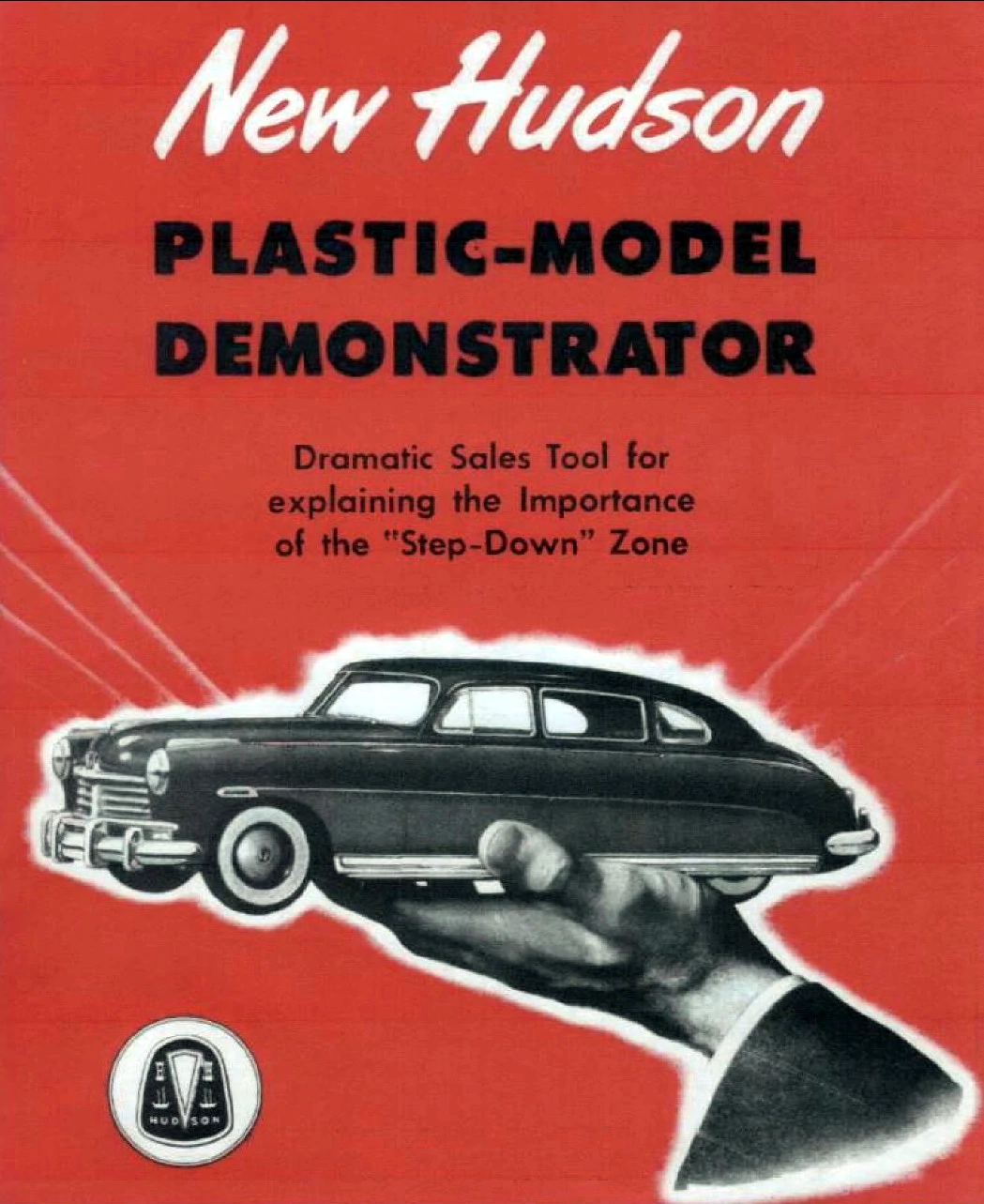
1:16 plastic model of the Hudson Commodore Sedan Image: MAR Online
To promote the new Hudson “Step-Down” design, 1:16 plastic scale models were made by plastic specialists. They were intended for shipment to Hudson dealers to demonstrate the car’s step-down and Monobilt design to customers. The dies alone cost $35,000. About 20,000 were produced by Hudson itself on a separate assembly line built specifically for this purpose in the Hudson factory.
Third generation 1948 Hudson Commodore
The Hudson Commodore was produced by the Hudson Motor Car Company of Detroit, Michigan between 1941 and 1952. During its production, the Commodore was the largest and most luxurious Hudson model.
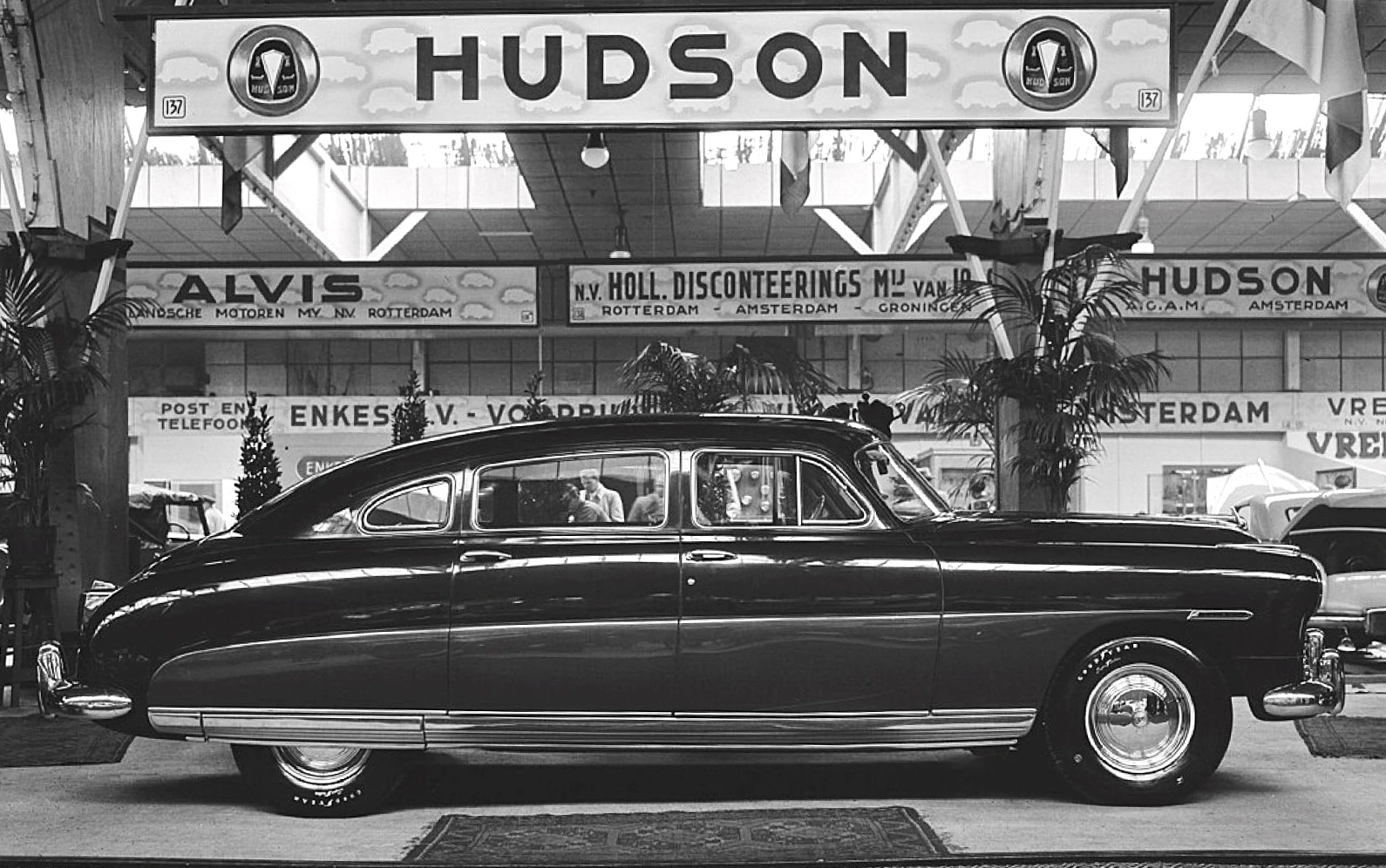
3rd generation Hudson Commodore sedan exhibited at the 1948 Amsterdam AutoRAI
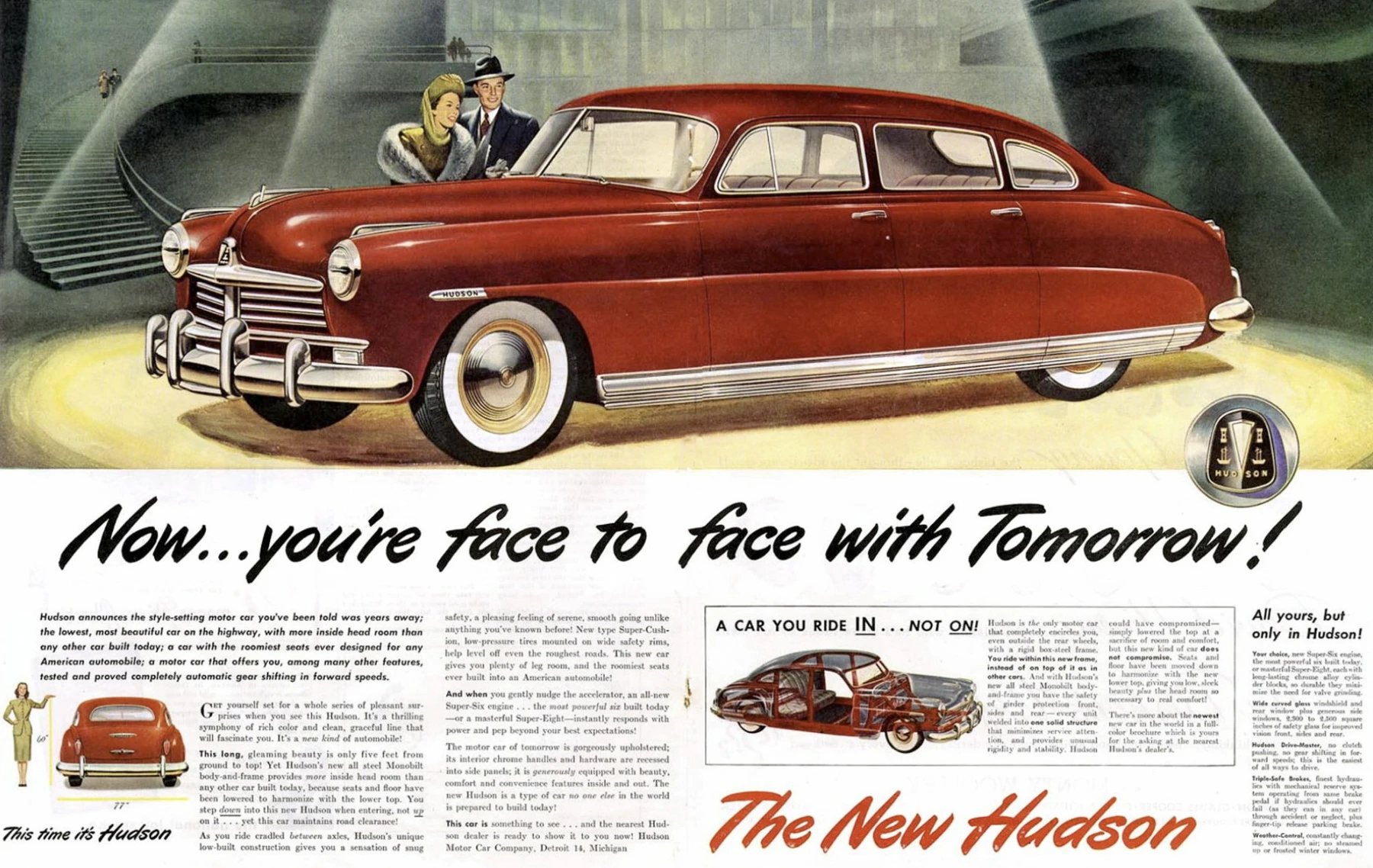
Hudson had developed a new and radical car design. Production of the 1948 Hudsons began on 12 October 1947. Introduced on 7 December 1947 to dealers, the Hudson Commodore was one of the first newly designed postwar cars made. The 1948 model year inaugurated Hudson’s trademarked “Monobilt” construction or “step-down” automobile. The new cars were designed by Frank Spring and in part by Betty Thatcher, the first female designer to be employed by a car manufacturer. The marketing tagline for the innovative Hudsons was “Now… you’re face to face with Tomorrow!”
1948 Hudson advertisement “Now… you’re face to face with Tomorrow!”. Image: eBay
The cars had a light and strong semi-unit body with a perimeter frame. Because of the encircling frame, passengers stepped down into the vehicles. Hudson’s step-down design made the body lower than contemporary cars. It offered passengers the protection of being surrounded by the car’s chassis with a lower center of gravity. In addition to the safety of being surrounded by the car’s chassis, the step-down design also allowed Hudson to achieve a weight savings through the unibody construction, making for a well performing automobile. The “Monobilt” or “step-down” design also required less steel for its production.
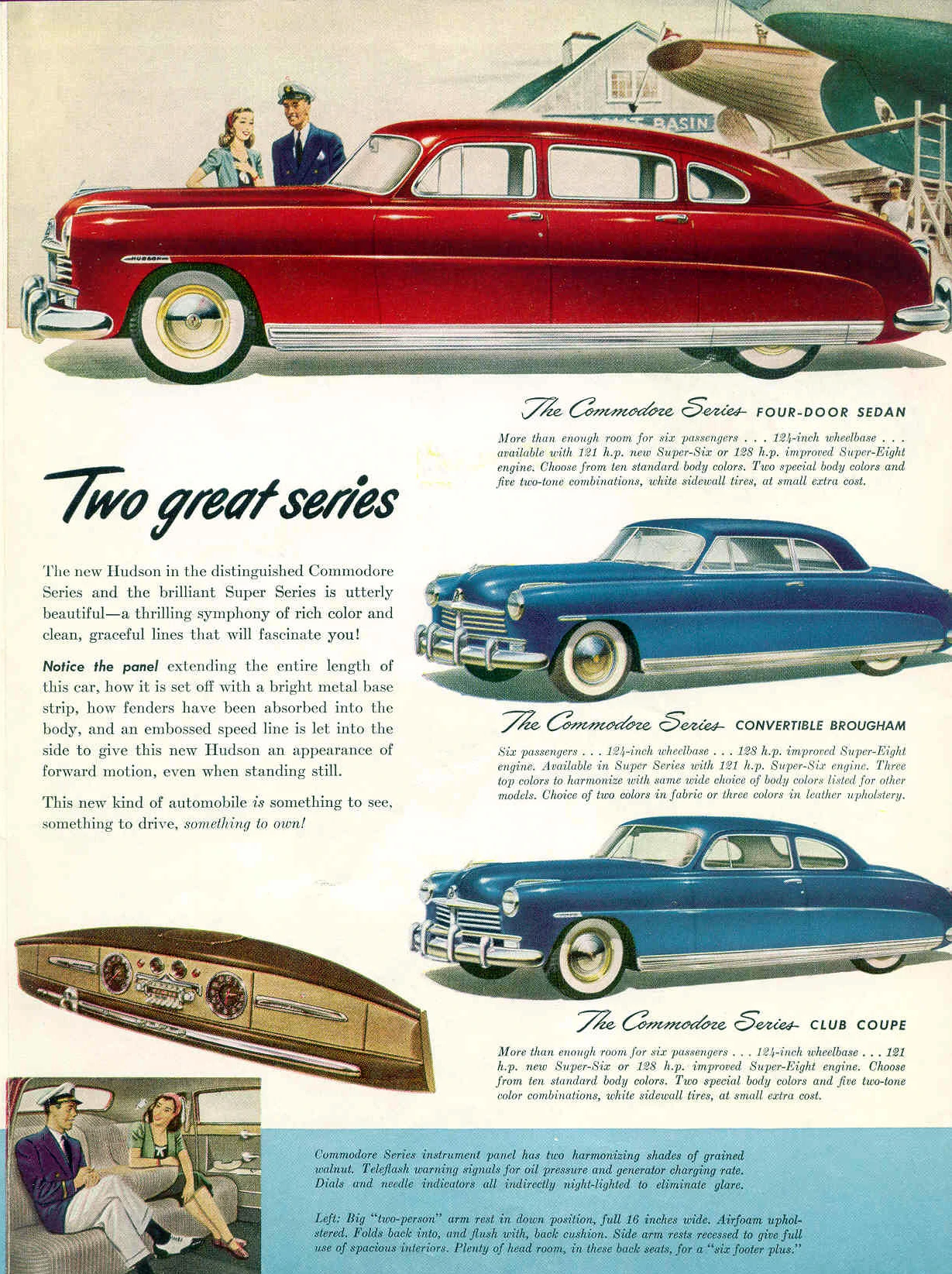
1948 Hudson brochure describing the Commodore series Image: Old Car Brochures
Hudson ceased operation of the Hudson automobile brand in 1957 after the parent company merged with Nash-Kelvinator in 1954 to form American Motors Corporation (AMC).
The “Monobilt” construction no longer exists in modern vehicle manufacturing. True “Monobilt” cars featured a perimeter frame welded directly to the body. Modern unibody construction integrates the floor pan, pillars, roof, and crumple zones into a single engineered shell, eliminating the need for a separate frame.
The Meccano Liverpool model
Meccano Liverpool chose to reproduce this attractive modern car, together with 139A Ford Fordor sedan, as one of the first new post-war Dinky Toys models of American closed passengers cars of the early 1950’s. The time had come to leave the outdated pre-war reissues behind and produce new models. The production of practically all older reissues ended in 1950.
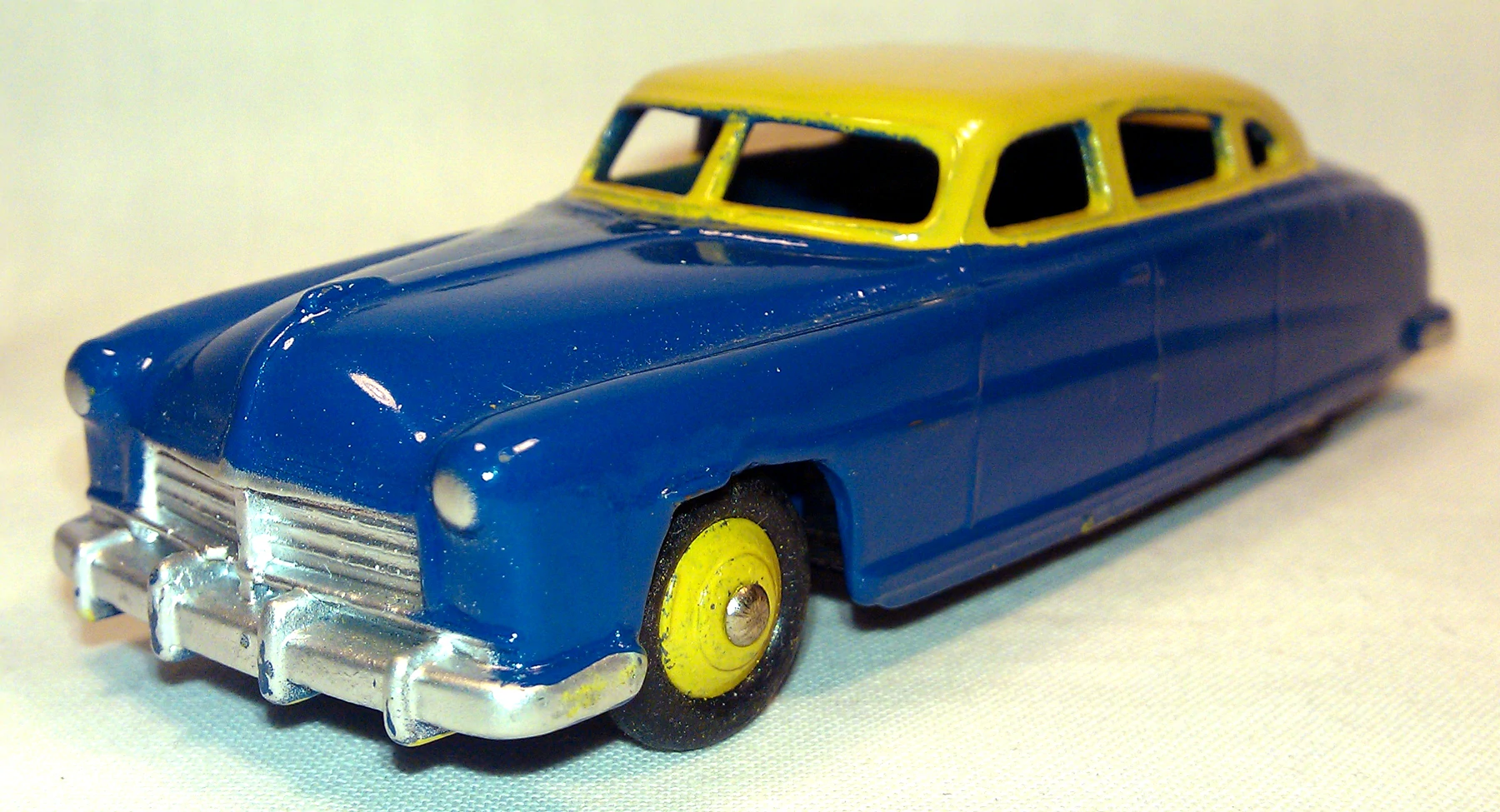
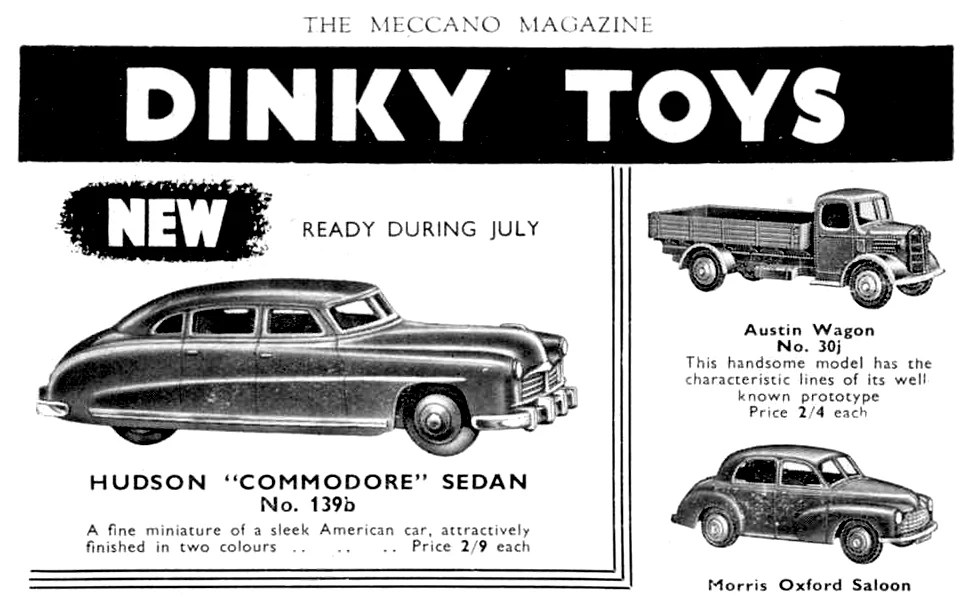
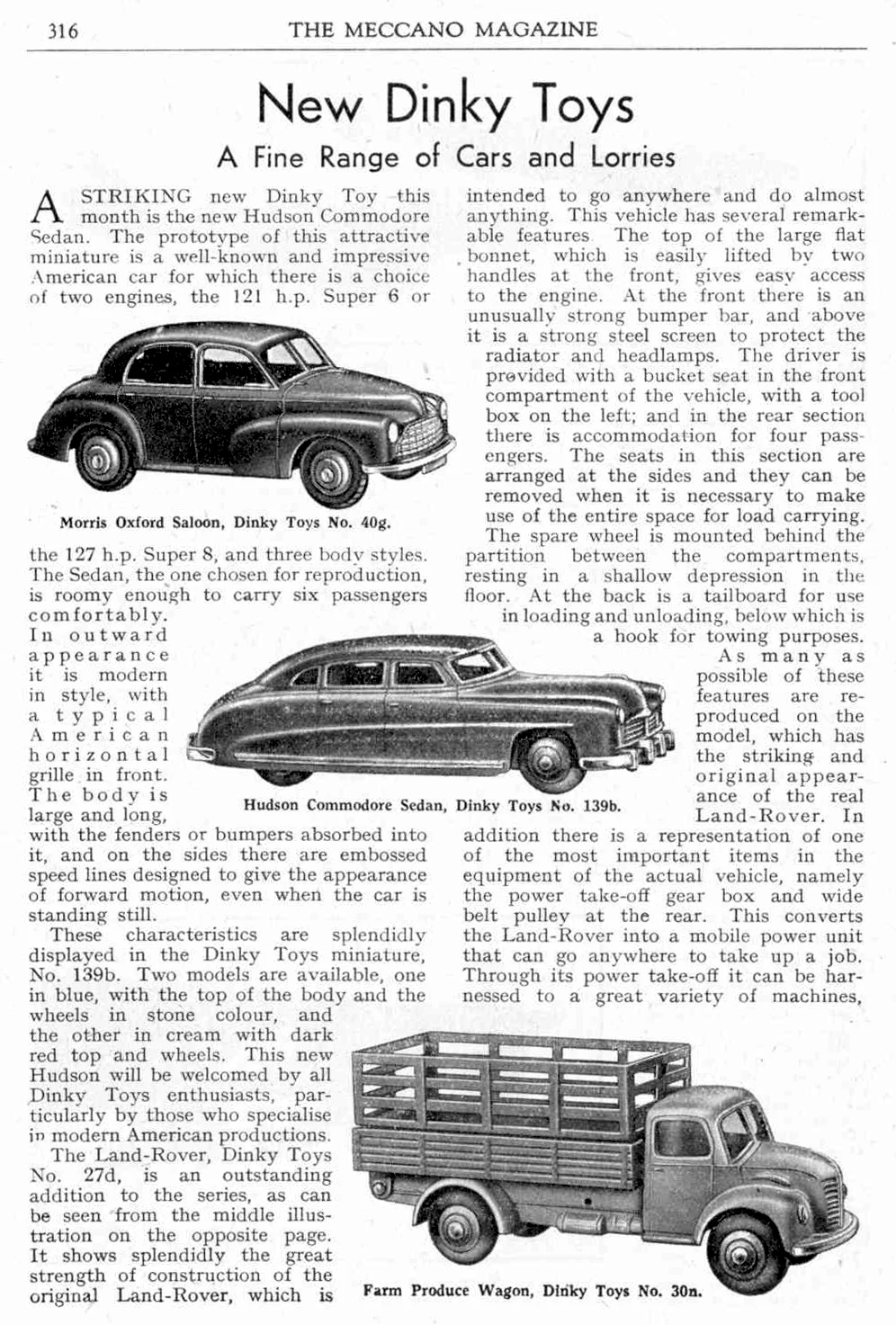
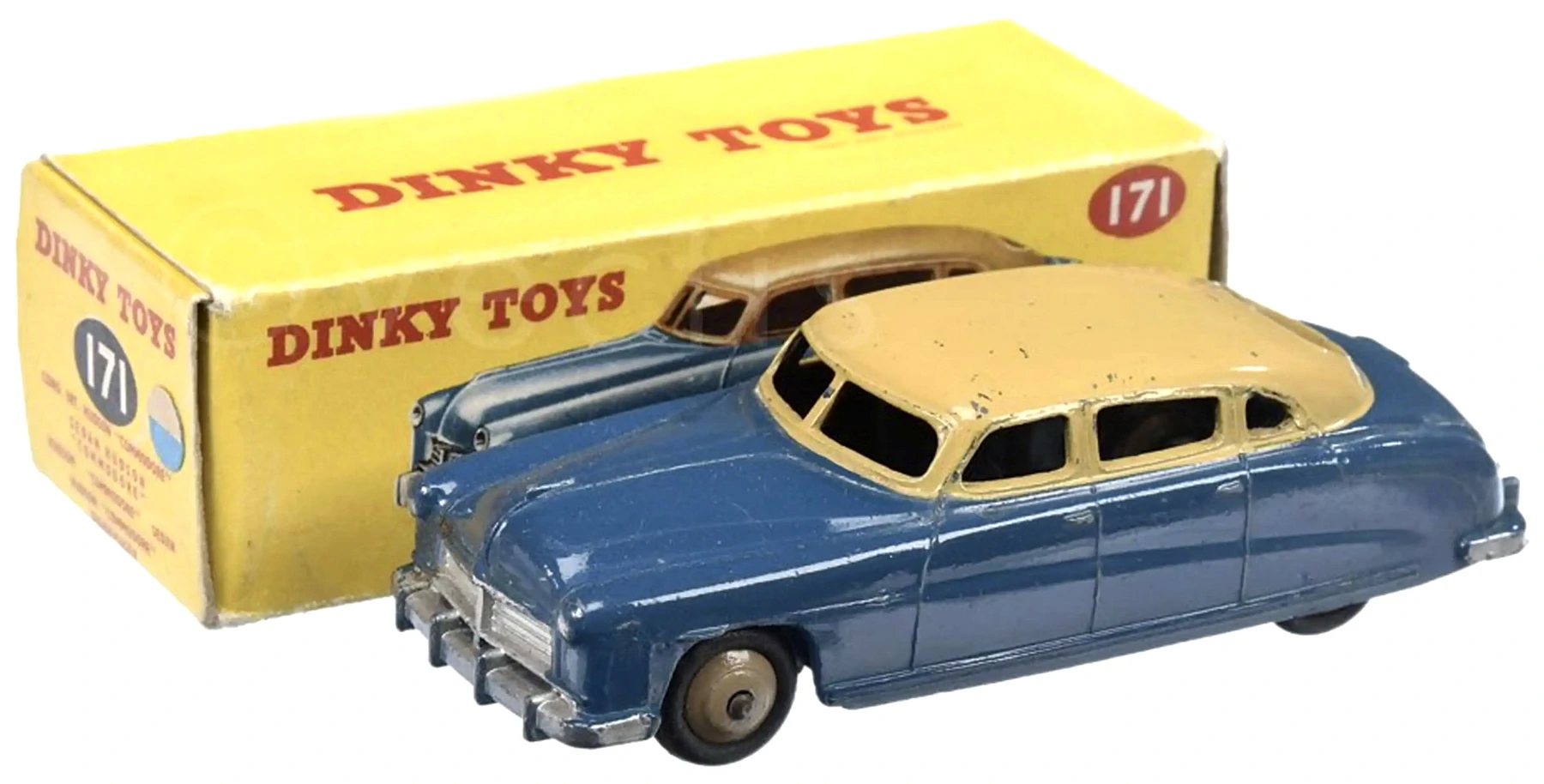
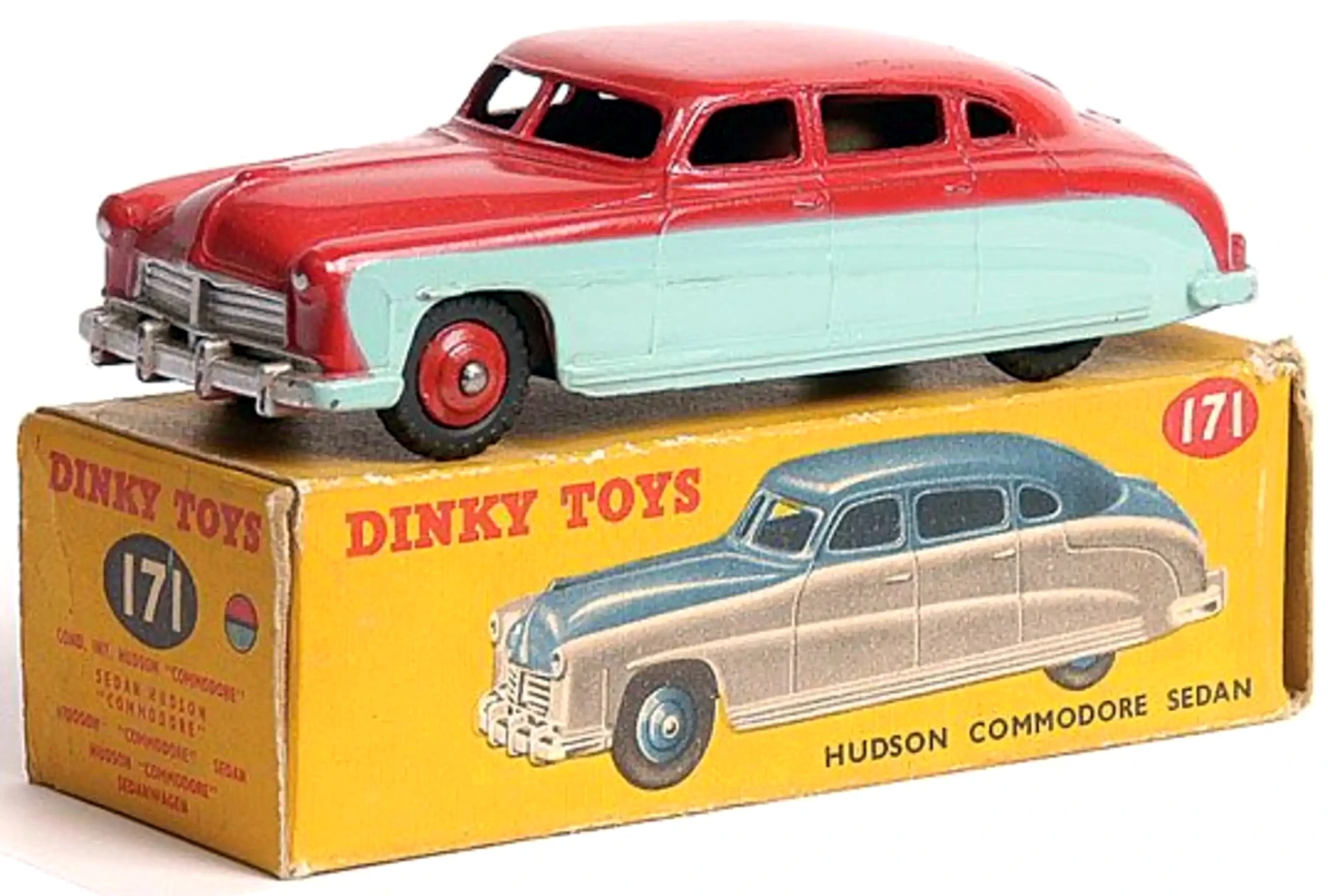
Meccano Liverpool reproduced this car as the 139B Hudson Commodore Sedan (assembly drawing 28–4‑49). It was first advertised in the July 1950 issue of Meccano Magazine which also included a separate description of the Hudson Commodore. In 1954 it was renumbered to Dinky 171 and was produced until 1959.
Advertisement of the Dinky Toys 139B Hudson Commodore Sedan in the June 1960 issue of Meccano Magazine, with the description: “A fine miniature of a sleek American car, attractively finished in two colors ..”.
Introducing the Dinky 139b Hudson Commodore Sedan in the July 1950 issue of Meccano Magazine
The Dinky Hudson Commodore was described in Meccano Magazine as “The body is large and long, with the fenders or bumpers absorbed into it, and on the sides there are embossed speed lines designed to give the appearance of forward motion, even when the car is standing still”. This alludes to the beautiful raised decorative speed line with a second color on the sides of the original car that gives it a very nice look.
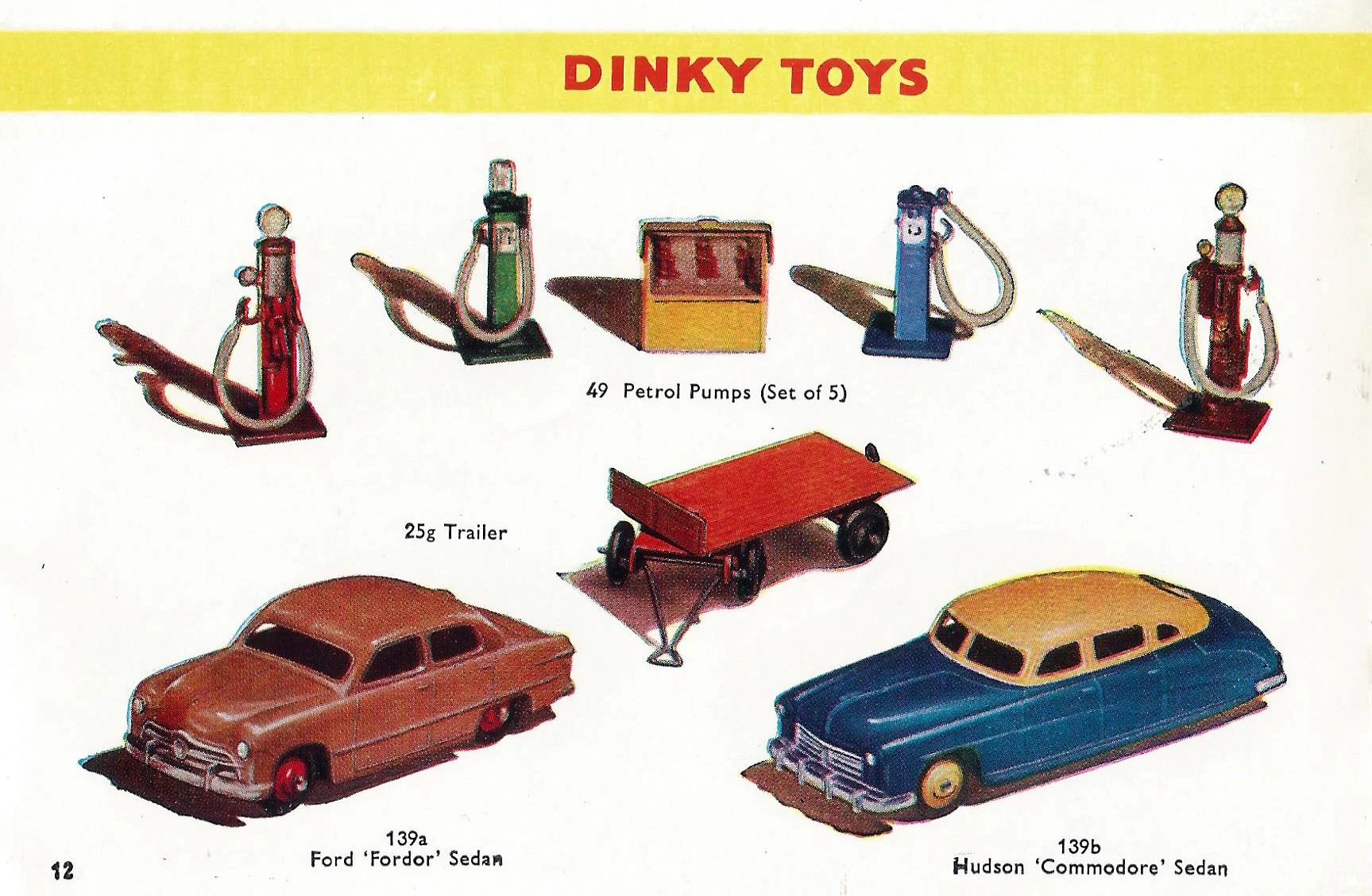
Dinky 139B Hudson Commodore Sedan in the 1952 UK catalog along with the Dinky139A Ford Fordor Sedan.
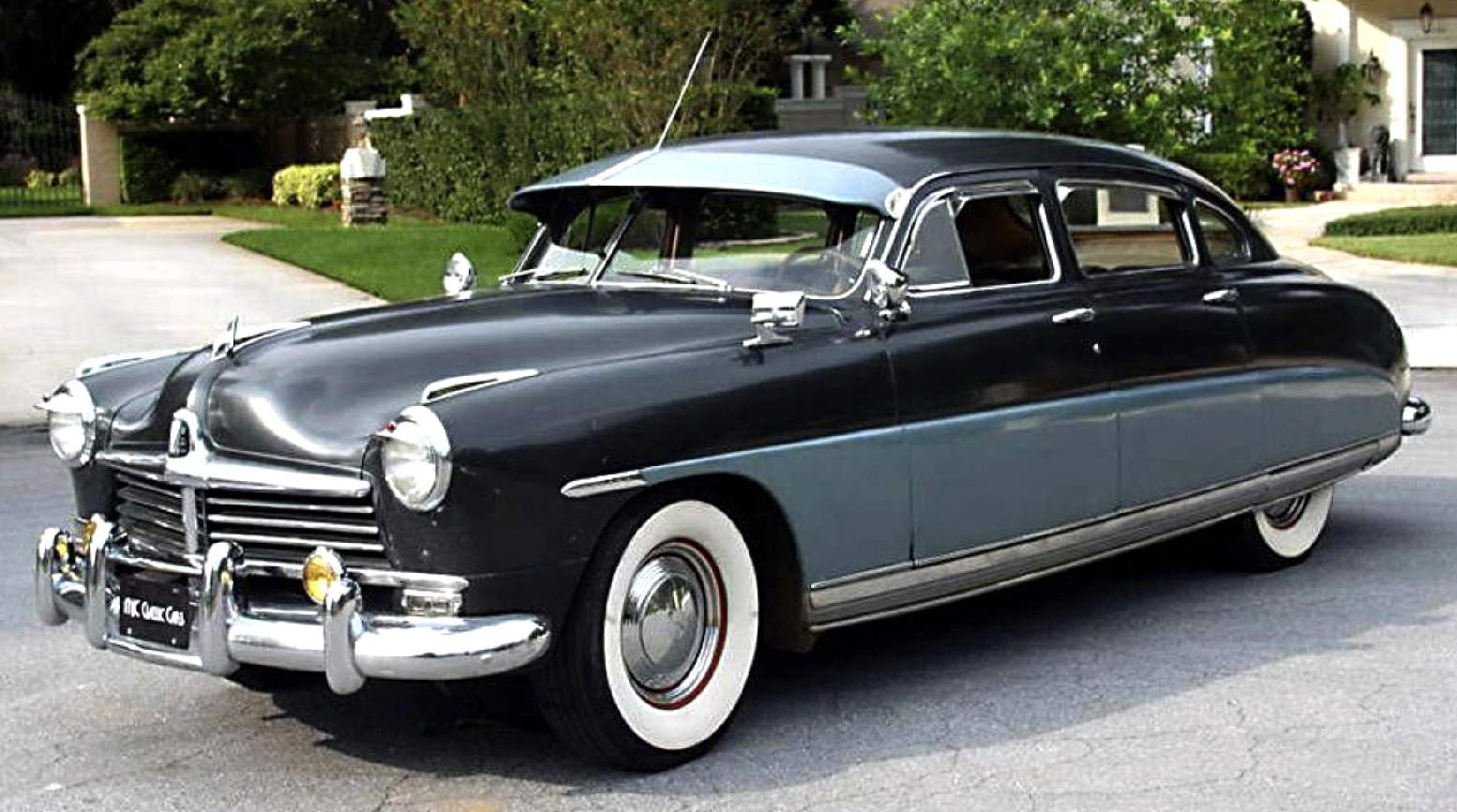
1948 Hudson Commodore sedan in two-tone blue with a second color on the raised lower sides. Image: ClassicCars
Dinky 139B Hudson Commodore Sedan first issue with two tone color scheme. This early model wasn’t individually boxed but instead offered in a trade box of six units.
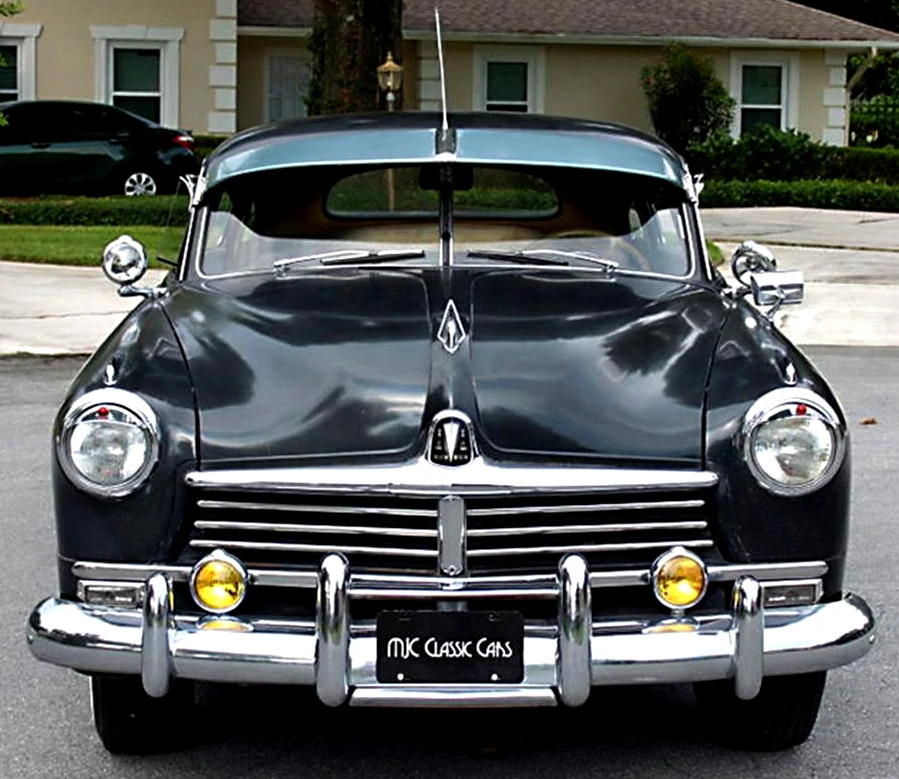
Front view of the 1948 Hudson Commodore sedan showing the Hudson badge and ornament on the hood. The car is luxuriously equipped with several useful accessories. Image: ClassicCars
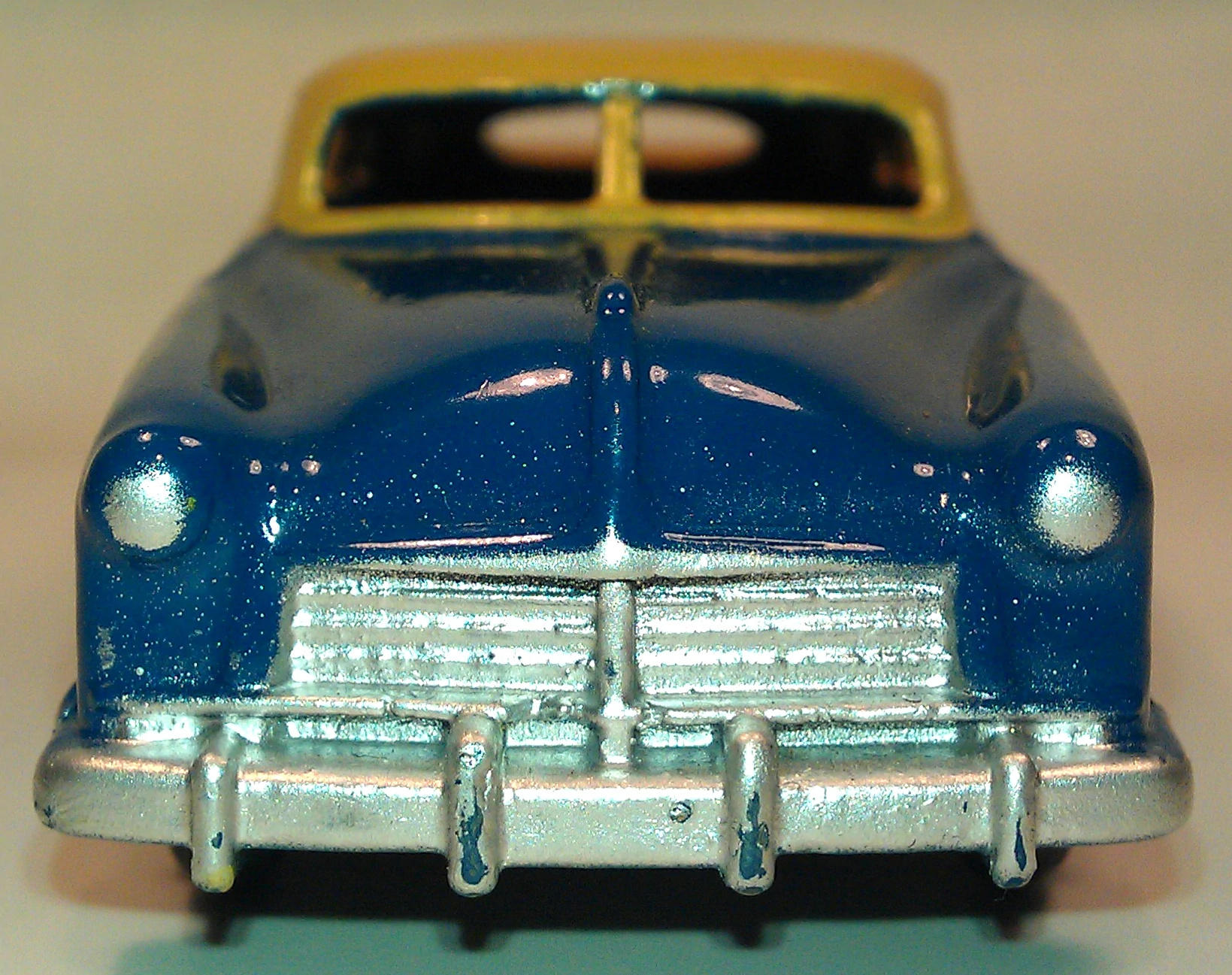
Front view of the Dinky 139B with chrome grill, bumper and headlights. The low roofline is striking.
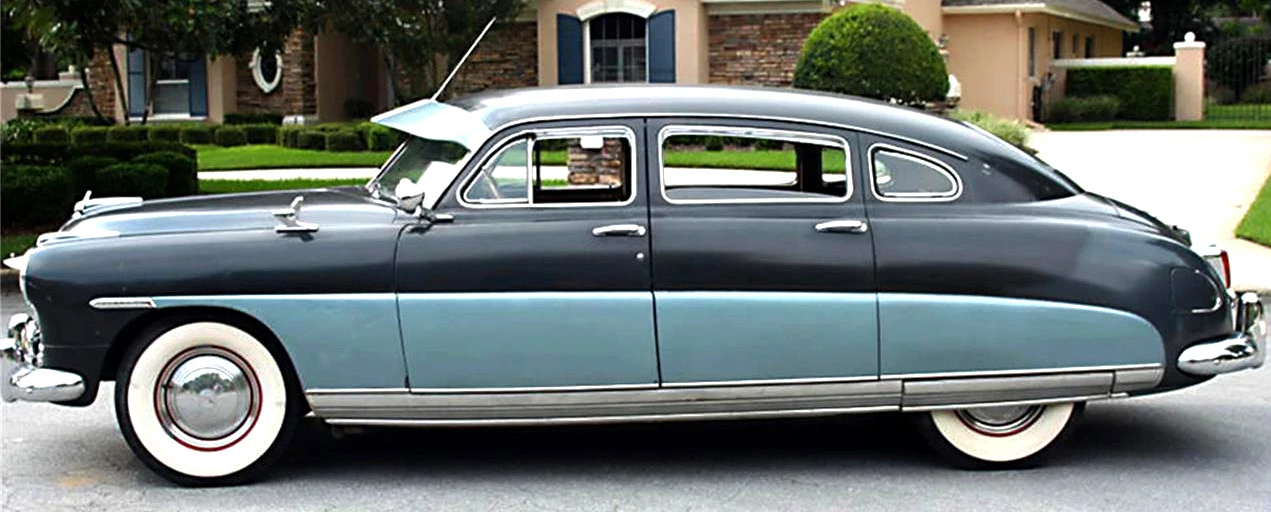
Left view of the 1948 Hudson Commodore Sedan. Note the second color on the attractive raised lower sidewall, rising from rear to front. Image: ClassicCars
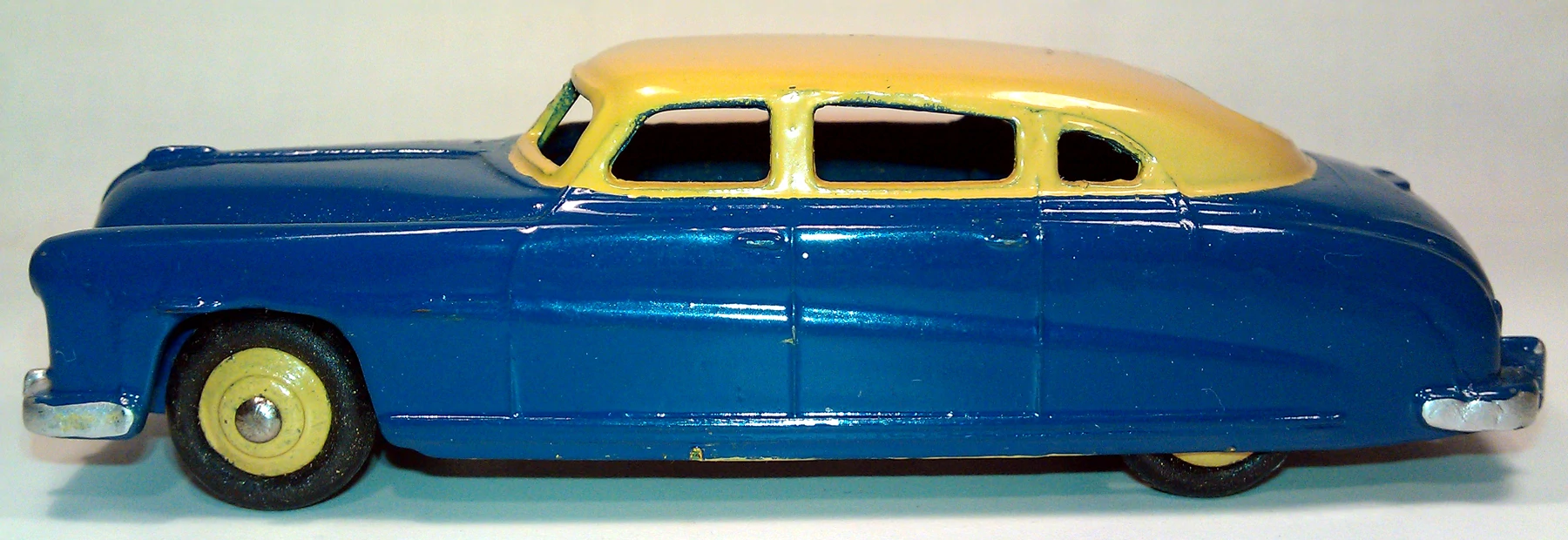
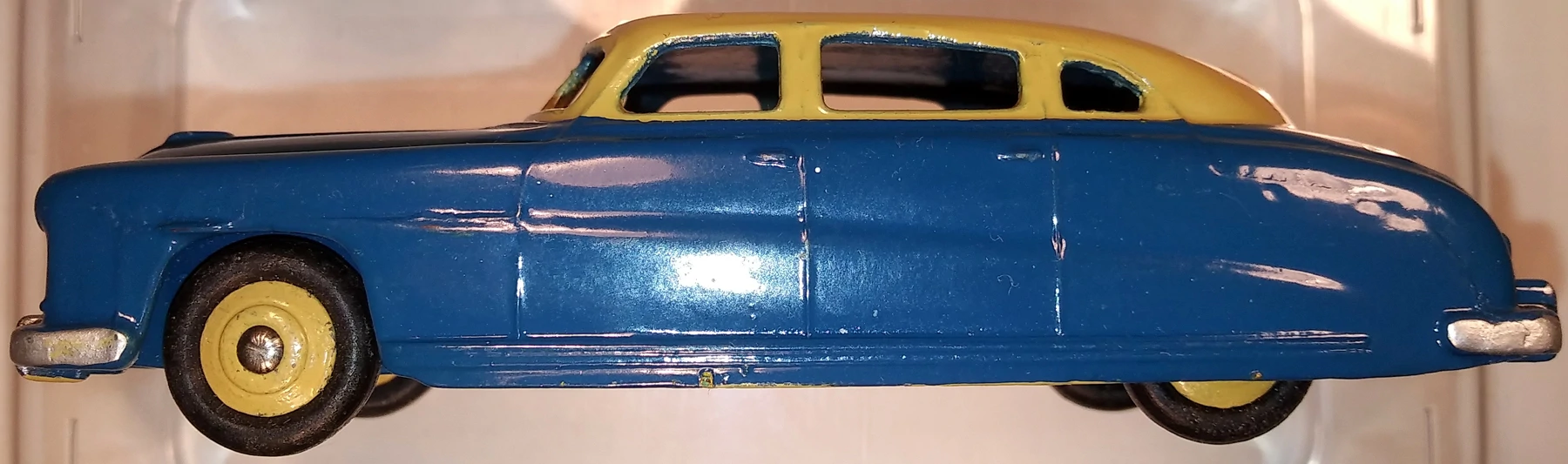
Shown above is the left profile view of the Dinky 139B Hudson Commodore Sedan with “embossed speed lines on the side, designed to give the appearance of forward motion, even when the car is standing still”, as described in the article introducing the model in Meccano Magazine. Unfortunately Meccano Liverpool chose to not highlight the raised speed lines on the sides by mask spraying a second color like the real car above. Instead, a two tone paint scheme was used to accentuate the roof.
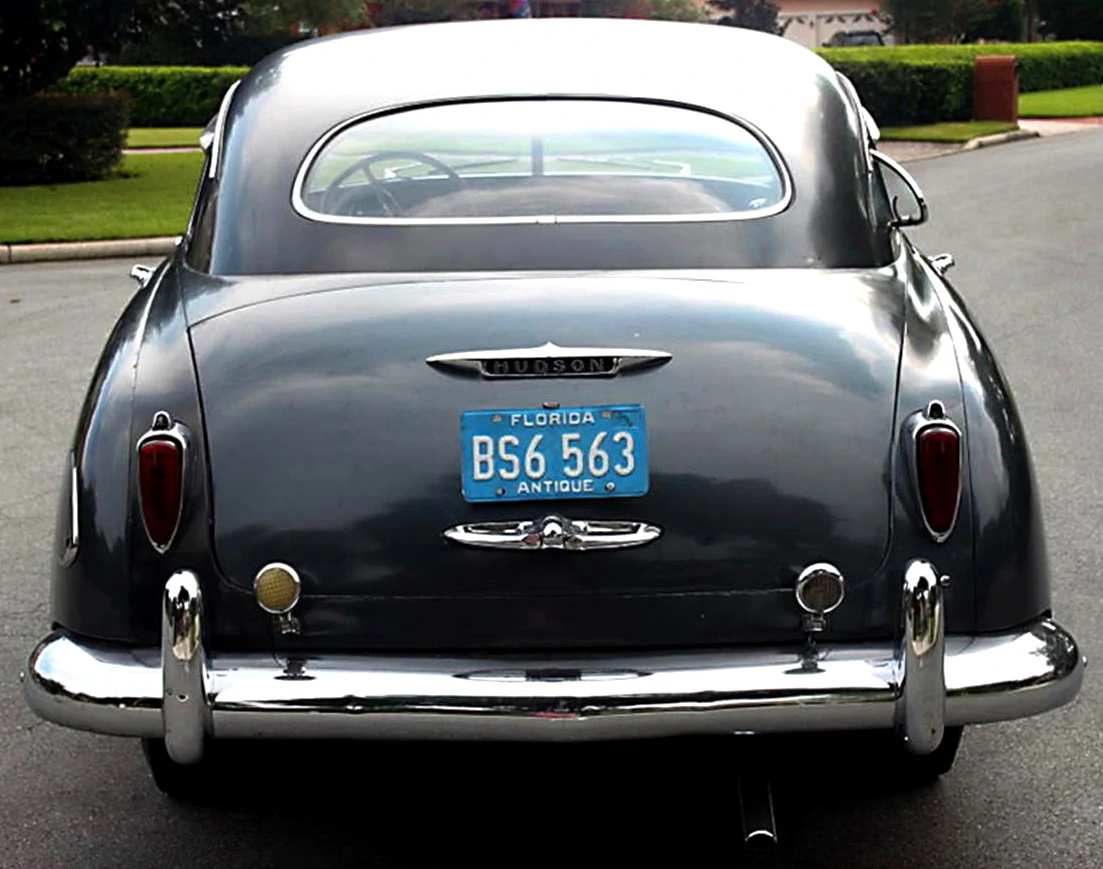
Rear view of the 1948 Hudson Commodore sedan. Image: ClassicCars
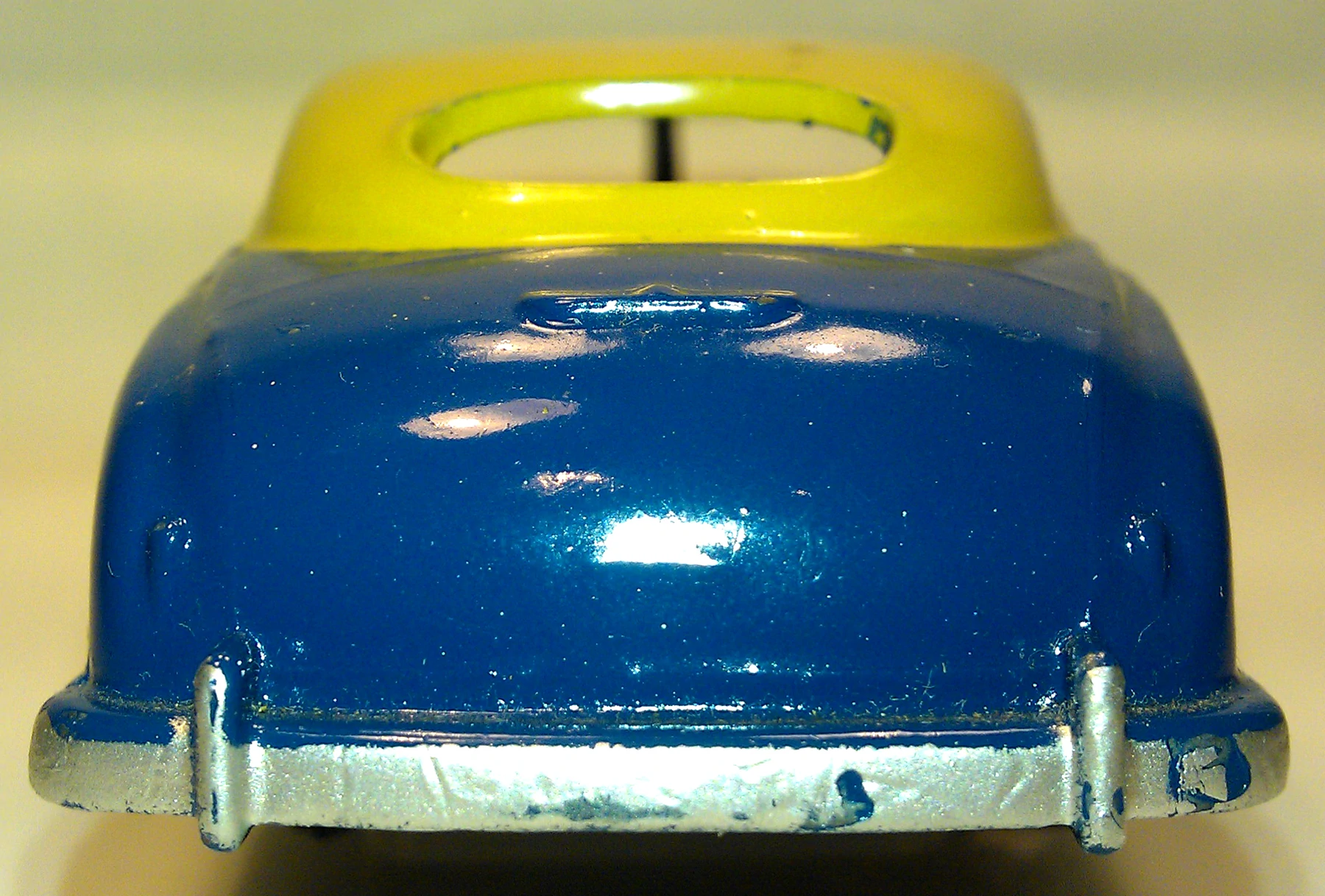
Shown above is the rear view of the Dinky 139B Hudson Commodore Sedan with a chrome bumper. It’s a pity the taillights aren’t painted red (although this was done on some later models) and the Hudson emblem on the tailgate isn’t painted in chrome. That would have given the model a nicer appearance.
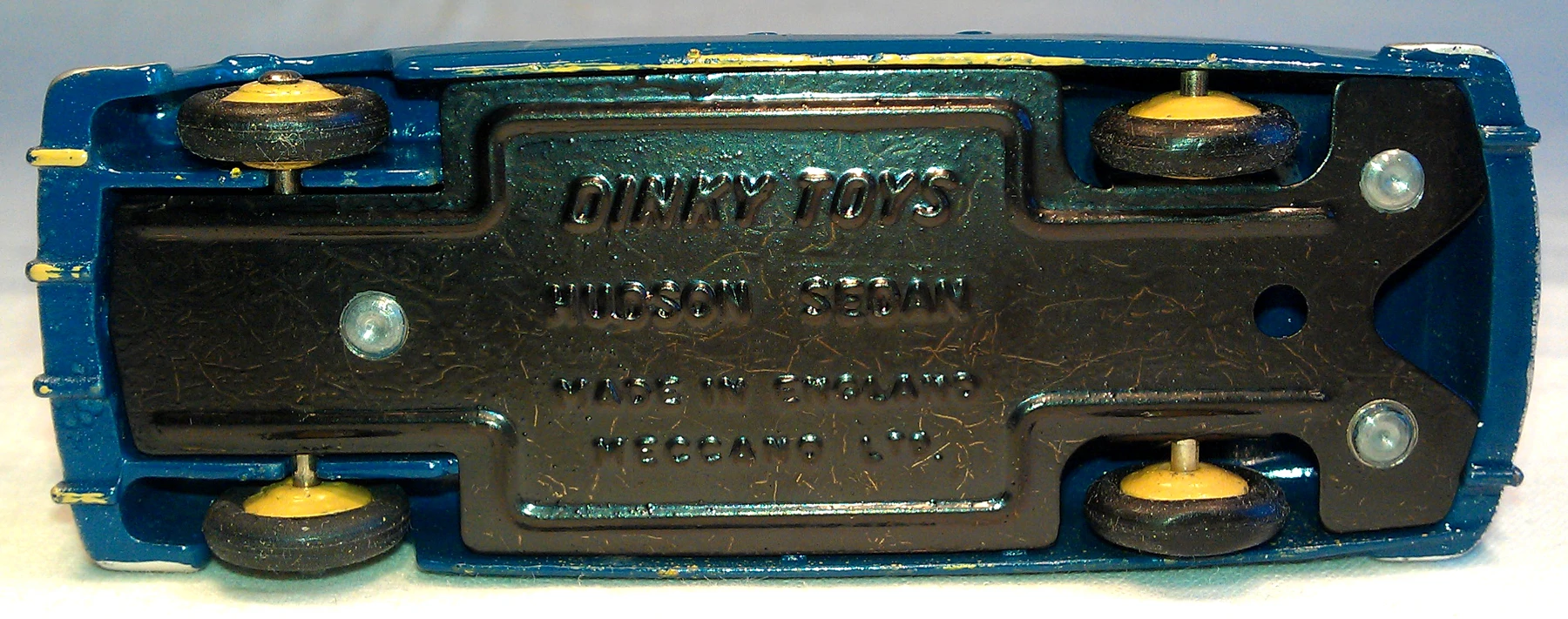
Shown above is the early Dinky 139B with small lettering on its mottled base. Later models used large lettering. In The Great Book of Dinky Toys by Mike & Sue Richardson, the authors indicate that on 27 August 1952 the model number 139B was added, and on 11 August 1954 the model was renumbered to 171, but not marked on the baseplate.
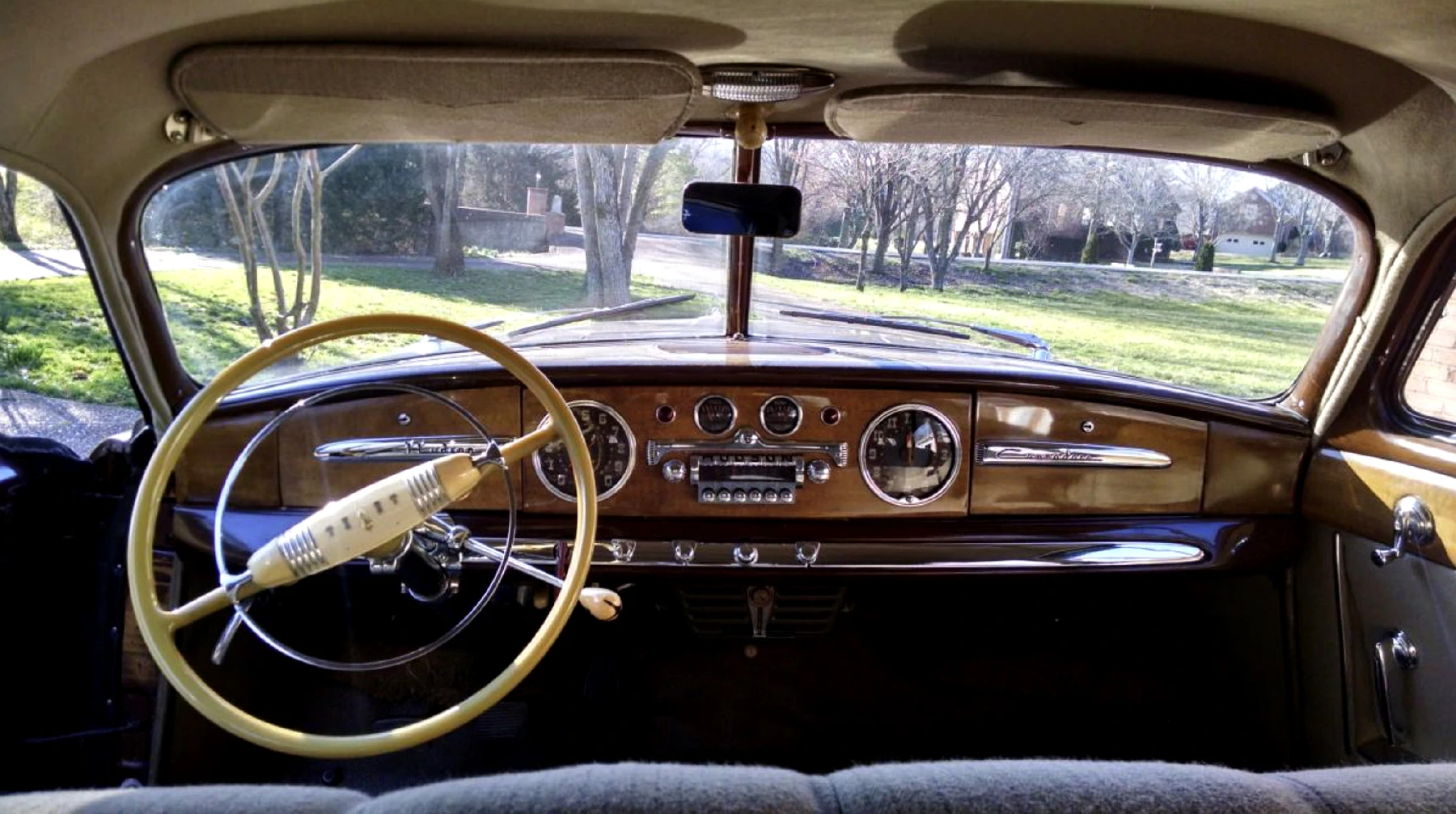
The luxurious dashboard of the real Hudson Commodore Sedan. Image: ClassicCars
My early Dinky Hudson Commodore has a smooth inner roof. Later models had “Hudson Sedan” cast into the roof
Two tone color schemes
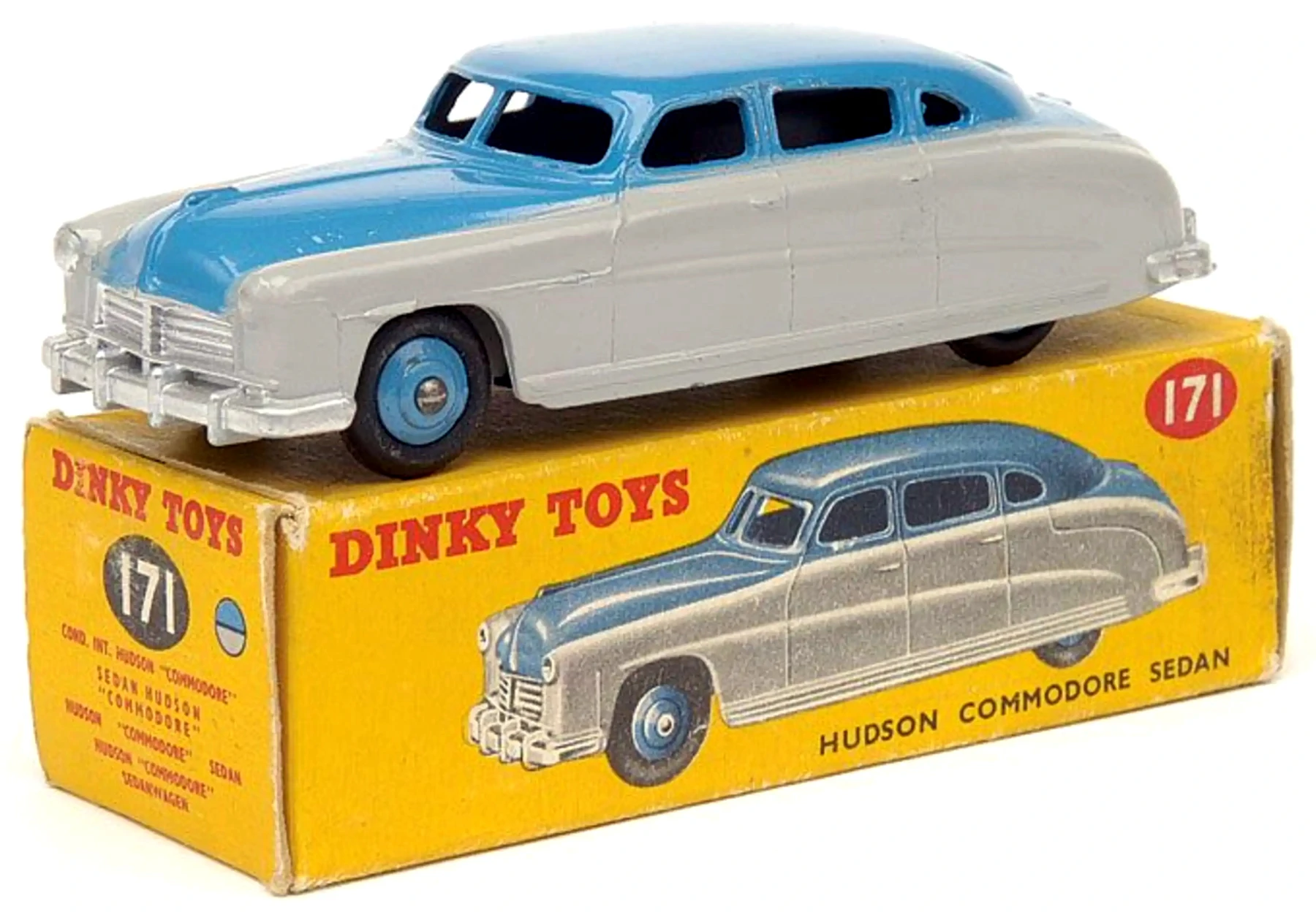
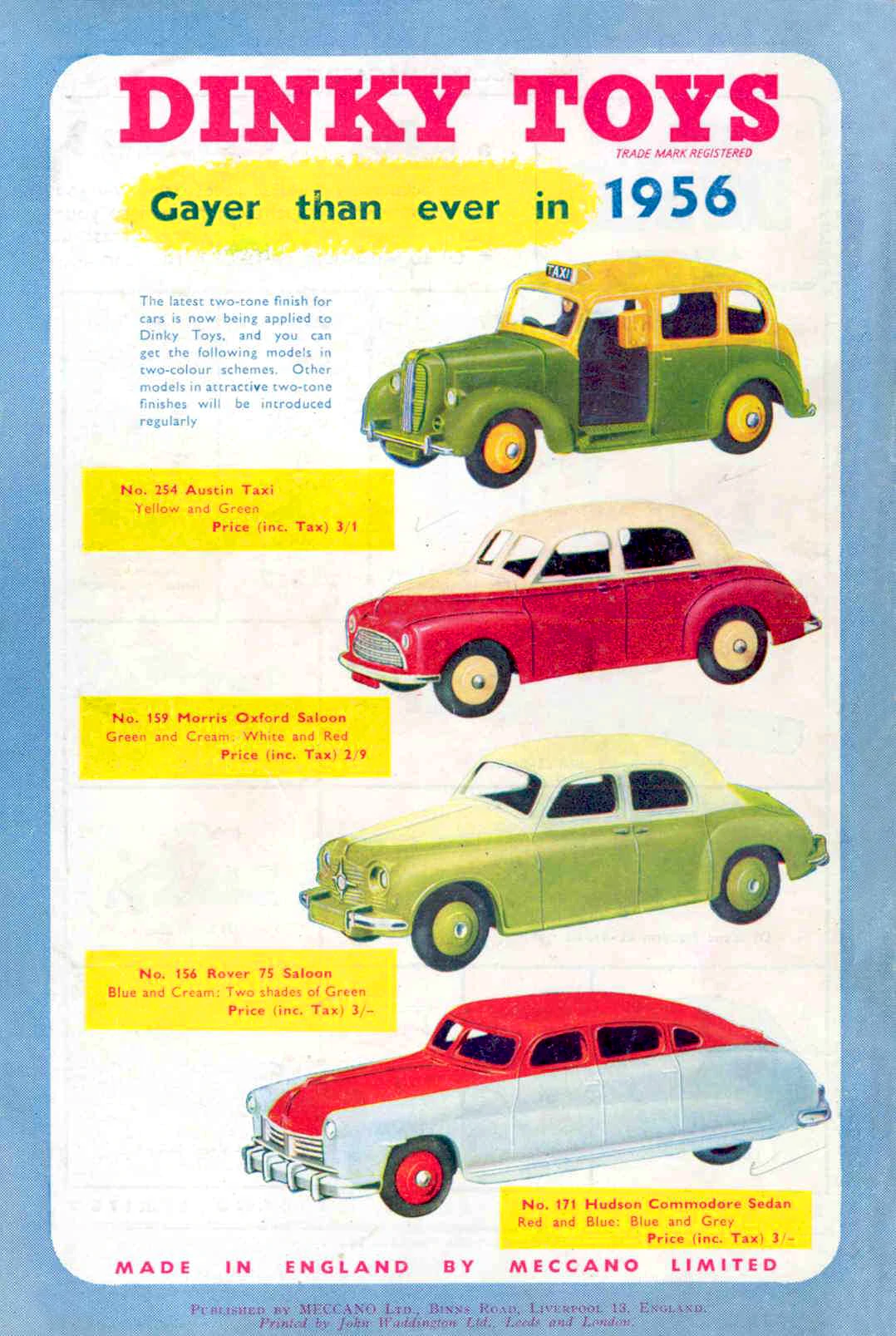
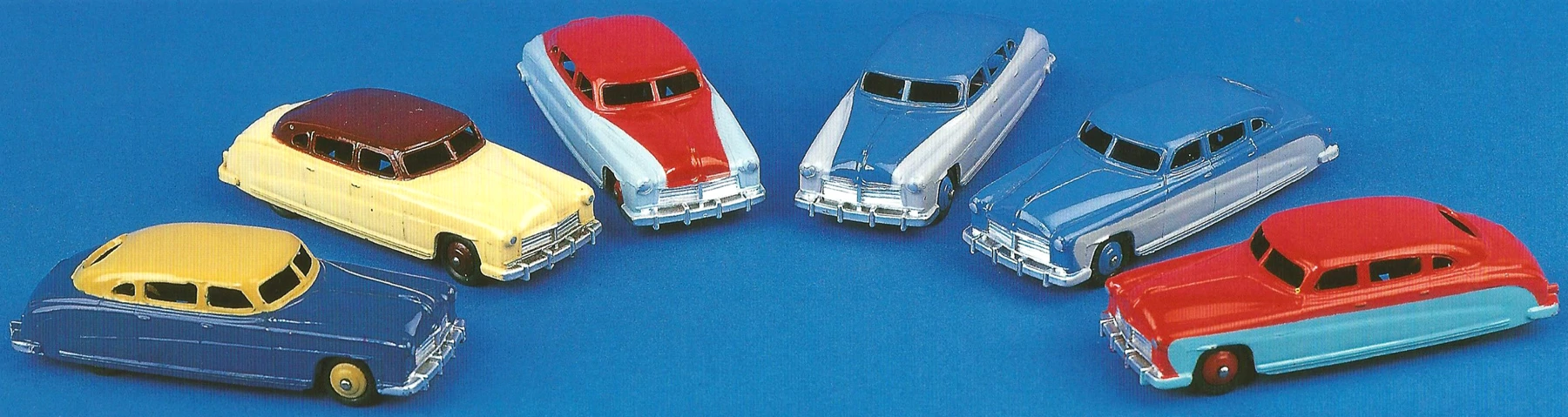
The Hudson Commodore was, in fact, the first post-war Dinky Toys model issued with a two-tone finish, which Meccano Liverpool then applied to other car models from 1956 onwards. Six different two-tone schemes were used on the Hudson Commodore Sedan, some of which are shown below.
Fawn on mid-blue two-tone color scheme used during 1950–1956. Image: Vectis Auctions
Light blue on grey “hi line” two-tone color scheme used during 1956–1958. Image: Vectis Auctions
Dark cerise on light blue “lo line” two-tone color scheme used during 1958–1959. Image: Vectis Auctions
It’s unfortunate that Meccano Liverpool didn’t highlight the attractive speed lines on the sides of the model by mask spraying them in a second color. The model’s speed lines don’t stand out like those of the real car.
From January 1956 onwards, many Dinky Toys models were issued in a two-tone finish, as shown on the back cover of the January 1956 issue of Meccano Magazine, with the slogan “Dinky Toys Gayer than ever in 1956”. Compared with the color schemes used on the real cars, these two-tone schemes are more fantastic than realistic.
Some two-tone variations of the Dinky Hudson Commodore Sedan. Image: The Great Book of Dinky Toys by Mike & Sue Richardson
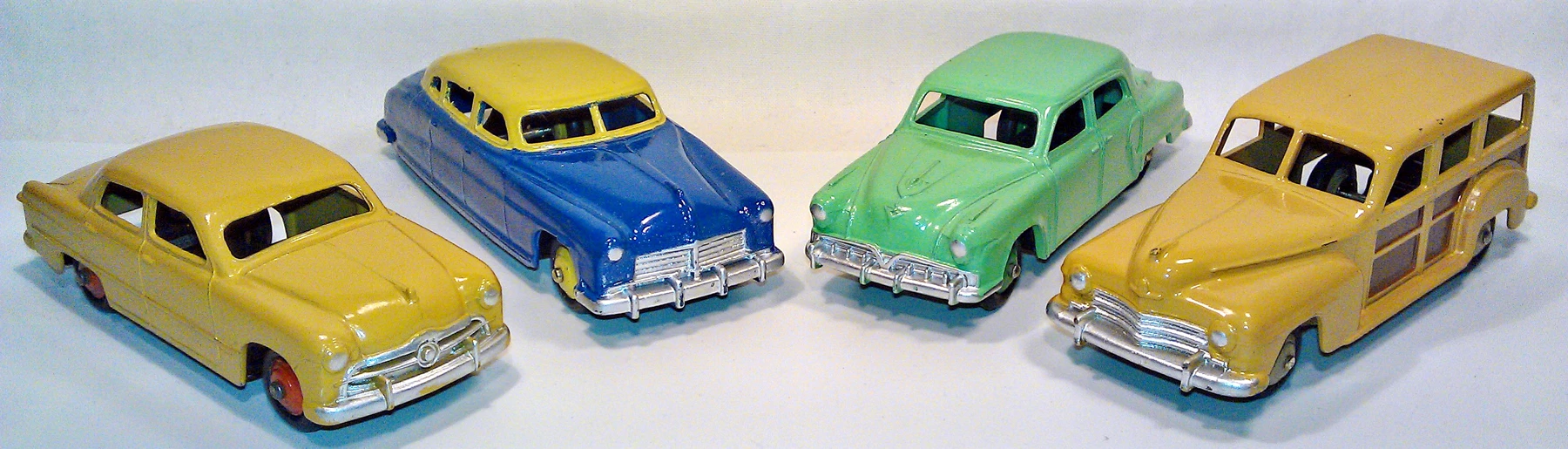
Shown above are my Dinky Toys hard top American cars of the early 1950’s. From left to right:
Dinky 139A/170 Ford Fordor Sedan (1949)
Dinky 139B/171 Hudson Commodore Sedan (1950)
Dinky 139C/172 Studebaker Land Cruiser (1954)
Dinky 27F/344 Plymouth Estate Car (1950)
The streamlined design and two-tone finish of the Hudson Commodore immediately stand out!
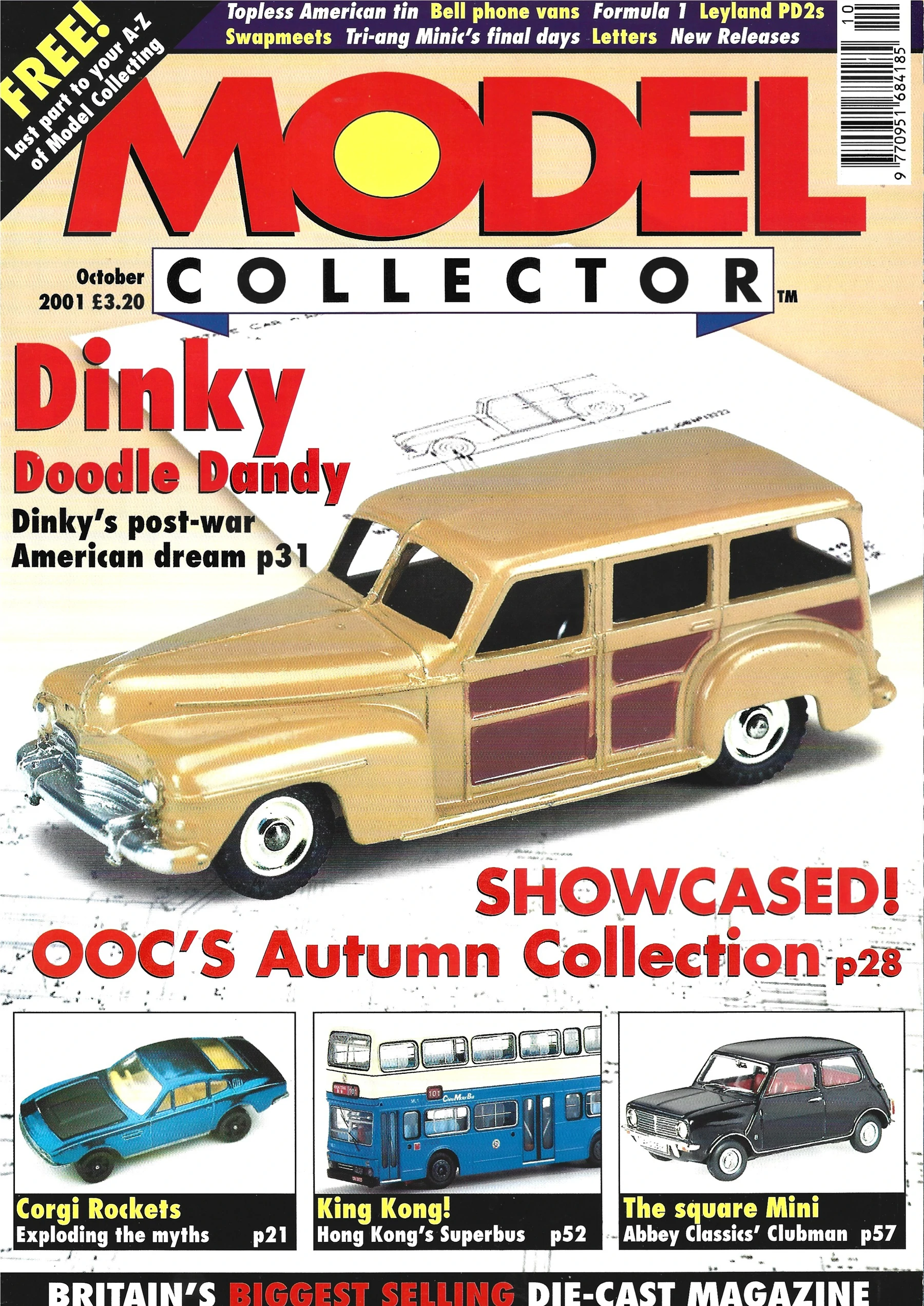
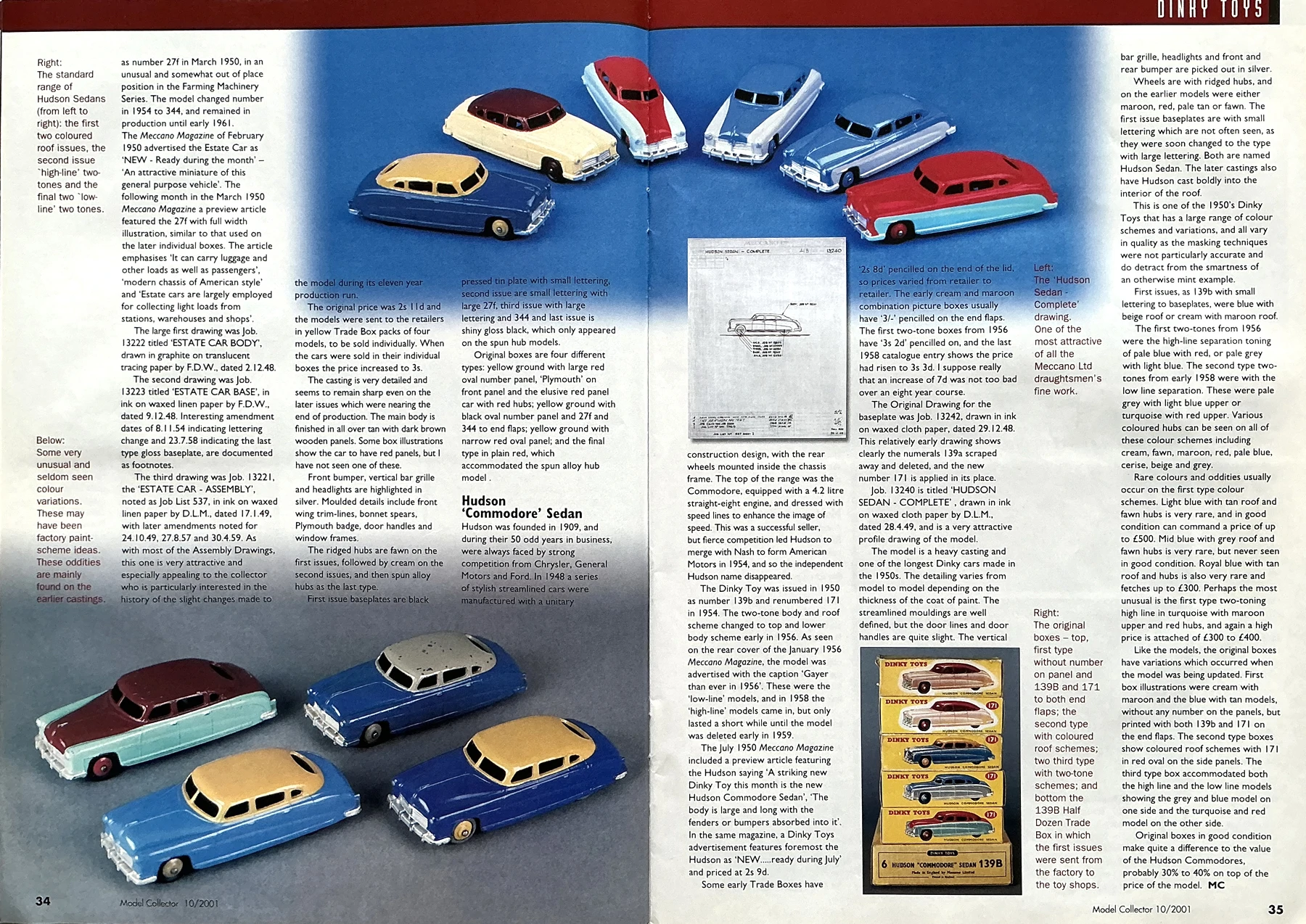
Nigel Mynheer wrote a very interesting article “Dinky’s American dream” about Dinky’s glamorous early 1950’s American cars, in the October 2001 issue of Model Collector. The article covers the Ford Fordor Sedan, the Plymouth Estate Car and the Hudson Commodore Sedan.
Nigel Mynheer’s article “Dinky’s American dream” in the October 2001 issue of Model Collector.
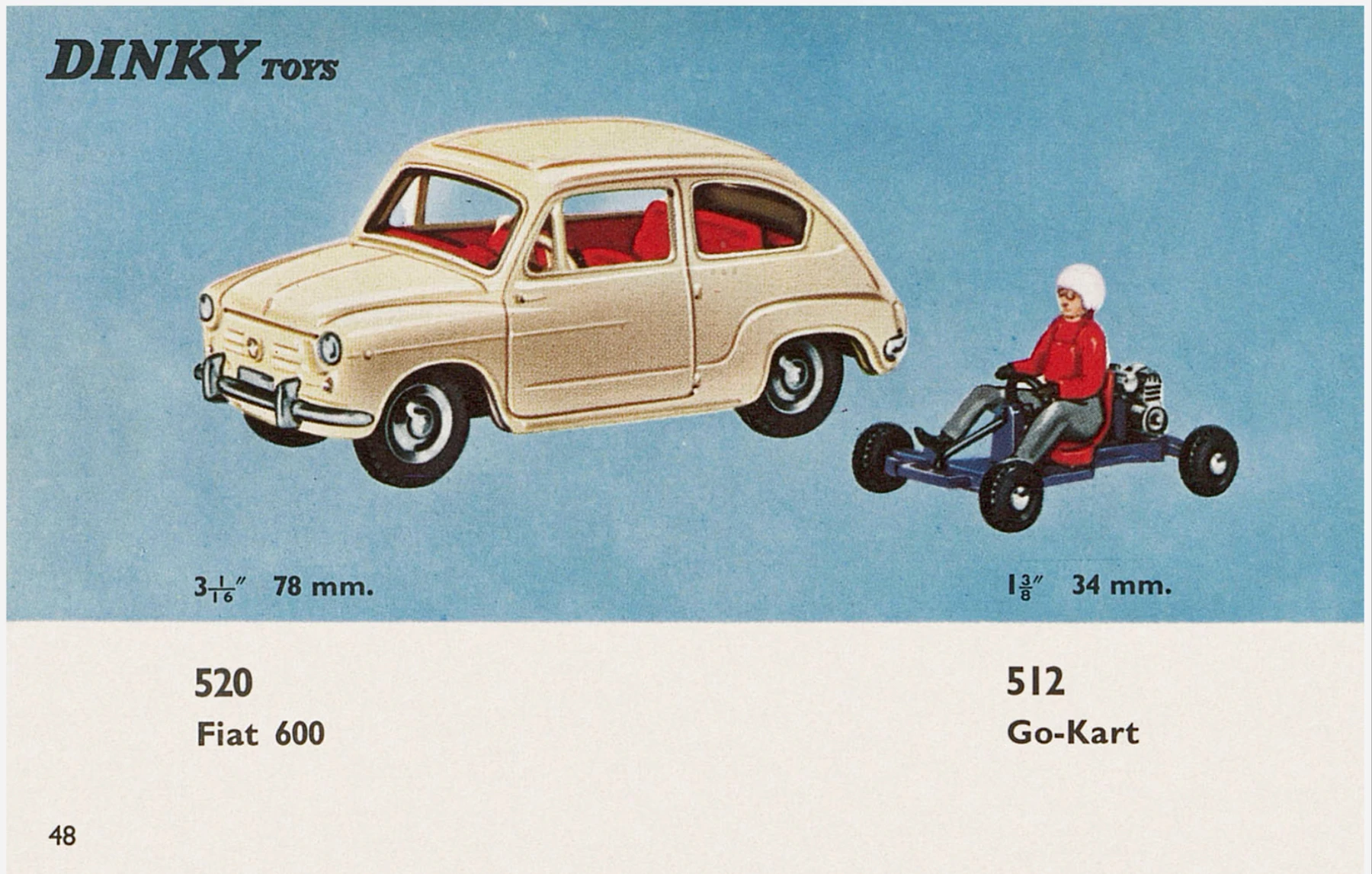
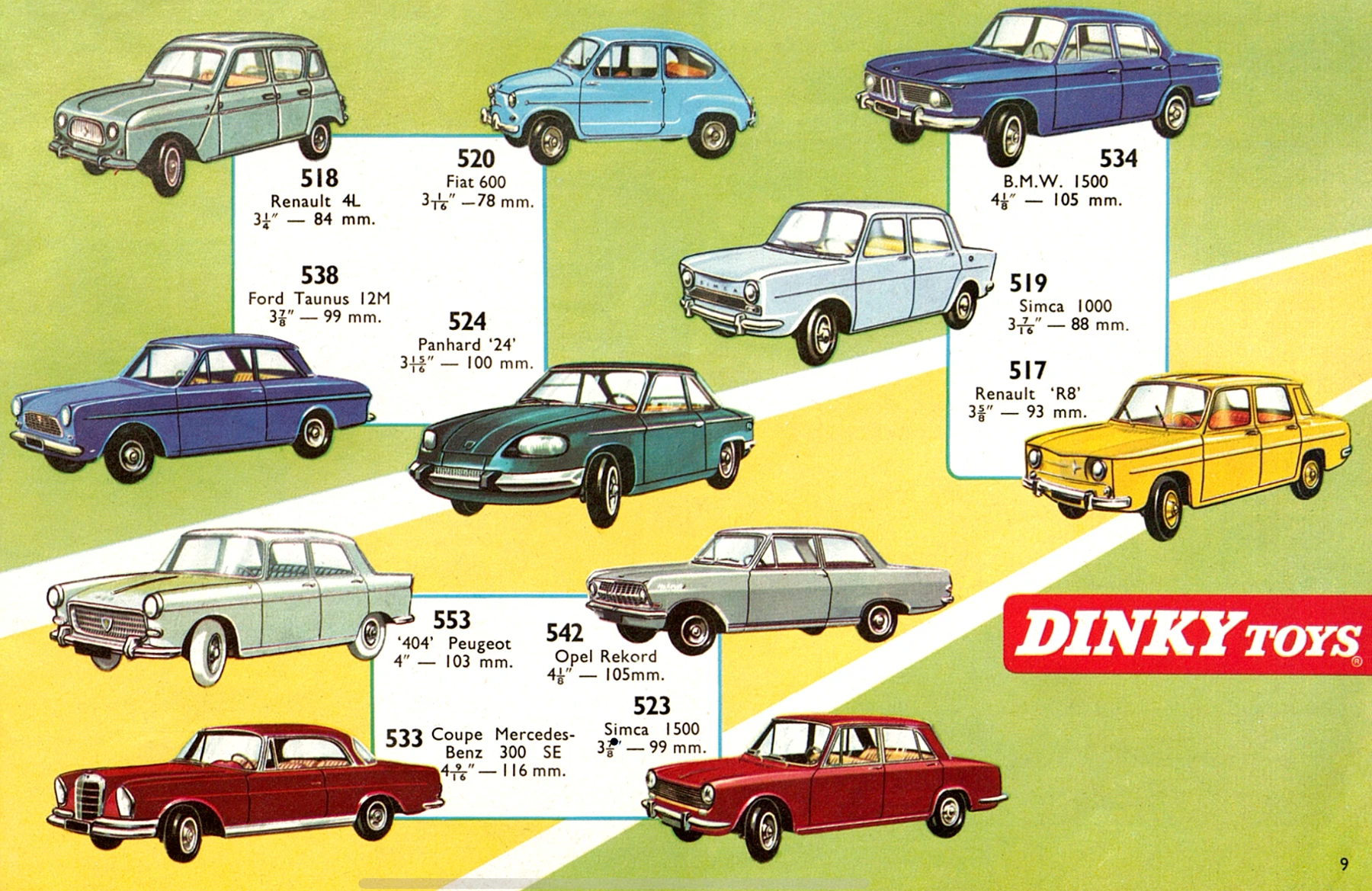
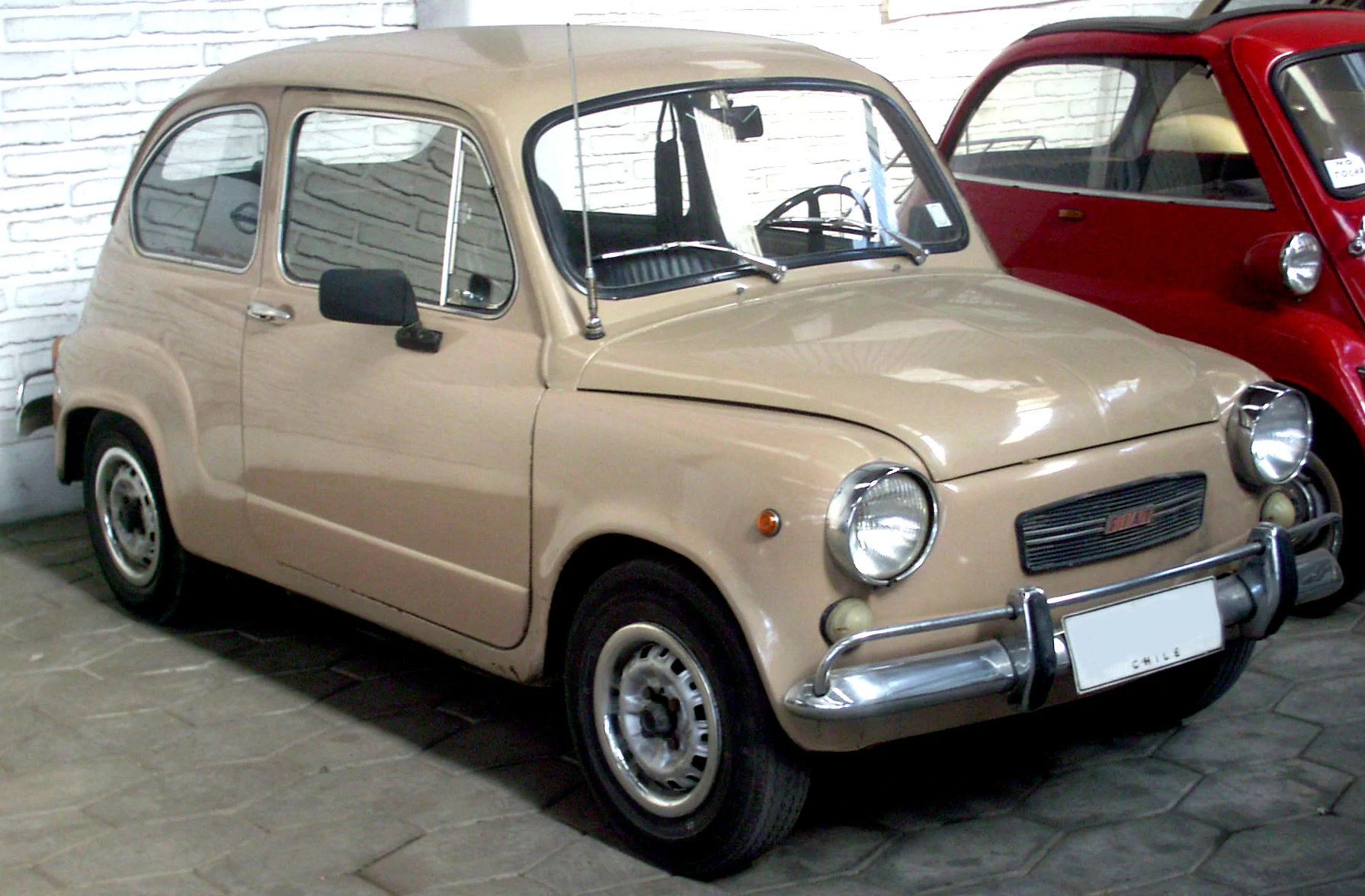
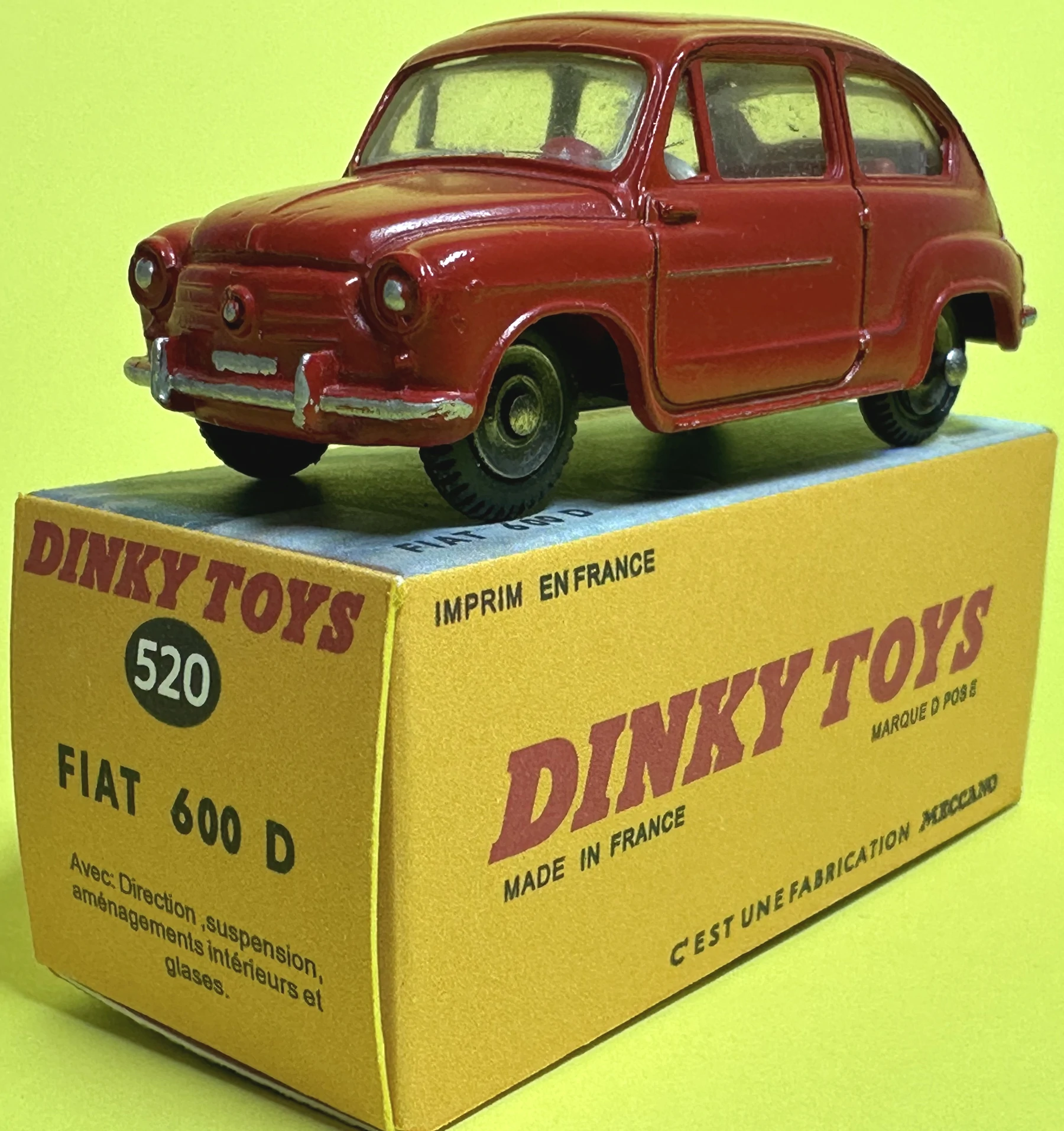
The Dinky 520, a miniature model of the Fiat 600 D, was launched by Dinky Toys France in 1964. This model pays tribute to one of the most iconic city cars of the twentieth century.
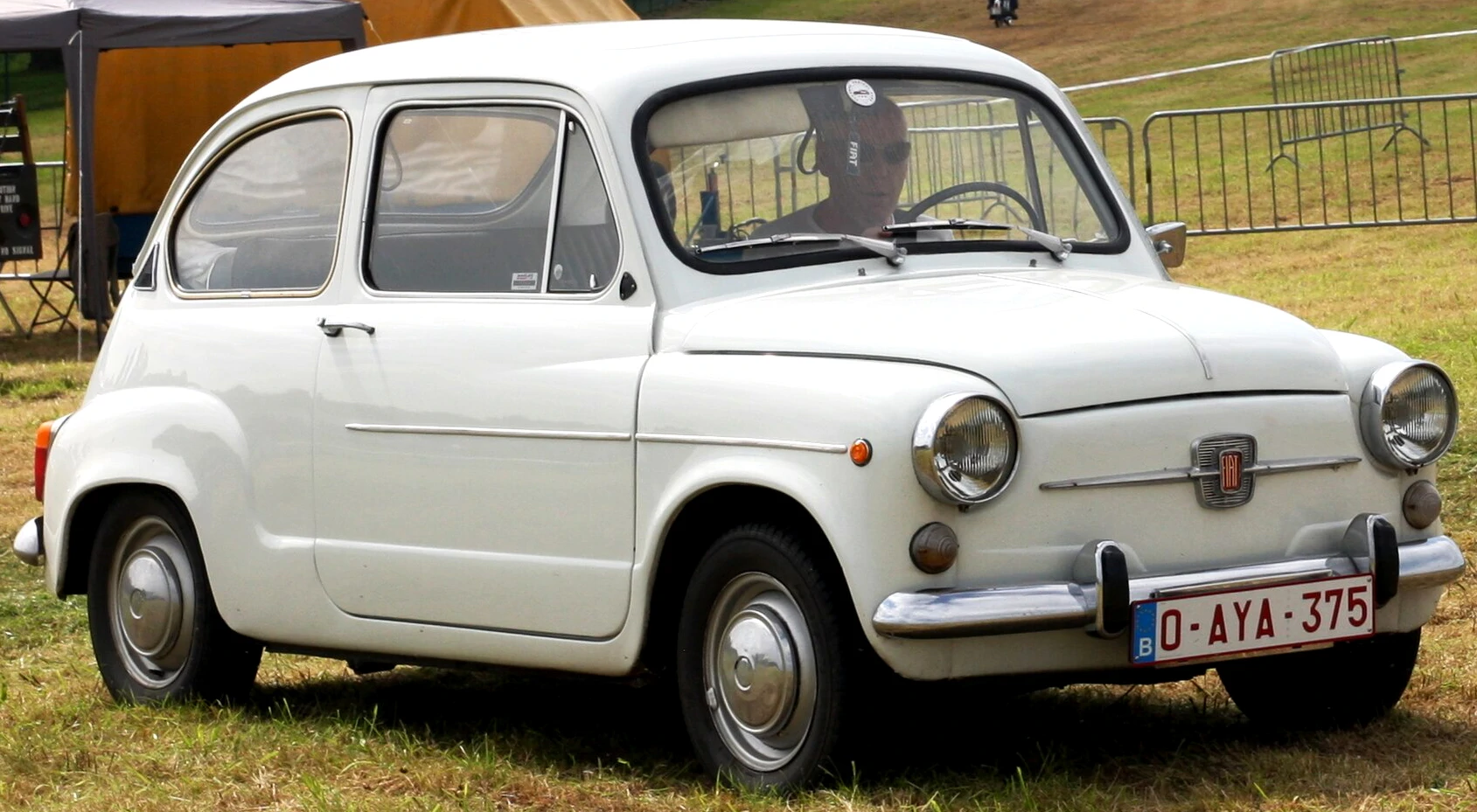
The real Fiat 600 D
The Fiat 600 was introduced in 1955 as the successor to the famous Fiat Topolino. Compact, economical, and affordable, it embodied exactly what post-war Europe needed. The later 600 D featured a larger 767 cc. engine and more comfort, making the car even more popular.
A global success under license
The success of the Fiat 600 wasn’t limited to Italy. Under license, several versions were produced around the world.
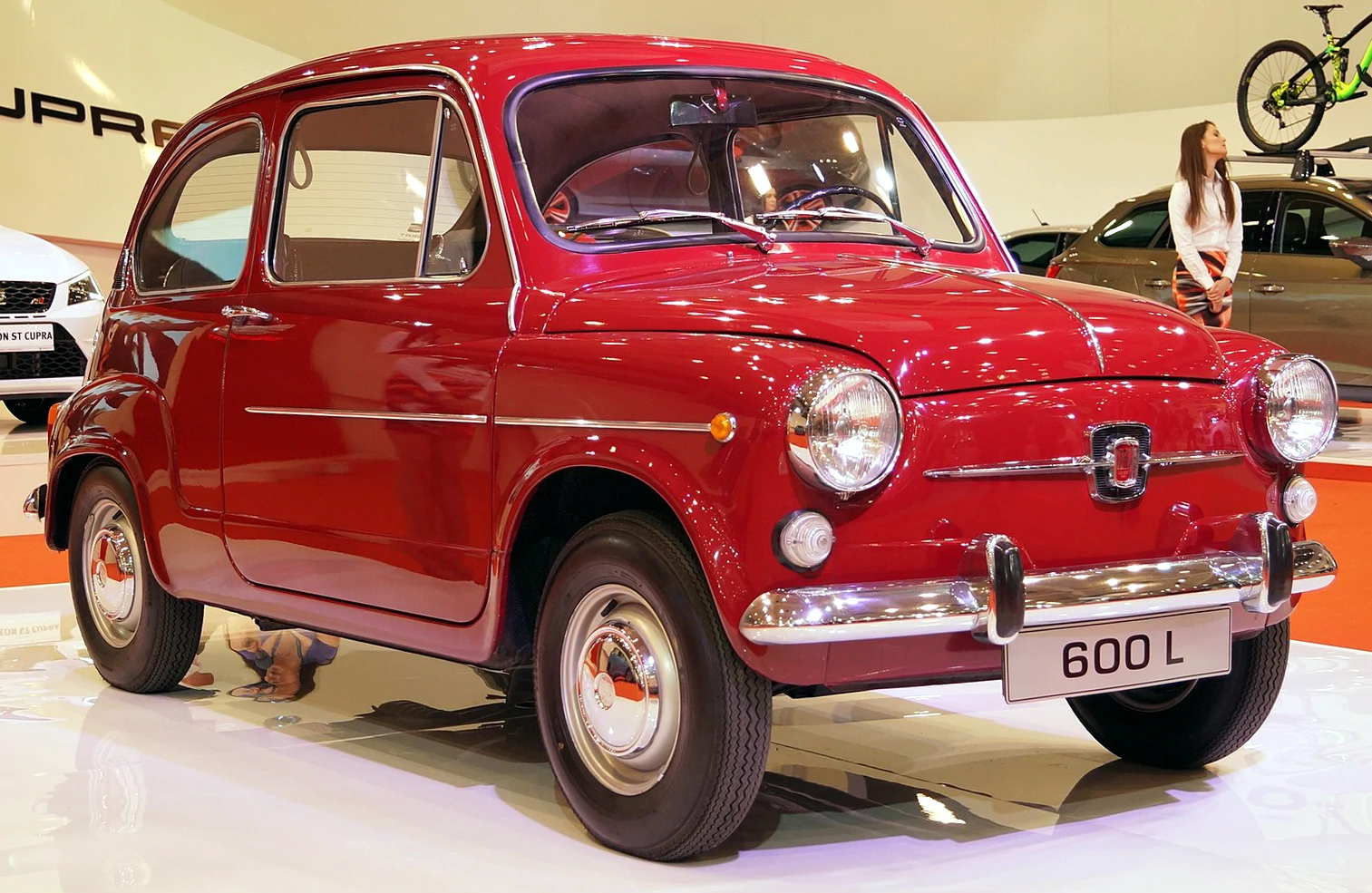
SEAT 600 (Spain) Produced between 1957 and 1973; more than 794,000 units built.
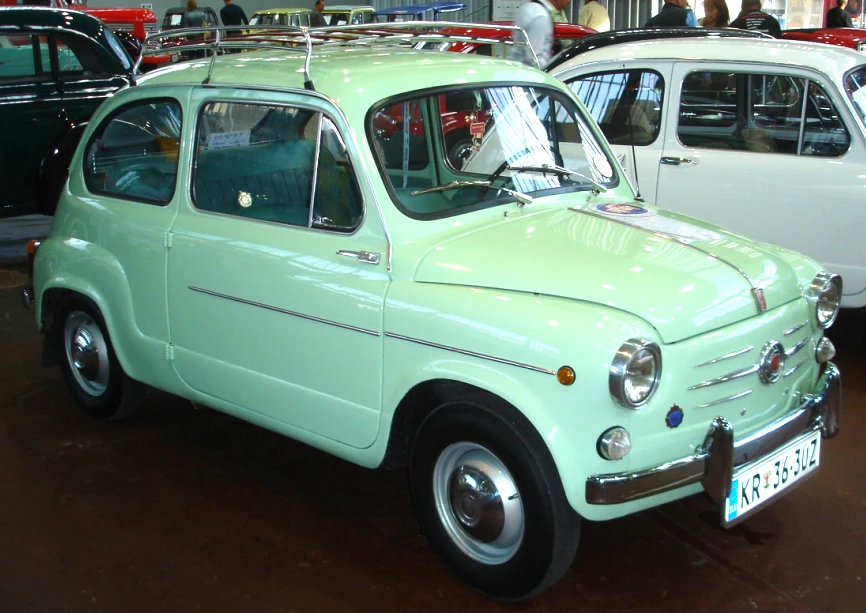
Zastava 750 (Yugoslavia) Produced from 1955 well into the 1980s; more than 923,000 units built.
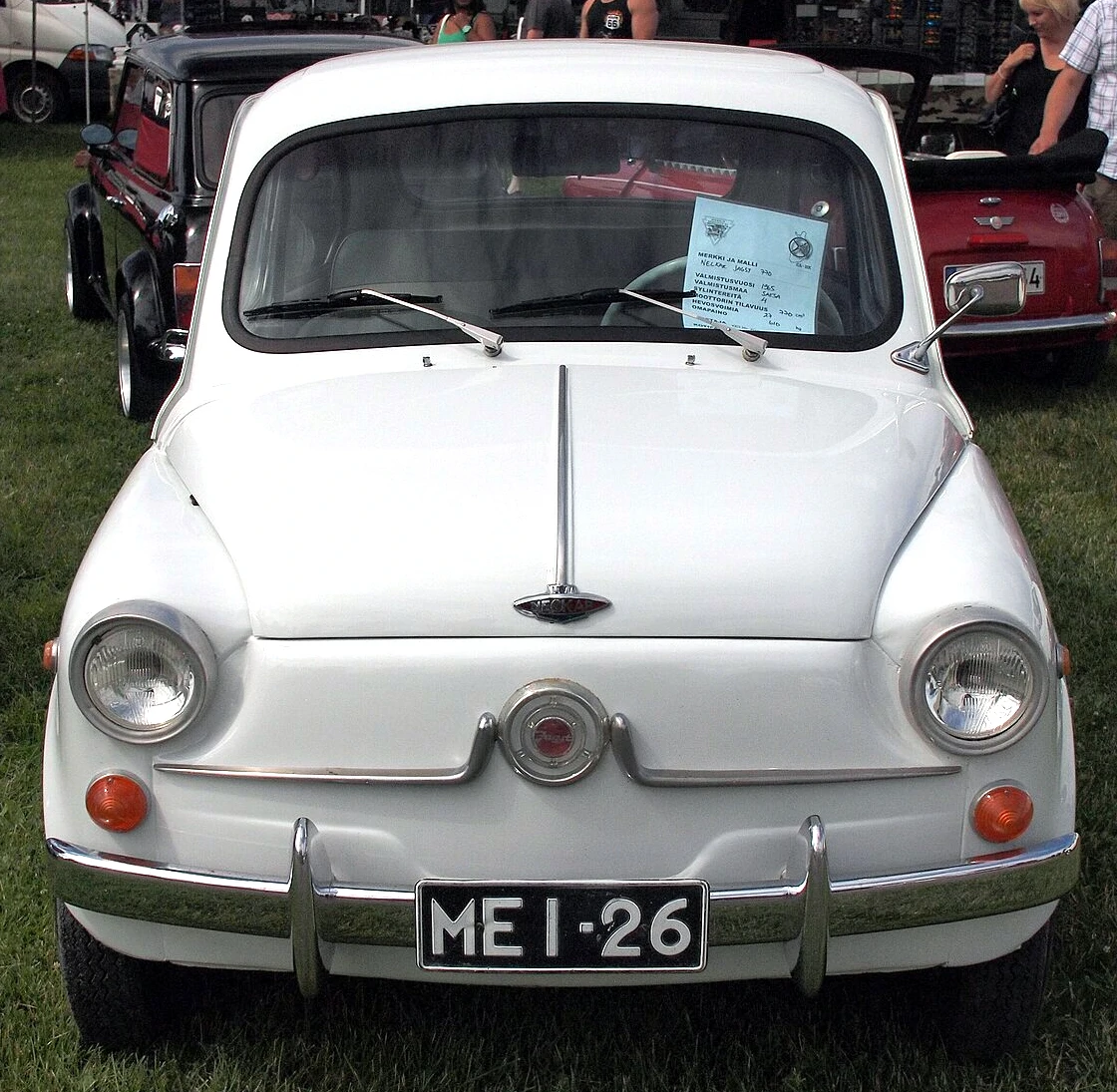
Fiat Neckar Jagst (Germany) Locally built versions for the German market; about 171,000 units built.
Fiat Concord (IKA) (Argentina) Produced for the South American market; about 304,000 units built.
Other local variations also appeared in countries such as Serbia and beyond.
In total, more than 4.9 million Fiat 600s and licensed derivatives were produced worldwide, making it a key player in the mass motorization of Southern and Eastern Europe.
Dinky Toys 520
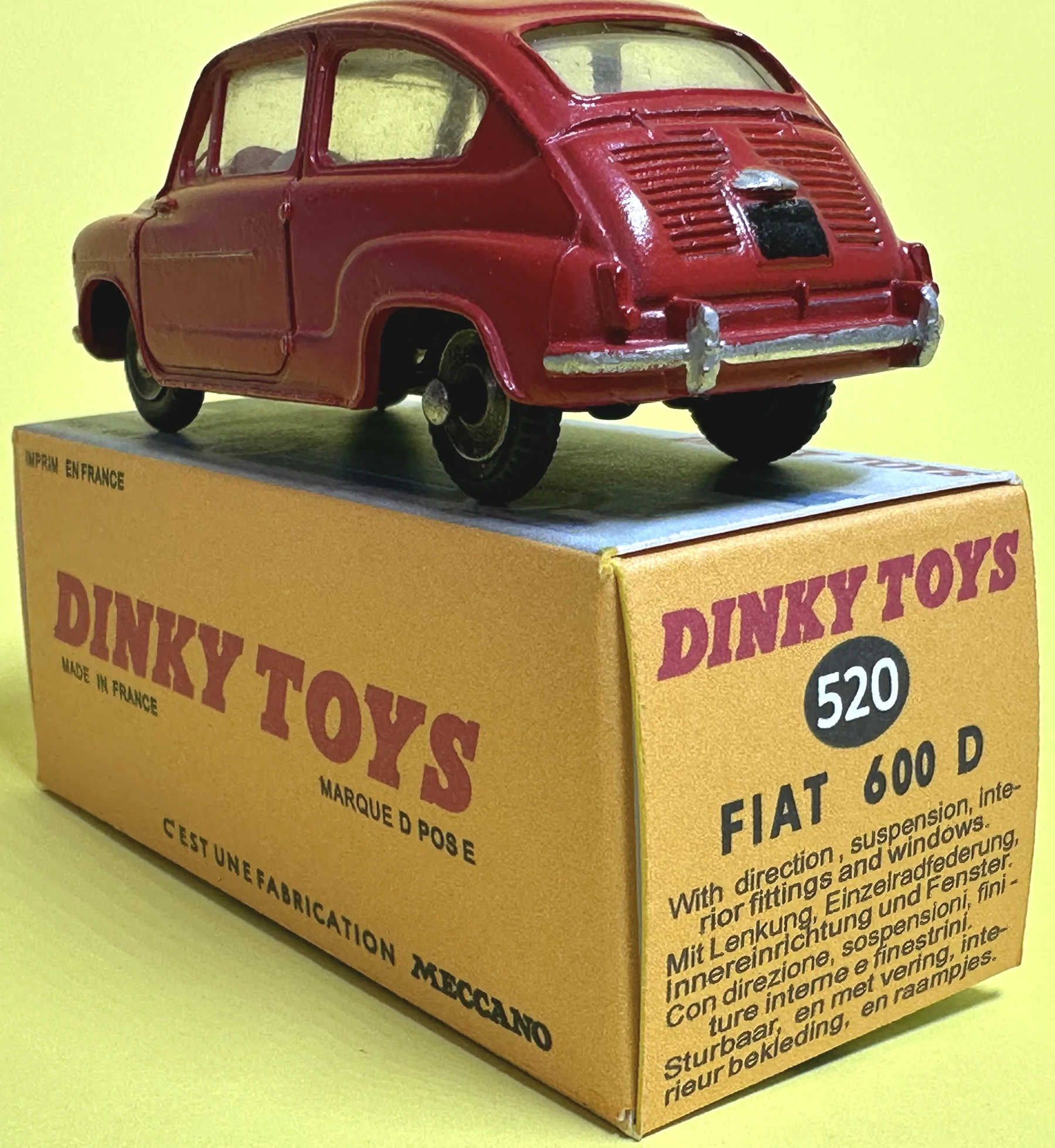
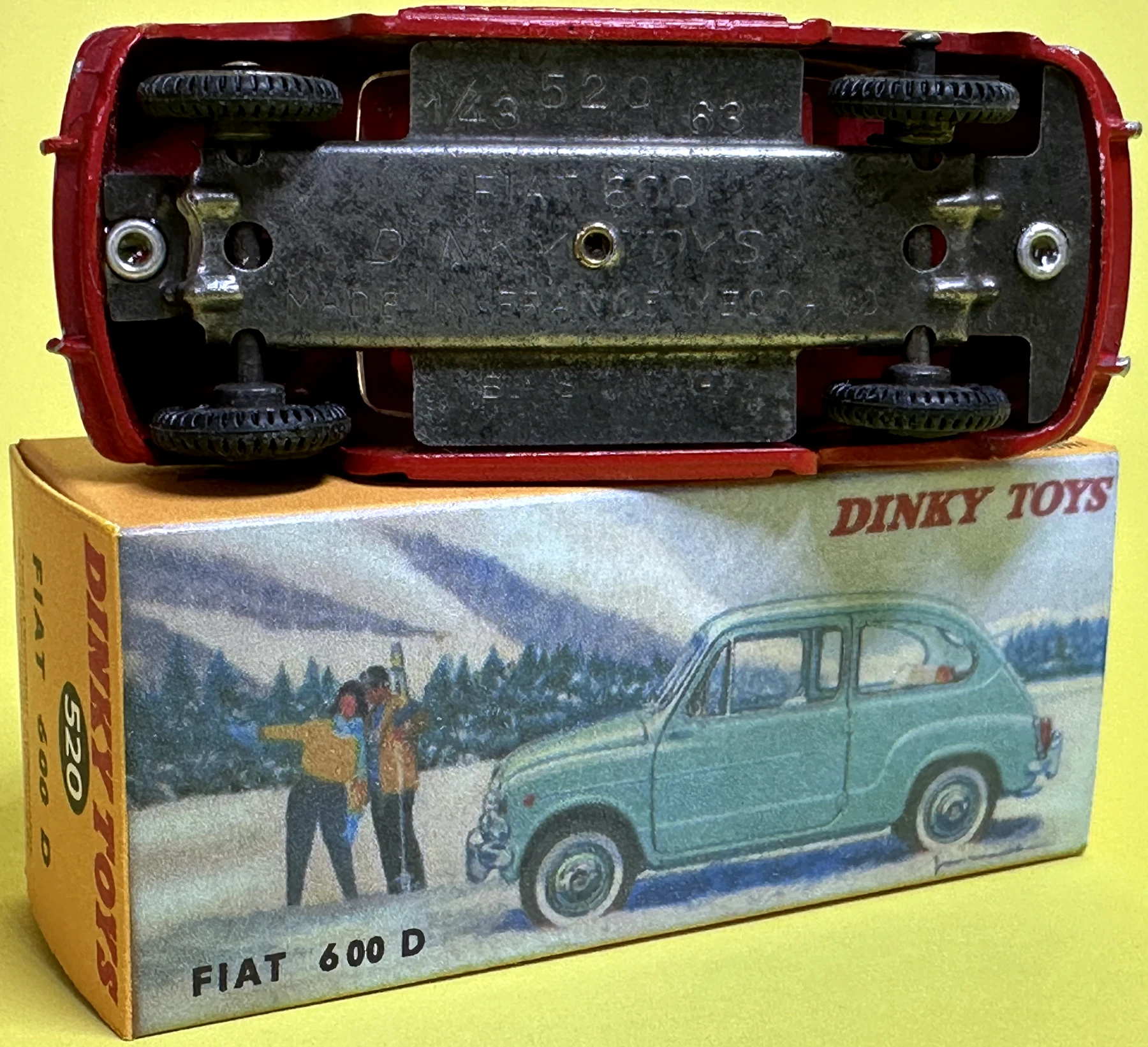
Dinky Toys recognized the popularity of the Fiat 600 D and released this scale model in the 1960s. Some of its key features are:
Die-cast metal body with painted finish.
Scale approximately 1:43.
Simple but recognizable details: grill, headlights and wheels.
Several color variants, some of which are rare and highly sought after by collectors.
Like its real-life counterpart, the Dinky 520 appeared in toy shops across Europe and was sometimes produced under license or with small local variations.
I rescued this little car from the scrap yard and restored it to an acceptable level. The box is a fine copy I made of the original French box.
Dinky 520 Fiat 600 D
Conclusion
The Dinky Toys 520 Fiat 600 D is more than just a toy. It’s a symbol of a time when Europe was getting back on the road. With millions of its real-life brothers on the streets — from Turin to Madrid and Belgrade — this little model packs a long history in a compact format.
When the Meccano factory decided to expand operations overseas in the mid 1920’s, it opened agencies in South American cities such as Bogota (Colombia), Buenos Aires (Argentina) and Iquitos (Peru). The last one is puzzling, as this city was not a capital like the other two, but a medium-sized regional city located in the heart of the Amazon jungle in the Great Plains of the Amazon Basin. It was probably chosen because it was a major inland river port, where ships carried goods to between Peru and Europe via Brazil.
Basic raw materials such as rubber, precious woods and tropical fruit were fundamental to the industrial development of European countries, including the United Kingdom. There were numerous British import/export firms and companies operating in Iquitos, which gave rise to a small market for finished products such as Meccano toys, for the children of expat families who lived there. Another reason could have been that it is the South American continent’s most centrally located city, from where distribution of goods was possible through an important waterway that was the Amazon River.
From 1920 until 1928, the Meccano company had started a North American subsidiary, with a factory located in Elizabeth, New Jersey, where Meccano sets and Hornby trains were essentially manufactured for the US market.
This production was short lived due to litigation by the A.C. Gilbert Company, which produced American Flyer trains and Erector sets, which were similar toys. Also, the effects of the Depression era were being felt, and the company was forced to close and was sold to its rival, which curiously enough, made Meccano parts for the US market until the early 1930’s. Canada was still part of the British Commonwealth, and Meccano had a warehouse and offices in Toronto, its market possibly a part of the distribution of this operation.
Nonetheless, South America offered a great manufacturing possibility after the closing of the N.J. factory, and Buenos Aires, Argentina, was chosen over the other two cities because it was more cosmopolitan and had strong links to Europe via the Atlantic Ocean and to the rest of South America. Industrial activity was at a high level of development, and specialized labor and lower taxes were a good incentive to open a new factory there. Buenos Aires had also a Harrod’s department store subsidiary, which was an additional venue for selling toys.
Meccano parts started being manufactured from the mid 1930’s under license, including special Hornby trains, boats and aircraft. It’s not known if Dinky Toys were also made or assembled there. Later after the war, Exacto S.R.L., continued producing 75% of the Liverpool range as well as some special parts from the mid 1960’s to the mid 1980’s.
Pre-War Spanish Dinky Toys Literature
Following the demise of the North American factory and the start of operations in South America, there was a need to market Meccano products to Spanish speaking countries. Thus, the Meccano general catalog of the times needed to be translated based on existing U.K. issues.
The first Dinky Toys had appeared as “modeled miniatures” in the general catalog of August 1933, and “Meccano Dinky Toys” were officially renamed in April 1934. These were done as accessories to Hornby train layouts, and to compete with the famous “Tootsietoy” range of products.
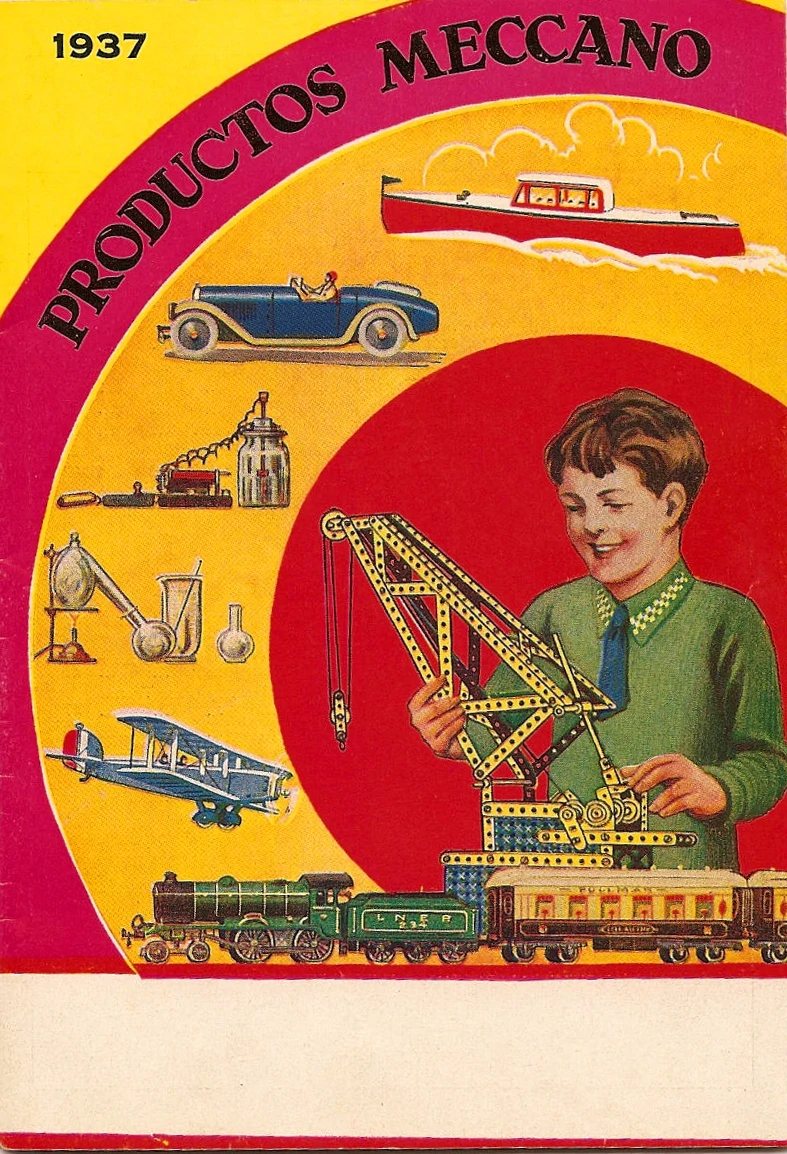
Meccano 1937 catalog
Like their British counterparts, the South American exports were shown first in the general catalog, the earliest known one being the 1937 issue.
1937 Meccano catalog
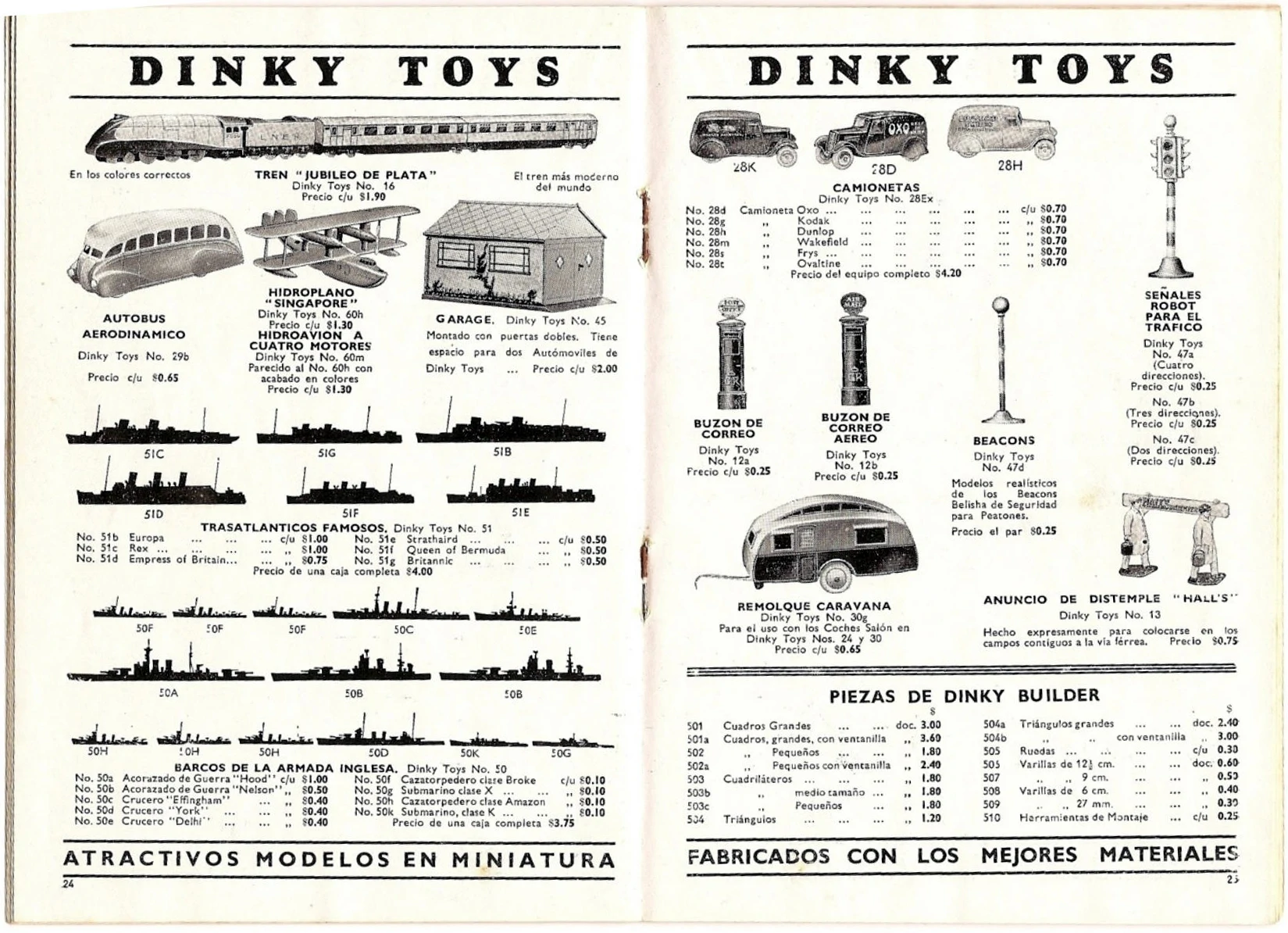
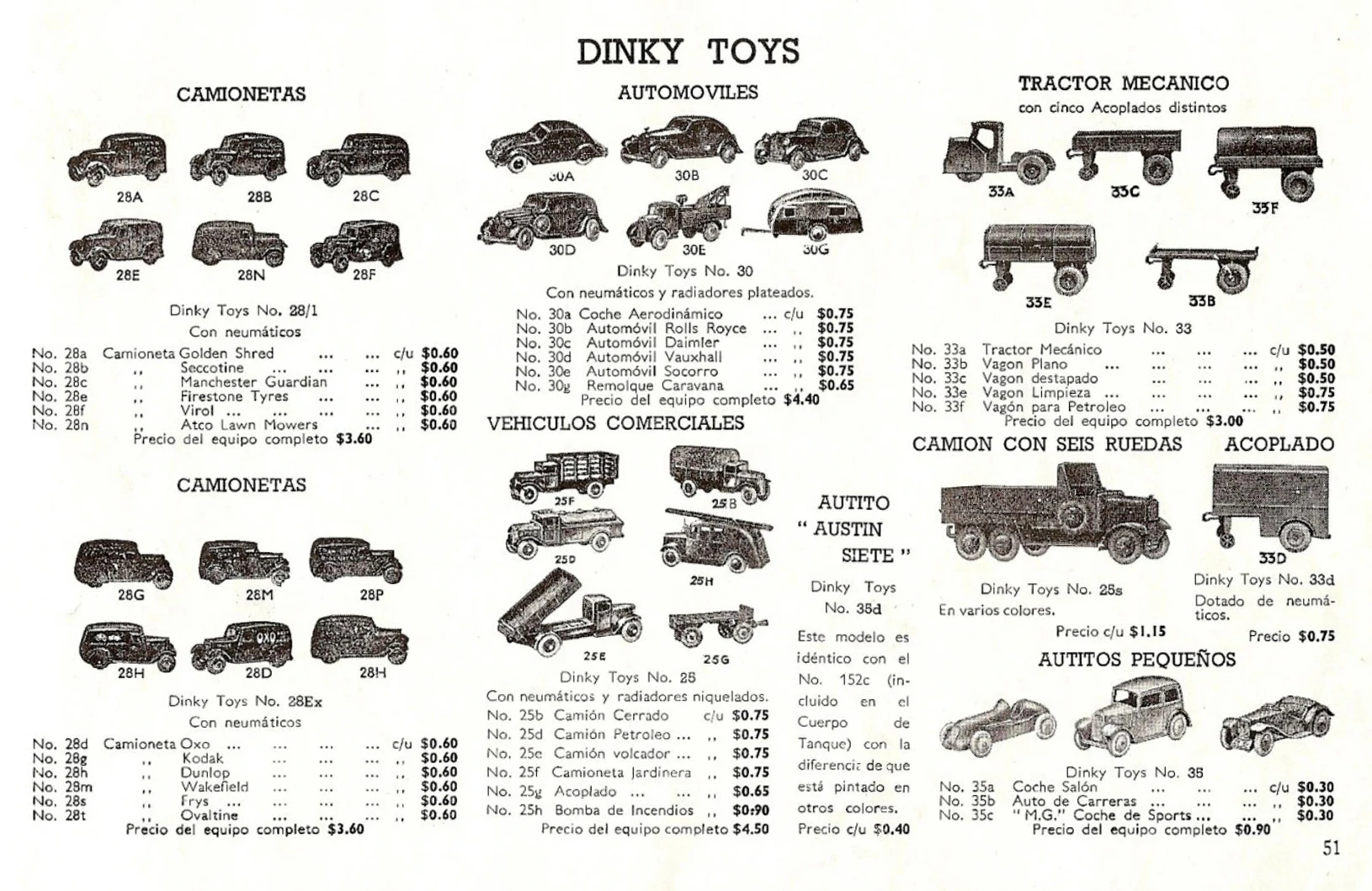
The range of Dinky Toys was similar to those of the previous or same year UK issue catalog, with Spanish descriptions and prices in Argentine pesos. The cover was in full color and printed on glossy paper, and the rest of the catalog was generally black and white with an extra color added if necessary.
The 1937 catalog has 50 pages including the covers, and has one page devoted to the Dinky Builder, two pages to Dolly Varden dollhouses and furniture, and six pages of Dinky Toys. It measures 5” x 7”. As can be seen in the pictures above, some of the highly sought after van liveries are shown.
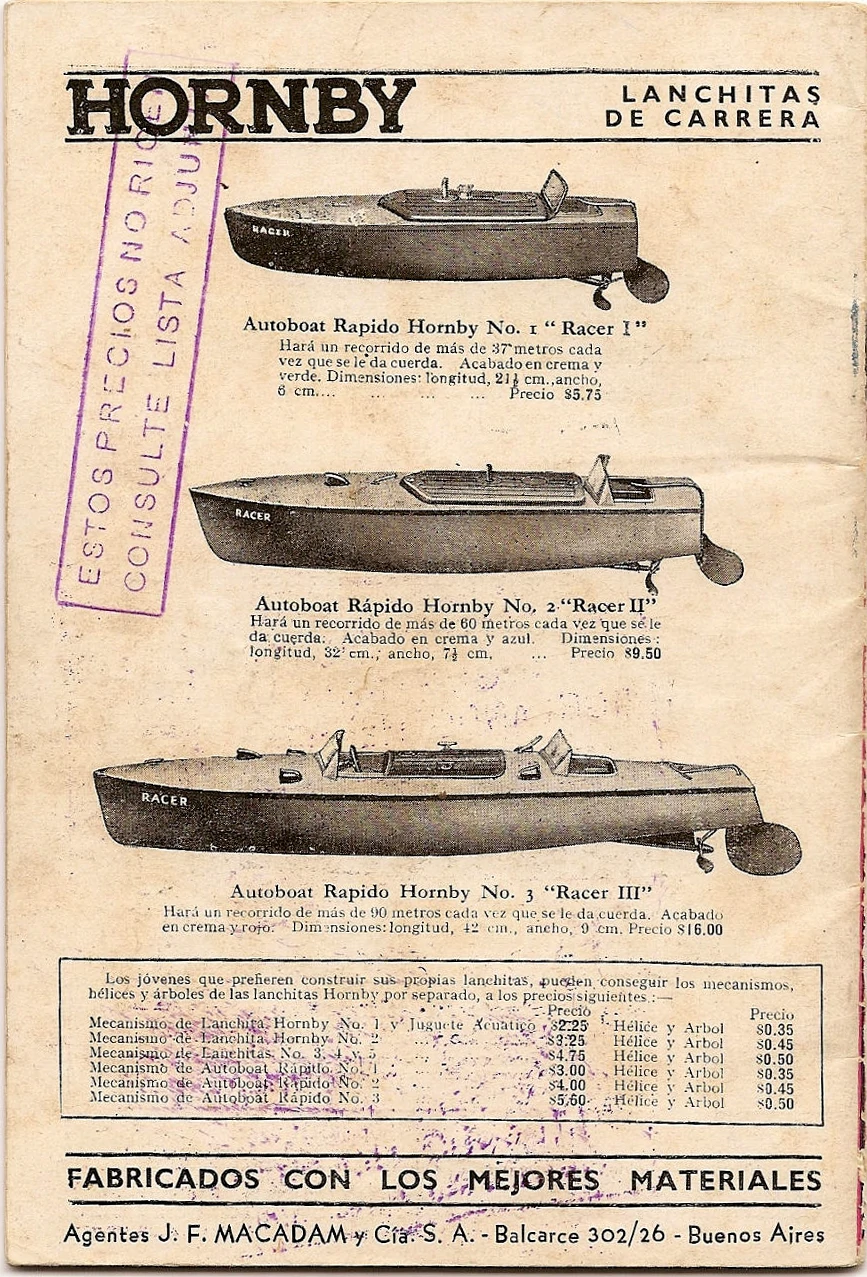
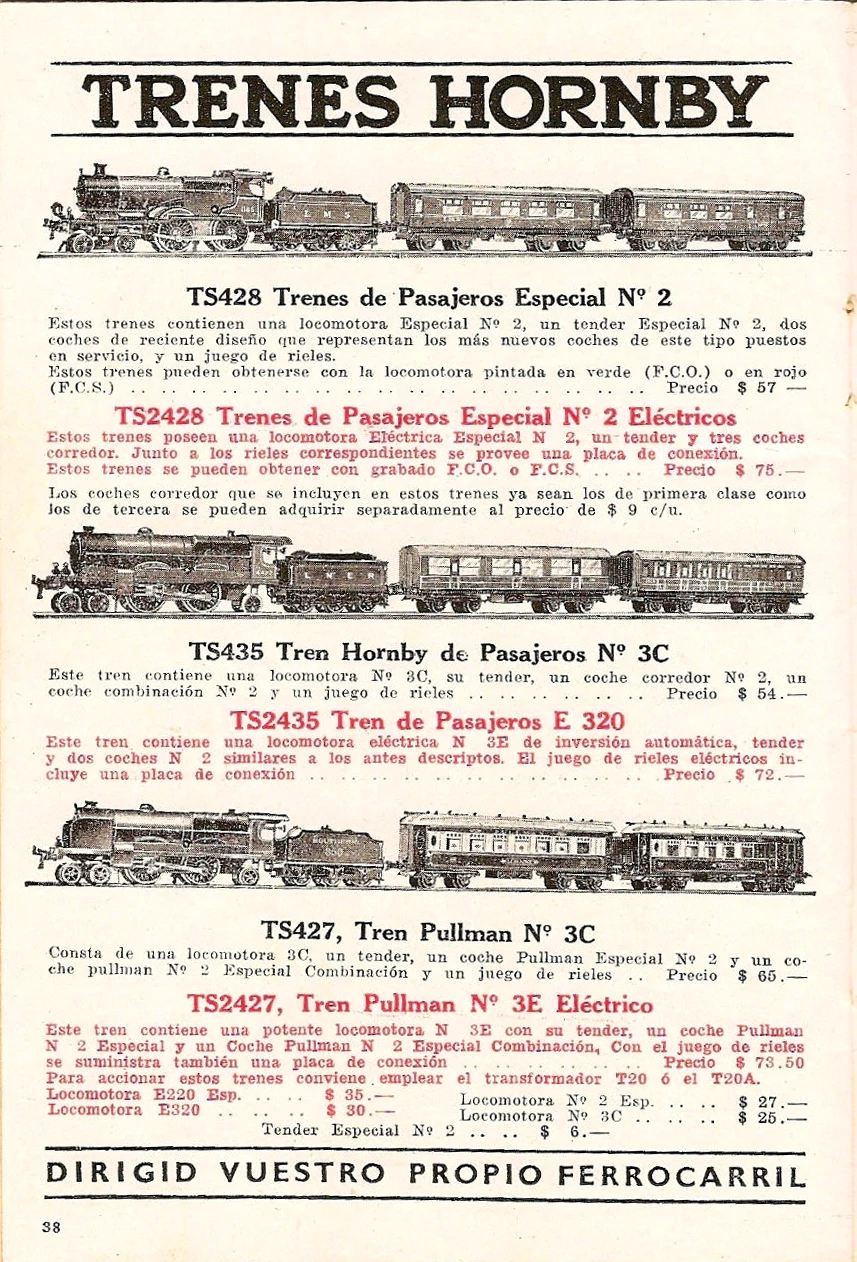
It’s interesting to note that certain Hornby train locomotives and rolling stock were made specially for the Argentine market in red or green colors, with painted lettering of local railroad systems. These items are very rare and much sought after by Hornby collectors.
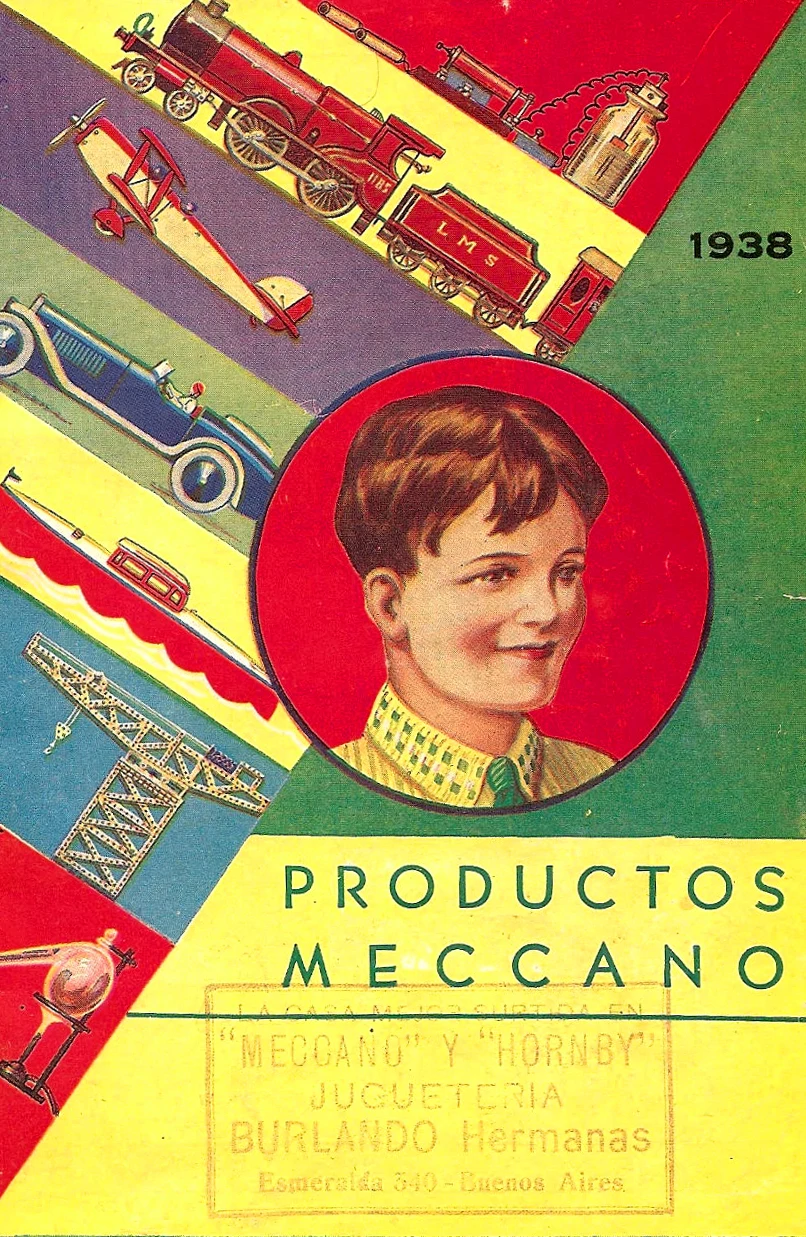
Meccano 1938 catalog
The 1938 catalog has 56 pages, including covers; one page dedicated to Dinky Builder models, two pages of Dolly Varden dollhouse and furniture and seven pages of Dinky Toys, the new additions being military models. Its size is 4¾” x 7”.
Again, there are special Hornby train issues, this time an addition of a metropolitan locomotive with the lettering F.C.S. (Ferro Carril Sur) or South Central Railways. The other letterings available were F.C.O. (Ferro Carril Oeste) or West Central Railways and F.C.C.A. (Ferro Carril Central Argentino) as shown in the pictures below.
1938 Meccano catalog
Meccano 1939 catalog
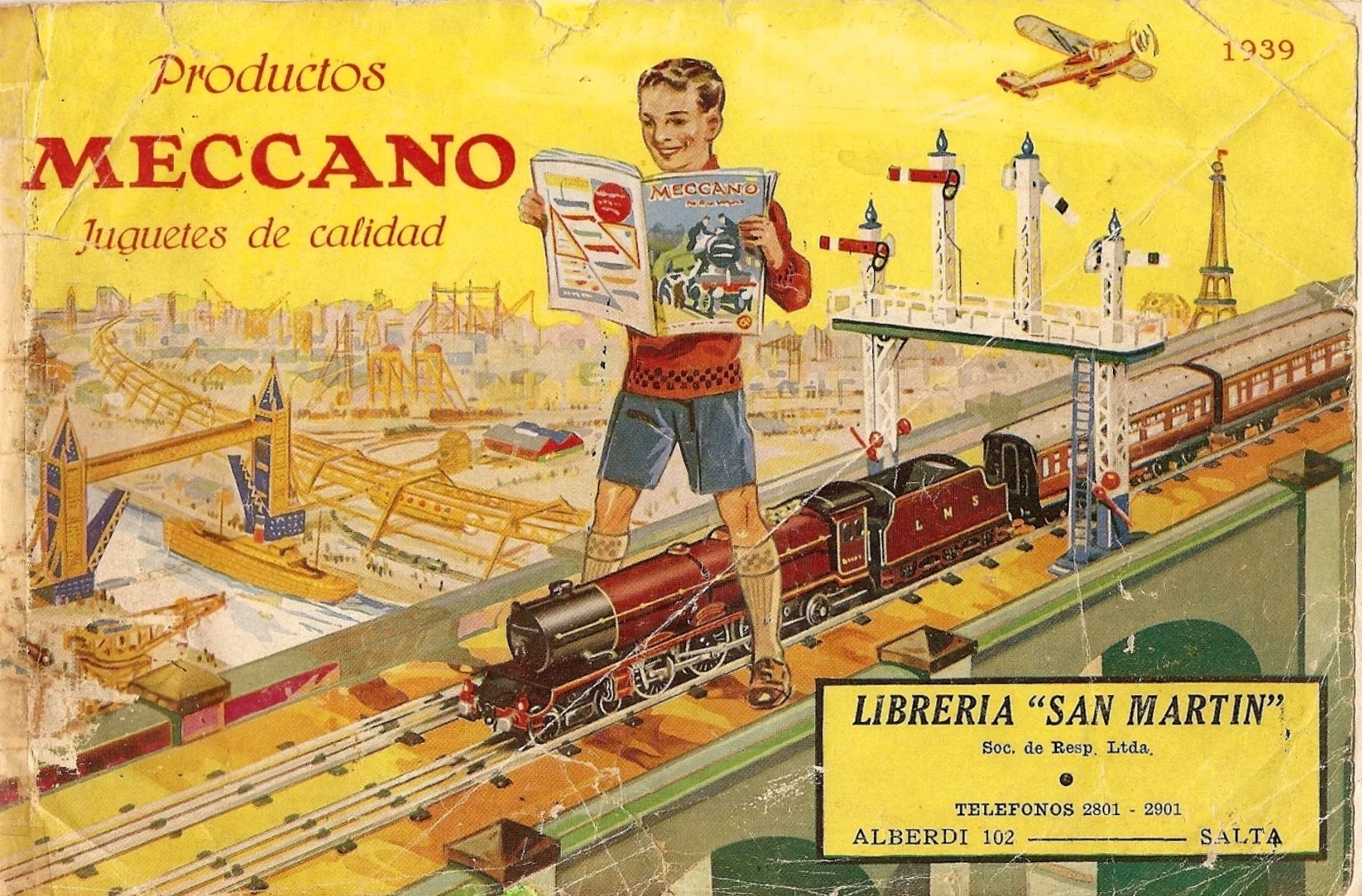
The 1939 catalog has 66 pages, including covers; one page for the Dinky Builder, two pages of Dolly Varden dollhouse and furniture, and nine pages devoted to Dinky Toys. The catalog measures 5½” x 8½”.
The new issues were some products of the French Meccano factory followed by a “z” to distinguish them from the British models:
60z Airplane set 60z
60az Arc-en-ciel
16z Diesel train 16z
26z Diesel autocar
14z Triporteur
53az Battleship Dunquerque
1939 Meccano catalog
Meccano 1940 brochure
In 1940, Meccano issued a separate brochure exclusively for marketing Dinky Toys, as they had increased in number and popularity. This was printed only in black and white duotone, following the 1939 famous U.K. issue. It was designed as a foldout like the 1940 U.K. issue, with 12 pages including covers. Its size when closed is 6” x 9” and 9” x 36” when fully opened. The new items were mostly military models, camouflaged aircraft and vehicles.
1940 Meccano brochure
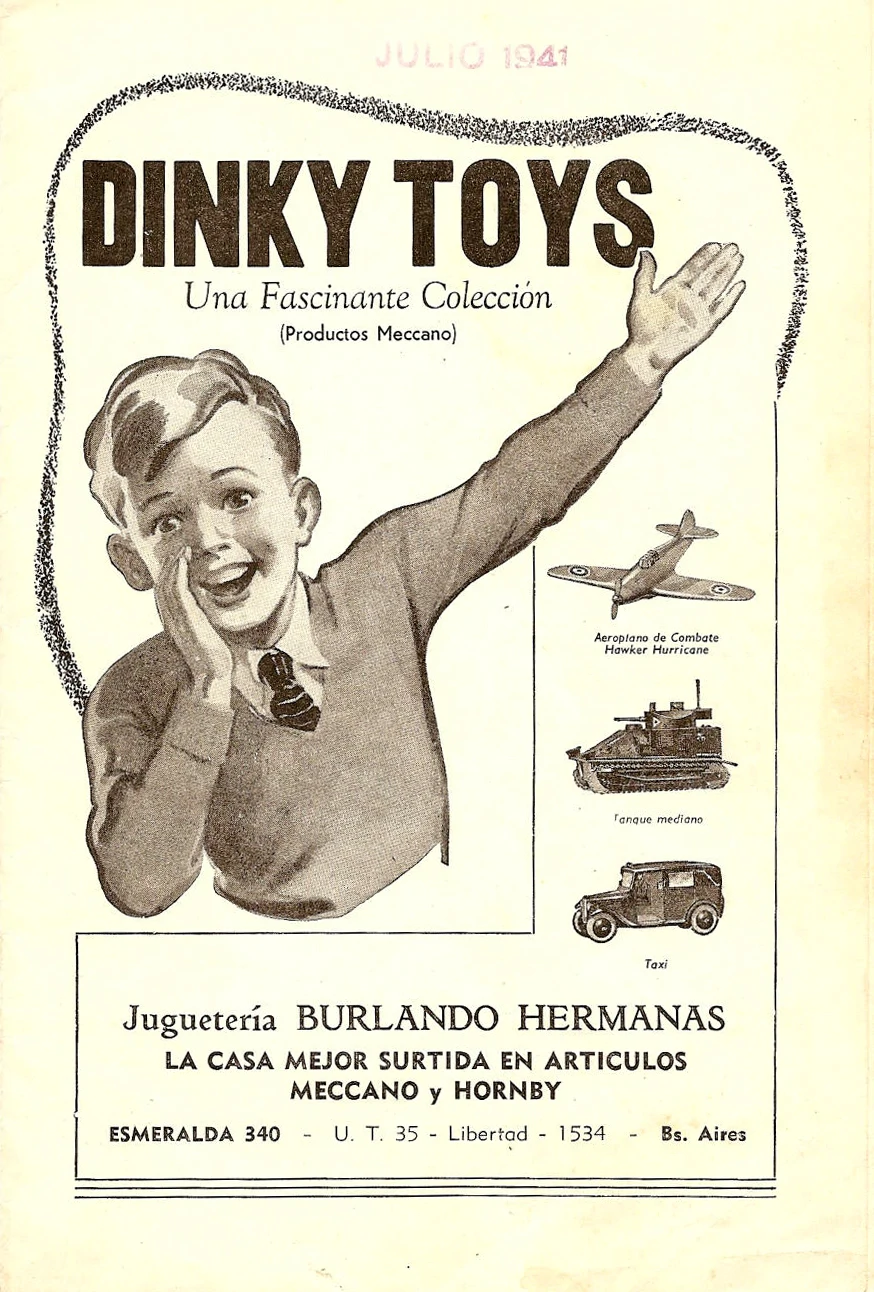
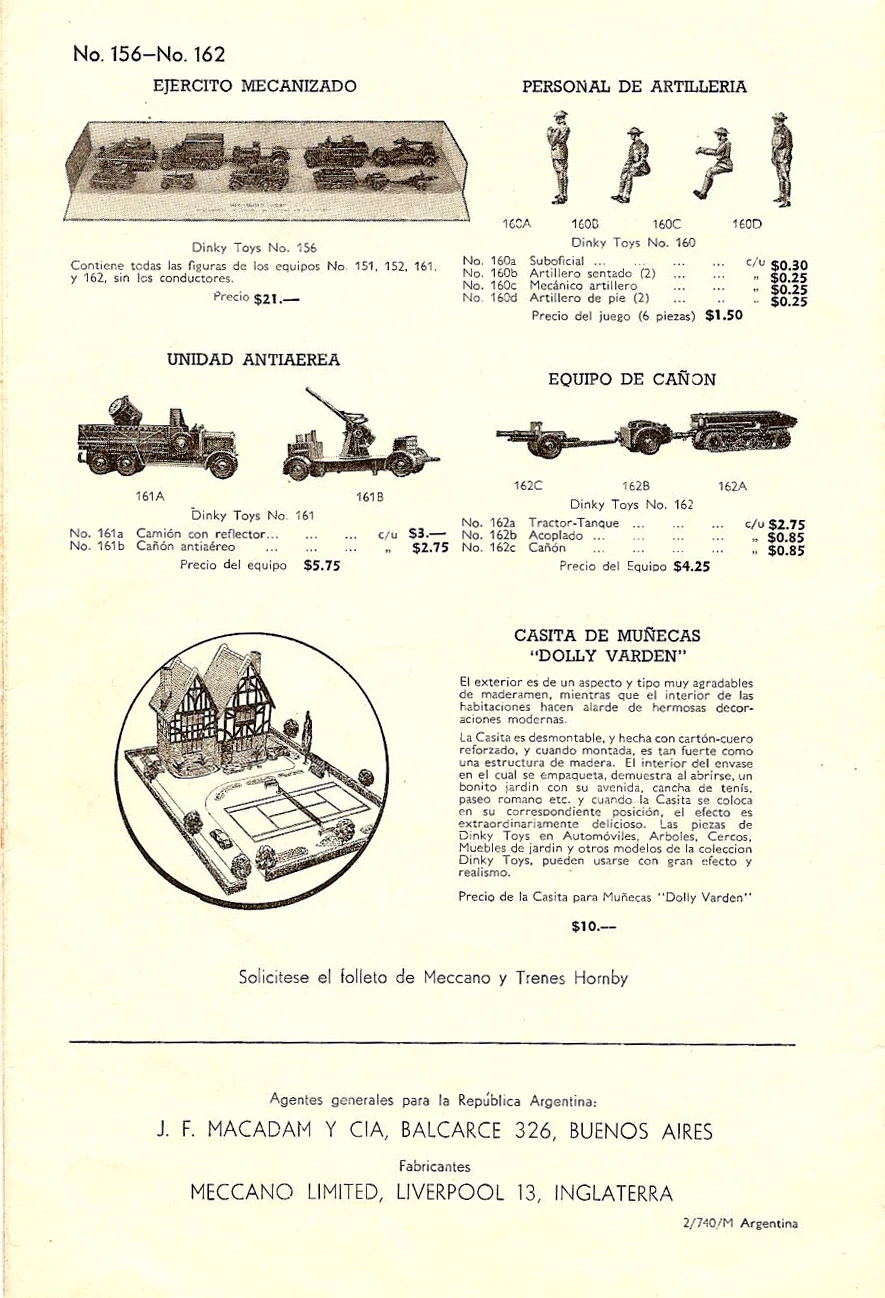
The start of World War II stopped production and exports in 1941, as well as literature. It should be noted that the agents for Argentina were J. F. Macadam and Co., located in Buenos Aires. The most well known toy store that specialized in Meccano products and Hornby trains was Burlando Hermanas (“Burlando Sisters”), now defunct.
Year
Title
Catalog type
Ref. number
1937
Productos Meccano
General
N/A
1938
Productos Meccano
General
N/A
1939
Productos Meccano Juguetes de Calidad
General
17/738/M Argentine
1940
Dinky Toys Una Fascinante Colección
Brochure
2/740/M Argentina
List of pre-war South American Meccano Dinky Toys literature
About the author
José Heraud is a retired architect who was born in Peru and now lives in the USA. His interests include Dinky Toys models produced during 1945–1963, rare issues, and Dinky Toys research. José has written several articles for many model magazines.
Here’s a look back at some truly vintage British Dinky Toys, some of the wonderful 30 Series models that were first made pre-war, then reintroduced again for a few years post-war. Cecil Gibson (History of British Dinky Toys 1934–1964) reports that the 30A — 30F models were introduced in 1935. Gibson states that this is the first time that Dinky used proper names for the vehicles instead of generic references to “sedans” and “saloons”.
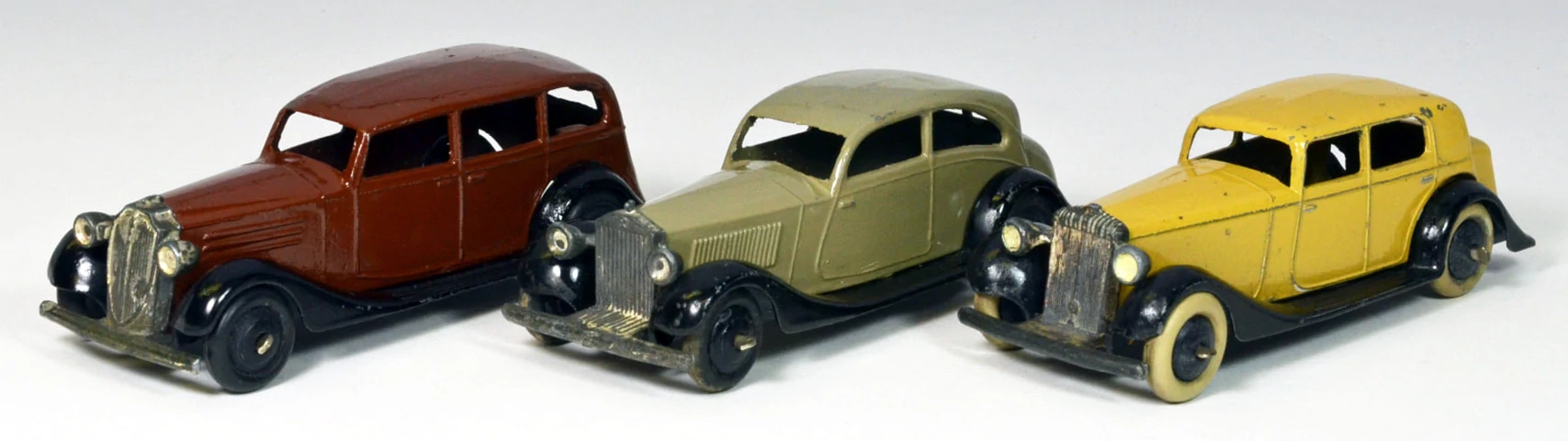
Shown above from left to right are the Vauxhall, Rolls-Royce, and Daimler, all of which happen to be post-war issues. Like the 36 Series that followed, the three models in the picture shared a common chassis and fender unit, with only the radiator and body being different.
30B Rolls-Royce
Dinky made this early Rolls-Royce Saloon that continued briefly after WWII, from 1935 through 1950. Although not my favorite when compared to the Vauxhall or the Daimler, it was nonetheless a rather stylish car from the pre-war era with distinctive sloping rear windows.
30C Daimler
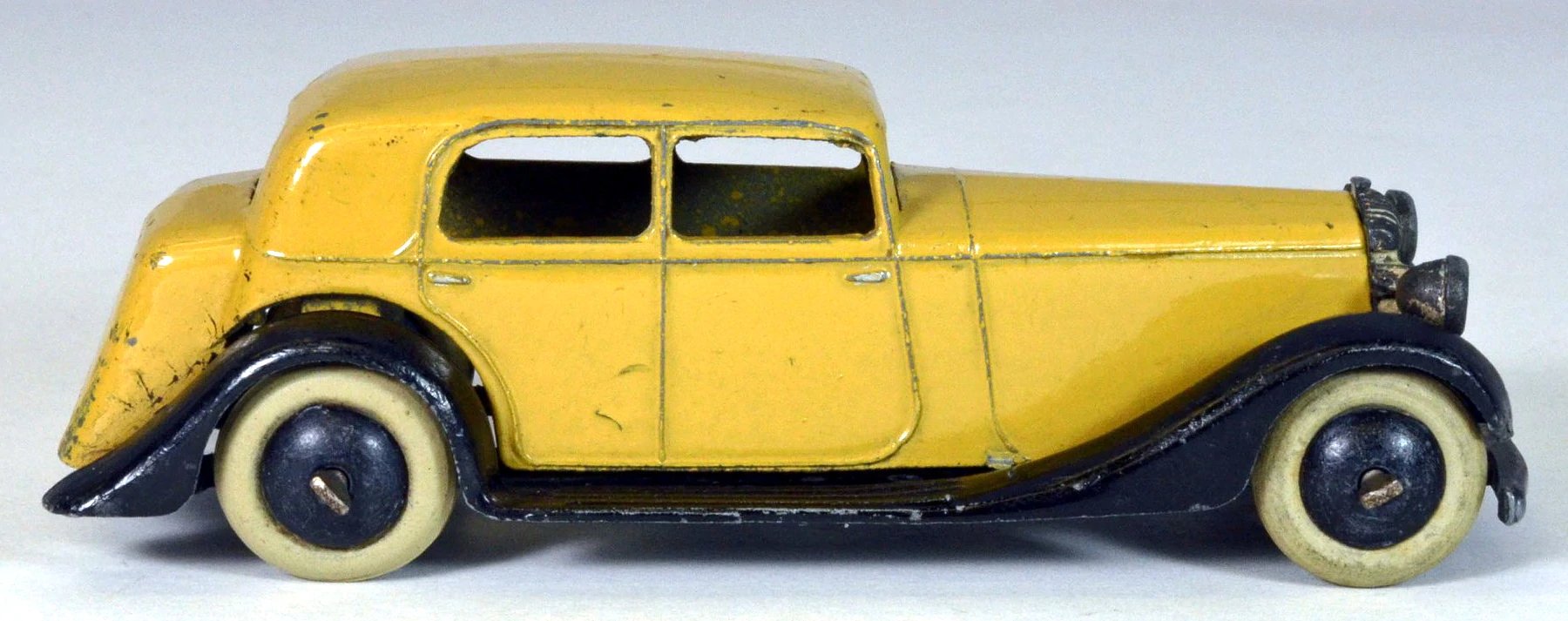
The 30C Daimler was made in either 1945 or very early 1946, as it features the earlier smooth, black wheels used on pre-war models with white tires, and also has a pair of triangular openings on the baseplate. However it lacks the thin axles that were only fitted on pre-war Dinkys. All post-war production switched to using thicker axles.
There was a brief transition period around 1946, when several pre-war variations were still used, and the Daimler is one of them, having pre-war tires and wheels, and wearing a pre-war paint color. These pre-war stocks were quickly used up, and a great many later versions produced, so this instance is a special glimpse back to the very early days of Dinky Toys.
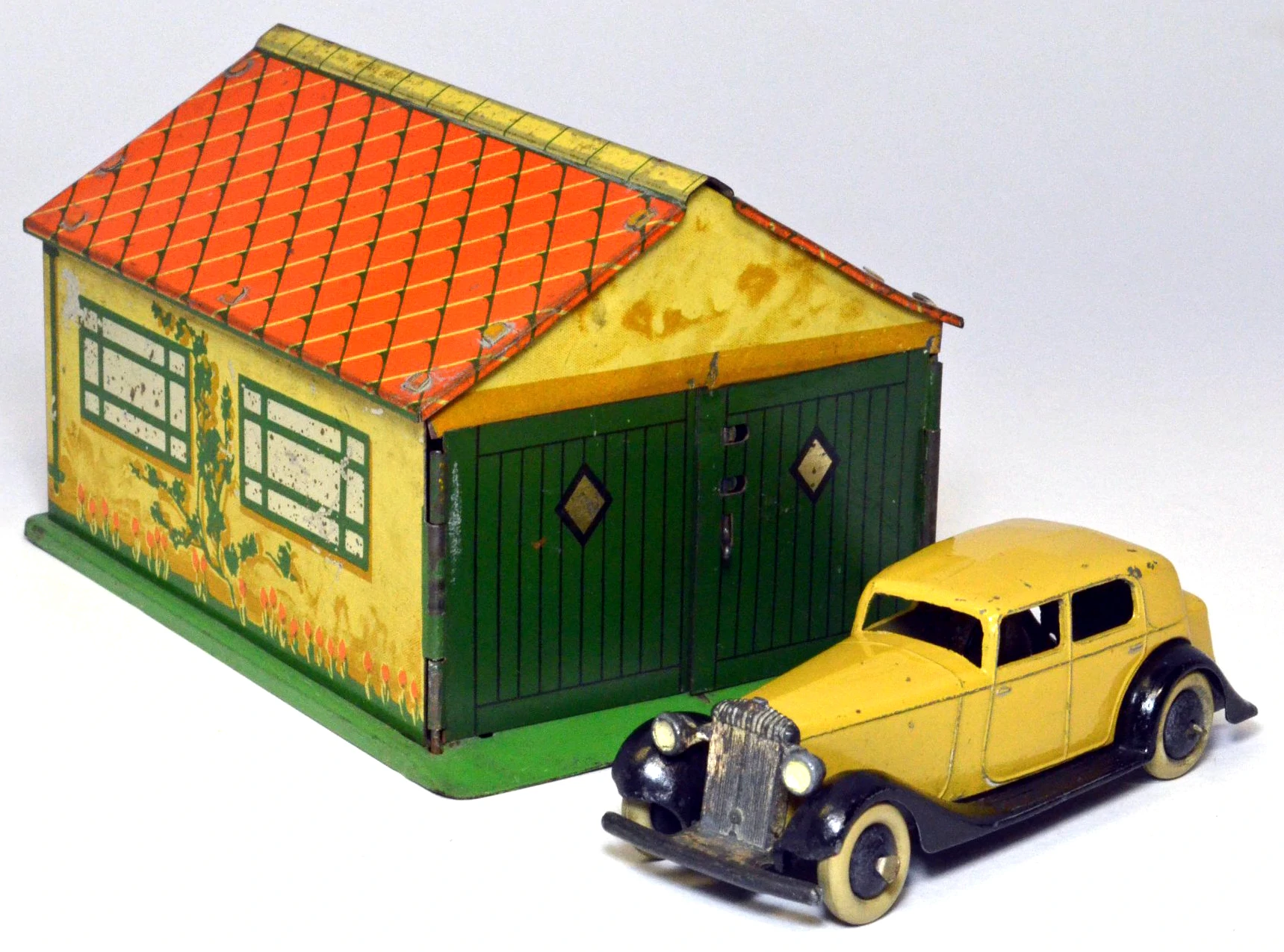
In this picture, the Daimler is parked in front of the Dinky Toys tinplate Garage from around 1939. The garage was only produced pre-WWII, so is fairly rare now.
30D Vauxhall
Even as a young boy in the mid-1950’s, I was taken by the wonderful paint quality of these early Dinky Toys. Meccano had long before figured out how to create a high quality paint finish, which to me was always a hallmark of these models.
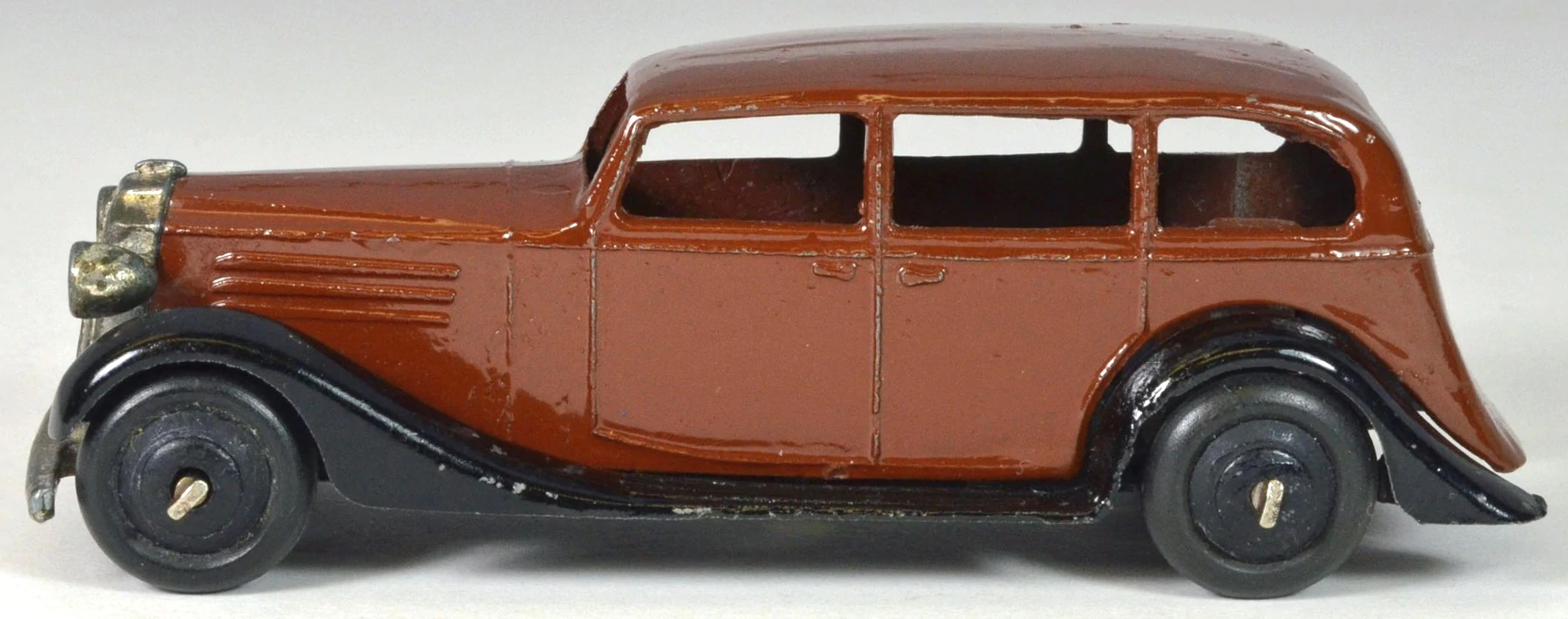
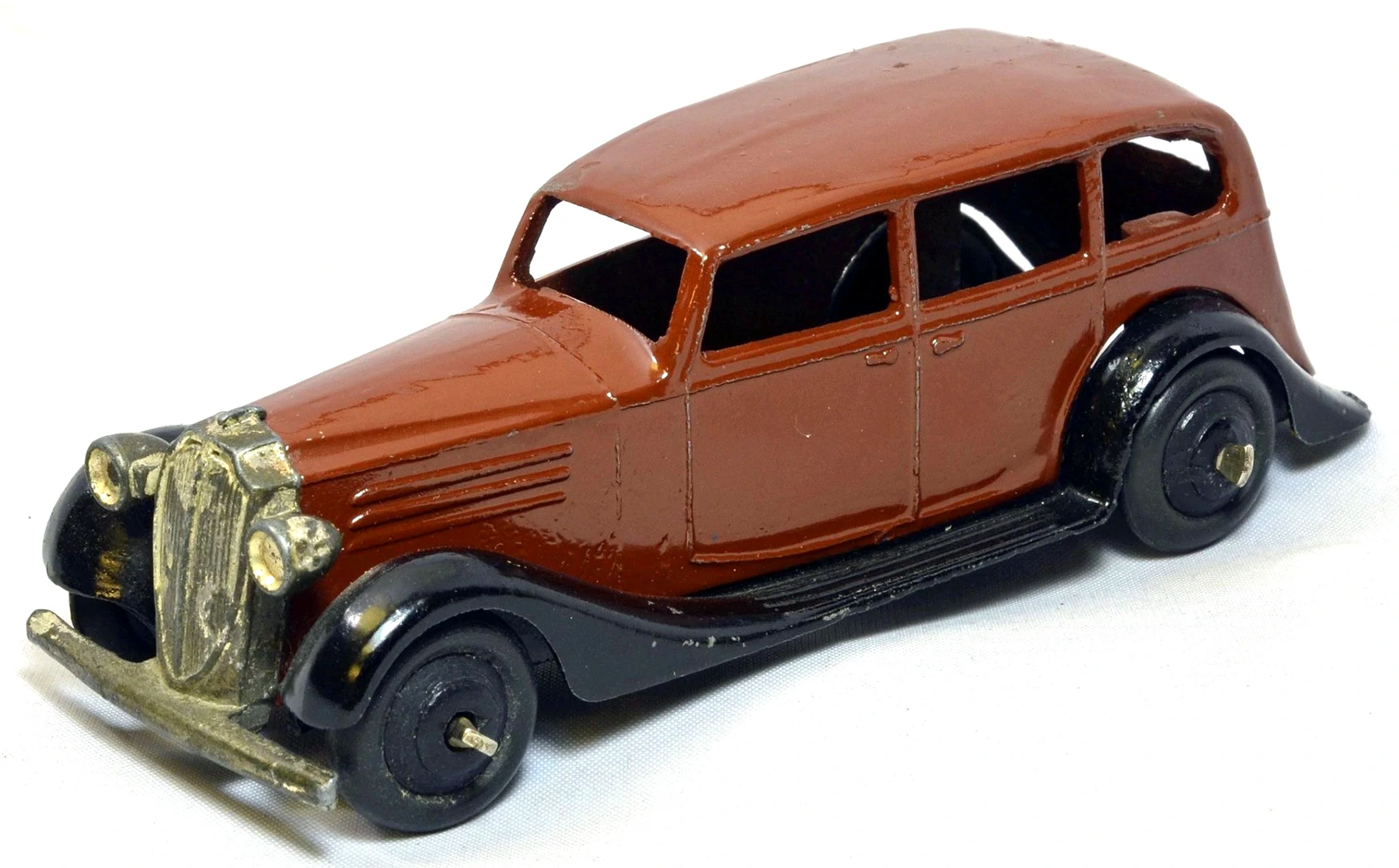
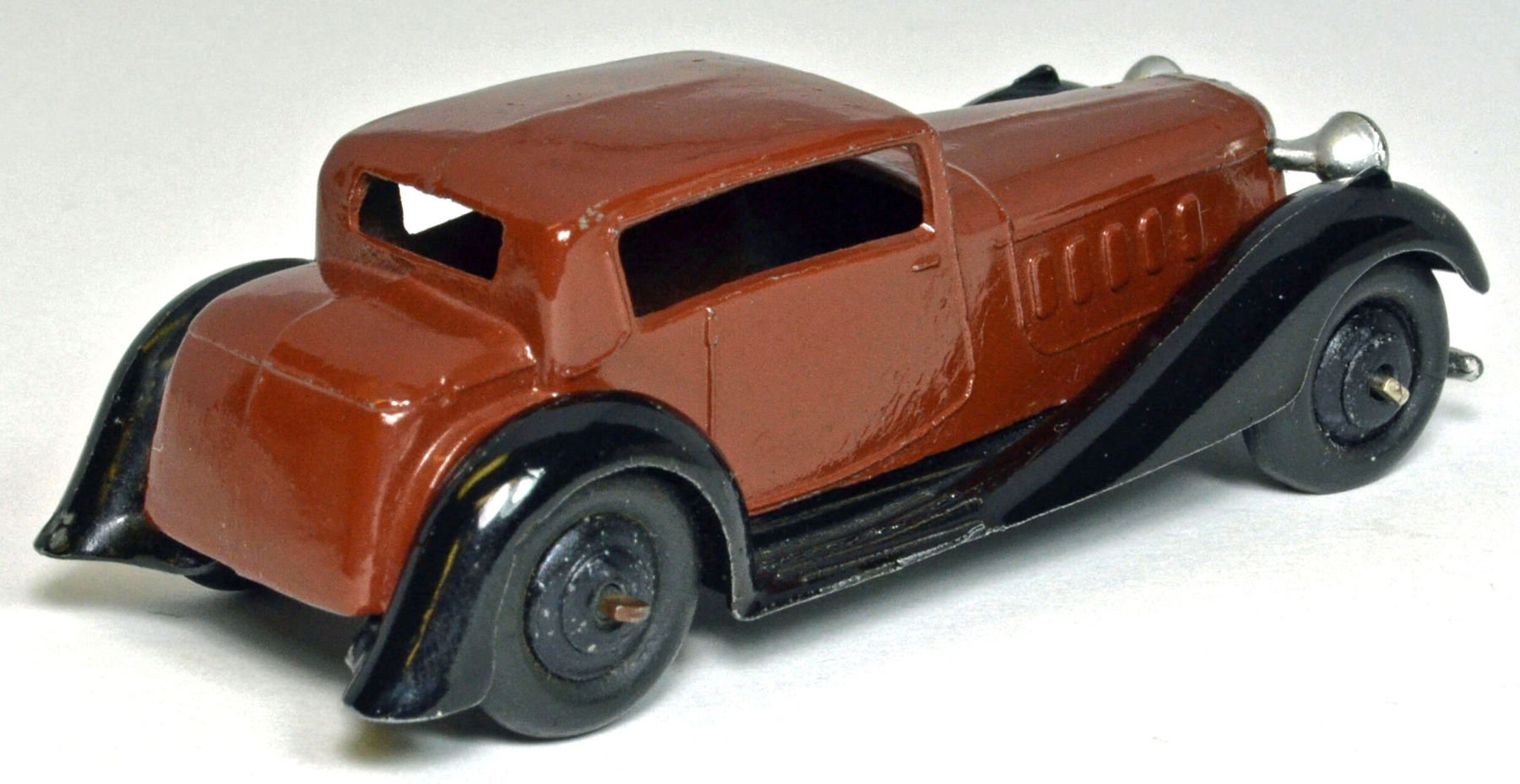
A nice example is this 30 Series Vauxhall from around 1950. The paint is lustrous and deep even after 70 years, and this post-war version is almost mint with its very rich, dark brown color.
The 30 Series Vauxhall is one of my favorites and has very handsome lines. It even retains a small amount of “plating” that Dinky used on the grills. It’s another nice little diecast model from so long ago.
30F Ambulance
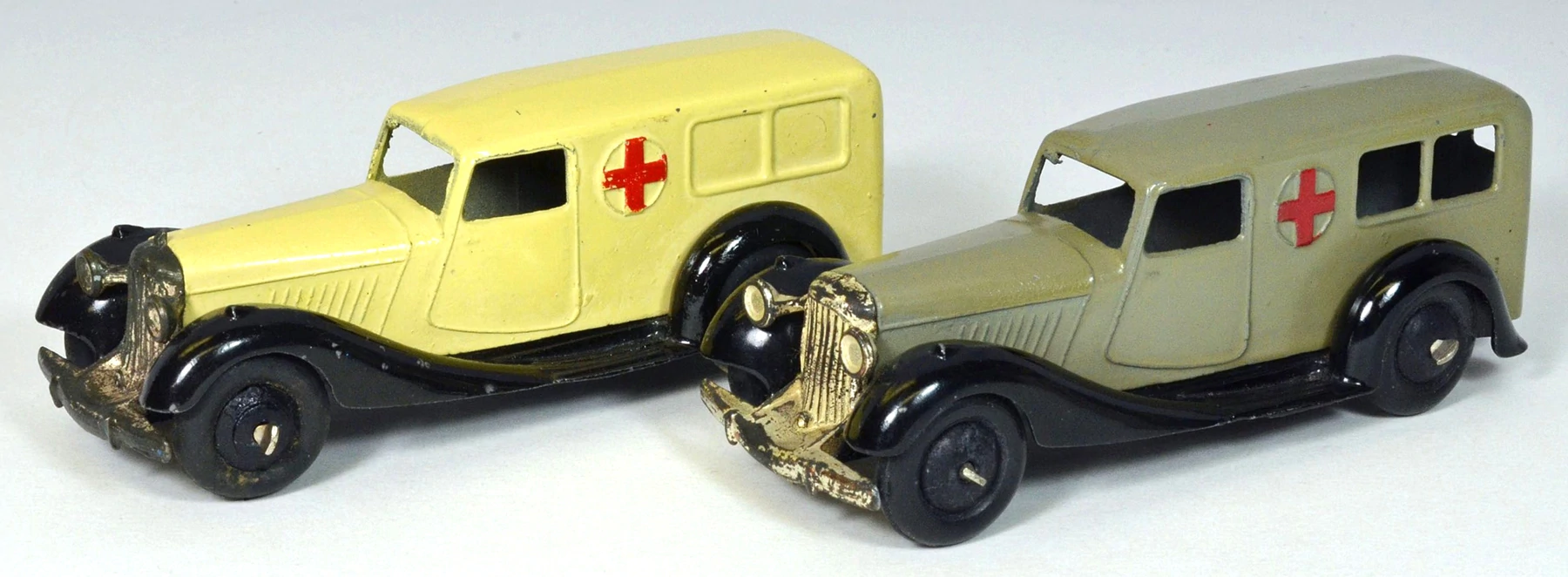
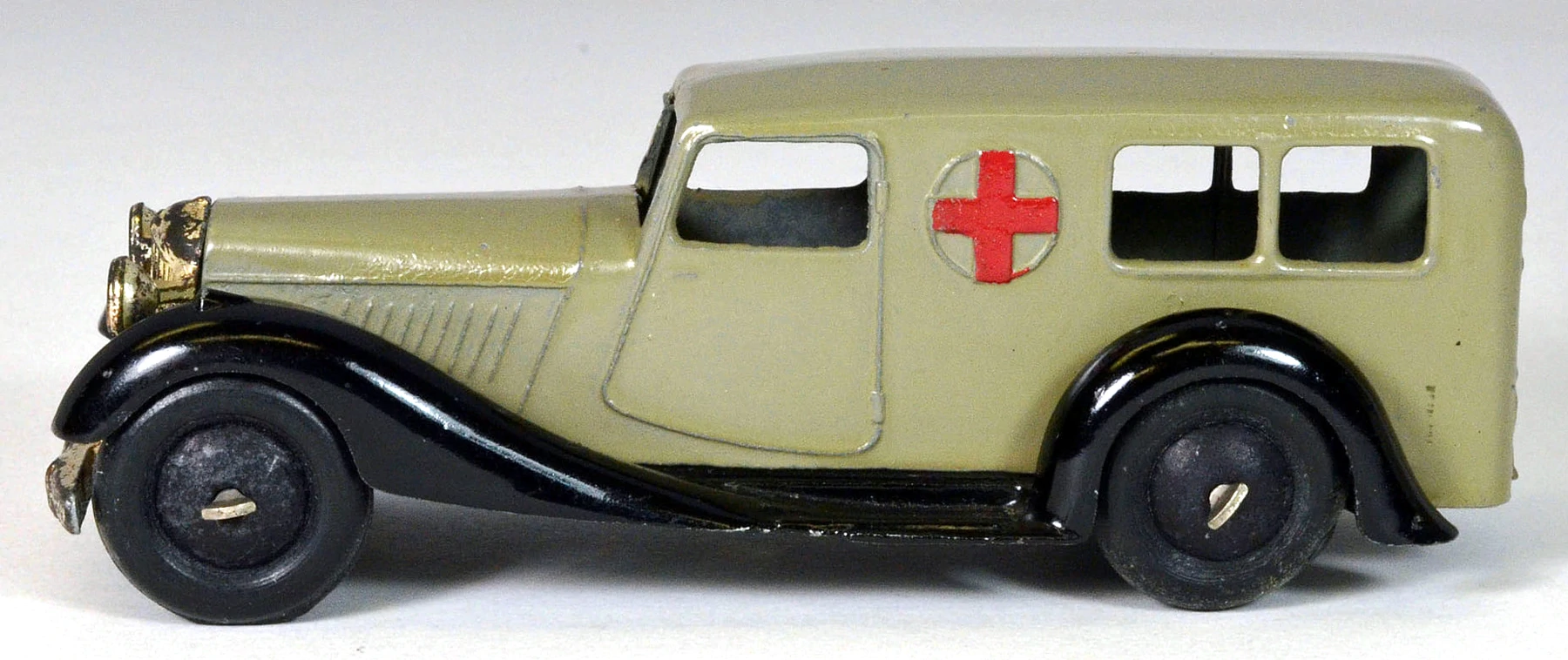
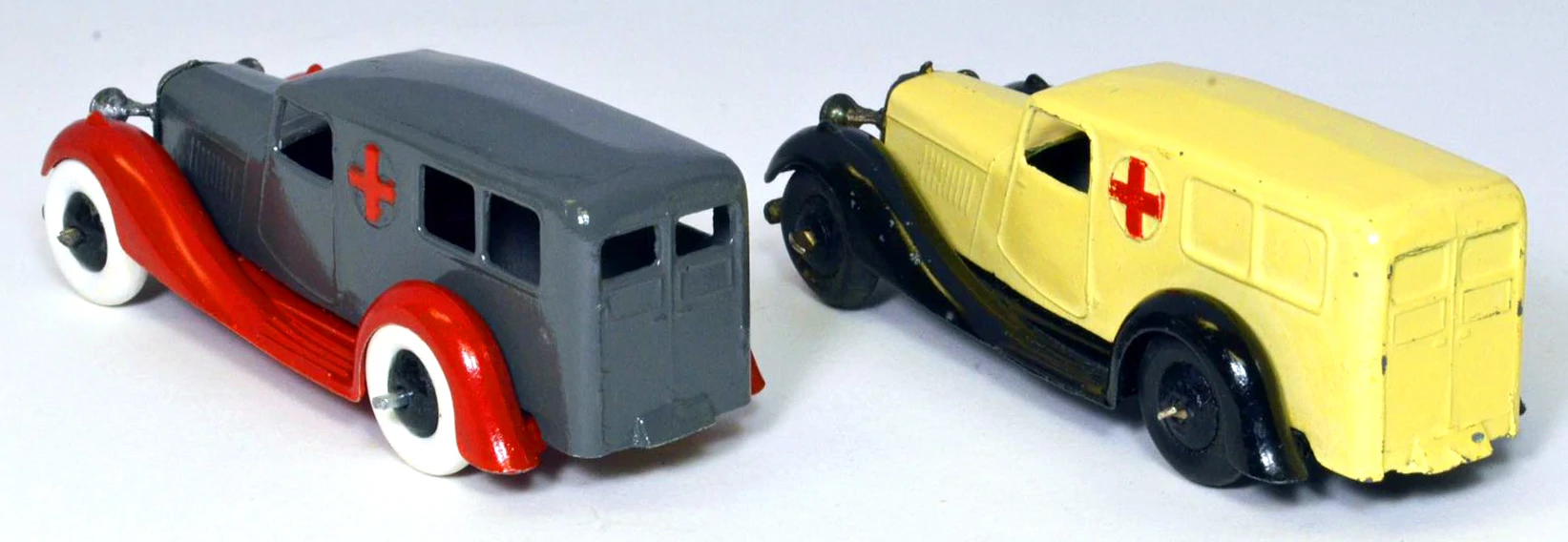
The 30 series Ambulance is probably my favorite model of both the 30 and 36 series, and I particularly like the earlier versions with the still open side and rear windows. It’s such an interesting and neat looking model. I originally owned a cream colored later post-war version without the open windows, but looked for several years, waiting to find a nice earlier example. When the darker one became available for sale, I couldn’t believe my eyes, especially after it arrived. Although not mint, it’s in excellent condition and with smooth wheels and open windows, it has to be from 1946. It also still has a surprising amount of plating on the front radiator grill.
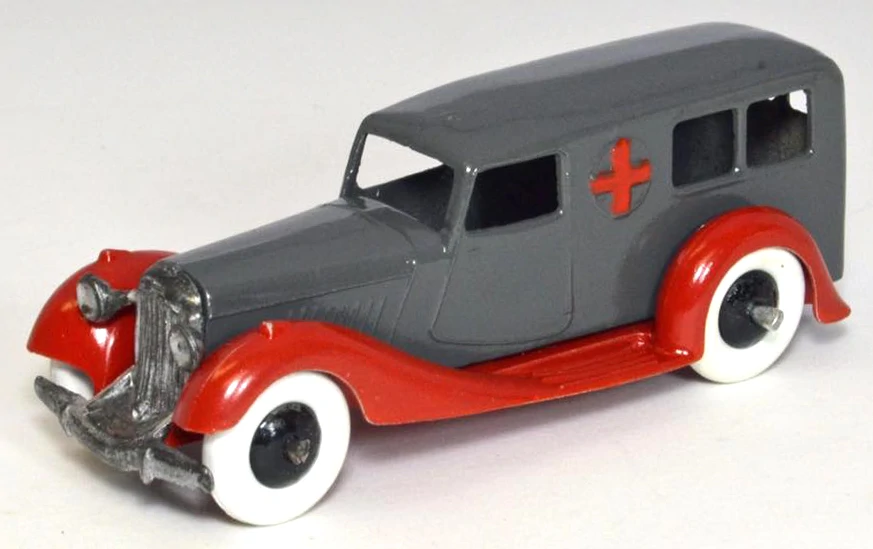
Shown below is my first cream and brown Ambulance along with one with red fenders, grey body and white tires, which has been carefully restored to look just like the first pre-war version with open windows. Shortly after the war, Meccano got rid off the open rear windows; a big mistake in my opinion.
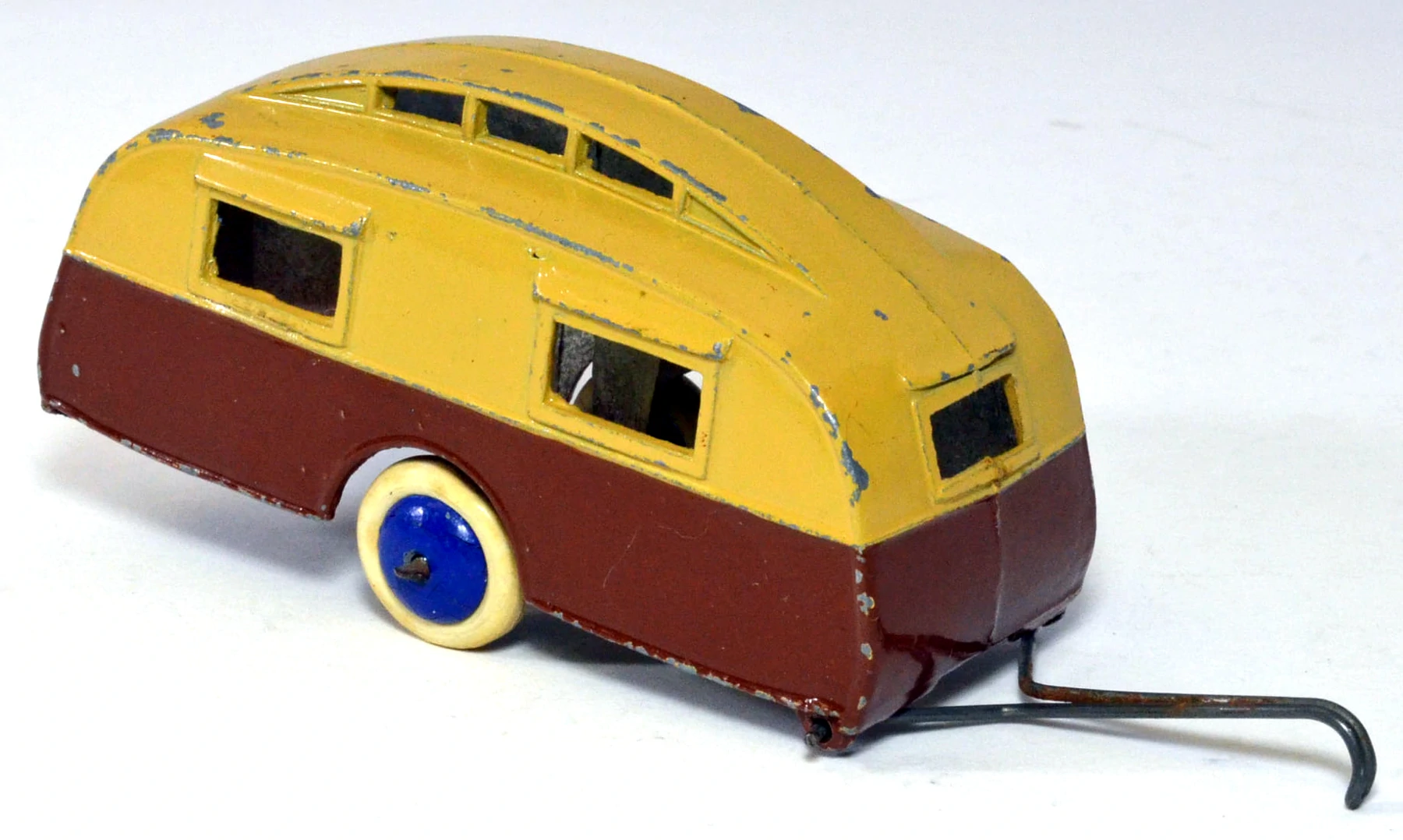
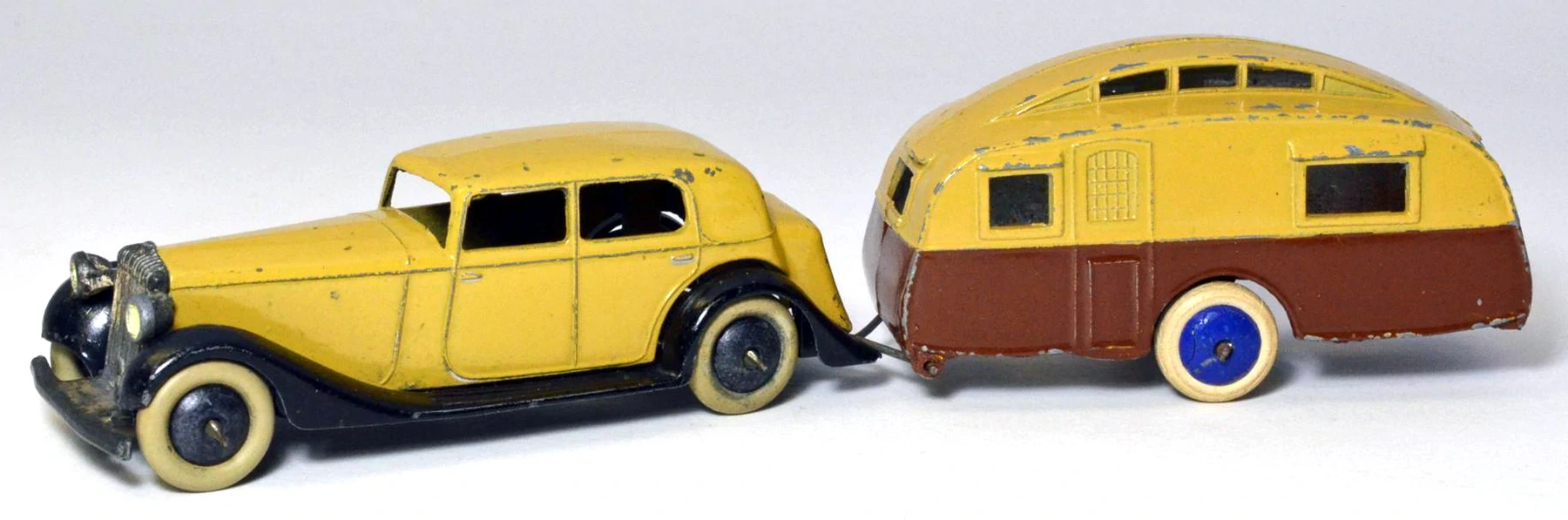
30G Caravan Trailer
Shown below is the 30G Caravan, made only for a few years pre-war, starting in 1935 and discontinued in 1941. It’s a neat little model that goes well with all thee period 24 and 30 Series automobiles that Dinky introduced.
These can still be found, but many have substantial metal fatigue. I’ve never heard of a prototype attributed to it, but I did my own research several years ago and came up with something very similar.
In the years after World War 2, more and more trucks were used to collect full milk cans from farmers and transport them to dairies. Milk truck drivers did heavy work. Strength and dexterity were required to hoist the 40 liter milk cans onto a truck’s loading platform.
Soon after the war, Meccano France restarted production and began to look for new models to introduce to the market. The production of new civilian French car and truck models had been delayed by the war and many old French Dinky Toy models were still being produced by Meccano France. A completely new range of models was found in the very nice Series 25 Studebaker and Ford trucks. These were very successful and became highly sought after by collectors. This article covers the Dinky 25o Studebaker Milk Truck “Nestlé”.
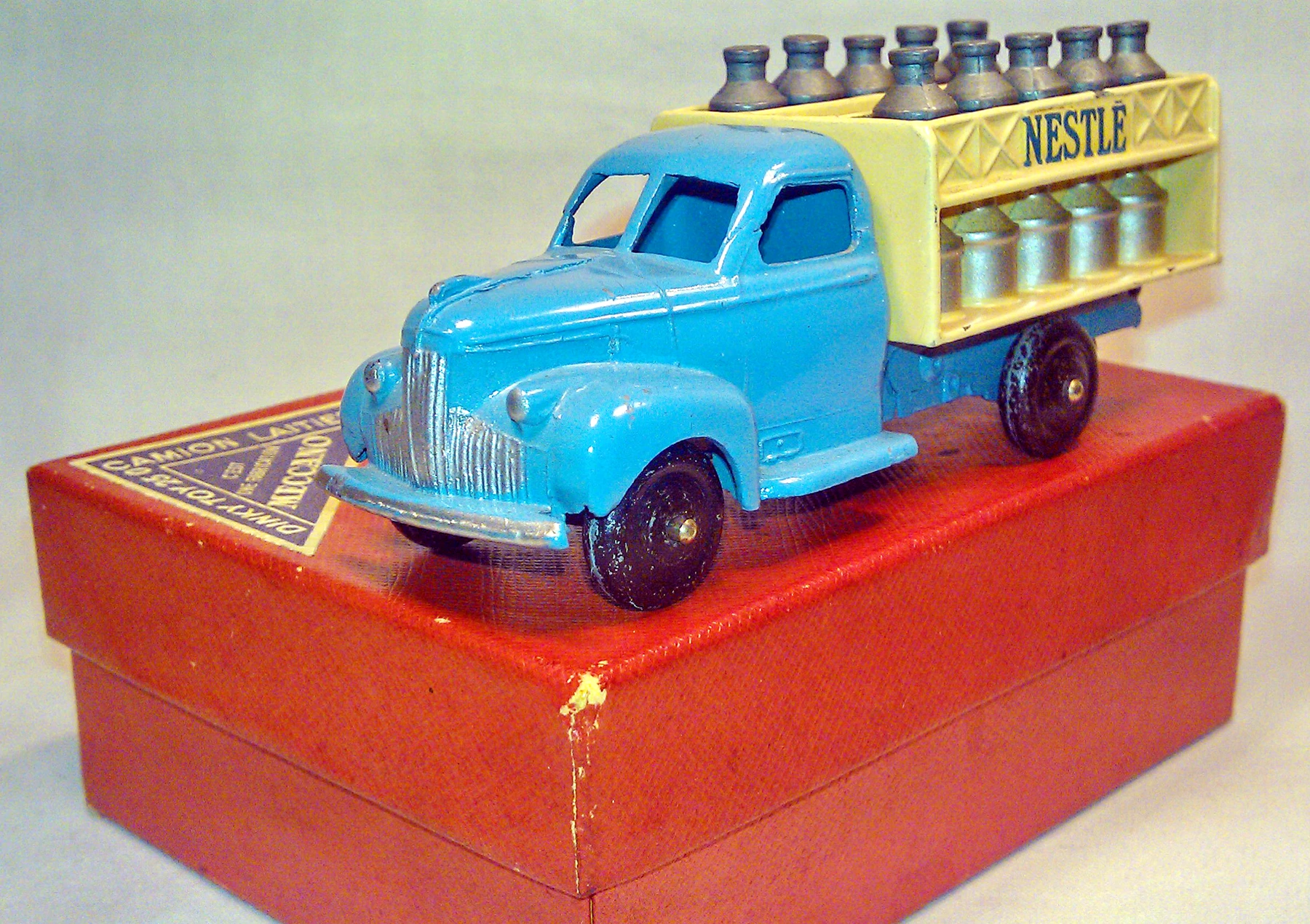
The first version of the 25O Studebaker Milk Truck “Nestlé” in its first type luxury French box.
Brief history of the Studebaker M series trucks
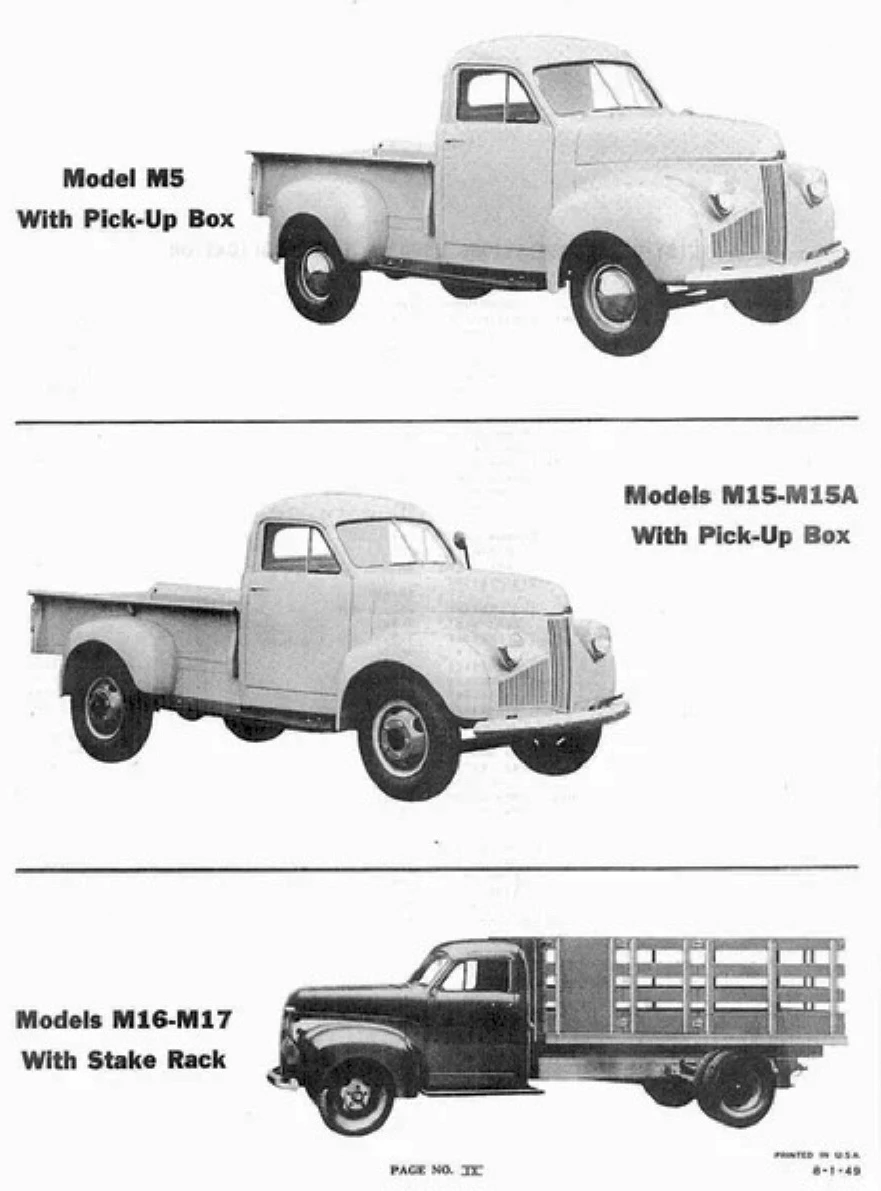
The real Studebaker truck on which the Dinky 25O is modelled was made in the United States in South Bend, Indiana. The prototype of the Studebaker milk truck is based on Studebaker’s M Series trucks that were built during 1941–1948. Like most truck lines, the Studebaker M Series trucks could be had in several body styles. The M Series range included the ½‑ton M5, 1‑ton M15 and M15A, 1½-ton M16 and 2‑ton M17.
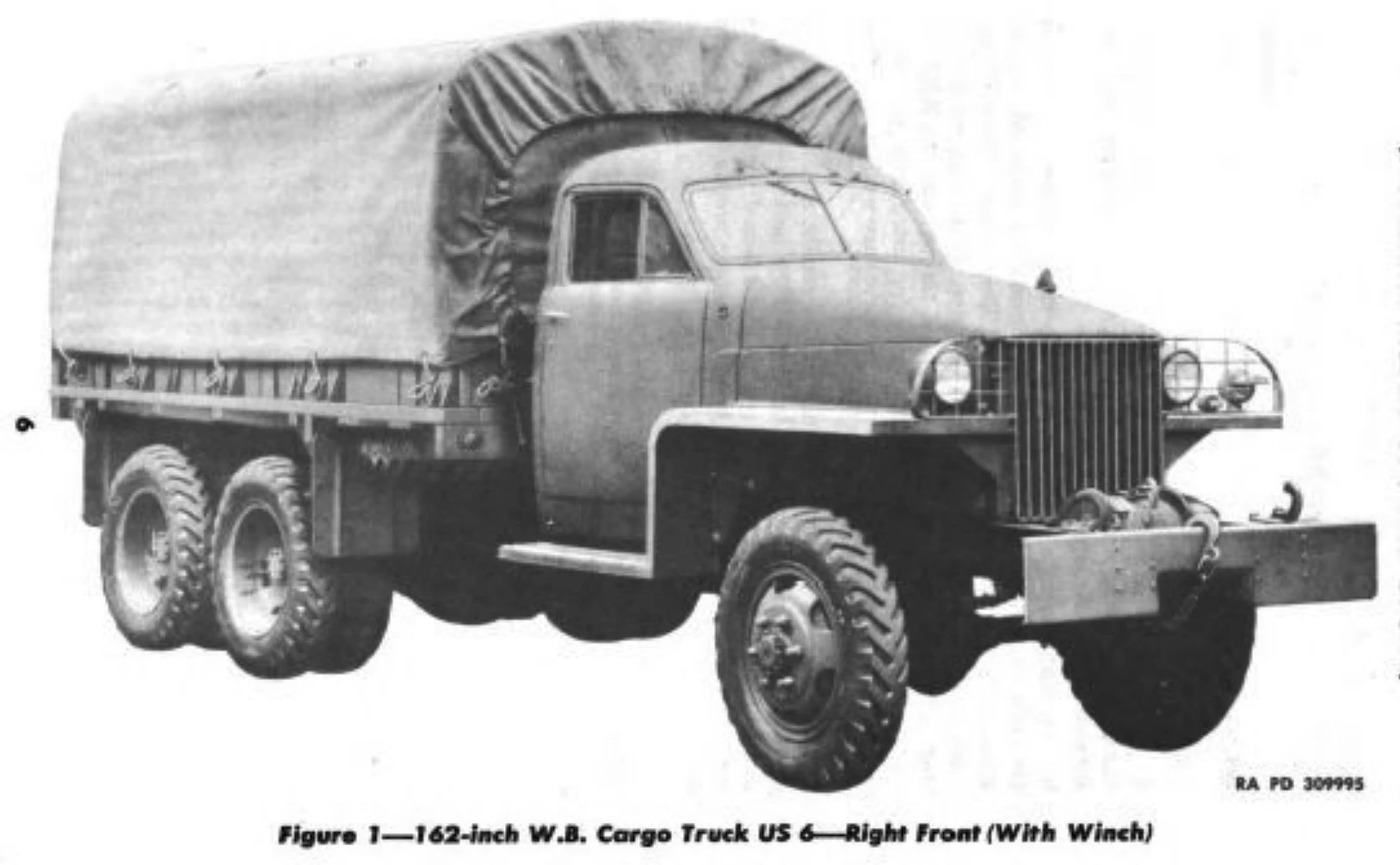
Shortly after the attack on Pearl Harbor in December 1941, the United States government shut down passenger car production, although trucks continued to be produced well into 1942. As with most other American industries, Studebaker began producing military systems under contract to the U.S. government in 1941. Its two most famous wartime products were the Weasel tracked vehicle and the US6 2½-ton military truck which went into production in South Bend in June 1941.
Studebaker WWII military truck US6 based on the M16 box.
After the war in the spring of 1945, Studebaker resumed production of M15 1‑ton trucks: an M15-20 pickup with a 120-inch wheelbase, and a M15-28 truck with dual rear wheels and 128-inch wheelbase. Because the US6 was still in production, these 1945 M15s were built with the military truck’s model C9 cab with a swing-out windshield, metal interior panels, and painted bumpers. All other 1941–1948 M Series trucks were built with a C2 cab with fixed windshield glass and cowl-mounted windshield wipers.
Full production of 1946 M Series trucks began with 367 M5s that were built in December 1945. The model lineup was the same as in 1941, along with a new M17 2‑ton export model. The new M15s were distinguished from the 1945 models with a C9 cab by designating them as M15A. The stainless steel grill trim and some other deluxe features were no longer available, but others were made standard equipment.
All M5s now had body color fenders, while larger models continued to be equipped with black fenders. M Series truck production continued with the same drive trains throughout 1946 and 1947 and into March 1948. A few running changes were made in 1947, one of which was the introduction of a massive painted front bumper on the M15-28, M16, and M17 models.
Studebaker M Series truck models.
Prototype 25O Studebaker milk truck
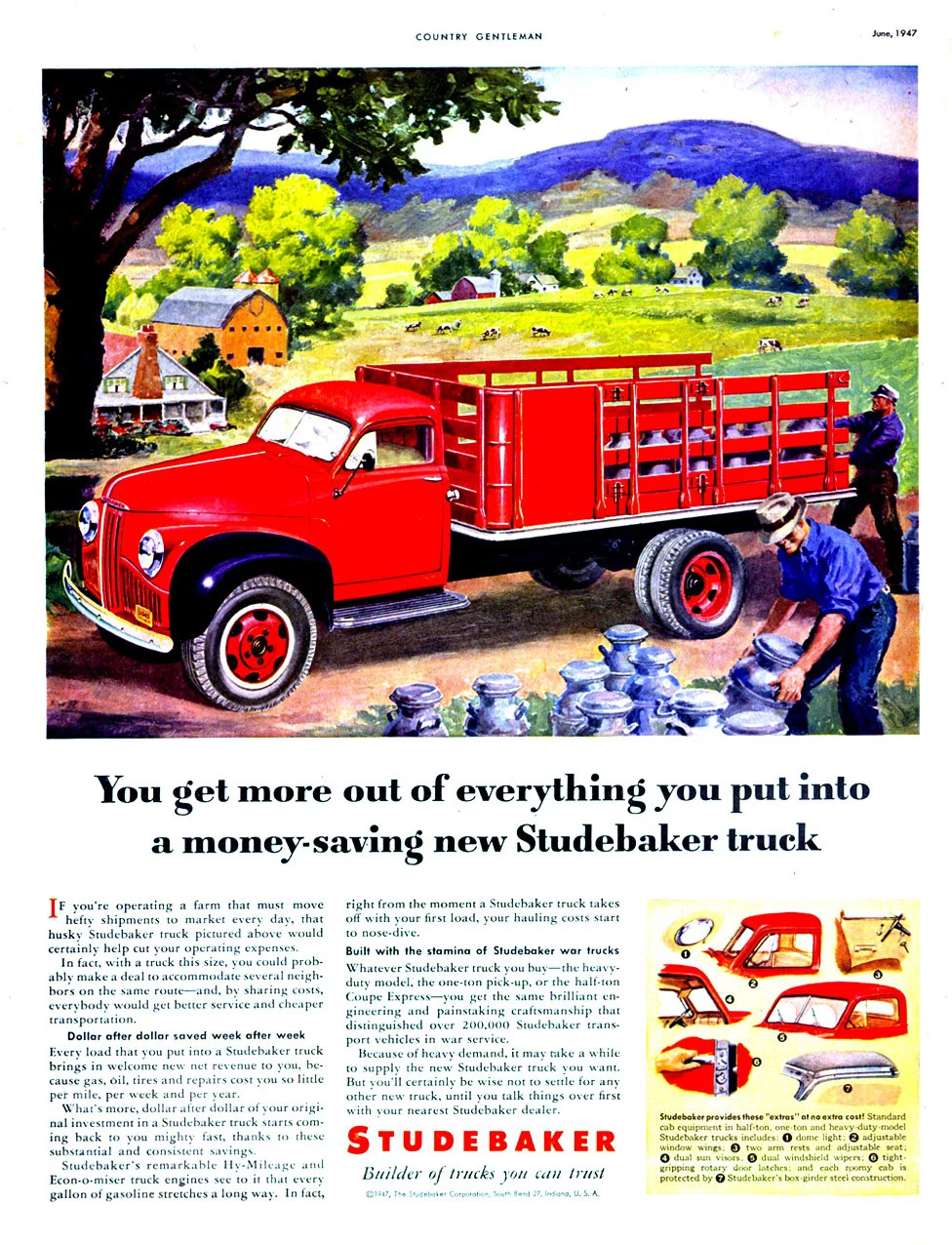
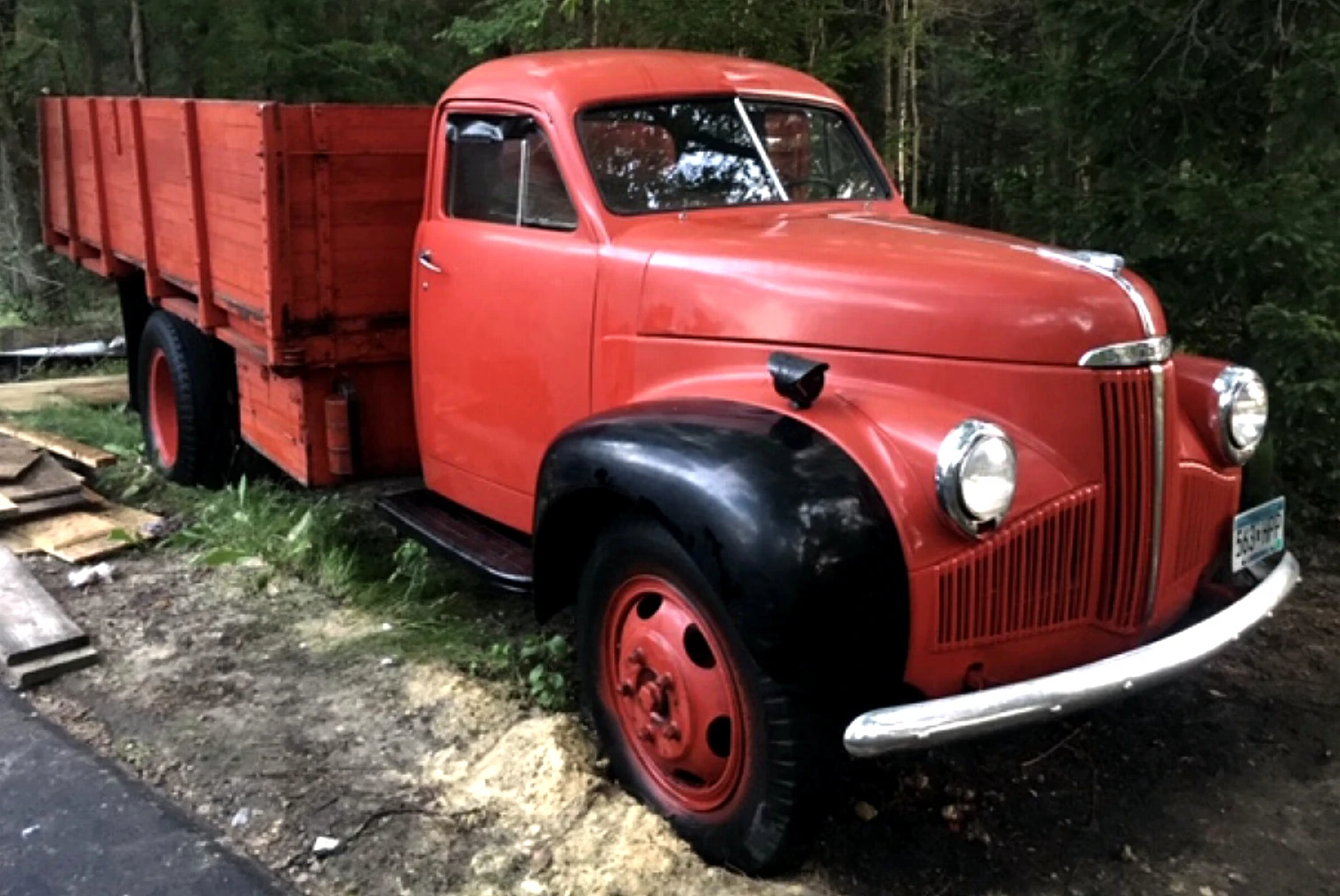
I wasn’t able to find a prototype of the 25O Studebaker Milk Truck with all the features of the Dinky Toys model. I’ve included some pictures of the real Studebaker M16 that was built during 1947 and 1948.
Studebaker truck advertisement from June 1947 Image: OldCarAdvertising.com
1947 Studebaker M16 Image: curbsideclassic.com
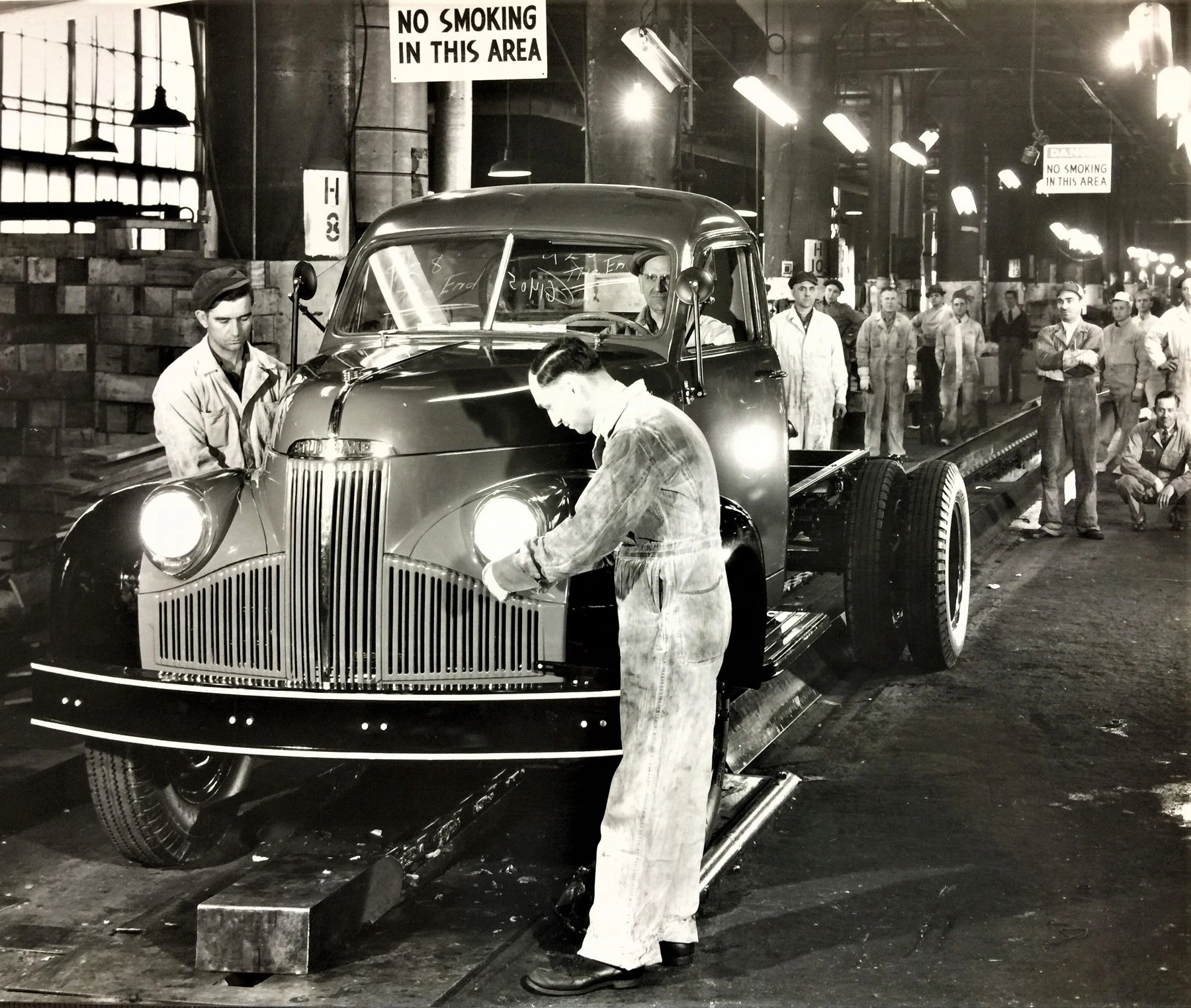
The last M Series truck coming off the assembly line in 1948. Image: Facebook
Show above is the very last M Series truck (an M16-52) coming off the assembly line in March 1948. Studebaker built 145,800 M Series trucks from 1941 to 1948 which included 52,541 1/2‑ton M5’s, 22,923 1‑ton M15 & M15A’s, 61,339 1–1/2‑ton M16’s and 8997 2‑ton M‑17’s. In 1947, a few running changes were made, one of which was the introduction of a massive painted front bumper on the M15-28, M16, and M17 models.
Dinky Toys Series 25 model range
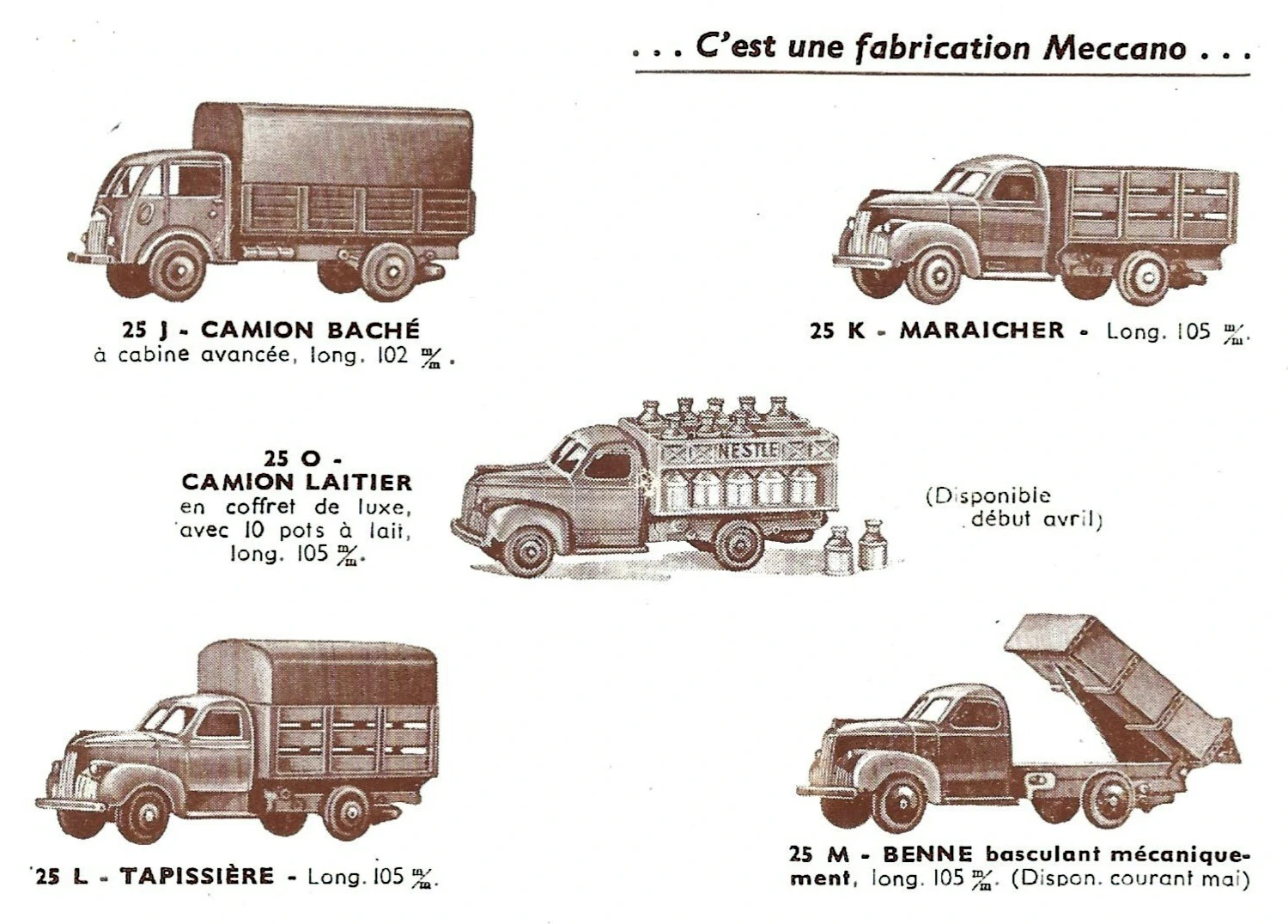
The chassis of Studebaker and Ford trucks provided Meccano France with the opportunity to produce many different models with the same basic chassis as a welcome addition to the French model range. In the series 25 Studebaker, 7 different models were produced of which the 25O is the only one with advertising (“Nestlé”).
Series 25 Ford trucks comprise 9 body variants, of which a total of 12 different models were produced, including 6 models with attractive advertising, including a 25O Ford Milk Truck “Nestlé”. In the Dinky Toys 1949 French catalog, the Series 25 Studebaker appeared for the first time with 7 models, and Ford with 3 models.
The Dinky 25O Studebaker Milk Truck “Nestlé” in 1949 French Dinky Toys catalog. Note the four different Studebaker models on the same basic chassis.
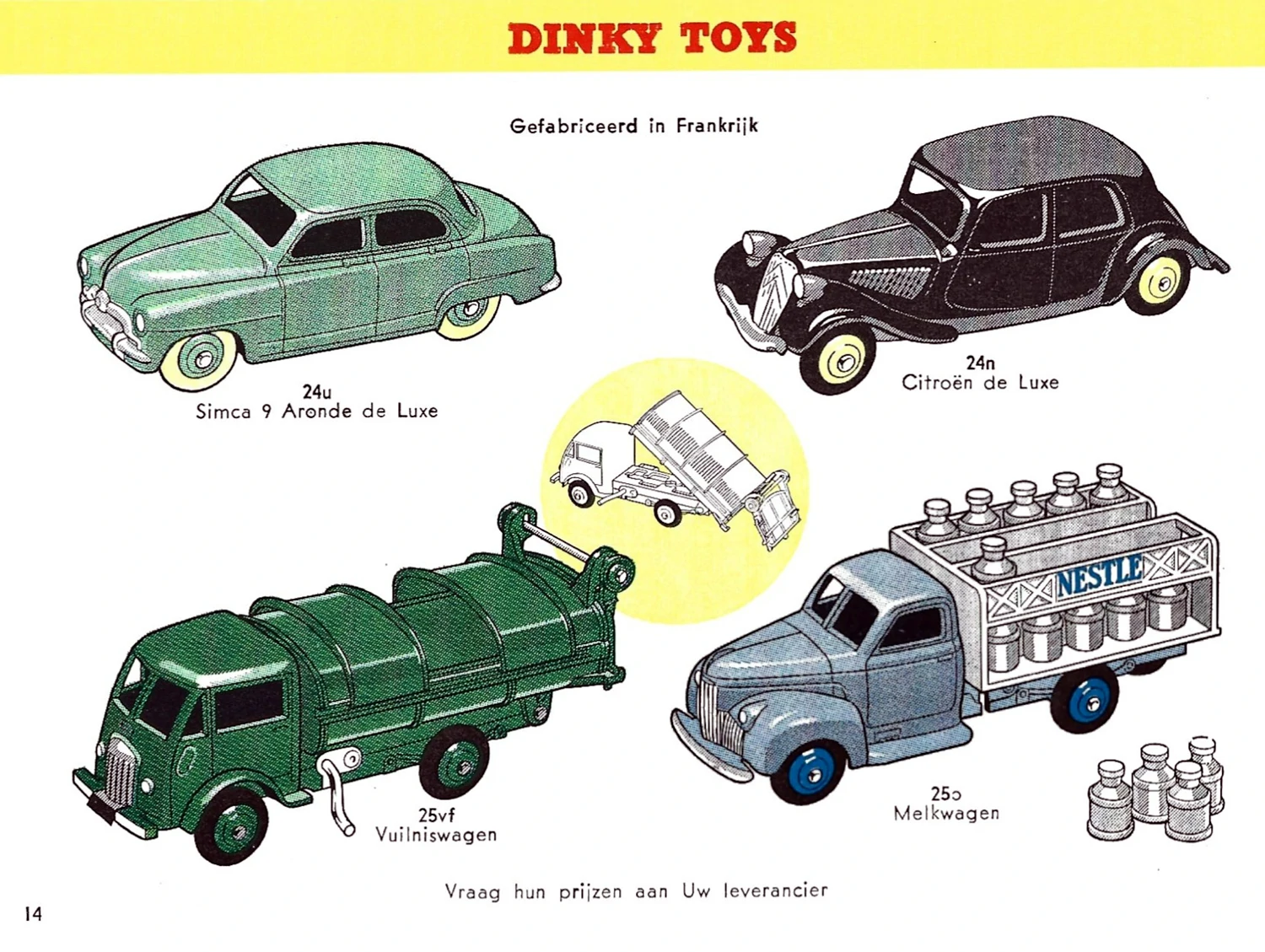
The Dinky 25O Studebaker Milk Truck “Nestlé” in the 1953 Dinky Toys Dutch color catalog.
The main versions
The Dinky 25O Studebaker Milk Truck with “Nestlé” advertising was produced from 1949 to 1954, of which I’ve collected the three main versions. This model was released before the Dinky 25O Ford Milk Truck that has the same milk can loading bed. It’s one of my favorites and I’ve done a lot of research on it. It has many interesting casting details and differences that I describe and show in the pictures that follow. The first versions in particular are a bit roughly finished, but despite that, I find it to be a rather nice and interesting model.
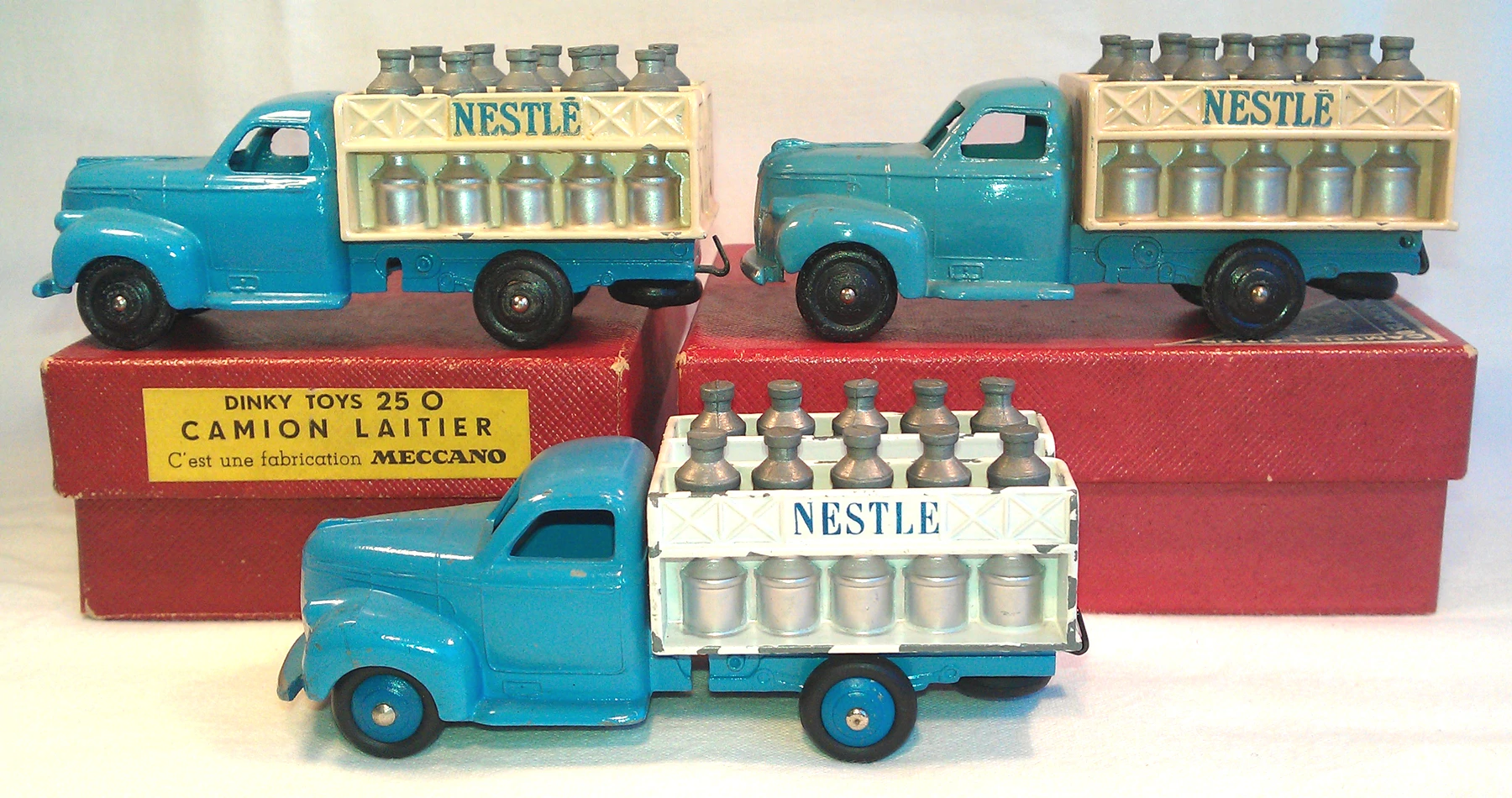
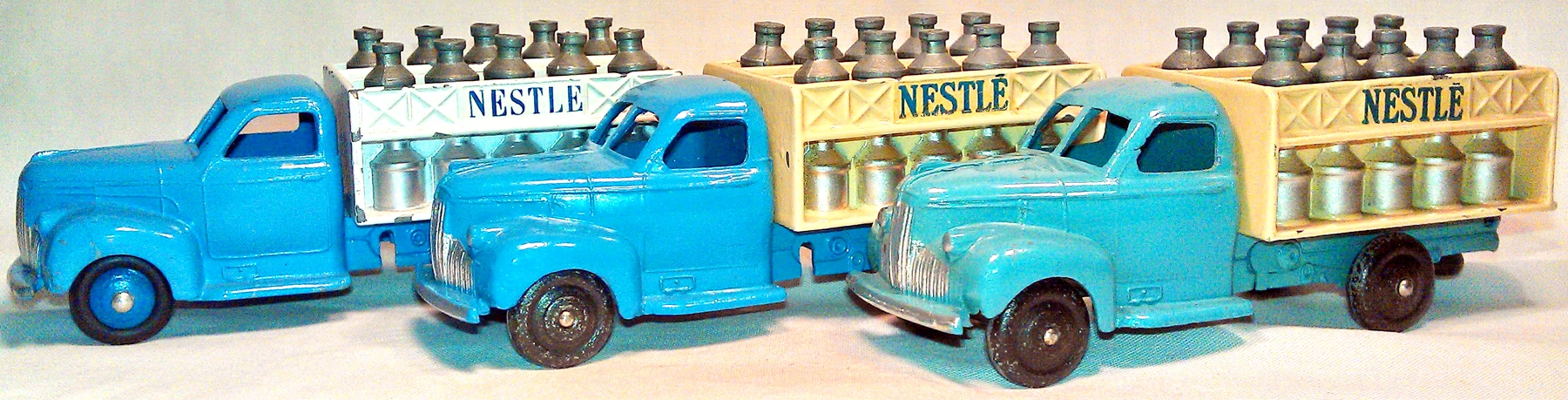
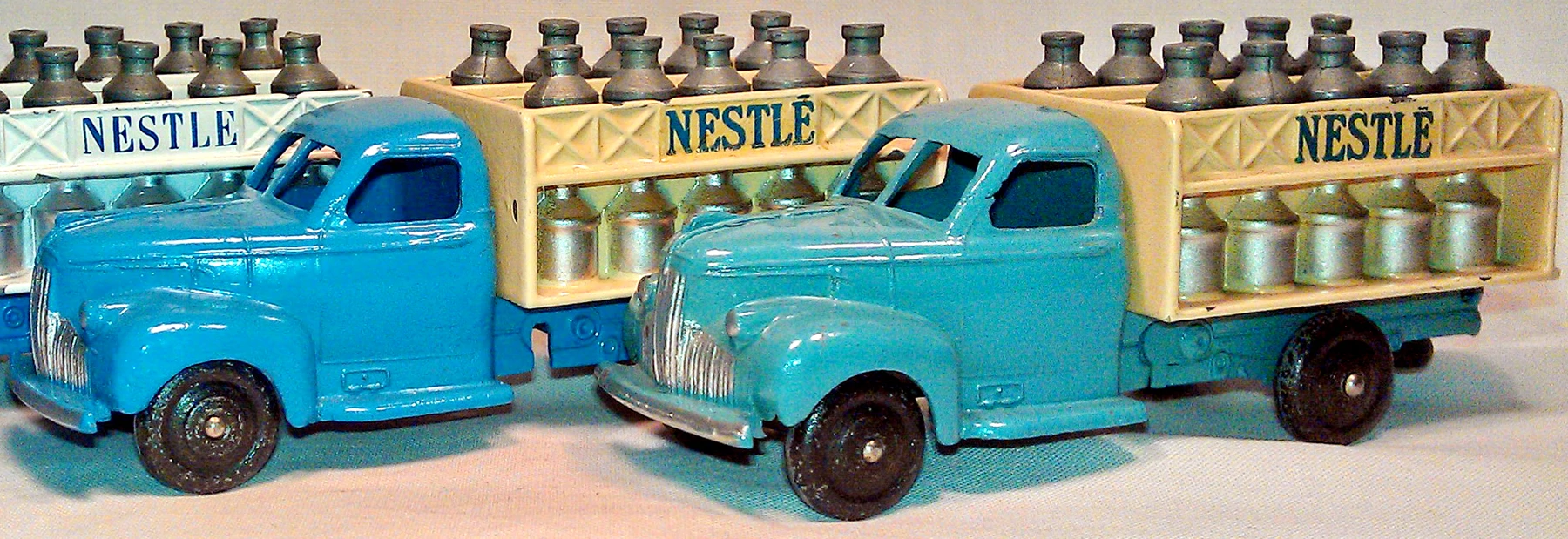
The three main versions of the Dinky 25O Studebaker Milk Truck
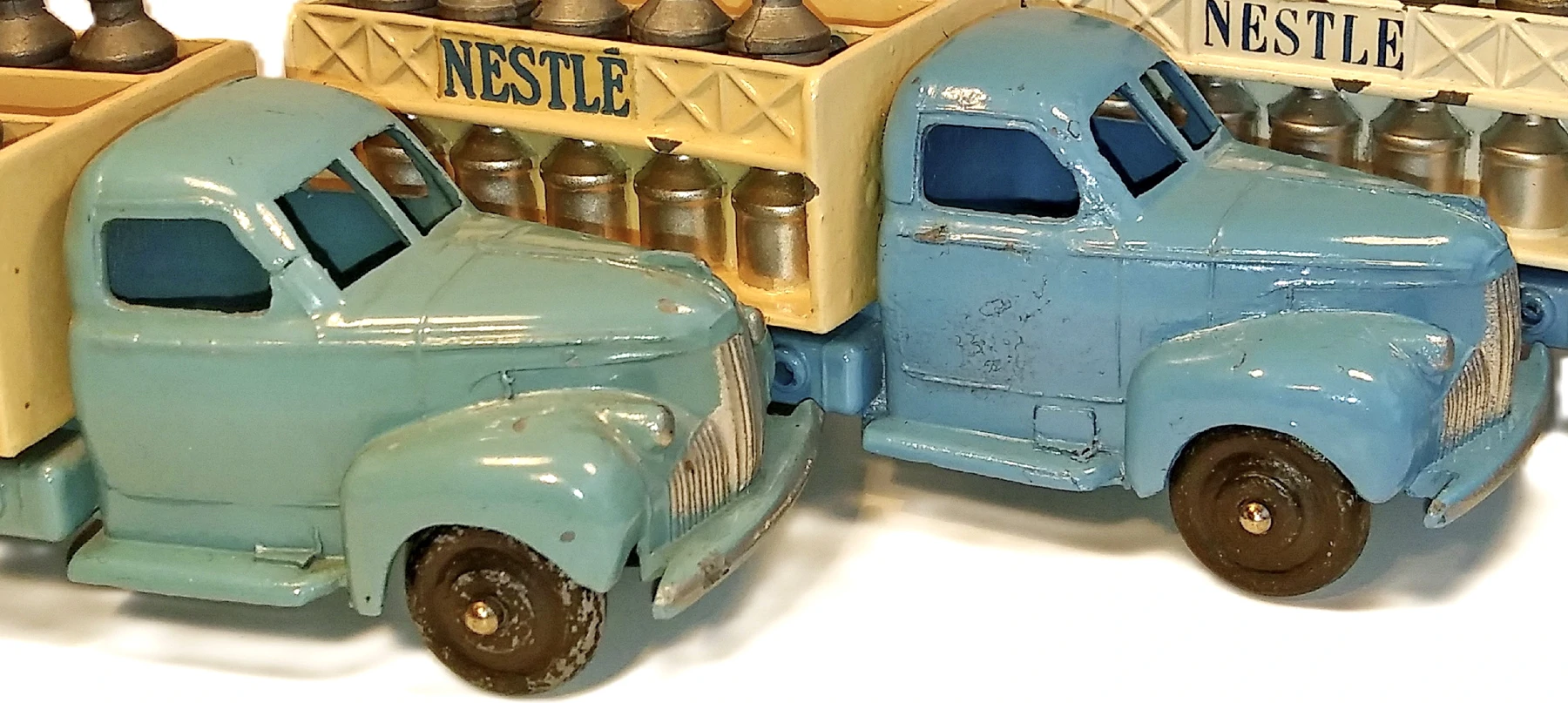
Shown above are my three main versions of the Dinky 25O Studebaker Milk Truck. From right to left are the first, second and third versions.
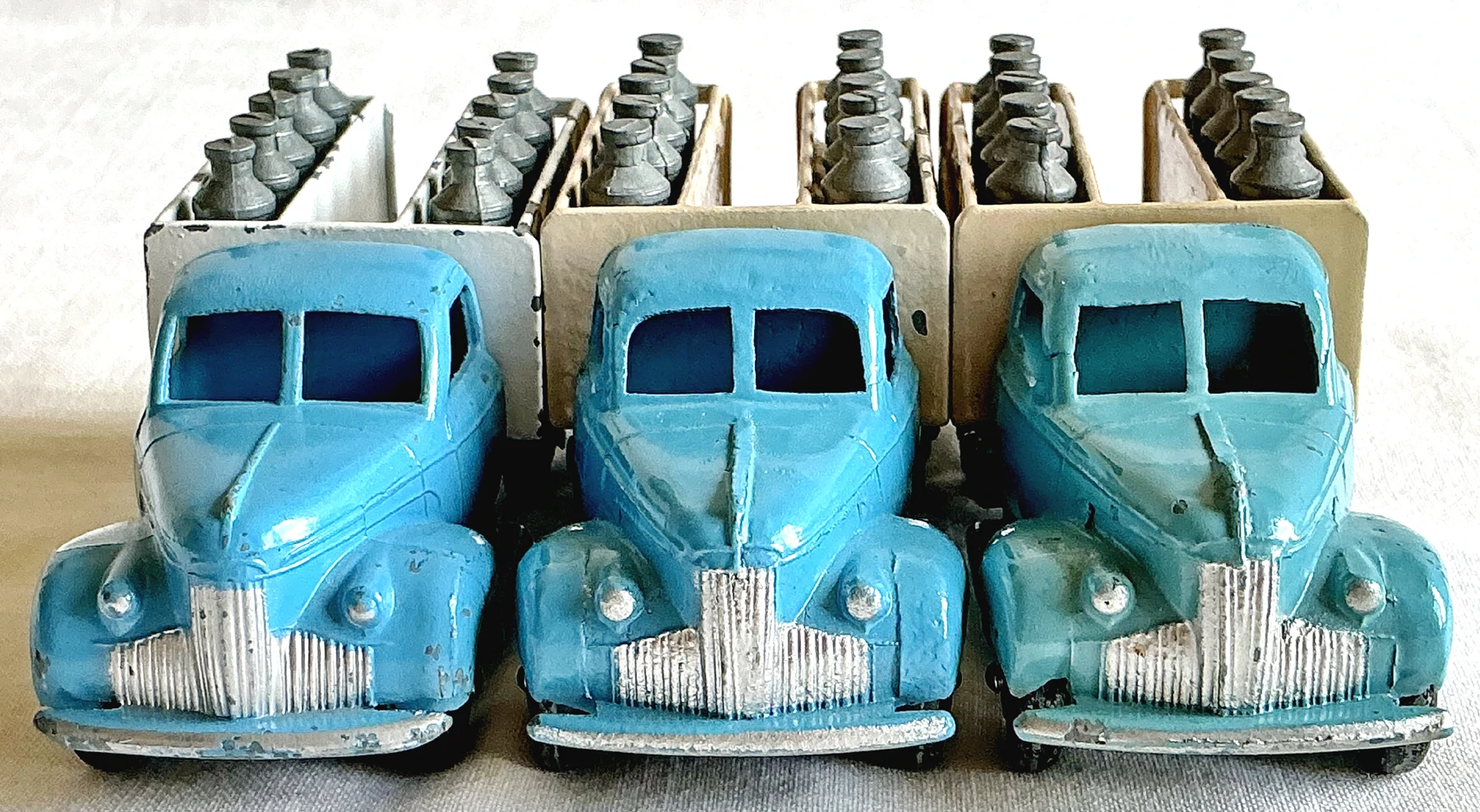
Front view of the Dinky 25O Studebaker Milk Truck
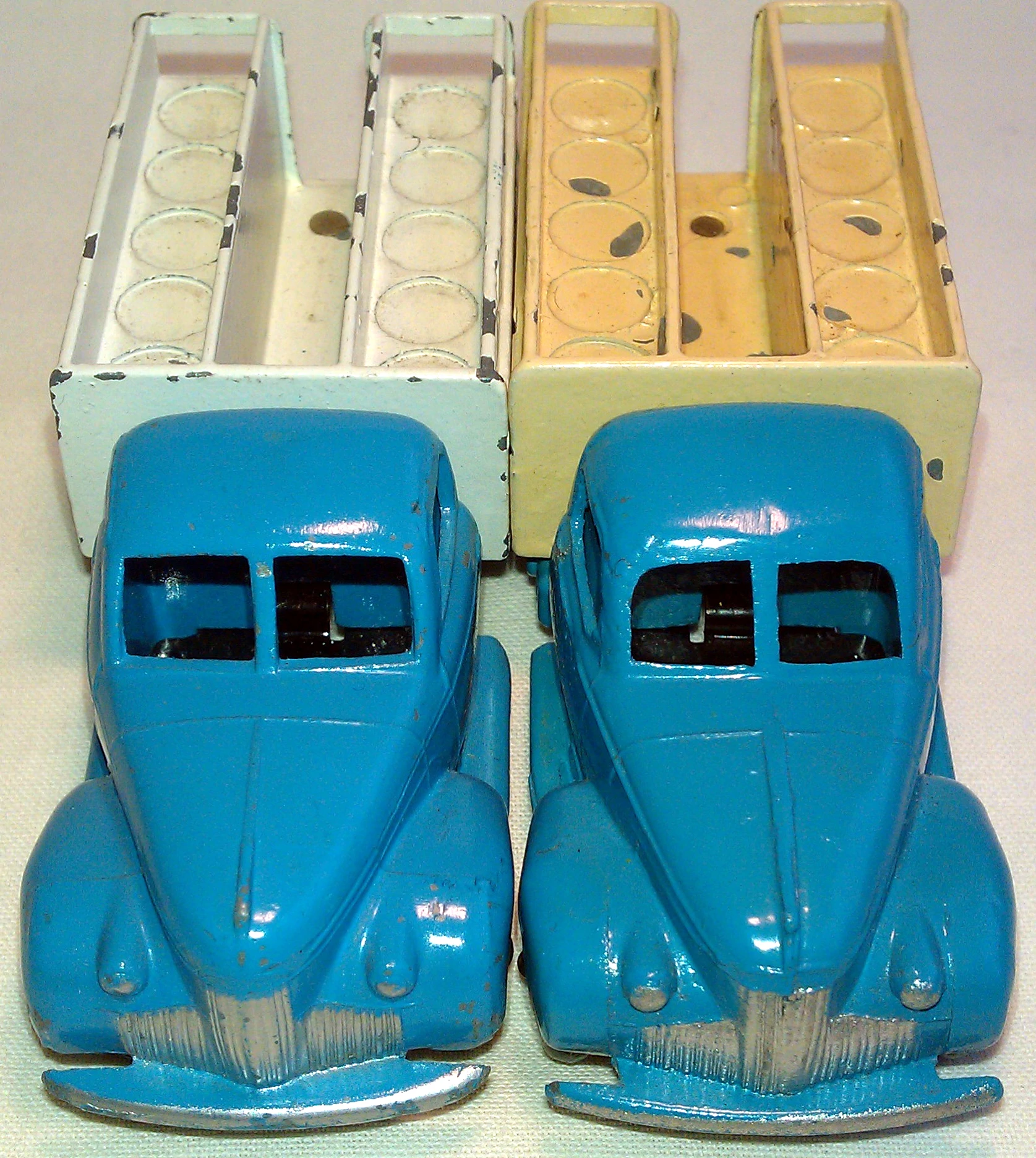
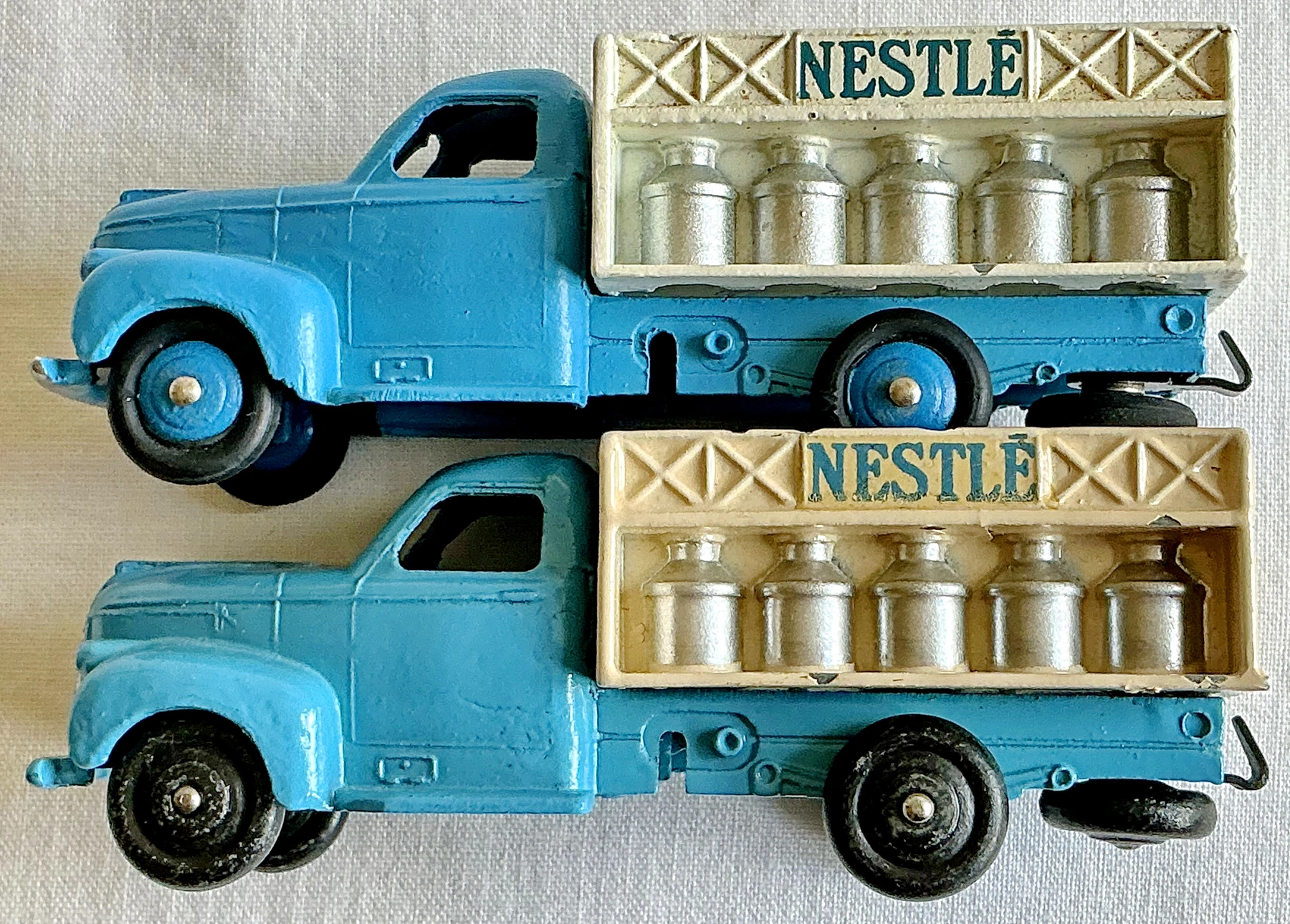
Shown above is the front view of my 25O models. From right to left are the first, second and third versions. Note the different cutouts for the windows. I like the design of the cab with its robust nose and many interesting details such as the prominent headlights, hood ornaments, moldings, chrome grills, headlights and bumpers.
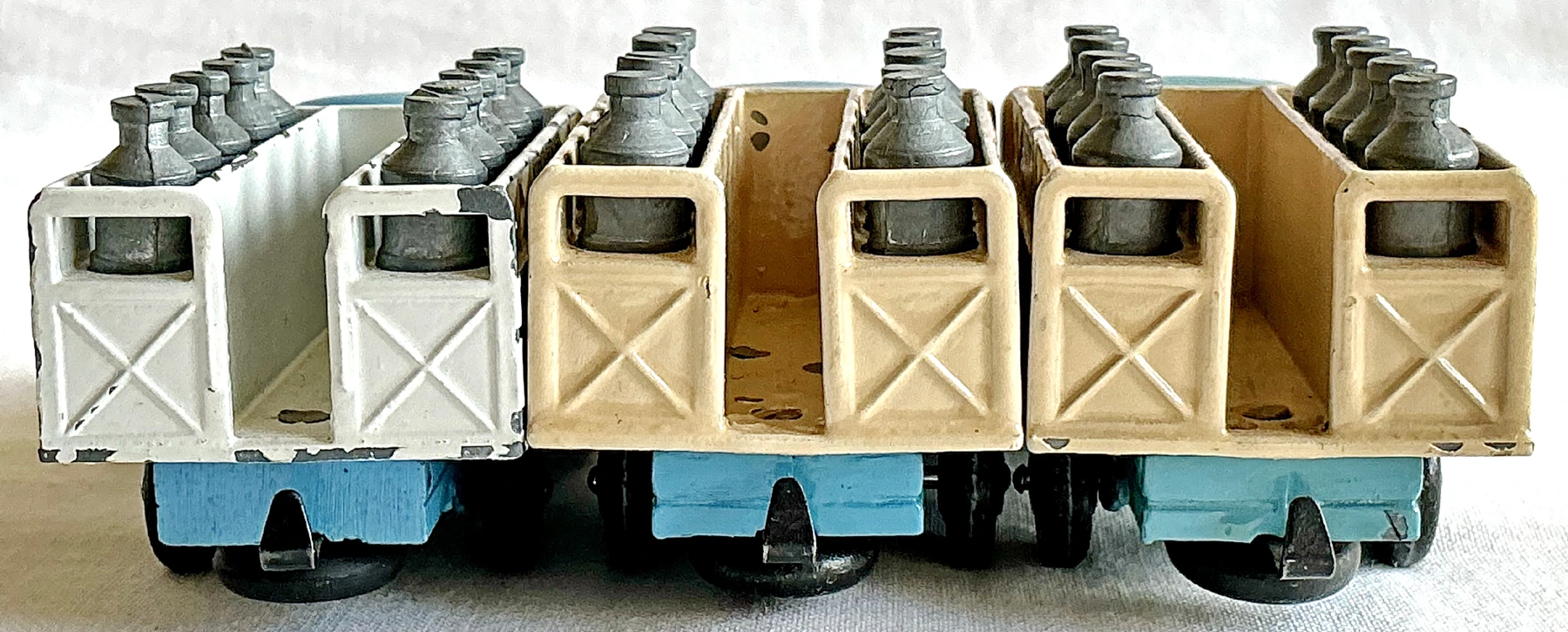
Rear view of the three main versions of the Dinky 25O Studebaker Milk Truck with cast crosses embossed on the rear wall
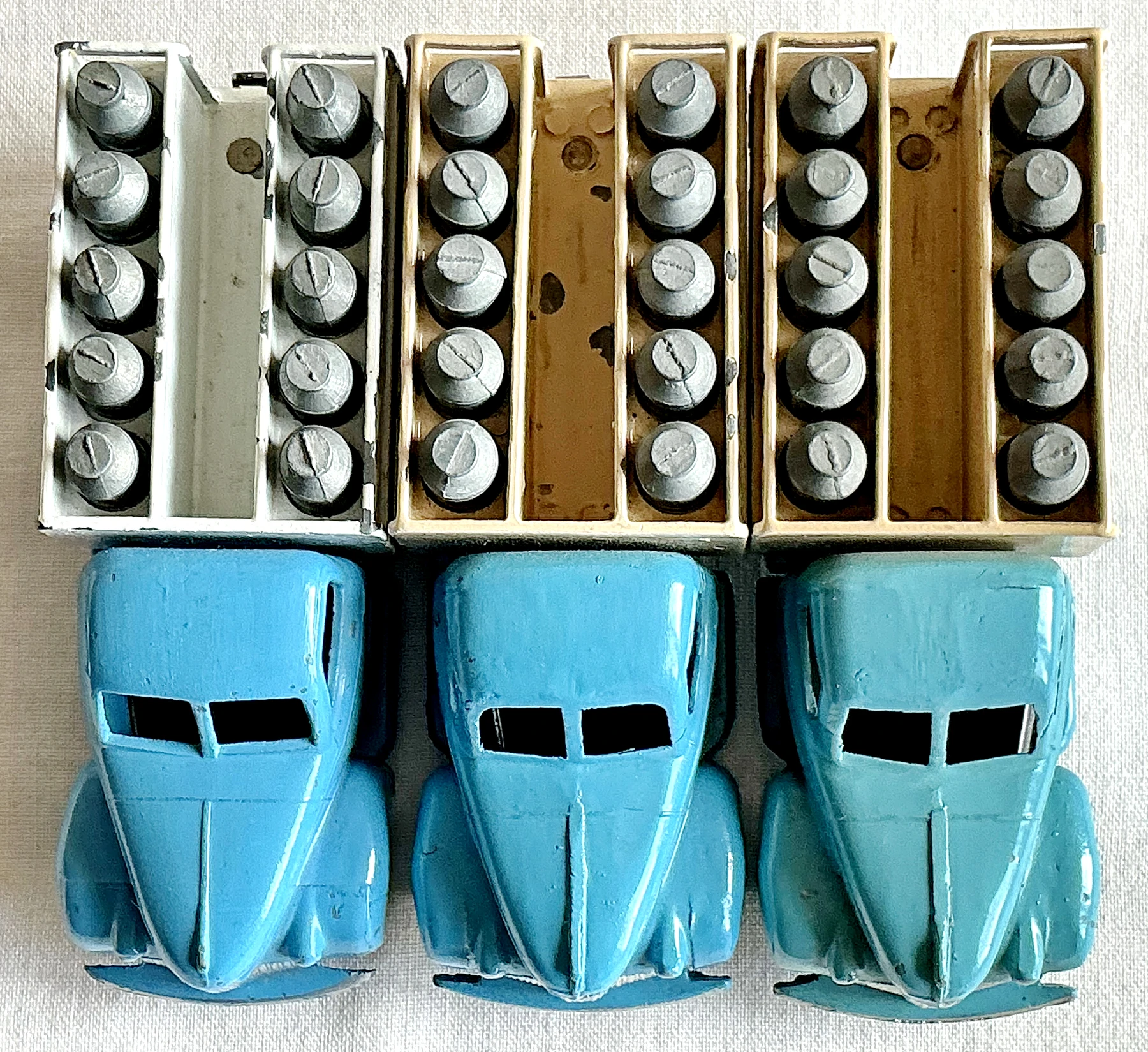
Top view of the three main versions of the Dinky 25O Studebaker Milk Truck
Casting details
The Dinky 25O Studebaker Milk Truck was released with two types of cabs, three different chassis and a body that was always light blue. The cargo bed was initially beige, then appeared in different shades of ivory and white, and was specially designed for the transport of milk cans. It features a “Nestlé” logo on the top of both sides applied with a sticker or stamp.
The model comes with ten loose milk cans. On both sides of the bottom row of the loading platform, five milk cans are beautifully cast in relief into the sidewall. They are meticulously painted silver using mask spraying techniques and look rather nice. Above that, on the upper row of the divided loading floor, five milk cans can be placed for a total of ten cans.
A round recess is present on the bottom of the loading floor for each milk can, into which the can can be placed as shown on pictures above. The “NESTLÉ” logo is applied in bold blue capital letters at the top of the outer sidewalls, with two embossed cast crosses on either side At the rear of the loading platform is cast a cross in relief on each of the two separate loading floors. All these details enhance the appearance of the model and make it very attractive.
Early versions of the model had all black metal wheels. Around November 1949 they were adorned with convex light blue hubs with black “M” rubber tires. The model is equipped with a towing hook which is riveted to the chassis along with a spare wheel and the loading platform.
Casting differences
The two types of cabs have interesting casting differences which are fun to discover and share with fellow Dinky collectors.
The body of the very first model was issued in lighter blue and the chassis was equipped with a closed crank hole. It’s quite remarkable that for a very short time the first version of this model was equipped with a plate with a hole for the crank, which was then omitted from later models. This version is very scarce and hard to find in complete and good condition with all the milk cans and box. I was lucky enough to acquire this version in good condition.
R: First version in lighter blue with closed crank hole. L: Second version with open crank hole.
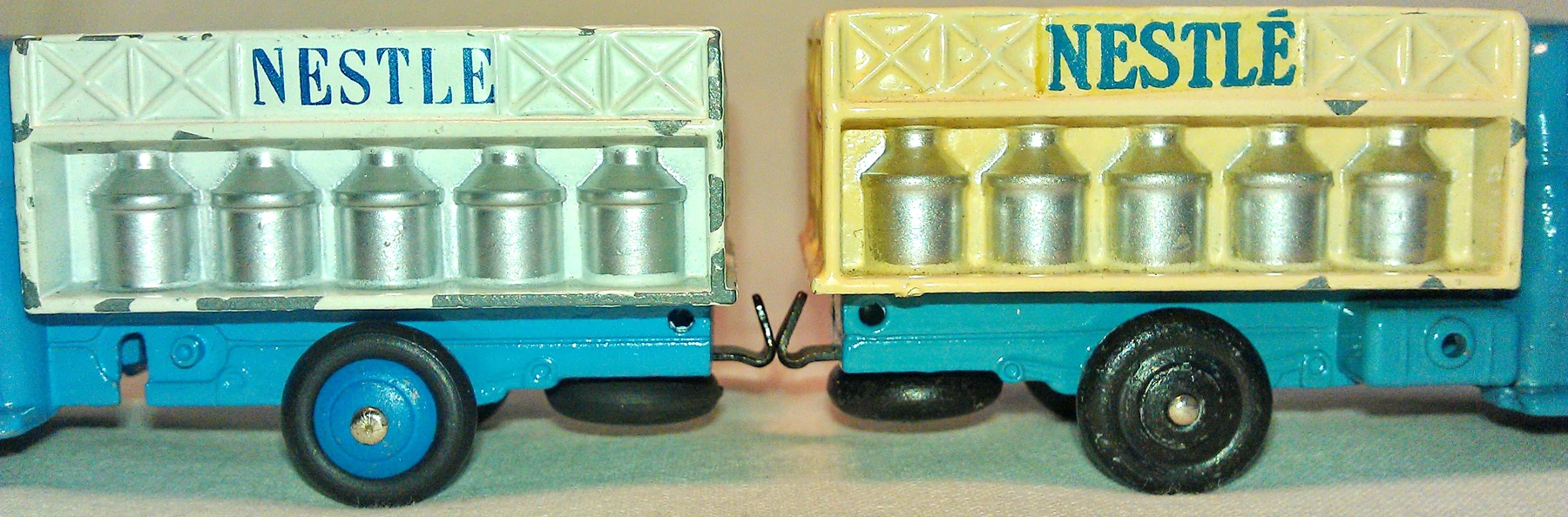
Shown above are the first (right) and second (left) type cabs. Note the differences in the cut out windows, the thickness of the center hood moldings, the hood ornament and the cut out bumpers. The round recesses at the bottom of the loading bed for each milk can are visible in the picture above. The right loading bed is beige in color while the left one is more ivory.
Shown here are type 1 cabs with different toolboxes embossed on the running board and different short side moldings on the hood. On the left is the lighter blue first version and on the right, the second version.
Shown above (on the left) is the second version of the model with a type 1 cab with a large toolbox and short side moldings on the hood and (on the right) the third version with a type 2 cab with a smaller toolbox and longer curved side moldings on the hood, as well as larger side windows. I couldn’t find a real Studebaker M series truck equipped with a toolbox on the running board under the door, so its presence on the model is a mystery to me.
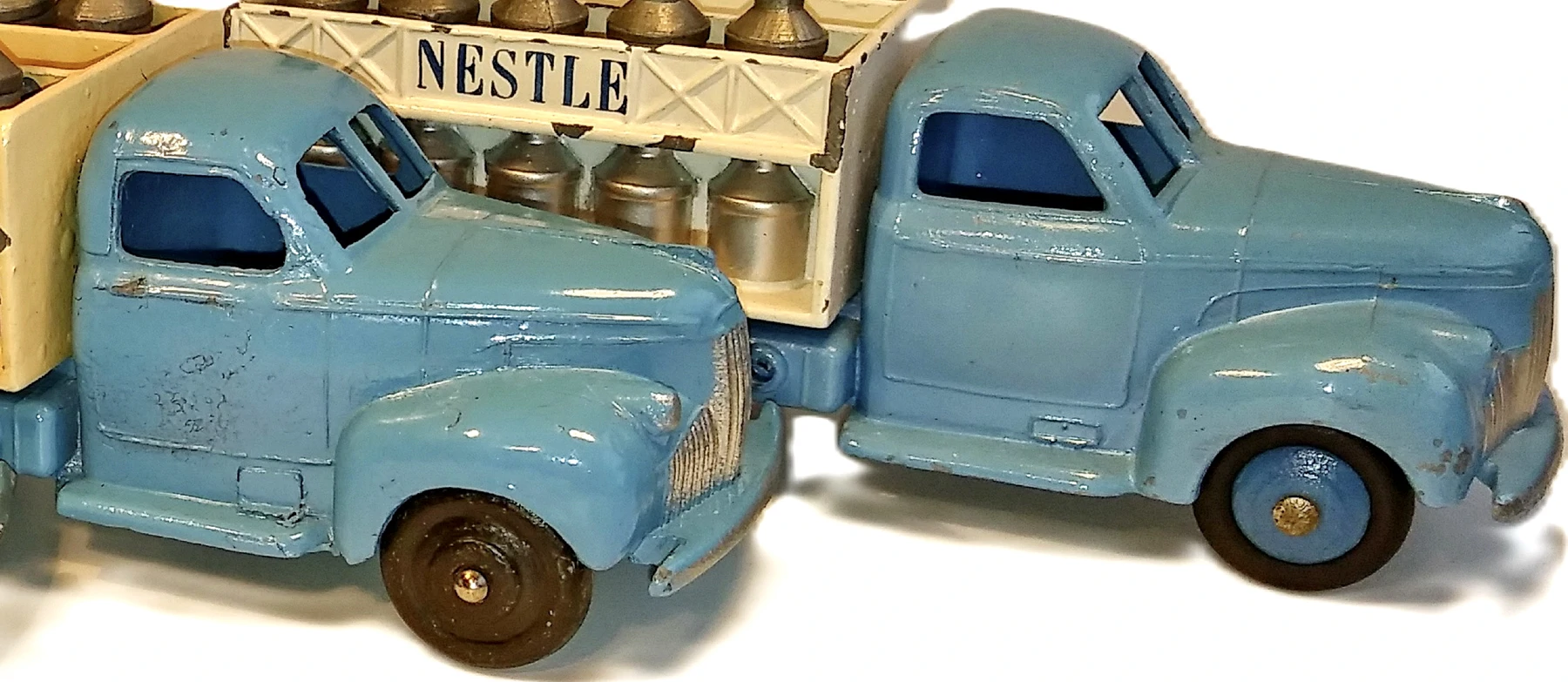
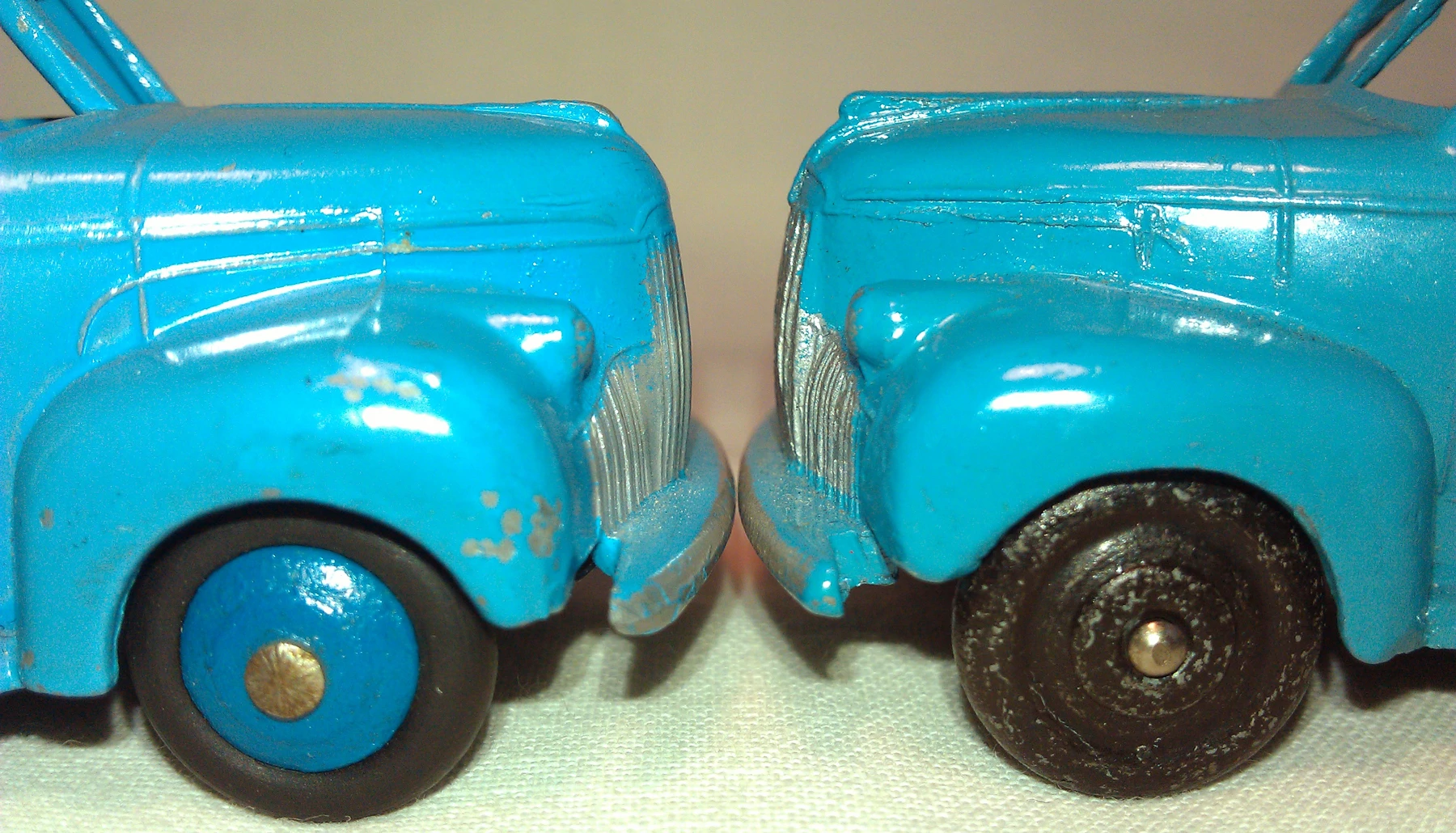
Here’s a close up front side view of the Dinky 25O Studebaker Milk Truck. On the right is the type 1 cab with a short curved side hood molding and a large hood ornament, and on the left a type 2 cab with a longer curved side hood molding and smaller hood ornament. I was also unable to locate a real Studebaker M series truck with side moldings, which makes for yet another mystery.
This picture shows differences in the “NESTLÉ” logo and colors of the loading platform between the first version (on right) and third version (on left). Also note the differences in wheels and the “M” tires on the model on the left. Both versions include milk cans in attractive relief on the lower sides of the platform.
Top view of open chassis. Image: Jacques Dujardin (DTCA)
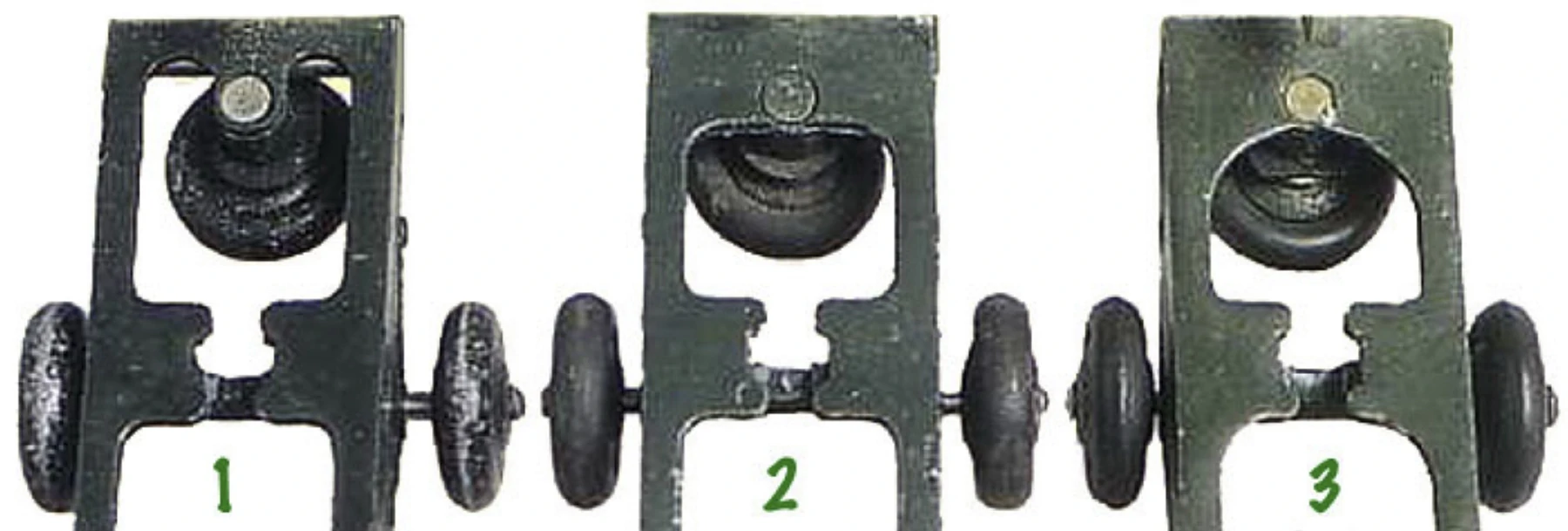
In the above picture we see the top view of three versions of the open chassis of the Dinky 25O Studebaker Milk Truck, with the first and second versions using a type 1 cab and the third version a type 2 cab.
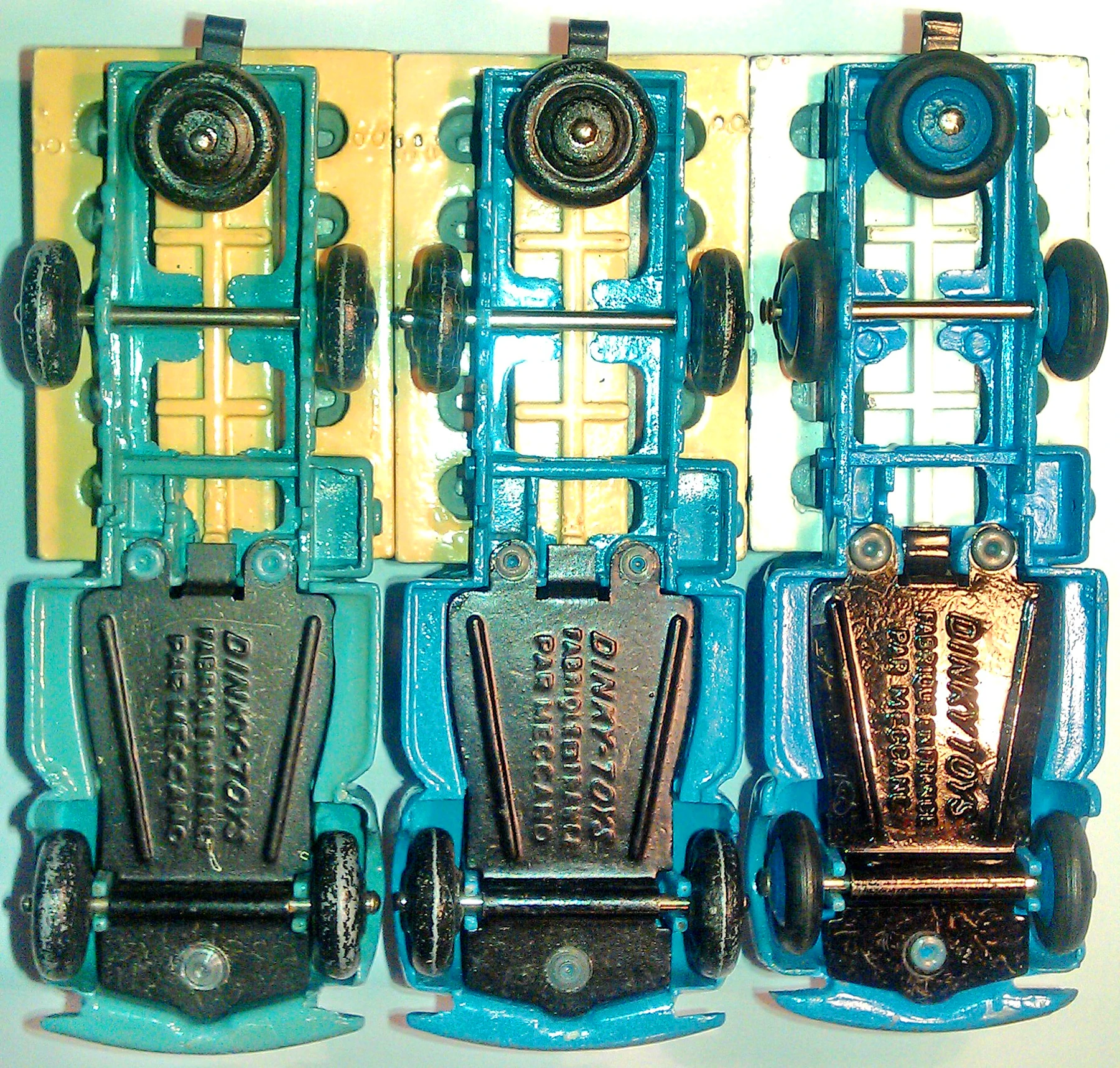
The picture above shows the bottom view of the three versions in order from left to right. The first two baseplates have a hyphen between DINKY and TOYS, which is missing in the third version. And only the third version has a pair of ejection markings below the rear axle.
More variants
Although this article describes the three main versions of the Dinky 25O Studebaker Milk Van, there are more variants. For example, my second version chassis with type 1 cab has black metal wheels and an open crank hole, but this version also exists with a closed crank hole. I also have a model with a second version chassis with open crank hole, but light blue ridged hubs and black rubber “M” tires as shown below. This version represents the transition from black metal wheels to light blue ridged hubs and black “M” tires that occurred around November 1949.
For the sake of completeness I should also mention the following curiosity:
Versions 1 and 2 have a smooth interior roof with three ribs.
Version 3 has a completely smooth interior roof without ribs, but these features aren’t really necessary to determine the main versions.
The second version with light blue ridged hubs and “M” tires (top) and black metal wheels (bottom).
French luxury 25O boxes
The Dinky 25O Studebaker Milk Truck was issued in a unique luxury box, shown in the 1950 Dinky Toys French catalog. Note the other two unique luxury French boxes, each also sporting a single flexible flap.
The Dinky 25O Studebaker Milk Truck was delivered in a unique luxury sturdy red plasticized cardboard lid box with a beautiful, fine and shiny checkered pattern. The box has an ingenious three piece cardboard inner packaging in which to store the truck and ten milk cans.
A yellow cardboard packing piece bent into shape covers the floor, with space in the middle to store the truck. In each of the two side supports, five removable milk cans can be stored. A pair of loose inner boxes under the sides of the packing piece serve as support for the cardboard containing the milk cans, and are laminated red on the front.
The front of the box has a flexible flap that can be lowered, allowing the truck to be driven in and out of the box between the two side boxes as if it were driving in and out of a garage. This, along with the removable milk cans, provides high play value.
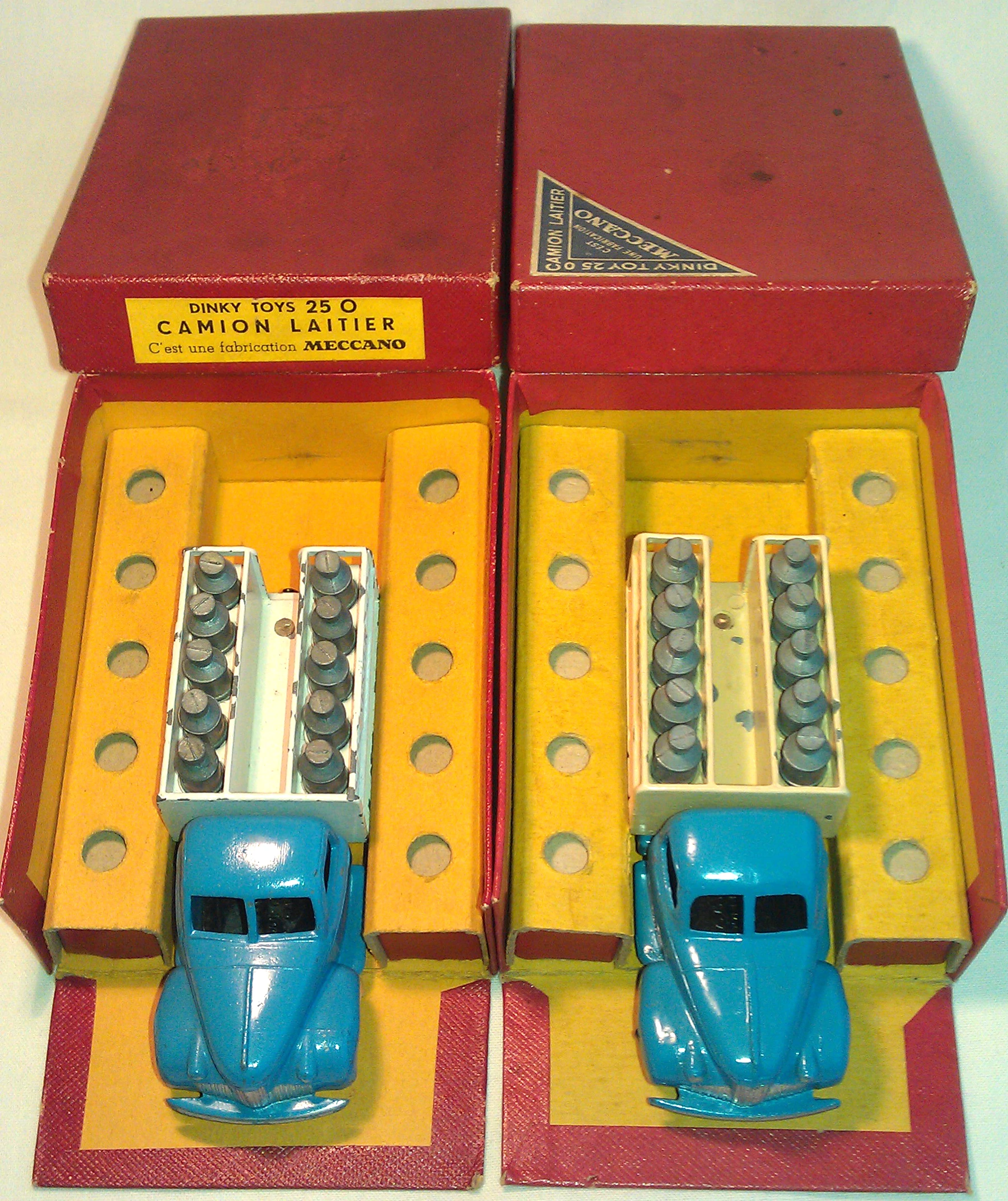
A round red French quality control stamp is placed on the inside lid of the box. The first box was issued with a unique blue triangular label on a corner of the top of the lid, on which “DINKY TOY (without the S) 25o CAMION LAITIER c’est une fabrication MECCANO” is printed in white. The second box had a rectangular yellow label on the front lid on which the name “DINKY TOYS” is printed correctly.
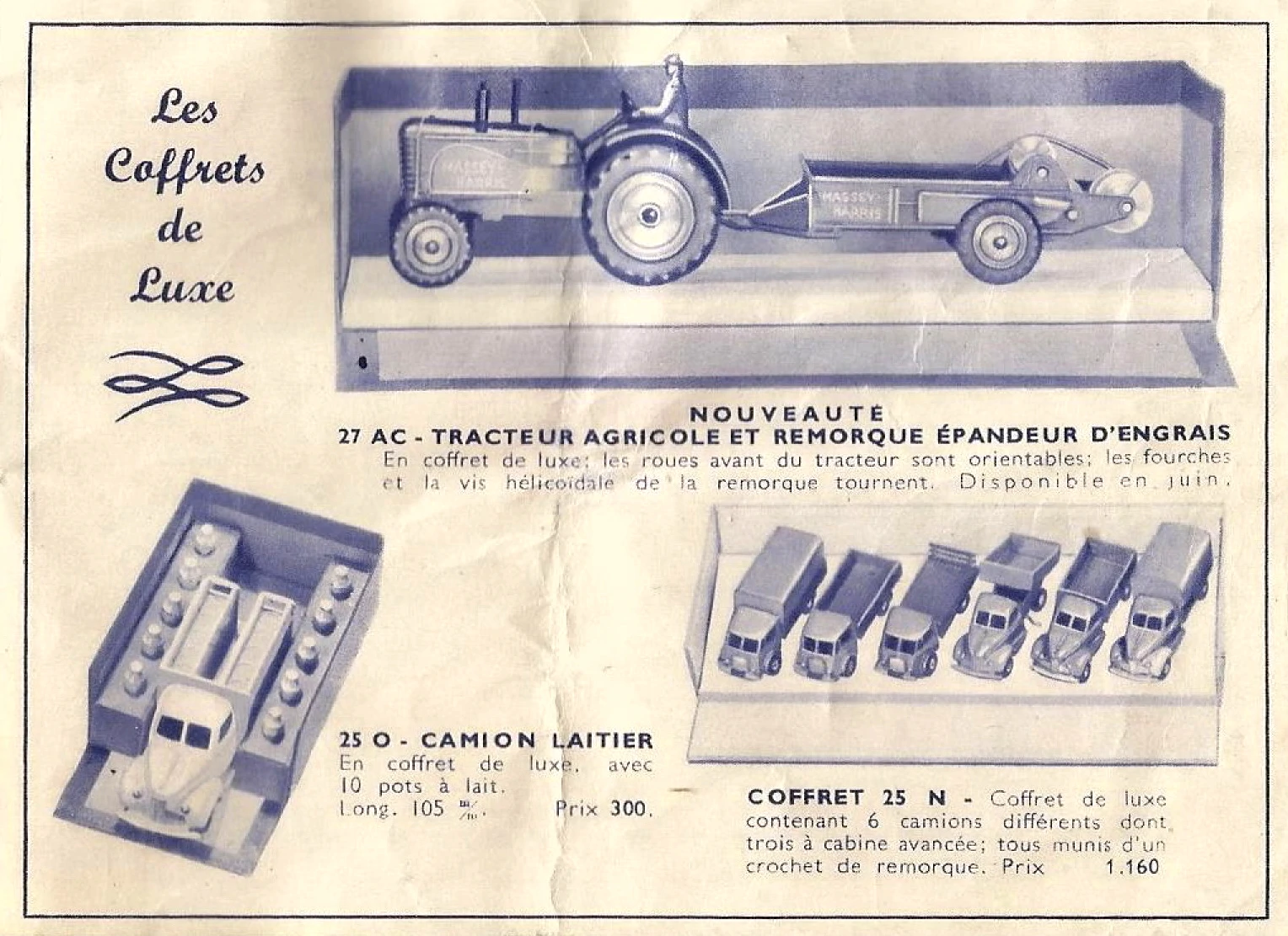
The Dinky 25O Studebaker and Ford were the only models in the 25 series issued in individual luxury boxes. All other Studebaker and Ford models in the 25 series were issued in a trade box of 6 units. The only other models assigned these French luxury boxes are the Dinky 27AC Tracteur Massey-Harris avec épandeur d’engraisand and the Dinky 14C Chariot à fourche Coventry Climax which were both imported from England. These boxes are described in my article 6 UK Dinky Toys repackaged by Meccano Paris for the French market (1950–1951).
Dinky 25O Studebaker in luxury French box. R: First version in type 1 box with triangular label. L: Third version in type 2 box with rectangular label.
Shown above are my three main versions of the Dinky 25O Studebaker Milk Truck “Nestlé”. The one at the top right is the very first version in lighter blue with a closed crank hole.
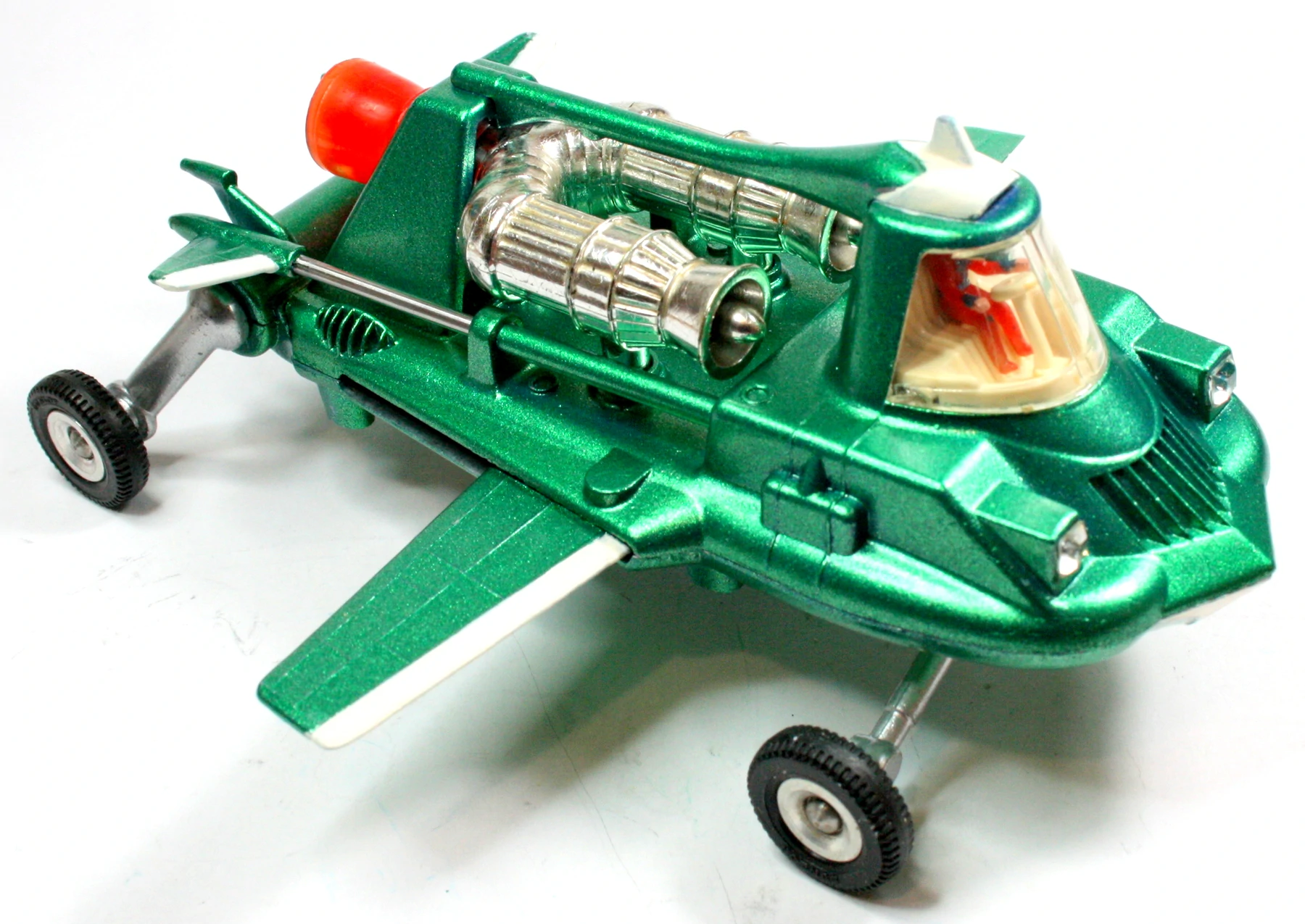
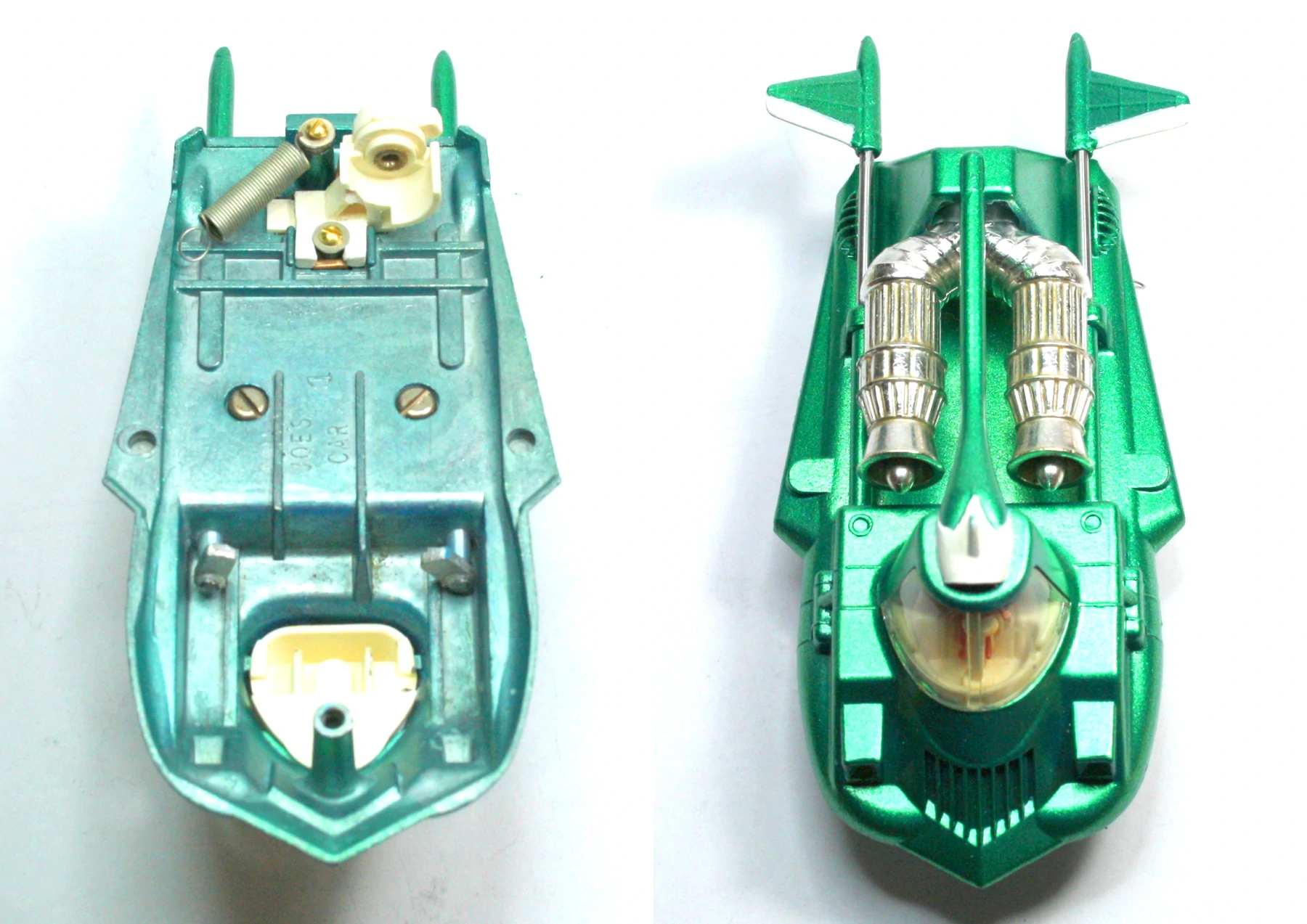
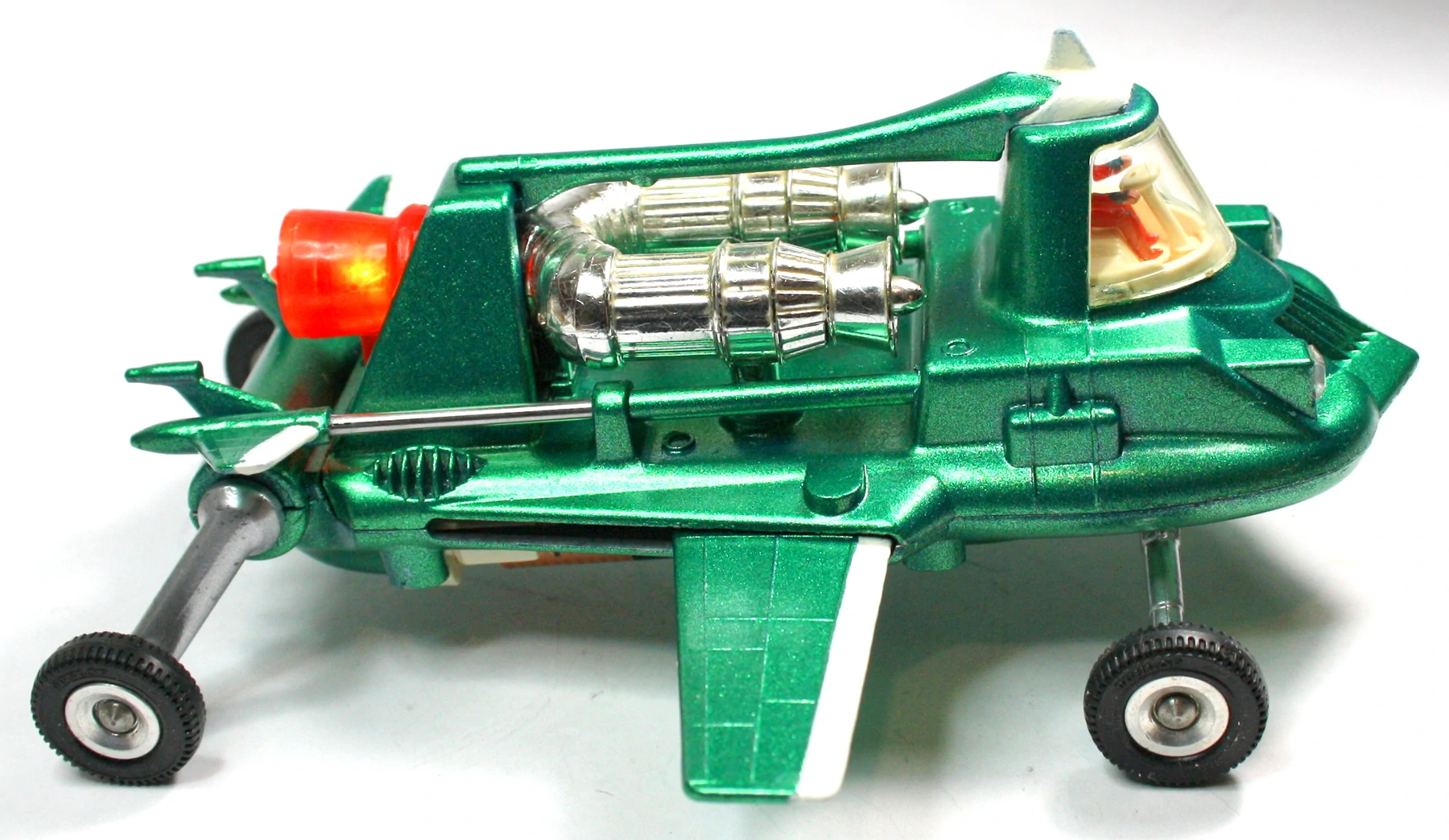
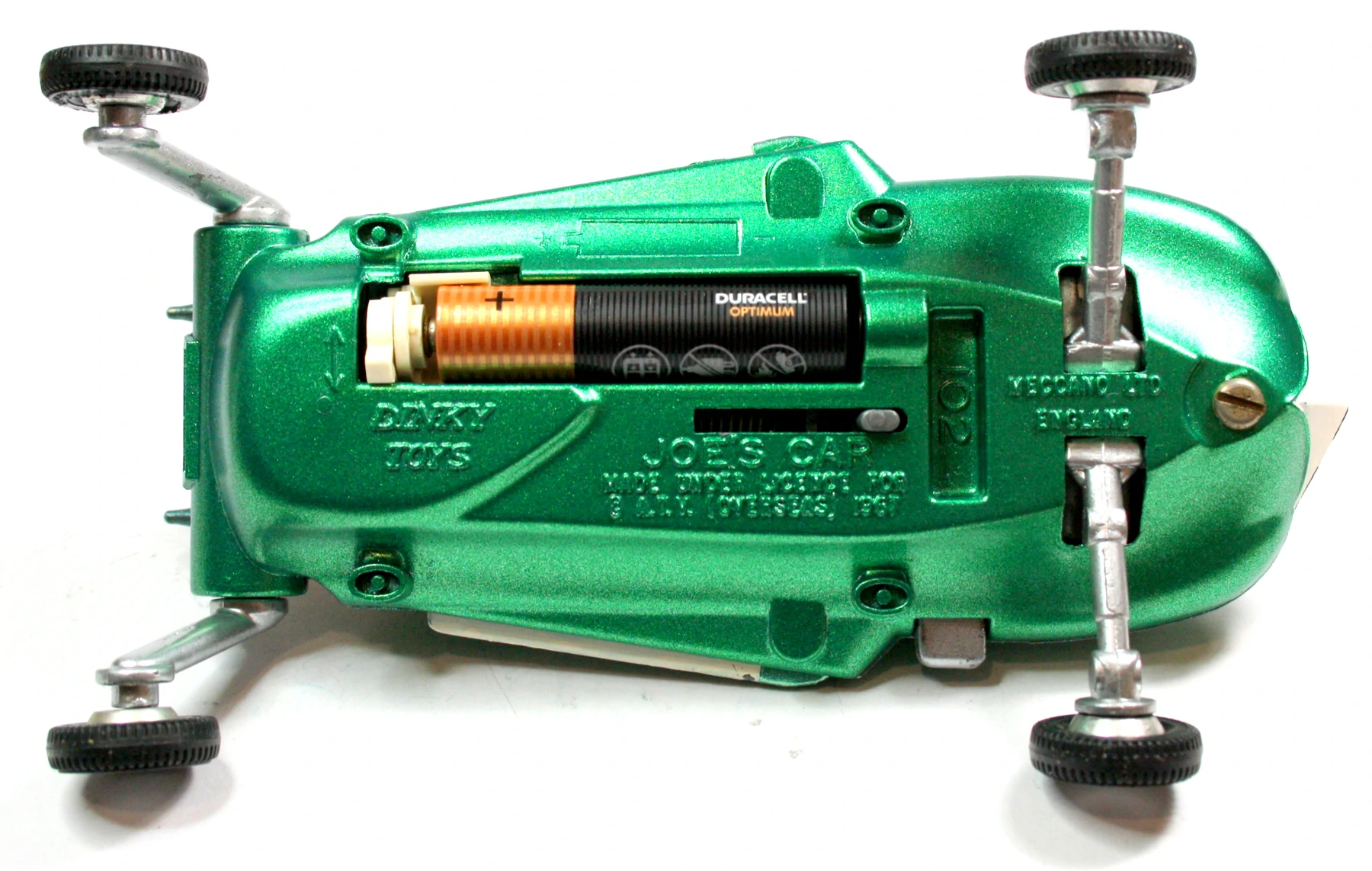
From 1965 to 1970, I worked on product design in Meccano’s drawing office. Sometime during 1968 I was tasked with designing Joe’s Car. The original proposed layout of this model was given to senior designer Terry Boland who only got as far as fixing the shape and layout of the major body parts when he was promoted to New Products Manager; so it was passed to me.
After about ten weeks of detail design and just before release for tooling, Managing Director Joe Fallman insisted on a flashing light within the engine cowl; so I had to shoe horn a AAA battery, switch and bulb holder into a chassis already already filled with mechanisms. In order to achieve this in a short timeframe, I was assisted by the late Fred Risk who was responsible for checking all product designs before handing them over to tool design. After working on numerous sketches a design was roughed out, so I committed it to paper. With no time left for making a mock up, it had to work right the first time.
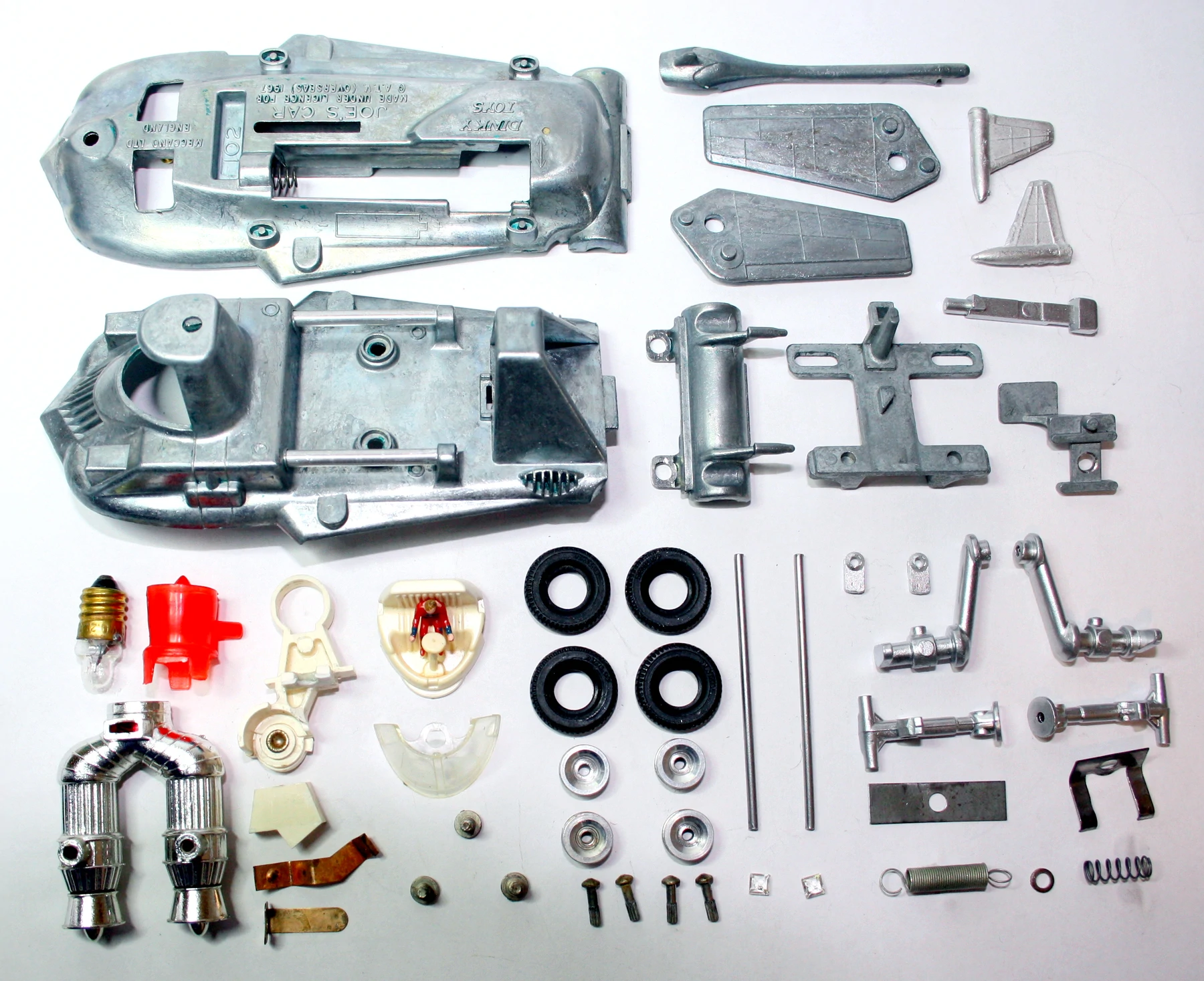
For the purposes of this article I have almost completely dismantled a rather shabby issue 1 Joe’s Car that was missing tail fins, piston rods and lugs. I managed to source white metal replacements for the fins and lugs, as well as a 2.2 mm diameter stainless steel rod for the pistons. I believe it is part of the 500 test pre-production run that every new Dinky undertook.
If all went well, the 500 finished and boxed models were put into storage for selling in the normal way, but an error was missed; the On/Off engraving for the switch had been left off and had to be corrected before serious production commenced. So the initial 500 boxed models must have been sold with the omission because they still keep turning up.
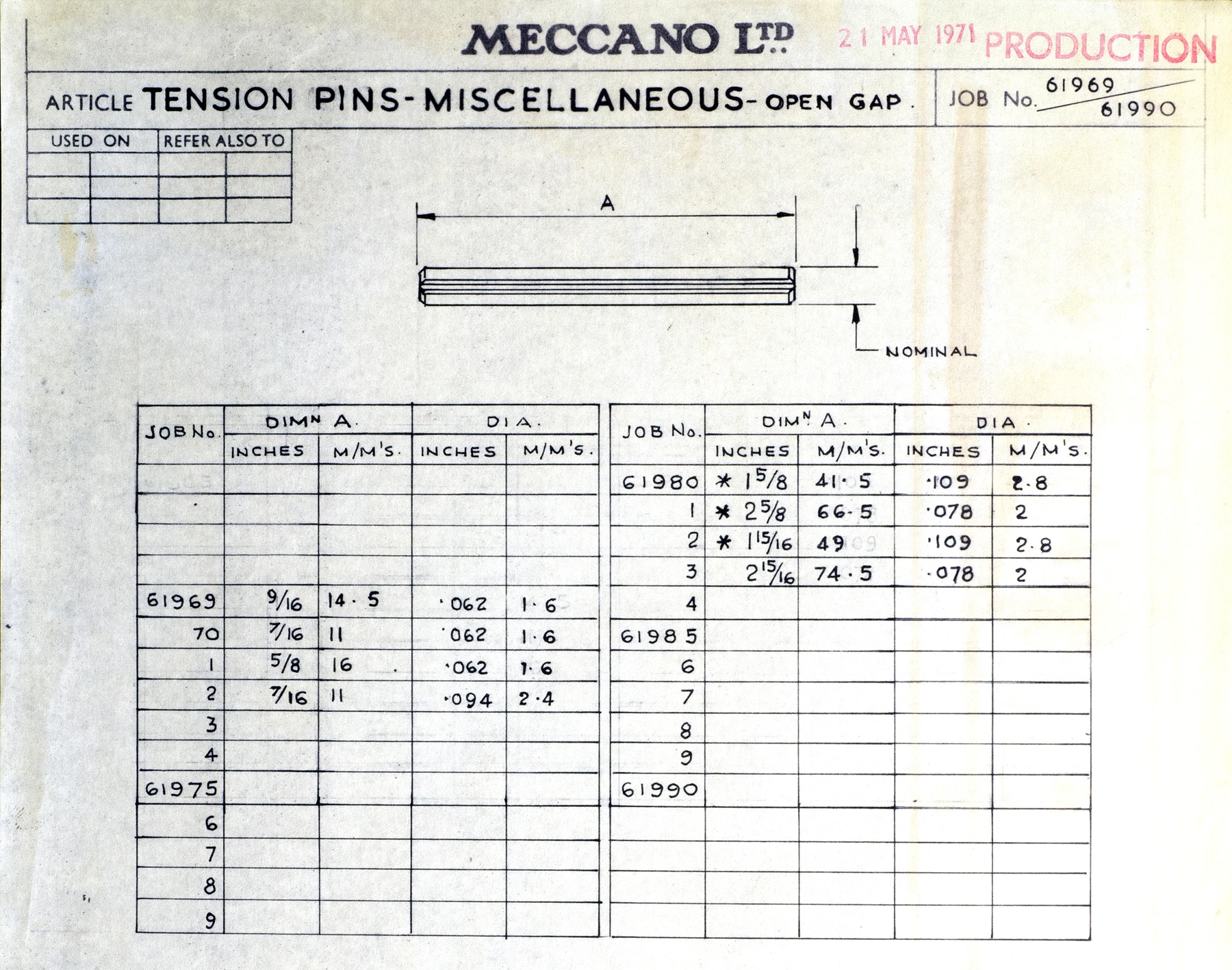
Tension pins list Image: HRCA archive
In production, tension pins were used for the piston rods. Tension pins have a body diameter which is about 0.2 mm larger than the hole they’re meant to fit, and a chamfer on either or both ends to facilitate starting the pin into the hole. The spring action of the pin allows it to compress as it assumes the diameter of the hole. Job No. 61983, 74.5 mm is for Joe’s Car.
Dismantling
It was necessary to grind off the spun over rivet heads holding many of the parts together. To allow later reassembly, the remaining mazak spigots were drilled and tapped to accept 9BA round head screws and washers. No attempt was made to dismantle the glued seat assembly comprising seat, steering wheel and pilot, split the engine moldings apart, remove the semi-tubular rivet holding the switch to the lamp holder, or force fit the aluminum cylinders into the upper body. This was to avoid irreparable damage to these parts. The conical spring in the battery compartment was also left in place, being very securely staked in position. The paint I have used isn’t a true copy. This was not an issue for me as I wasn’t trying to create a perfect replica. The total number of parts is 59 which is very high for a Dinky Toy.
A full set of parts for Joe’s Car
Assembly
Obviously, all the assembly actions that follow would be aided in production by jigs and fixtures to locate parts correctly and prevent them from moving during riveting or screwing together.
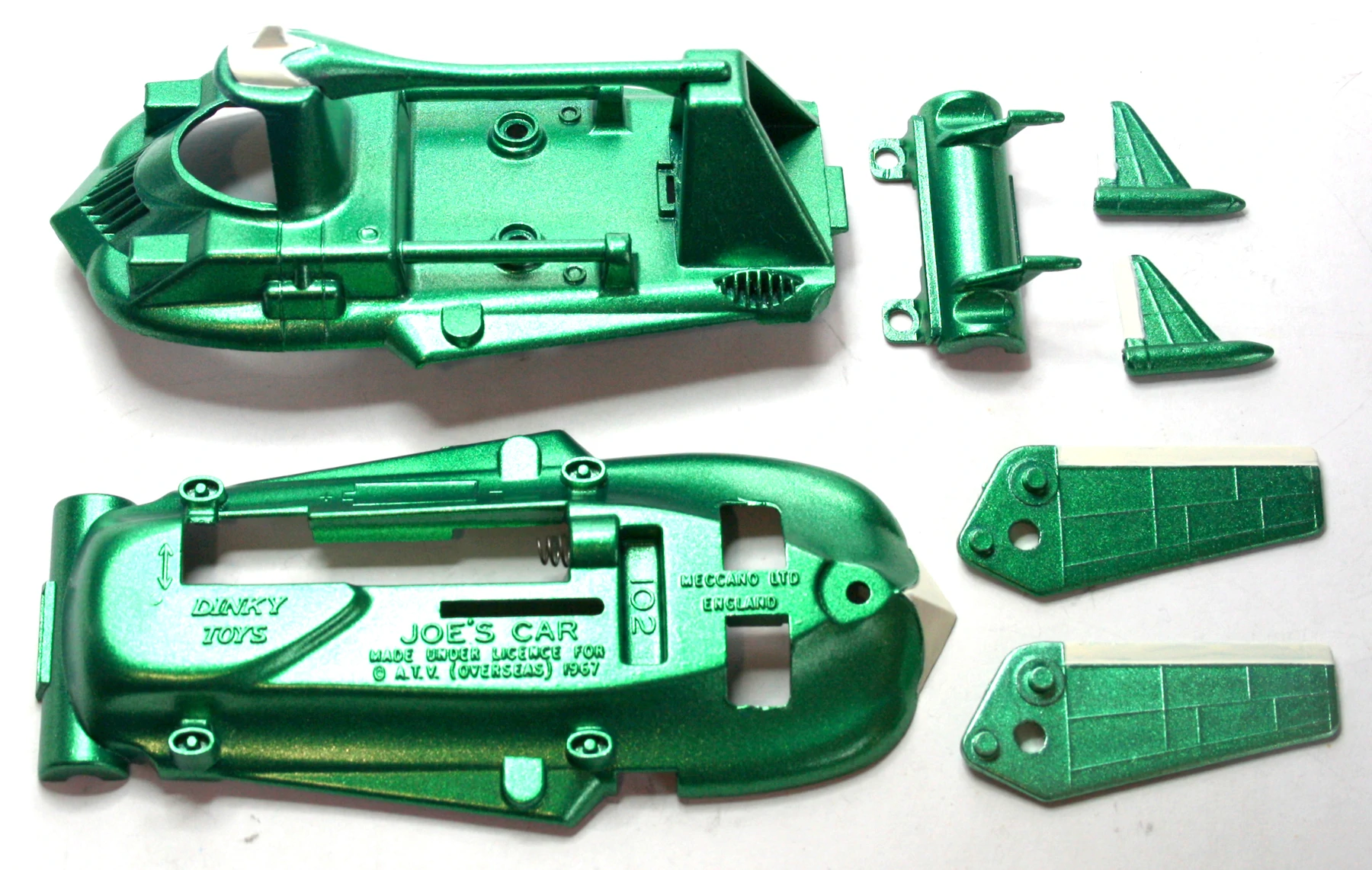
I’ve attempted to sequence the build in the manner of production. The first action is to fit the aluminum cylinders and the top finned cross bar to the upper body. Next, all the parts finished in green would be auto sprayed and the white details masked sprayed by hand. Elsewhere, the mazak suspension arms would be zinc plated and the engine moldings ultrasonically welded together before being sent away for vacuum plating.
Painting completed
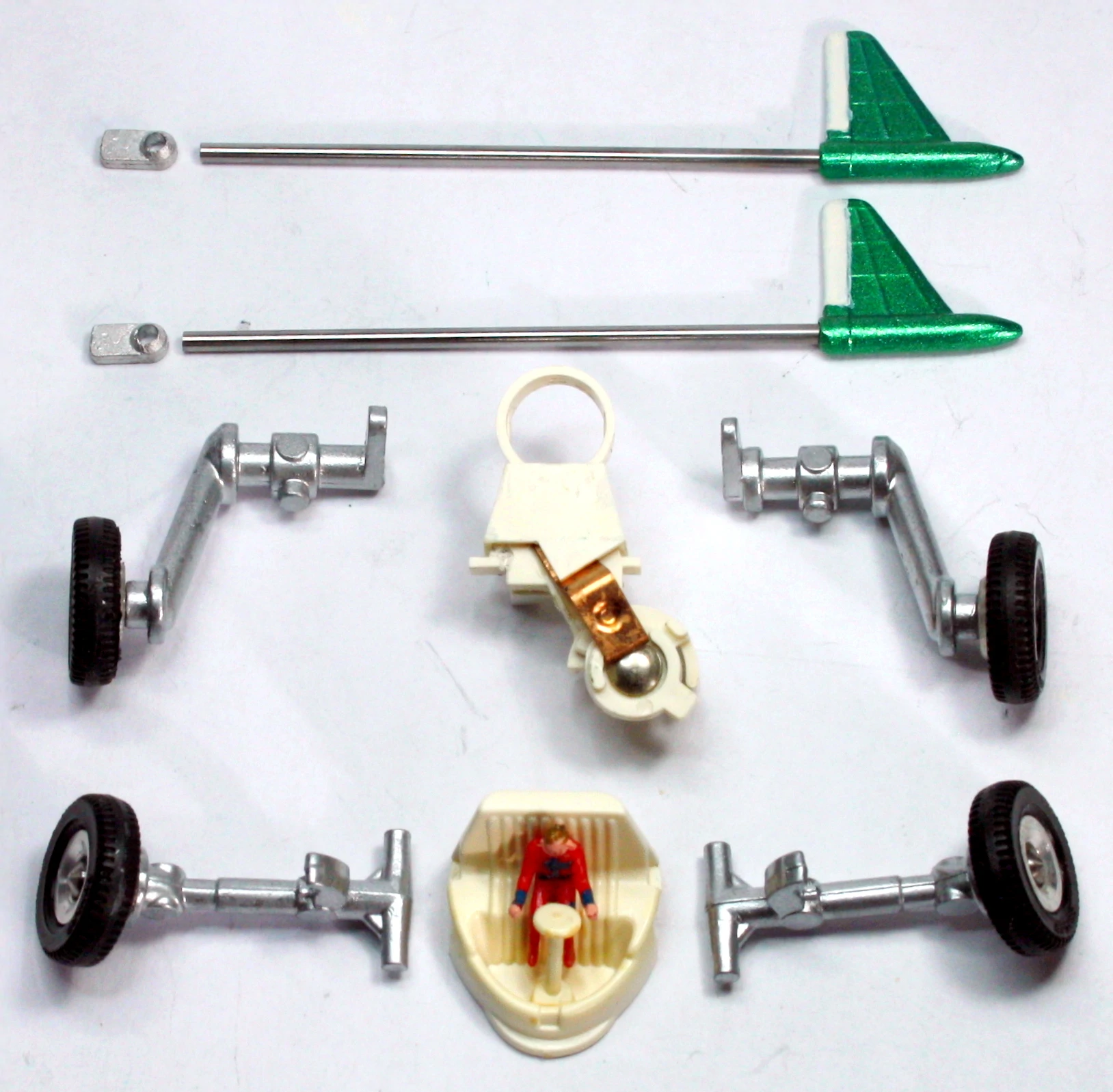
Now it’s time to create a number of sub-assemblies. The piston rods are pushed into the tail fins. The wheels are attached to the four suspension arms. The bulb carrier is fitted with the switch which comprises the switch lever and molded washer all secured with a semi-tubular rivet. The positive contact is then held in place by a molded clip. Finally, the pilot and his steering wheel are glued into the seat molding.
Subassemblies
Assembling the upper body
With the upper body held in a special fixture to ensure correct orientation with the lugs, the fins are fitted. The engine is now fitted and secured with two self tapping screws because the negative bulb contact passes through it at a later stage.
Fins, lugs and engine assembled
With the upper body still inverted, the extension spring and washer are attached to the tower at the rear of the body. Next, the bulb holder assembly is attached to the upper body, trapping the negative contact. Because it was impossible to hold the seat in place using supports cast into the lower body, the seat was dropped into the cab from below and held while the body was turned over and the window pushed into position. Clips molded on the interior of the window engage the seat, and a hole at the top of the window clips over a ramped stud cast into the roof of the cockpit, thus securing the window perfectly flush with the body. This completes assembly of the upper body.
Tension spring, seat and window fitted
Assembling the lower body
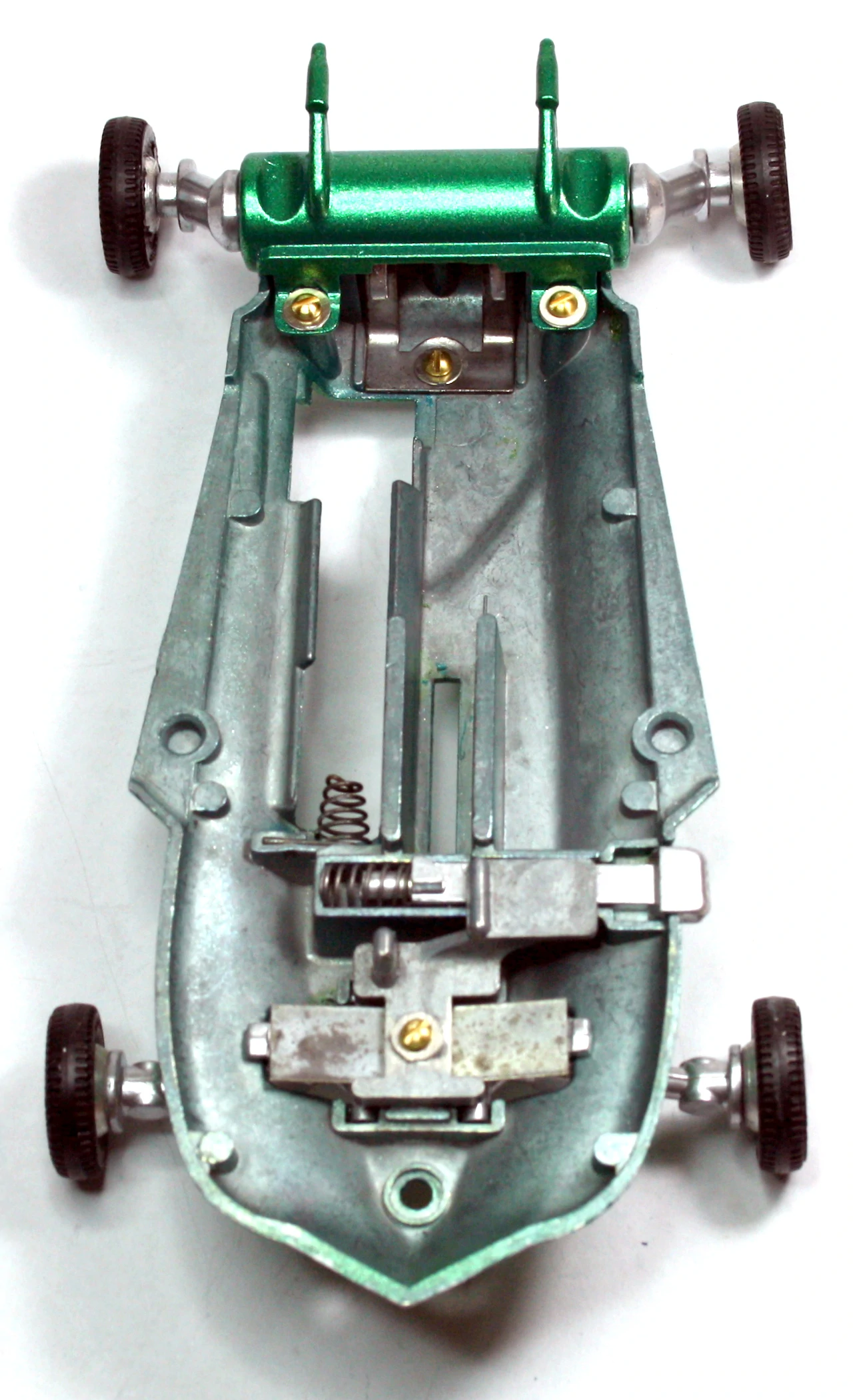
The rear suspension spring is secured, suspension arms located and held in place by the rear suspension cover which slots in and is secured with two spun over rivets. A compression spring is fitted to the wing release button which is then placed in the lower body, followed by the front suspension arms, suspension spring and release button retainer which holds everything in place. The conical battery spring is staked into position. The lower body assembly is now complete.
Lower body assembly
Final assembly
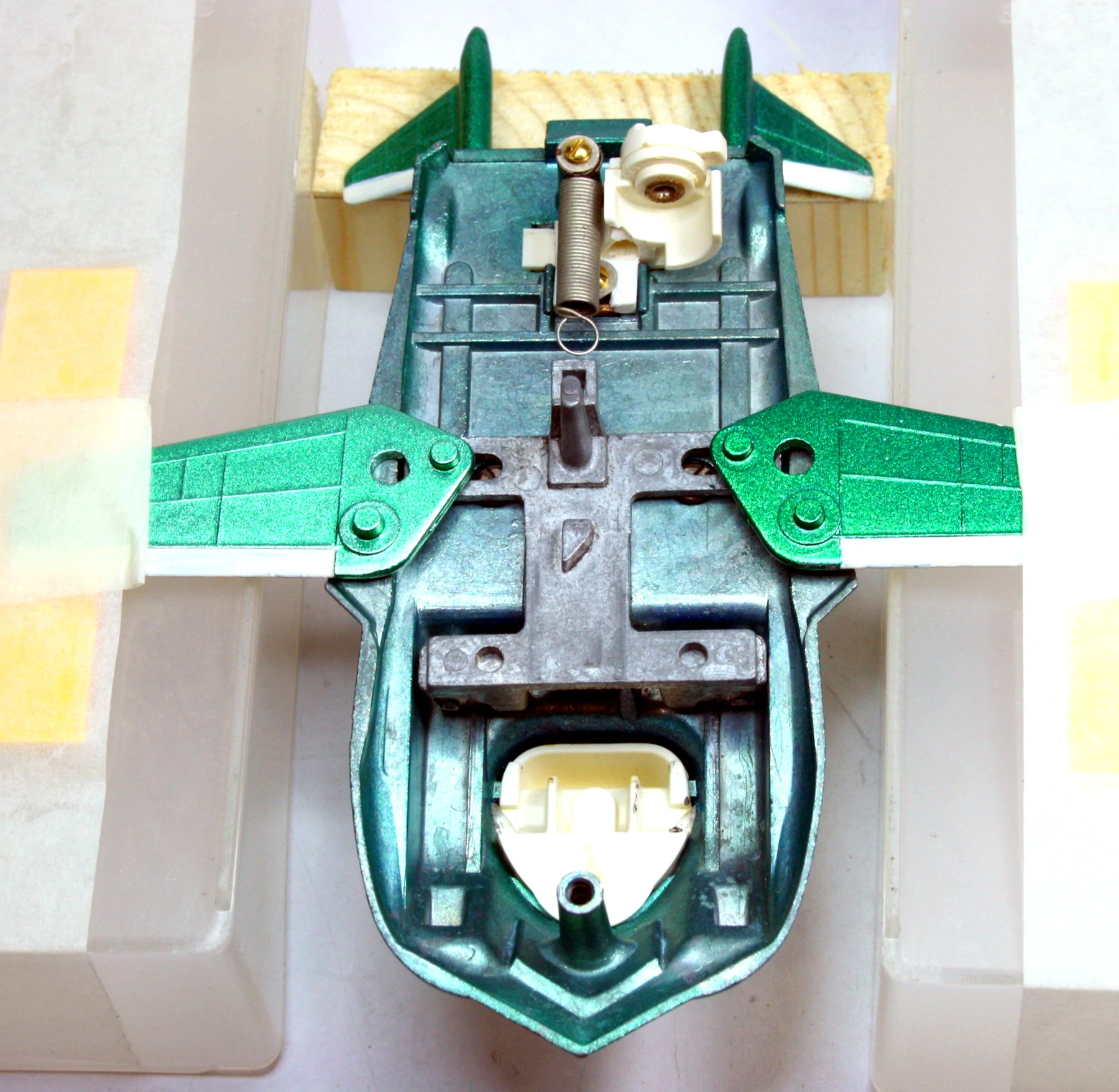
Now, the upper and lower bodies must be joined. With the lower body securely held in a special fixture, the wing actuator is placed in the body in the rear position ensuring that the tail fin lugs engage the slots in the actuator. Both wings are located in their pivot holes in the body, and the actuator is set to the open position and securely held down with clamps. The tension spring is hooked on to the actuator.
Lower body assembly
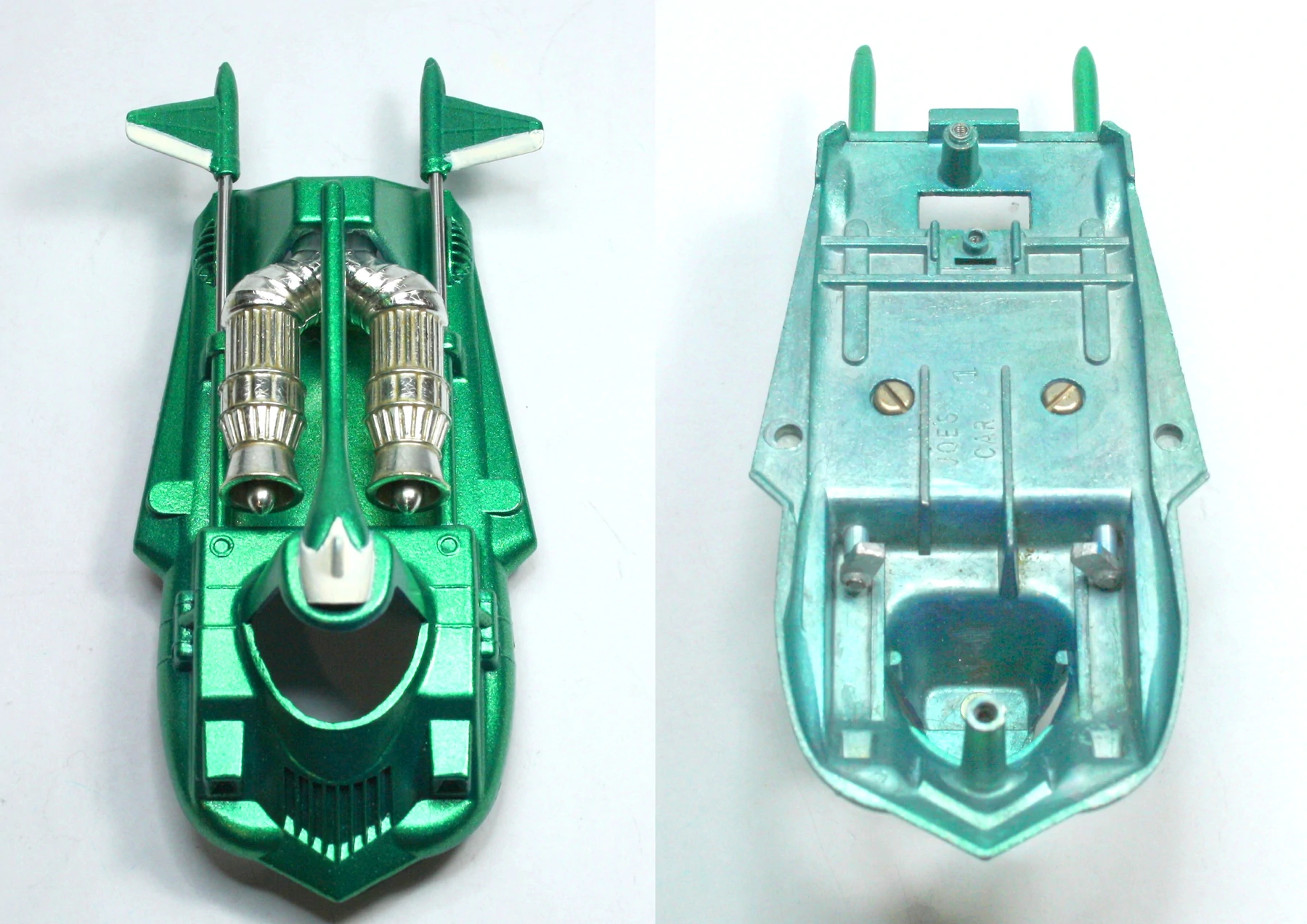
The upper body is now carefully hooked into the rear suspension cover and lowered into position. With a little jiggling, the wing pivots will find their holes in the upper body. Finally, the jeweled headlights are glued in, the bulb screwed into its holder and the engine exhaust fitted.
Final assembly
About the author
Vic Mumby joined Meccano Ltd. in 1961 as an apprentice toolmaker and transferred to the drawing office in 1965. After spending several years in product design, he transferred to tool design and finally became Chief Draughtsman from 1975 until the closure of the company in 1979.
Vic is active in the Hornby Railway Collectors Association (HRCA) and Dinky Toy Collectors Association (DTCA) and was interviewed by Jon Angel. You can read the interview here:
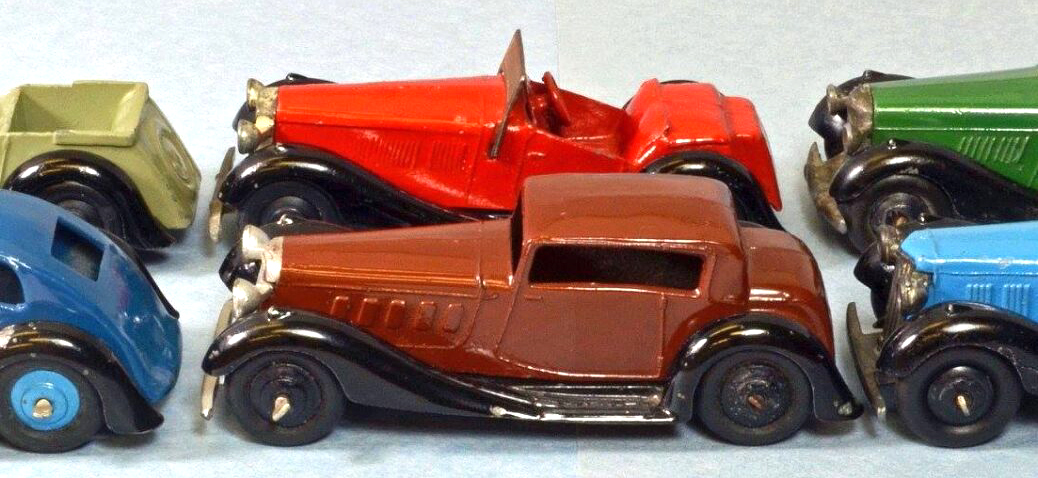
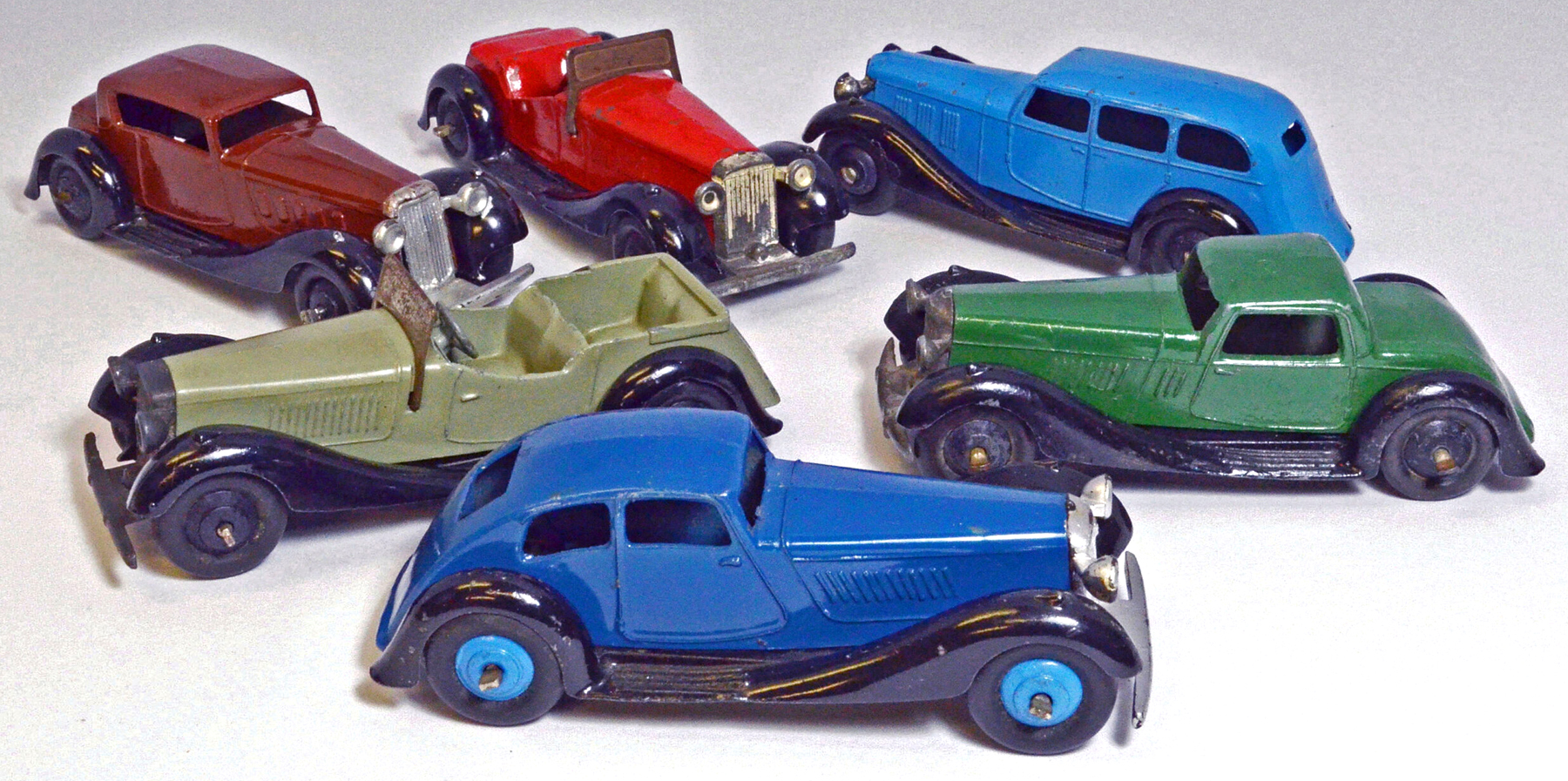
The Dinky Toys 36 series of motorcars was introduced in 1937 and was the direct successor of the 24 series introduced in 1934. Although very similar in appearance, the 36 series featured individually styled radiator shells that closely resembled the real cars, whereas the 24 series used a single surround for each model.
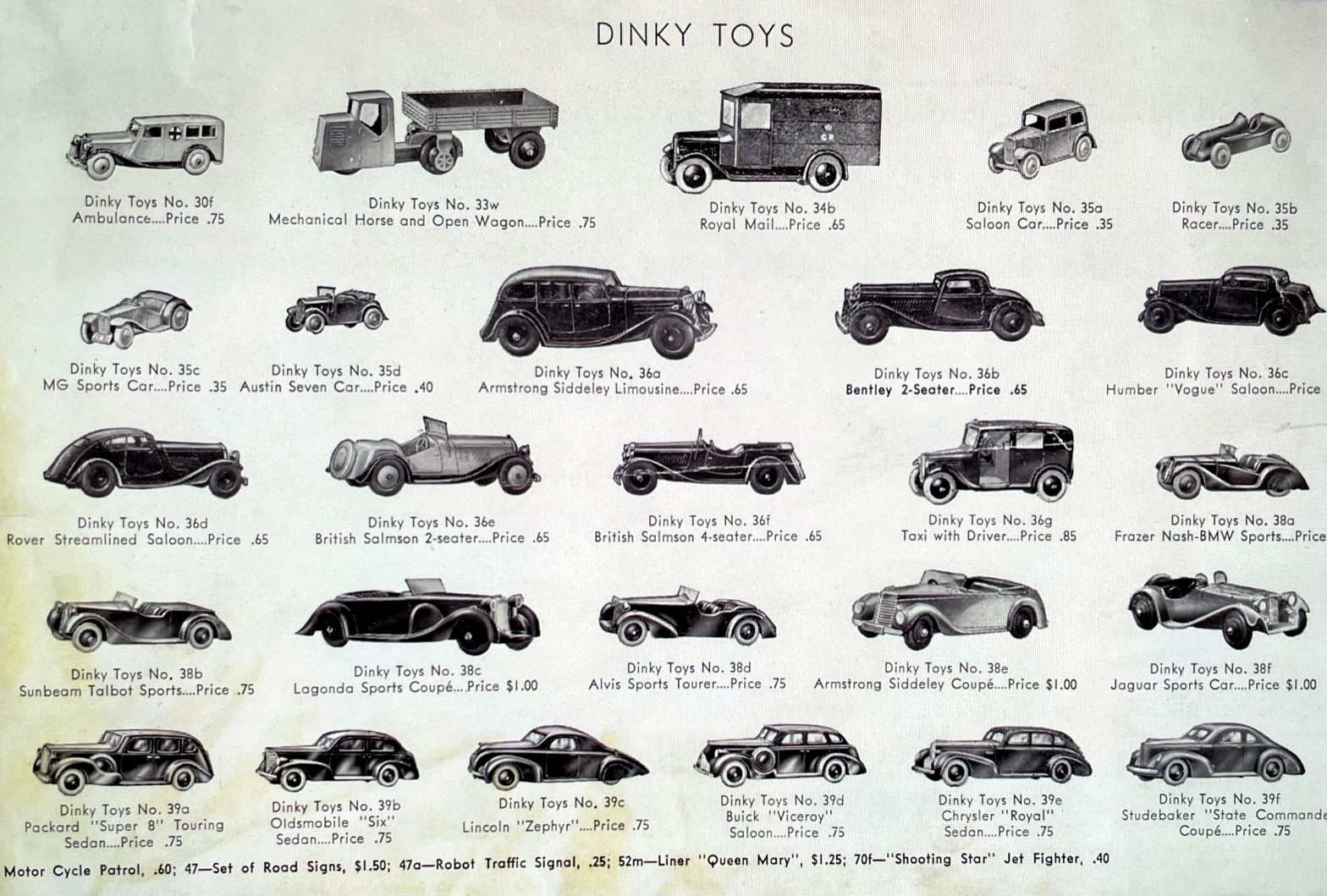
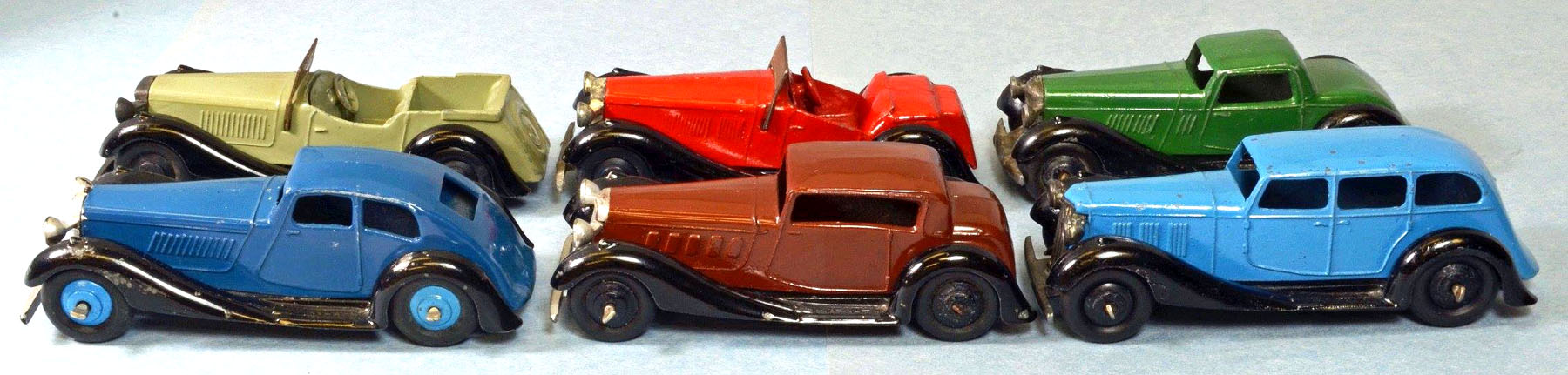
Further, the 24 series models had only generic names such as Limousine, Town Sedan, Super Streamlined Saloon, Sportsman’s Coupe, and Sports Tourer, while the new 36 series were assigned the following names:
36a Armstrong-Siddeley Limousine
36b Bentley Two Seater Sports Coupe
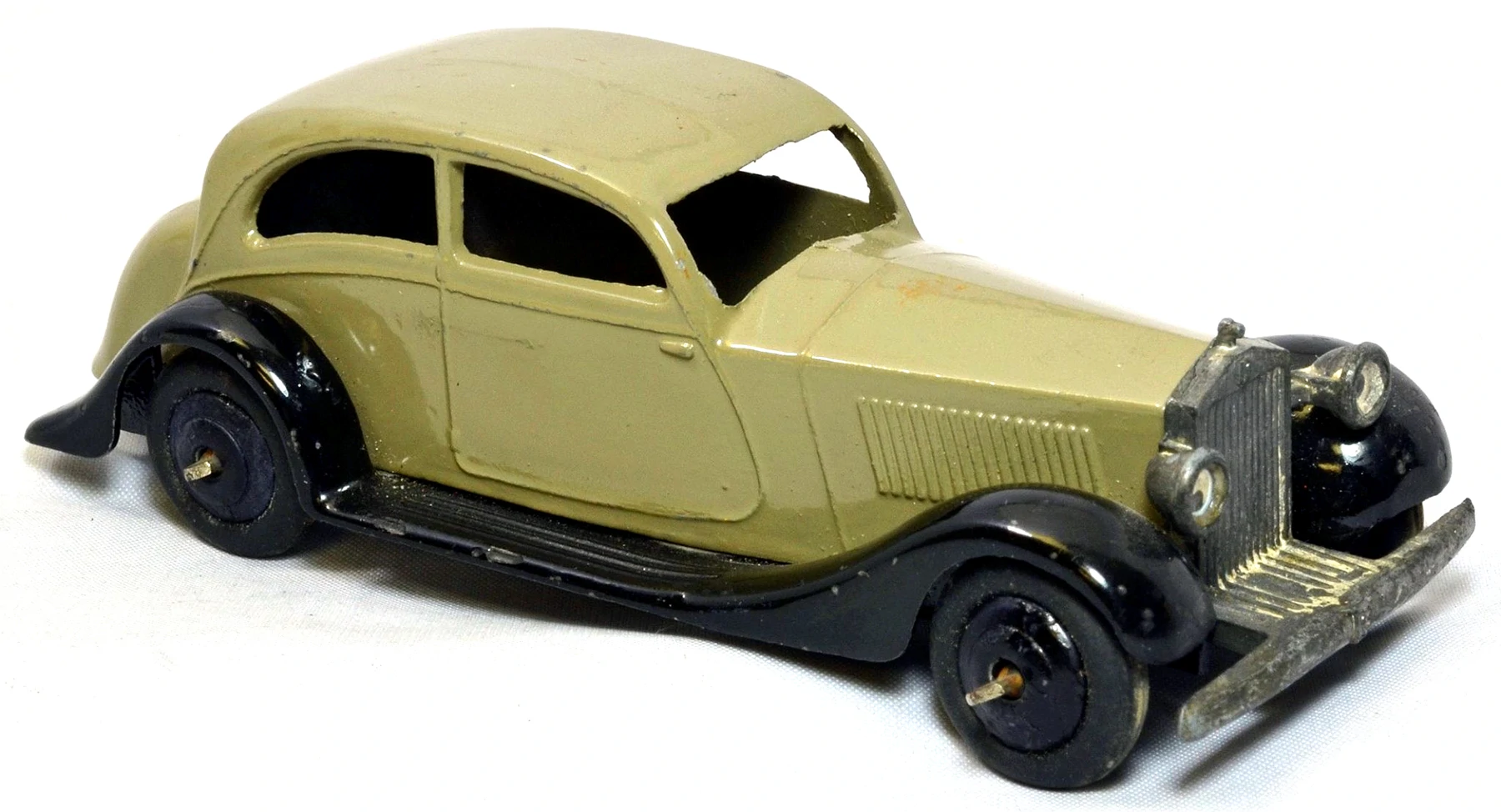
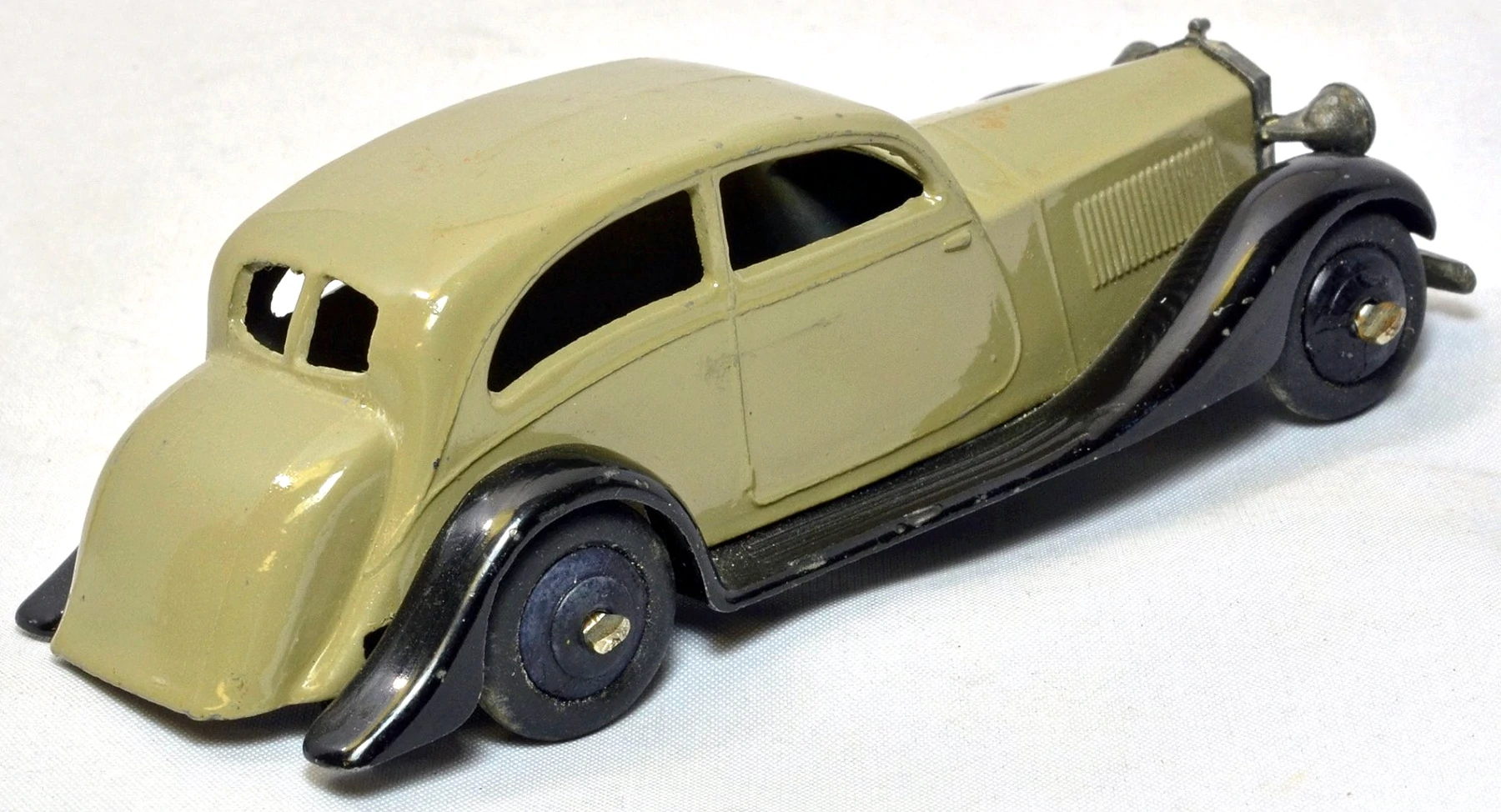
36c Humber Vogue Saloon
36d Rover Streamlined Saloon
36e Salmson Two Seater Sports
36f Salmson Four Seater Sports
36g Taxi with Driver (a new offering)
Dinky Toys 1947 USA catalog
The evolution from the earlier 24 series to the 36 series marked a small but important trend for Meccano Ltd. and Dinky Toys: the beginning of striving to make more accurate and recognizable models. The pre-war 36 series models differed from the post-war releases in one important way: the earlier versions featured drivers and passengers or footmen inserted via a clip attached to the baseplate. Sadly these were dropped when post-war production resumed.
Pre-war production of all Dinky Toys was halted in 1941 due to the onset of WWII. When the war ended in 1945, Meccano was anxious to resume production. Many existing dies were therefore immediately pressed into service and the 36 series models were re-released in early 1946, now without those earlier drivers.
Another change involved colors. The pre-war issues had the chassis and fenders painted in a variety of bright colors, while the post-war models only had black chassis and fenders.
In addition, the pre-war cars had thinner axles, smooth wheels, white tires and plain baseplates. Later, during 1946–1950, they had molded baseplates showing a drivetrain, ridged wheels, and sported black tires.
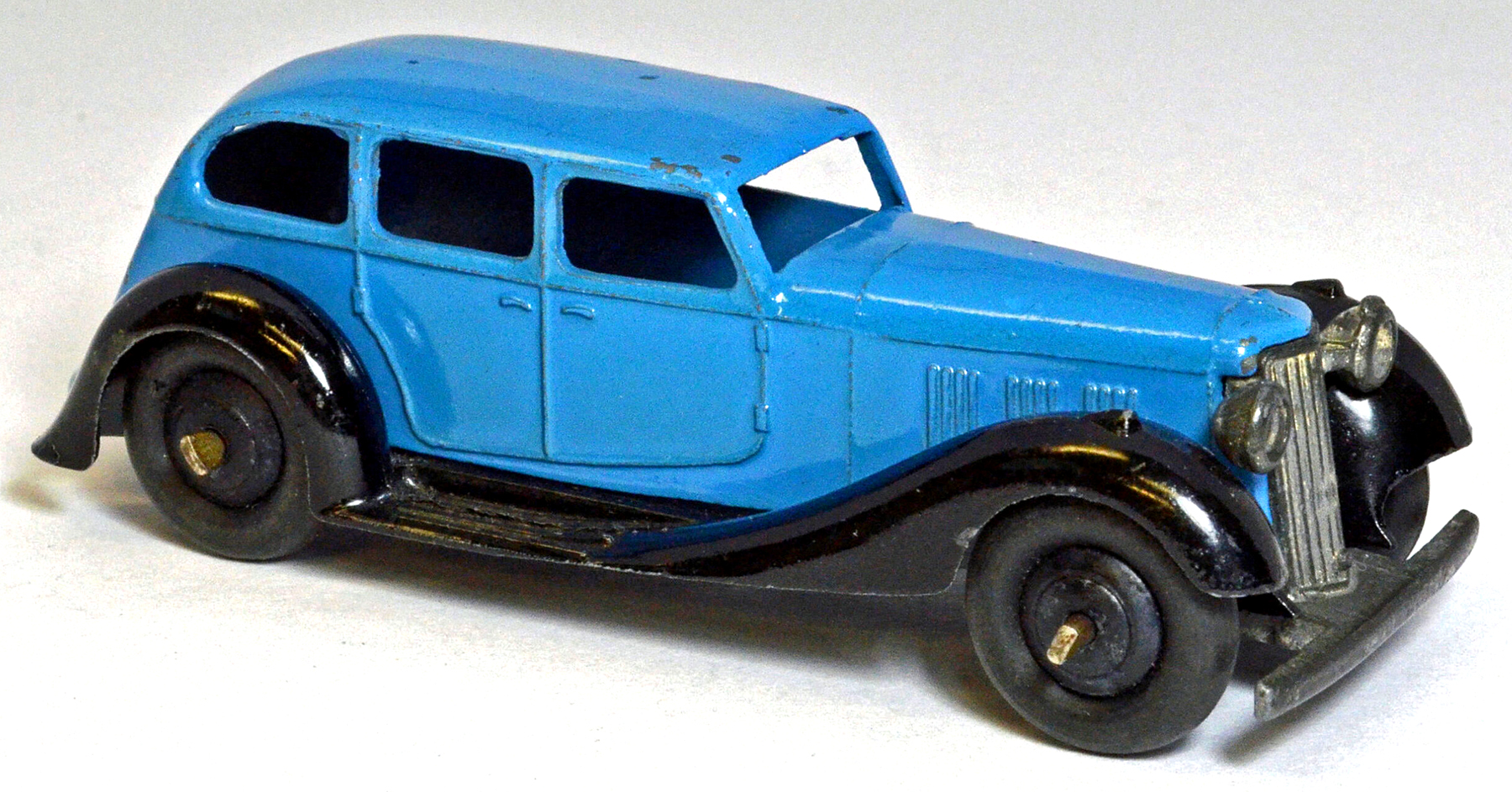
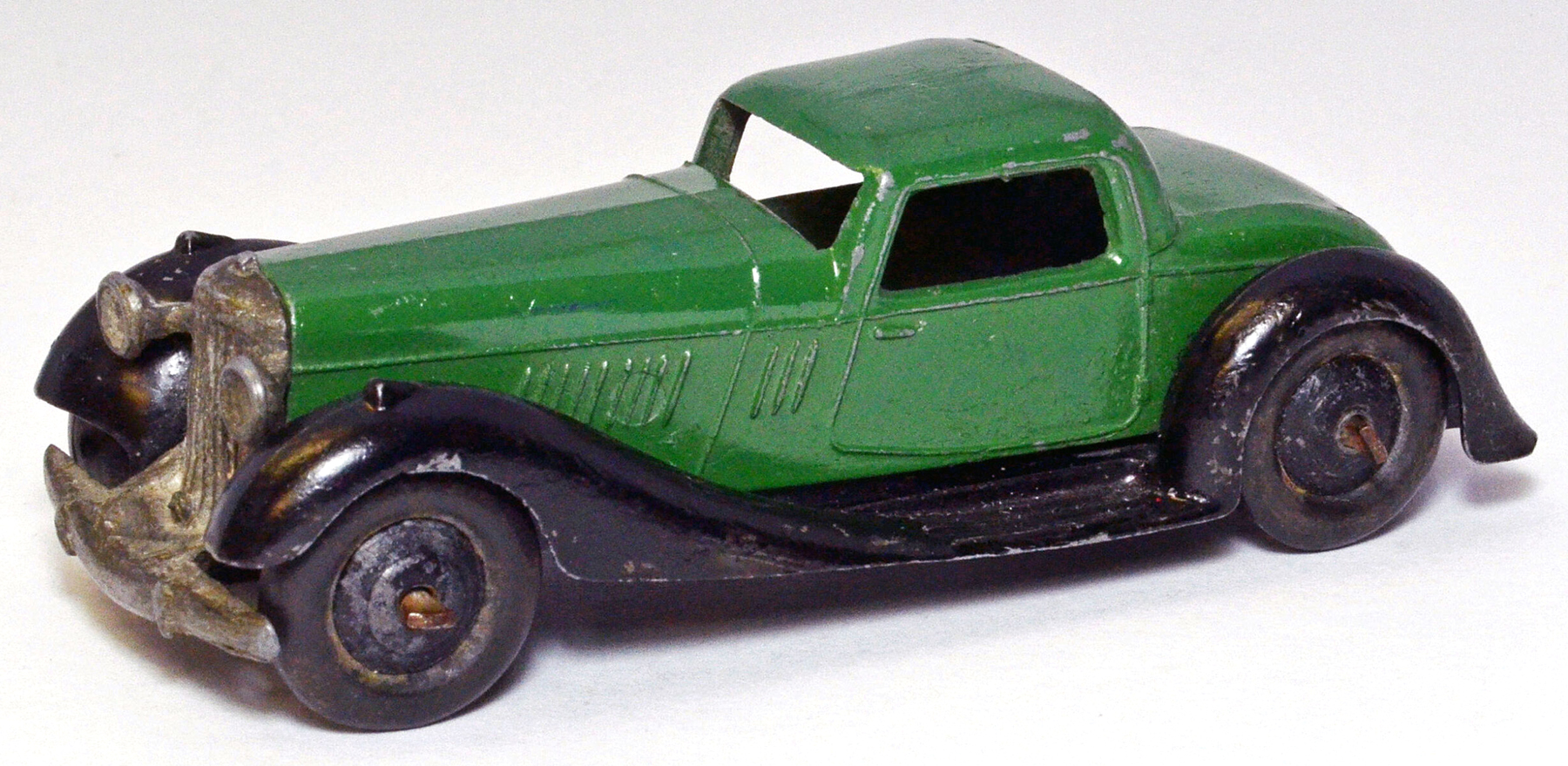
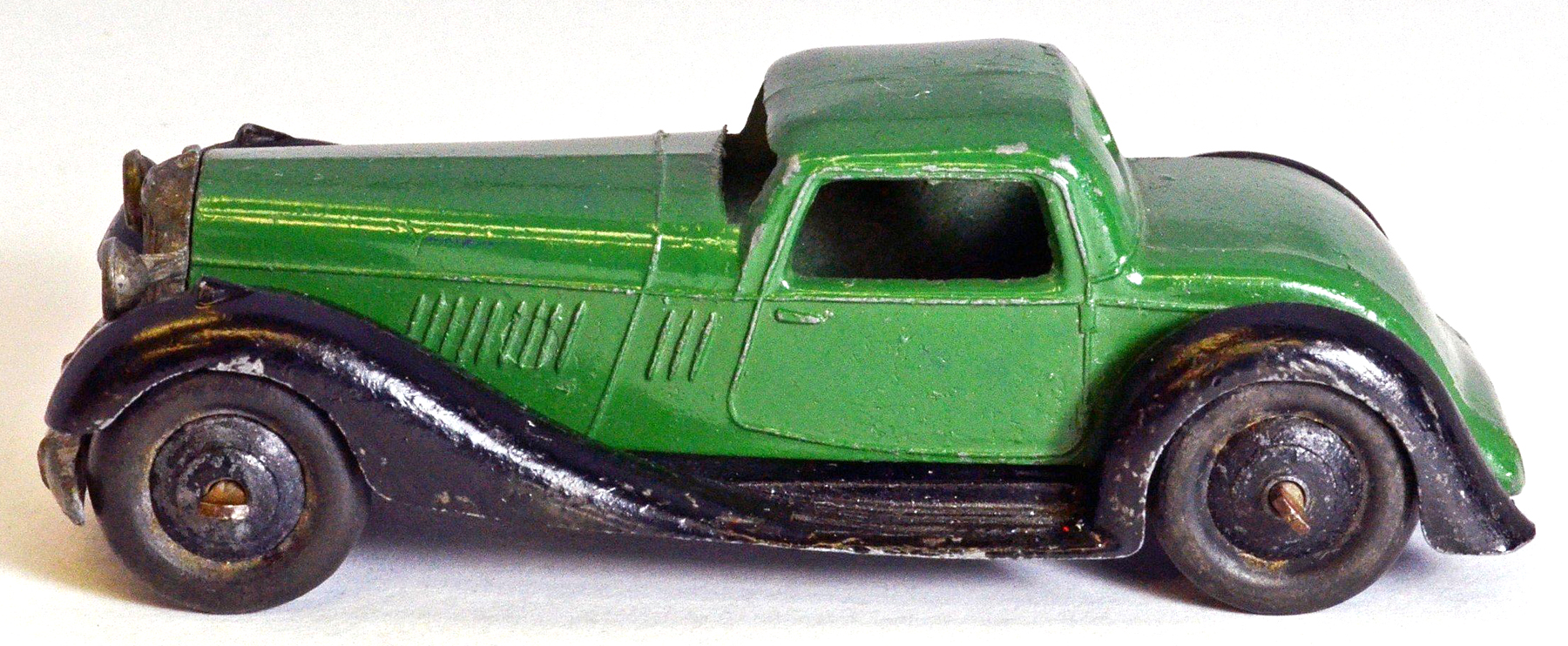
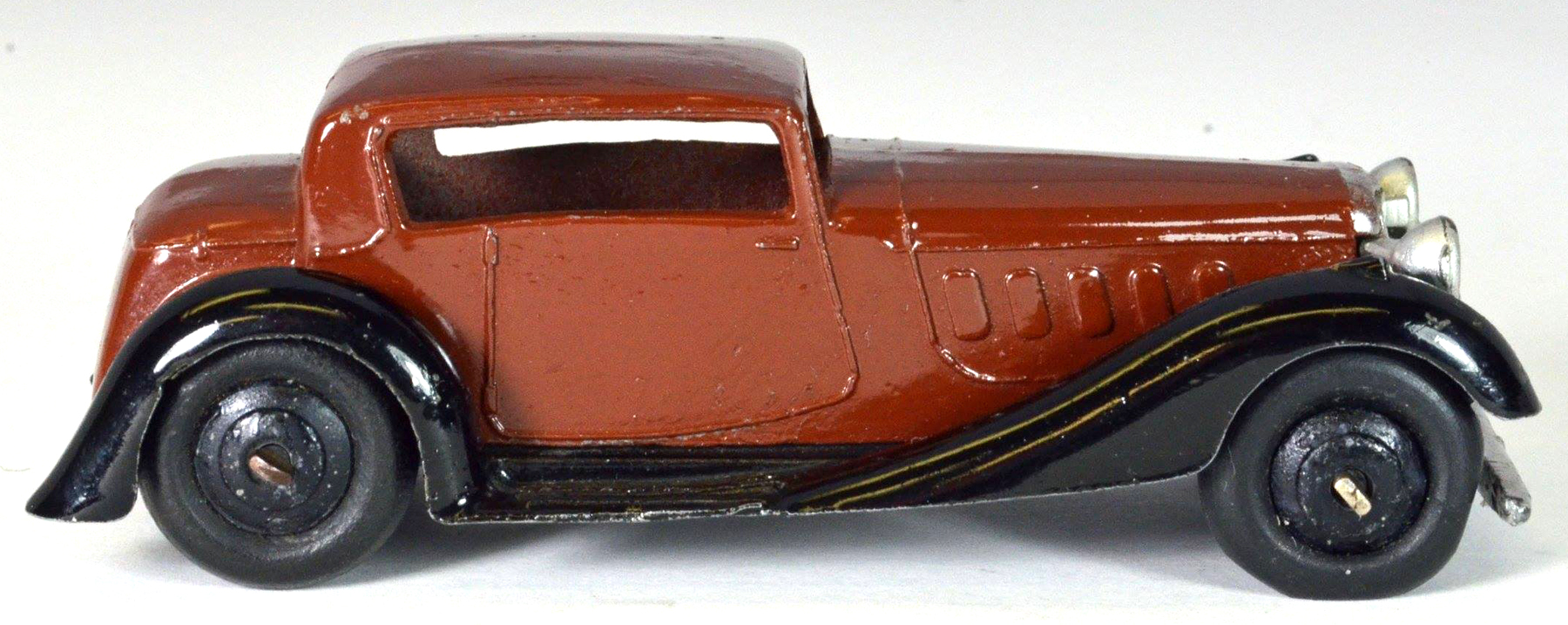
All of these models shared the same chassis and fenders, with only different bodies to differentiate them. The very different bodies and radiator shells certainly give each car a distinctive look, with some being sedans, coupes and open cars. They are attractive models that were produced in a wide variety of colors. The ones shown in the pictures below are all post-war versions.
36A Armstrong Siddeley Limousine
Only one sedan was featured in this series, and I always liked it: the Armstrong Siddeley Limousine. Oddly enough, it was one of the last of the 36 series that I acquired. Mine is a decent example with a few nicks, but it’s still a lovely model representing a bygone era!
36B Bentley Two Seater Sports Coupe
The Bentley Coupe was another pre-war design, reissued for a short time after the war.
36C Humber Vogue Saloon
The 36 series Humber Vogue complements the next model in the series, the Rover Saloon well and was made around the same time. I was able to buy this model from H. Hudson Dobson in 1959. I really like the style and color of this Humber, and the paint is still glossy more than 60 years later.
36D Rover Streamlined Saloon
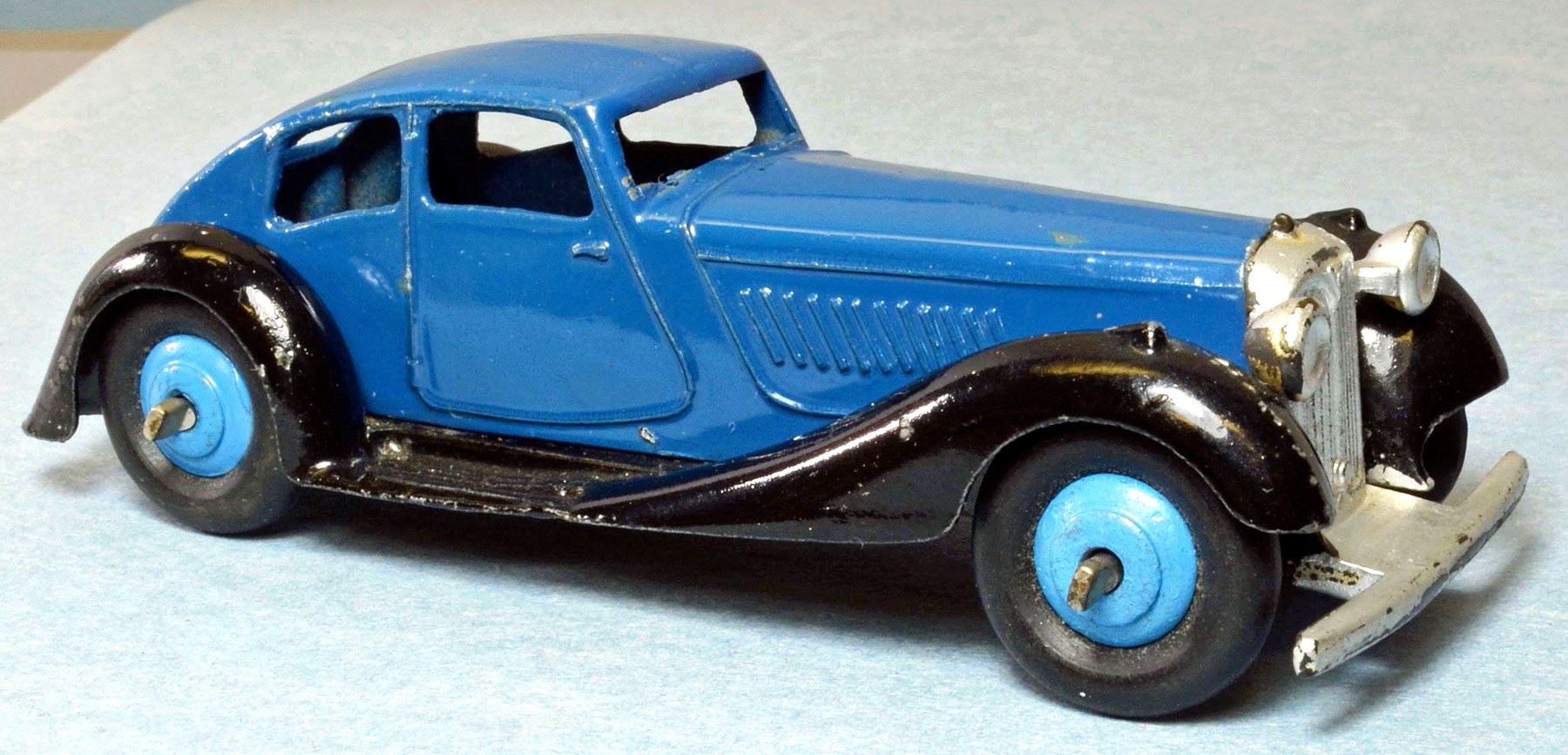
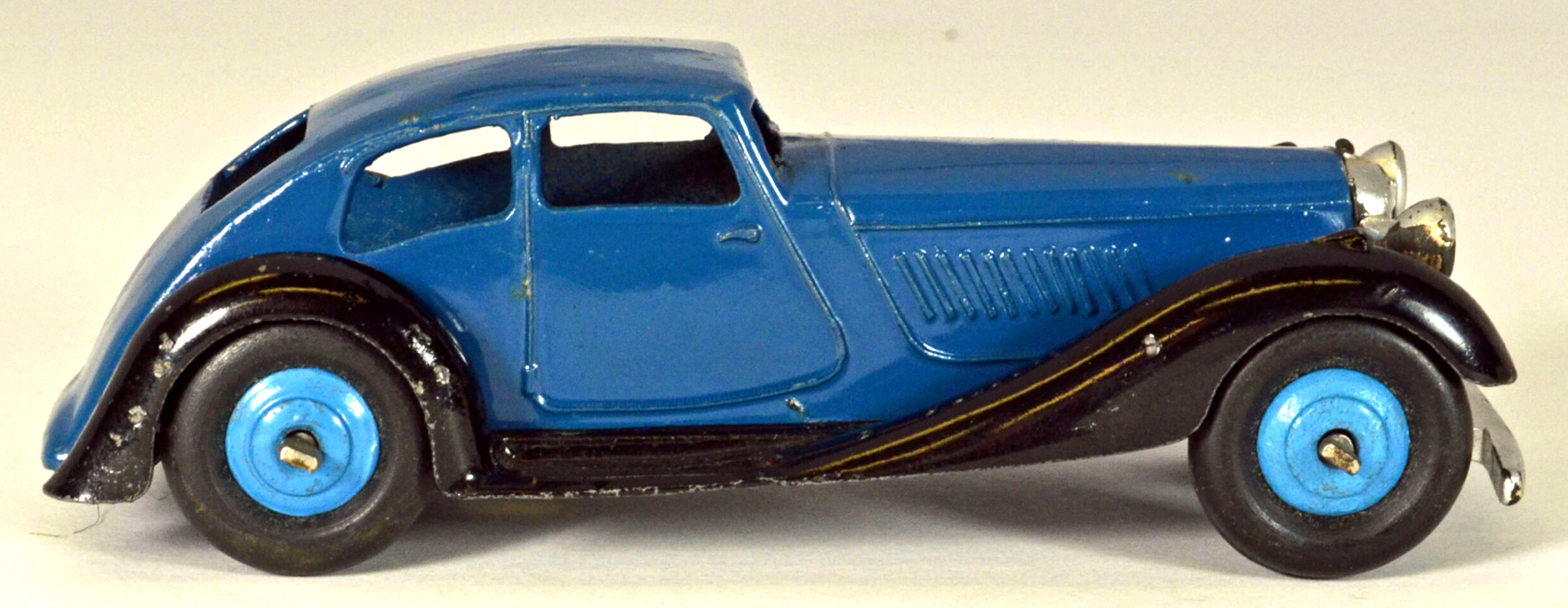
Another blue 36 series model I’ve always admired is the Rover Streamlined Saloon, produced in my favorite shade of blue, a wonderful darker blue. This model also happens to be a later version, with light blue wheels instead of the usual black.
This was also one of my first purchases from the US distributor, H. Hudson Dobson, in New Jersey, who in 1958 still had some NOS (new old stock) versions available. One mistake I made then, when I was 13, was to repaint the silver paint on the grill.
36D Salmson Two Seater Sports
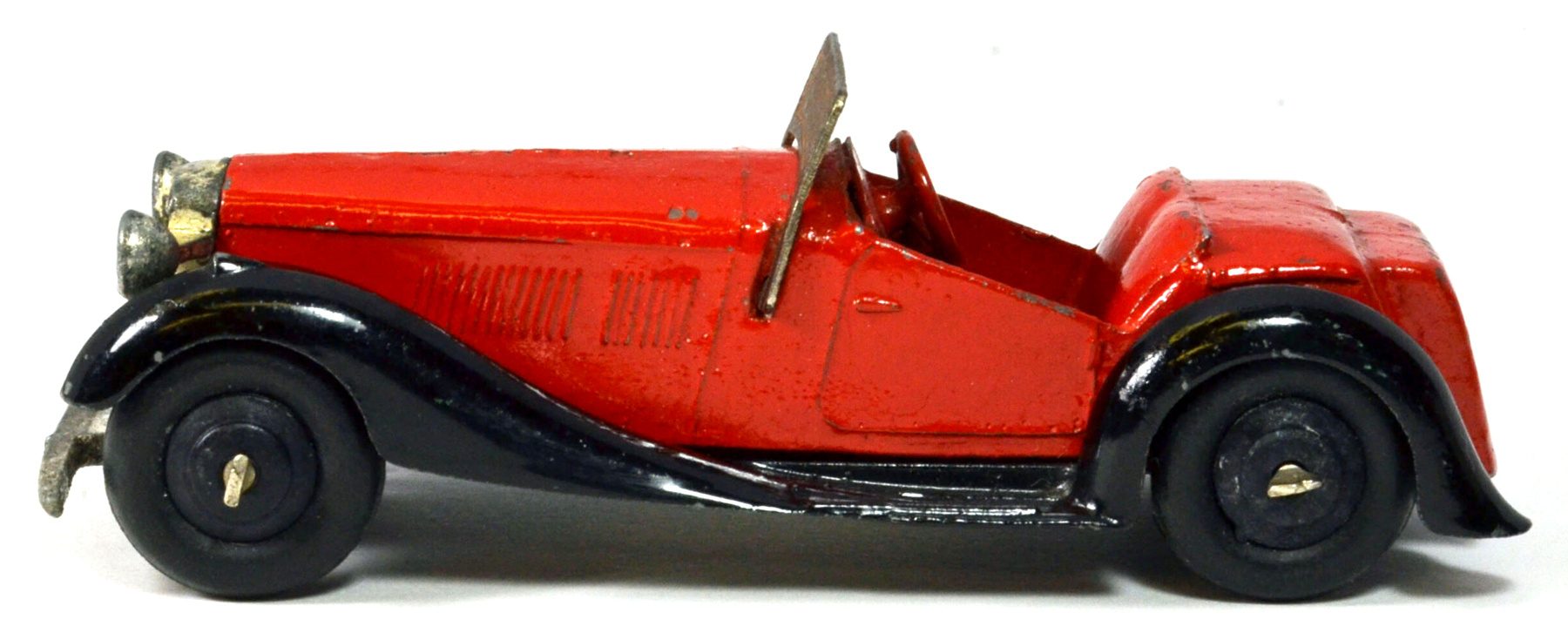
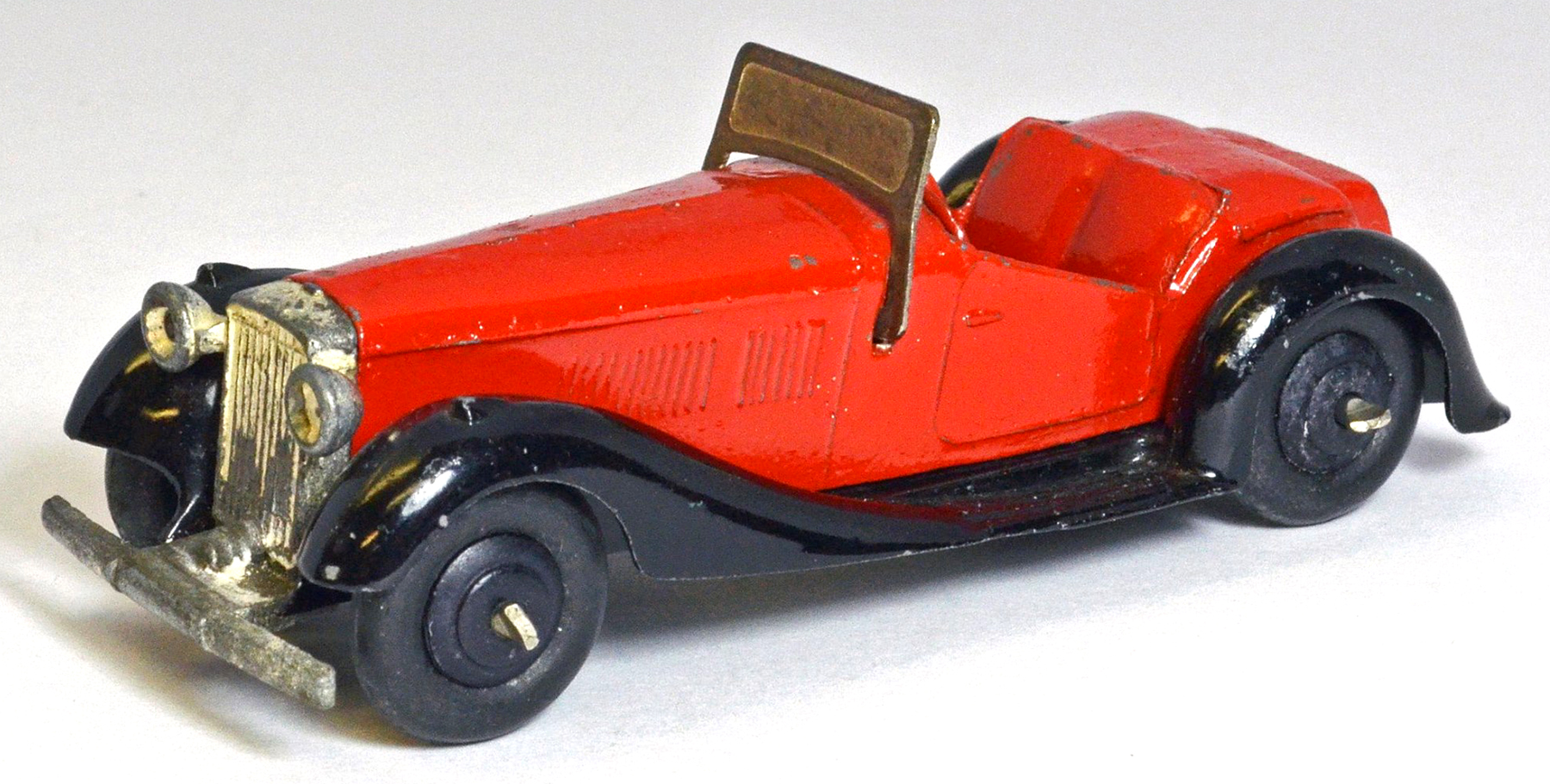
Although I usually think of the Rover or Humber Vogue as being my favorites, a case can also be made for the Salmson 2‑Seat Roadster. Like the other 36 series cars, this was first made during the pre-war years from 1937 to 1940, and then reintroduced after the war from 1946 to 1950.
I particularly like this side view that shows off the rakish angle of the door and the sporting overall lines of the car. And its red color certainly suits it well. Like most vintage Dinkys, these seem to have a certain charm all their own.
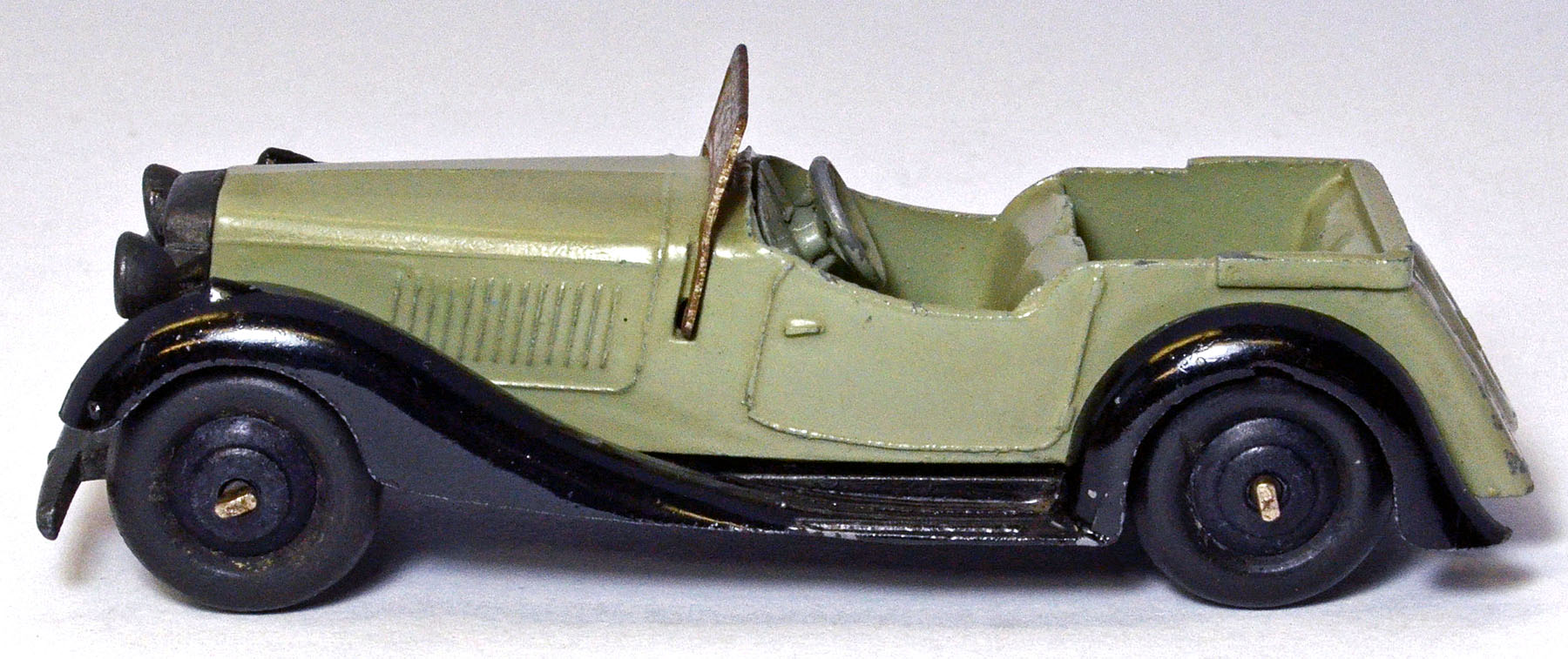
36F Salmson Four Seater Sports
Strangely, the very similar Four Seater Salmson was also made in the 36 series. It has a nice color, but not as striking as other models in the post-war series.
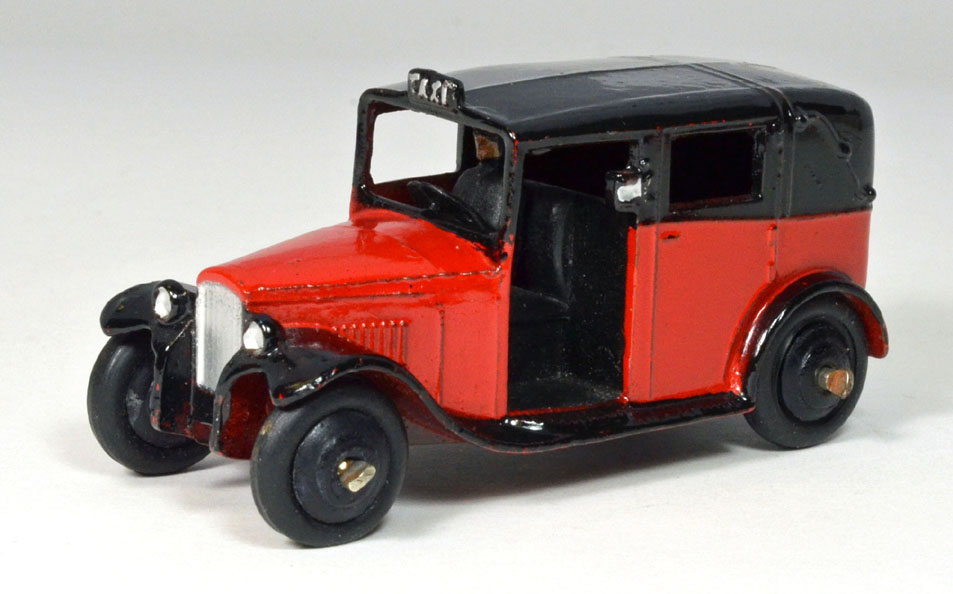
36G Taxi with Driver
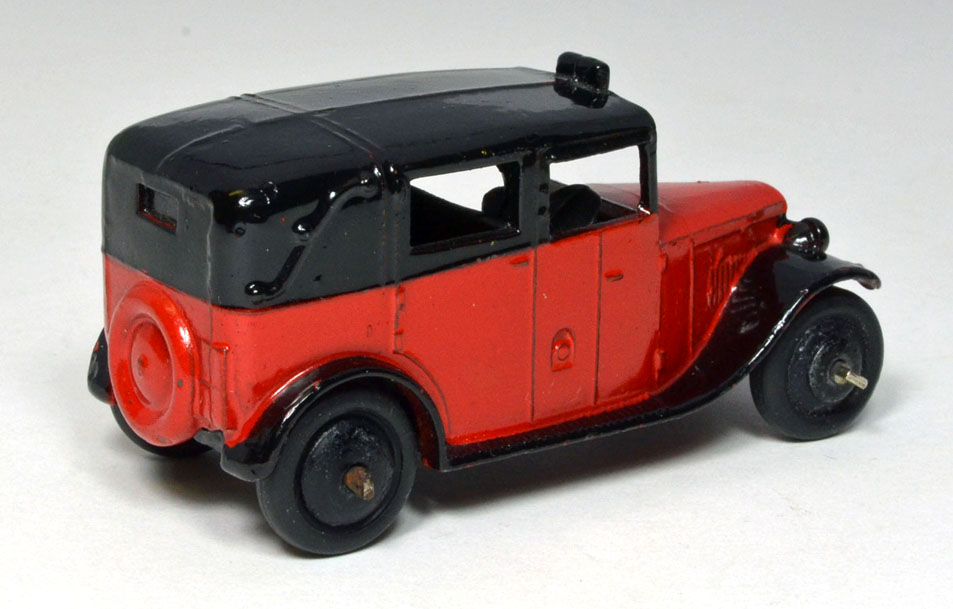
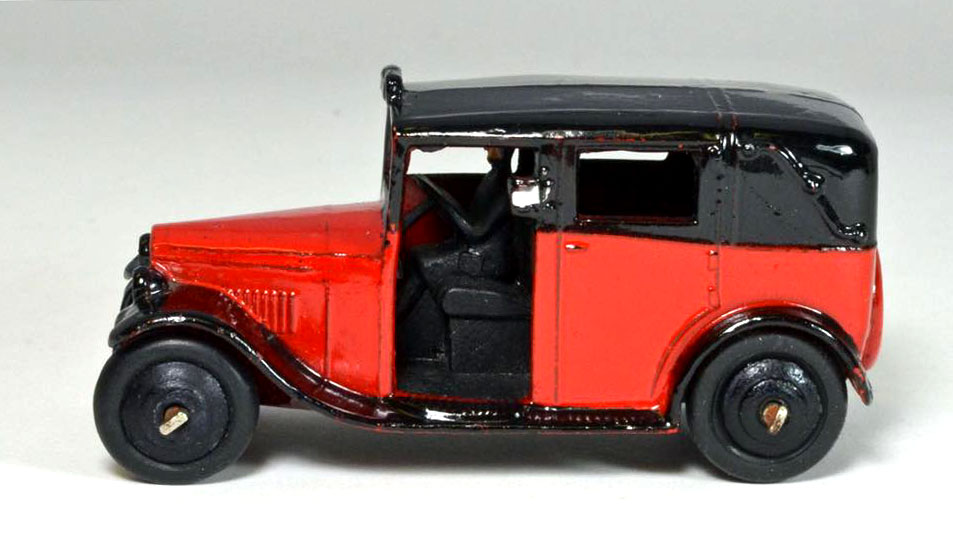
The very first Dinky Toys taxi was the 36g Taxi with Driver, first introduced in 1937 and produced until 1950–52. Based on the pre-war Austin Taxi that was in common use at the time, the Dinky model had an open rear window until the early post-war period, when it was closed. Made in a wide variety of colors, it’s another representation of a classic British vehicle, with lots of vintage charm. I bought this one many years ago from well known collector Keith Harvie, and it continues to be in excellent condition for a 80+ year old toy. Mine is a later post-war model, made around 1950.
By 1950, these models began to show their age and looked quite obsolete with new motorcars quickly appearing on the roads. As a result, the 36 series made its last appearance that year in the US catalog.
The 36 series range was produced in great numbers, and good examples can still be found despite their age. All in all, they are a very important and long lived series of Dinky Toys, and still popular today.