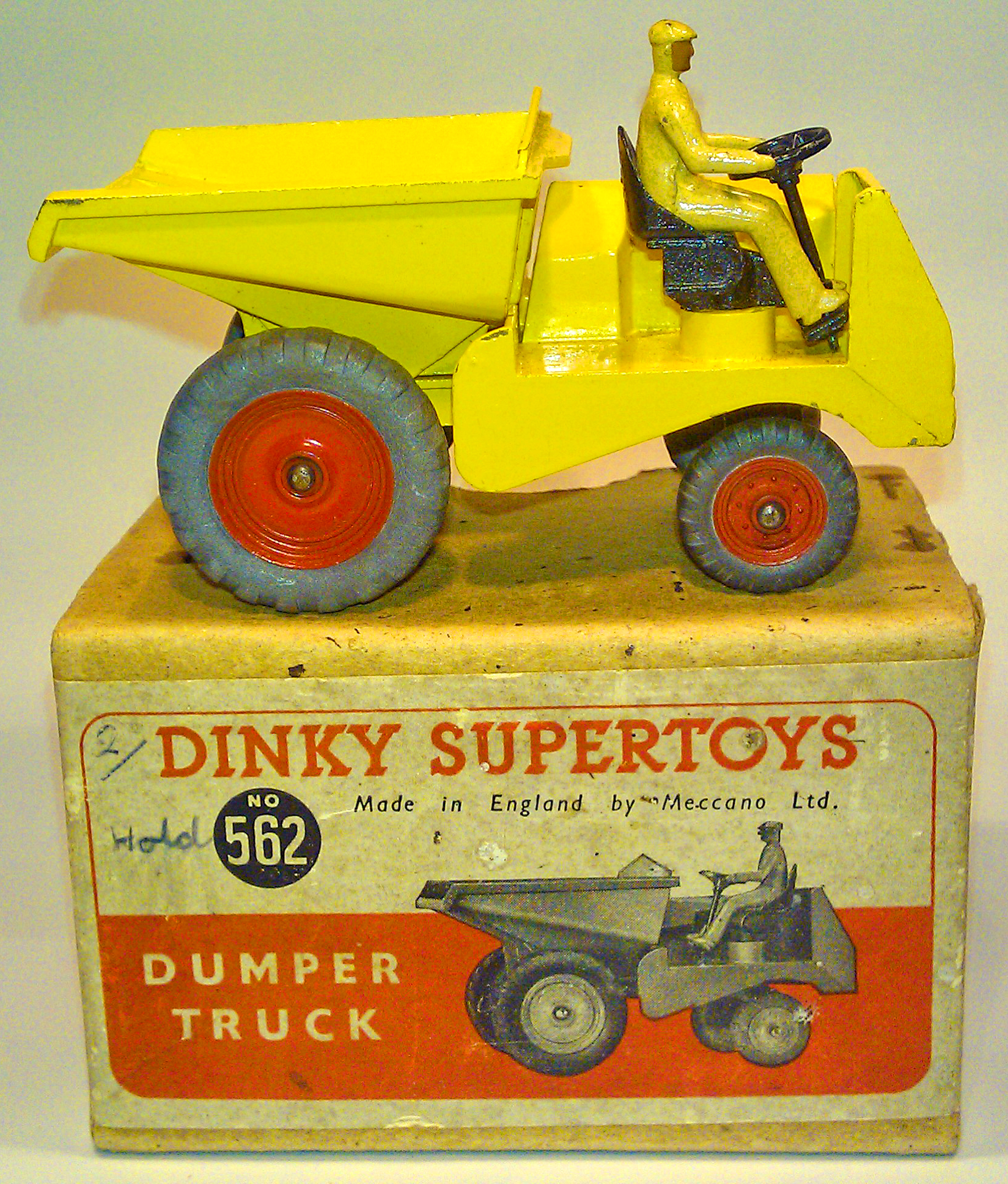
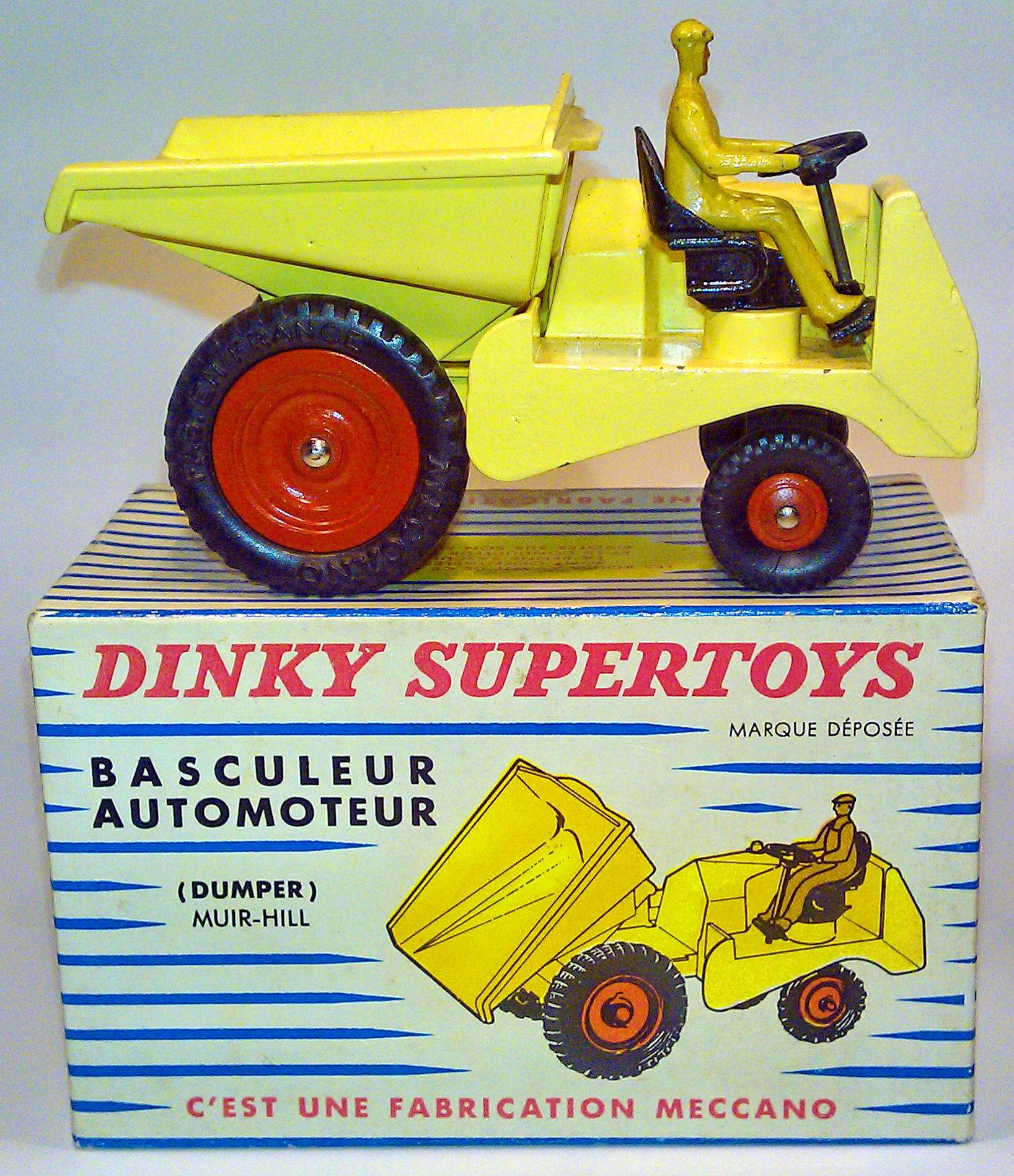
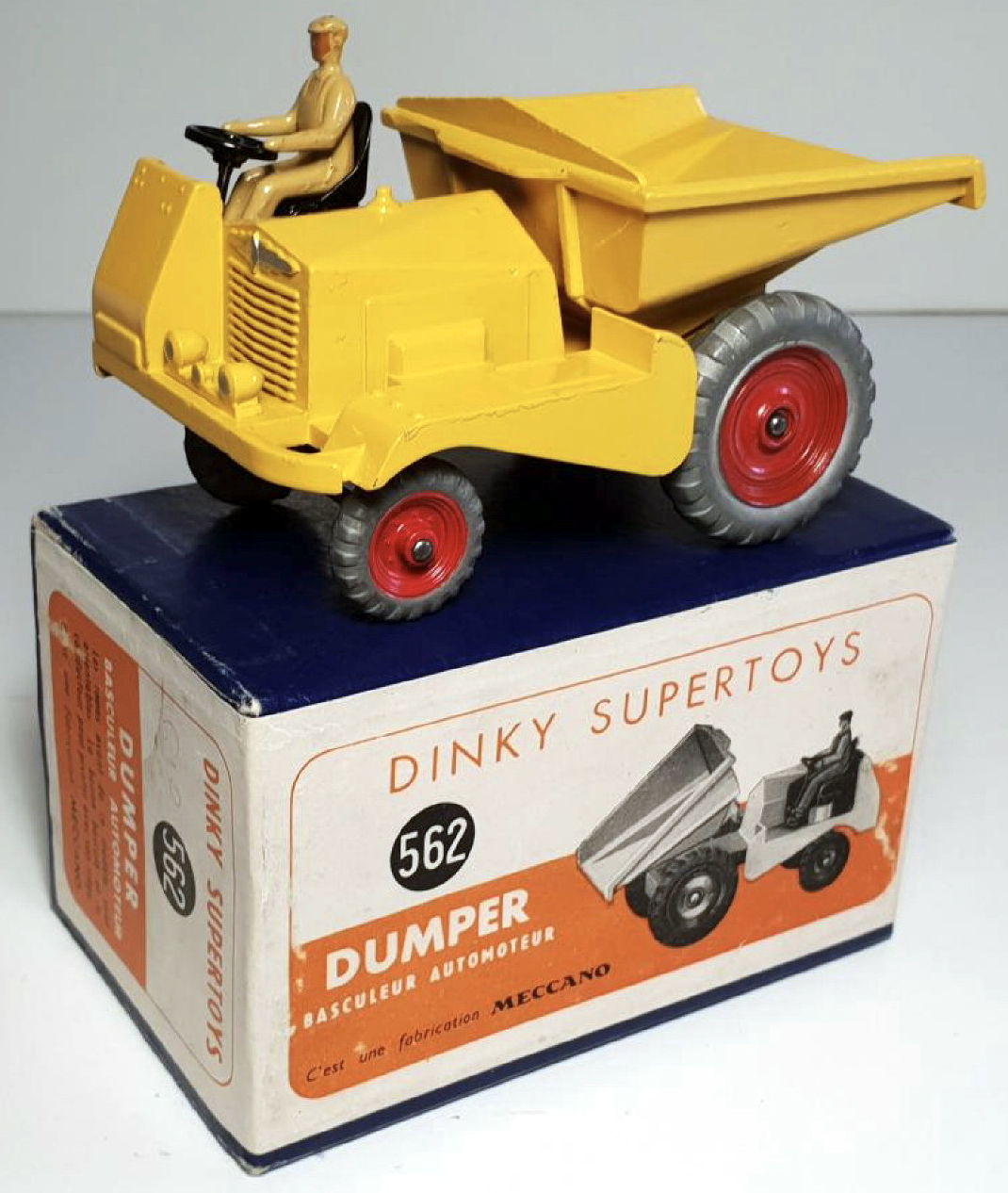
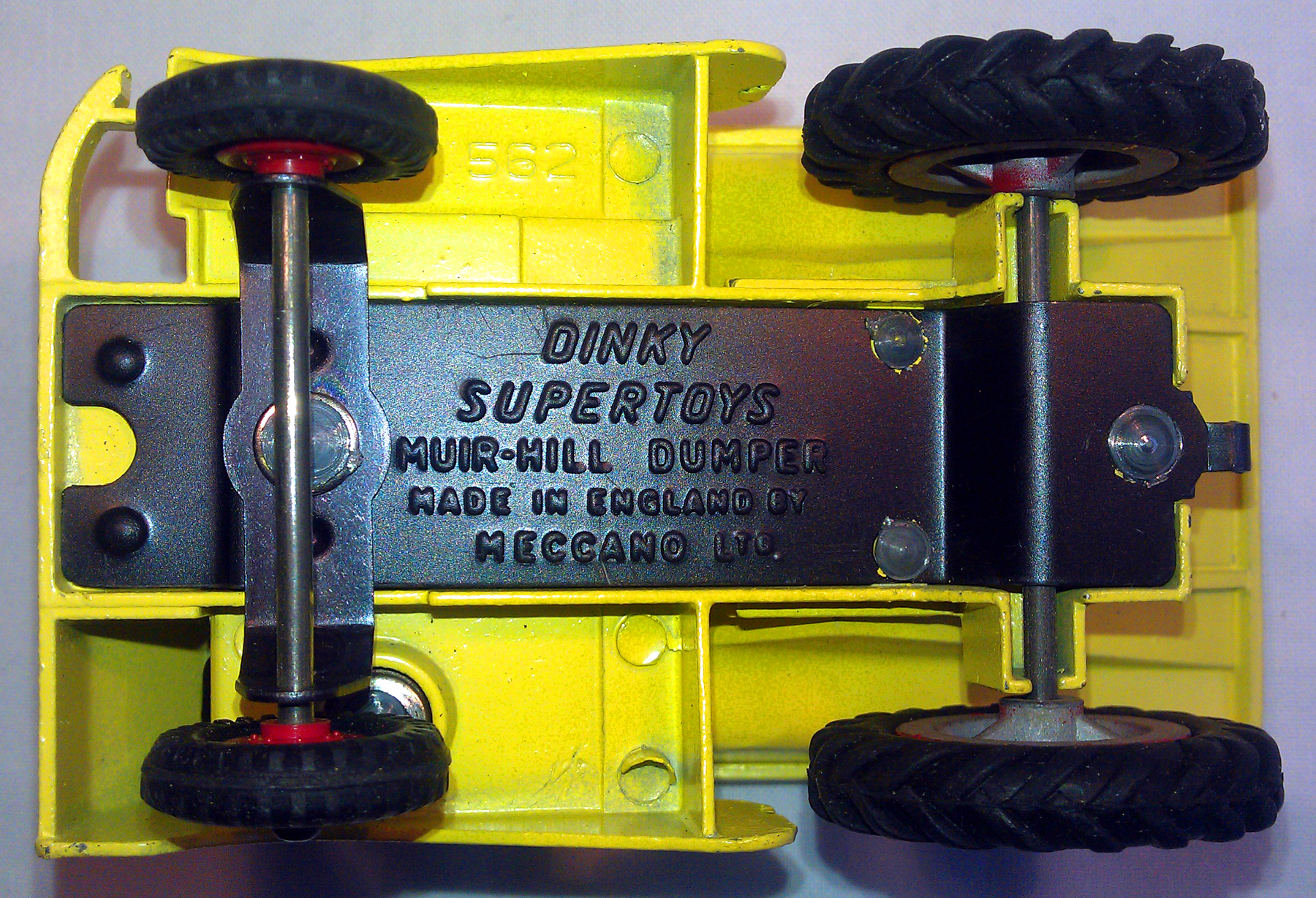
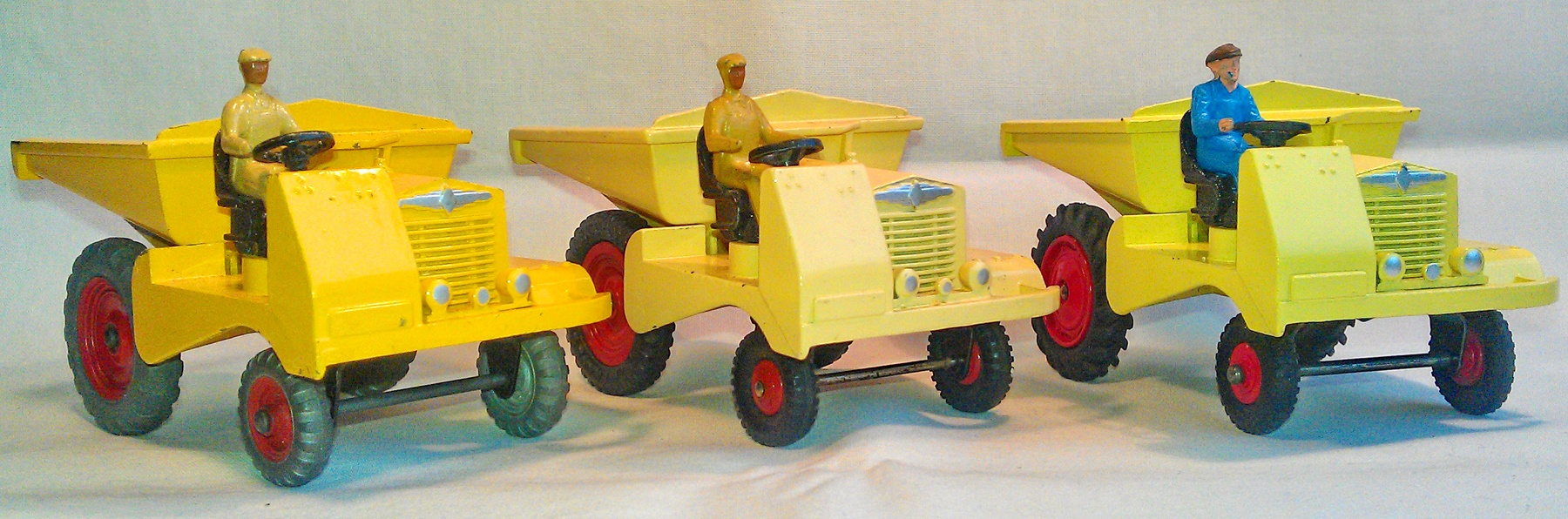
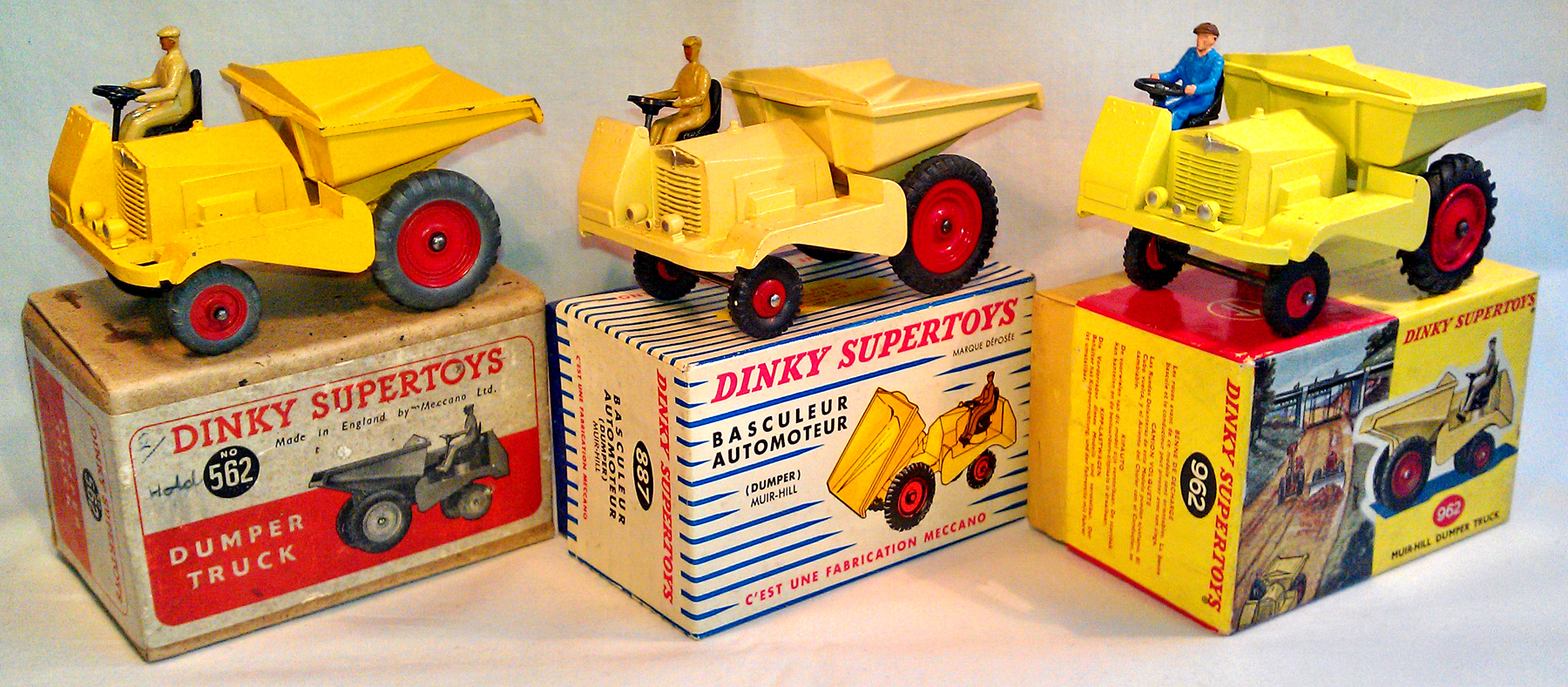
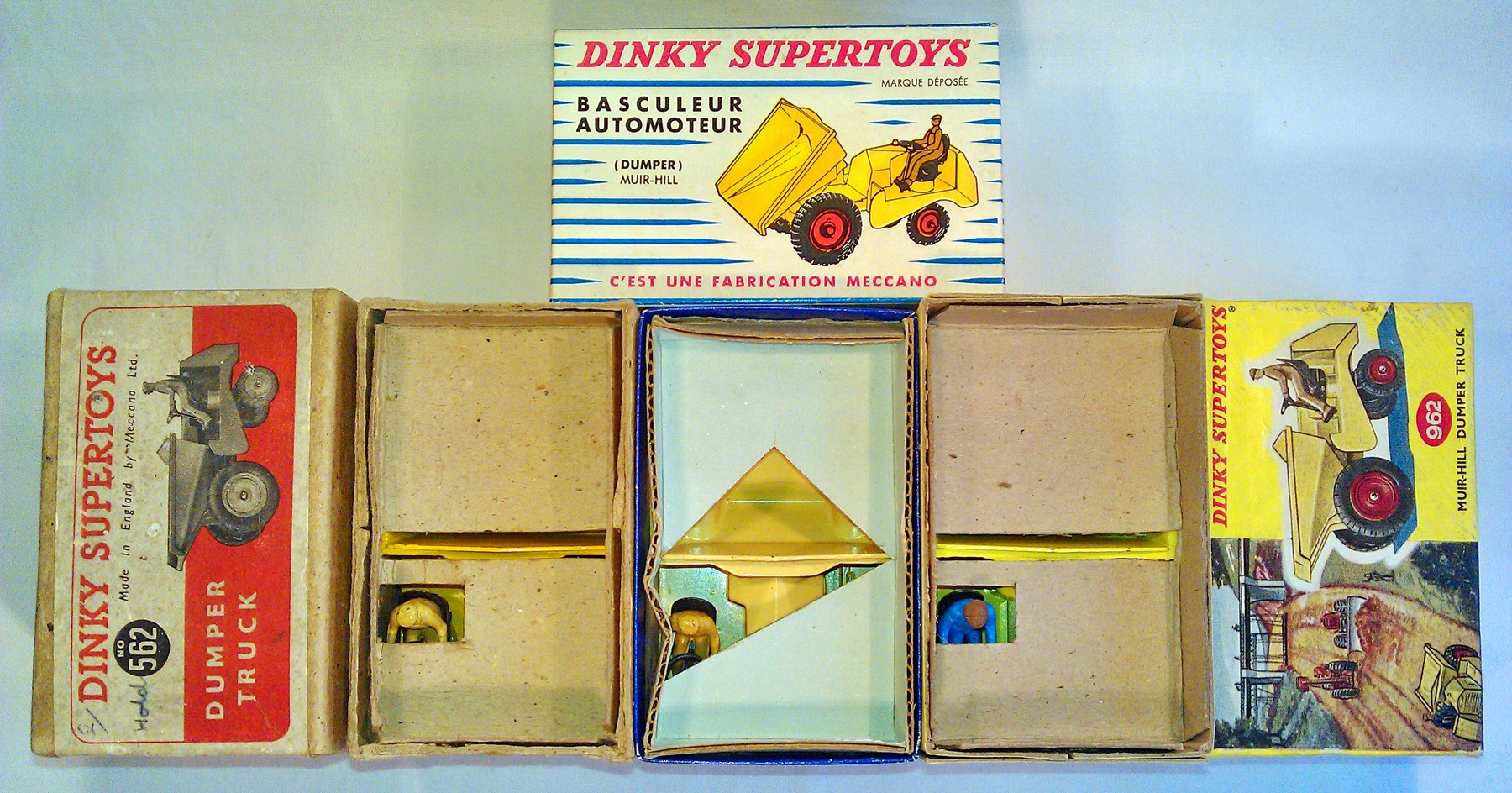
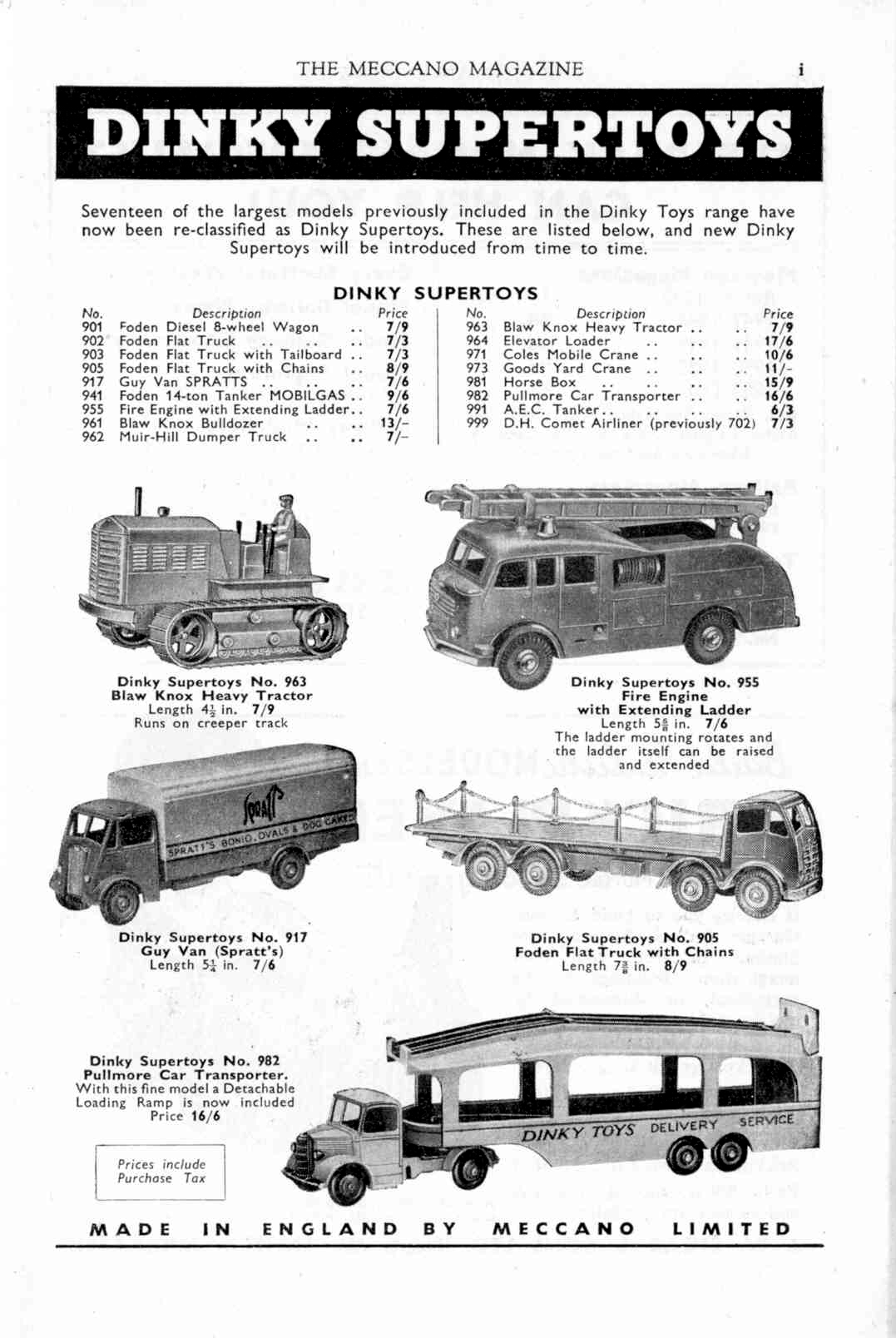
In this article, I’ll show the three versions of the Dinky Supertoys 562 Muir-Hill Dumper Truck in my collection. Among them is the British No. 562 that was imported into France and assembled by Meccano Bobigny, and assigned the product number 887. This model was produced by Meccano Bobigny from 1959 to 1961. The English model 562 was renumbered to 962 in 1954 and remained in Dinky catalogs until 1965. The Muir-Hill Dumper Truck was so popular that it had a production run of 17 years!
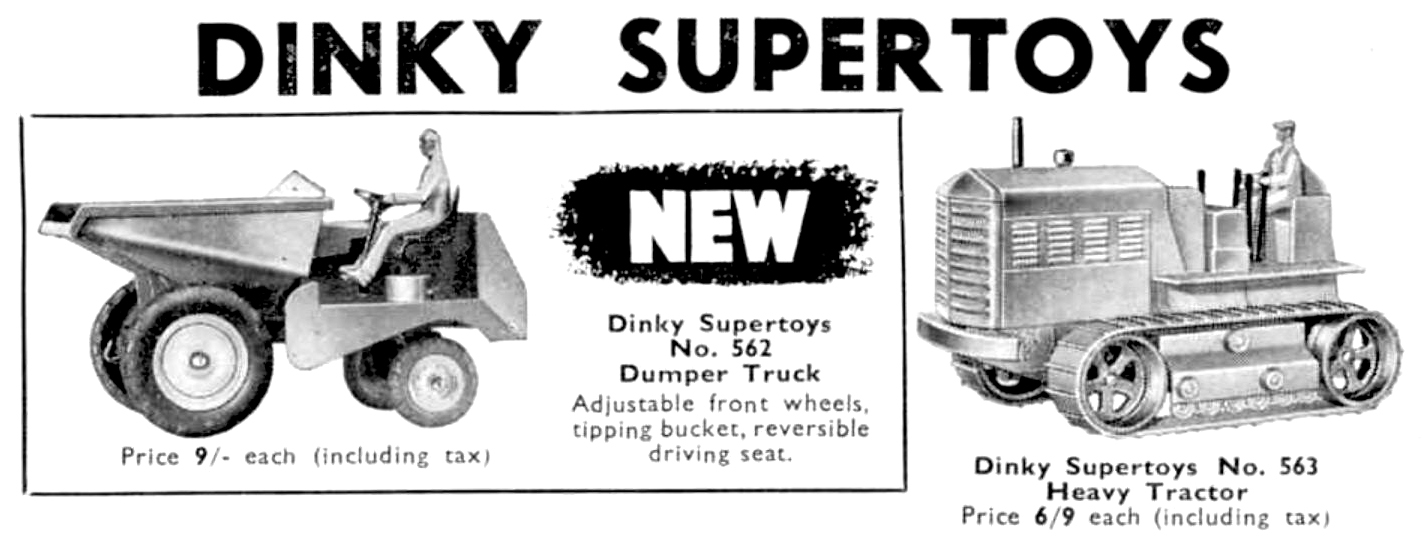
Dinky Supertoys 562 was announced in the September 1948 issue of Meccano Magazine in an advertisement that highlighted following features:
adjustable front wheels
tipping bucket
reversible driving seat
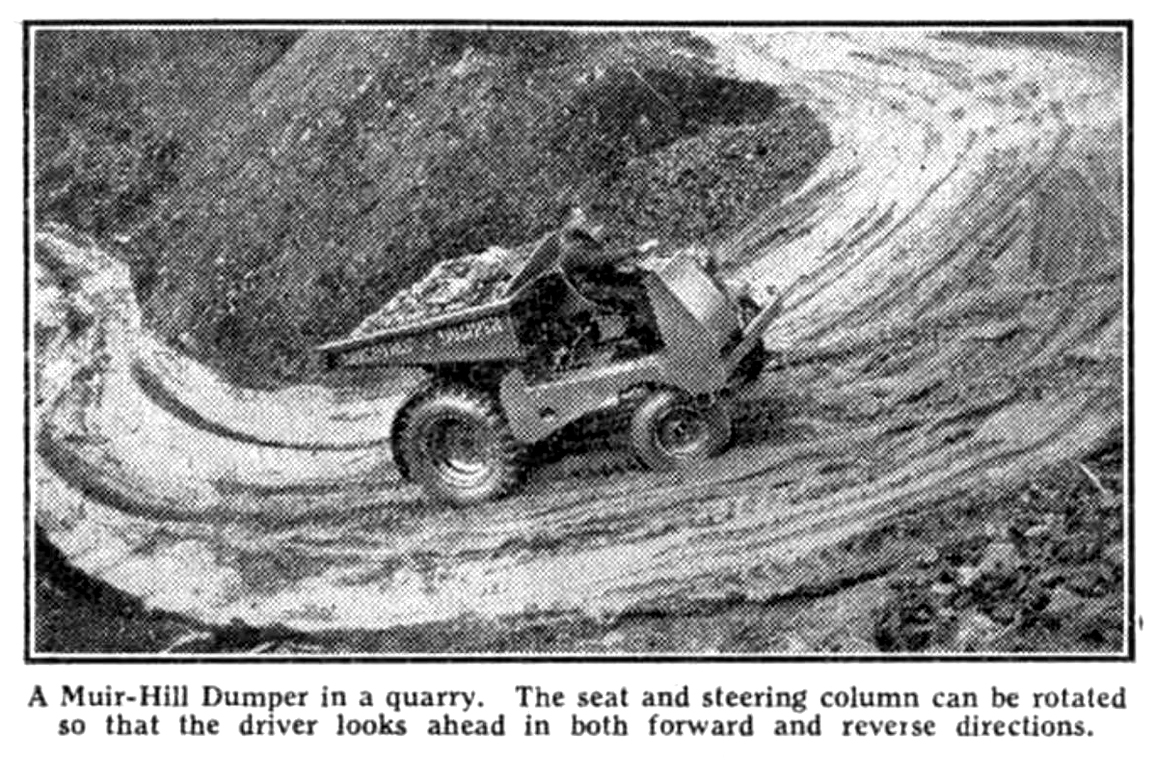
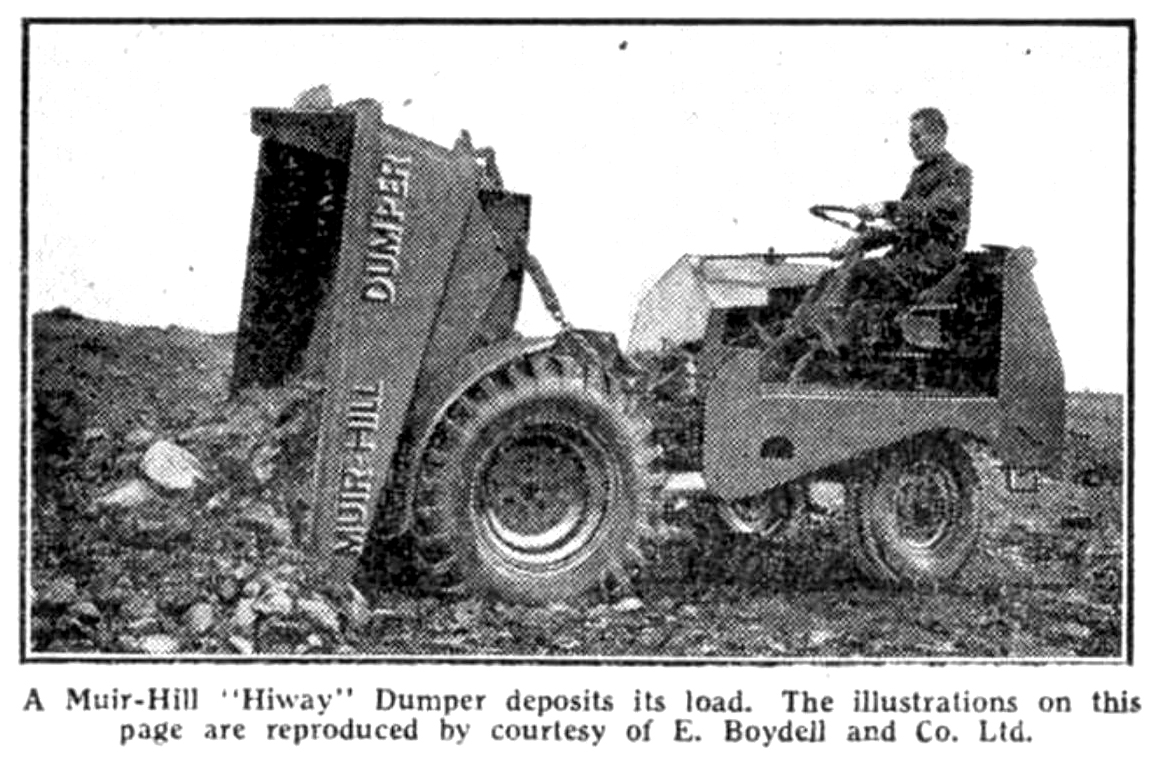
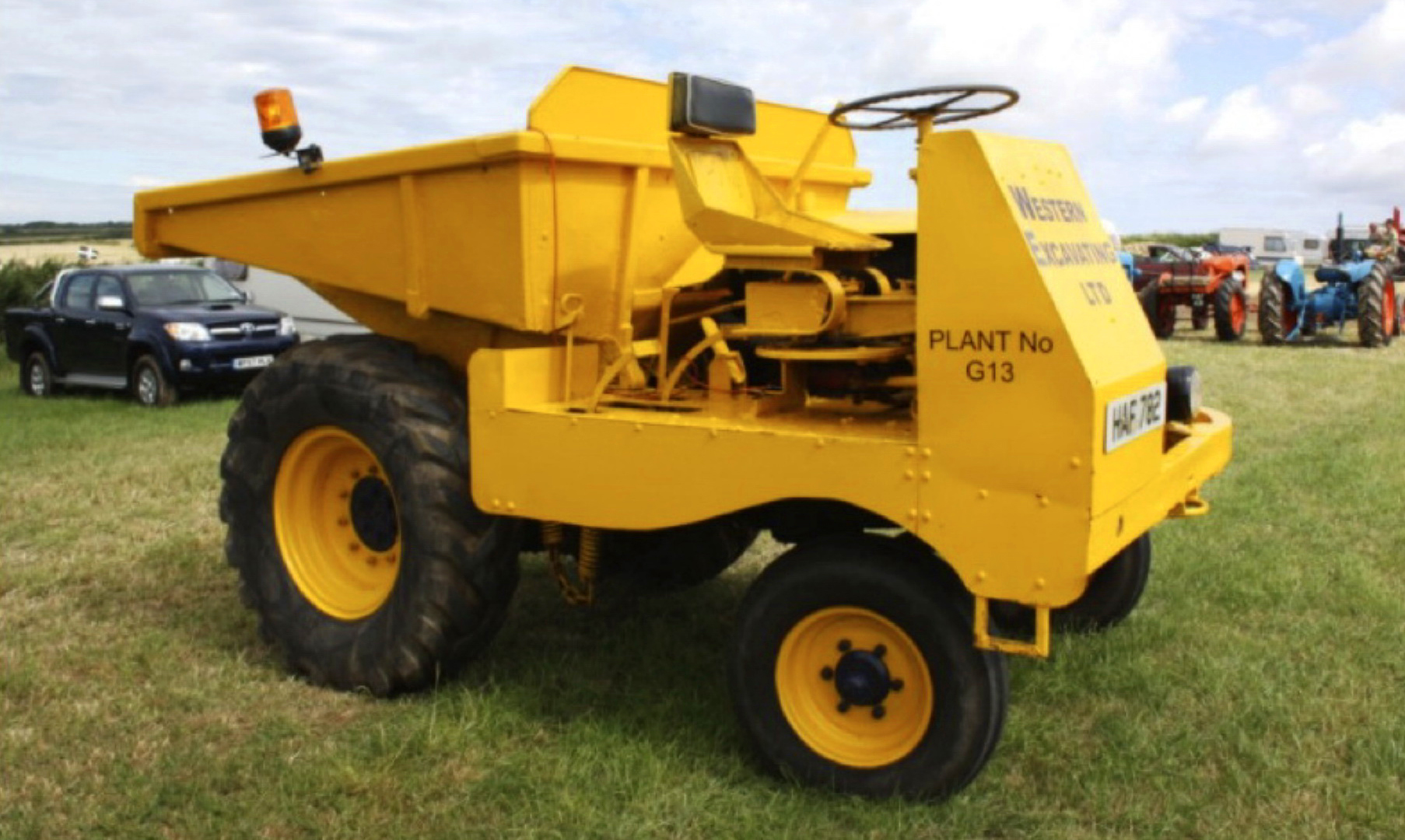
In the December 1948 issue of the same magazine an article titled “Mechanical Surface Excavation Plant” described the Dinky Supertoys 562 as a Muir-Hill Hiway dumper, and included two images of the real Muir-Hill Hiway dumper truck.
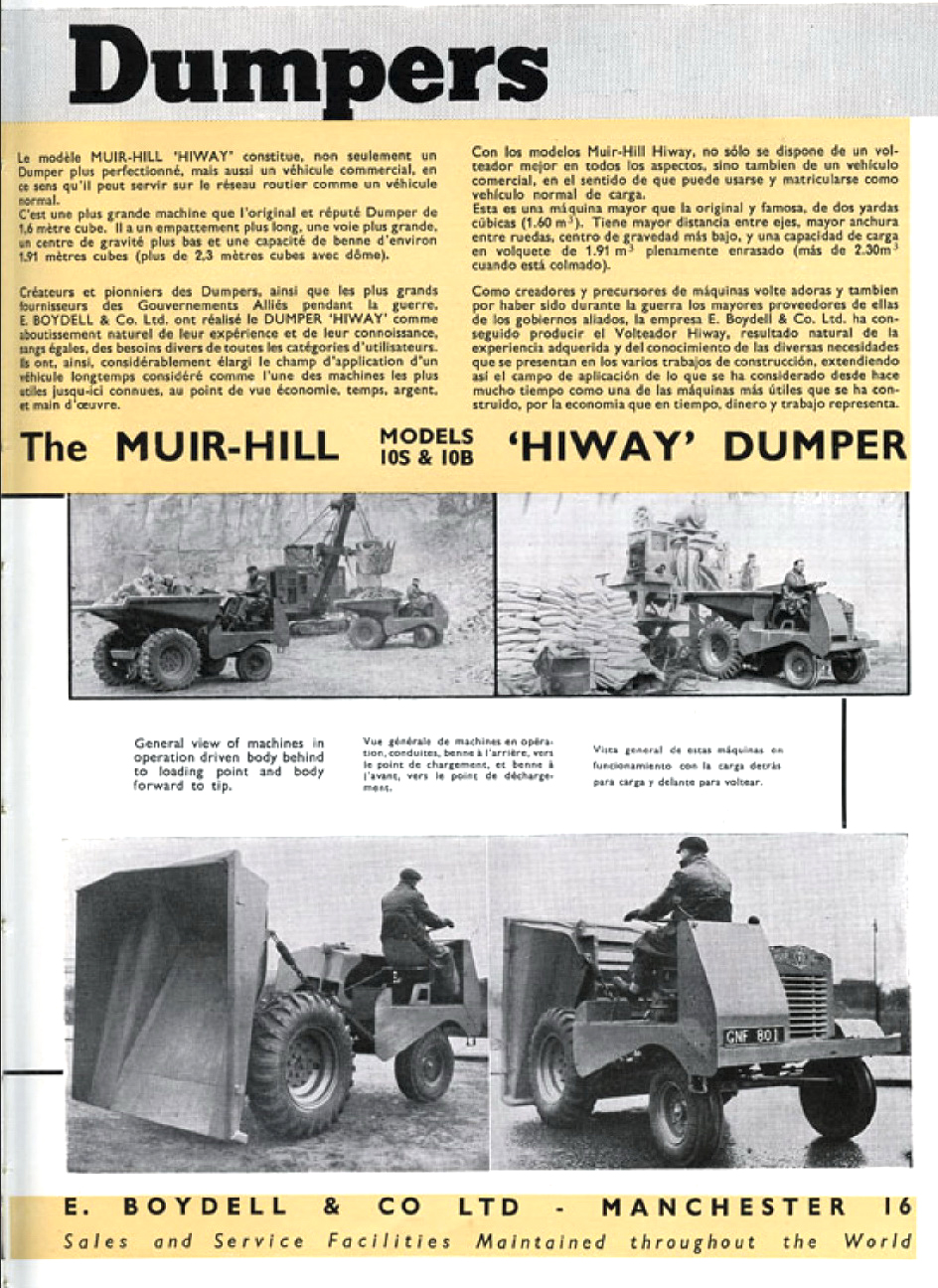
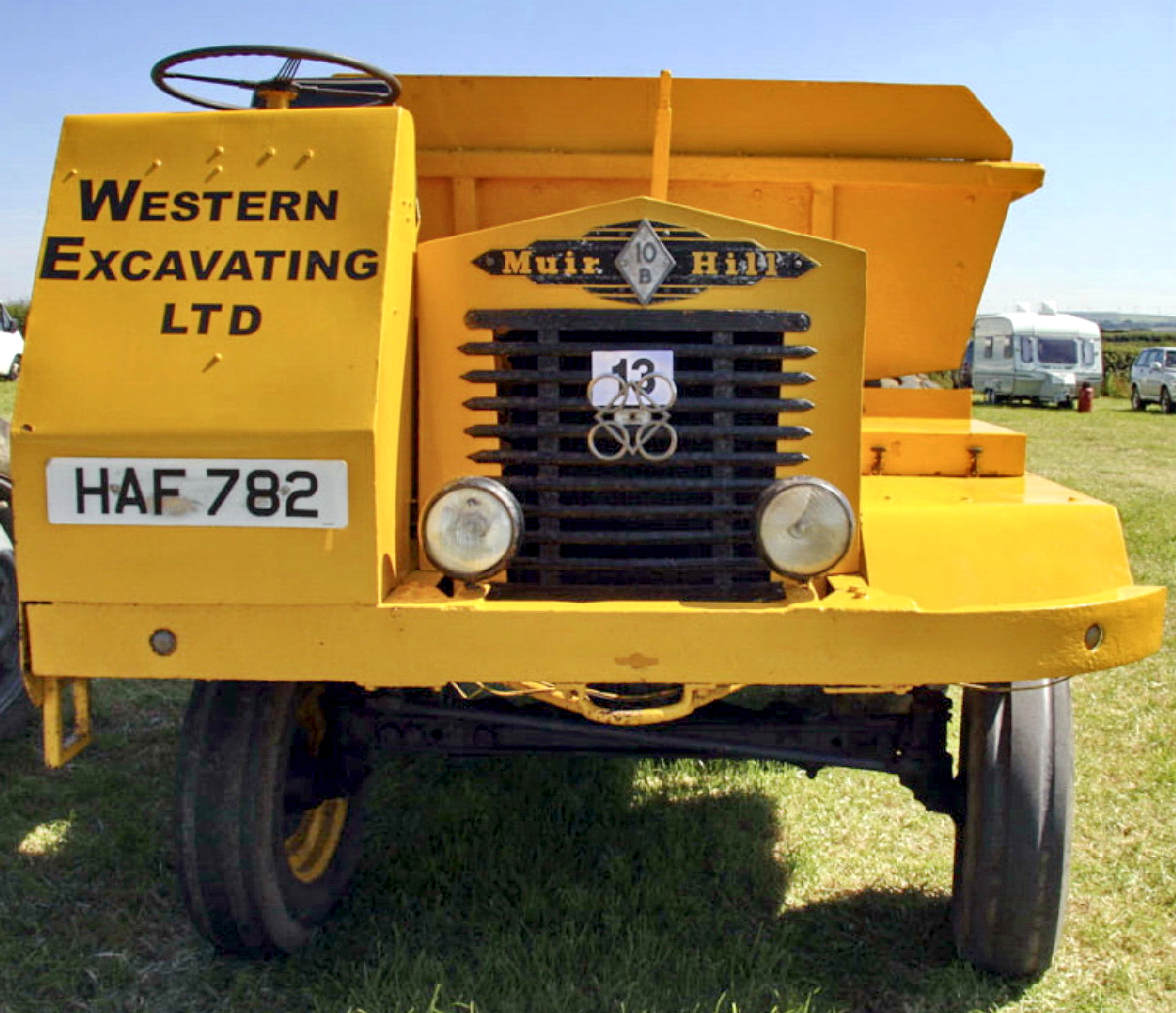
The real Muir-Hill Hiway dumper on which the Dinky Supertoys 562 Dumper Truck was based.
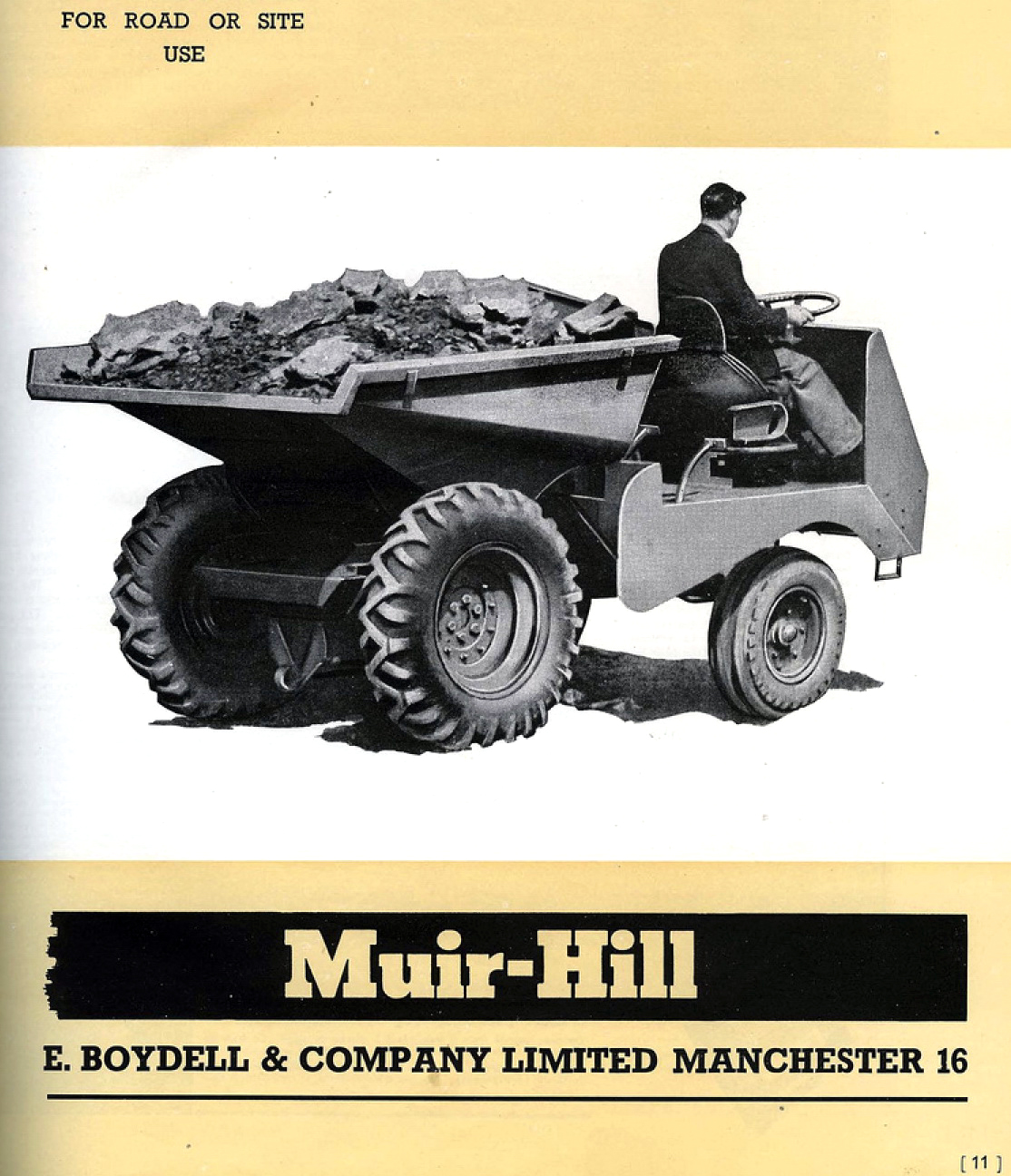
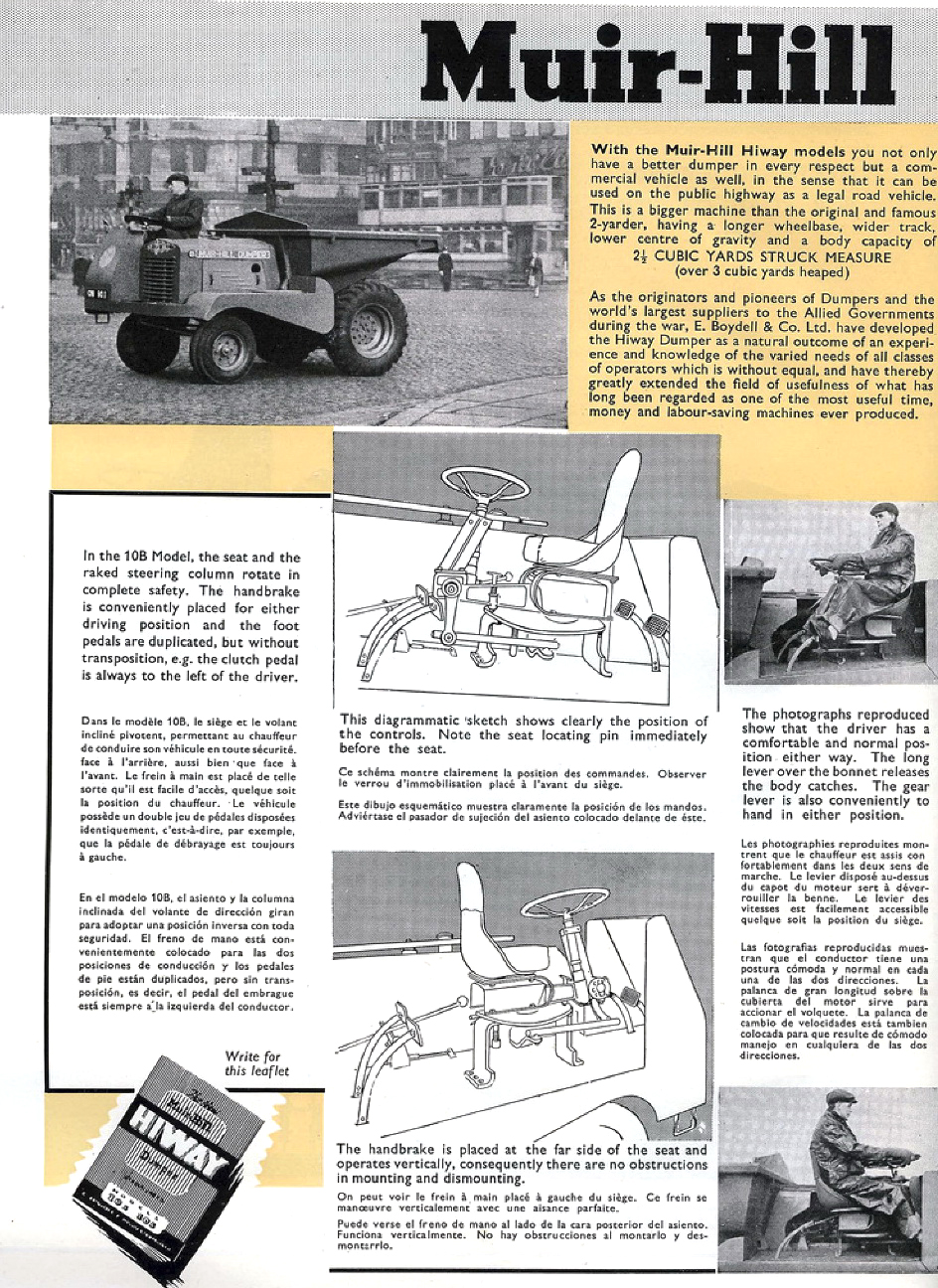
Muir-Hill Hiway Dumper Truck brochure. Images: Dave Busfield
The Muir-Hill Hiway Dump Truck Model 10B that included a raked steering column and a seat that could be rotated. The Model 10A has a fixed seat. Image: Grace’s Guide
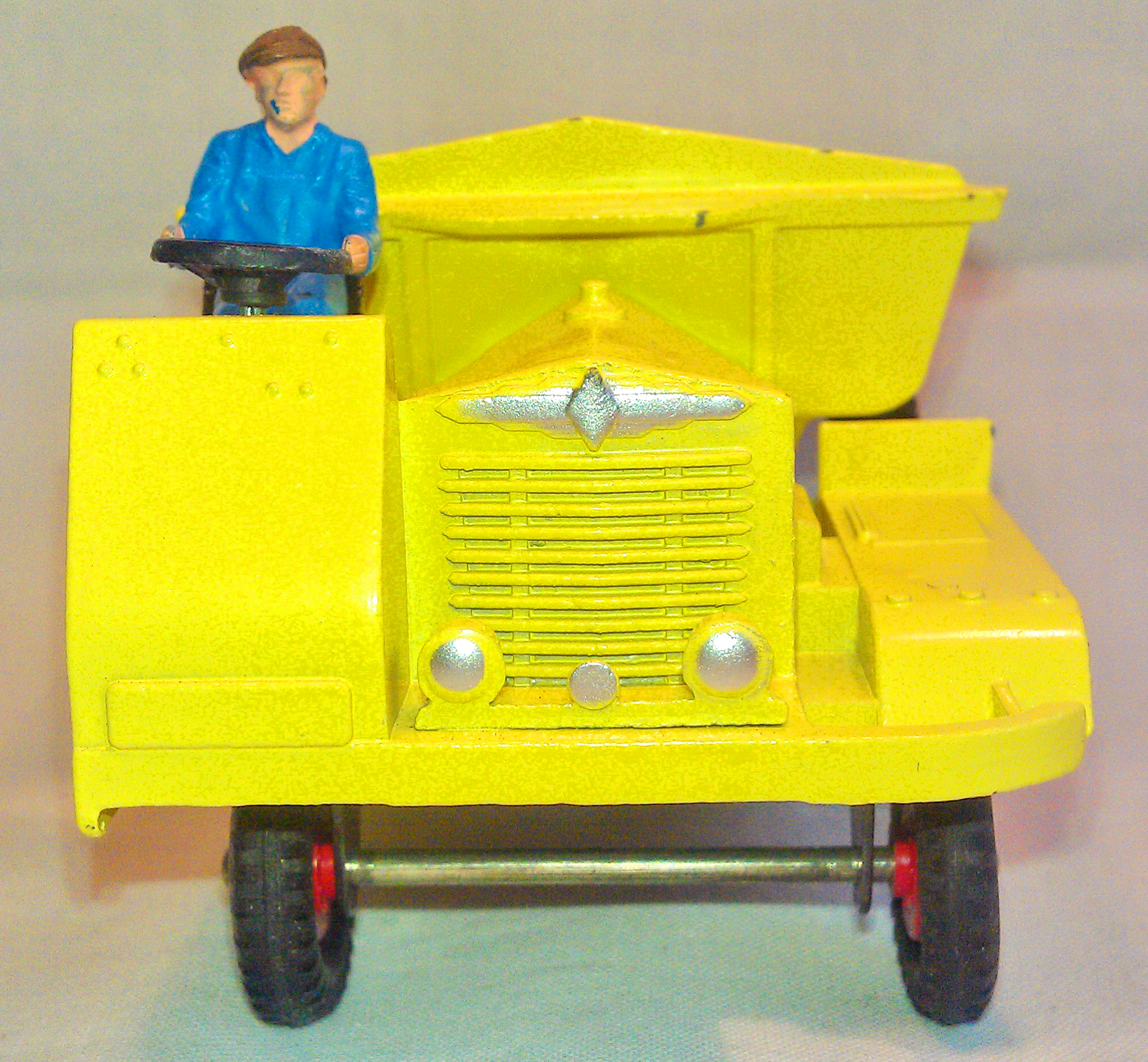
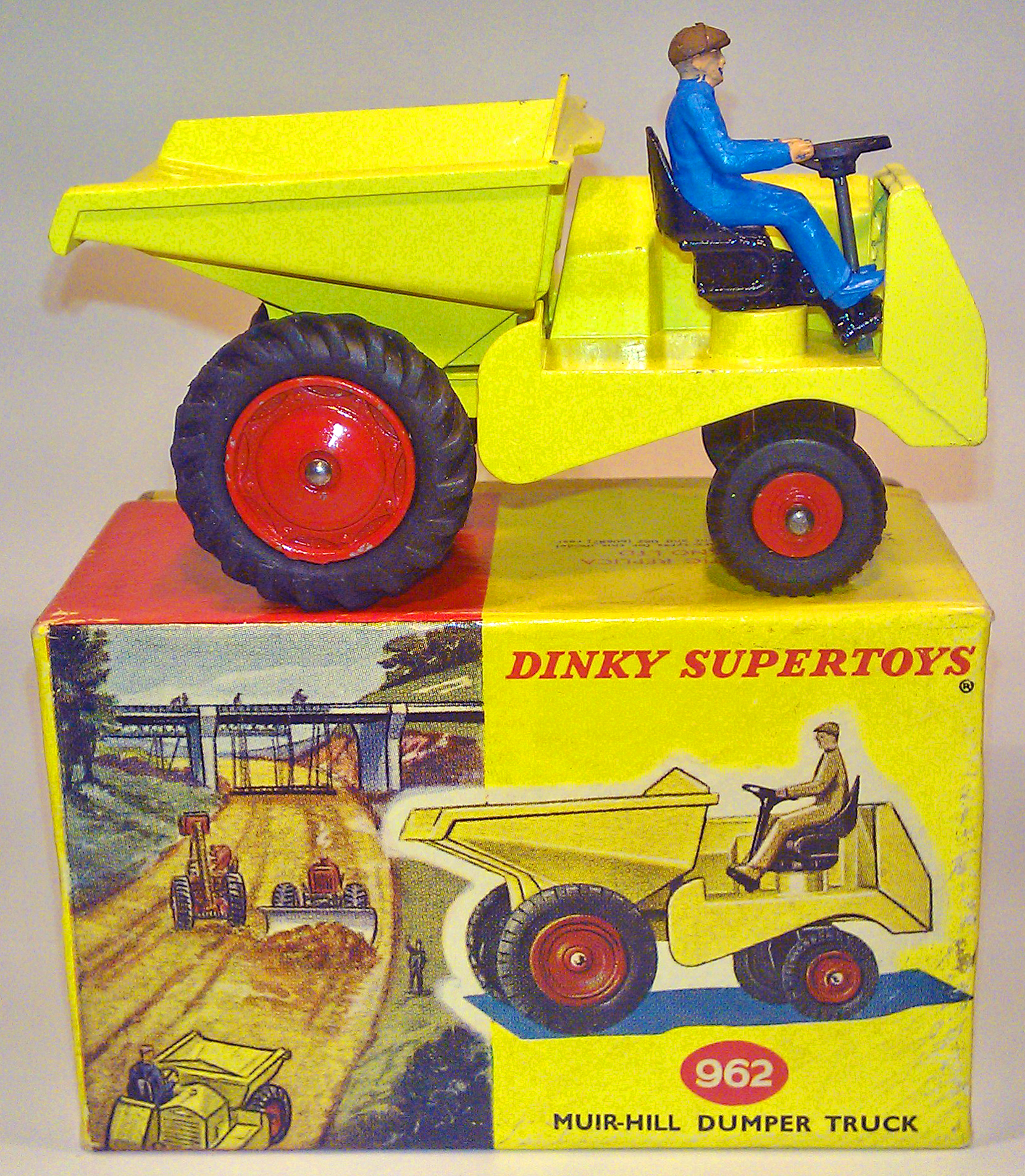
Front view of the Dinky Supertoys 962 Muir Hill Dumper Truck with rubber tires and a blue driver.
Close up of the Muir-Hill Hiway Dumper Truck showing the swivel driver’s seat. Image: Grace’s Guide
The first version of the Dinky Supertoys 562 Dumper Truck with metal wheels and cast tan driver in a first version Dinky Supertoys box.
The French assembled English Dinky Supertoys 562 Muir-Hill Dumper Truck with French blue and white striped Dinky Supertoys box bearing the French product number 887 and named “Basculeur Automoteur (Dumper) Muir-Hill”, produced during 1959–1961.
Shown below is the Muir-Hill Dumper Truck model that was exported by Meccano Liverpool to Meccano France in 1951 as number 562. In Paris it was repackaged in a French box and released for sale in France as No. 562 “Dumper Basculeur Automoteur”. Also see my other article 6 UK Dinky Toys repackaged by Meccano Paris for the French market (1950–1951).
The English Dinky Supertoys 562 repackaged in France for the French market as “Dumper Basculeur Automoteur ” in 1951.
No. 962 Muir-Hill Dumper Truck in yellow red Dinky Supertoys picture lid box, with rubber tires and blue plastic driver.
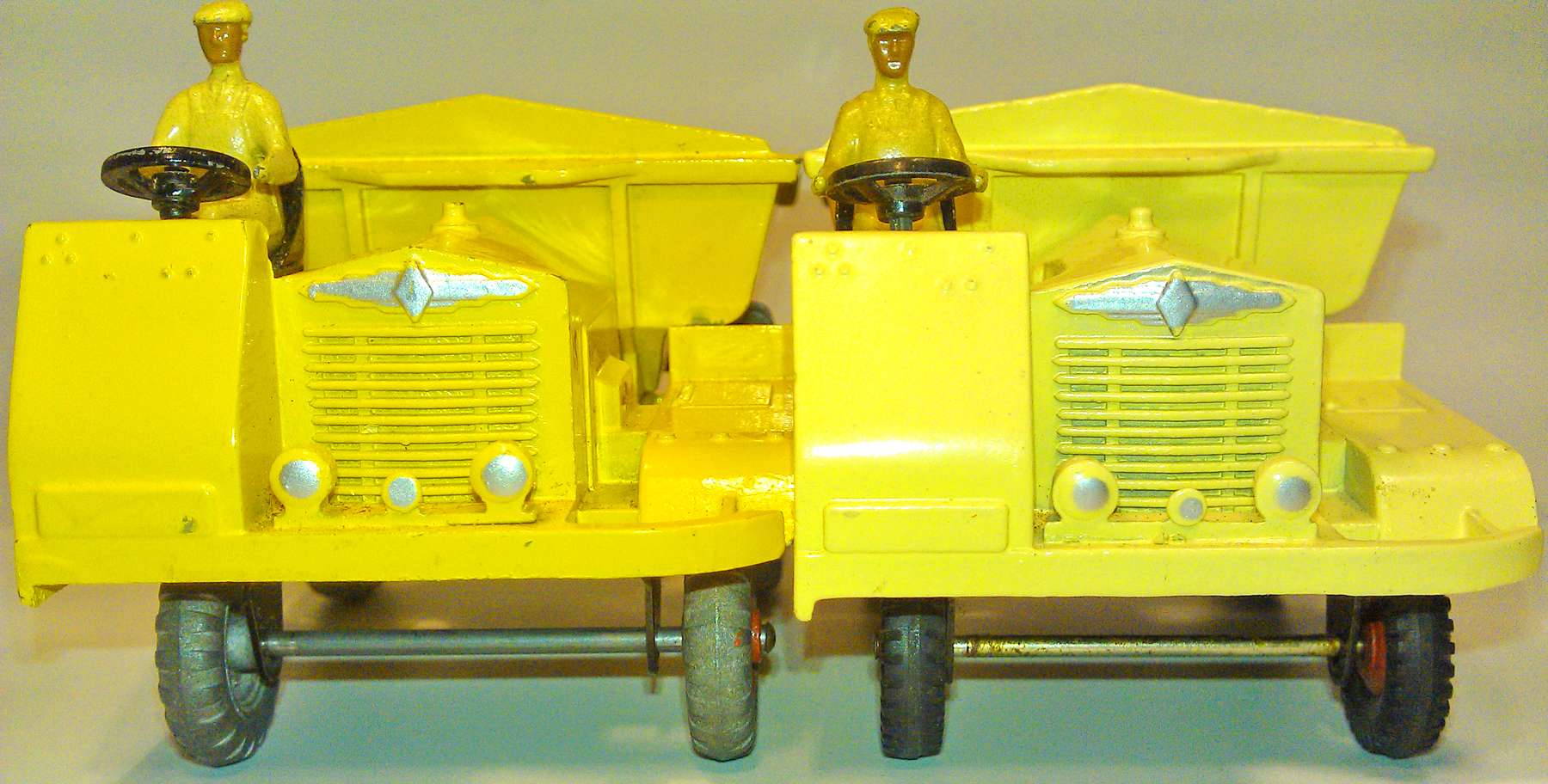
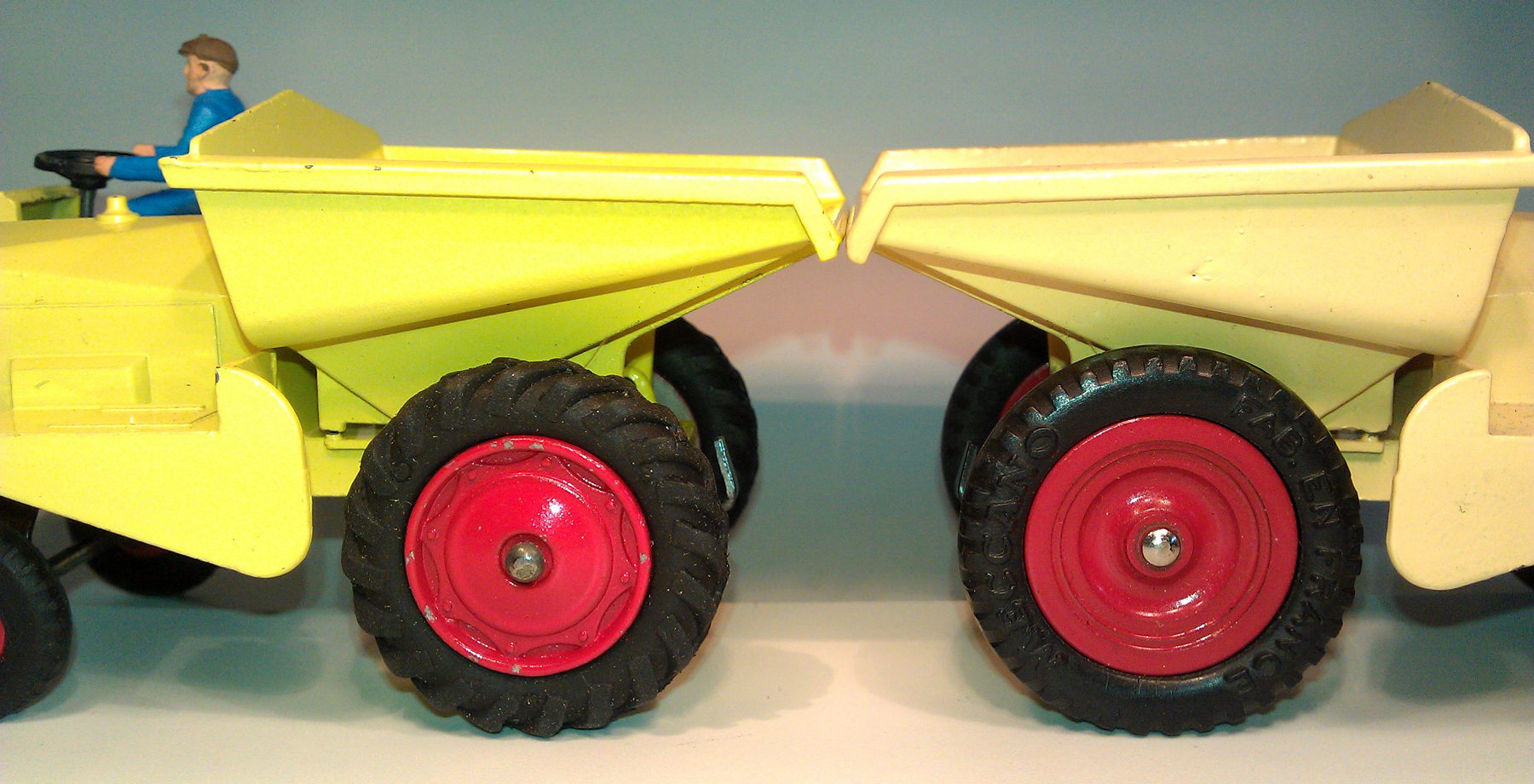
Comparing the heights of the English No. 562 (left) and French No. 887 (right) Dinky Supertoys Muir-Hill Dumper Truck. The English model had metal tires while the French model had rubber tires.
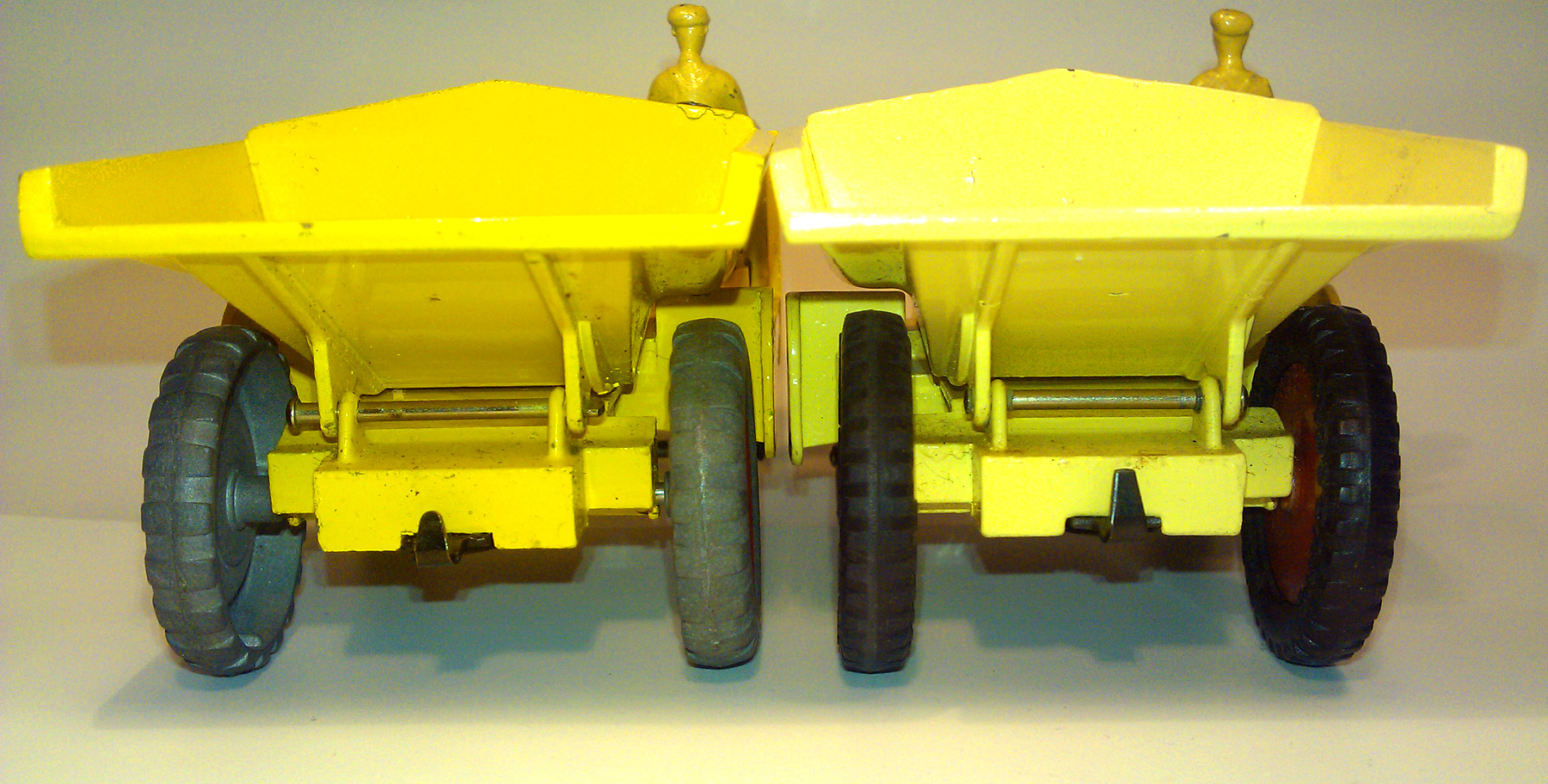
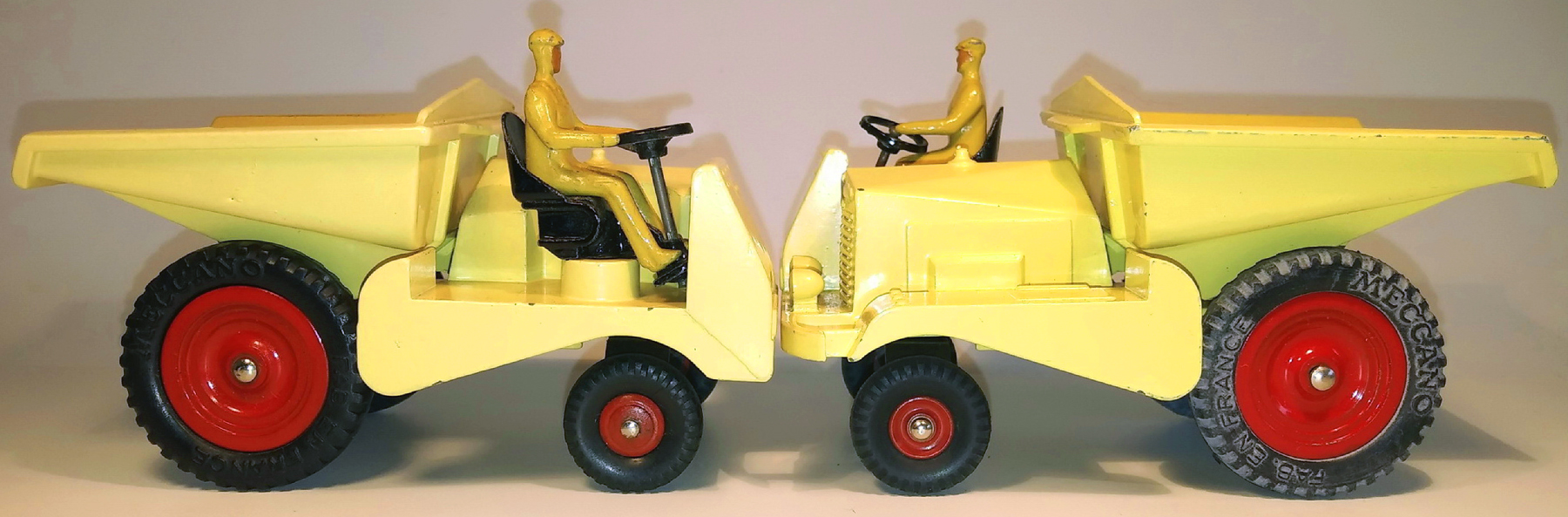
Rear view of the English No. 562 (left) and French No. 887 (right) Dinky Supertoys Muir-Hill Dumper Truck.
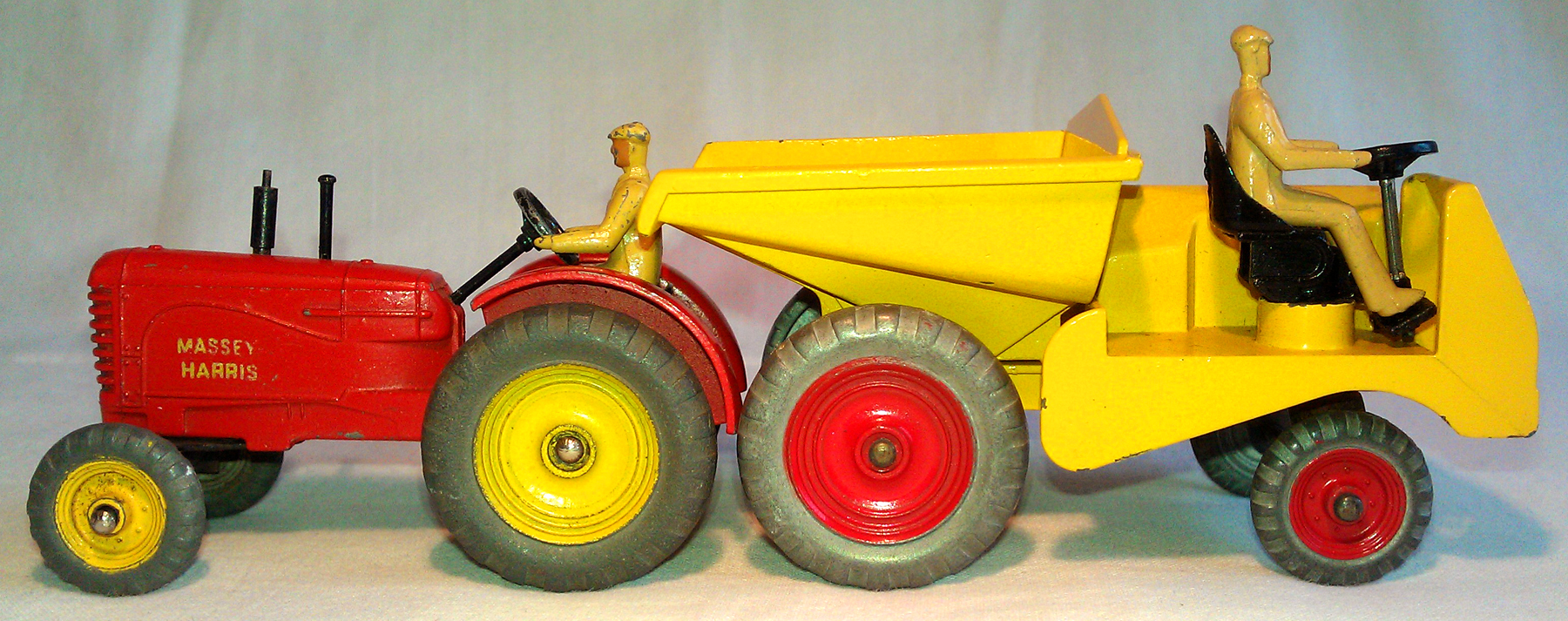
In “The Great Book of Dinky Toys” by Mike and Sue Richardson, the authors state the wheel, tire and steering wheel assembly of the No. 562 Muir-Hill Dumper Truck are the same as those of the No 27A Massey-Harris tractor.
Comparing the wheels of the Muir-Hill Dumper Truck (L: English No. 962, R: French No. 887)
Shown above are the different versions of the hubs of the front wheels of the French No. 887 Basculeur Automoteur Dumper Muir-Hill. The earlier version on the right has concave hubs while the later version has convex hubs. The text “Meccano Fab. en France” on the rear rubber tires on the model on the right is also clearly visible.
First version of the English Muir-Hill Dumper Truck
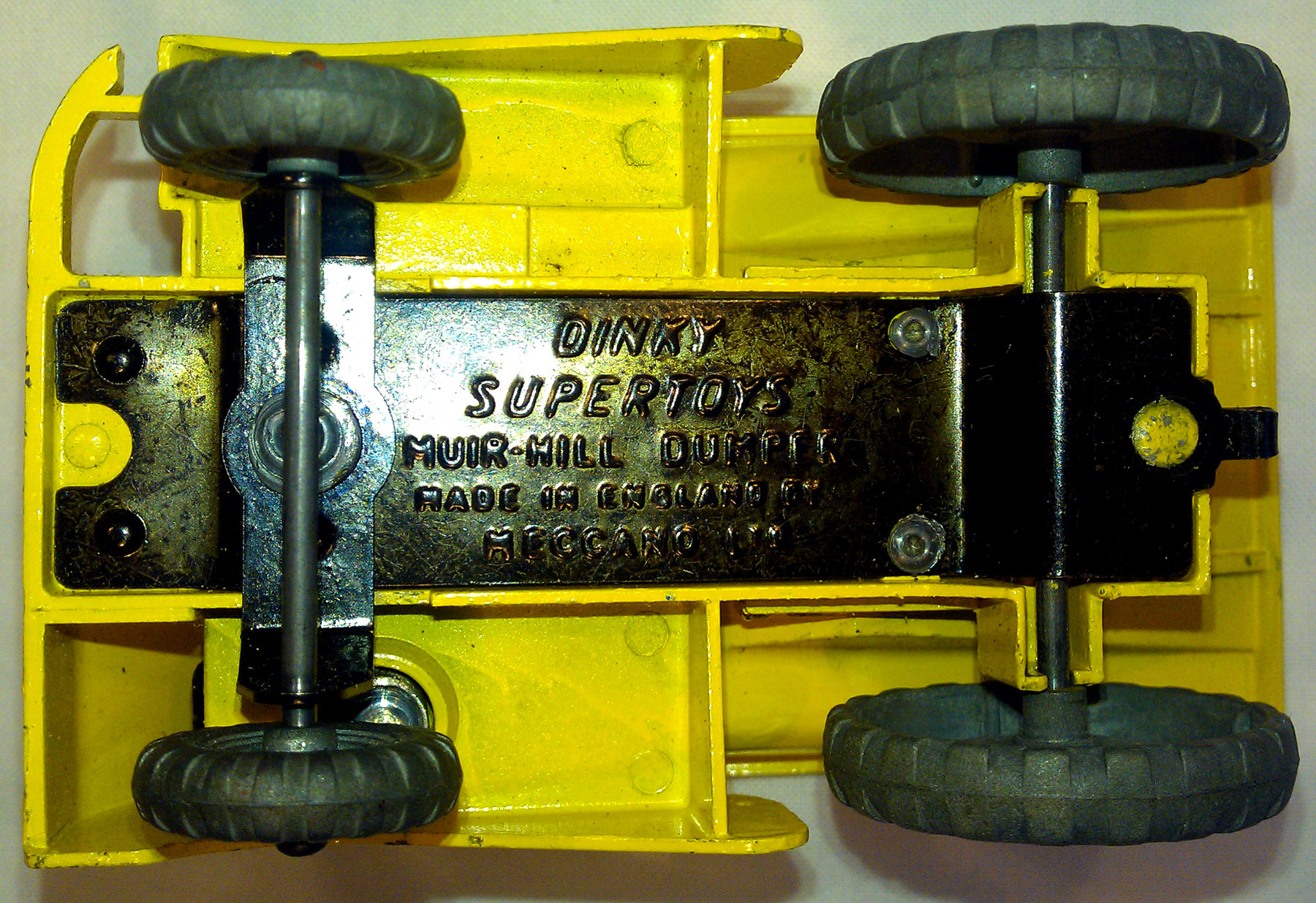
The chassis and baseplate of the first version of the English Muir-Hill Dumper Truck lacked a model number. It sported metal wheels and had a rivet in front central area that was used to fasten the headlights to the model.
No. 887, the French assembled version of the No. 562 English Muir-Hill Dumper Truck
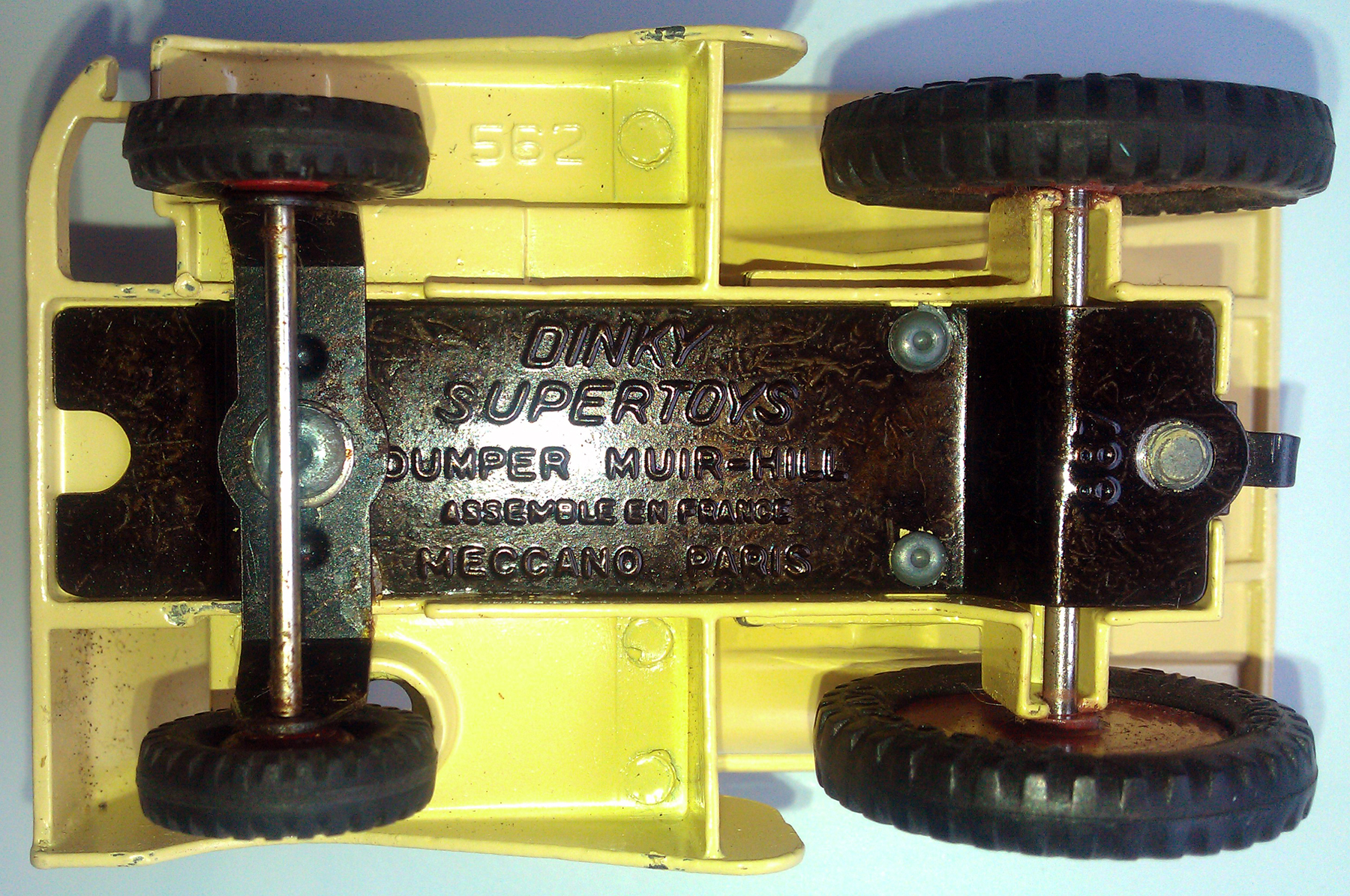
The No. 887 French assembled version of the No. 562 English model had “562” inscribed on the chassis while the baseplate was inscribed “887” and the legend “Assemble en France Meccano Paris”. This version also had rubber tires and lacked a rivet for fastening the headlights.
Dinky Supertoys 962 Muir-Hill Dumper Truck with number 562 on the chassis.
Shown above is the No. 962 Muir-Hill Dumper Truck with the number “562” on the chassis, rubber tires, and a matte black baseplate without a model number.
Here are the three versions of the Muir-Hill Dumper Truck. From left to right: Dinky Supertoys 562, the French 887 and the 962. Note the clearly visible differences in color.
Shown above are the same models on their boxes.
Finally, here are the three versions of the Muir-Hill Dumper Truck in their boxes, showing the inner packing pieces. From left to right: Dinky Supertoys 562, the French 887 and the 962.
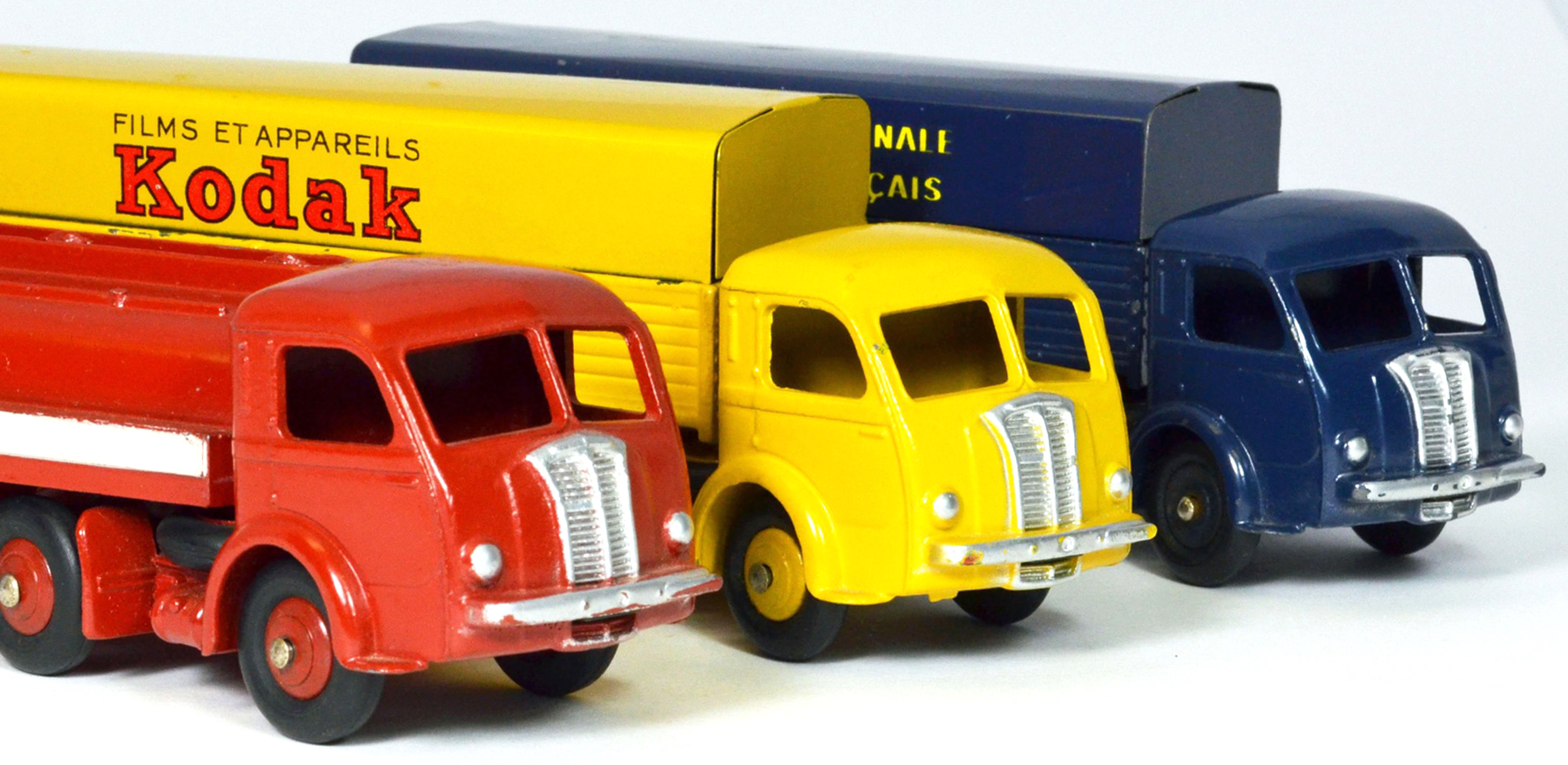
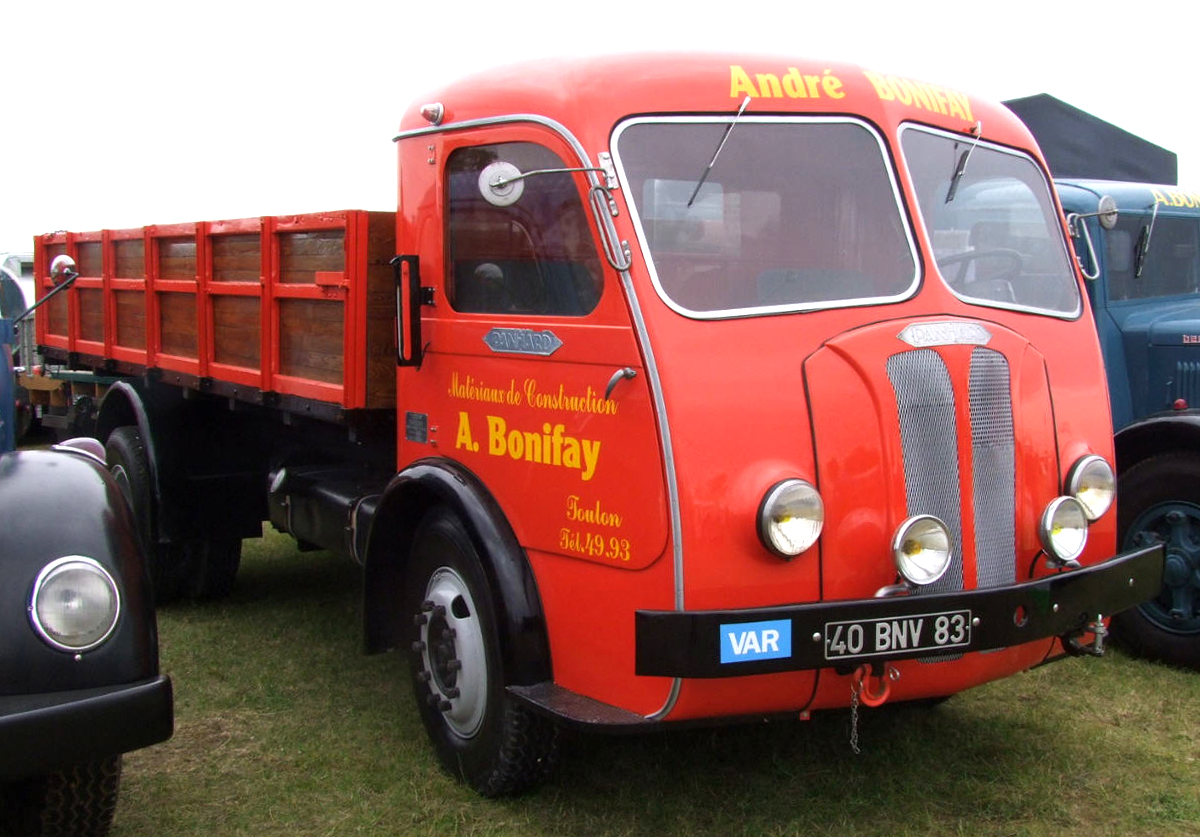
Although the English Meccano factory quickly got to work and introduced larger scale commercial vehicles in 1947 with the Foden and Guy trucks, it took the Dinky Toys French factory a lot longer to do the same. But the wait proved worthwhile, because in 1952 the French introduced what turned out to be a classic and very desirable set of trucks: the Panhard Articulated trucks. These were a very good likeness of the Panhard Movic 7 ton diesel trucks then in service.
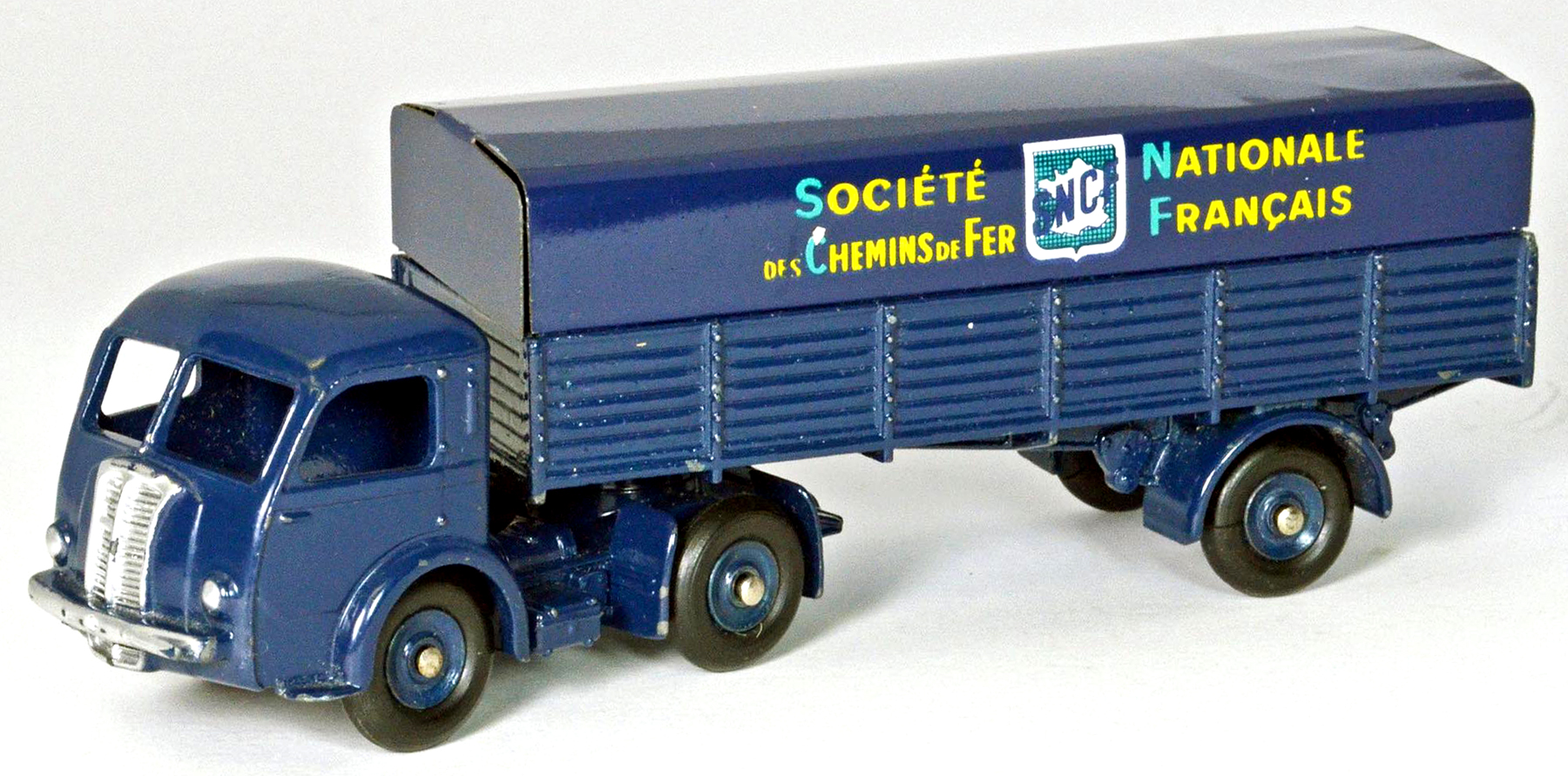
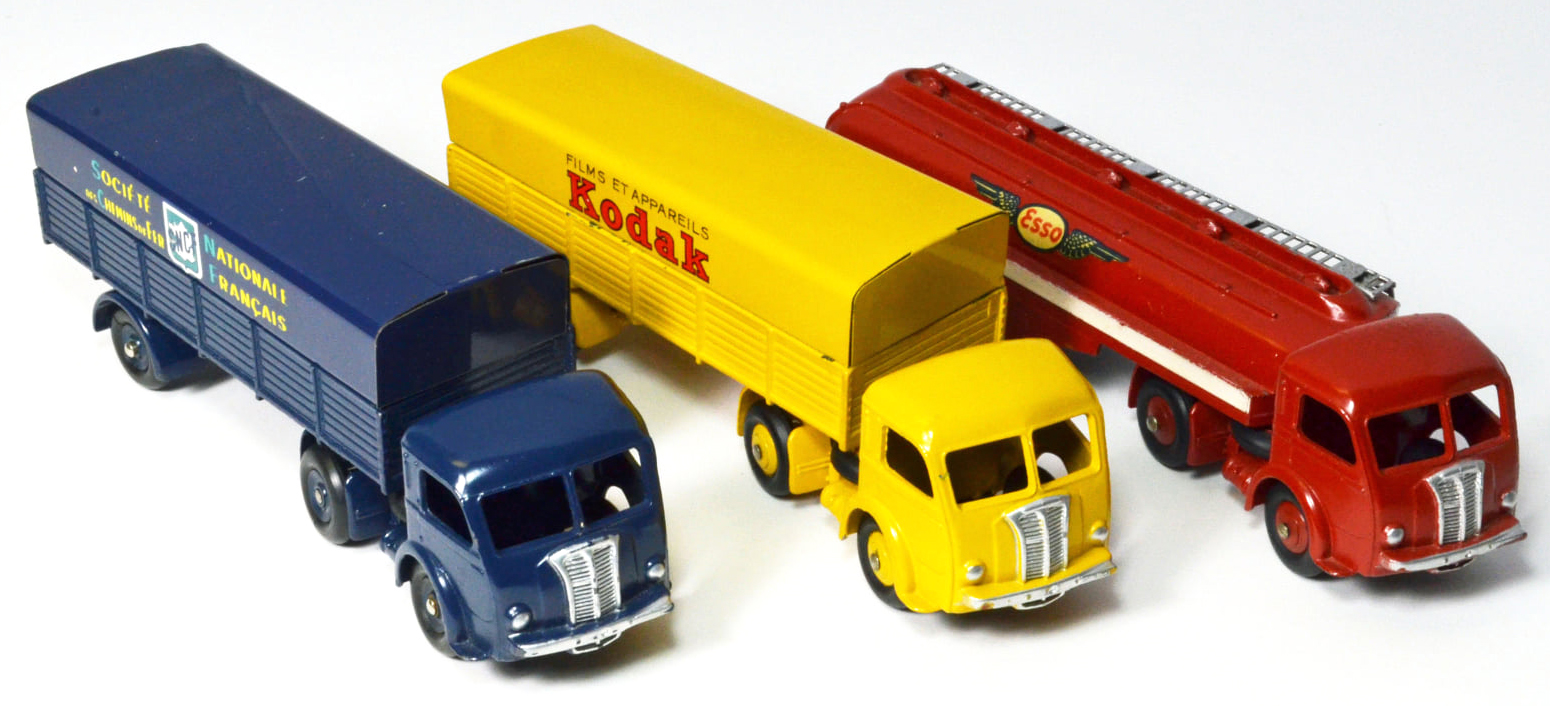
Initially two Dinky Toys models were produced: the 32AB/575 Panhard “SNCF” Articulated truck and the 32AJ Panhard “Kodak” Articulated truck. Almost everyone recognizes “Kodak”, but for those who aren’t French the “SNCF” name may be a mystery; it is the French national railroad agency.
The 32AB SNCF version was produced during 1952 to 1964 and over the years three different SNCF logo decals were used: the first had a steam locomotive in the center, but mine is the last one. The dark blue makes this a very handsome truck.
With their articulated trailers, both the SNCF and Kodak made great toys, and in typical French Dinky Toys fashion they were also very well executed, with great detailing and fabulous paint jobs.
A delightful image from the 1952 French Dinky Toys catalog shows some classic scenes. Note the Panhard Kodak articulated truck is listed as new, making its debut!
My very first model of this series was the Kodak truck, and I was lucky to acquire it. In 1958 I visited a large department store in downtown San Diego, USA, and in their display case was a stunningly beautiful, bright yellow Kodak truck. As soon as I saw it I knew I had to buy it, so I paid the US $2.50. These always came in trade boxes of six, so I never had a box for it. Keeping a yellow model in good condition all these years was no easy task. And I never saw an other one for sale again in any stores.
These two trucks soldiered on a few years and in 1954 Dinky introduced another version: this time a wonderful tanker truck 32C/576in the livery of Esso, as an airport refueler with the winged logo present.
The Kodak version was only made for a few years, and in 1955 was sold only as an export model. This export model featured a largely unknown change: the letter “a” in Kodak was changed from the earlier version to a different font, apparently to match the company logo seen in the US. Later models also had a checkered cabin roof.
The Esso tanker was made until 1961, while the SNCF was discontinued in 1963. This is a superb set of trucks that you should try to obtain, or at least one of them!
There are a few decal differences on both the SNCF and Esso versions, and the earlier convex wheels were replaced by the later concave ones.
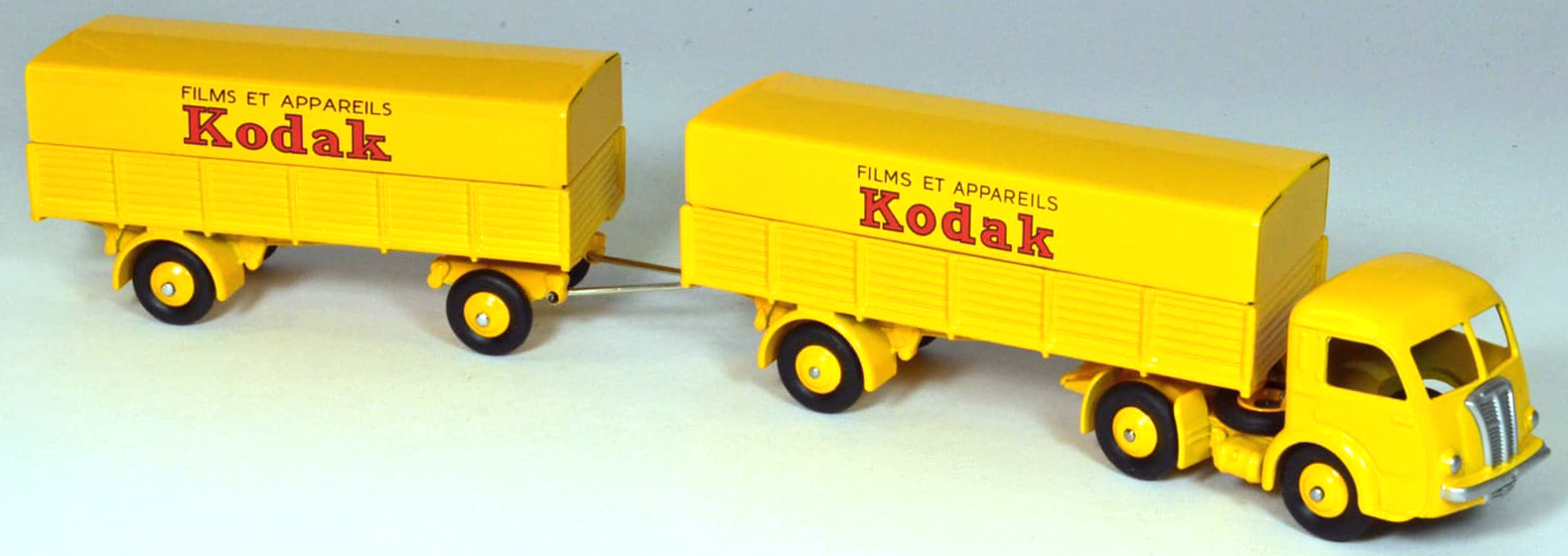
I thought some of you might like to see a version that Dinky didn’t make. I always wanted to see a matching Kodak trailer. Well, guess what? Between Atlasand Dan Toys reproductions, here is the ultimate Panhard Kodak rig!
Dinky Toys have been around since 1934 and have amazed boys of pre-war Britain and other countries to which they were exported. During the 1940s and 1950s they filled the Christmas stockings of Baby Boomers, and by the late 1960s inspired adult collectors reliving their youth.
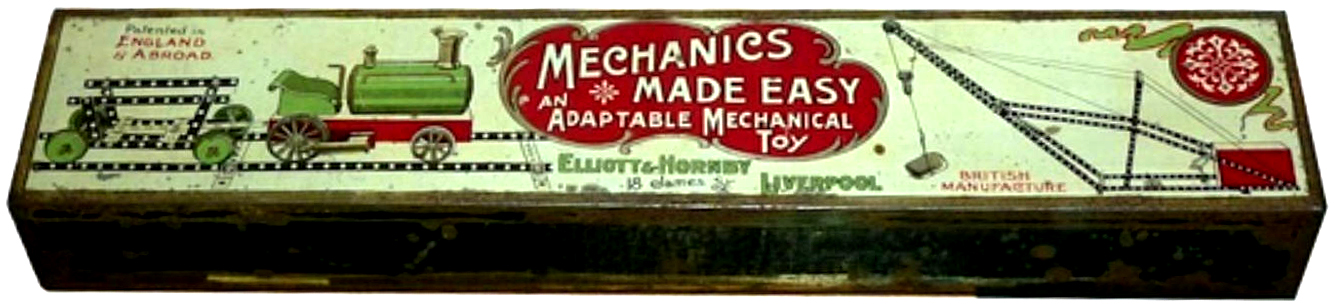
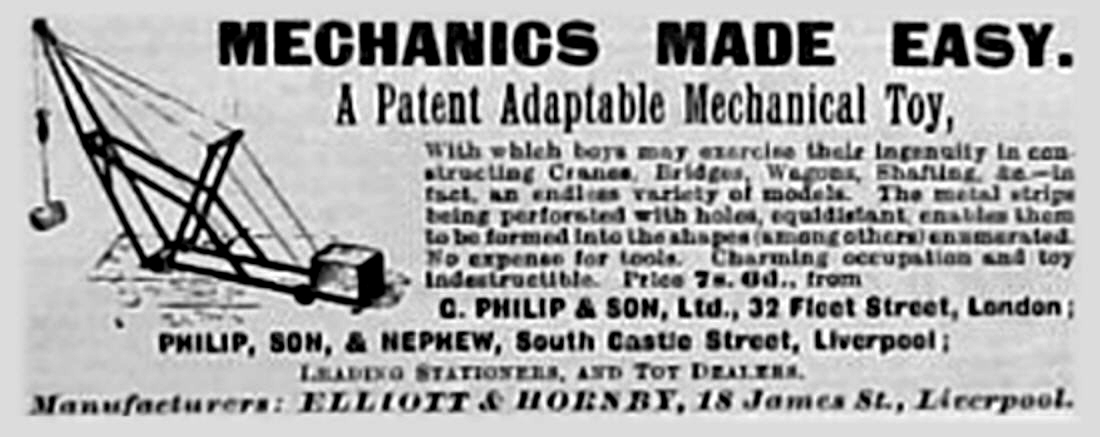
But the roots of these world renown collectables go back to 1900, when Frank Hornby designed some metal parts for a construction set that was patented in 1901 and known as “Mechanics Made Easy”. By 1907 its name was changed to “Meccano”, which was to become a household name.
“Mechanics Made Easy” construction set and advertisement. Image: First Versions
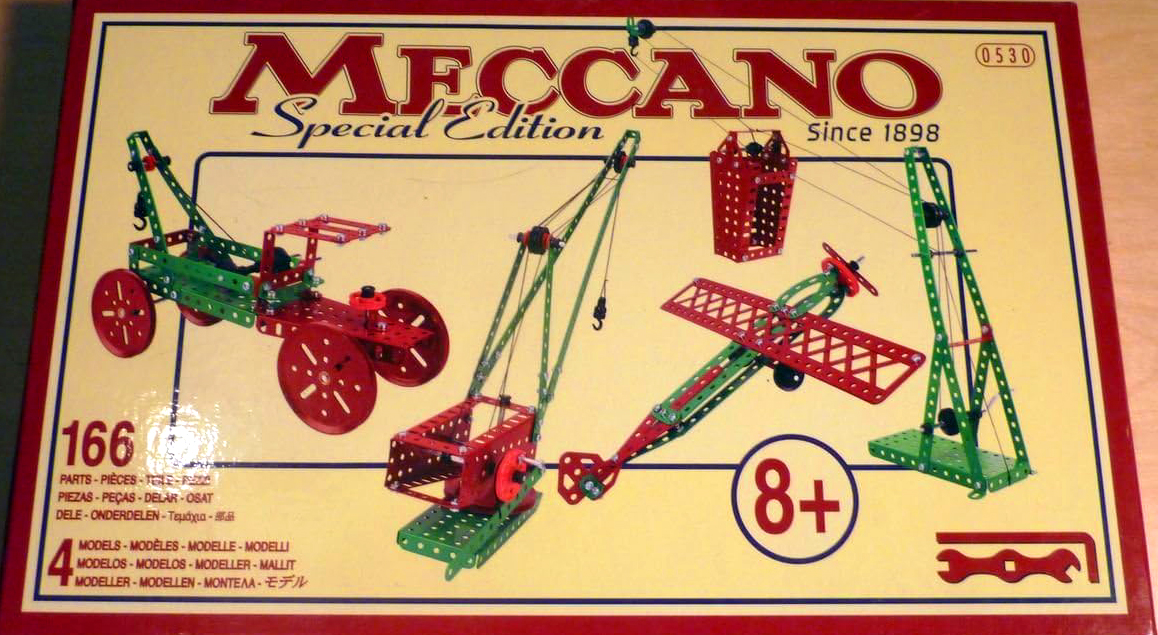
Reproduction of a circa 1930s Meccano set. Image: Amazon.com
By 1920 the first “O” gauge ready to run trains were available and from 1931 a set of accessories consisting of figures and platform decorations was introduced. These were numbered 1 to 21. In 1933, a set of six road vehicles numbered 22 called “Modelled Miniatures” was introduced. These were thought to look “dinky” meaning attractively small or cute, and so a brand name was born, later to become synonymous with the likes of “Hoover” for vacuum cleaners.
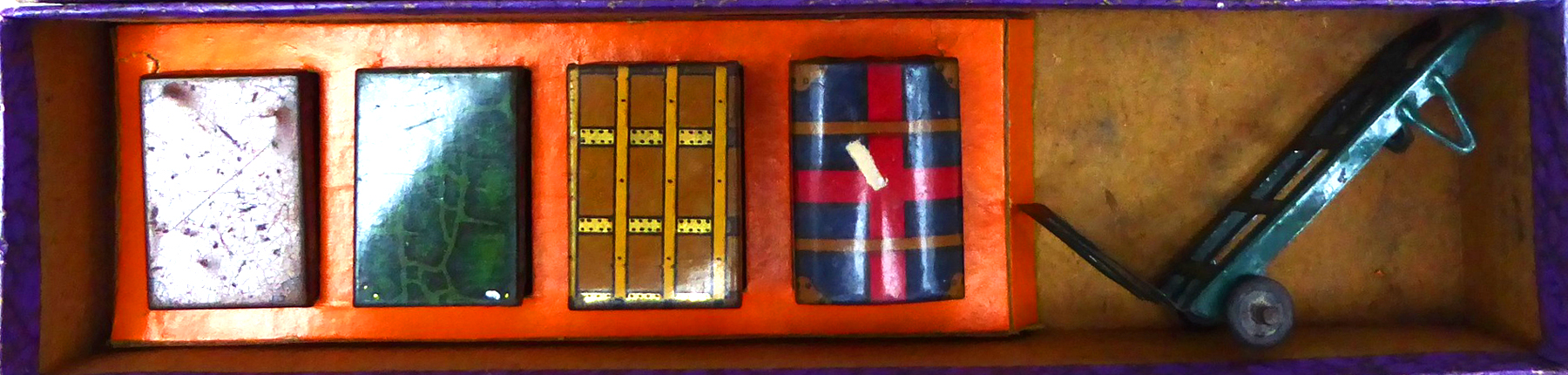
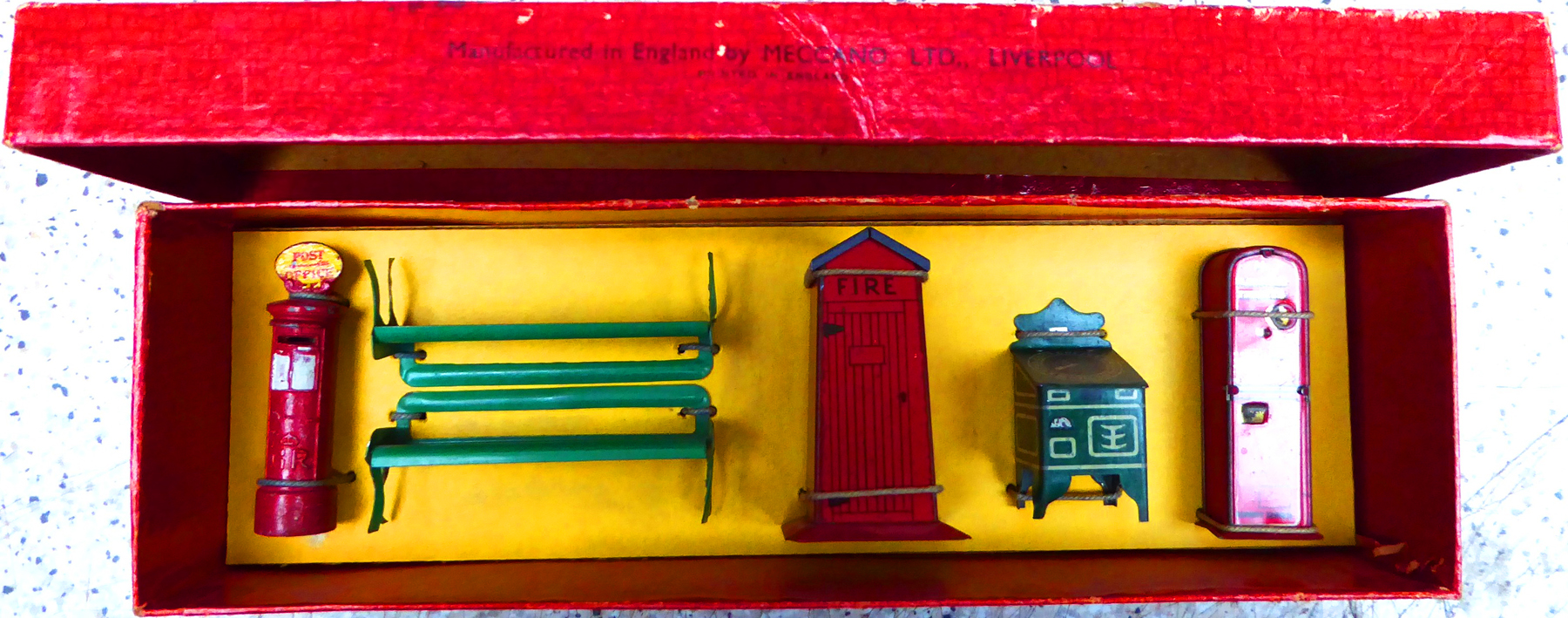
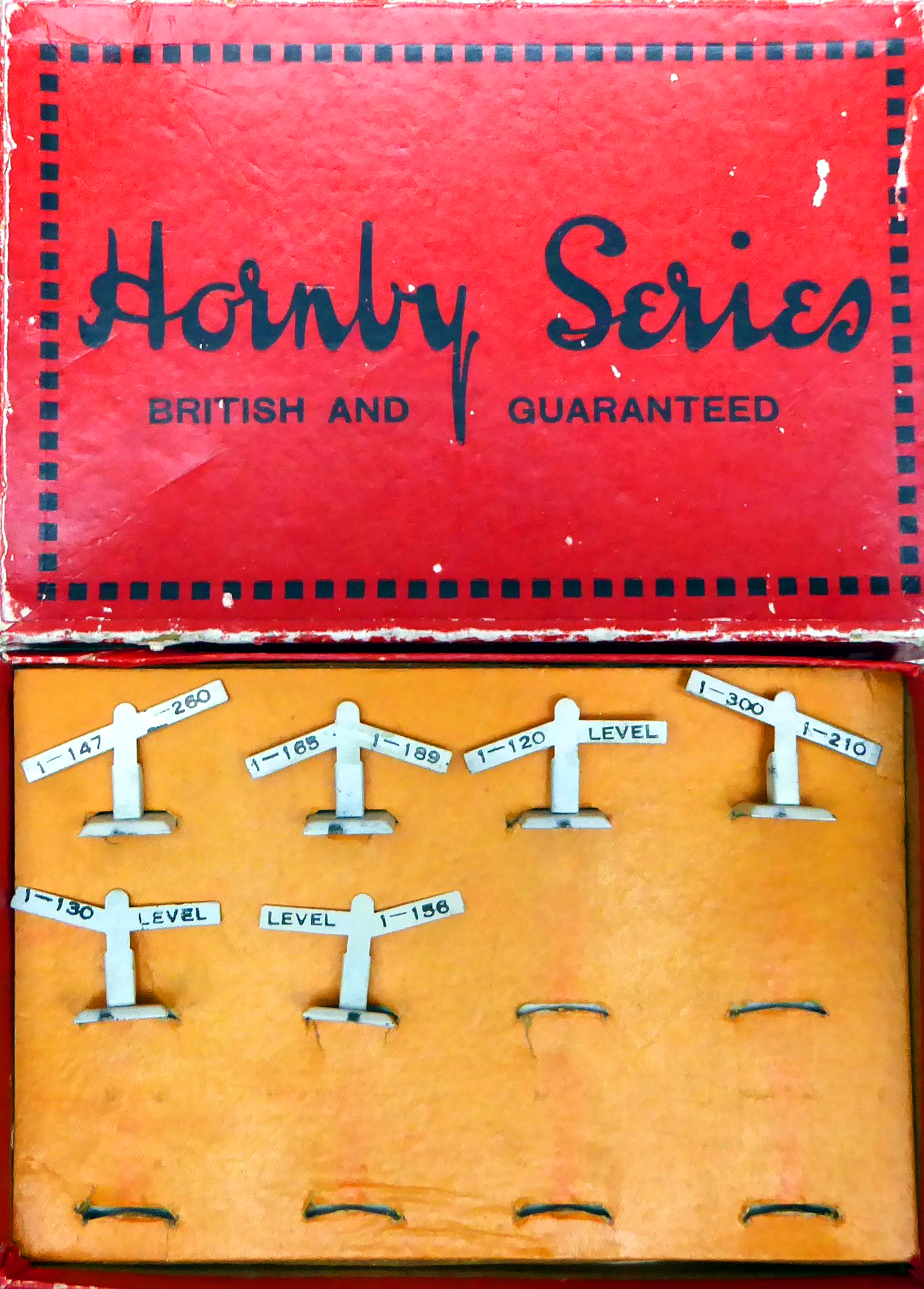
In this article, I present a selection of some of the accessories numbered 1–21 that predated the set of cars. Some are in original boxes while others have nice replica boxes that have been created by a good friend.
Hornby Series Modelled Miniatures
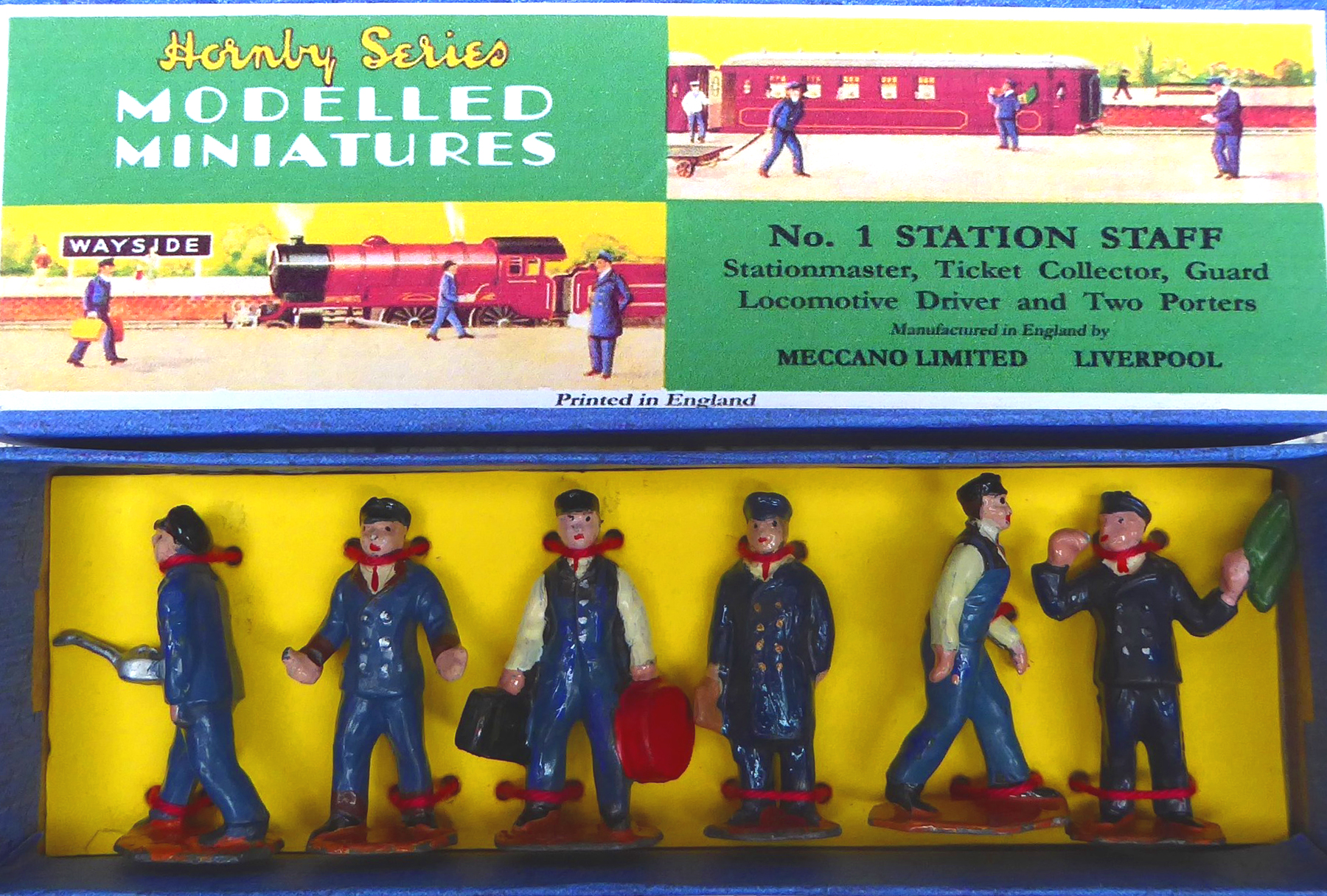
Hornby Modelled Miniatures Station Staff Set No. 1
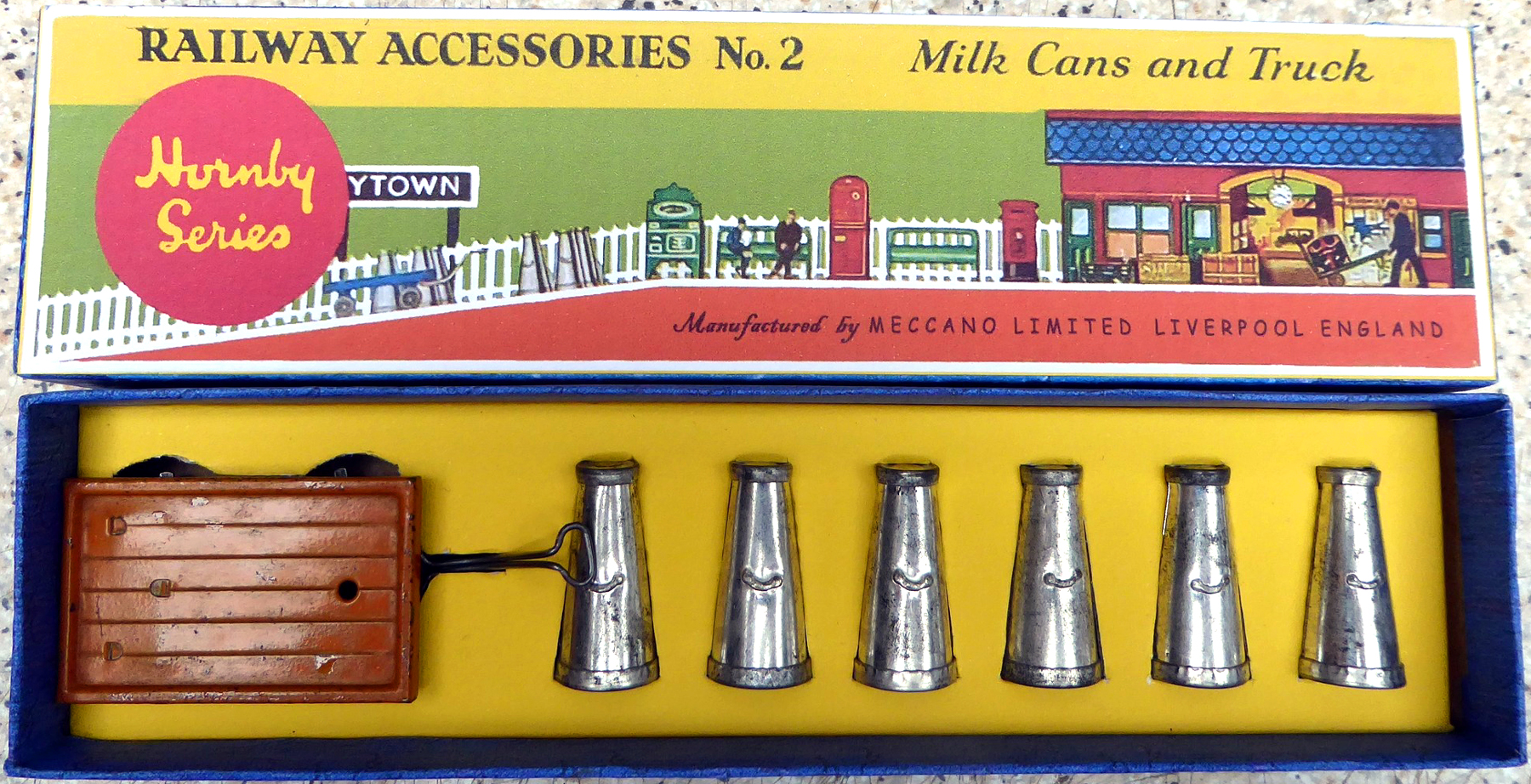
Hornby Modelled Miniatures Railway Accessories Set No. 2
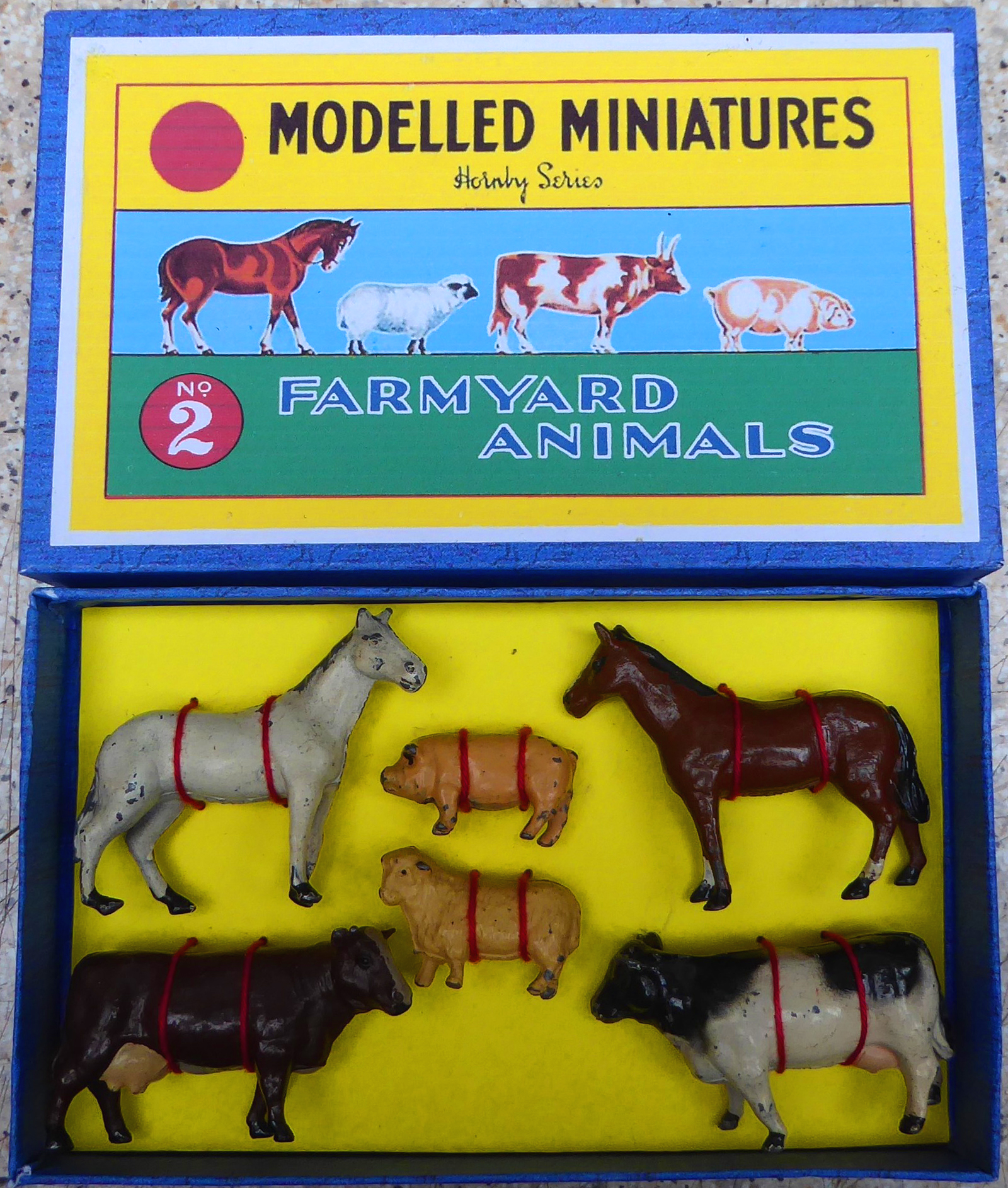
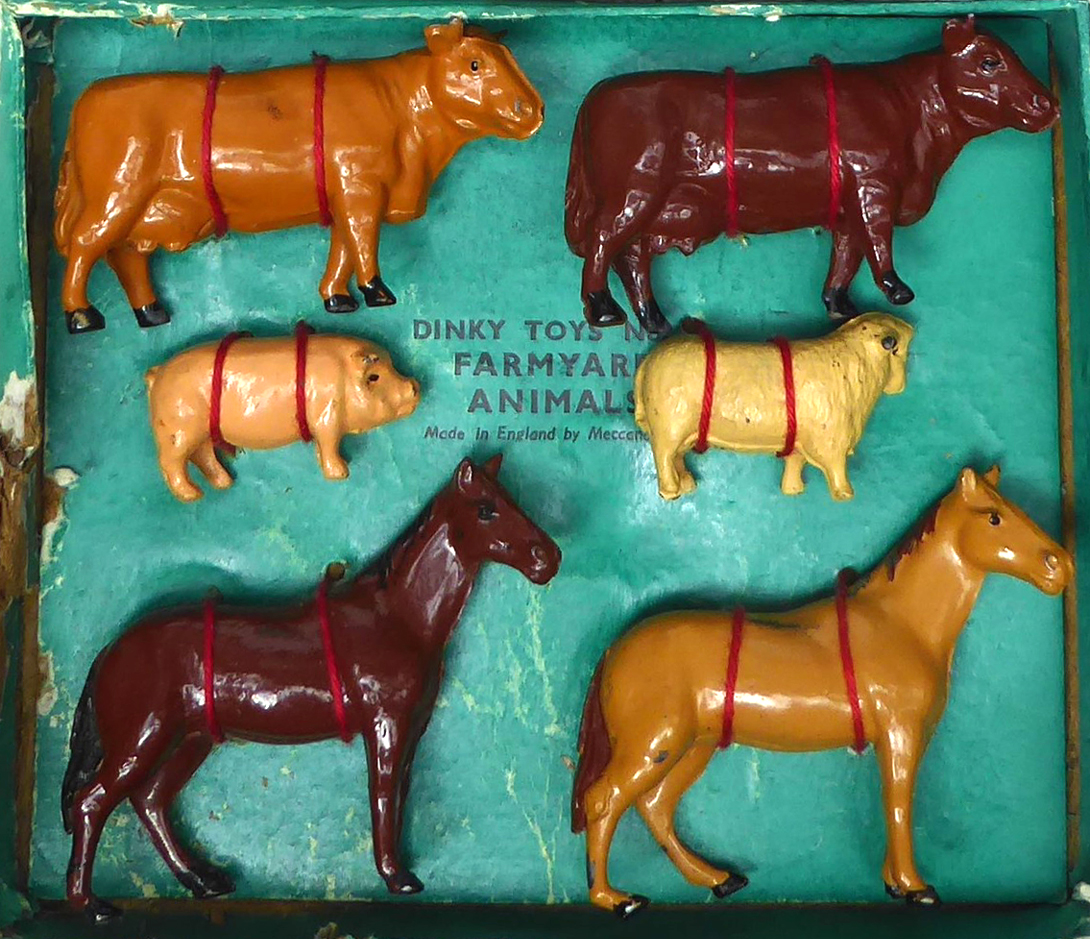
Hornby Modelled Miniatures Farmyard Animals Set No. 2
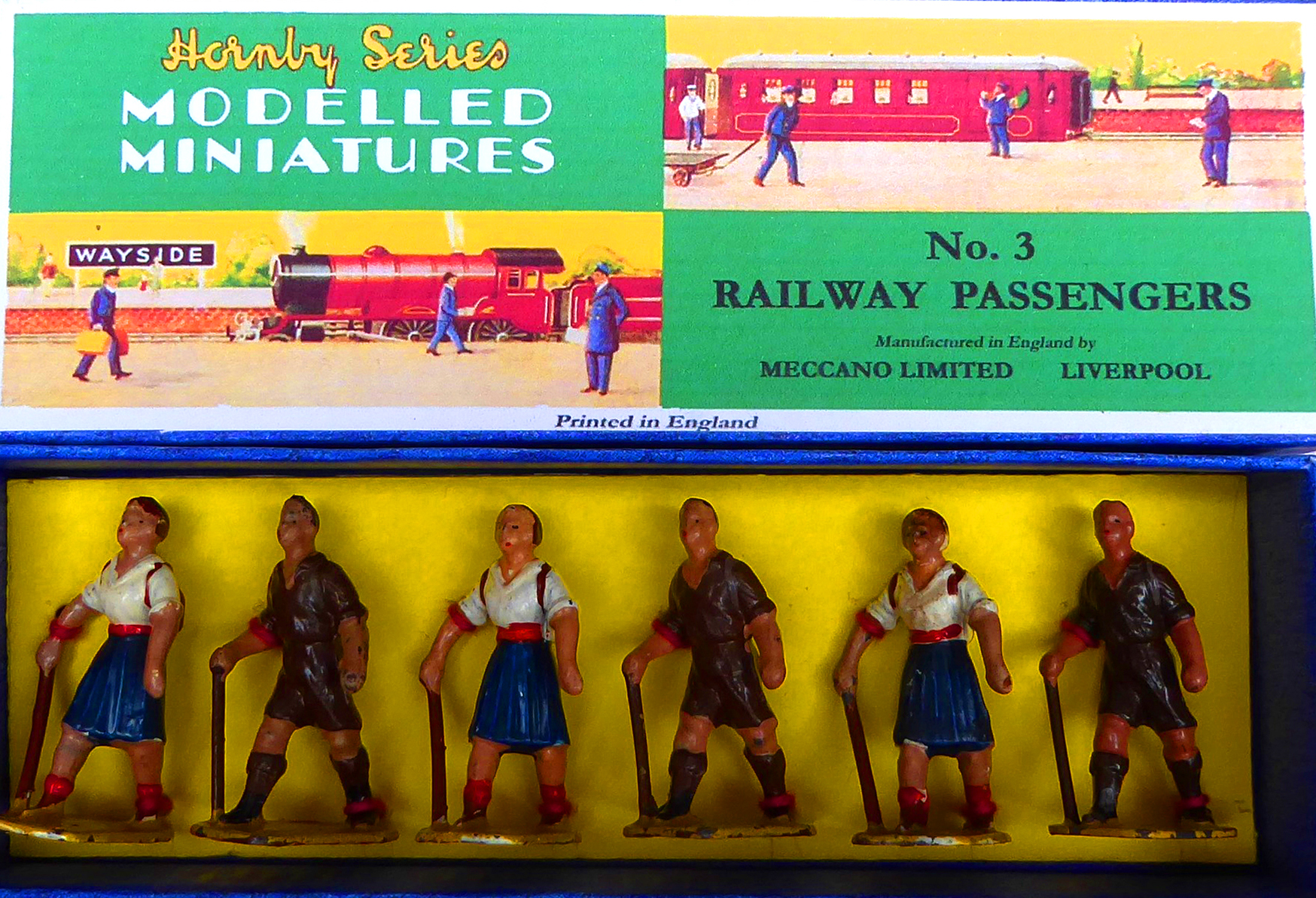
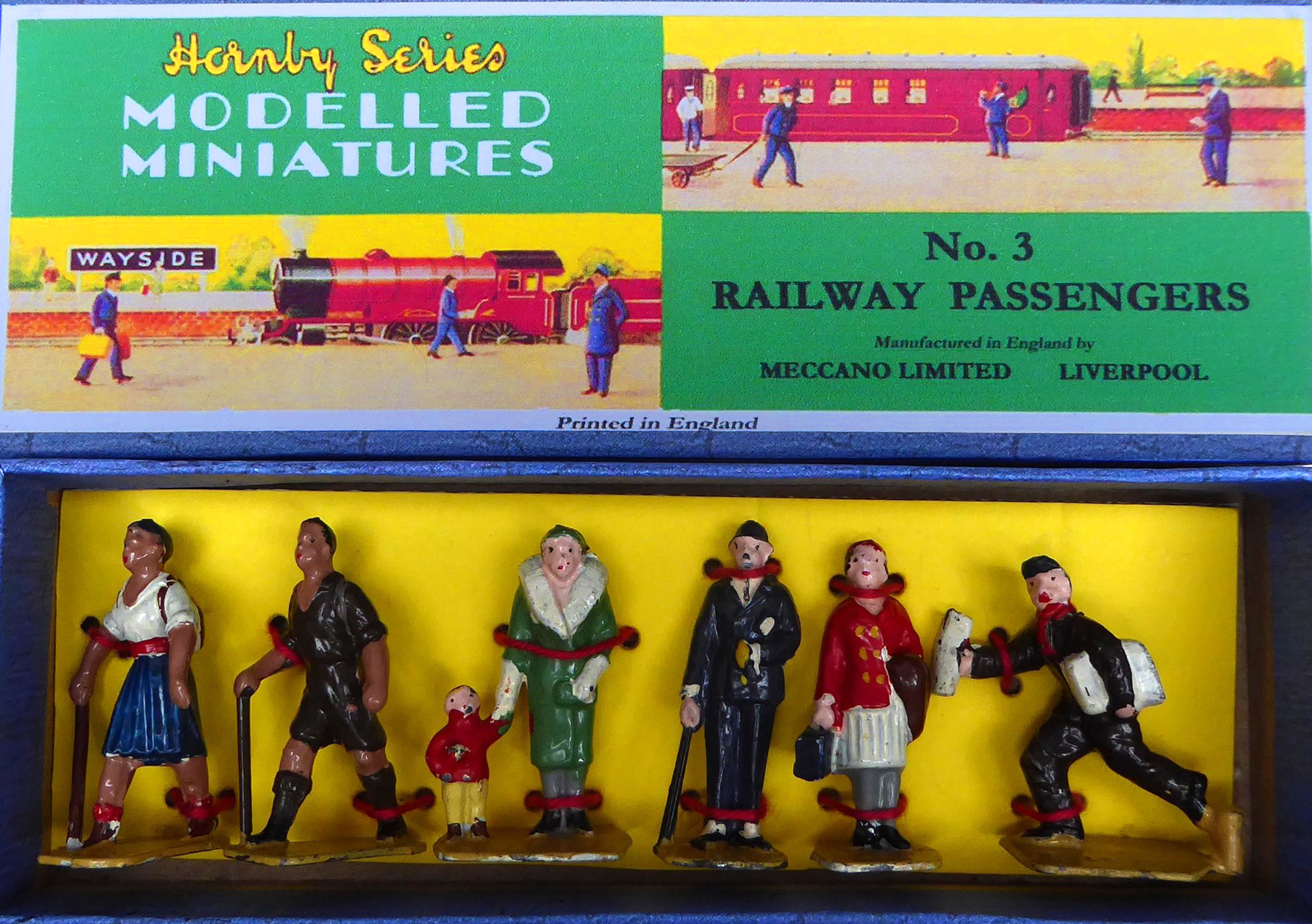
Hornby Modelled Miniatures Railway Passengers Set No. 3
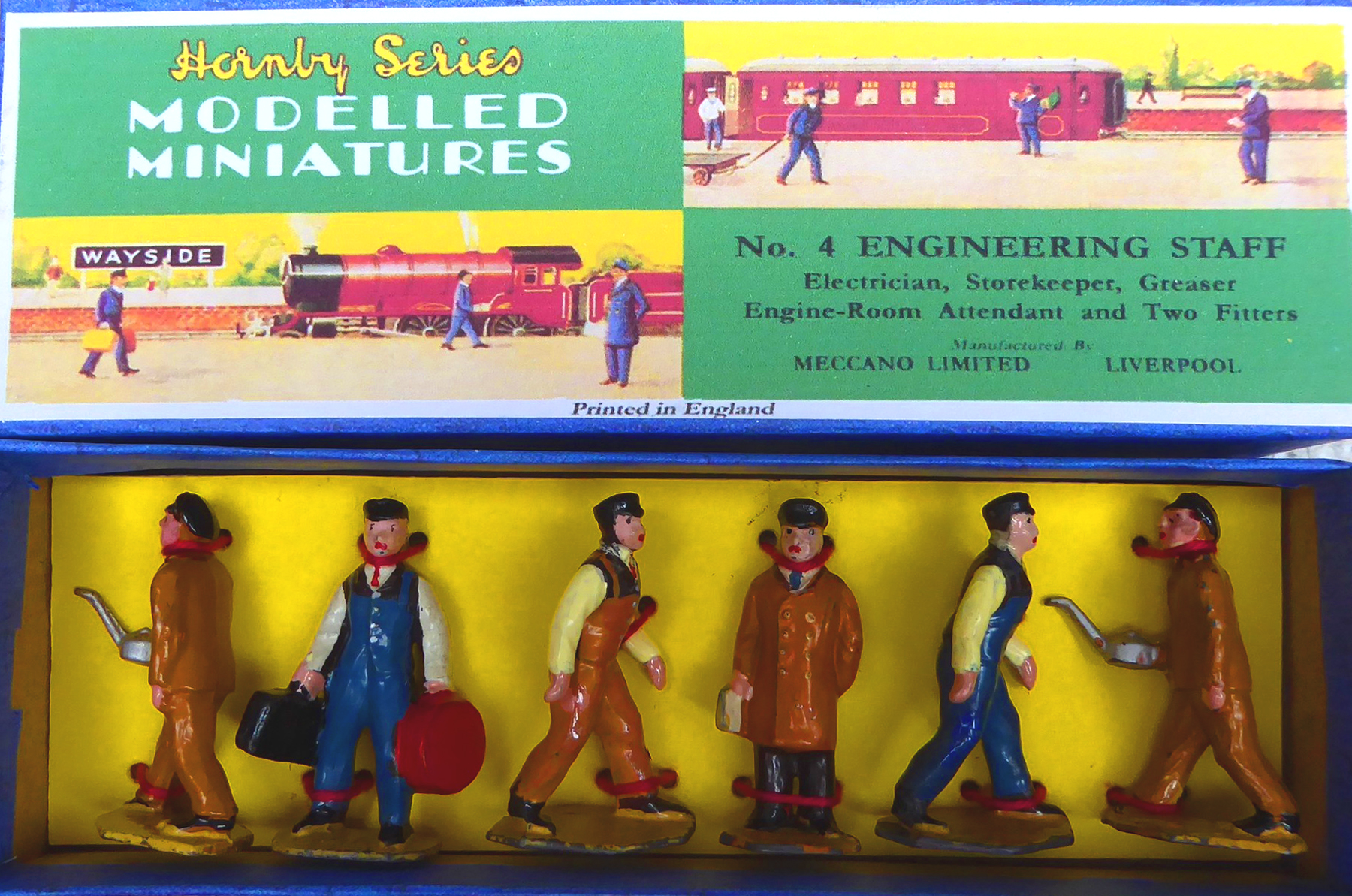
Hornby Modelled Miniatures Engineering Staff Set No. 4
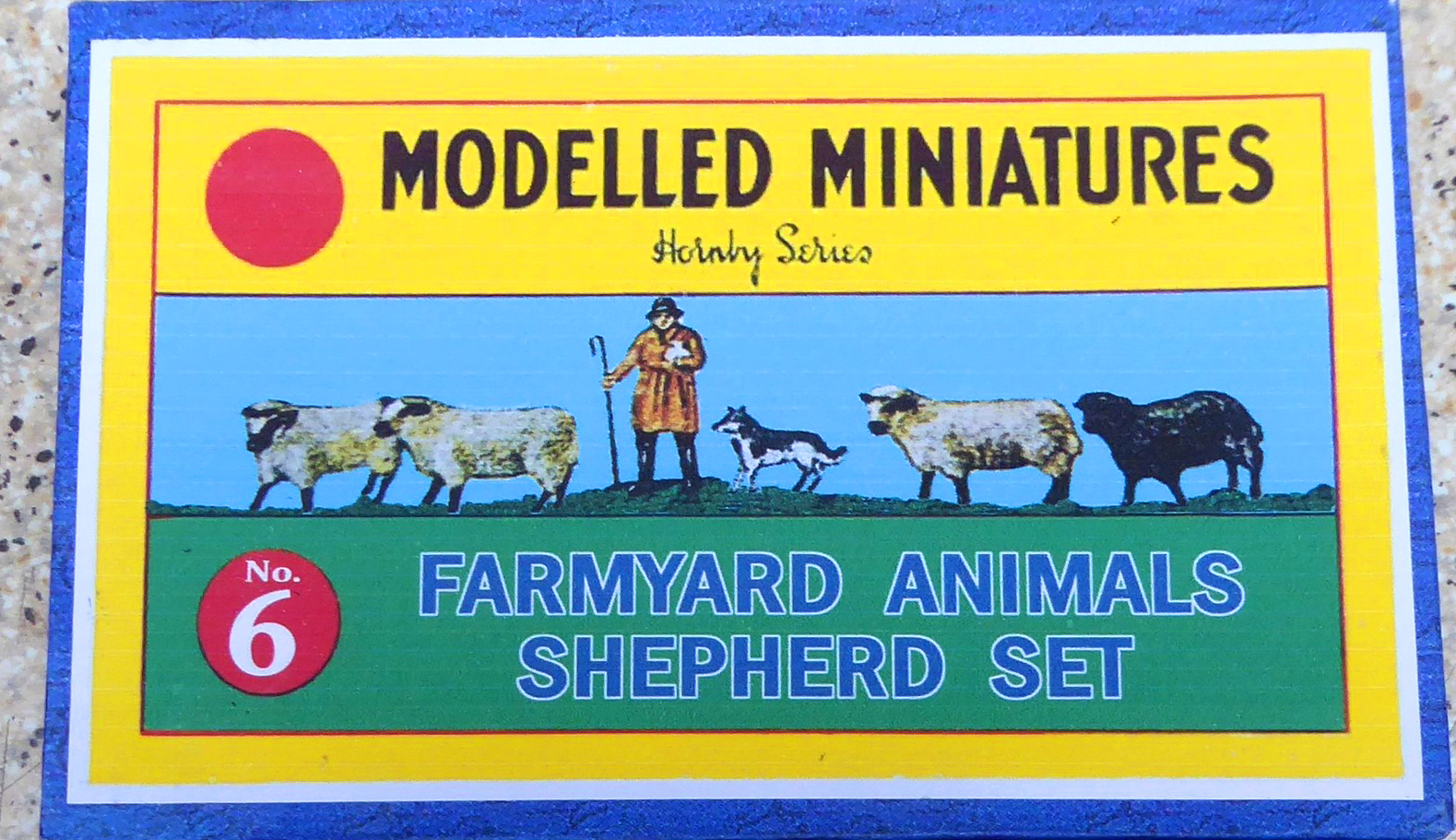
Hornby Modelled Miniatures Farmyard Animals Set No. 6
Dinky Toys ‘O’ Gauge accessories
Dinky Toys Station Staff Set No. 1
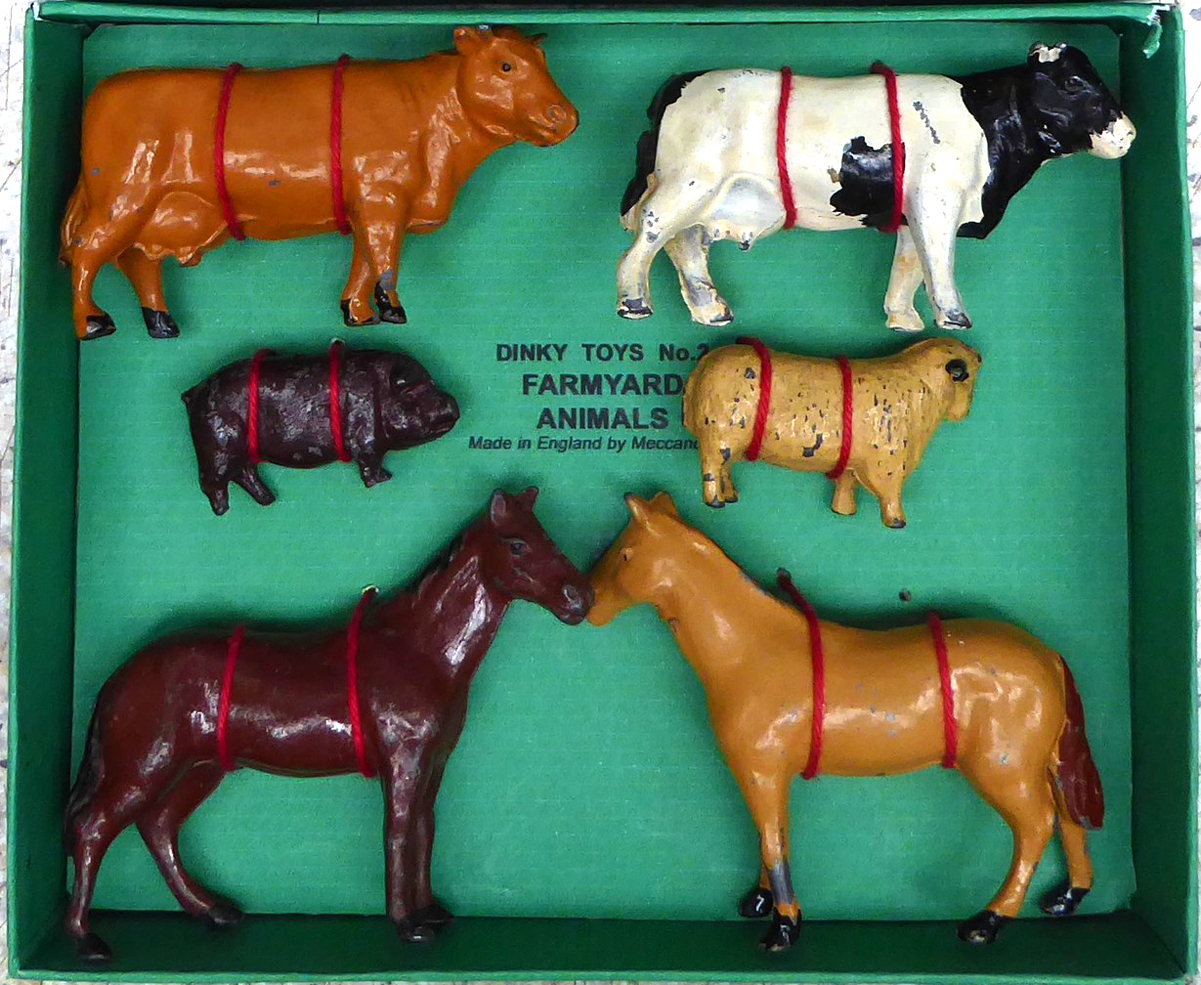
Dinky Toys Farmyard Animals Set No. 2
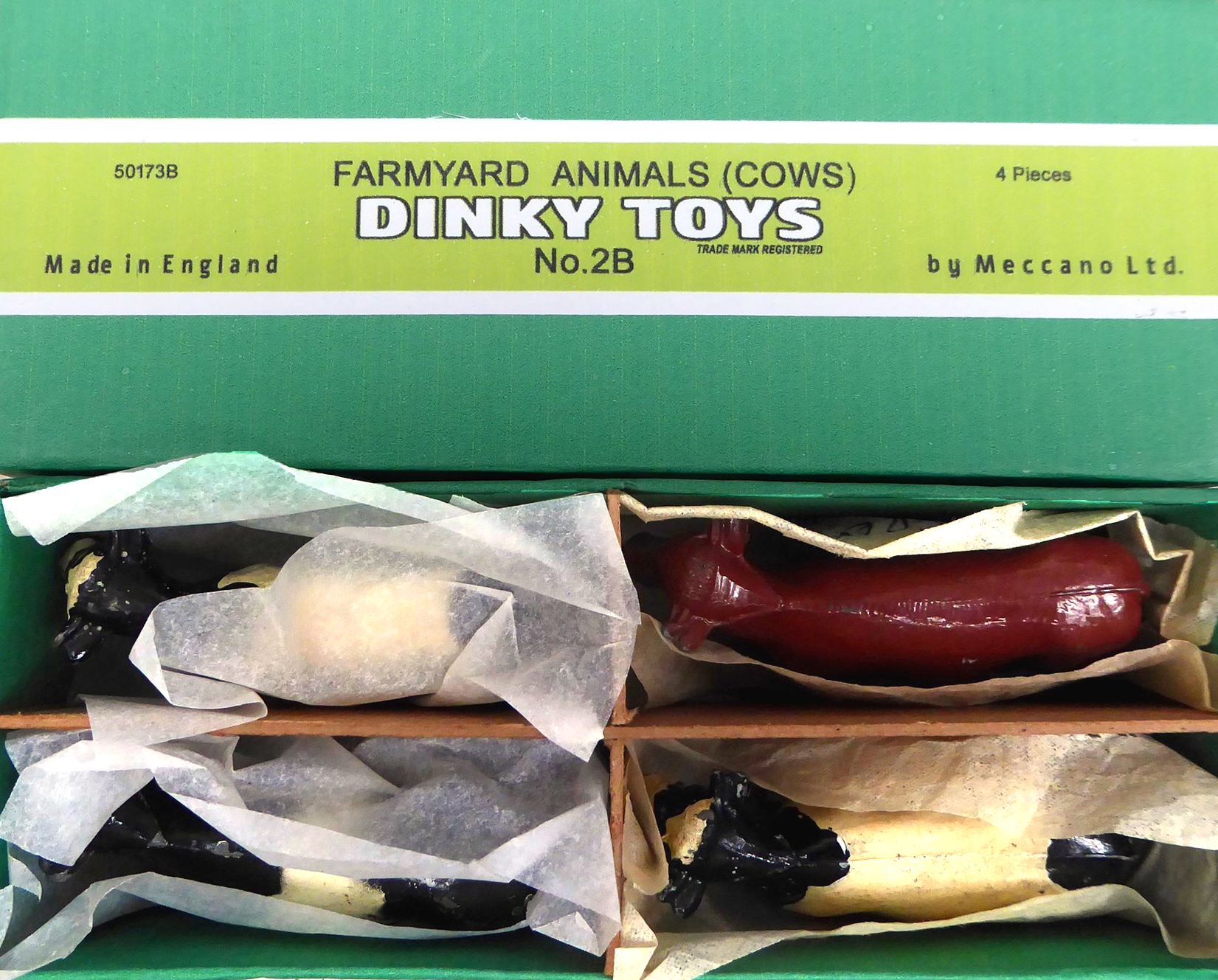
Dinky Toys Farmyard Animals (Cows) Set No. 2B
Dinky Toys Railway Accessories Set No. 3
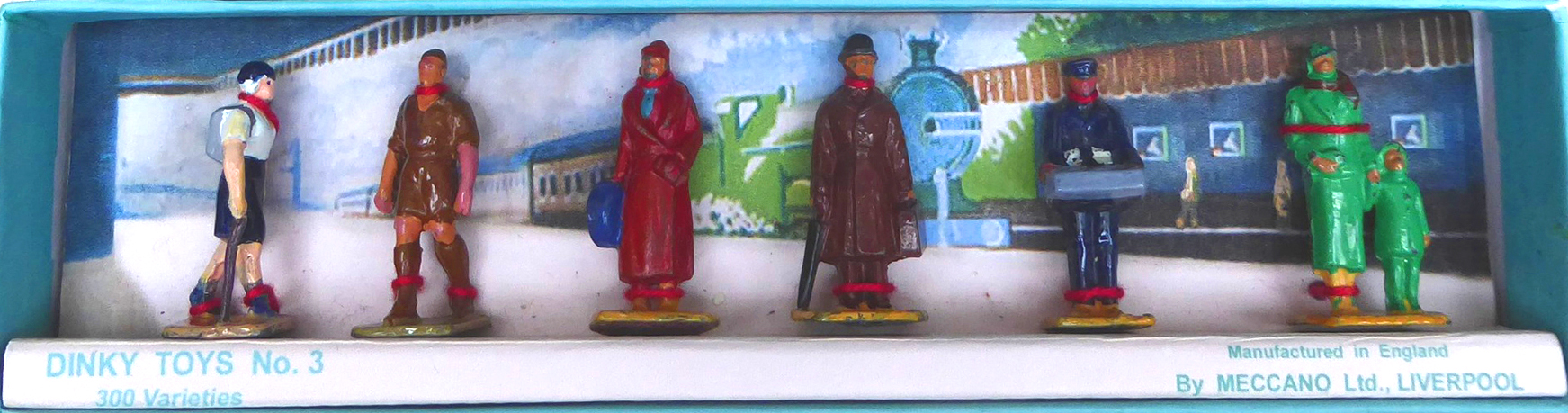
Dinky Toys Passengers Set No. 3
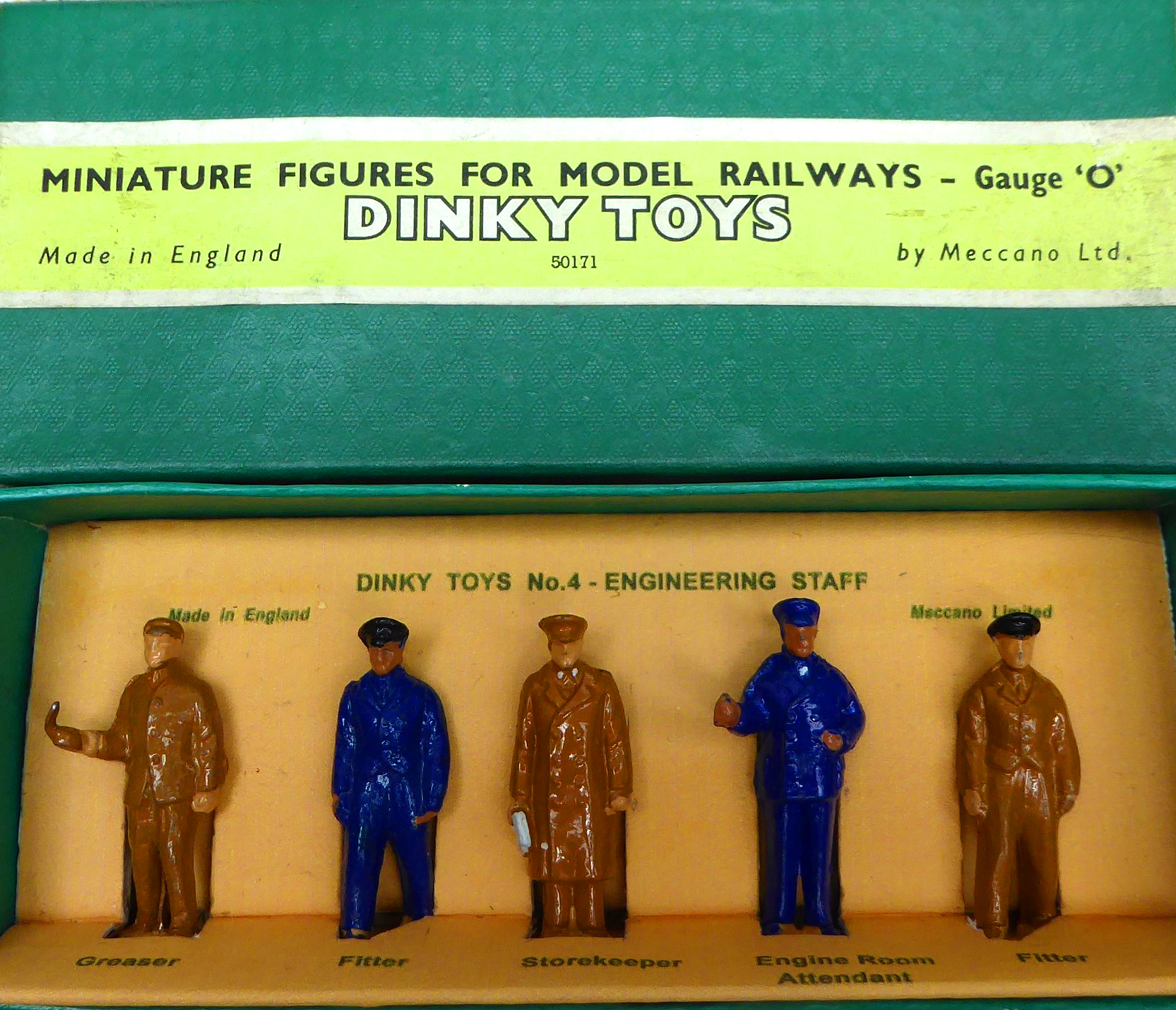
Dinky Toys Engineering Staff Set No. 4
Dinky Toys Train & Hotel Staff Set No. 5
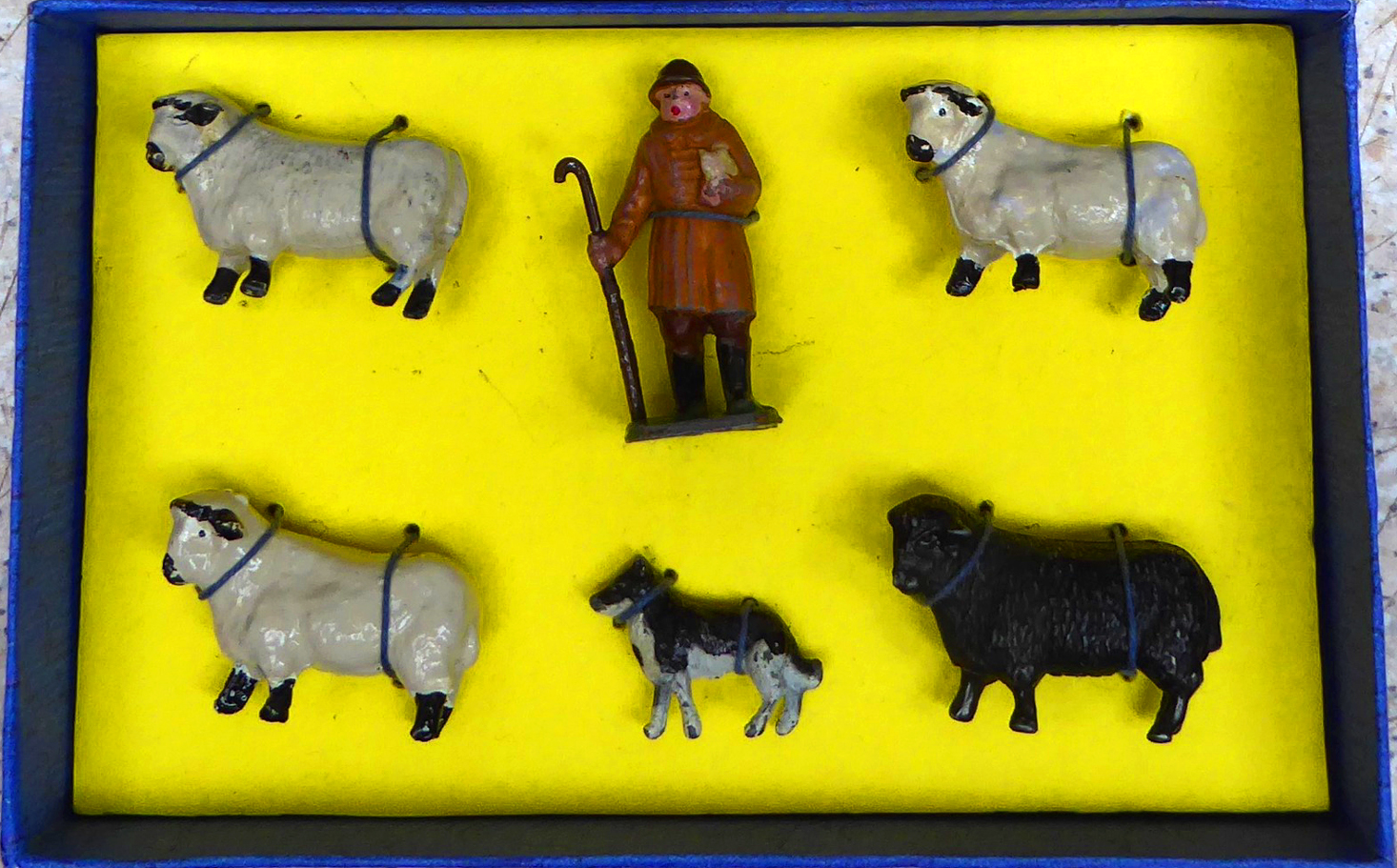
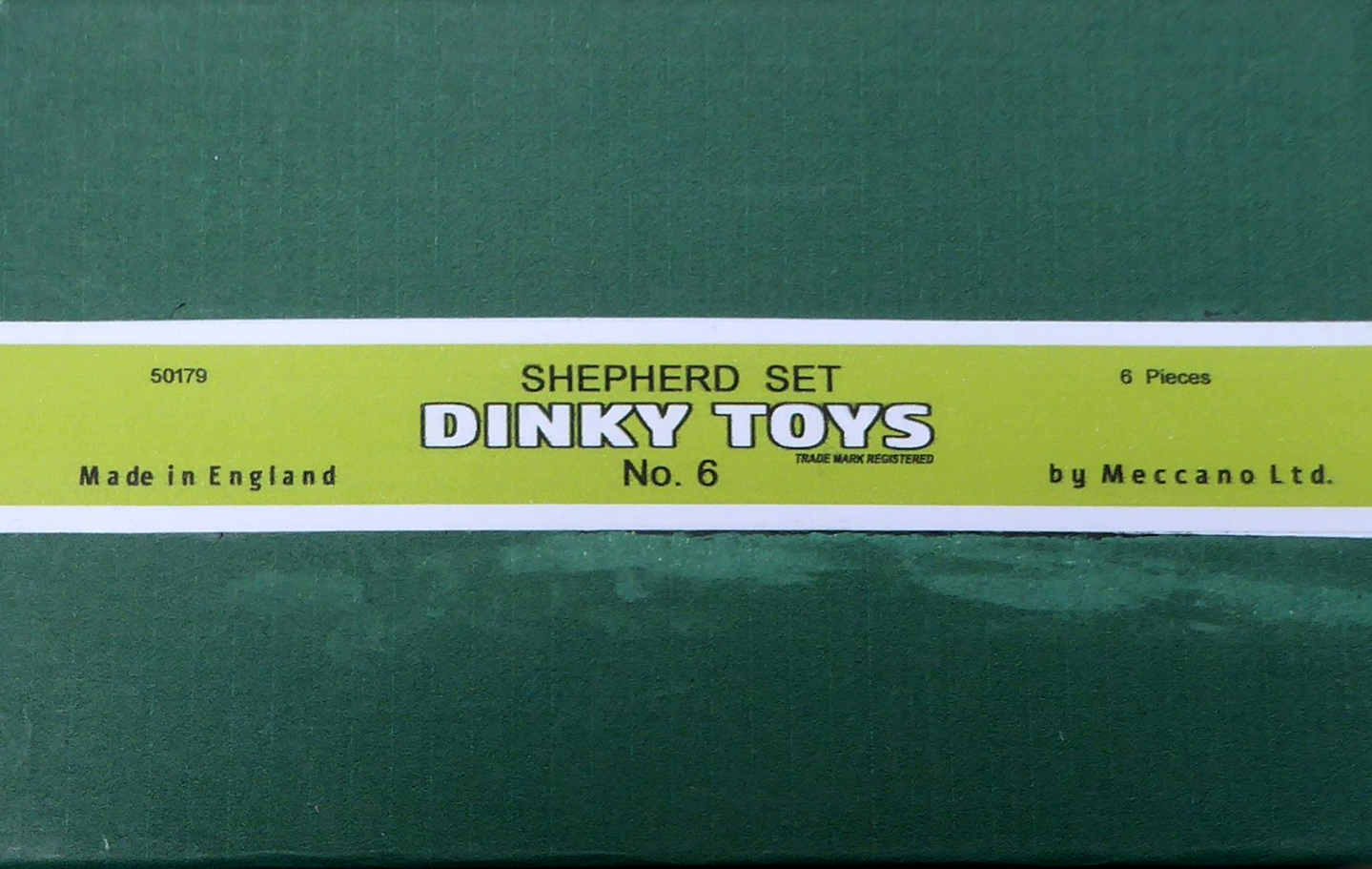
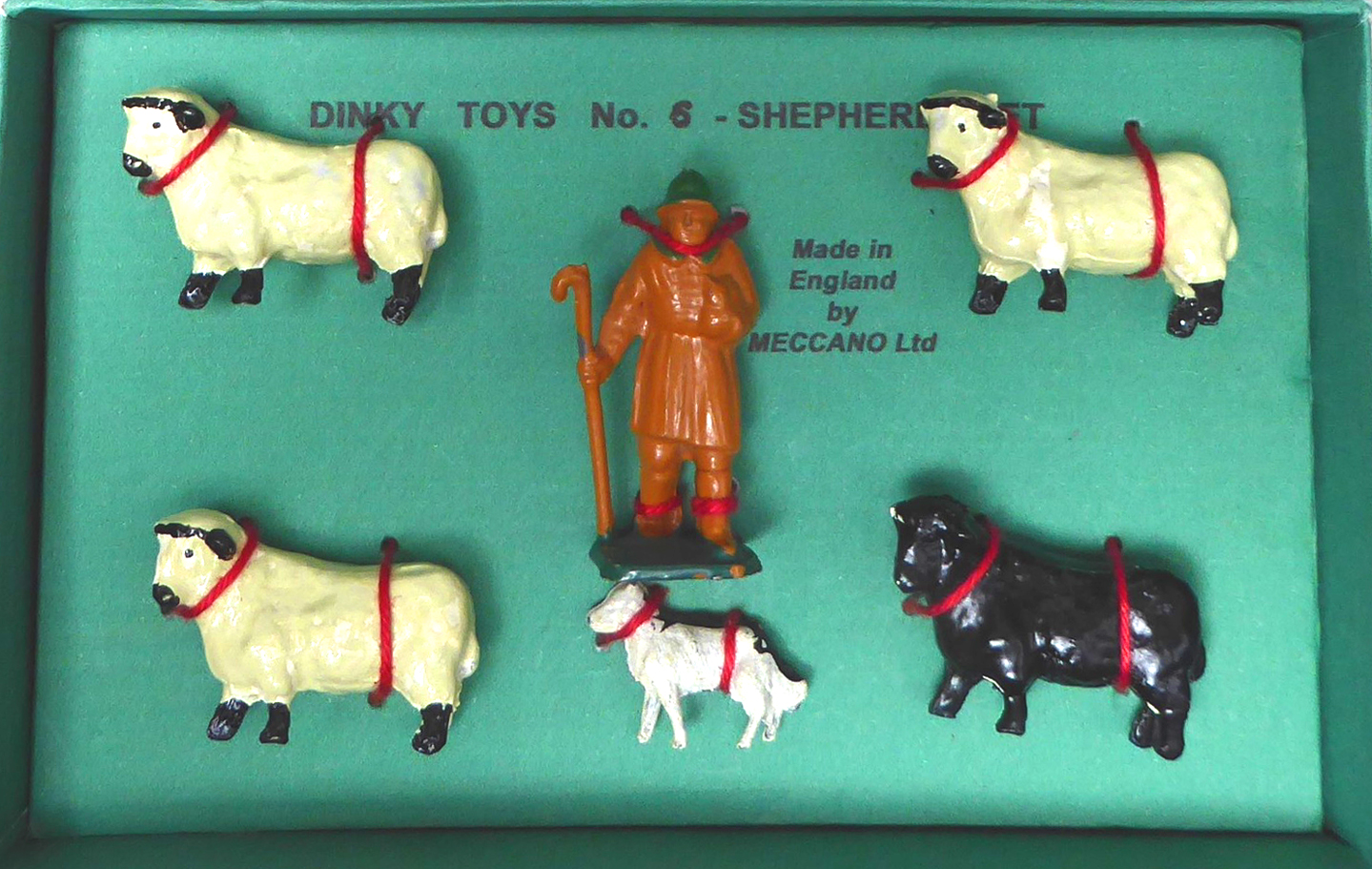
Dinky Toys Shepherd Set No. 6
More pre-Dinky and Hornby Series accessories
In this section, I present some more early pre-Dinky and Hornby Series accessories.
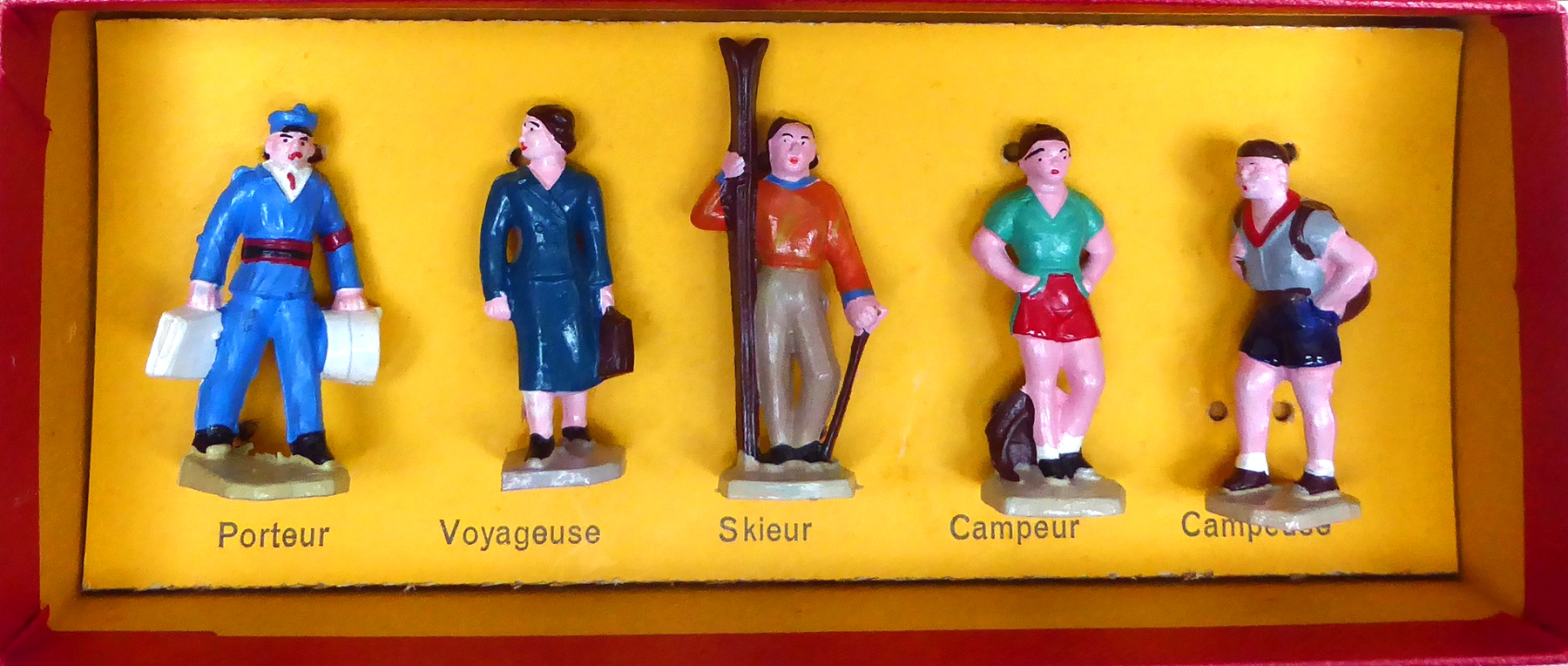
The first example is a French Dinky issue which I believe is from the early 1960s, in which the figures are made of plastic rather than metal.
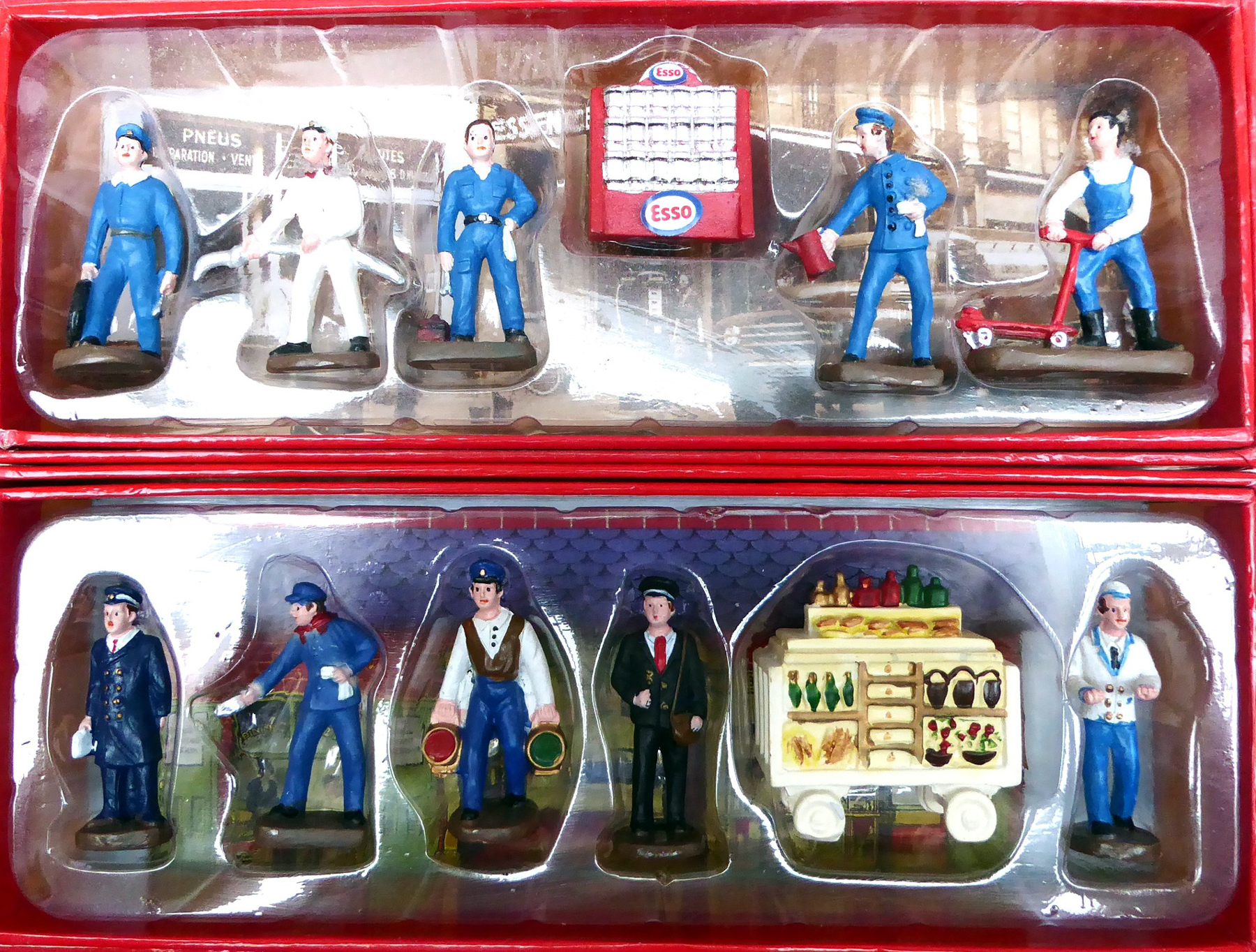
The second example below is of two recent Atlas Editions sets from 2013. These seem to be produced in resin rather than metal or plastic.
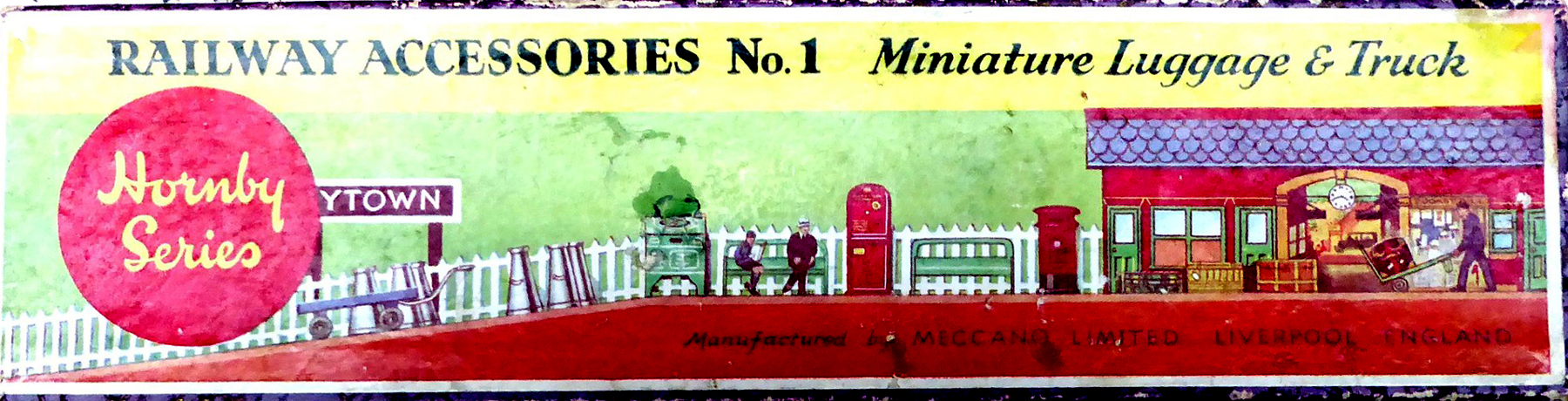
This next example is Railway Accessories Set No. 1 in which all pieces are made of tinplate.
Shown below is Platform Accessories Set No. 3 which was made in 1934 and also made from tinplate.
Here is a picture of the same set made a bit later between 1935 and 1940.
The final image below is of Set No. 5 which I acquired at the Bluebell Railway Collectors Fair in May 2025. It’s missing six of the twelve pieces which I hope to eventually locate.
Dinky Toys road accessories
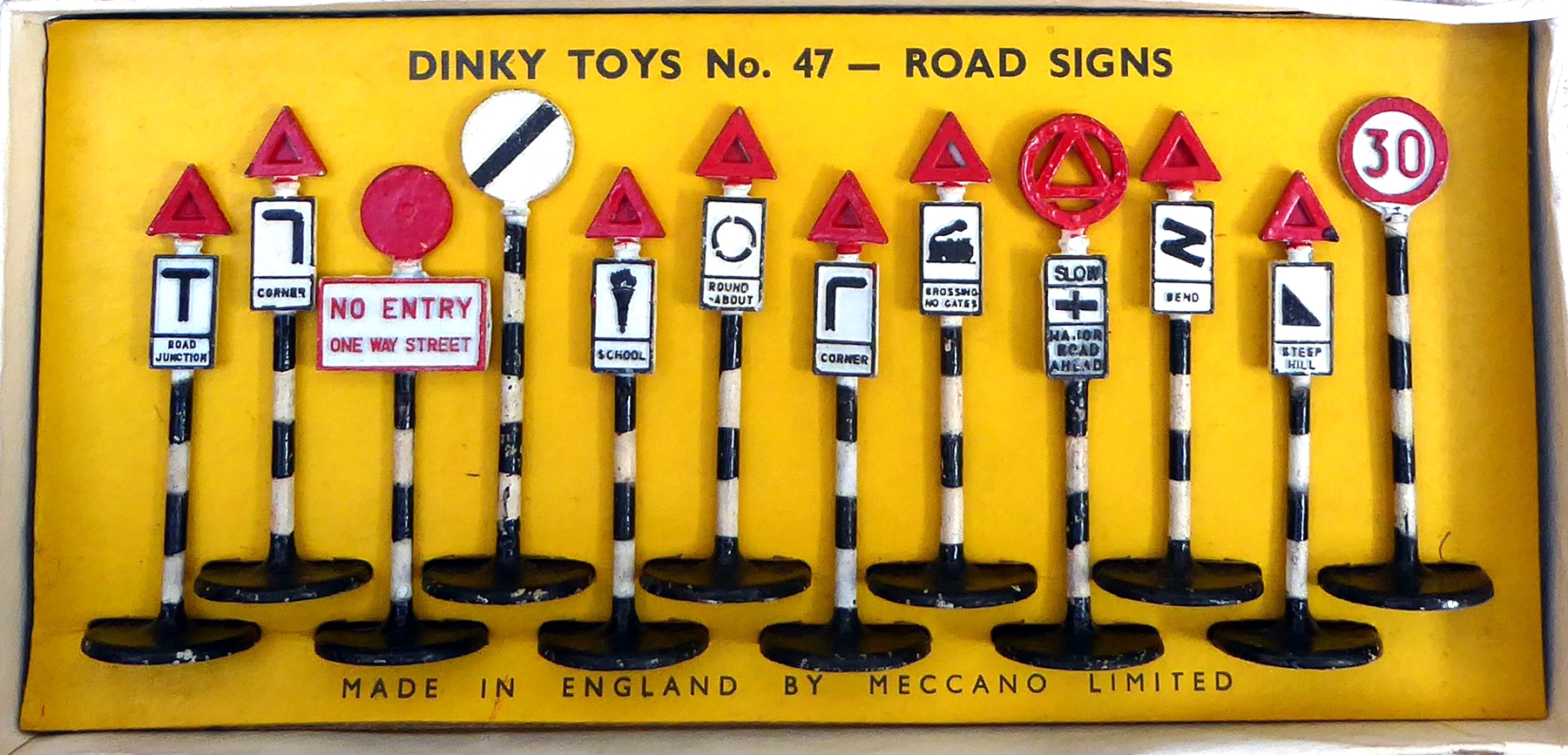
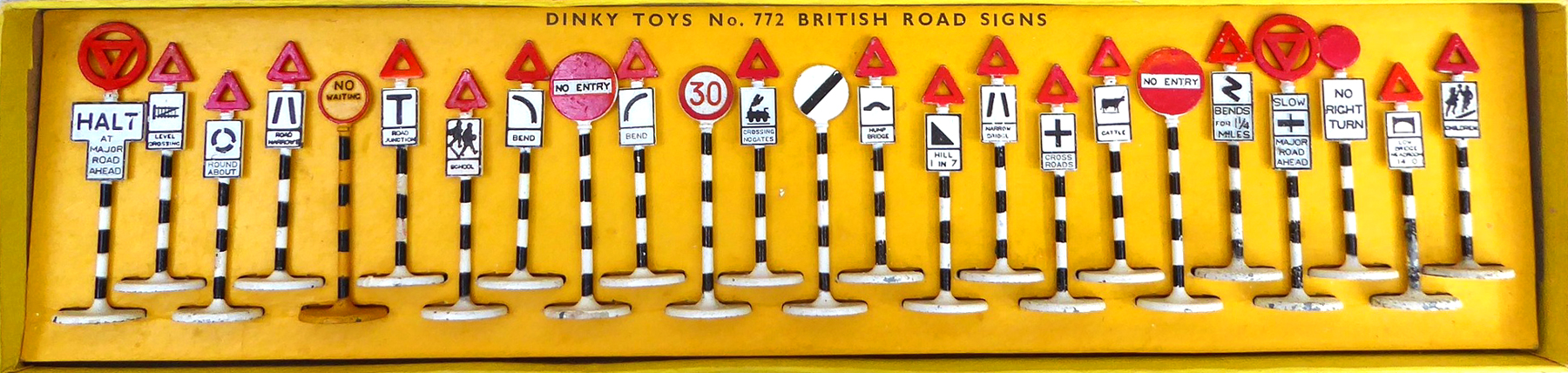
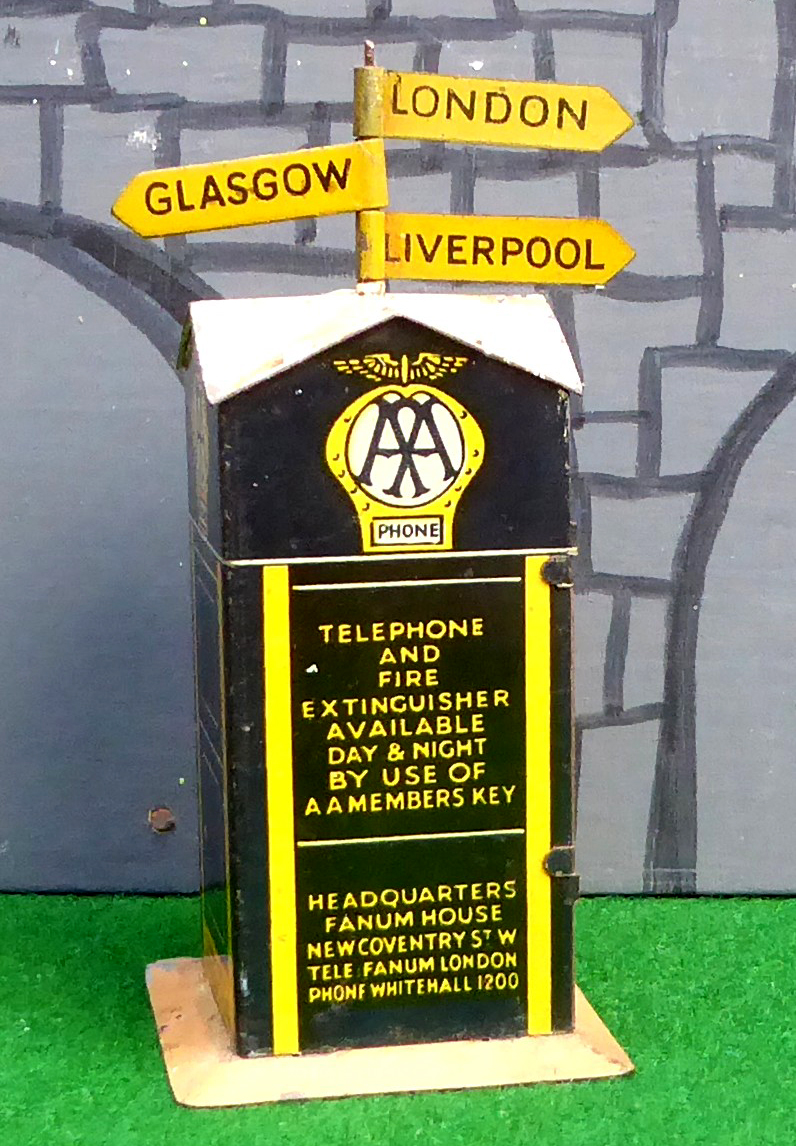
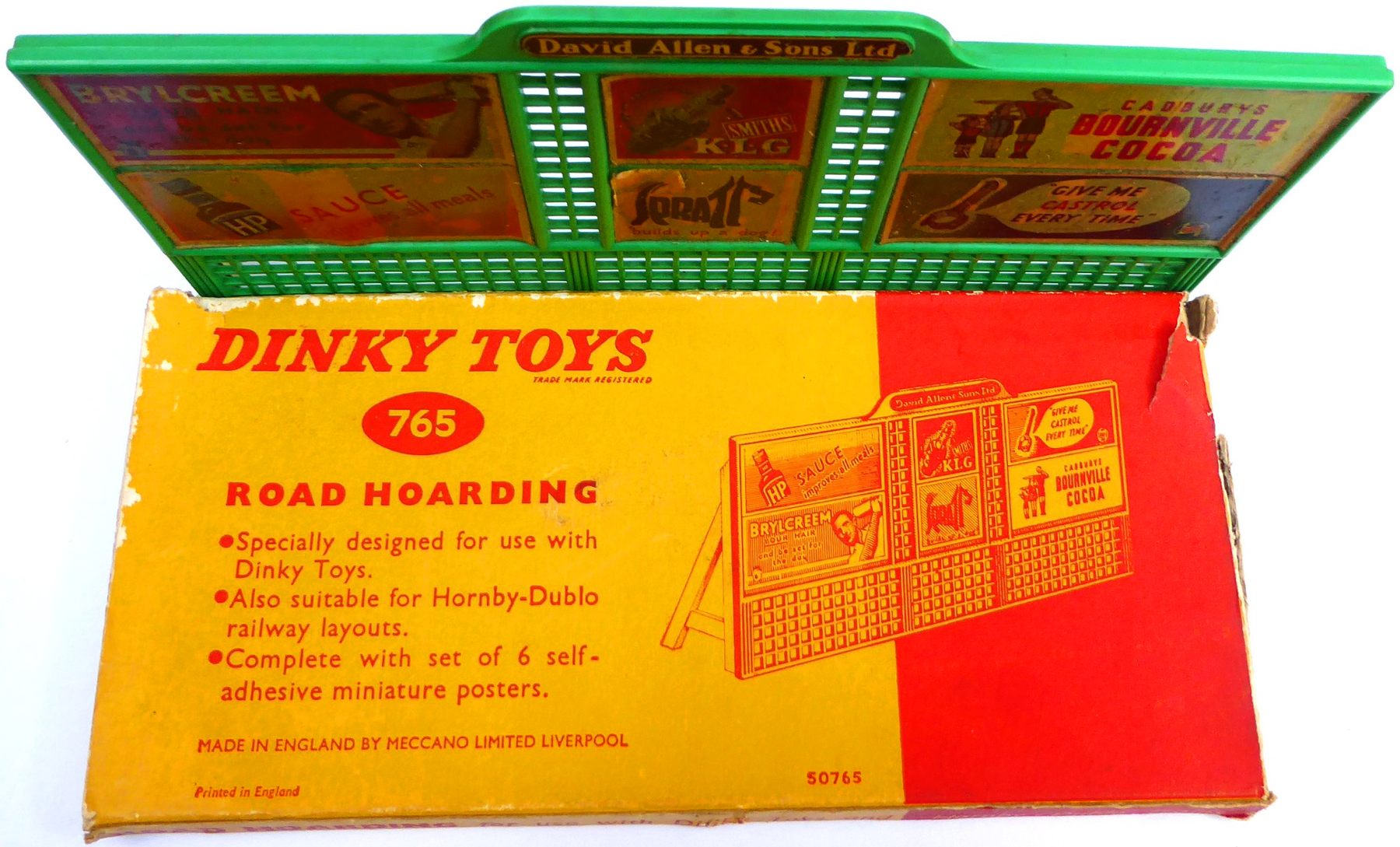
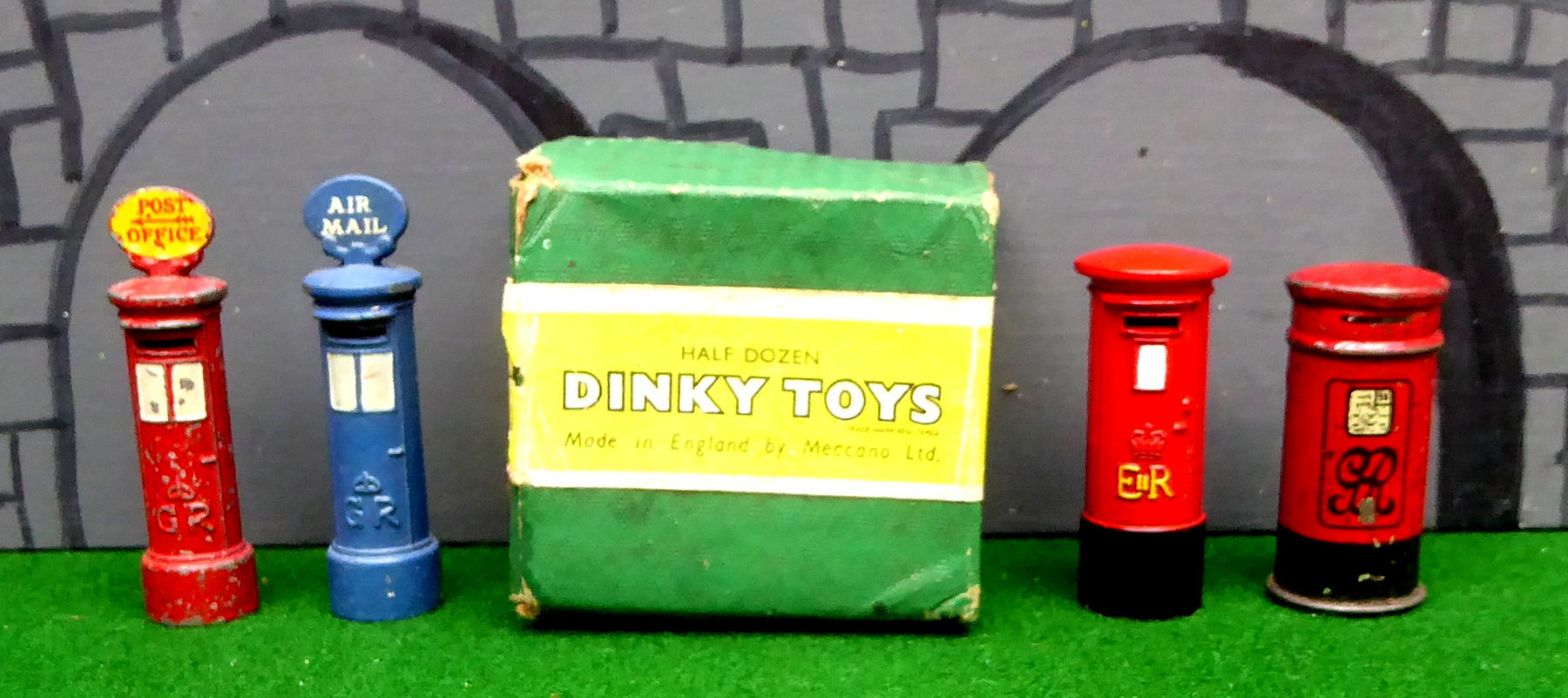
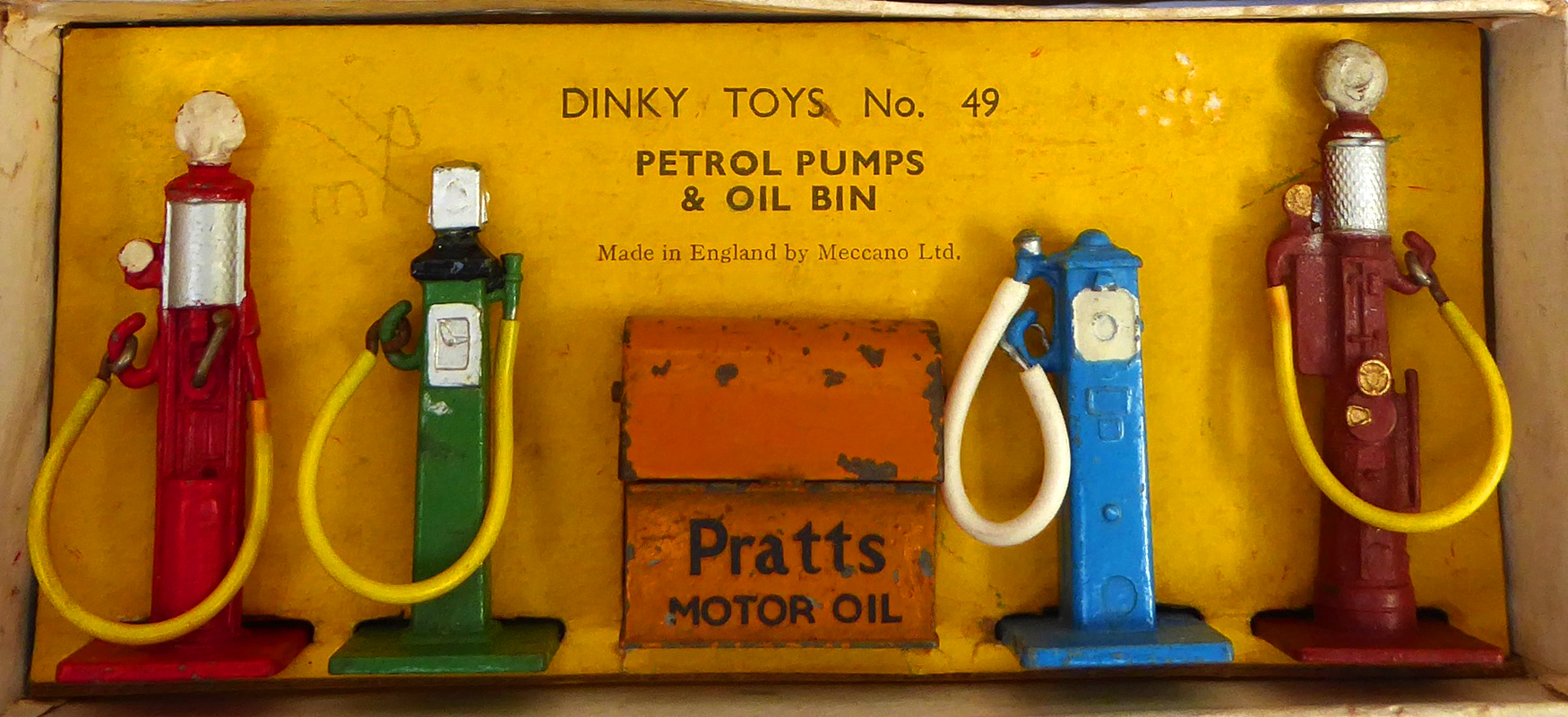
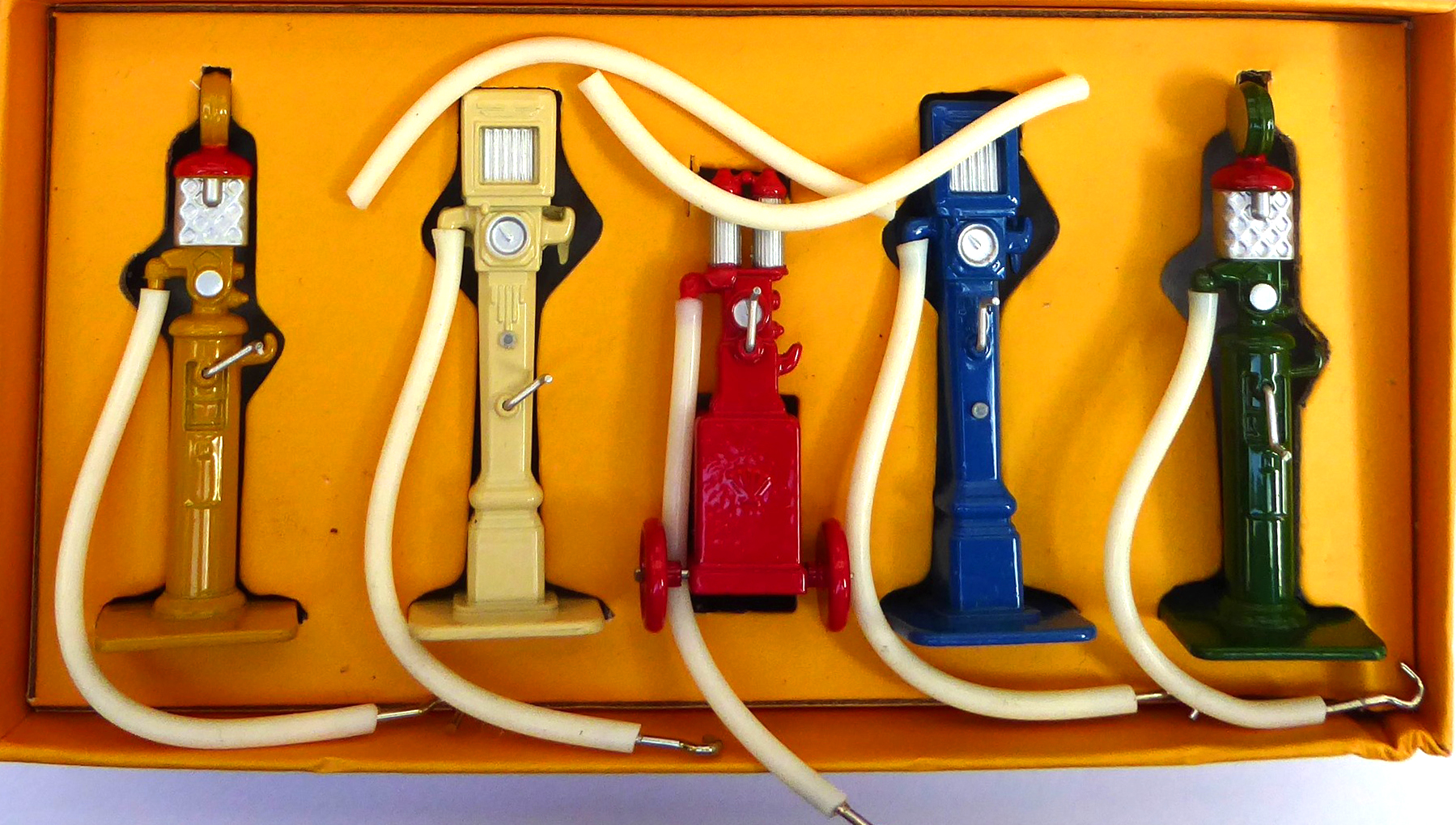
In this final section, I present various road accessory sets that include road signs, hoardings, mailboxes, pavement sections and petrol pumps.
Road signs
Dinky Toys Road Signs Set No. 47
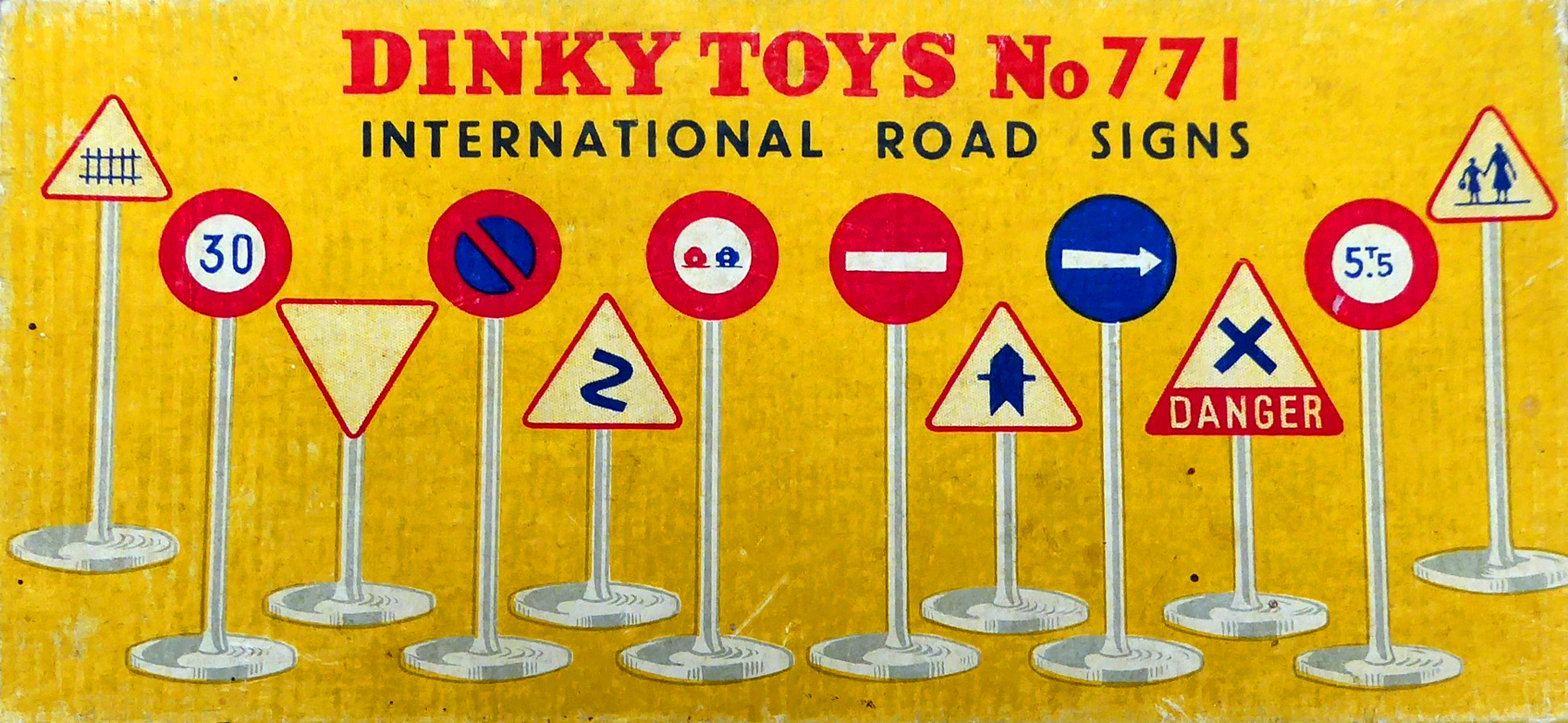
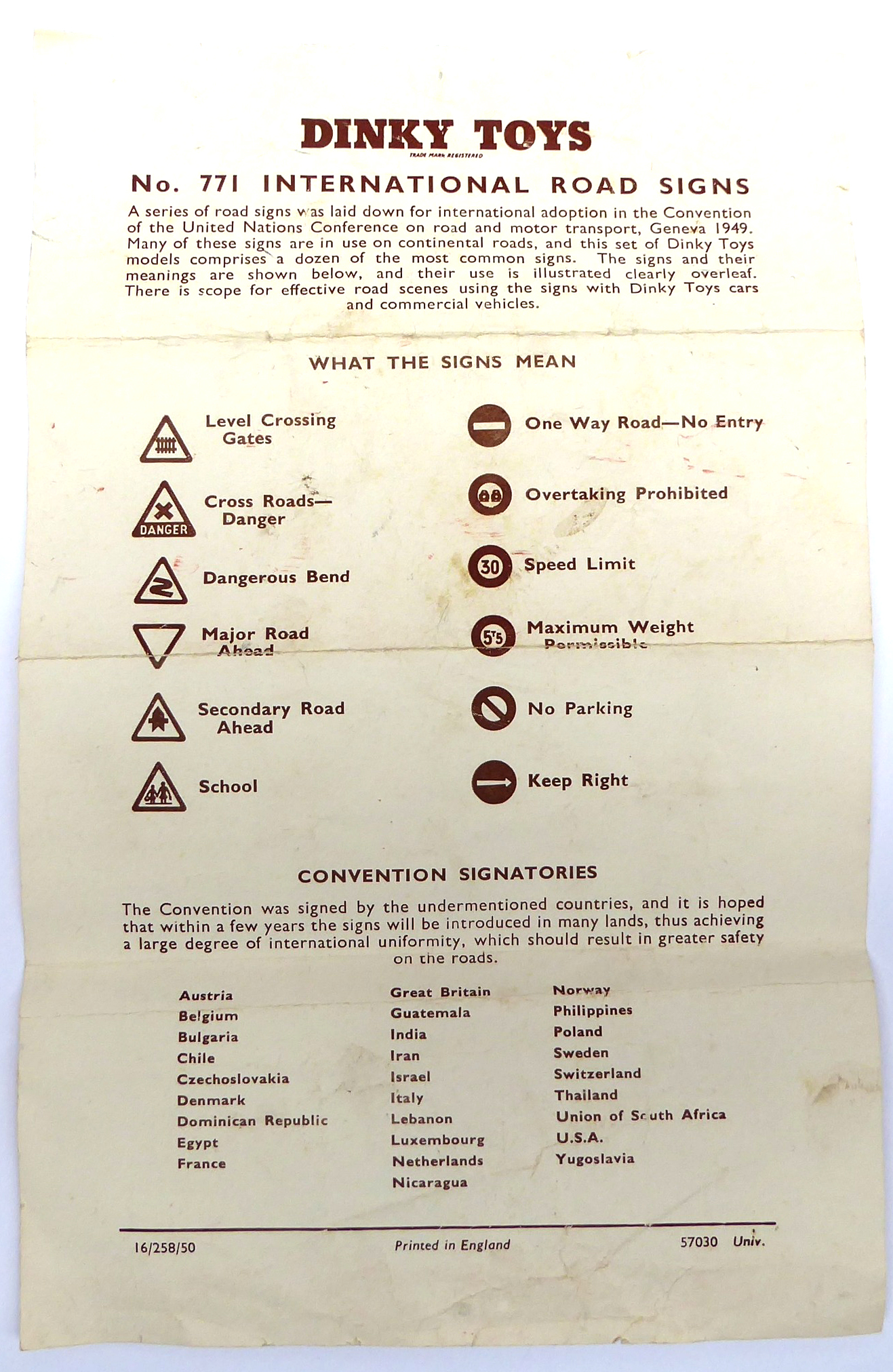
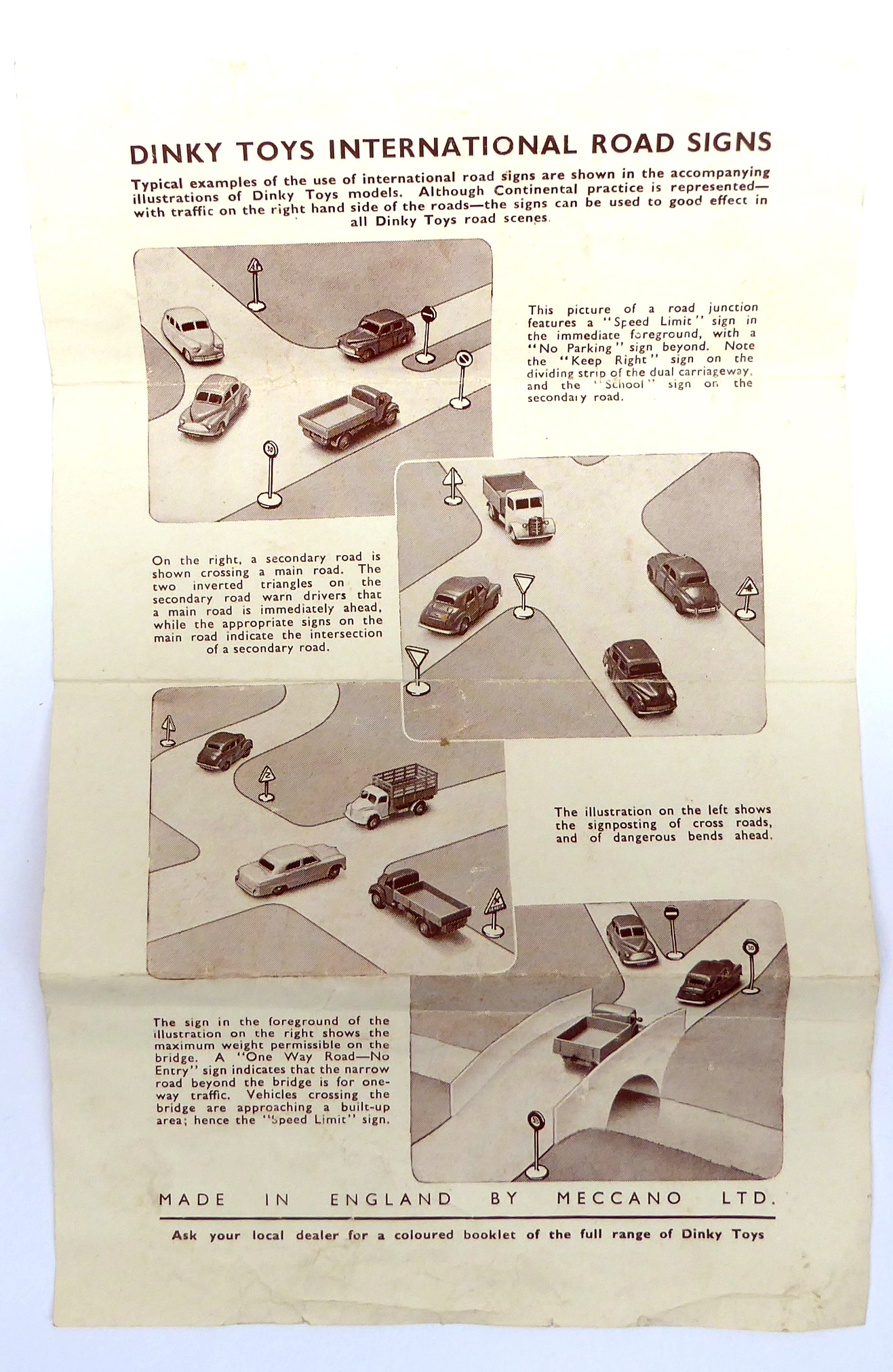
Dinky 771 International Road Signs (1953–1965) with instruction manual
My Dinky 104 Spectrum Pursuit vehicle, or SPV, was purchased for me by my mom around 1975 from either Bloomingdale’s in Hackensack, NJ, which had a lovely toy department, or Five Corners Toy and Gift in Westwood, NJ. My SPV was played with often but had been packed away with the rest of my surviving childhood diecasts since 1986. I dug it out a few years ago.
Like most late-1960s and 1970s Dinky Toys, the Dinky 104 SPV was packed with features that made it a very fun toy. The front hatch fired a missile when the front of the model was pressed down, and the rooftop antenna lowered and raised with a fingertip knob. At the rear were four retractable rubber tank-like treads for extra traction. The operator’s door had a spring release activated by pressing the white button on the roof, revealing a miniature Captain Scarlet driver figure. The designers at Meccano did a very good job modelling the toy after the actual SPV from Gerry Anderson’s hit TV show Captain Scarlet and the Mysterons.
Although this toy survived my childhood somewhat intact and with minimal paint loss, it looked as though it had actually seen heavy combat with Captain Black and the Mysterons. It was missing the rear track assembly, the rooftop antenna was broken, and pieces had fallen inside the model.
The release pin that opened the front hatch to fire the missile was jammed and some of the decals were gone. The white front rubber bumper had split and the Captain Scarlet figure was missing. As a kid, I would take apart some of my screwed-together toys, much to the dismay of my parents. But it was hard to resist, and fun! As a result, mine was also missing one of the screws that held the model together.
I don’t “restore” my old toys, as that involves stripping and repainting, drilling out rivets, and a host of other tasks. Instead, I enjoy refurbishing them, which to me means giving them a thorough cleaning and polishing, and then replacing any broken parts and decals. Luckily, the driver’s door and front missile hatch were intact and fully operational. I still had a few of the original missiles, too. Many Dinky toys from my 1970s childhood era were screwed together, so they are easily disassembled for refurbishing.
Although modern reproductions of the missing parts and decals are currently available, they can be expensive. Almost all have to be sourced from the U.K., so shipping can be very high for these small items, especially when listed on eBay with the dreaded Global Shipping Program. I decided to instead look for a “parts queen” SPV, as there are often many available on eBay, and one preferably sold by a U.S. seller in order to save on shipping. Over a period of a few months, I purchased two for a total of about $30, including shipping.
This pair of “parts queens” donated the front bumper, antenna, and rear track assembly.
My search took a bit longer than expected, as many of these models are fitted with the very incorrect and unattractive black bumper. The actual SPV in the show had a white bumper, as did mine. The two I found provided the antenna, rear track assembly and an intact white front bumper. Using these original play worn models was much cheaper than purchasing reproduction parts, which are often not quite right in terms of fit. I later was able to resell the two parts queens on eBay, recouping almost half of what I paid for them, which was a bonus.
The only new parts I bought from the U.K. were the Captain Scarlet figure and a set of beautifully reproduced pre-cut decals. Luckily, neither seller used the extremely overpriced eBay Global Shipping Program but instead shipped via Royal Mail, and the cost was quite modest.
Refurbishing began by unscrewing the model to separate the upper and lower body pieces. The interior of the lower body was quite dusty and needed a good cleaning. A dry paintbrush and a few blasts of compressed air did the trick. The lower body was then polished, with cleaning around the ten wheels taking the most time.
The upper body received the same treatment, leaving the silver-blue paint with a lovely sheen. Two of the three round Spectrum decals were missing, and the third was peeling off. The old glue had left a hard residue, so this had to be carefully compounded away before new ones could be applied. Two of the three square SPV decals were still quite presentable, so only the front one had to be replaced. Over the years, this decal had slid downward and was jamming the front missile hatch.
It took some research to find high quality pre-cut decals. I’m amazed that in the 21st century, some vendors still sell decals that have to be cut out, which I think is ridiculous. The original 50 year old decals were pre-cut by Meccano’s vendor, so one would think they all would be by now. Instead, some suppliers are printing decal sheets at home and lack the commercial equipment to produce them pre-cut.
The donor SPVs provided a complete and unbroken track assembly with still flexible original tracks, which easily snapped into a slot at the rear. They also provided the antenna that was inserted back into place, and the white rubber bumper which also snapped into position. The rubber tracks were very dirty, as was the bumper, so I soaked them in Dawn dish soap for a few hours. I then gently scrubbed them with a soft toothbrush, and they came out looking new again. The release pin that opens the front hatch when pressure is applied was jammed, so it was freed.
The Captain Scarlet driver figure had long been missing from my model, so a good replacement was sourced from Steve Flowers’ Model Supplies in the UK. This part fits surprisingly well into the hole in the driver’s seat back and was secured with a small dab of Weldbond, a strong non-solvent white glue that won’t attack plastic parts.
The SPV is now fully assembled, cleaned, and looking almost new again, with the tracks, decals, antenna, and bumper all installed.
This was a fun little winter project, and I’m extremely pleased with the result. The finished SPV now looks almost new as if it just came out of the Spectrum workshops, and functions as it should — more than 50 years later. Since its rebirth, the SPV puts a smile on my face every time I see it.
Meccano Liverpool had a good relationship with the Bedford truck company, and many Bedford models were reproduced by Meccano. The January 1960 issue of Meccano Magazine contained an advertisement for the new Dinky Supertoys 930 Bedford Pallet-Jekta Van, a Bedford model that Meccano Liverpool used themselves for transporting their own products. Among other jobs, it was used for transporting castings from the Meccano Speke factory at Edward’s Lane near Liverpool’s airport to the original Meccano factory at Binns Road, a distance of about 5.3 miles (8.5 km), or 17 minutes by car.
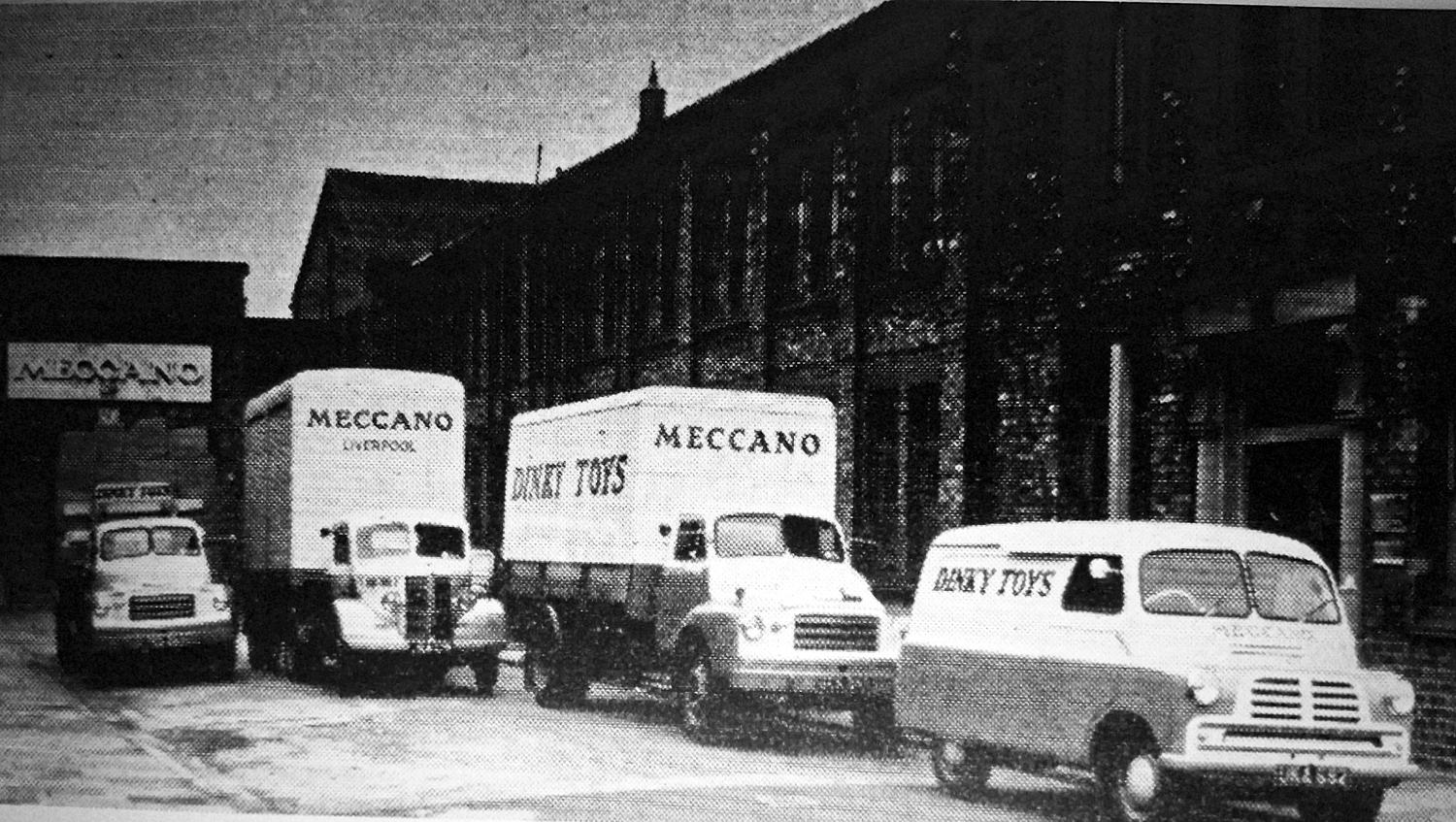
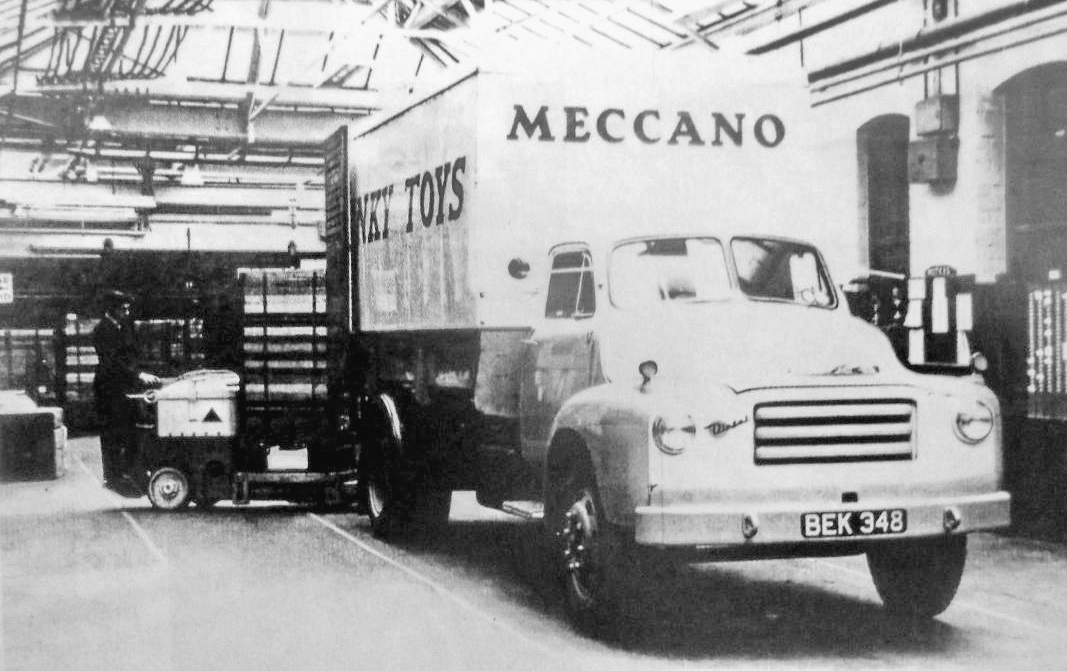
While searching for a photograph of the real Bedford Pallet Jekta Van, I came across this picture in a Facebook group for truck drivers that I hadn’t seen before. A fleet of Meccano Limited Bedford trucks are parked at the entrance of the Meccano factory on Binns Road in Liverpool. This picture reflects the glory days of Meccano Liverpool.
A fleet of Bedford “Meccano Dinky Toys” trucks and vans parked at the entrance of the Meccano factory at Binns Road in Liverpool. Image: Facebook
All the vehicles sport Meccano and Dinky Toys logos. I was pleasantly surprised to see a Bedford CA Van with the Dinky Toys logo, because its existence was doubted. I find it remarkable that these four different types of Bedford trucks were parked together at the Meccano factory entrance. Perhaps the photograph was commissioned by Meccano Limited. Unfortunately, there was no text accompanying the image.
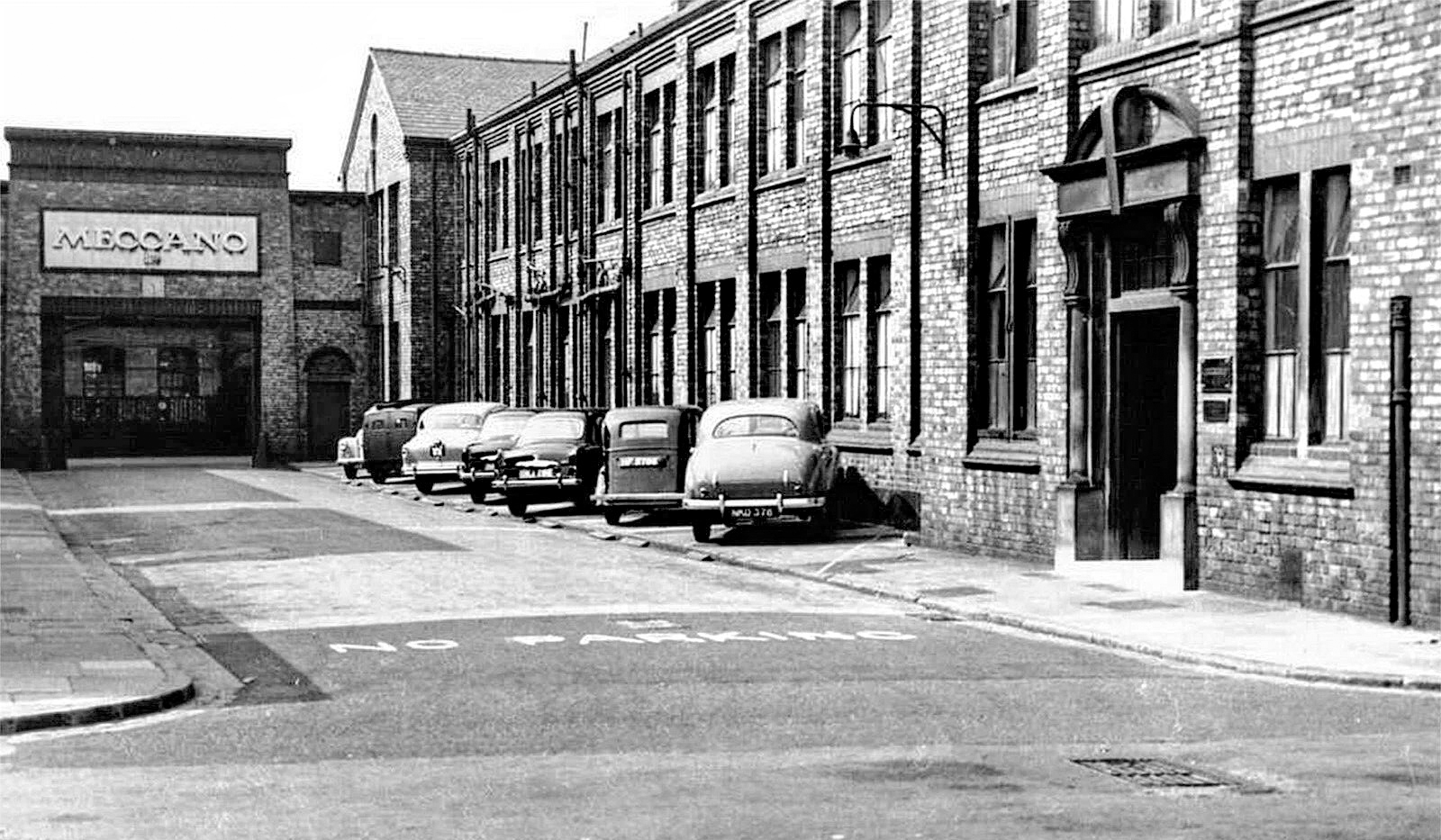
The Bedford CA Van at the front with the Dinky Toys logo was reproduced by Meccano Liverpool in 1956 as model 482. Behind it is the Bedford TA Pallet Jekta Van. The third vehicle is a Bedford O truck with a covered cargo bed and the Meccano Liverpool logo on the front. It looks as if the left side of the cargo bed is open and covered with a tarpaulin. The fourth vehicle is a Bedford TA articulated lorry loaded with parcels. This photograph must have been taken around the mid 1950’s, perhaps by the driver of one of these trucks. The door on the right of the building is the main entrance to the office of Meccano Limited. A clearer picture of the same location is shown below.
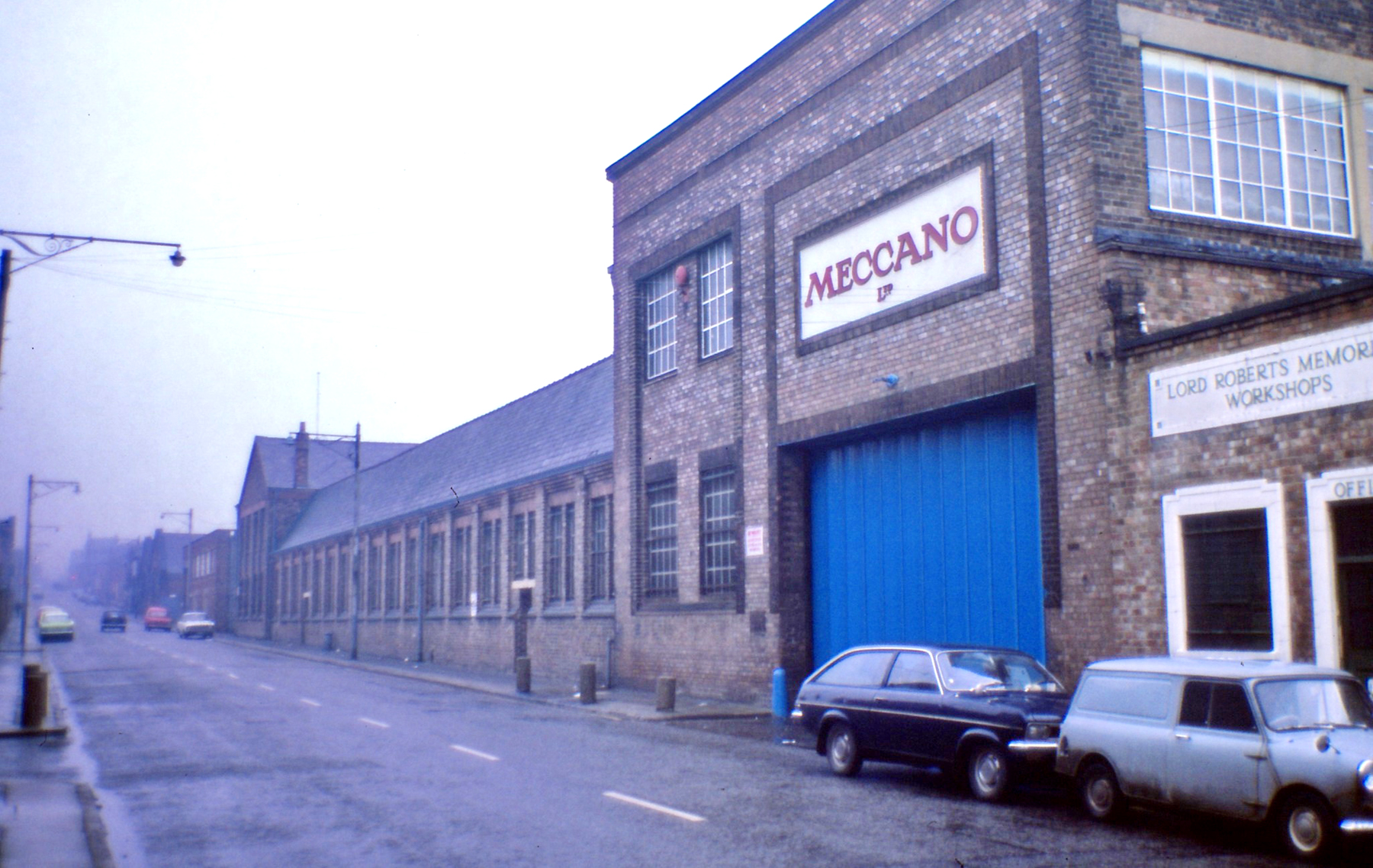
The Meccano factory at Binns Road, Liverpool. The door on the right is the main entrance to the office.
The Meccano factory at Binns Road in 1978. The blue door under the “MECCANO Ltd.” marquee is the truck entrance. Image: Facebook
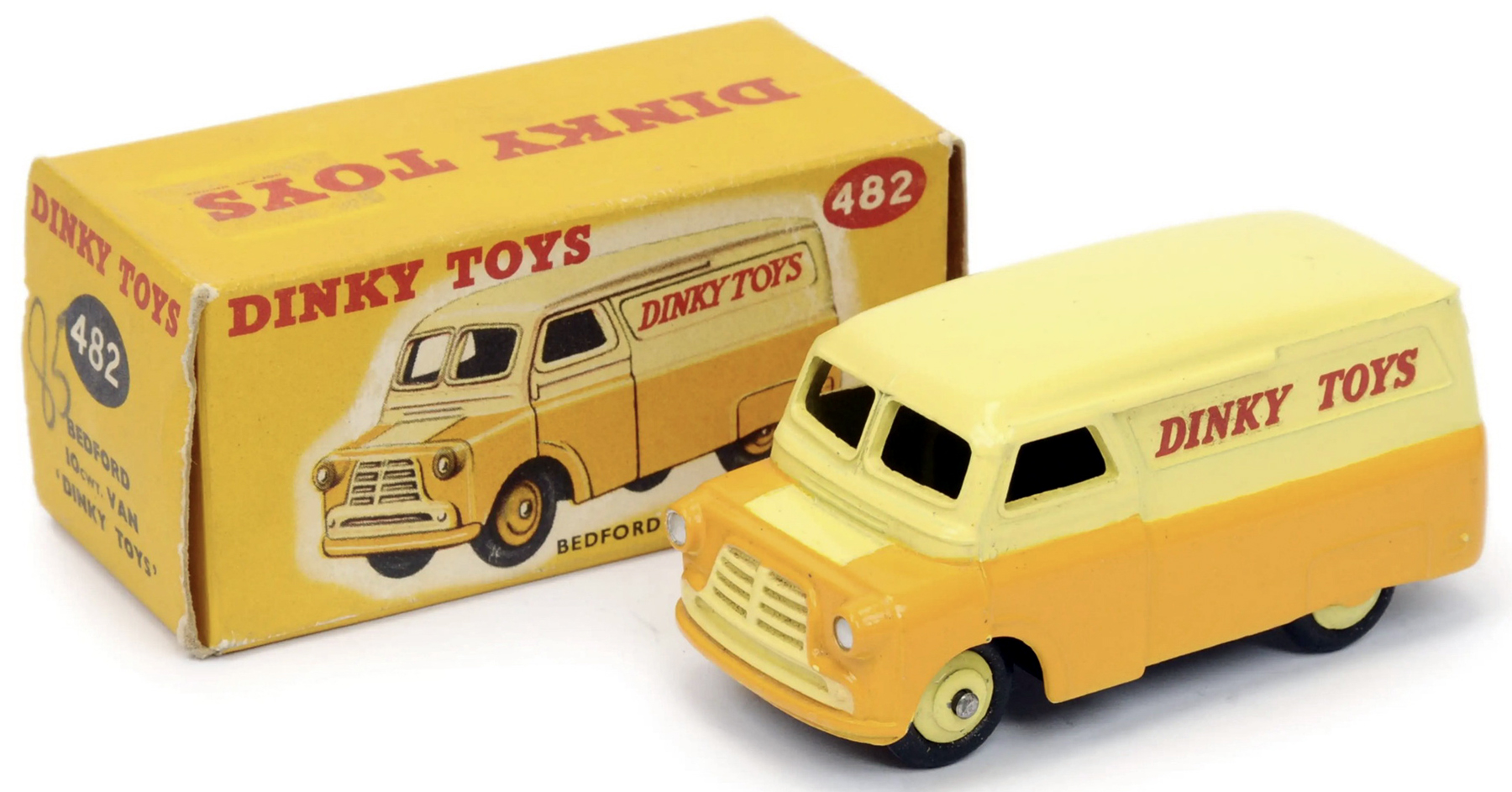
The Dinky 482 Bedford 10 cwt. Van “Dinky Toys” model that was produced between 1956 and 1960. Image: Vectis Auctions
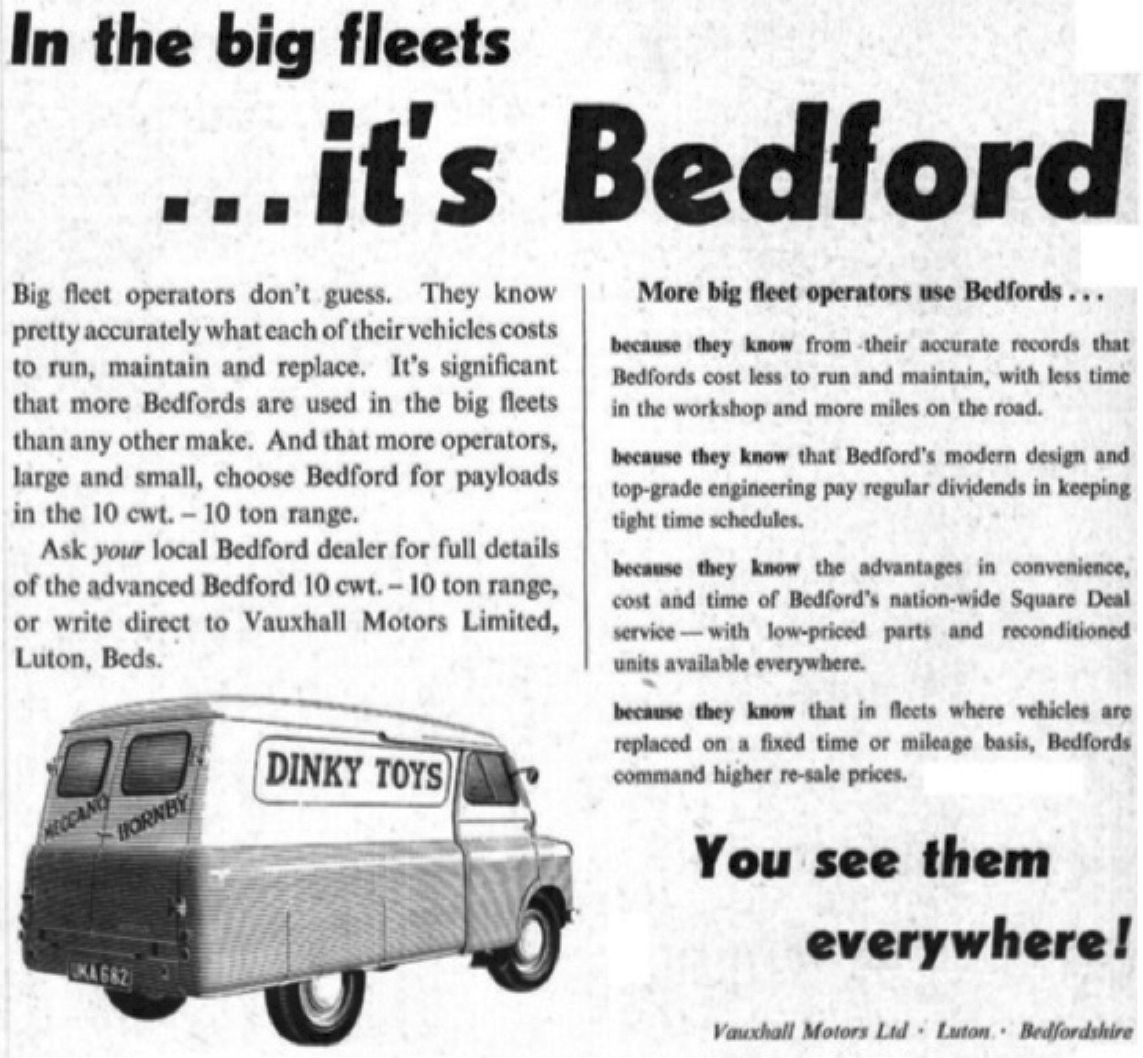
An advertisement for the Bedford CA “Dinky Toys” model in the July 1956 issue of The Commercial Motor. Image: vauxpedianet
Shown above is the Dinky Supertoys 930 Bedford Pallet-Jekta Van with its beautiful Meccano and Dinky Toys advertising transfers on the closed cargo bed in red and outlined in black. The loading bed of the real Bedford Van was equipped with a movable platform, the so-called Pallet-Jekta movable floor, to speed up loading and unloading. This was reproduced in the Dinky model.
This is the second reproduction of a Bedford Van that was put into service by Meccano Liverpool. The first was the Dinky 482 Bedford 10 cwt. Van “Dinky Toys” released in 1956 and superseded by the Dinky Supertoys 930 Bedford Pallet-Jekta Van in January 1960.
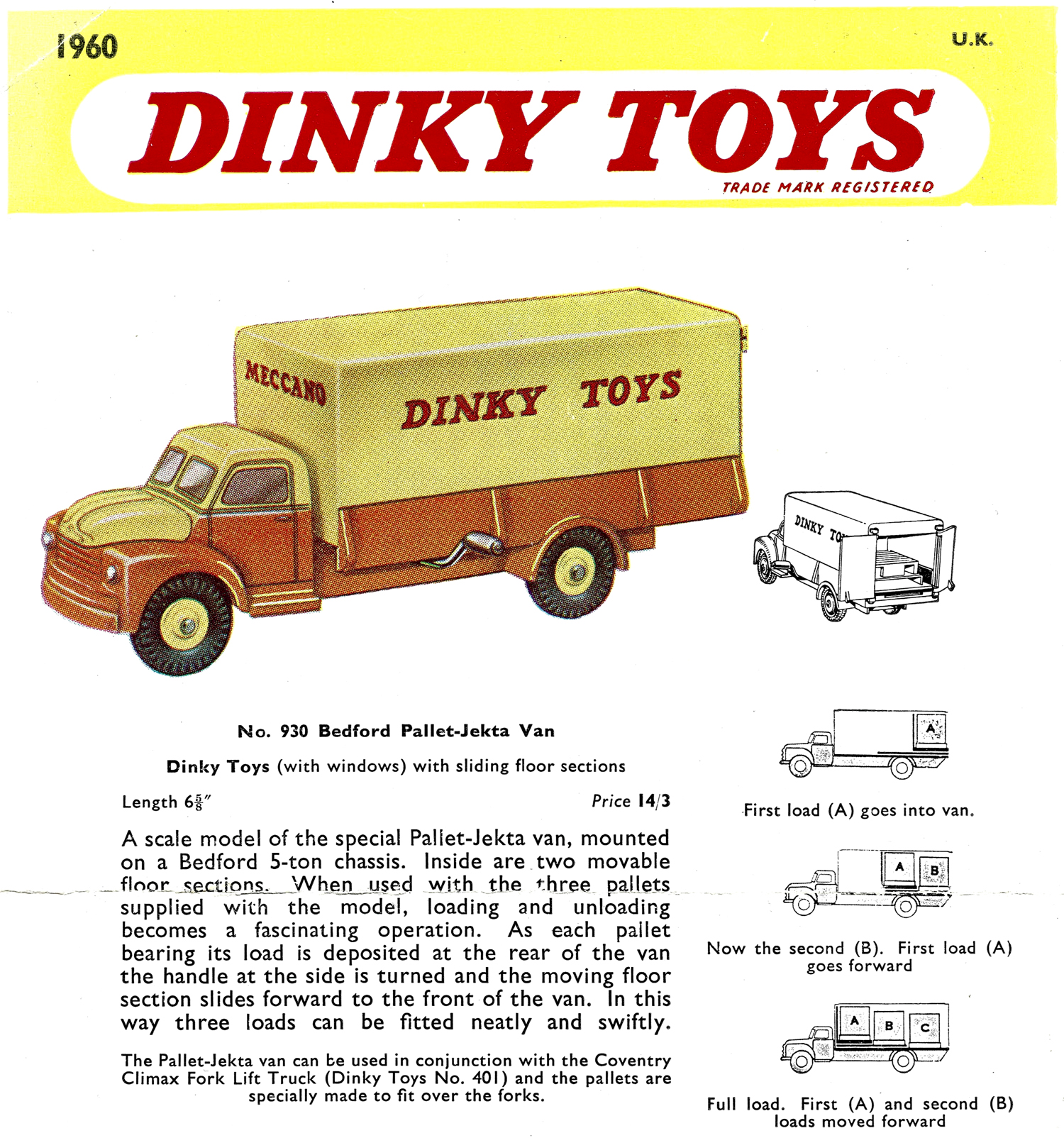
The Dinky Supertoys 930 Bedford Pallet-Jekta Van was advertised in the January 1960 issue of Meccano Magazine as shown above. On the right is part of the article by Toyman describing the new model.
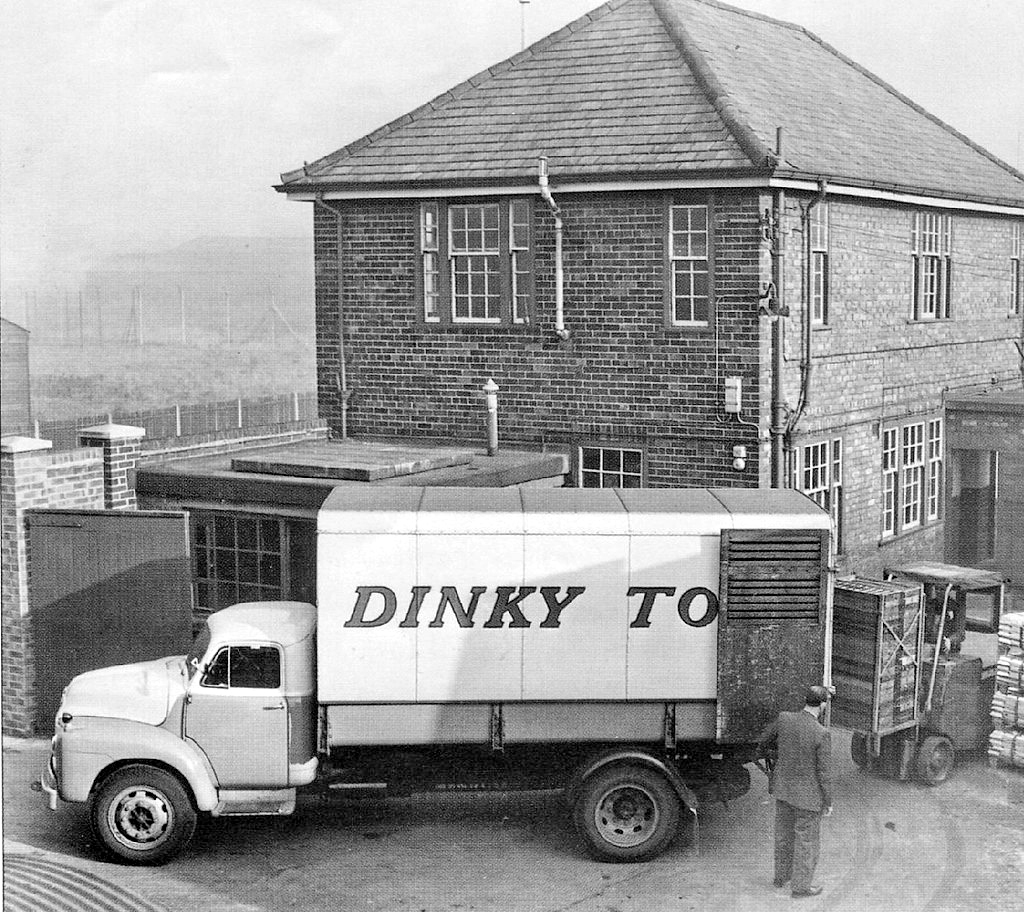
Loading the Meccano Bedford TA Jekta Van with a fork lift truck at the Speke factory. Image: Flickr
The Dinky Supertoys 930 Bedford Pallet-Jekta Van is an attractive model with lots of play value. The enclosed cargo bed has two rear doors that open to the sides, and an ingenious sliding platform is built into the loading bed, which can be moved back and forth using a turn handle on the left side of the bed. The turn handle can divide the bed into three platforms, as shown in the 1960 Dinky Toys (UK) leaflet below. The model is equipped with three pallets that can be lifted onto the platform by the Coventry Climax Fork Lift Truck.
A page from the 1960 Dinky Toys (UK) leaflet showing how to work the loading platform of the Dinky Supertoys 930 Bedford Pallet-Jekta Van.
Bedford trucks
Bedford Vehicles, abbreviated as Bedford, was a British commercial vehicle manufacturer that operated from 1930 to 1986. The company belonged to the British company Vauxhall, which itself had been part of American General Motors since 1925. Bedford was one of the larger international manufacturers of light, medium, and heavy-duty trucks and vans. For several years, it was the most profitable company within General Motors Europe.
English Bedfords were mostly produced at the parent company Vauxhall’s factories in Luton, Bedfordshire, in the UK, where production began in the 1930s and continued until the marque’s demise, with the last vehicles (such as the Midi/Seta) produced until 1994.
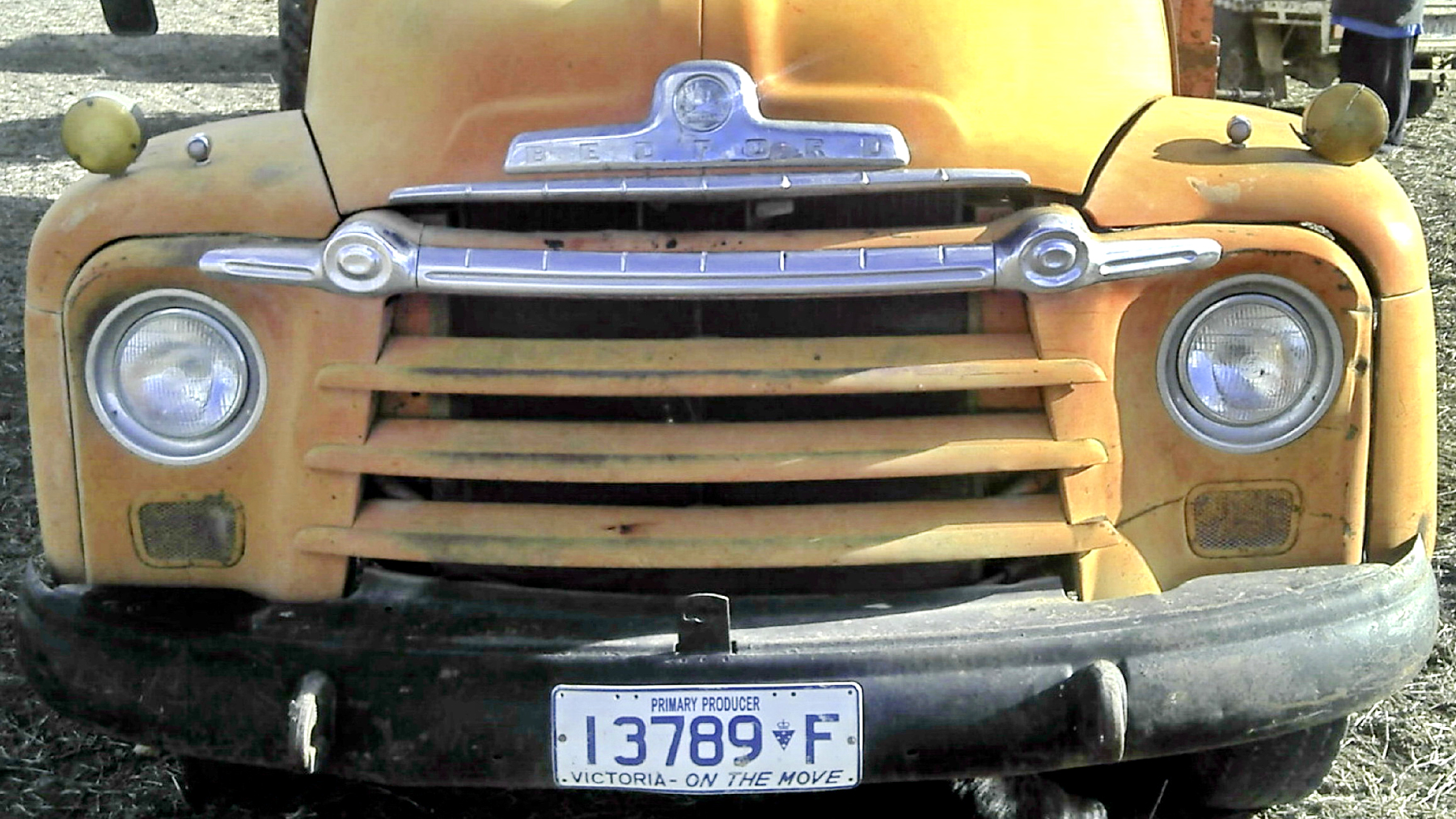
1958 Bedford truck D series front with Bedford hood emblem and Victoria (Australia) registration plate. The Bedford D‑Series was one of many Bedford models produced by Holden in Australia, where the brand had a very strong market share. Image: Flickr
Bedford trucks used by Meccano Liverpool
In post 21 of the DTCA forum topic “Meccano Ltd, Binns Road, Miscellaneous”, user Fodenway posted a nice overview of transport vehicles that were placed in service by Meccano Liverpool. Five different vehicles are described and depicted with Meccano Dinky Toys logos on them. In this article I show some of them that most closely match a Dinky model.
Bedford truck at the Meccano factory in Liverpool. Image: DTCA (Fodenway)
Shown above is a Bedford truck at the Meccano factory in Liverpool. This is the earlier Bedford TA model, manufactured from 1953 to 1957. The loading bed of this truck was equipped with a movable Jekta platform to speed up loading and unloading, which is why it was called the Bedford Jekta.
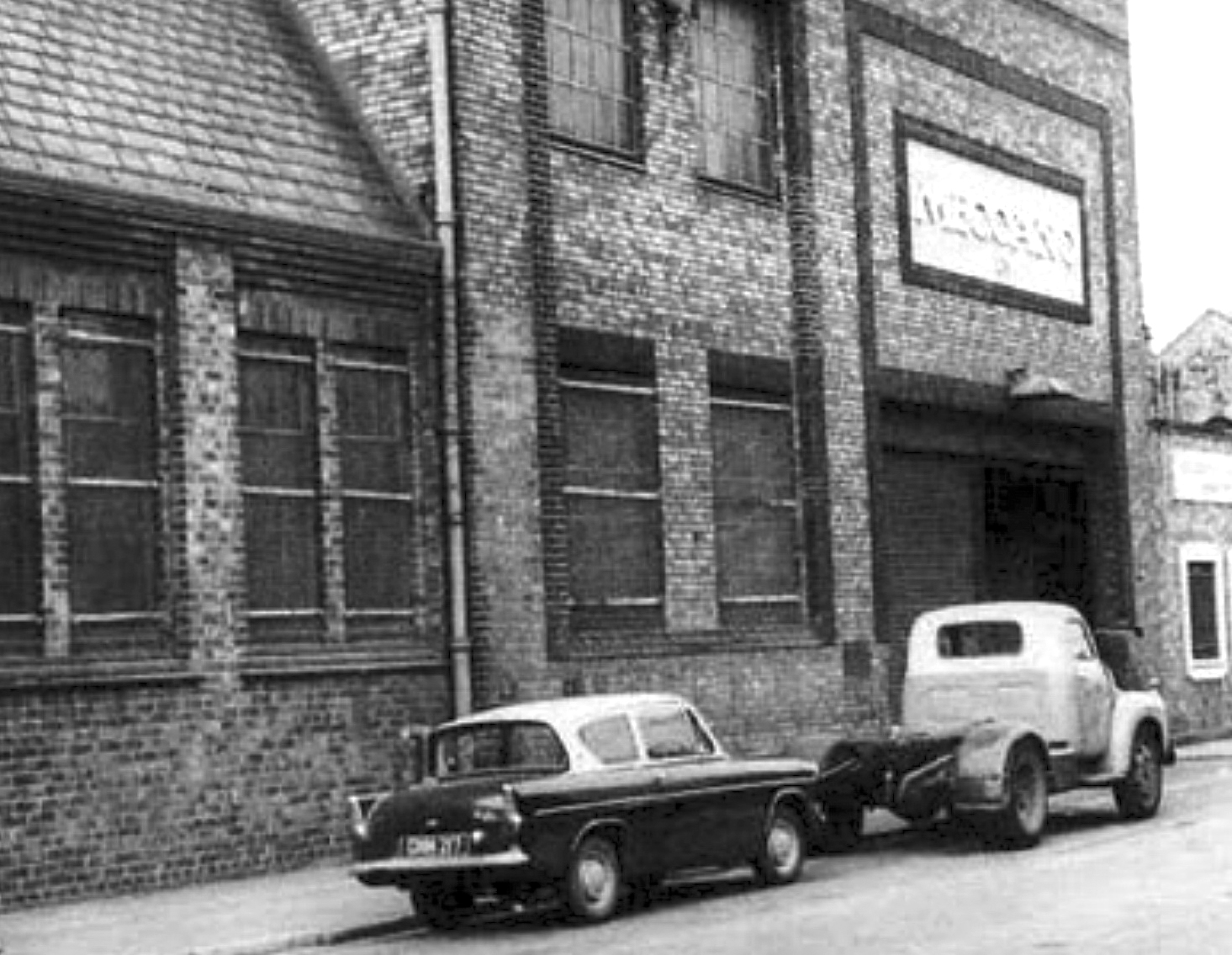
L: Bedford Tractor unit — Image: alansmeccano.org R: Bedford Tractor unit (TD) — Image: DTCA Fodenway
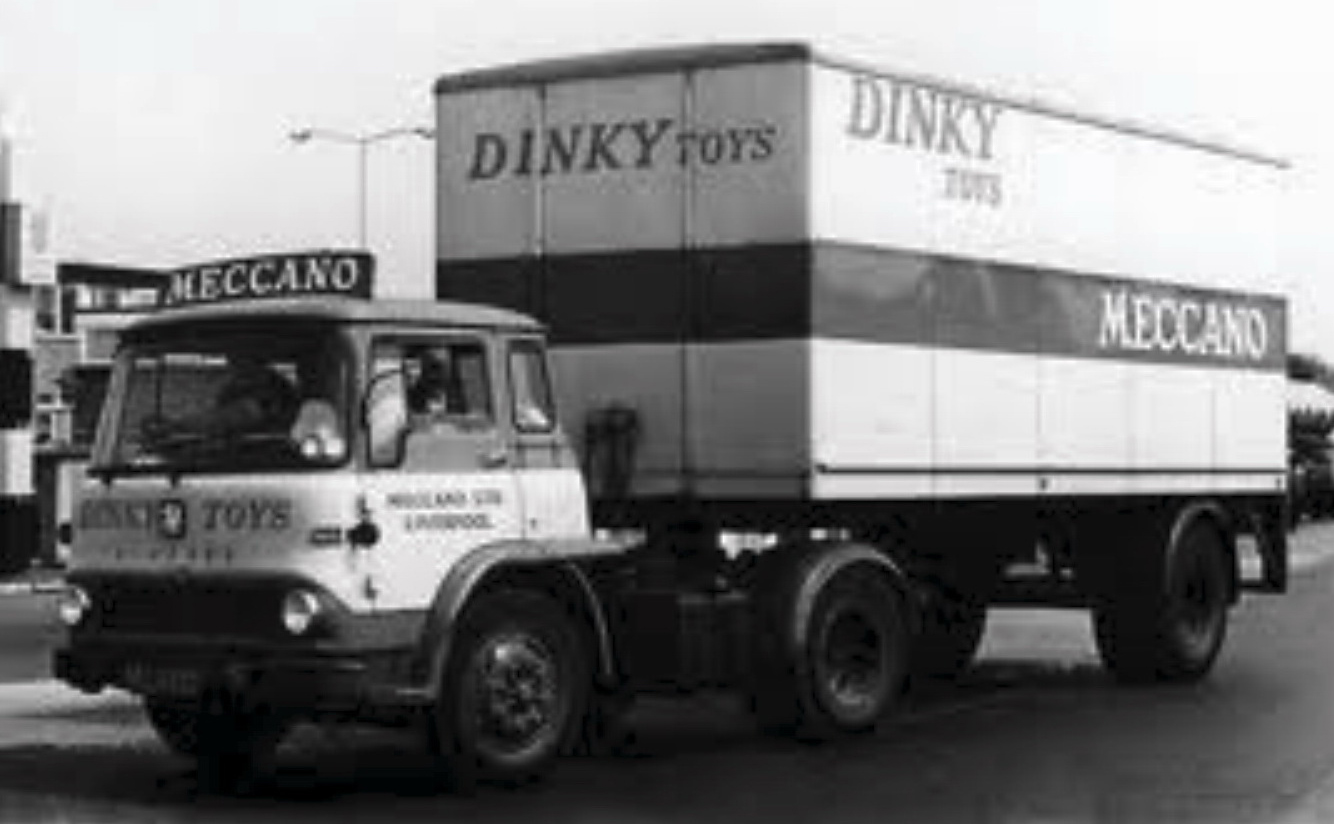
The picture on the left is of a Bedford Tractor unit with a semi trailer at the Meccano factory in Liverpool. This is the later type Bedford TD that was produced during 1957 and 1958, and has the same cab as the Dinky Supertoys 930 Bedford Pallet-Jekta Van. Note the “Diesel” designation under the left headlight, and “Meccano Ltd. Liverpool” that adorns the left door. The image on the right shows a Bedford Tractor unit (TD series) parked outside the Meccano Factory, in front of a British Ford Anglia.
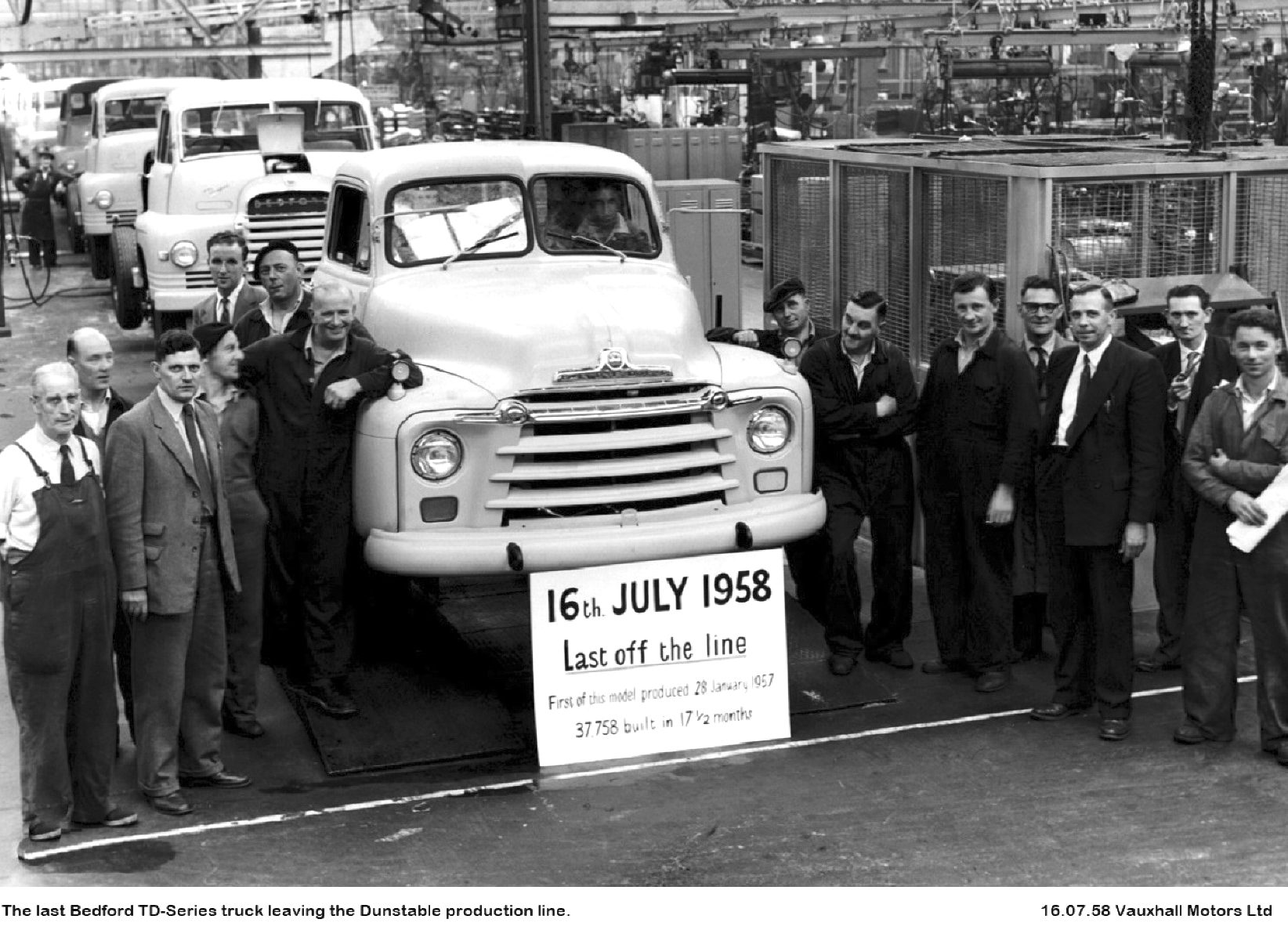
The advertisement in the January 1960 issue of Meccano Magazine indicates the Bedford Jekta Van is based on a 5‑ton Bedford chassis. This mention, along with the picture of the front of the Dinky Supertoys 930 Bedford Van, corresponds to the Bedford TD truck model of which I found a factory photo. These trucks were produced at the Dunstable factory during 1957 and 1958.
The last Bedford TD series truck, which left the Dunstable production line on 16 July 1958. The front of this truck is identical to that of the Bedford tractor unit from the Meccano factory pictured above and the Dinky Supertoys 930 Bedford Pallet-Jekta Van, pictured below. Image: vauxpedianet
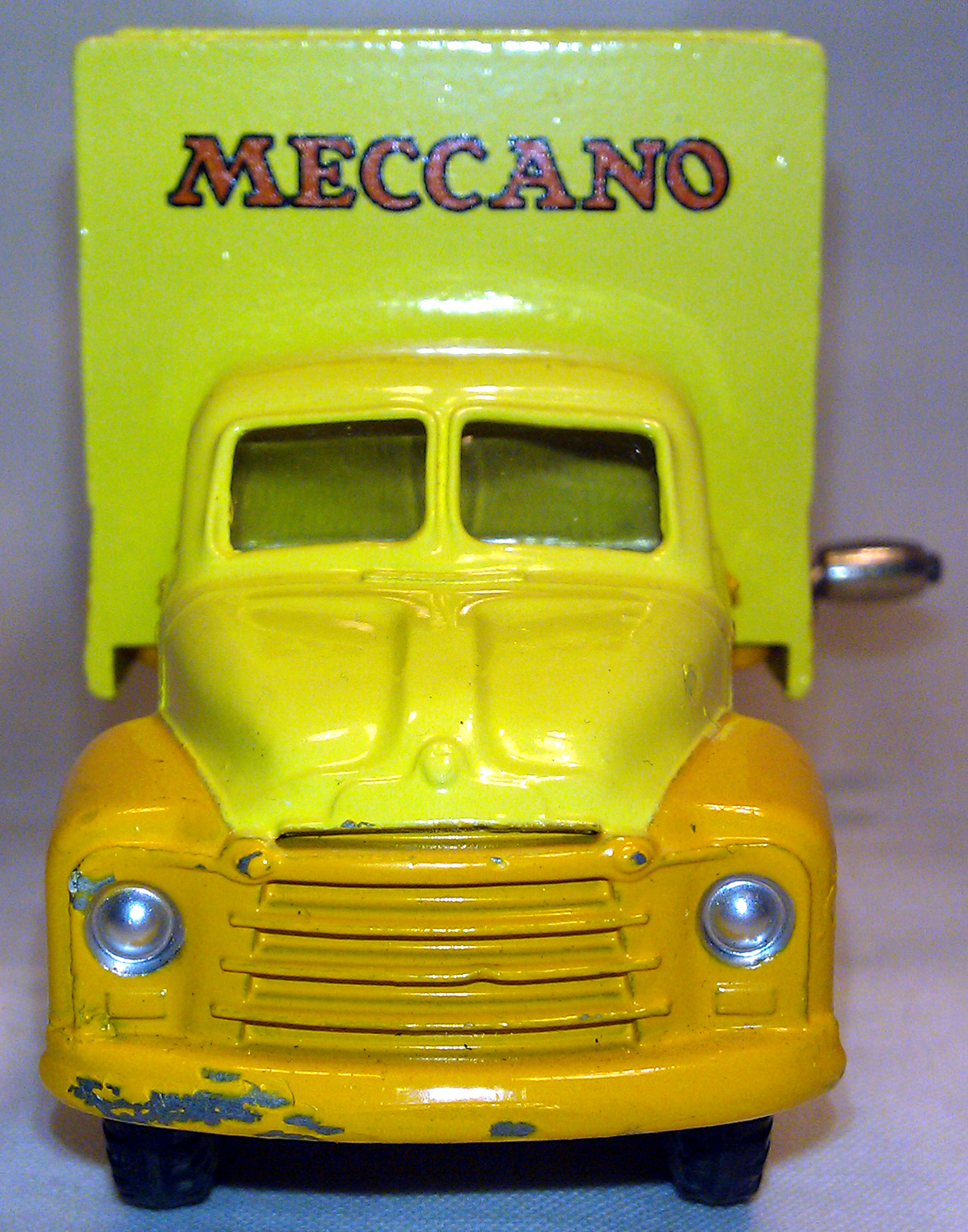
Here is a front view of the Dinky Supertoys 930 Bedford Van with “Meccano” advertising on the front of the closed cargo bed. This 930 Bedford Van is similar to the Bedford TD shown above.
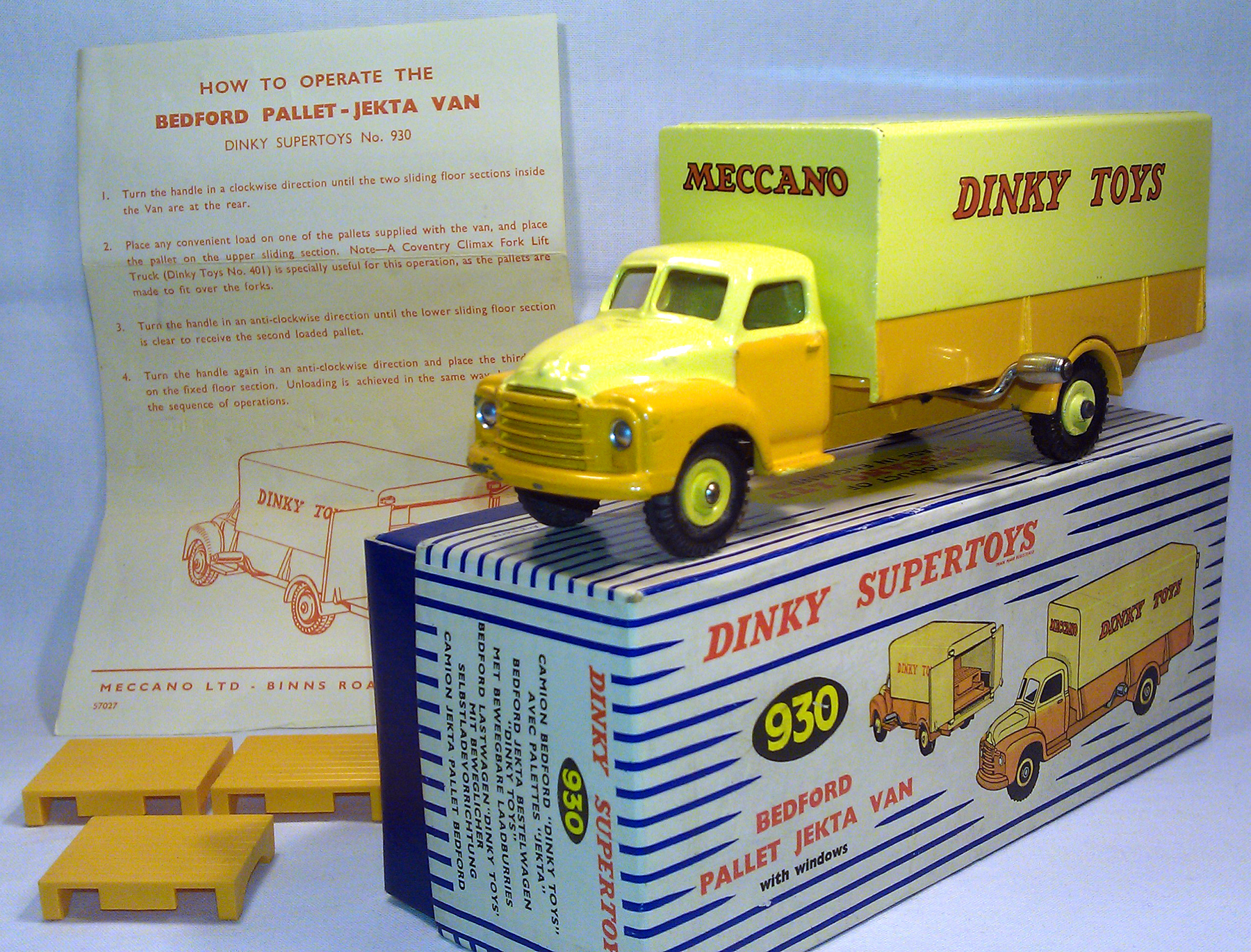
Shown here is the Dinky Supertoys 930 Bedford Pallet-Jekta Van on its box, with three pallets and an instruction leaflet.
Shown here is the left side of the 930 with a turn handle to operate the loading platform. Note the attractively detailed “DINKY TOYS” transfers in red with a black outline that contrast well with the model’s yellow body.
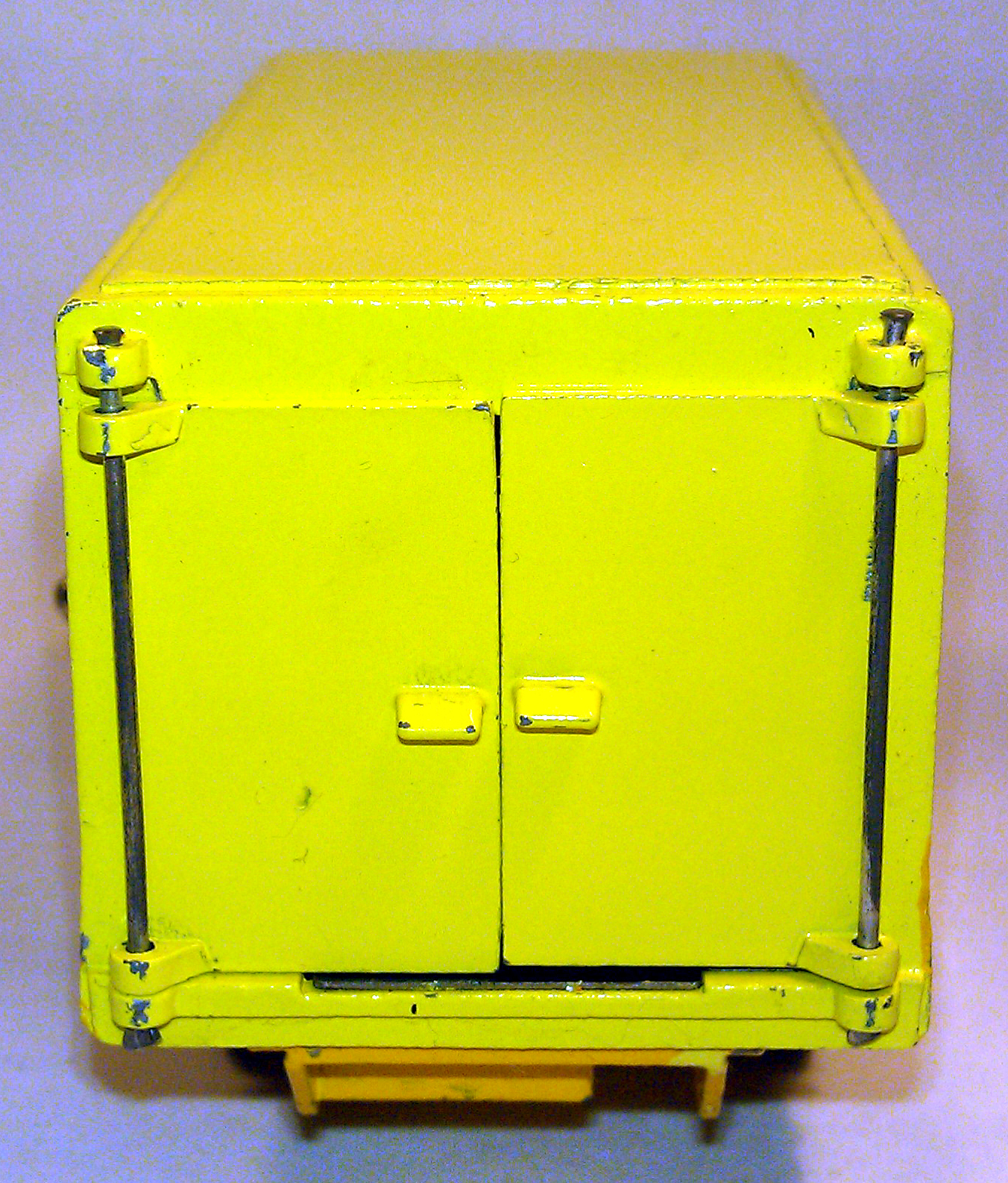
The rear of the 930 Bedford Pallet-Jekta Van with its doors closed.
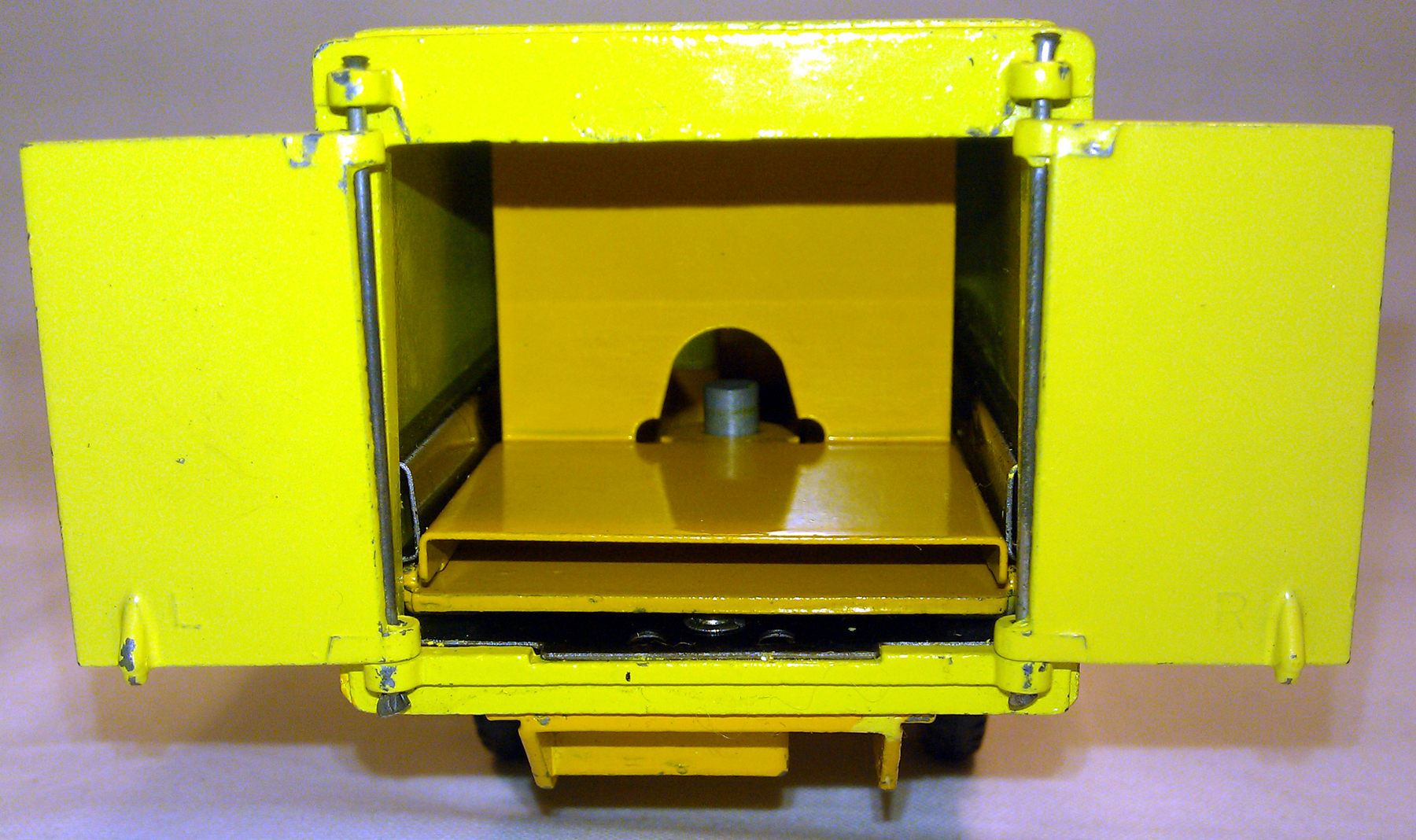
The doors opened, revealing the interior of the loading platform in its first position, without a pallet.
The loading platform in its first position with a pallet.
The loading platform moved inside to its second position by using the turn handle.
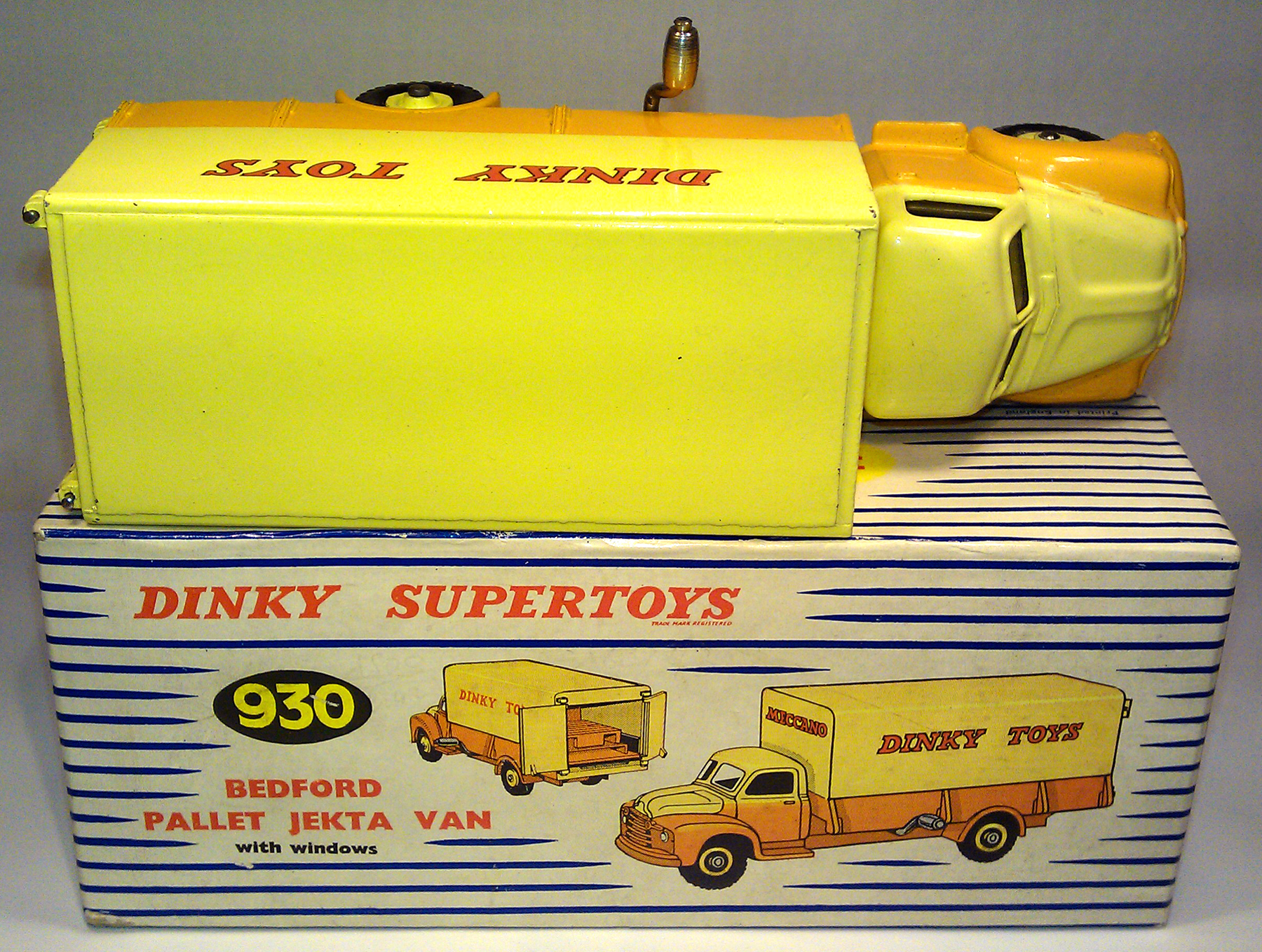
An upper side view of the Dinky Supertoys 930 Bedford Pallet-Jekta Van.
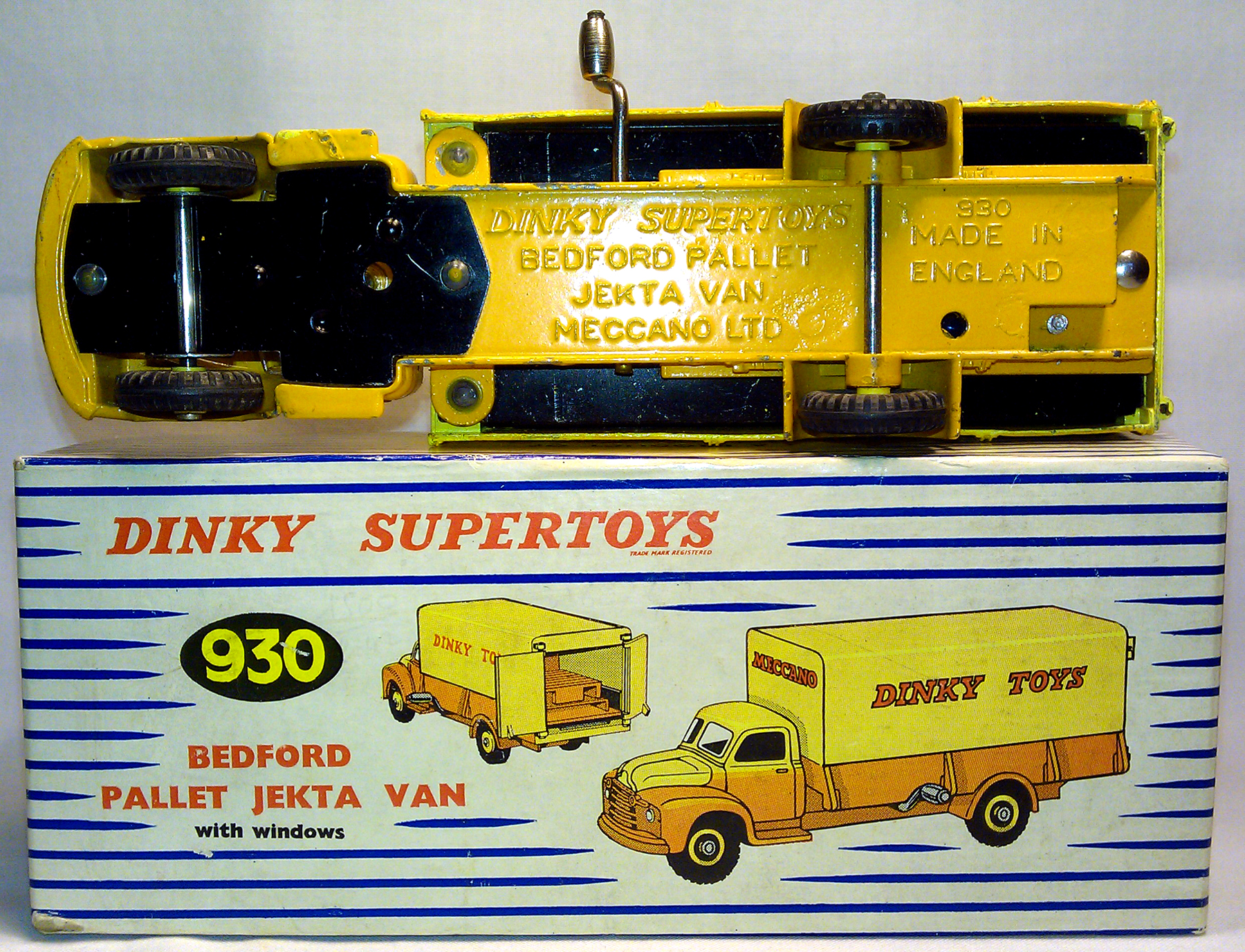
The base of the Dinky Supertoys 930 Bedford Pallet Jekta Van on its box.
Instruction leaflet (Ref. 16/1259/100, printed in four languages) that describes how to operate the loading platform.
Shown above is a clearer picture of the Bedford TA articulated lorry that was taken in the port of Liverpool, and the picture below (courtesy DTCA Fodenway) shows the Bedford TK articulated lorry which was in use at Meccano Liverpool.
With these, all the Bedford trucks known to have been in use at Meccano Liverpool and for which I was able to find photos are included in this article. Unfortunately I wasn’t able to find a picture of the real Bedford TD Pallet Jekta Van from Meccano Liverpool, which served as the prototype for the model 930.
In 1961, I joined Meccano Ltd. as an Apprentice Toolmaker based at their factory in Hanson Road, Aintree, Liverpool. This factory had considerable molding facilities for the production of Bayko and Hornby Dublo models. After about six months I was transferred to the main tool room at Binns Road. My starting wage was the princely sum of £3 9s 11d (£3.50 in new money) for a 40 hour week.
The apprenticeship was well organized, starting out by learning to use the most common machines in turn, after which you were placed alongside a fully qualified toolmaker. I was very fortunate to be placed under the top man in the tool room, Billy Carr. As your skills improved your work became more responsible, moving from jigs and fixtures to (in my case) specializing in injection molds.
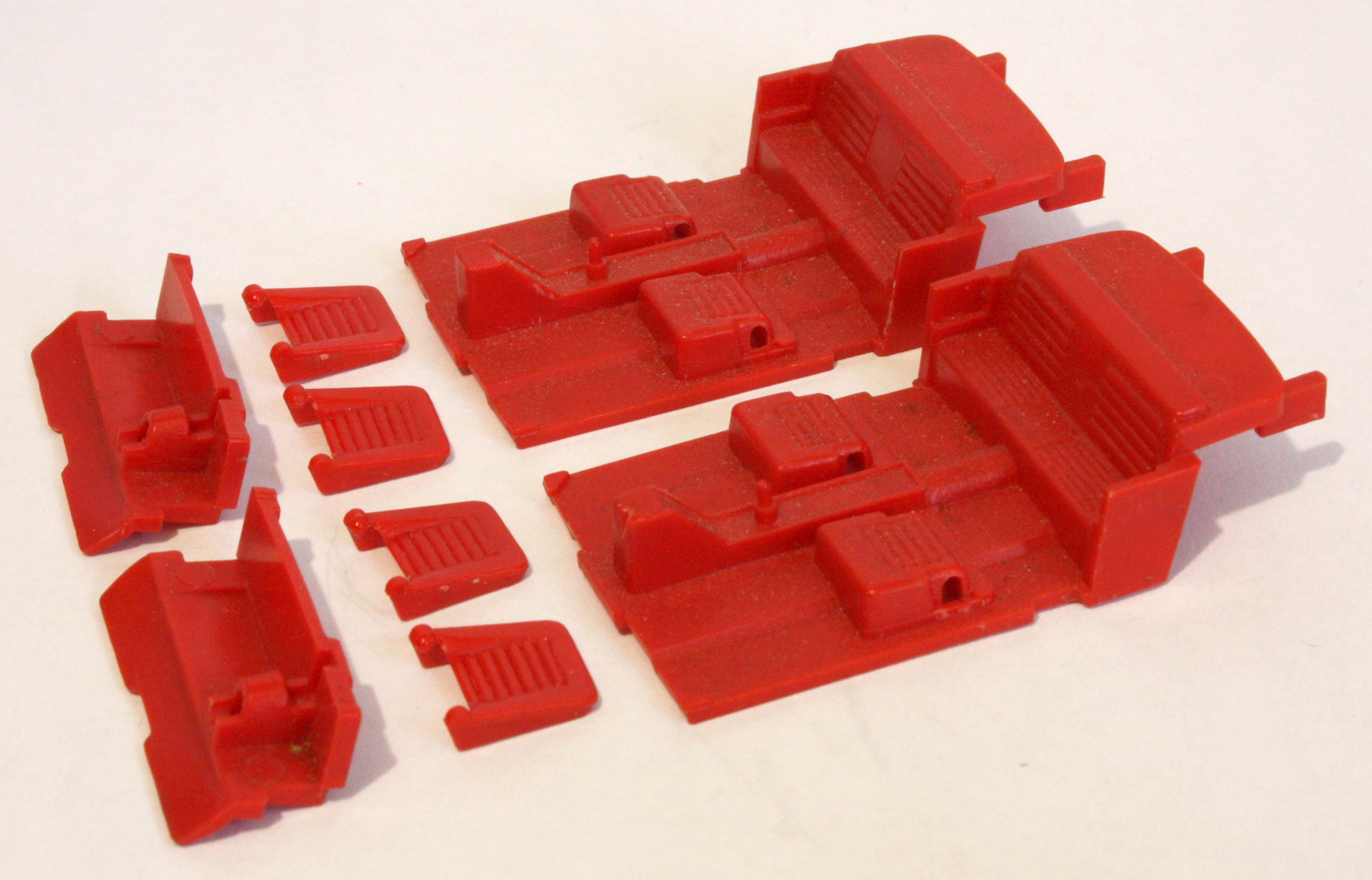
At the age of 20 I had completed two plastic injection molds before being asked to take up a post in the Drawing Office. The molds were a 144 impression wing mirror tool (used on various prestigious Dinky saloons) and an 8 impression mold for the seats and dashboard of the Dinky 161 Ford Mustang Fastback.
Dinky 161 Ford Mustang Fastback interior moldings.
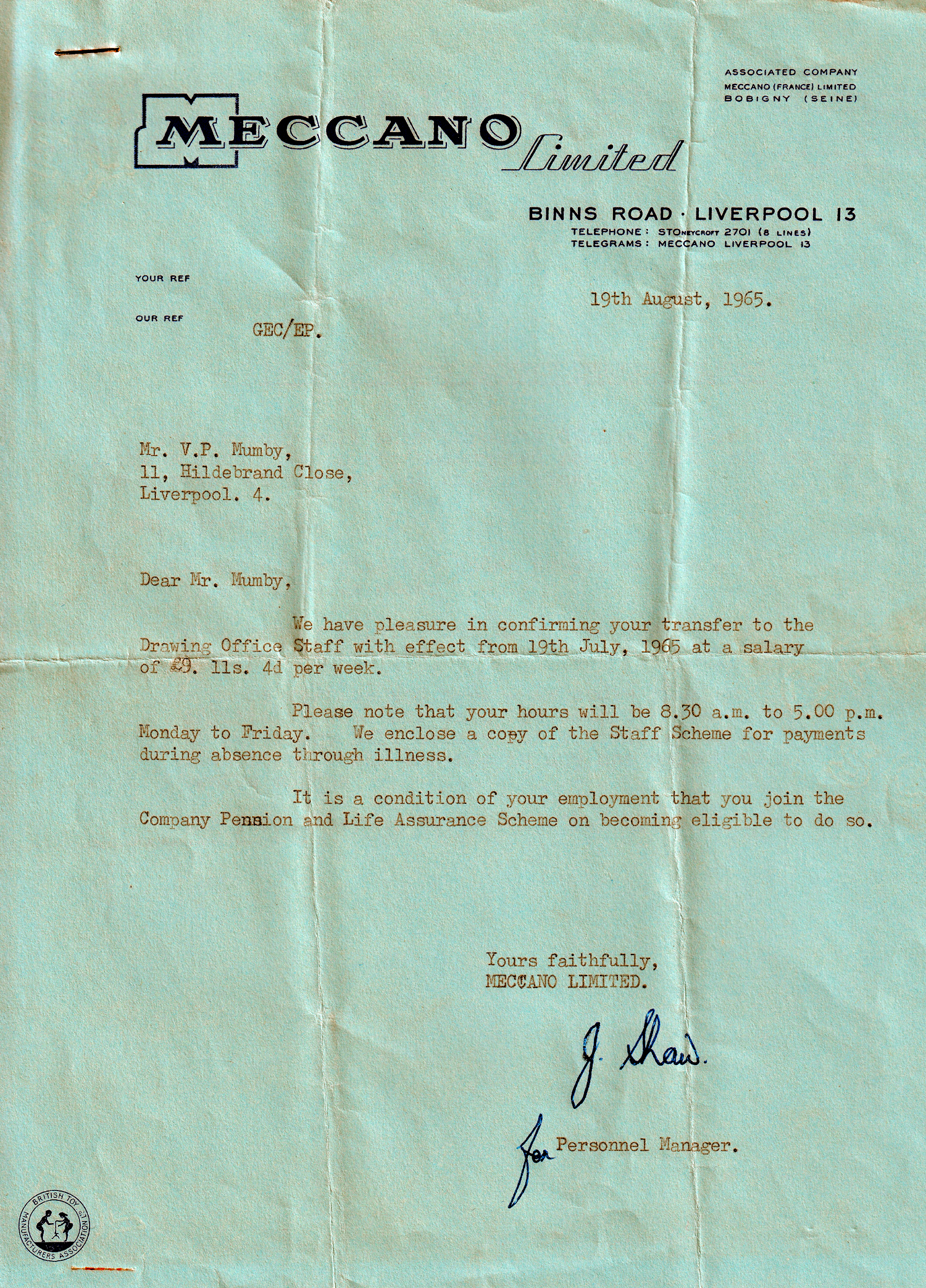
In 1965, I transferred to the Drawing Office as a Product Designer earning £9.50 per week.
My appointment letter to the Drawing Office.
Products I designed
Between 1965 and 1970, I designed the following products:
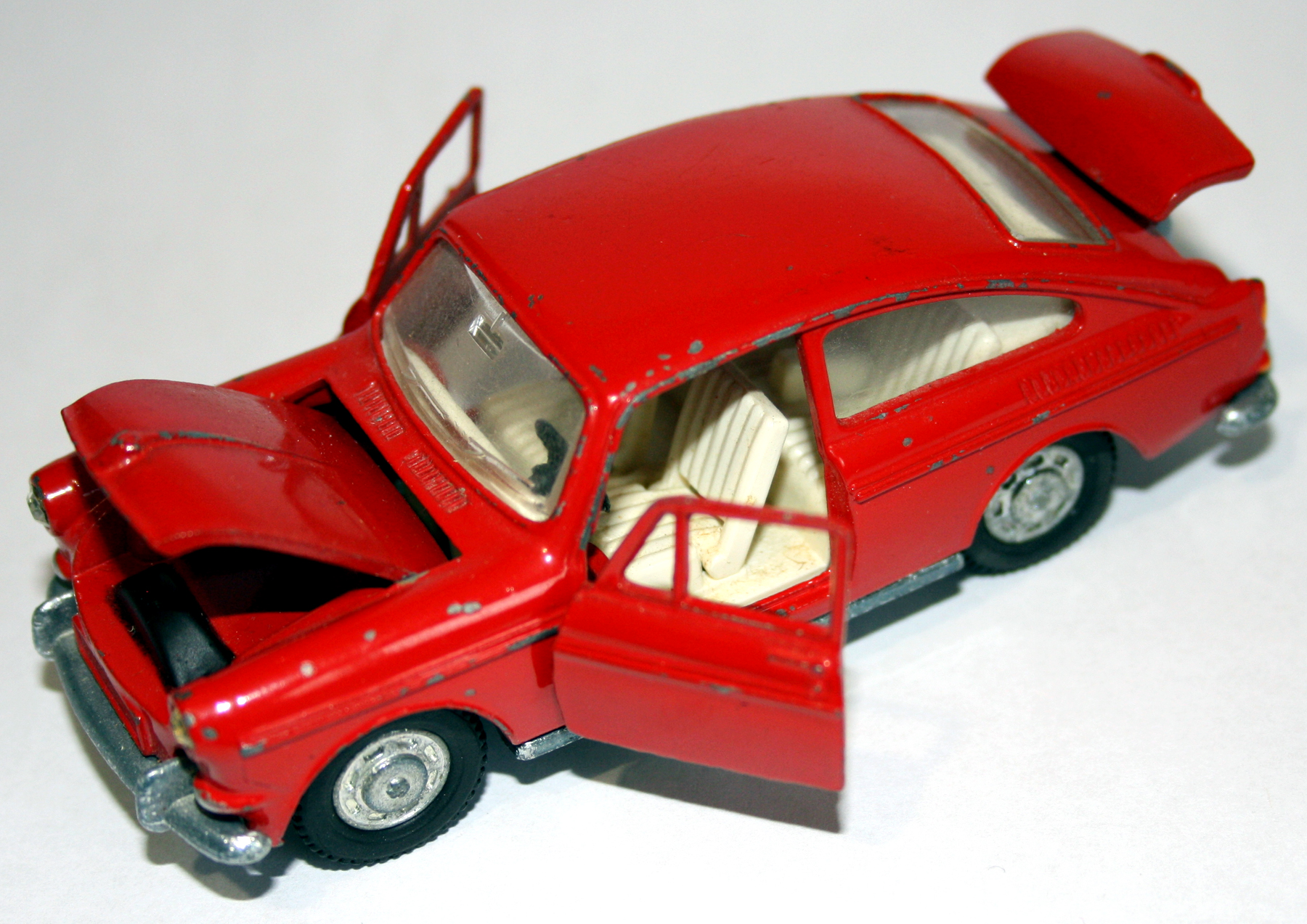
Dinky 163 Volkswagen 1600TL Fastback
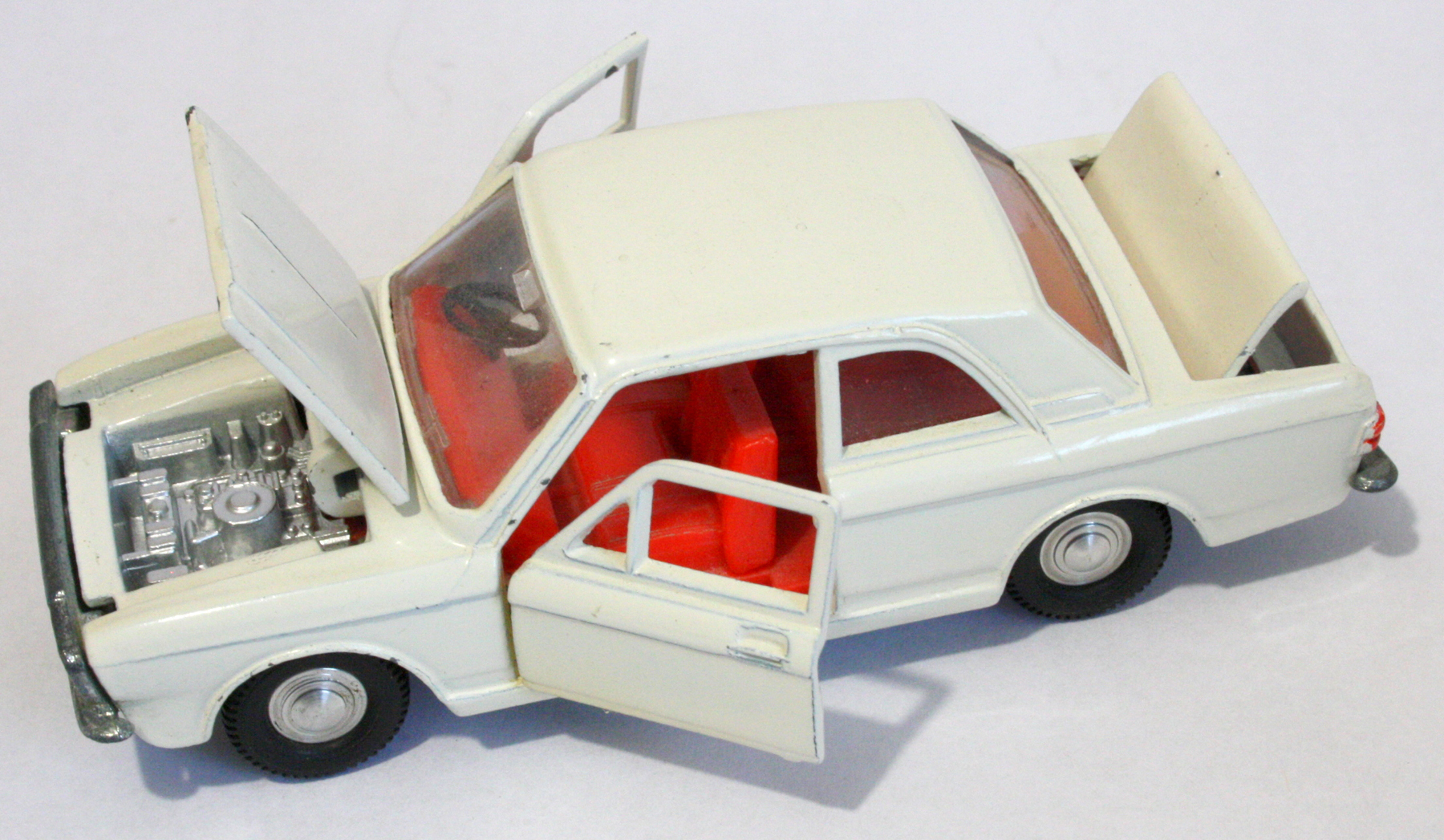
Dinky 159 Ford Cortina Mk II
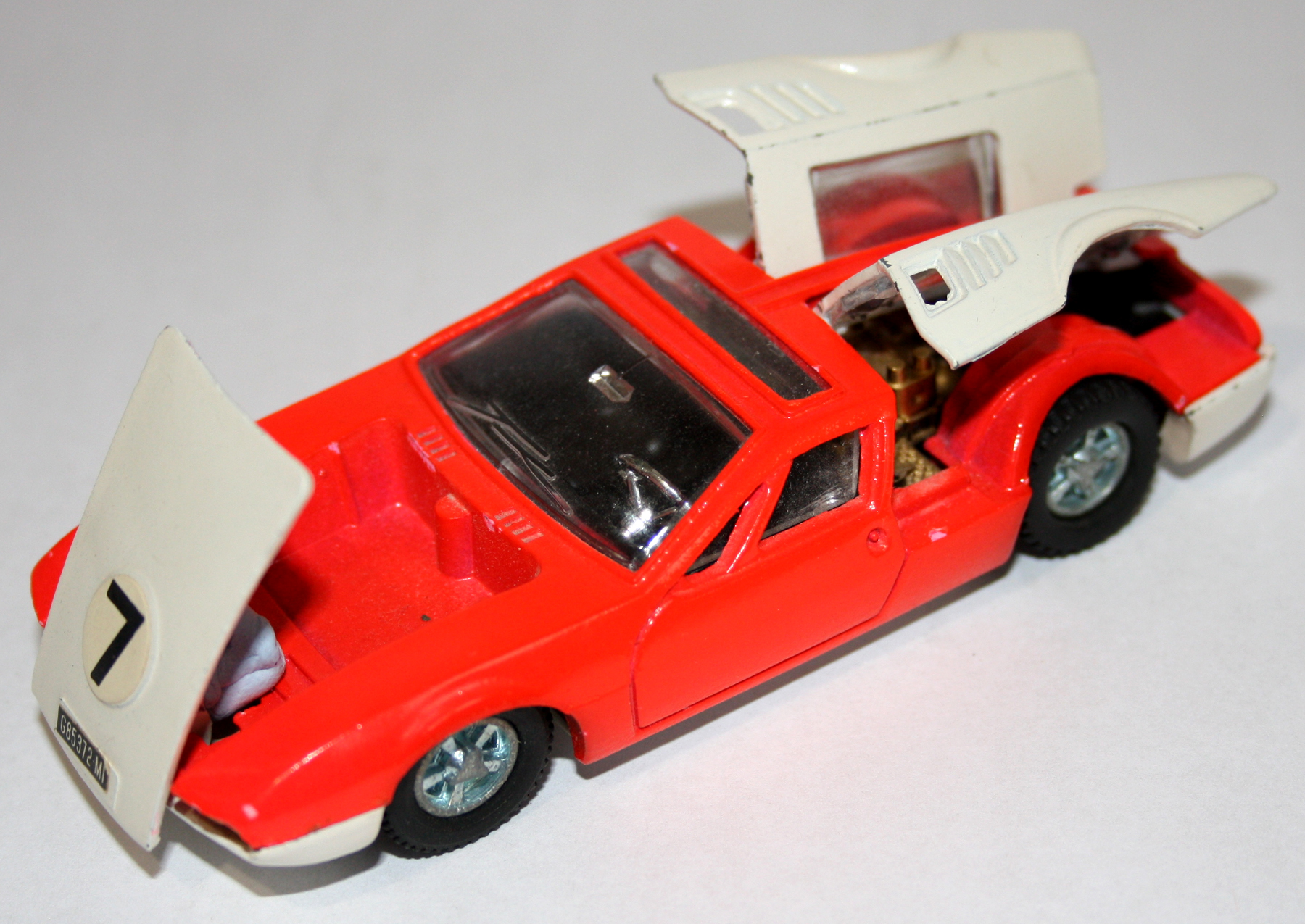
Dinky 187 De-Tomaso Mangusta 5000
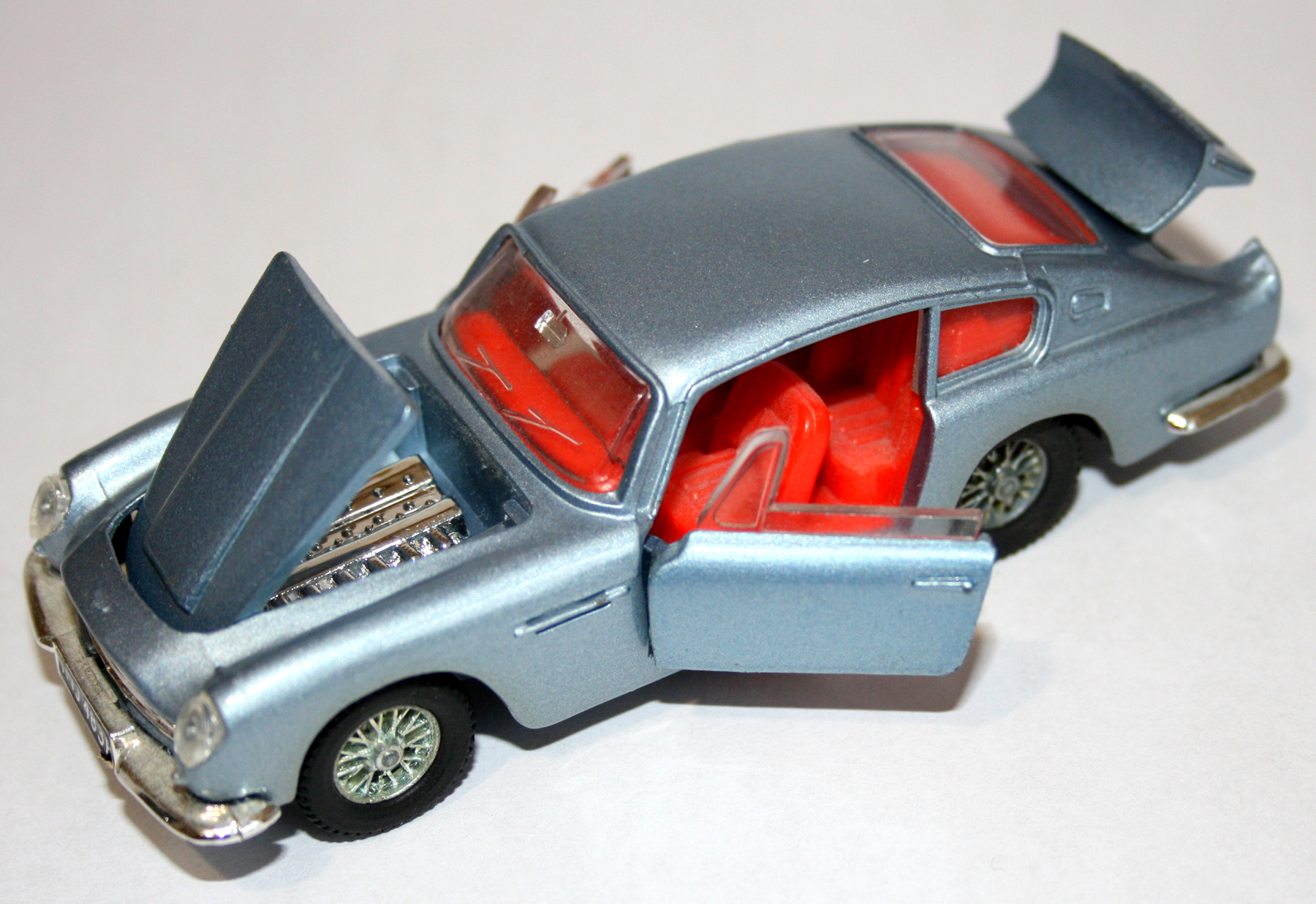
Dinky 153 Aston Martin DB6
Dinky 102 Joe’s Car
Dinky 344 Long Wheelbase Land Rover
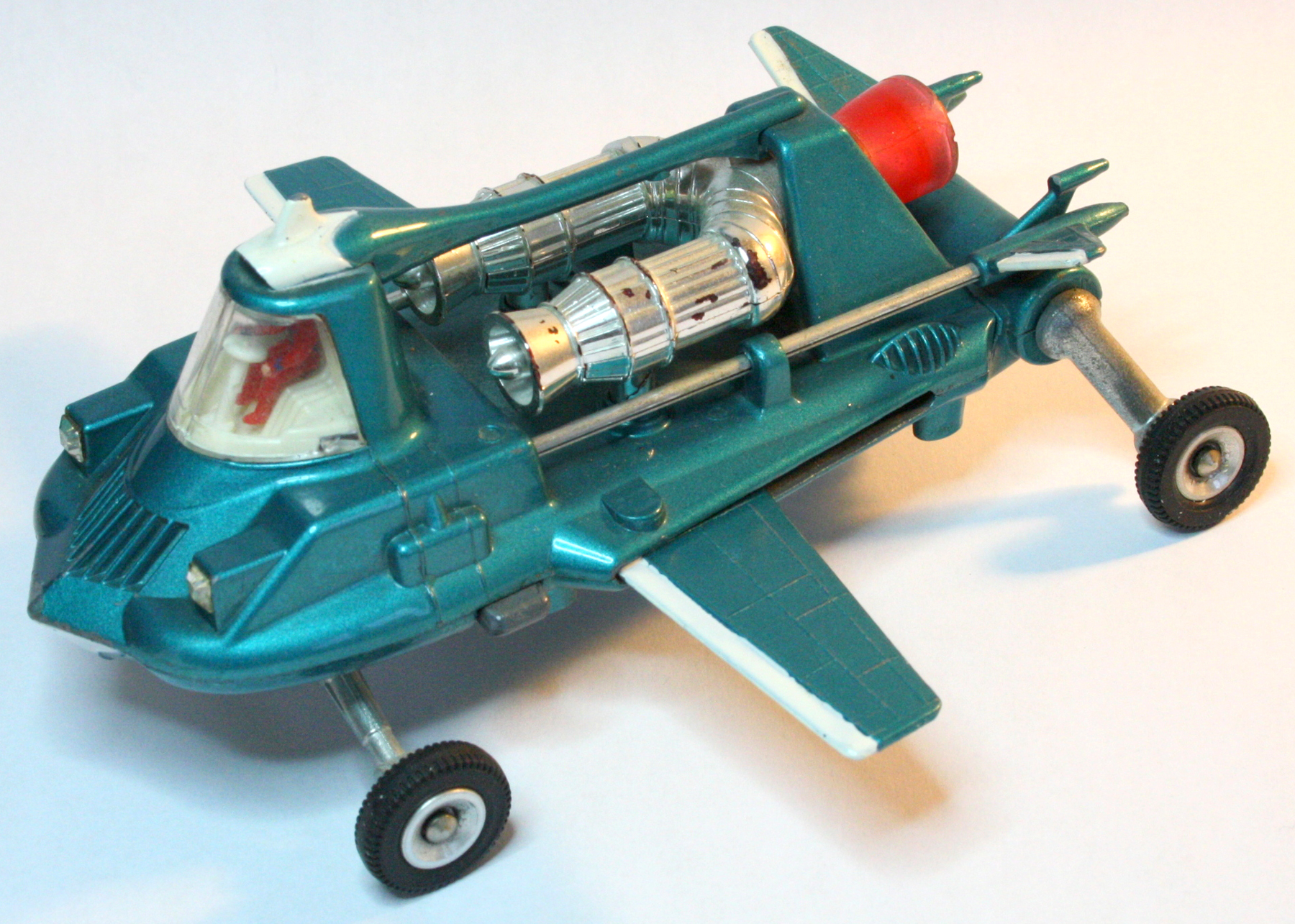
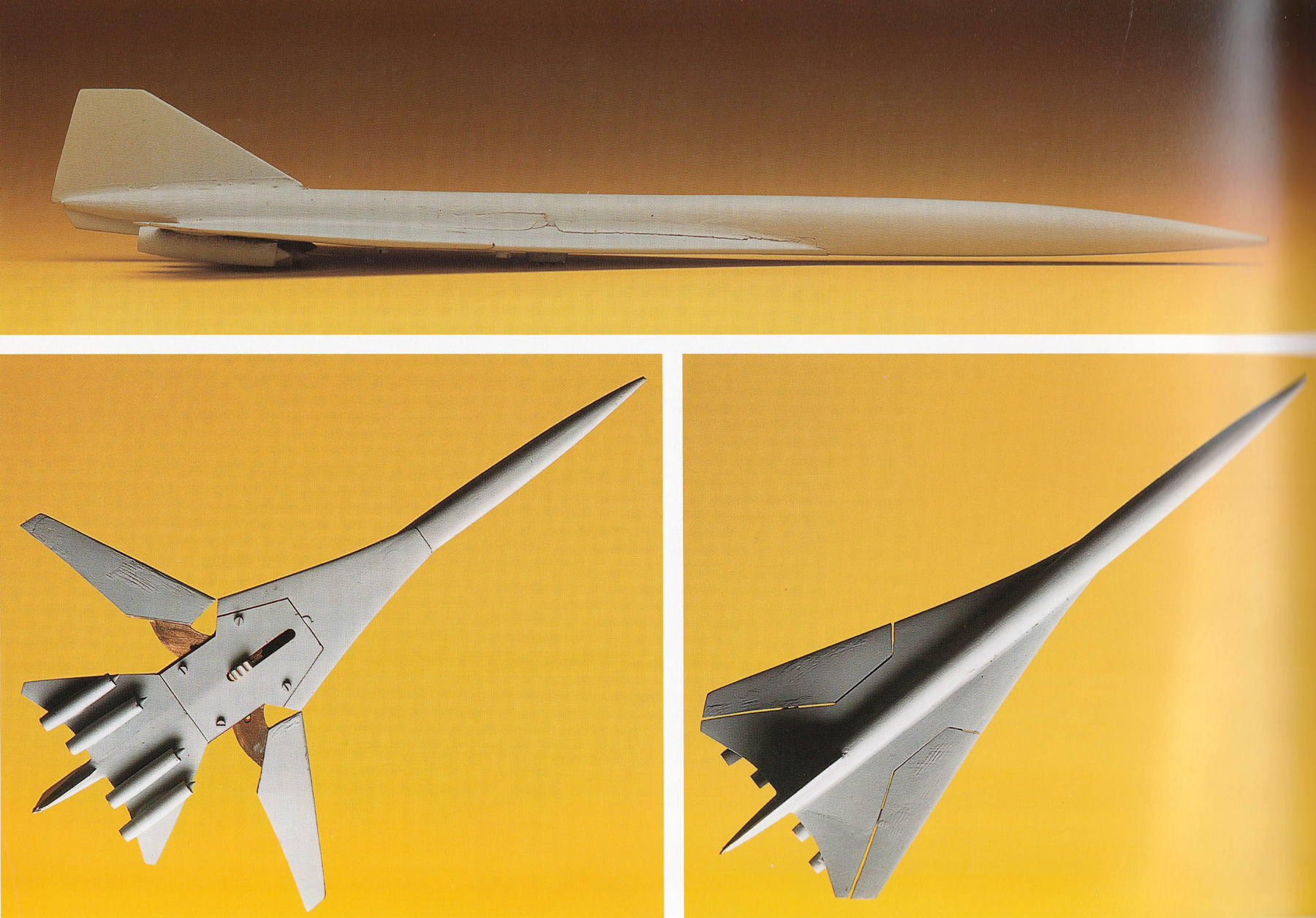
Dinky 995/996 Boeing 2707 SST
Electric screwdriver for Meccano sets
Dinky 163 Volkswagen 1600TL Fastback with opening doors, trunk, engine compartment hood and tipping front seat backs.
Dinky 159 Ford Cortina Mk II with opening doors, hood and trunk and tipping seat backs.
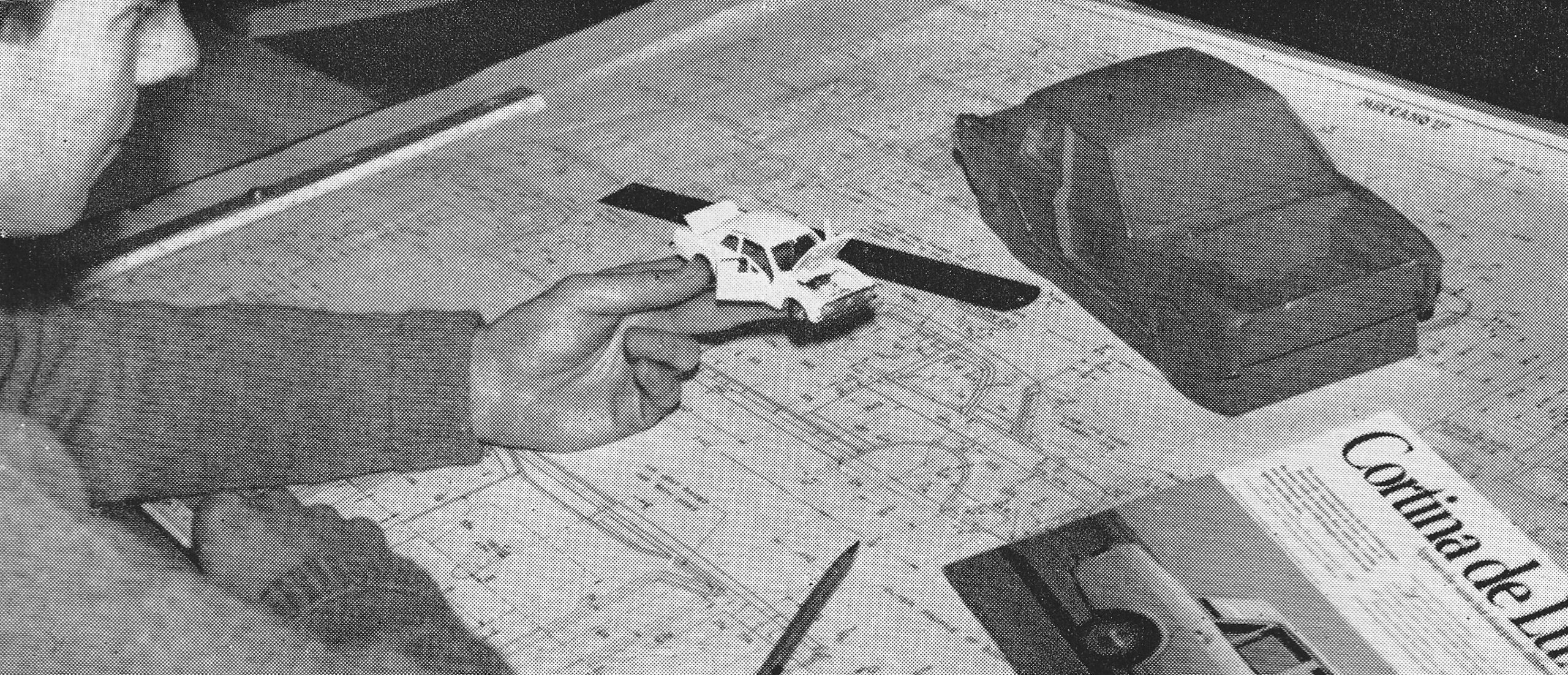
The Dinky 159 Ford Cortina Mk II model utilized the same window and seat unit as Dinky 154 Ford Taunus 17M. Managing director Joe Fallmann wasn’t impressed when he saw the first production samples of the Taunus. He didn’t like the complicated die split line around the air vent behind the rear side window and demanded that it be simplified. I don’t know if any of these examples were made available for sale.
The author at work on the Dinky 159 Ford Cortina Mk II.
Dinky 187 De-Tomaso Mangusta 5000 with opening trunk and gull wing doors over the engine compartment.
Dinky Aston Martin DB6 with opening doors, hood and trunk and tipping seat backs. A model that utilized many parts from the Aston Martin DB5.
Dinky 102 Joe’s Car.
The original proposed layout of the Dinky 102 Joe’s Car was given to fellow designer Terry Boland, but he had hardly got started when he was promoted to New Products Manager and the work passed to me. Just before release for tooling, Managing Director Joe Fallman insisted on a flashing light within the engine cowl, requiring me to shoe horn a AAA battery, switch and bulb holder into a chassis that was already filled with several other mechanisms.
Dinky 995/996 Boeing 2707 SST with swing wings. Image: The Great Book of Dinky Toys.
The Dinky 995/996 Boeing 2707 SST was taken right through to tooling with several tools half completed when Boeing announced the cancellation of the real aircraft, causing Meccano to follow suit. As a consolation, I was presented with the prototype model.
Another challenging product I worked on was an Electric Screwdriver for use with Meccano sets. It was to be driven by a 6 or 12 volt motor with power supplied by a separate mains transformer. Several obstacles became apparent, namely the unavailability of commercially produced compact 6–12 volt motors capable of delivering the necessary torque to sufficiently tighten the Meccano screws; further, any transformer would have to be capable of delivering a current of up to 2.5 amps at 6–12 volts. There was no question of producing a motor or transformer in-house as the necessary equipment had been sold or scrapped when Hornby Dublo ceased production in 1964/1965.
Joe Fallman was very keen to have this screwdriver and ruled like an iron hand and usually got what he wanted. He didn’t suffer fools or ditherers lightly, so you can imagine my horror when I was summoned to a new product meeting chaired by him to explain the technical difficulties that faced us.
I trotted in armed with performance graphs from various motor manufacturers to illustrate the problem. To my relief Joe understood immediately, thanked me for being so candid and I returned to my desk much relieved. Later, my boss returned and asked if I could introduce a reduction gear box to increase torque. This suggestion had initially been resisted due to the extra weight and cost. The use of normal reduction spur gearing took up too much space, so I hit upon the idea of using epicyclic gearing which is very compact. The design was completed but never tooled as the board felt the final cost was too steep.
My career in the 1970s
The following events occurred in my career in the 1970s:
1970 Moved from Product Design to the Tool Design Section.
1973 There was a period of industrial unrest in the Design Office, so I left and spent 12 months as a Senior Tool Designer for Dunlop GRG Division based in Skelmersdale, Lancashire working on automotive products.
1974 Rejoined Meccano Ltd. as Chief Draughtsman for Products.
1976 Chief Draughtsman responsible for Products and Tooling
Although not commonly known, the self adhesive number plates fitted to Dinky Toys are the initials of staff within the Drawing Office including myself (VPM), also the year letter was regularly changed in line with the DVLA (Driver Vehicle Licensing Authority). This is a good indication of the age of many Dinky Toys although it can also be the subject of abuse.
Obviously, besides designing new products, much time had to be spent doing modifications, revising model issues and labels for different countries and changing the design of many common items such as axles, wheel centers and tires. A lot of effort was put into modifying a number of existing saloons to accommodate the first type of Speed Wheels which was only possible when the model’s chassis was diecast.
By modern standards the Binns Road factory didn’t have an ideal layout, having expanded organically as products diversified. Some areas were located appropriately, such as the diecast department which was adjacent to casting de-burring, casting cleaning and the paint shop, and the small parts stores that were located adjacent to the assembly room for ease of distribution. However, molding and some finished painted parts had to be moved by electric pallet truck. At one time an overhead conveyor system linked the paint shop to the assembly room. Basically, dirty processes were kept as far as possible from the clean assembly room.
Promotional models
There were three types of promotional models:
The application of a different color scheme and/or transfers to an existing model. The cost of generating the transfers would be covered by the company requesting the advertising. Models would be freely available to all with possibly an early batch supplied to the advertiser.
As above but with models supplied exclusively to the advertiser. Eventually examples of these models would filter back into the general second hand toy market, for example the Dinky 945 Lucas Oil Tanker.
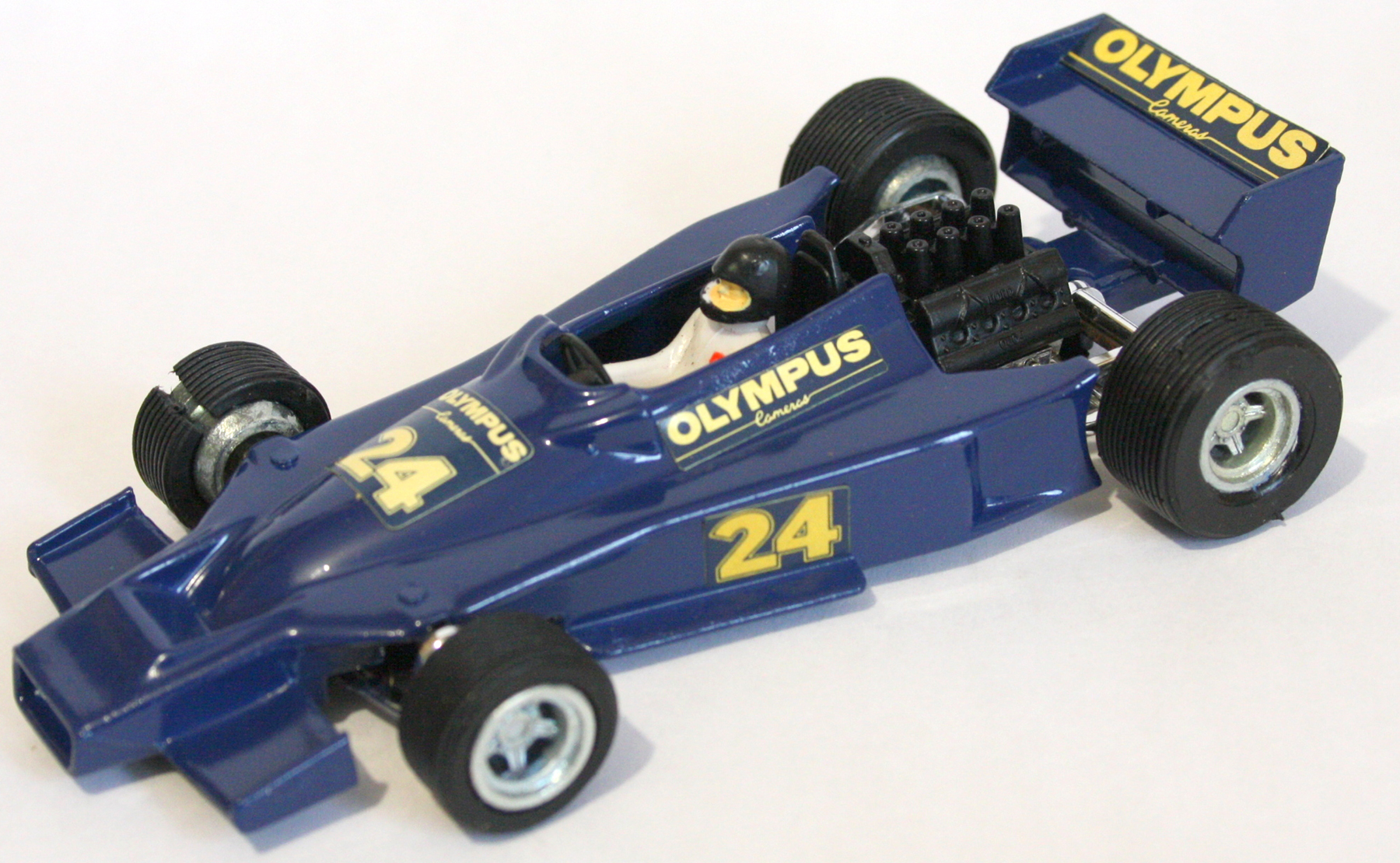
The tooling of a new promotional model, where some proportion of tooling costs and certainly labels and transfers would be funded by the advertiser. I know of only two such models: the Dinky 222 Hesketh 308E F1 racing car manufactured for Olympus Cameras and the Dinky 115 UB Taxi for United Biscuits.
I believe Olympus took 20,000 units after which it became available to the general public. To meet a very tight schedule, it was necessary to use and modify parts from the Dinky 225 Ferrari F1 tooling which effectively eliminated the Dinky 225 from the range.
The UB Taxi supplied to United Biscuits in a plain white box was available to customers who had collected sufficient tokens from biscuit packets.
Dinky 222 Hesketh 308E F1.
It was very common for Meccano Ltd. to have the cost of producing labels and transfers covered by the producer of the article or the service being advertised, even though no special run of models would be specified. The advertiser would just be grateful that their product or service appeared for free on every toy sold. This is true for dozens of Dinky Toys manufactured over the years.
Many toys had their body experimentally molded in plastic. To my knowledge the only toy that was changed and made it to market was Dinky 354 The Pink Panther Car. This change was done before its public release because the diecast body didn’t travel far enough when propelled by its gyroscopic flywheel. Any other plastic body parts around today were possibly ‘appropriated’ after testing.
Only one Dinky, the 992 Avro Vulcan bomber was cast in aluminum at Binns Road. Tool life was very short so very few entered the market place.
Apart from Dinky Toys, the office designed a range of ‘MOGUL’ steel toys to compete with ‘TONKA’ and ‘PRIMA’ Meccano, a construction toy for the very young.
Post Meccano
In May 1979, the atmosphere at Meccano felt bad so I resigned and took up a post as Senior Tool Designer with a growing mold maker based in Dublin Street, close to the Liverpool docks. It turned out this was a fortuitous move as Meccano closed in October that year.
Meccano provided me a memorable and enjoyable first 17 years of employment, where the skills I learned proved invaluable for the remainder of my working career:
1981 Moved to Hampshire to join IBM UK Laboratories Ltd. as a Senior Mold Designer.
1994 Took up the post of Senior Production Engineer at Kenwood Domestic Appliances in Havant.
1998 Joined Nokia UK Development Laboratories in Farnborough as a Tooling Specialist, where I stayed until retiring in 2009.
This article covers the history of the Dinky Supertoys Foden tankers which were released in four versions. The Dinky Supertoys fuel tankers that appeared later with beautiful period advertising of oil companies on the sides and rear of the tank are charming reproductions of the real fuel tankers that filled the underground tanks of roadside gas stations. They represent a period when the economy began to flourish once again after the war, and motorized traffic — thirsty for fuel — increasingly appeared on the roads.
The range of vehicles that Meccano Liverpool produced, including the Dinky Supertoys, began to expand. The large tankers were part of the Dinky Supertoys range whose production began in 1947 and continued until 1964. Their history is truly remarkable. There was an interruption in the use of the Dinky Supertoys name for a period of time that requires explanation, which I will describe in this article, and also show the beauty of these very popular tankers and their boxes.
Dinky Supertoys 504 Foden 14-ton Tanker with 1st type cab (1948–1952)
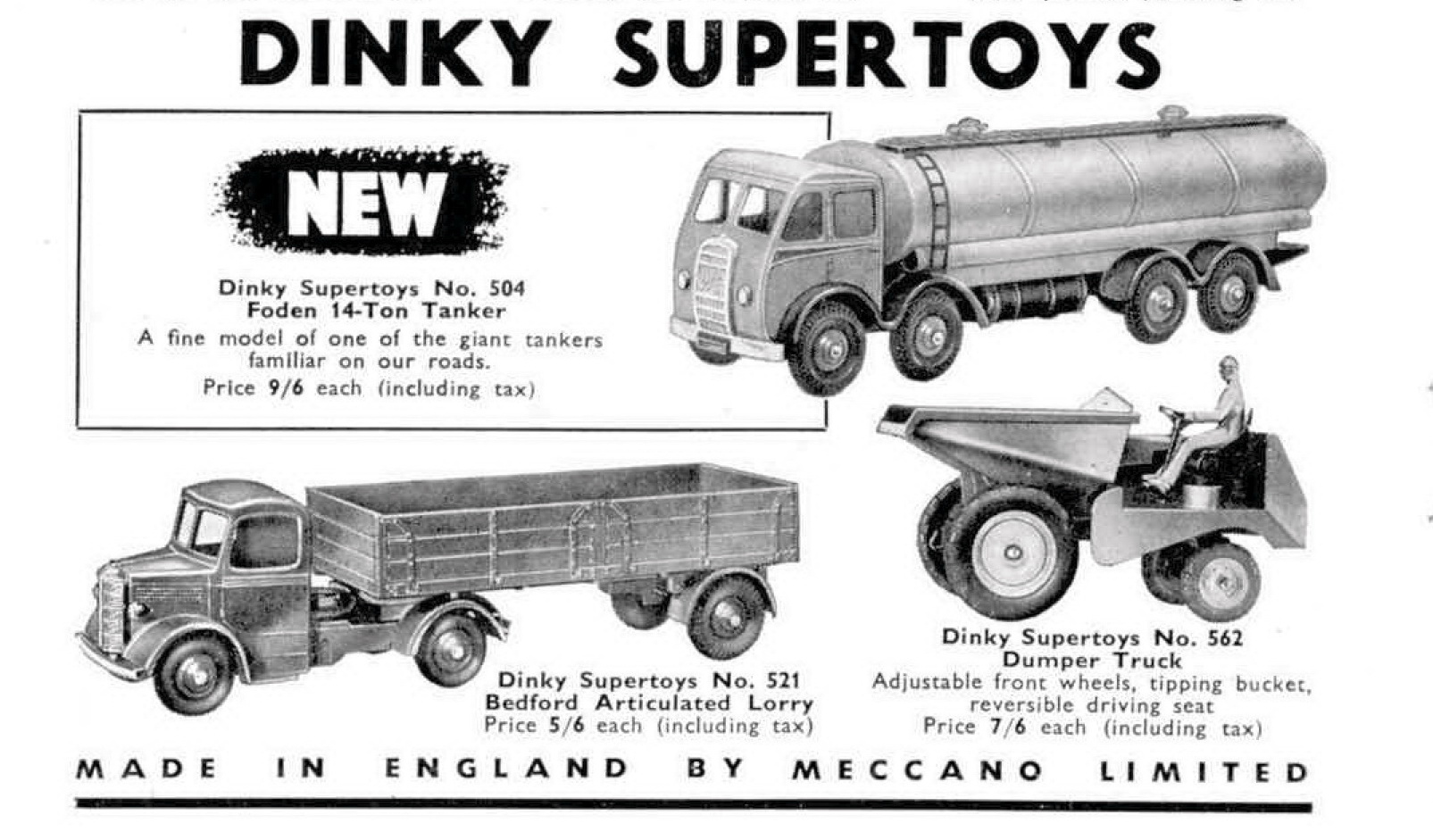
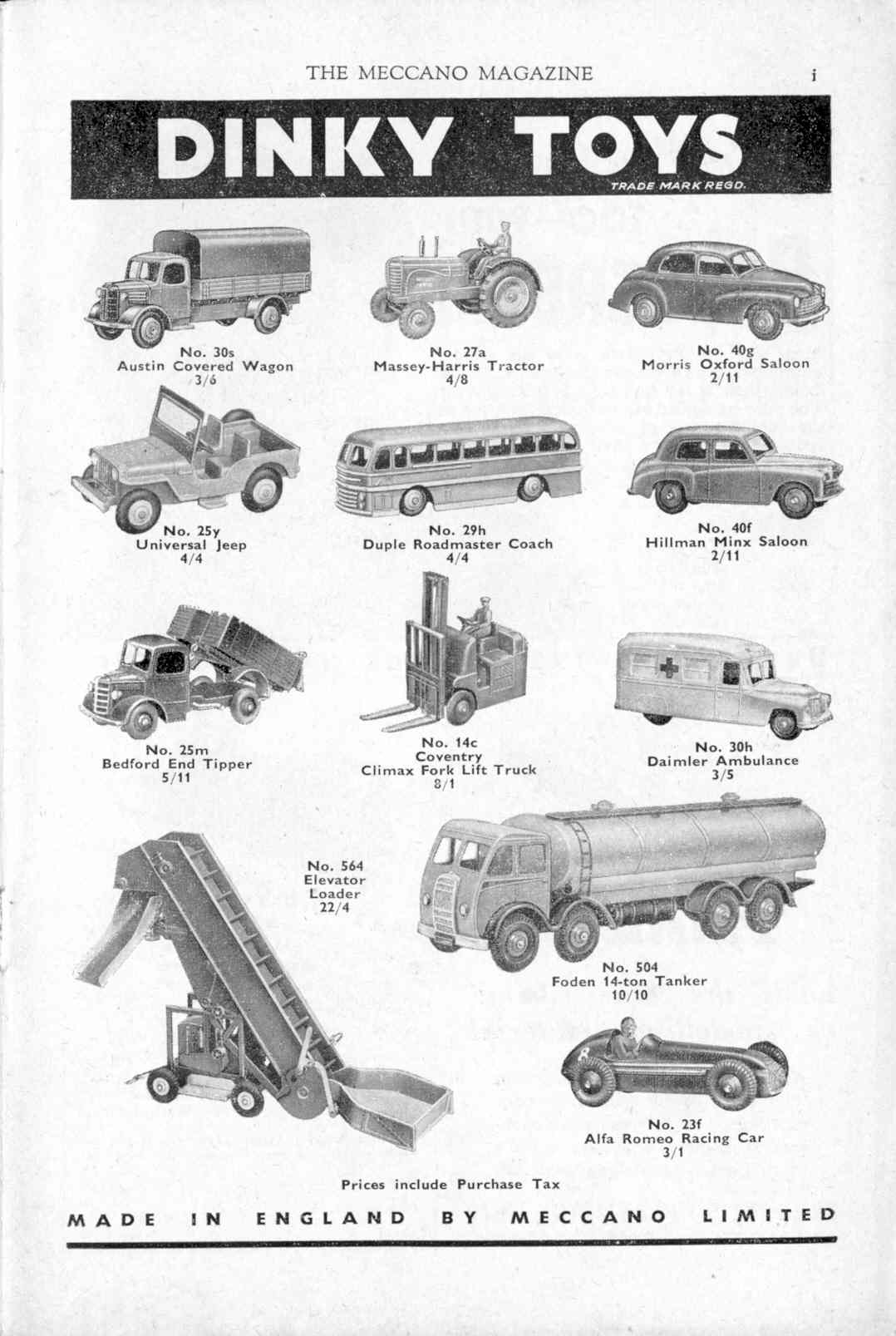
The first Dinky Supertoys tanker, the No. 504 Foden 14-ton Tanker, was advertised in the December 1948 issue of Meccano Magazine as “A fine model of one of the giant tankers familiar on our roads.” and was the fourth of five Foden truck models that were released. The advertisement included the Dinky Supertoys 521 Bedford Articulated Lorry and the Dinky Supertoys 562 Dumper Truck.
The first tankers were produced for five years without any advertising, and later with attractive logos. It was a marketing strategy by Meccano Liverpool that was designed to maximize profit from the model. They were released in various color combinations until 1953, with two types of Foden cabs as shown below. The Fodens were very popular and with their long production timespan, became a bestselling product of Meccano Liverpool.
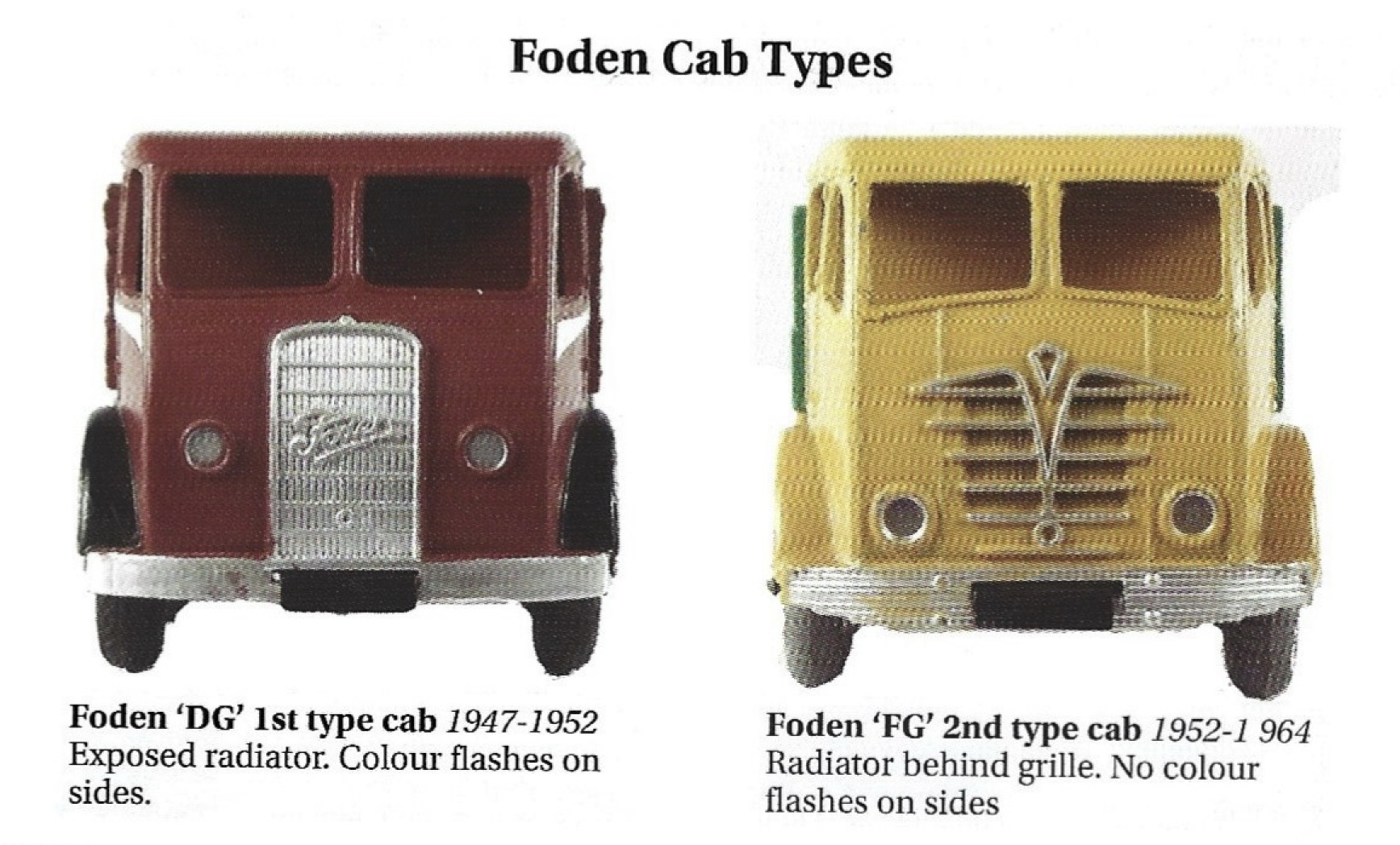
Foden trucks and tankers were released with two types of cabs. Image: Courtesy Michael Driver in Ramsay’s Model Toys Catalog 15th edition.
A Foden DG 8x4 tanker “BISOL”. Image: Alan Biggs (Flickr).
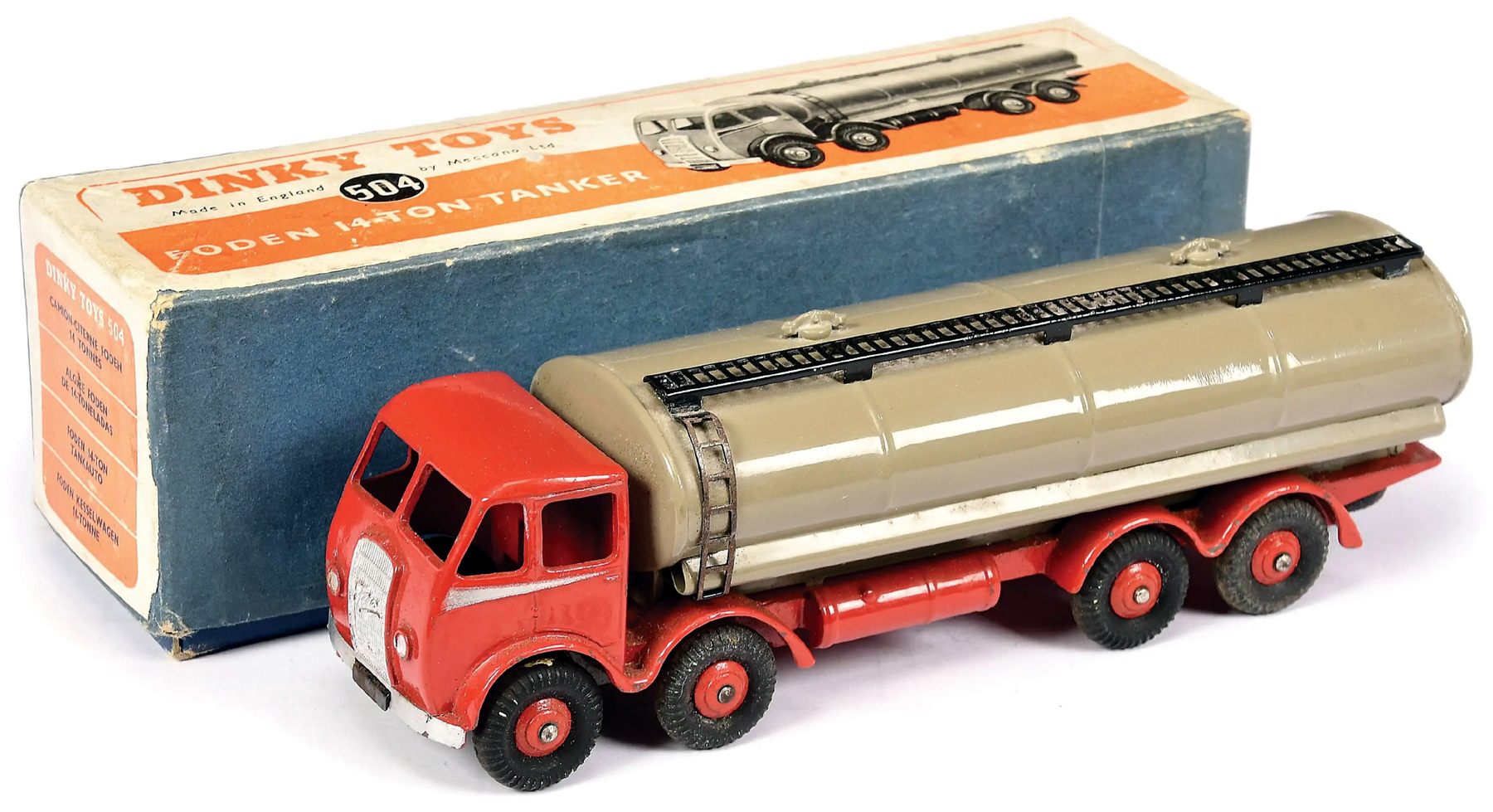
Shown above is the Dinky Supertoys 504 Foden 14-ton Tanker with the 1st type cab and a circa 1948 1st type Dinky Supertoys picture box with an orange and white label. Note the silver flash on the side of the cab and the early black herringbone tires.
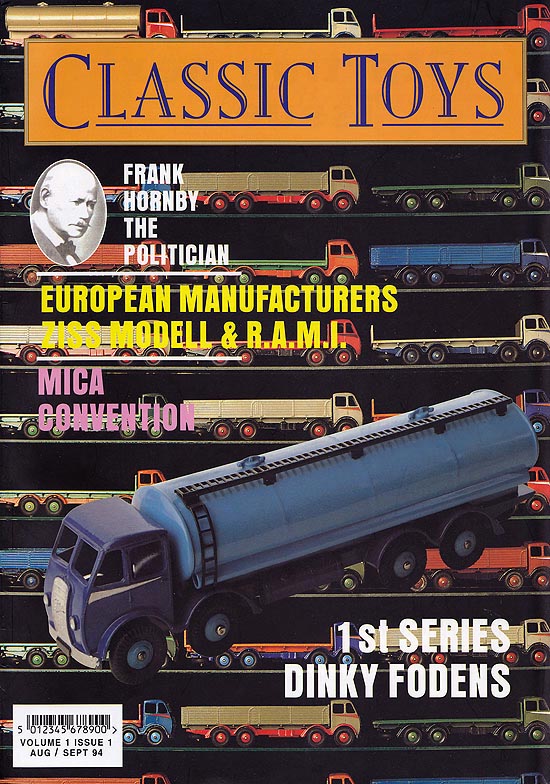
Interestingly, these tanker bodies weren’t made by Meccano Liverpool but were supplied by an outside contractor in London whose proprietor, Tom Atkins, was an ex-Meccano employee. The tanker section complete with pipe holders and ladders were assembled at Meccano after spraying, but the filler caps were a genuine Meccano item. (Source: Classic Toys, Volume 1 Issue 1 August/September 1994)
“It comes as a complete surprise to me that they were outsourced to Tom Atkins. Meccano were well versed in manufacturing complex tin parts.”
(Response by Vic Mumby)
Image: Vectis Auctions
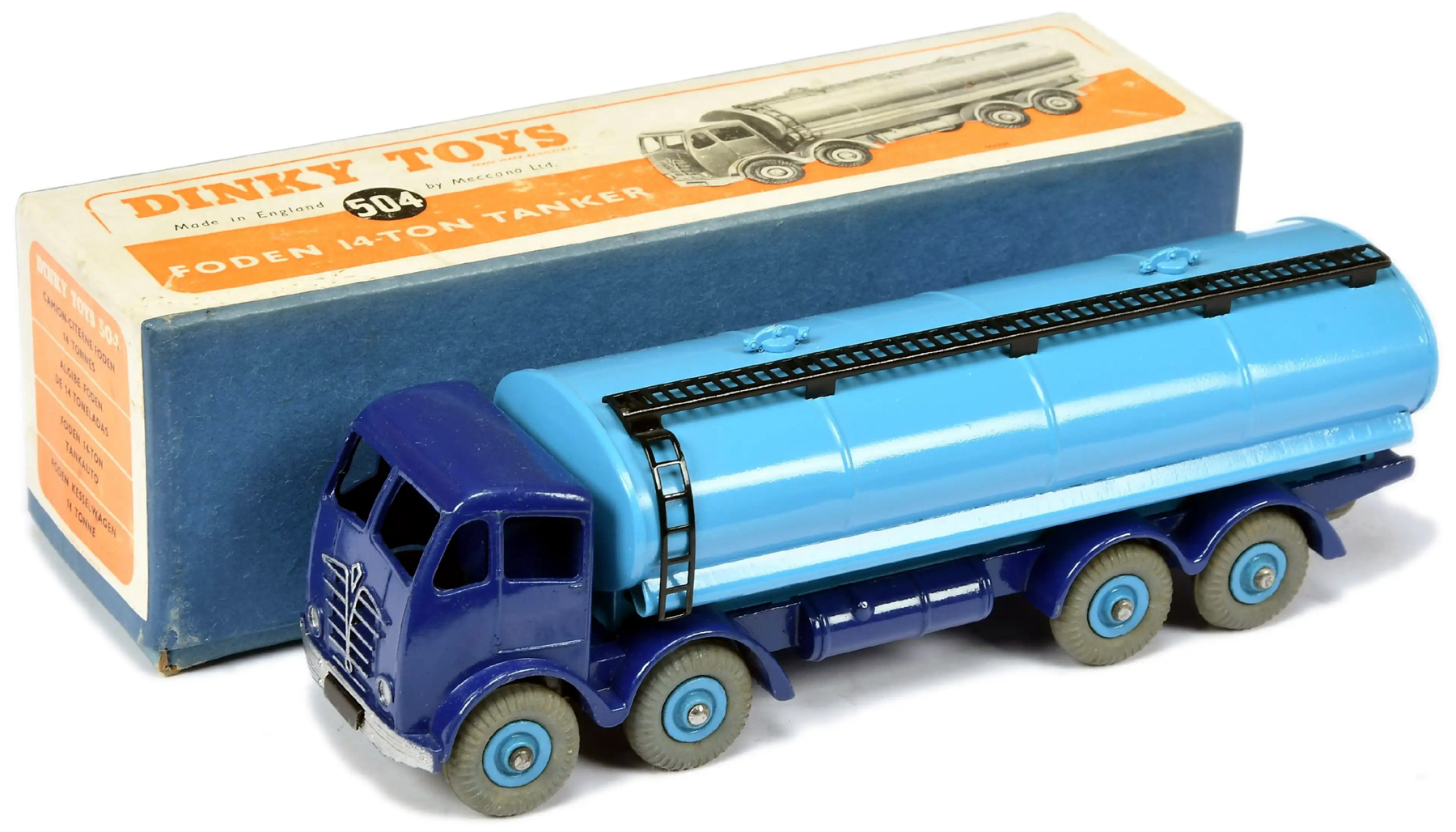
Shown above is the Dinky Toys 504 Foden 14-ton Tanker with the 1st type cab but a light blue Dinky Toys picture box with an orange white label. Note the sudden change from the Dinky Supertoys box to a Dinky Toys box which occurred during 1951–52. More on this later.
Dinky Toys 504 Foden 14-ton Tanker with 2nd type cab (1952–1953)
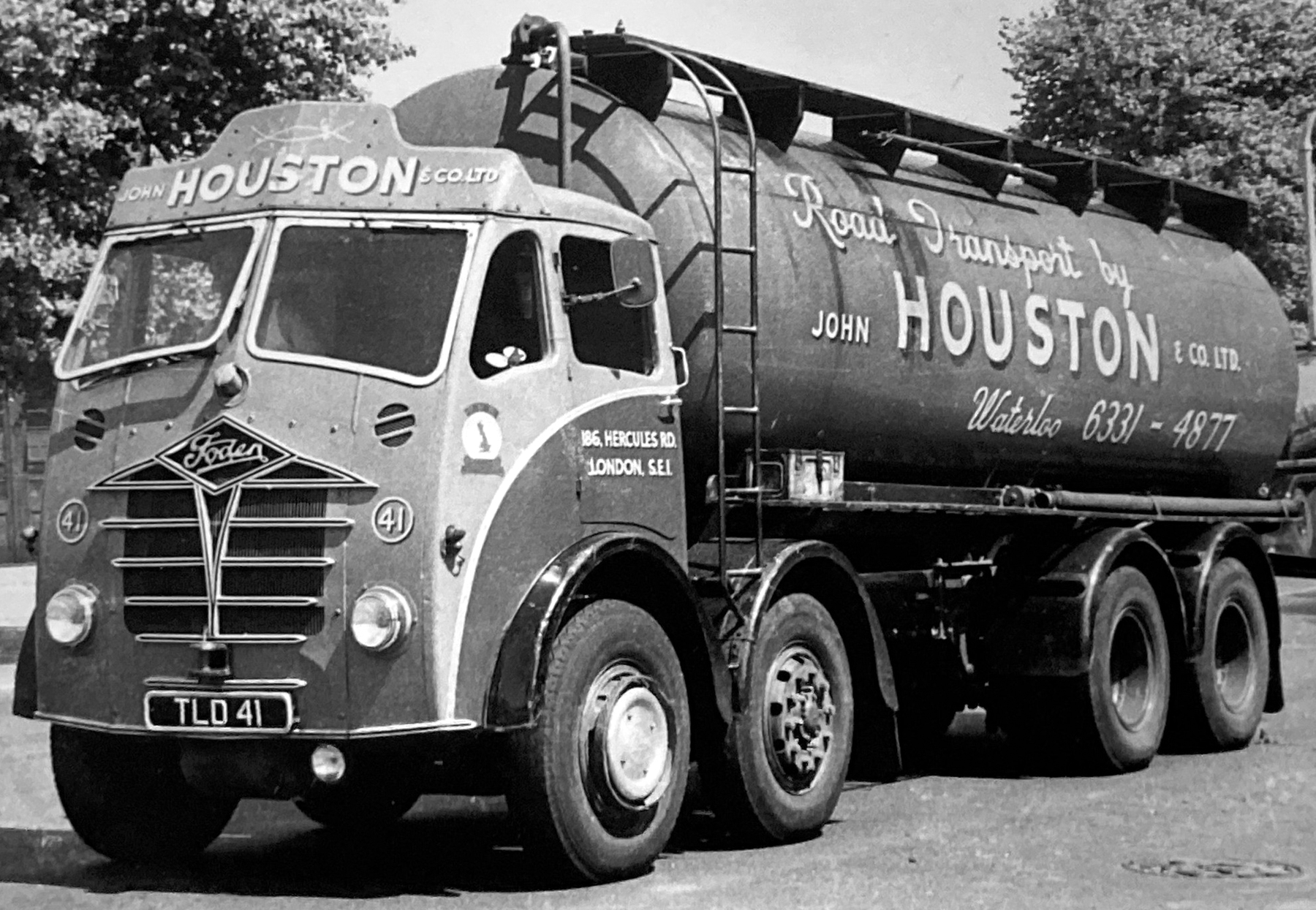
A Foden S18-FG tanker “HOUSTON”. Image: Alan Biggs (Flickr).
Image: Vectis Auctions
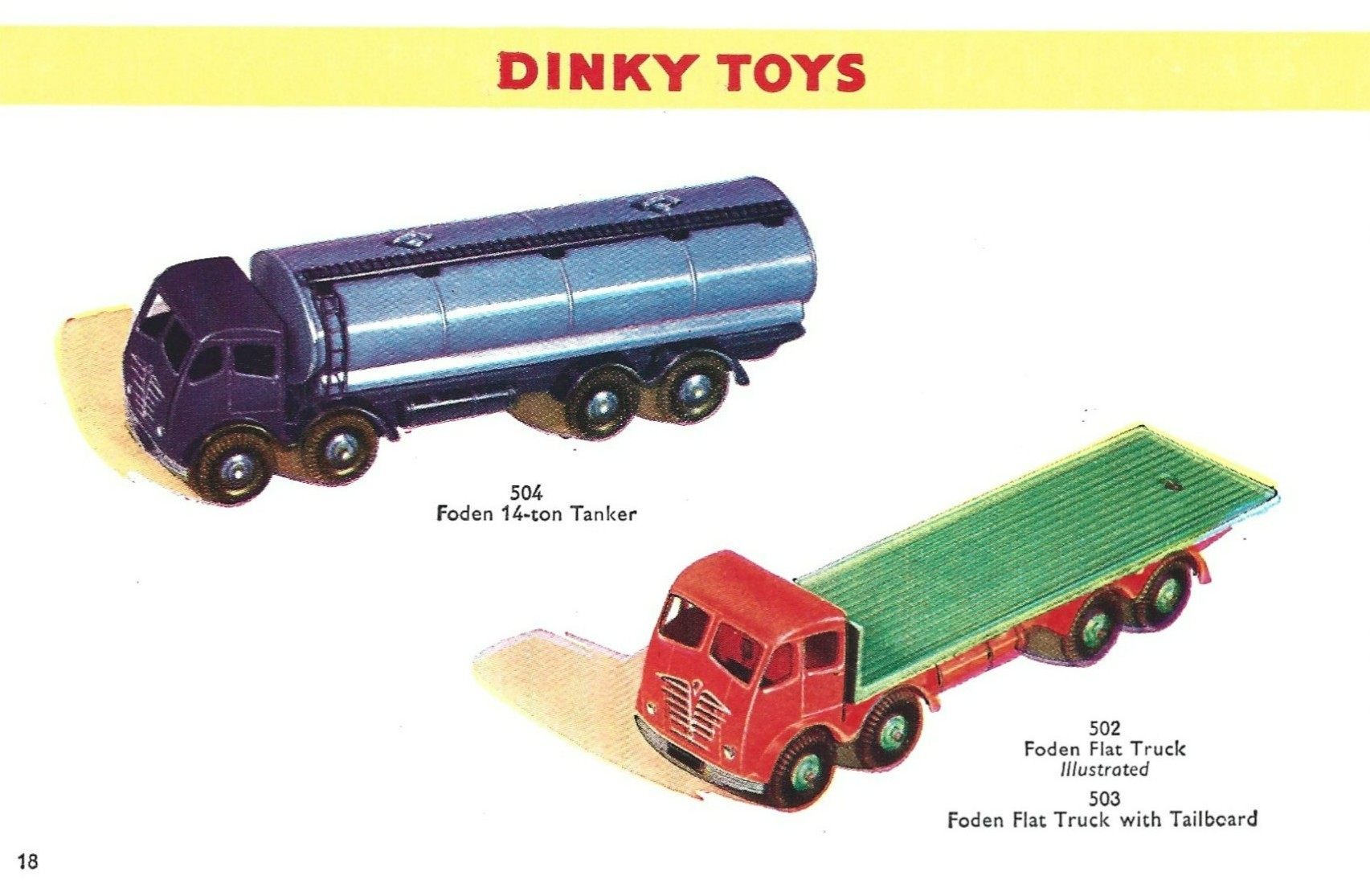
Shown above is the Dinky Toys 504 Foden 14-ton Tanker with a 2nd type cab with a Dinky Toys picture box. This Dinky Toys Foden tanker appeared for only one year in the 1952 Dinky catalogs. As described below, its release was very short and in May 1953 it was replaced by the Dinky 504 Foden Tanker “Mobilgas”.
The 504 Foden 14-ton Tanker with 2nd type cab included in 1952 Dinky catalogs for just one year, and classified as a Dinky Toys (not Dinky Supertoys) model. Also note the ridged (instead of grooved) hubs.
Oddly enough, the December (Christmas) 1952 issue of Meccano Magazine contained an advertisement for the No 504 Foden Tanker with a 1st type cab, while the version with the 2nd type cab was included in all 1952 Dinky catalogs. In Classic Toys Magazine (Volume 1, Issue 1, January/February 1995), Graham Bridges and Stewart Orr wrote:
“The first three Dinky models (with 2nd type cab) arrived in 1952 and were available within a few months of one another. The petrol tanker arrived one year later. The new chassis and cab was an entirely new casting and really bears no relation to the old ones.”
This leads me to conclude the 504 Foden petrol tanker with the 2nd type cab wasn’t available until 1953. Its release was short lived and it was replaced by the 504 Foden tanker “Mobilgas” which was introduced in the May 1953 issue of Meccano Magazine. Thus this combination of model and box is very scarce and highly sought after by collectors.
To make the familiar Foden tankers that lacked advertising more attractive and recognizable, Meccano Liverpool applied the name and logo of the respective oil companies to the tanks with beautiful transfers. No 504 Foden Tanker “Mobilgas” was the first model to feature an oil company’s name and logo, and was introduced in the May 1953 issue of Meccano Magazine as a Dinky Toys model. It was the start of the series of well-known oil company fuel tankers that were produced until the Meccano factory shut down in 1979.
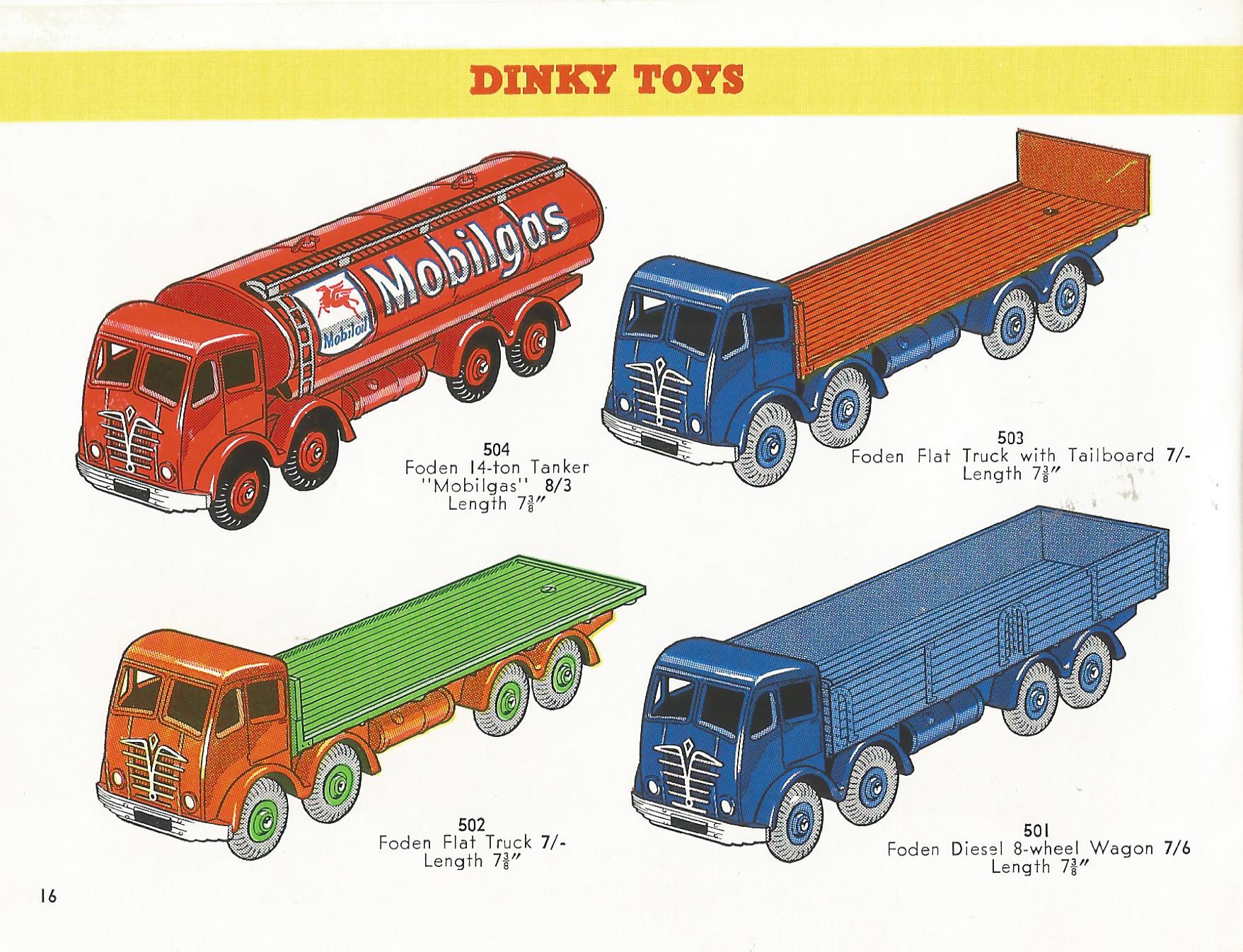
The 504 Foden Tanker without advertising was replaced in 1953 by the 504 Dinky Toys Foden Tanker “Mobilgas”, and with all Fodens being classified as Dinky Toys. This was first advertised in the 1953 UK catalog shown above. The sales number 504 was retained with the addition of “Mobilgas”. The image on the Dinky Toys box received the Mobilgas transfers, and the “Mobilgas” suffix in black text was added to the model name.
A Mobilgas service station in the 1950s on the A4 near London with typical British cars, Morris Minor and a Ford Anglia, with attendants. At the time, gas stations were operated by attendants who provided service to motorists. Image: Alamy
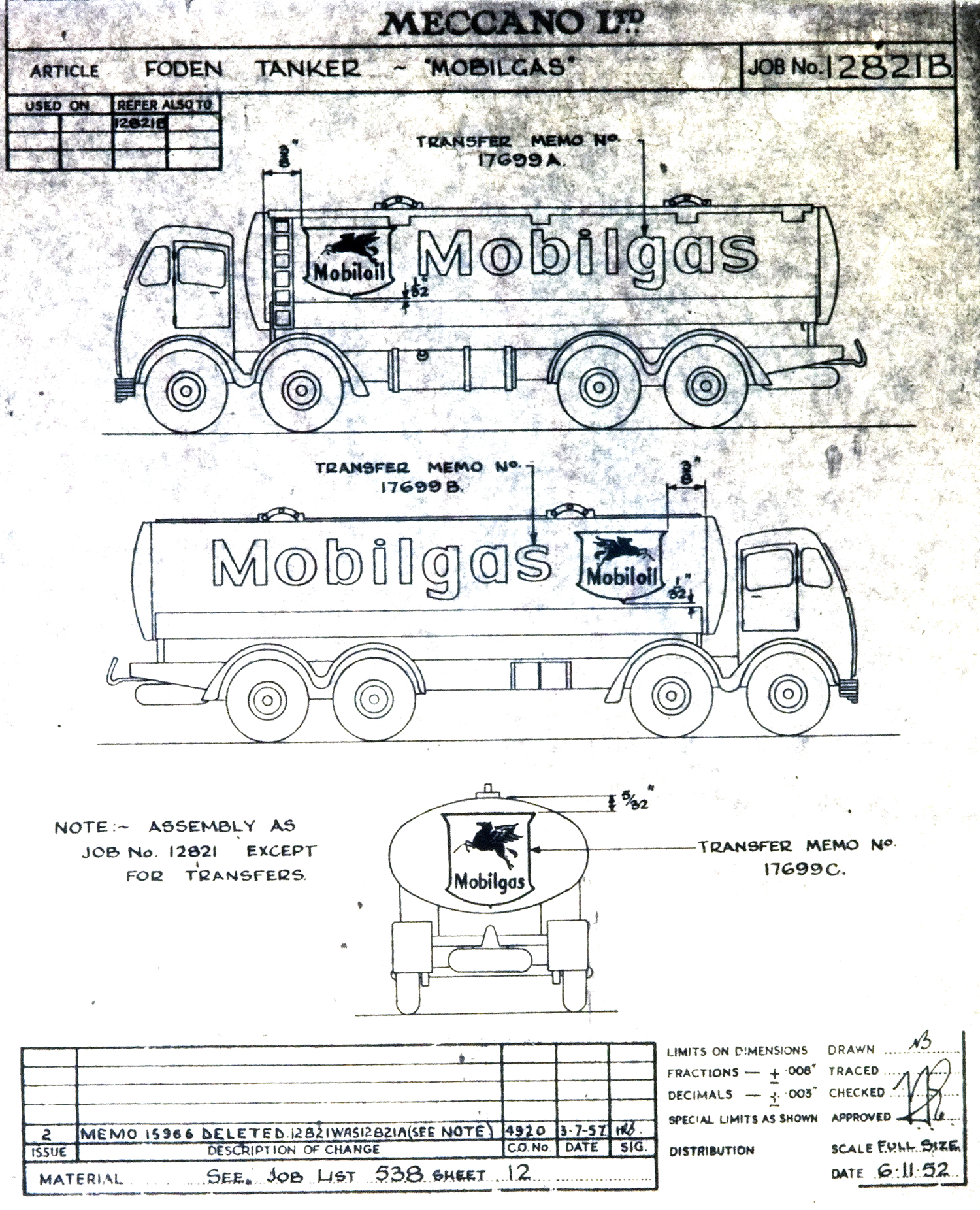
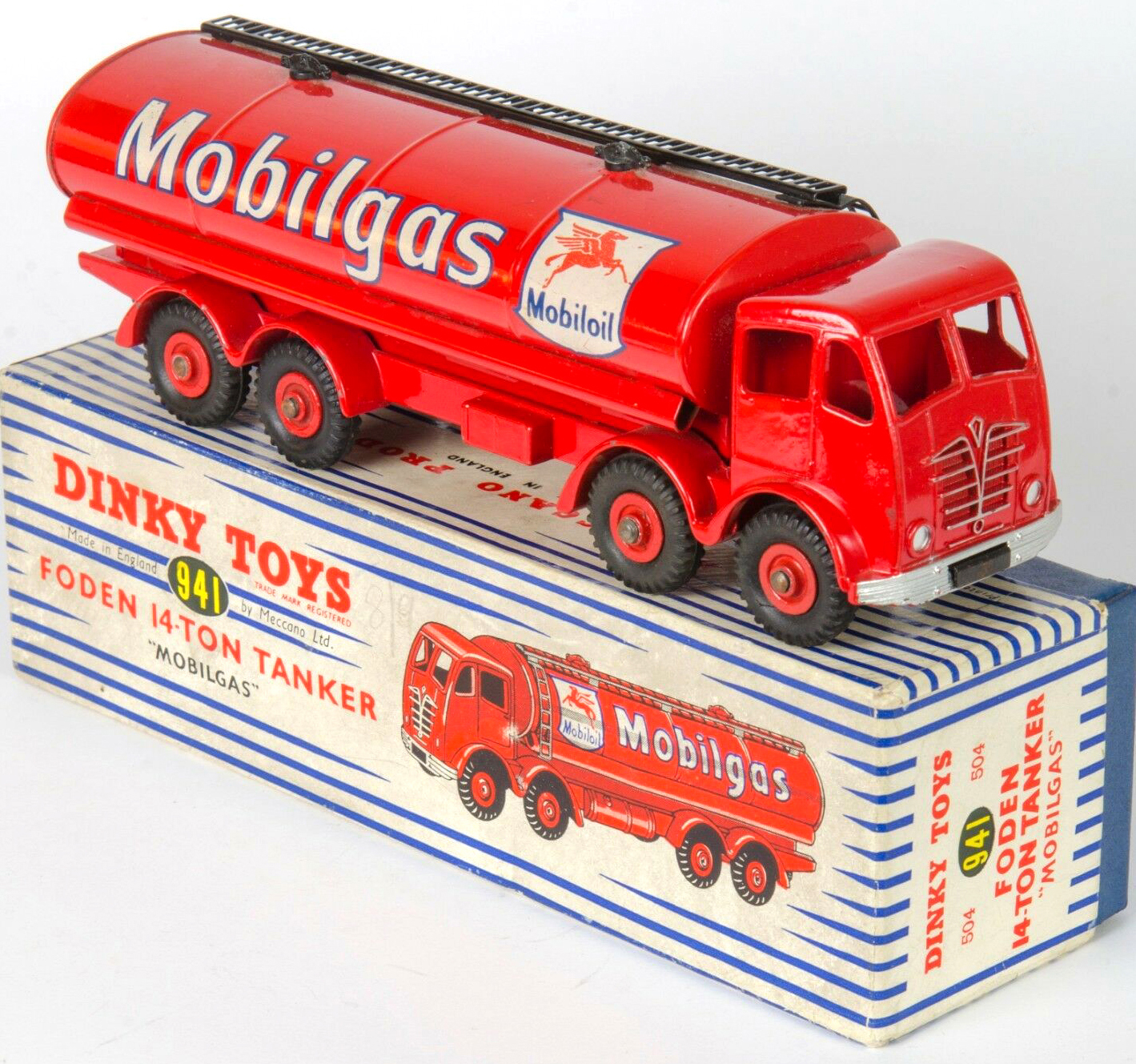
The 504 Foden 14-ton Tanker “Mobilgas” shown above with the attractive Mobilgas transfers has the flying horse (Pegasus) logo of the Mobil Oil company on either side as well as on the rear of the tanker. The white Mobilgas lettering on the sides of the red tank is outlined in blue and the red Mobil Oil flying horse logo faces forward. Meccano drawing Job No. 12821 B shown below indicates how the transfers on the tank were to be applied. The model is a US export version with the red H. Hudson Dobson export label on one side of the box.
Drawing of the Foden Tanker “Mobilgas” (Meccano Job No. 12821 B, dated 6 November 1952). The description of the change at point 2 in the drawing refers to the deletion of the 20 mph speed limit sign on 3 July 1957. Image: Dave Busfield.
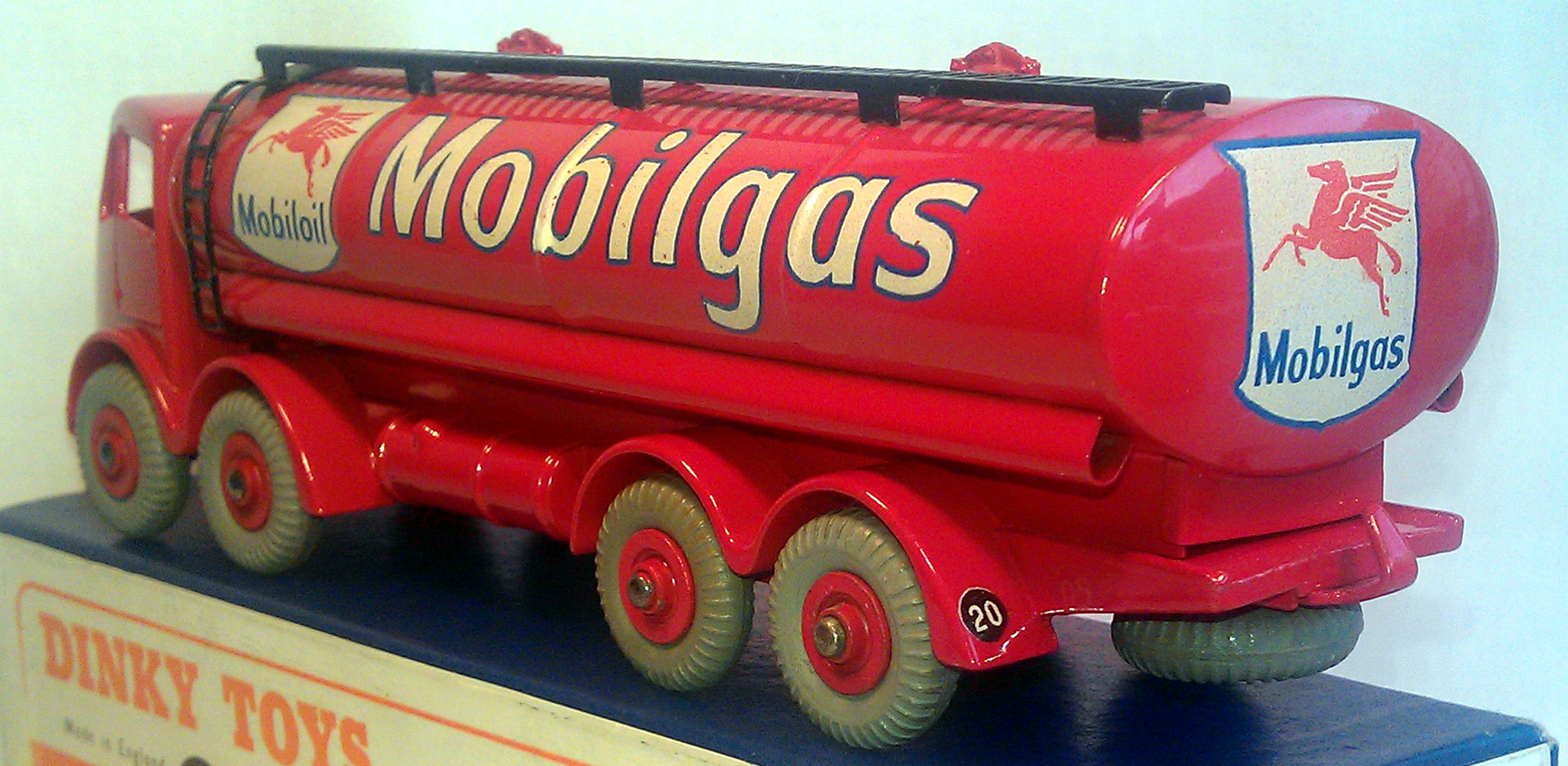
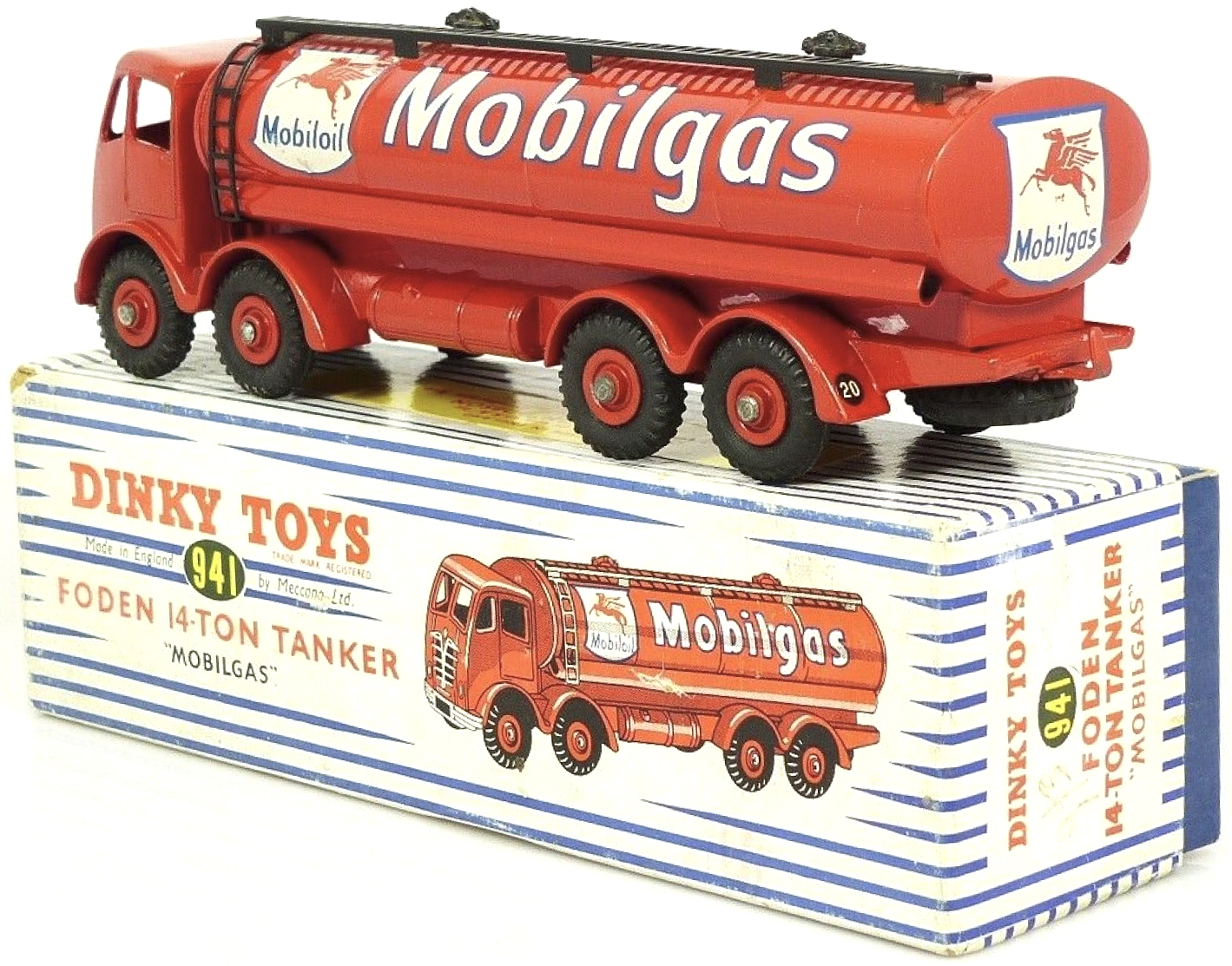
Here we see the rear left side of the model with the Mobilgas flying horse logo at the rear of the tank, facing forward as shown on the Meccano drawing above. This model is the the first version with red filler caps and grey tires, unlike the later version that has black filler caps and tires. This first version also includes the 20 mph speed limit sign on the left rear fender. This is my first model with a US export label and is in excellent condition. The box is stamped “M8 8”, possibly for the person who inspected the model.
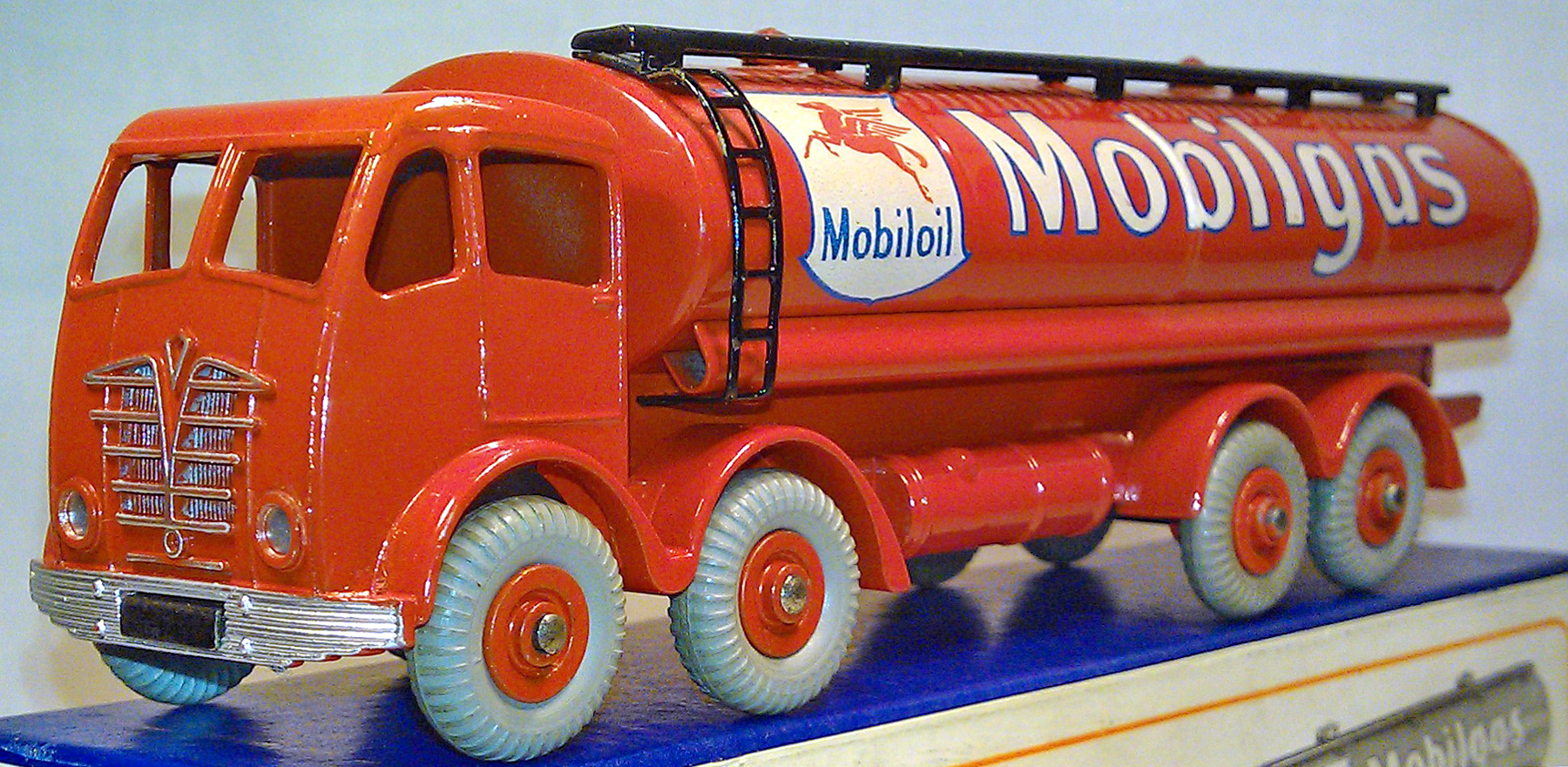
The picture above shows the front of the model with its detailed radiator grill, headlights and bumper in silver trim. Access to the two filler caps (that were made by Meccano) on the roof of the tank is provided by a ladder on the front left of the tank. Below the tank on either side are connectors to connect a hose for delivering its contents to their destination.
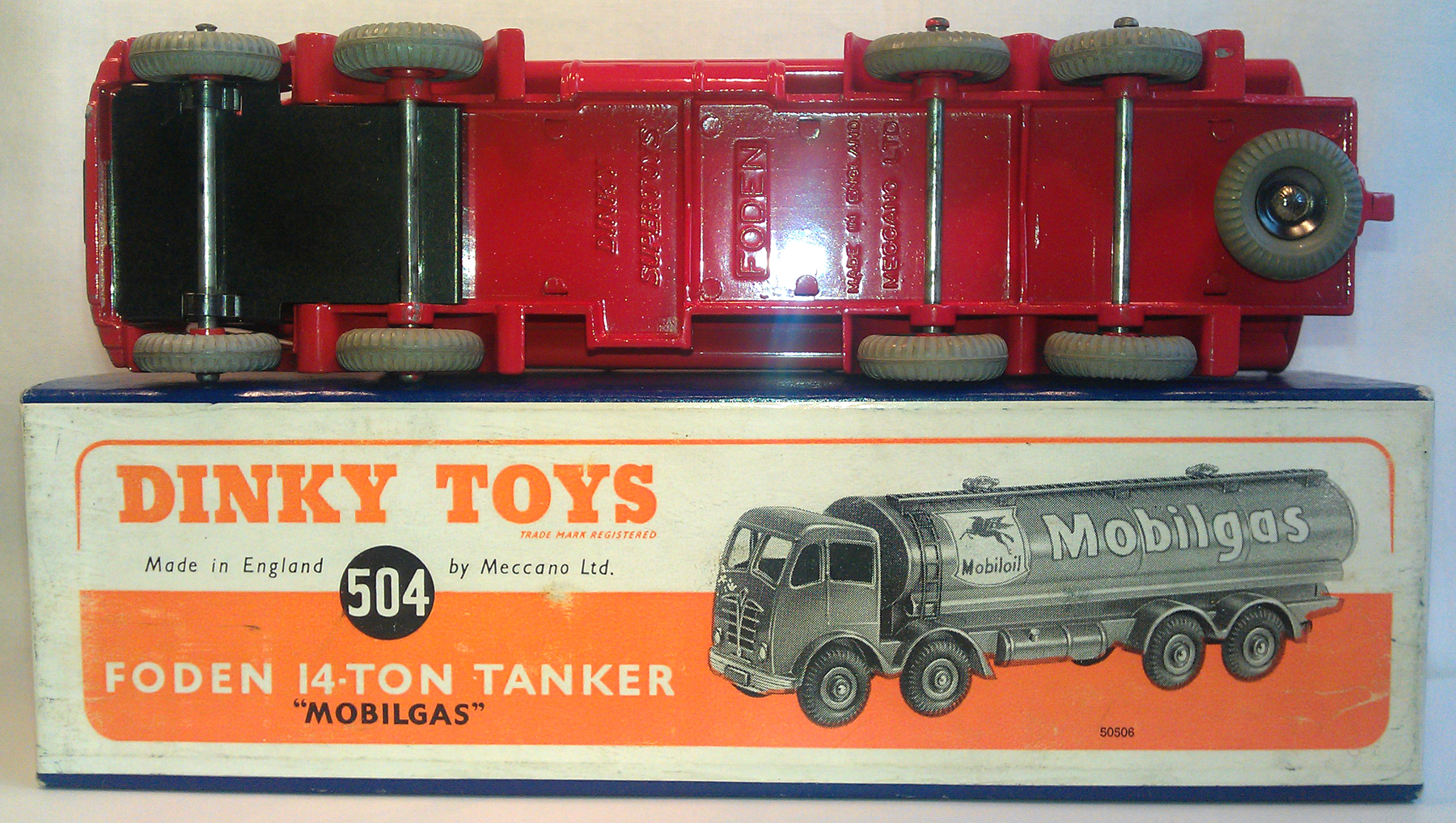
Here we see the 504 Foden 14-ton Tanker “Mobilgas” with its Dinky Supertoys Foden base. The tin plate tank is attached to the chassis with six fold-over mounting tin tabs, with the spacing between the tabs being uneven along the length of the tank. The spare wheel is riveted to the chassis. The model is resting on a type 1 Dinky Toys 504 blue box with an orange and white label with an accurate image of the tanker, below which is the factory code number 50506.
This 504 box was soon replaced during the renumbering phase by a blue and white striped dual numbered 941–504 box, and later by a single numbered 941 box. The 941 box continued to sport the “Dinky Toys” name although the model was classified as part of the “new 900 Supertoys range”.
These pictures show the 941 Foden 14-ton Tanker “Mobilgas” on a dual numbered 941–504 blue on white striped Dinky Toys box (left) and a single numbered 941 box (right). Note the black filler caps and tires.
Dinky Toys or Dinky Supertoys?
Dinky collectors would have been surprised to see the 504 Foden Tanker with a Dinky Supertoys base suddenly being advertised as a Dinky Toys model and released in a Dinky Toys box, soon after the announcement and start of Dinky Supertoys production in August 1947. This is one of the remarkable developments at Meccano Liverpool.
In the early 1950s, Meccano Liverpool was struggling with renumbering and the move to the Dinky Supertoys name. Between March 1951 and January 1955, advertisements in Meccano Magazine bore the name Dinky Toys exclusively without any explanation. For four years, no Dinky catalog or price list mentioned Dinky Supertoys. Only the American catalogs from 1952 and 1953–1 still listed Dinky Supertoys, which must have been a mistake. No new Dinky Supertoys models were released and all new issues were named Dinky Toys. Existing Dinky Supertoys models were issued in Dinky Toys boxes during that period.
The new model 505 Foden Flat Truck with Chains (with a Dinky Supertoys base) that was advertised in the January 1952 issue of Meccano Magazine, was released as a Dinky Toys model with a first type cab and a Dinky Toys box. It seemed as if the Dinky Supertoys name was being phased out.
Reintroduction of the Dinky Supertoys name
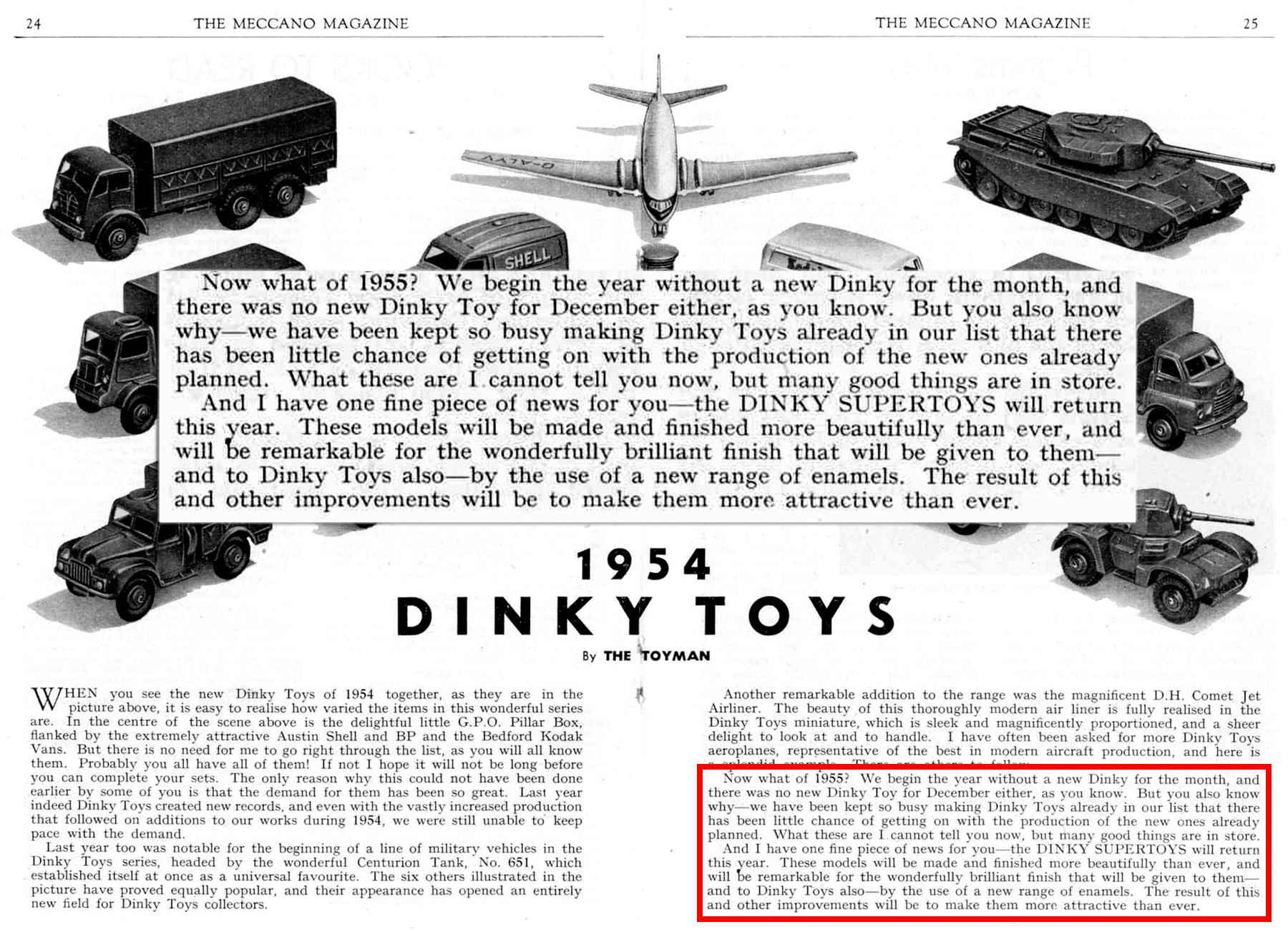
In his New Year’s article in the January 1955 issue of Meccano Magazine, The Toyman announced the reintroduction of the Dinky Supertoys moniker with the words: “And I have one fine piece of news for you – the DINKY SUPERTOYS will return this year”.
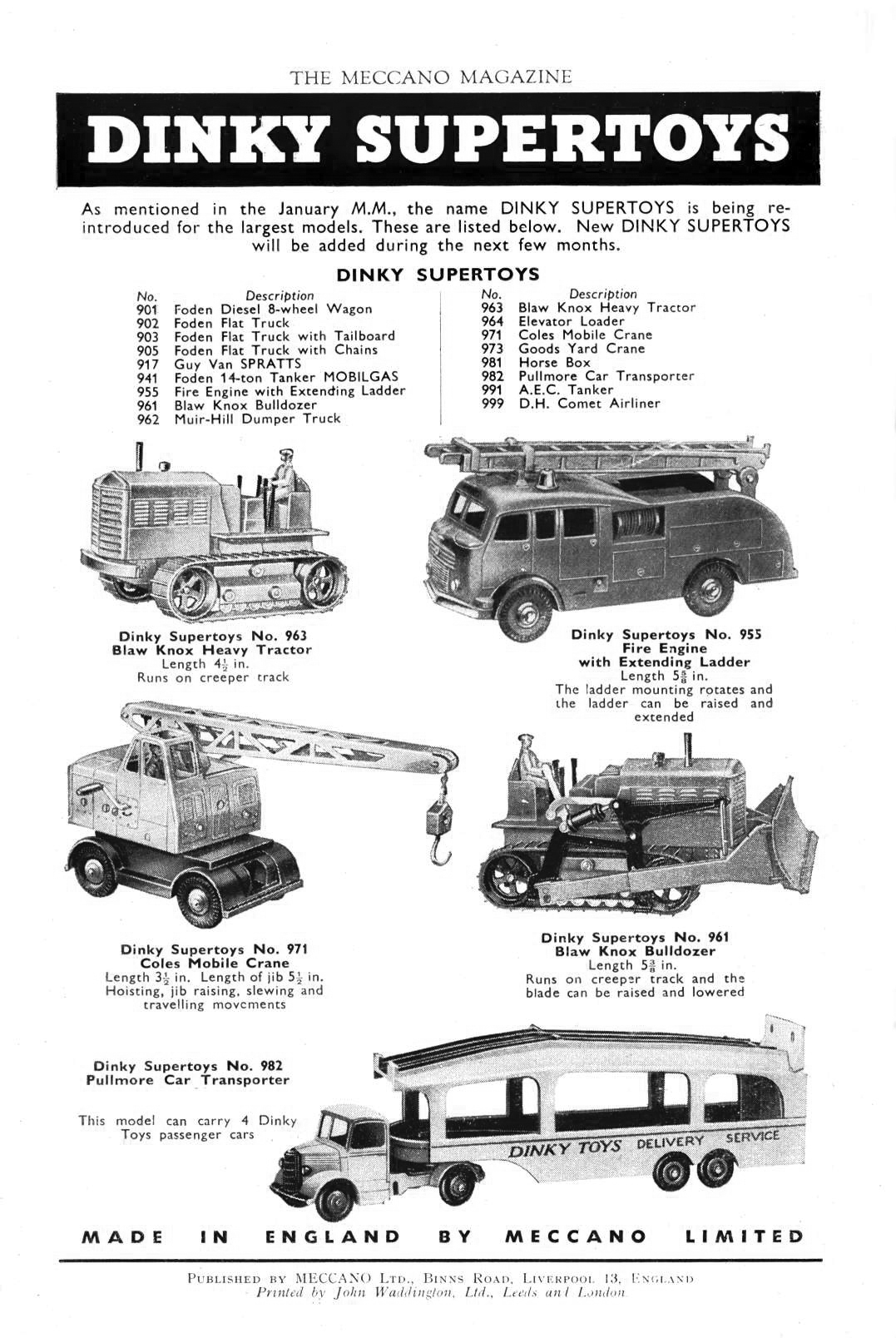
In February 1955, Dinky Supertoys advertisements in Meccano Magazine resumed and the reclassification of 17 Dinky Toys to Dinky Supertoys was announced in the March 1955 issue, including the 941 Foden Tanker Mobilgas and all other Fodens, as shown in the pictures above.
The Dinky Supertoys advertisement of February 1955 announced: “New Dinky Supertoys will be added during the next few months”. The first Dinky Supertoys announced as “new” was the No. 972 Coles 20 Ton Lorry Mounted Crane which was pictured on the back cover of the May 1955 issue of Meccano Magazine. The reissue of Dinky Supertoys boxes took some time to be implemented in practice. The 941 Foden Tanker Mobilgas that had been recently reclassified as a Dinky Supertoys didn’t receive a Dinky Supertoys box, but two Dinky Toys boxes. Its successor, the Dinky Supertoys 942 Foden 14-ton Tanker Regent, was also initially released in a Dinky Toys box. Pictures of these boxes appear later in this article.
Cause of the interruption
The cause of the interruption of the Dinky Supertoys name in the early 1950s was undoubtedly the shortage of metal due to the Korean War (1950–1953). Because the production of Dinky Supertoys required more metal, production focused on Dinky Toys, causing the Dinky Supertoys name to temporarily disappear. The supply of Dinky Supertoys models was therefore very limited.
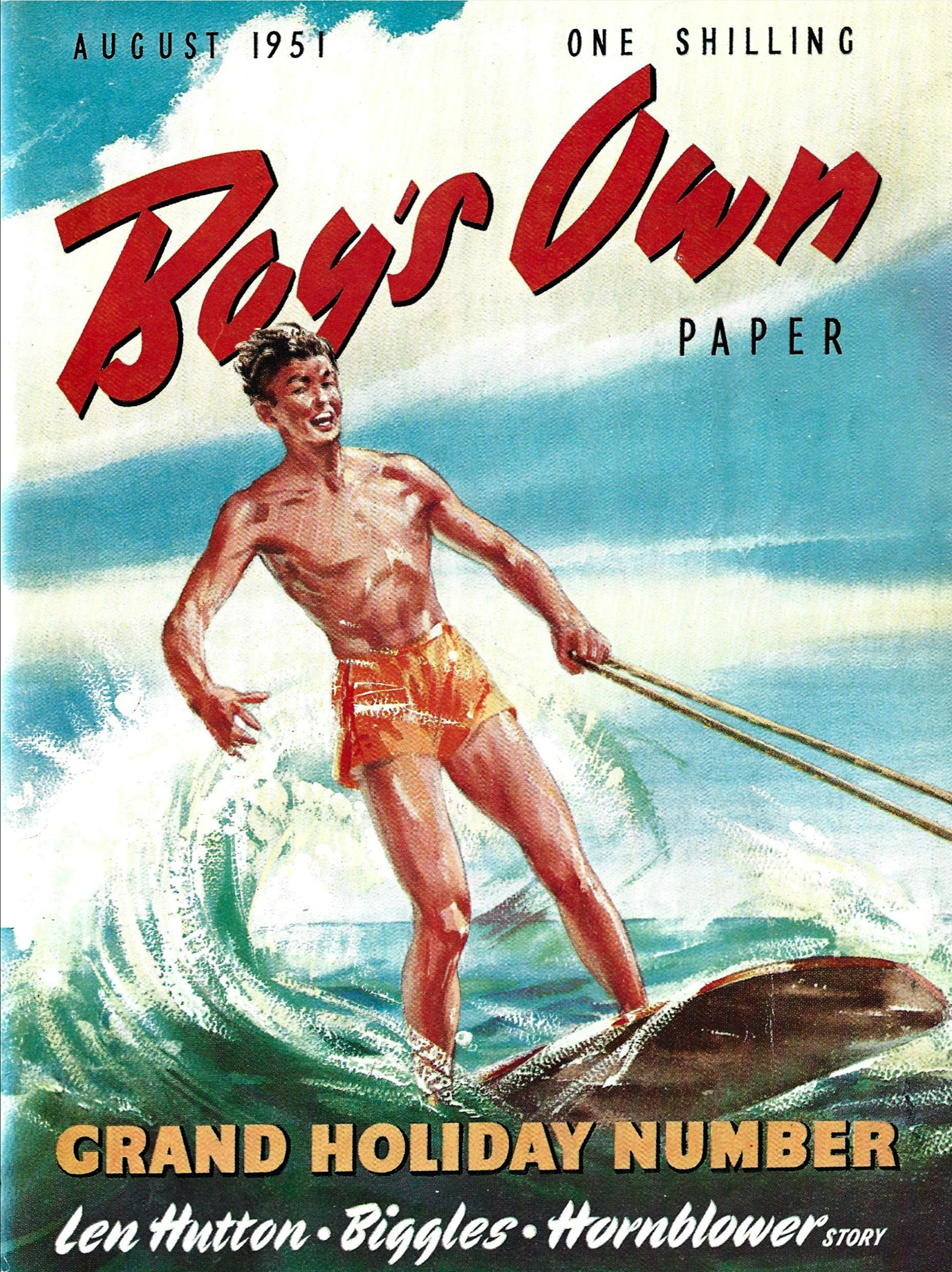
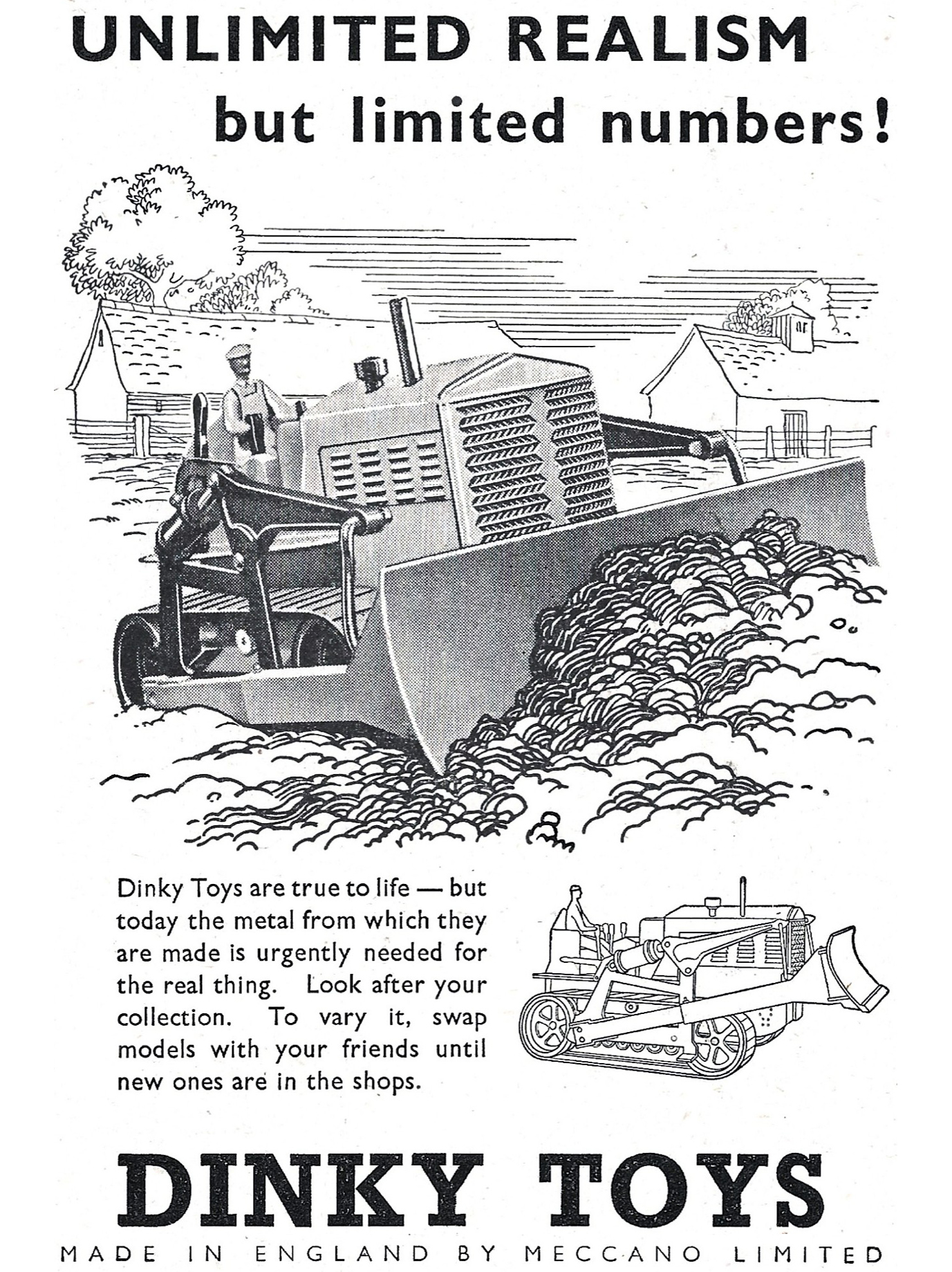
This coincides with a remarkable advertisement of Meccano Limited in the August 1951 issue of Boy’s Own Paper magazine. The advertisement shows a drawing of the Dinky Supertoys 561 Blue-Knox bulldozer in action with the statement: “UNLIMITED REALISM but limited numbers!”. Below the drawing is written “Dinky Toys are true to life – but today the metal from which they are made is urgently needed for the real thing. Look after your collection. To vary it, swap models with your friends until new ones are in the shops.”
Note: The ad shown above was posted by DTCA Chairman Michael Driver in the July 2017 issue of the DTCA Journal, along with the description “Because of the metal shortages, the supply of Dinky Toys was restricted and Meccano produced limited supplies of Dinky Toys for sale in that period.” I was able to obtain this issue of Boy’s Own Paper and scanned the cover and ad for this article. I think it’s remarkable that this advertisement never appeared in Meccano Magazine.
Meccano Liverpool looked for alternative raw materials and produced some models in aluminum, such as the No. 581 Horse Box and the No. 582 Pullmore Car Transporter. But they also struggled with production capacity, as The Toyman revealed in his New Year’s editorial of January 1955: “Last year indeed Dinky Toys created new records, and even with the vastly increased production that followed on additions to our works during 1954 (Speke factory), we were still unable to keep pace with the demand.”
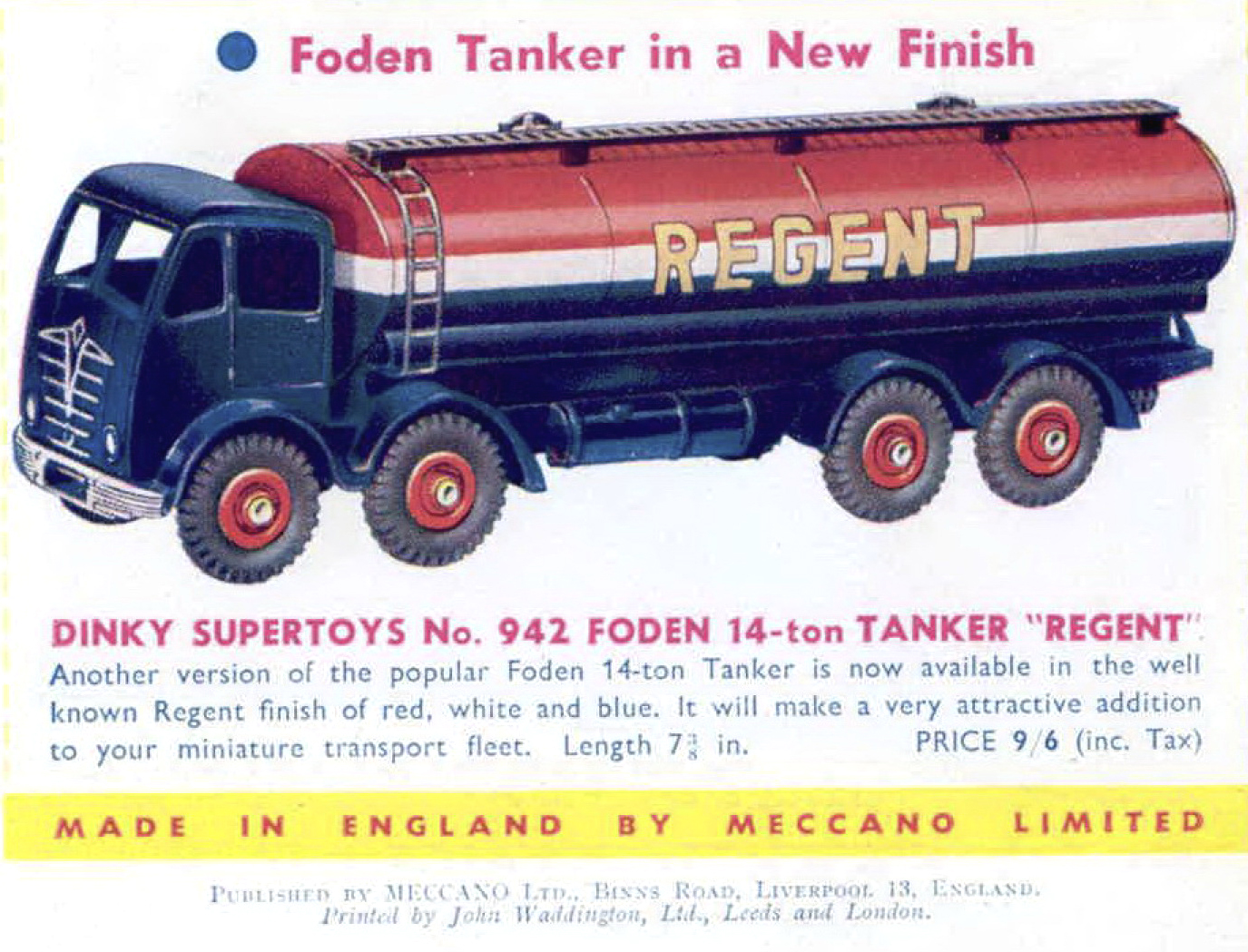
To renew its range of Dinky Toys tanker vehicles, Meccano Liverpool introduced the popular Foden tanker in a new finish with the name and logo of the British Regent Oil Co. Ltd. in red, white, and blue Regent livery. This tanker was the first to be once again advertised as a Dinky Supertoys model, namely the Dinky Supertoys 942 Foden 14-Ton Tanker “Regent” in the June 1955 issue of Meccano Magazine, along with a separate description by The Toyman that read “The catalogue number of the Regent tanker is No. 942 and it is of course included in the Supertoys range”, thereby definitively classifying it as a Dinky Supertoys model.
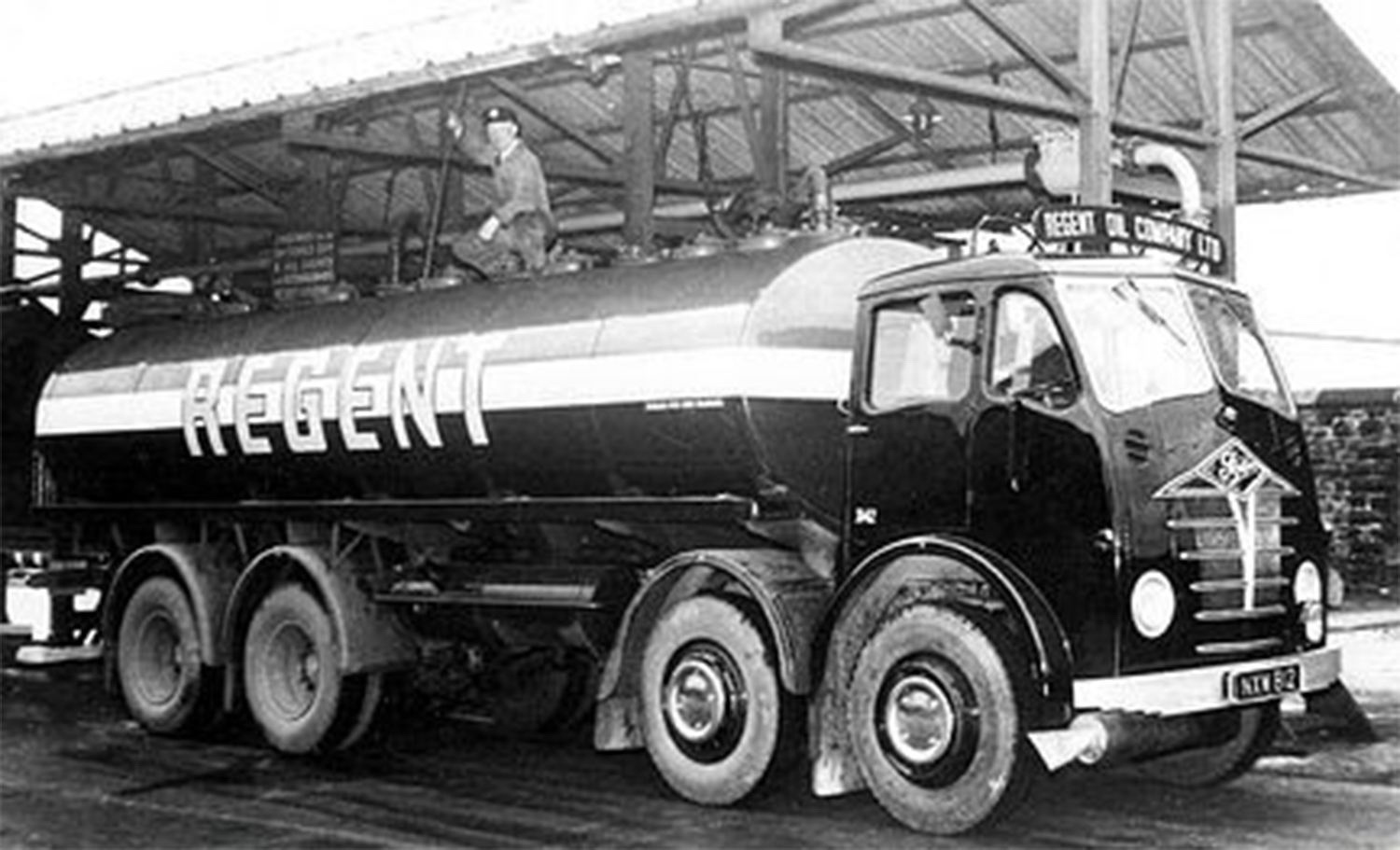
A Foden FG Tanker Regent at a fuel depot. Image: Aroldo Morais (Facebook)
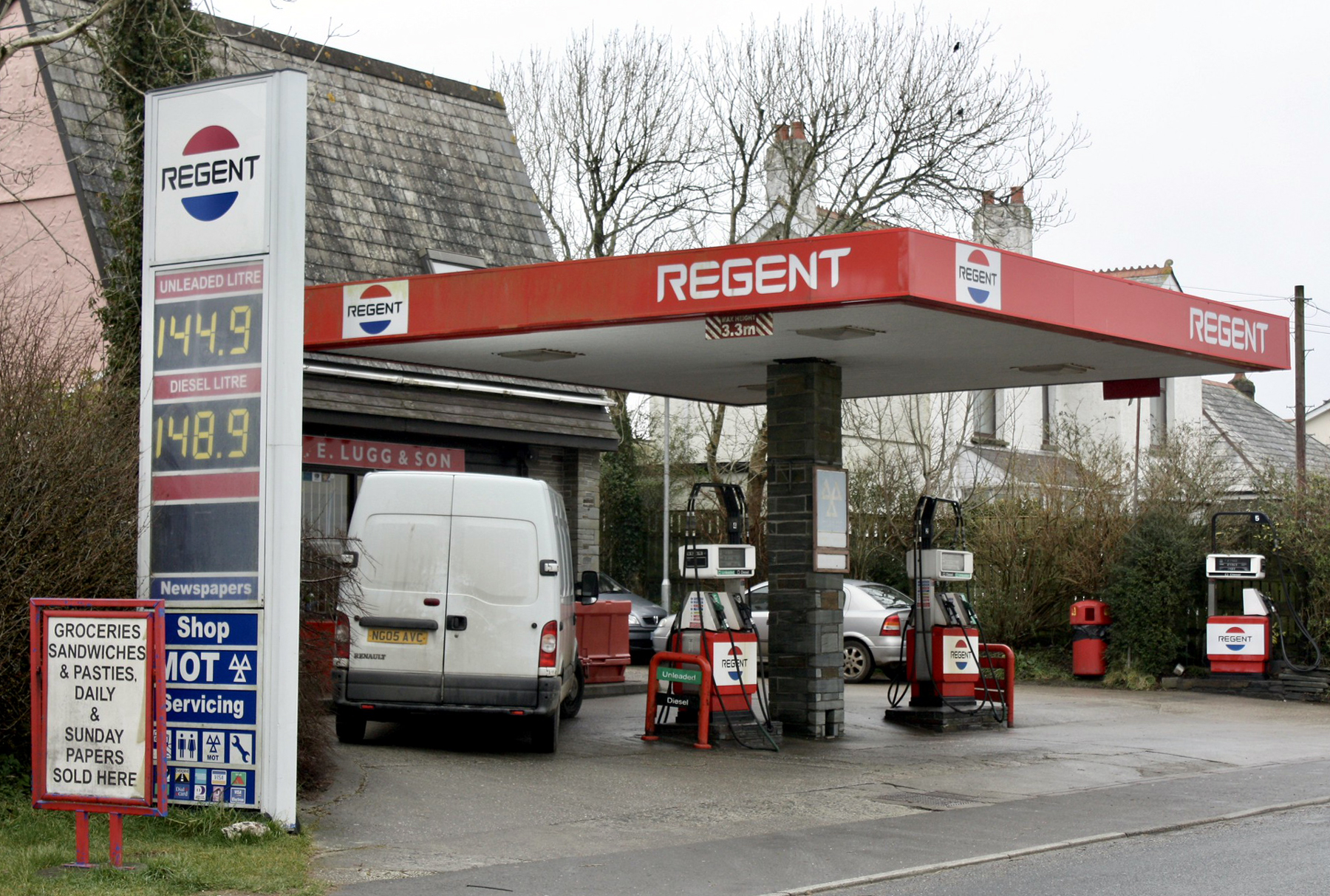
A Regent gas station, Rockhead Street, Delabole, Cornwall (2013). Image: E Y Busman (Flickr)
In the June 1955 issue of Meccano Magazine the Dinky Supertoys No. 942 Foden 14-ton Tanker “Regent” was advertised with the byline “Another version of the popular Foden 14-ton Tanker is now available in the well known Regent finish of red, white and blue.” It replaced the Dinky Toys 941 Foden 14-ton Tanker “Mobilgas”.
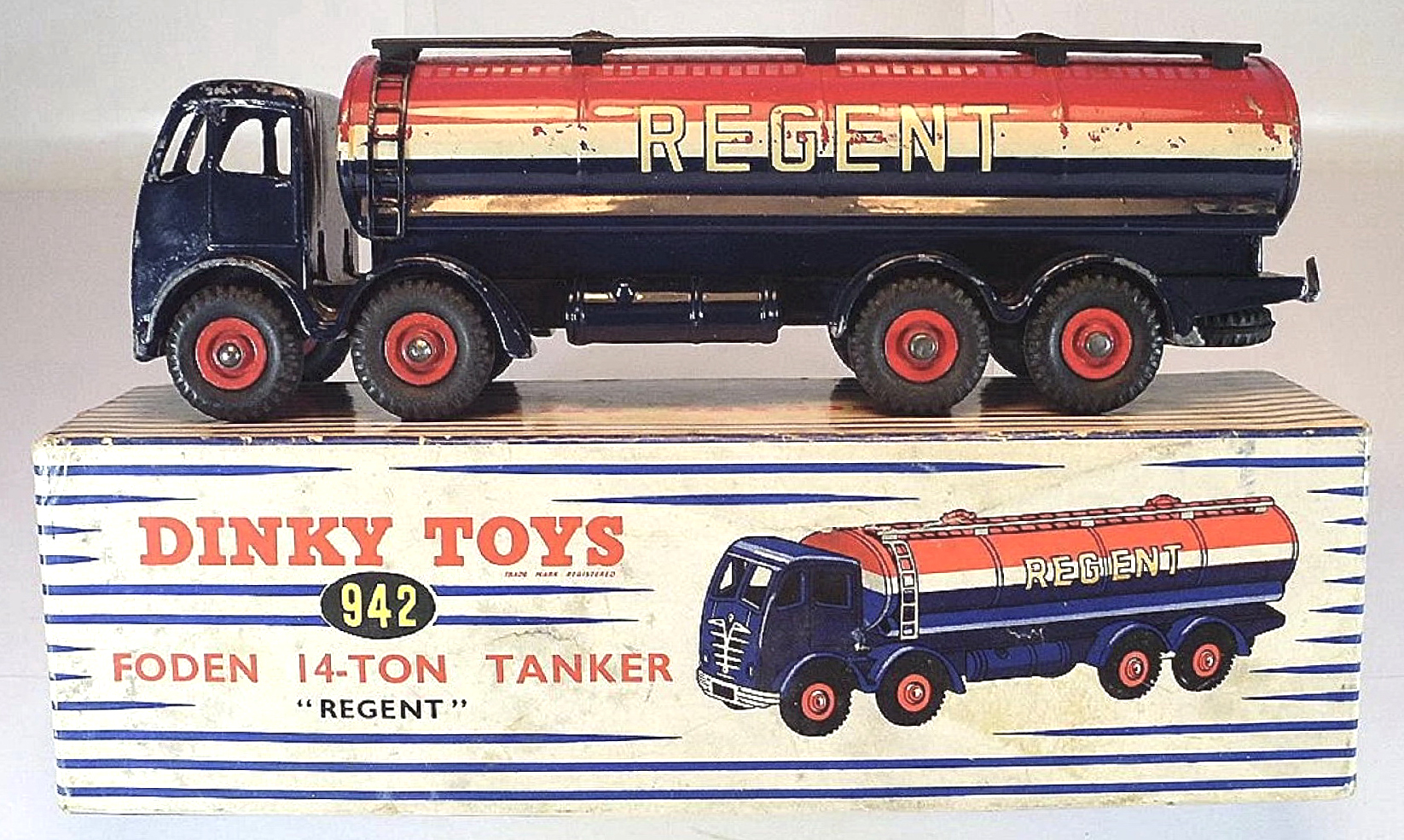
Shown above is the No. 942 Foden 14-ton Tanker “Regent” in its first blue and white striped Dinky Toys box, despite it being classified as a Dinky Supertoys in the advertisement and in The Toyman’s description above.
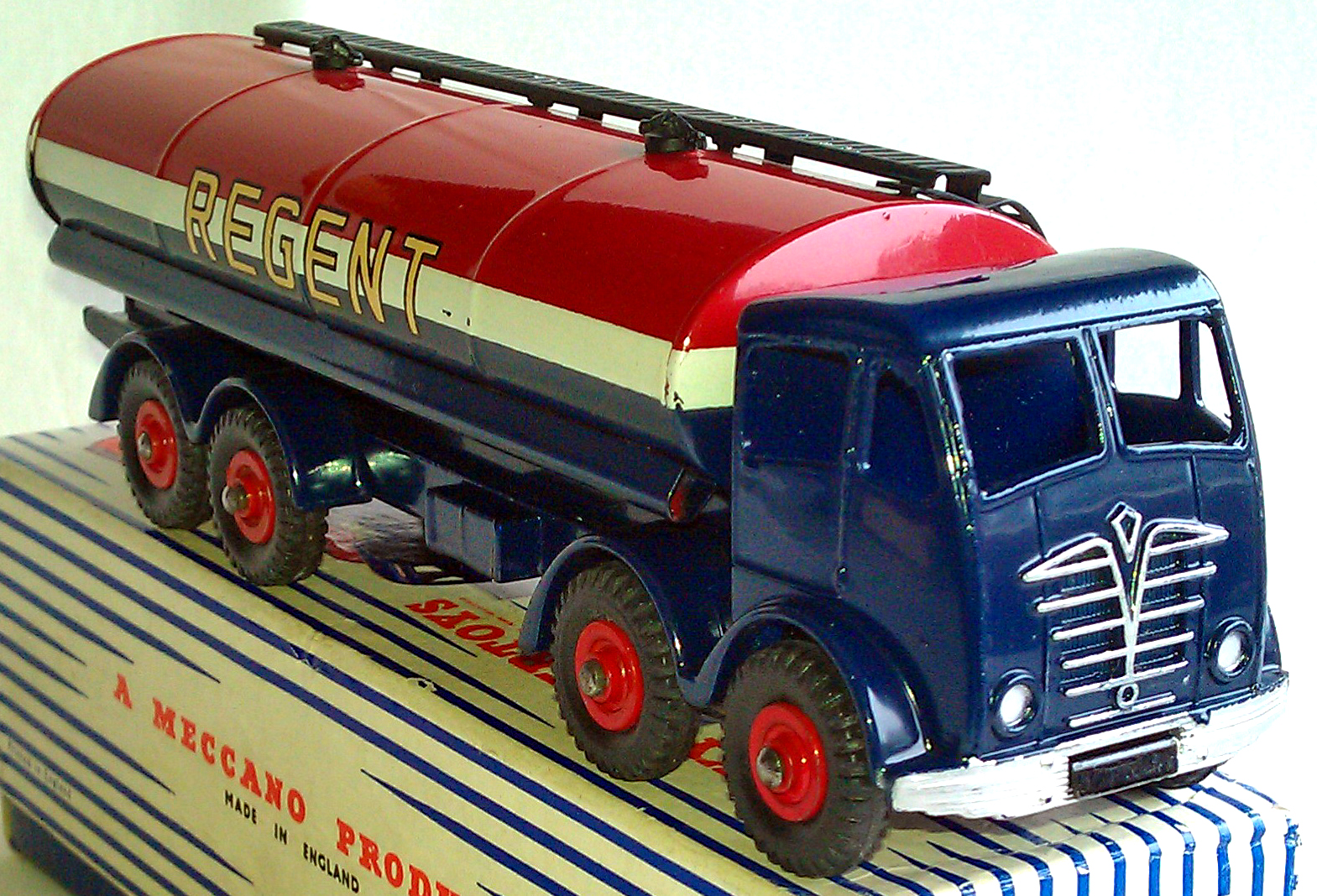
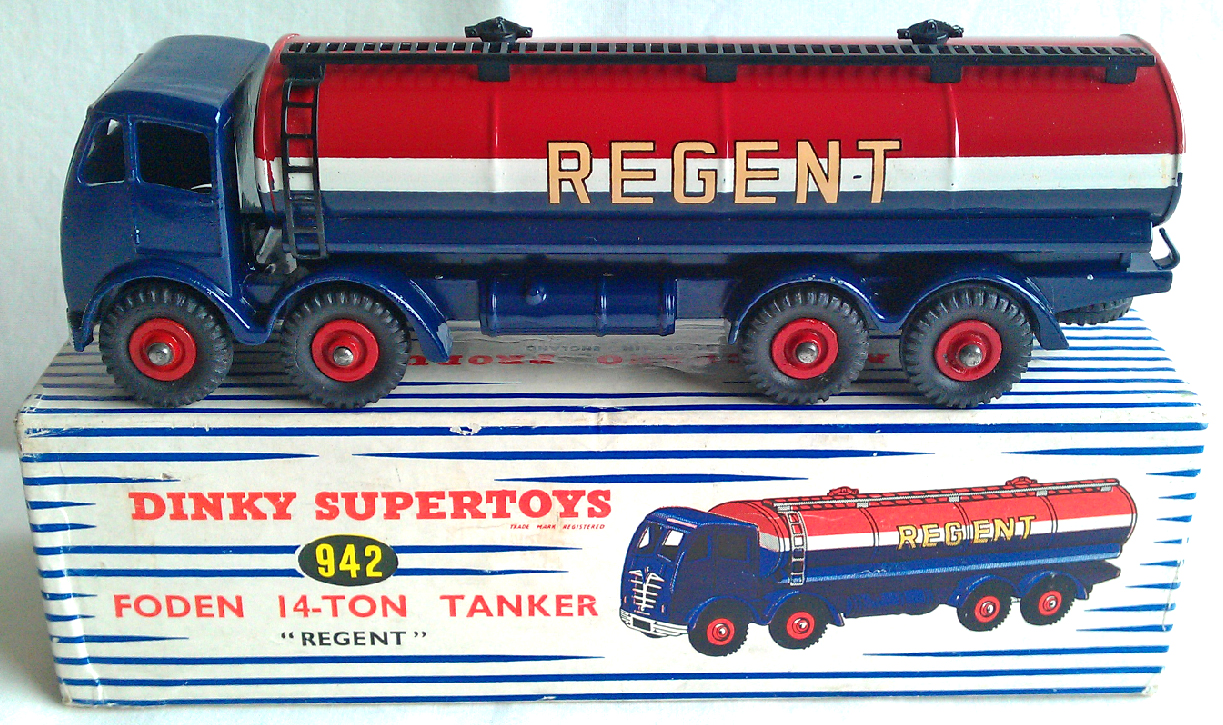
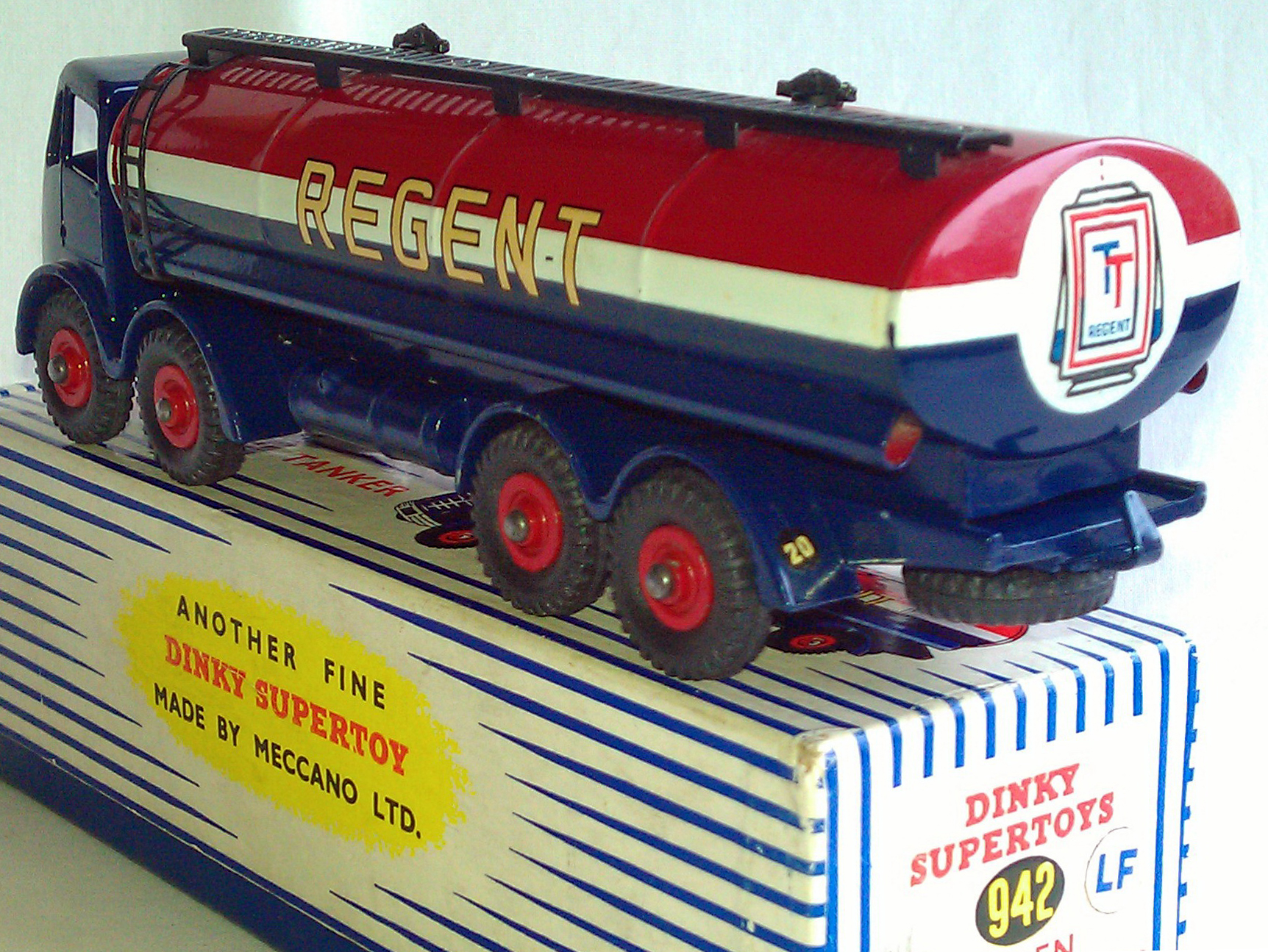
This picture shows the No. 942 Foden 14-ton Tanker “Regent” atop a correct Dinky Supertoys box and stamped “Z E1156” for “November 1956”. The company name “REGENT” is adorned in gold and outlined in black.
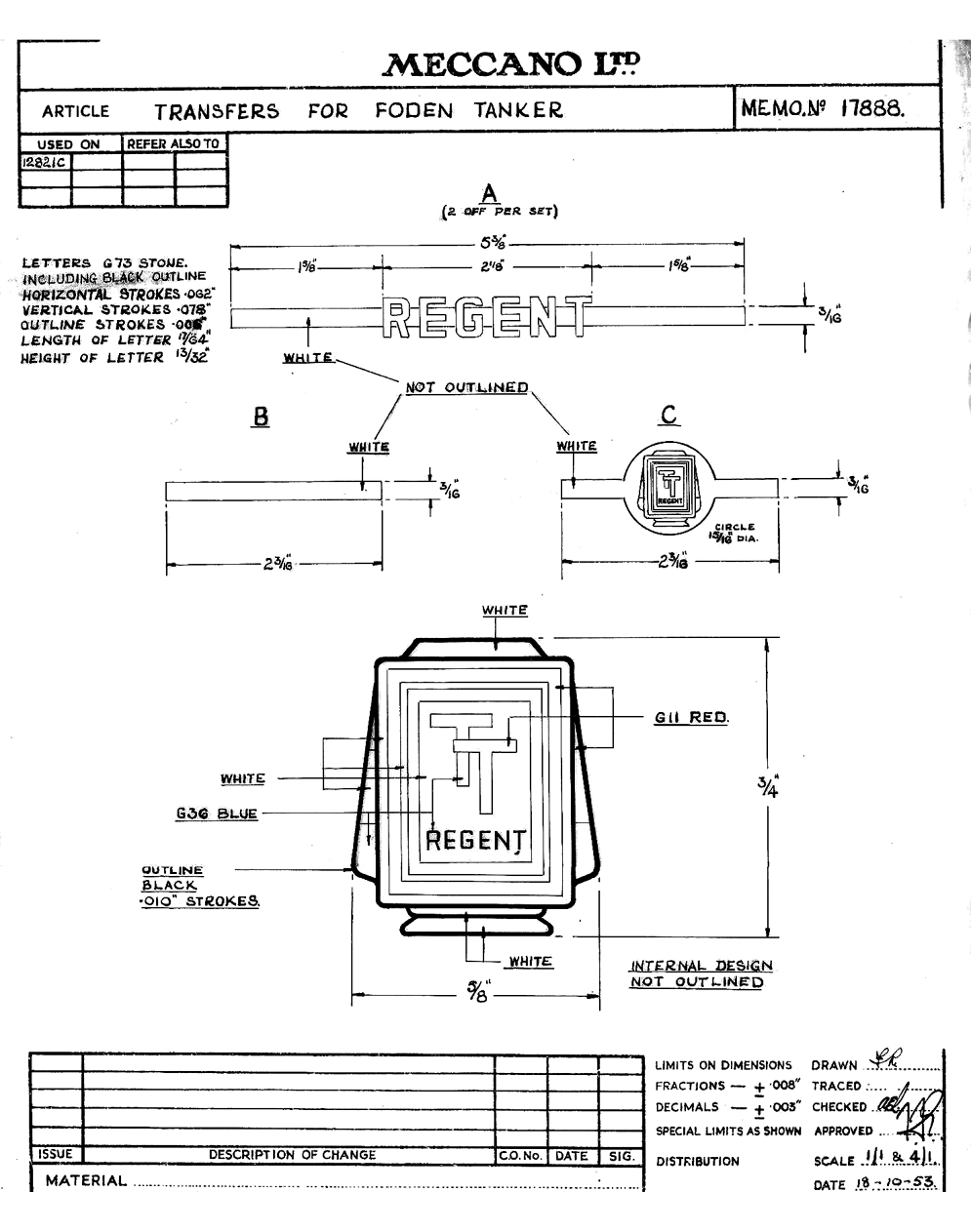
Shown above on the left is the Meccano drawing for the Foden Tanker “Regent”, Job. No. 12821.C dated 15 October 1953, supplied by Jan Werner. The description of change at point 2 of the drawing refers to the deletion of the 20 mph speed limit sign on 2 February 1957. On the right is Meccano Memo 17888 “Transfers for Foden Tanker Regent”, dated 18 October 1953 and supplied by the DTCA.
Shown above is the right front view of the Foden Tanker “Regent” with its radiator grill, bumper and headlights attractively accented in silver chrome.
The rear of the Foden Tanker “Regent” is adorned with the “TT REGENT” logo as shown in Meccano Memo 17888 pictured earlier, as well as the 20 mph speed limit sign on the left rear fender. Note the “LF” sticker on the end of the box, indicating the model was painted using lead free paint.
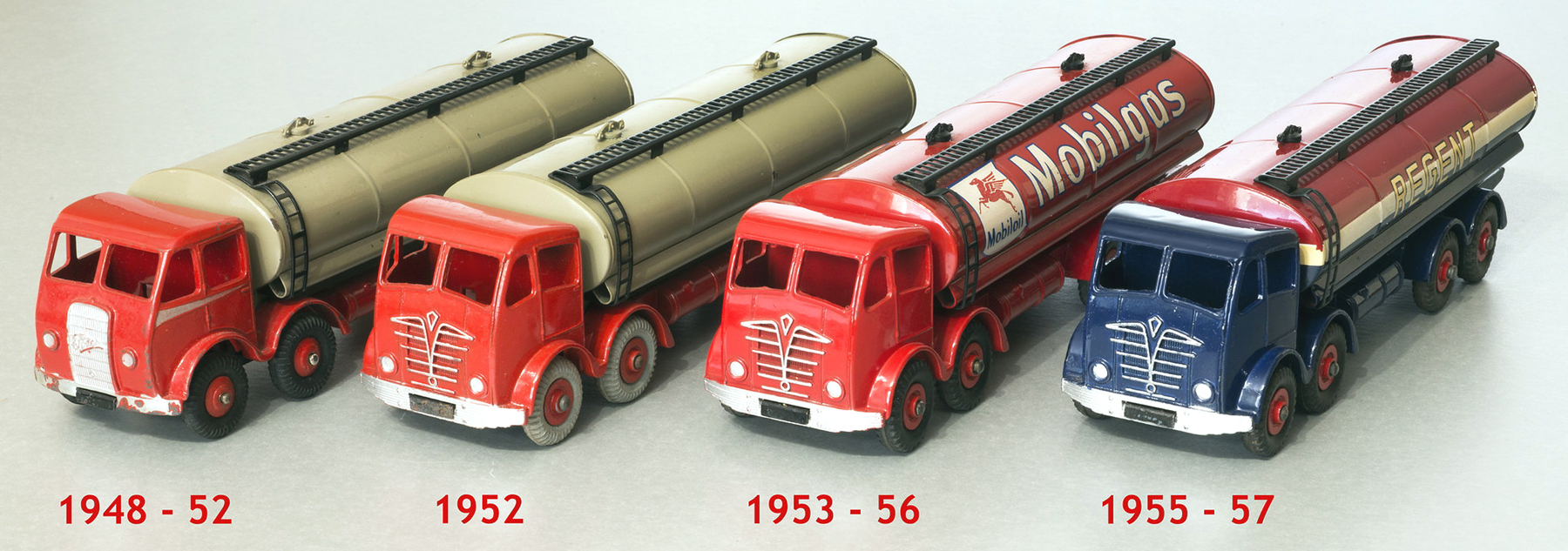
Shown here are four versions of the Dinky Supertoys Foden Fuel Tanker shared on Flickr by the late Dave Busfield. The Foden Dinky Supertoys tankers were succeeded in 1958 by three versions of the Leyland Octopus Supertoys tankers. They were the last tankers produced by Meccano Liverpool in the Dinky Supertoys range.
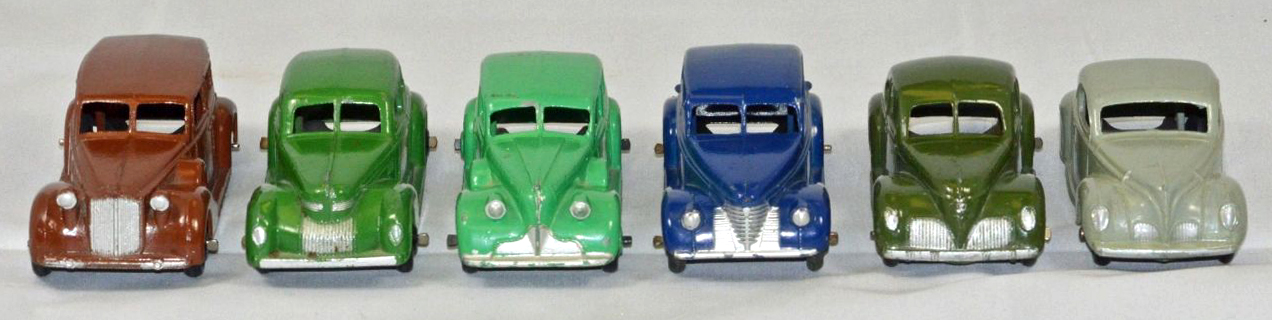
These 39 series, along with their English cousins, the 38 series, really put Dinky Toyson the model map in the late 1930s. The 39 series showcased new American sedans when they were introduced in 1939, and along with the 38 series of English tourers, were two key series of diecast Dinky models at that time.
Models from the Dinky 39A Series
Dinky Toys historians and experts believe that both the 38 and 39 series were two of the most important series Dinky ever made. They were the first Dinky Toys cars to be modeled more precisely on real cars. Besides that, they are just lovely models!
Dinky Toys 1950 US catalog
Looking at the details on these castings, Dinky Toys certainly established a “look” with their models that was distinctive for a very long time. It was a combination of an initial design based on the original vehicle, executing the die with Dinkyesque detail, and finishing it. It was a very successful combination for a long time. In this article I share my impressions and photos of the series.
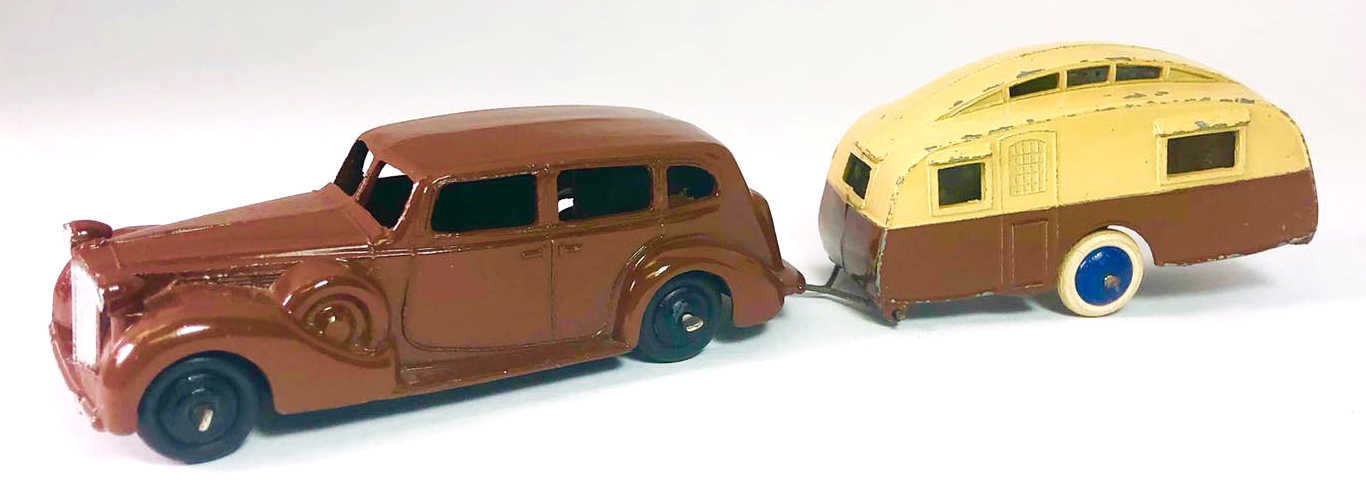
39A Packard Super 8 Touring Sedan
This lovely Packard was made from 1939 to 1941 and then from 1945 to 1952. The model shown dates from around 1950.
Dinky 39A Packard Super 8 Touring Sedan and Dinky 30G Caravan
I have seen many photos of the later 1950’s Caravan by Dinky Toys, but the earlier one, No. 30G, in the photo above was made pre-war only, and remarkably free of any of the dreaded metal fatigue which haunts so many pre-war Dinkys. This instance was made around 1939, and it is being towed by the majestic Packard.
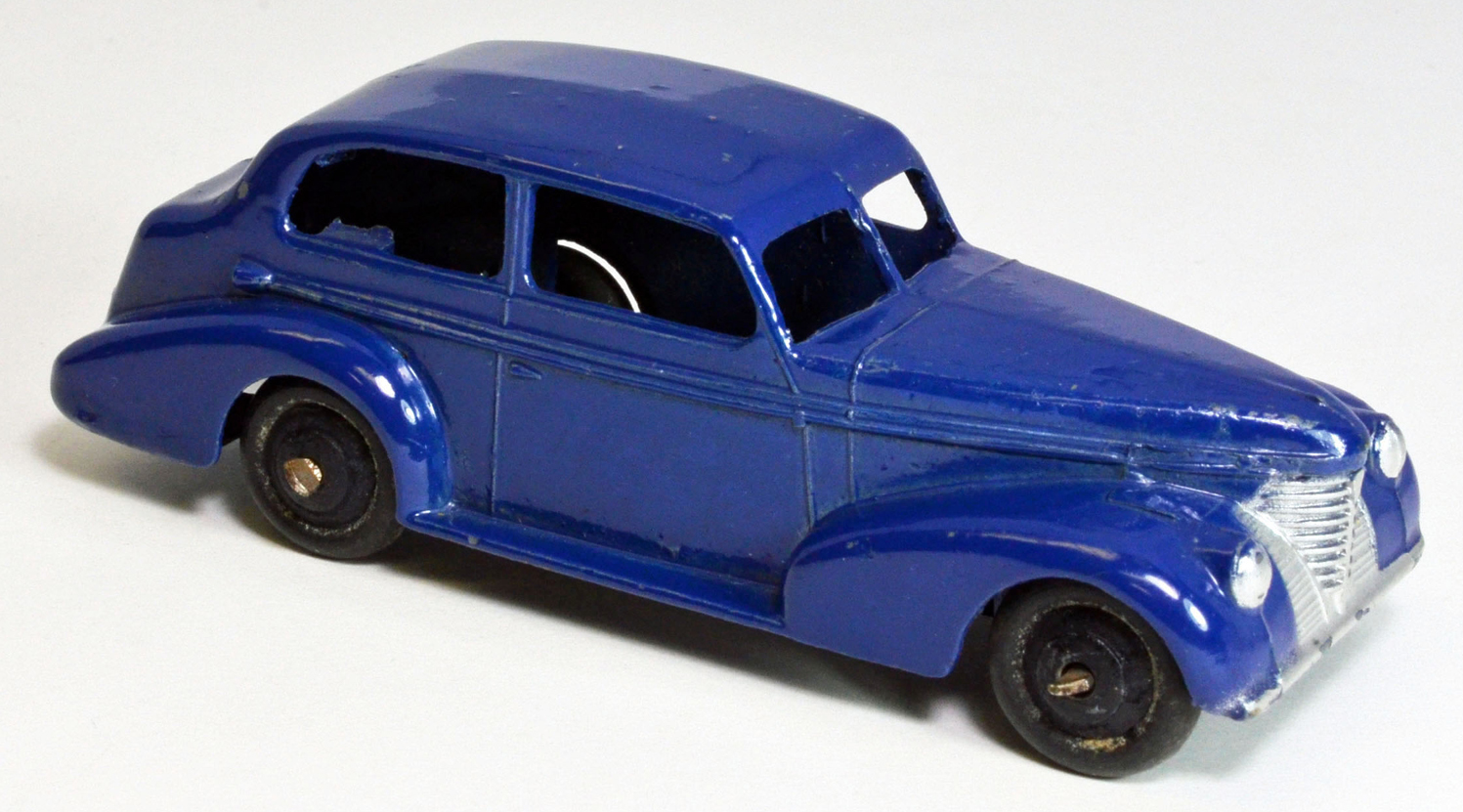
39B Oldsmobile Six Sedan
This 39 series Dinky Toys Oldsmobile Six Sedan dates from around 1950 and is painted a beautiful violet blue color. These pre-war and early Post-war Dinky Toys models have a wonderful look and charm all their own. Even as a young boy, I came to love them.
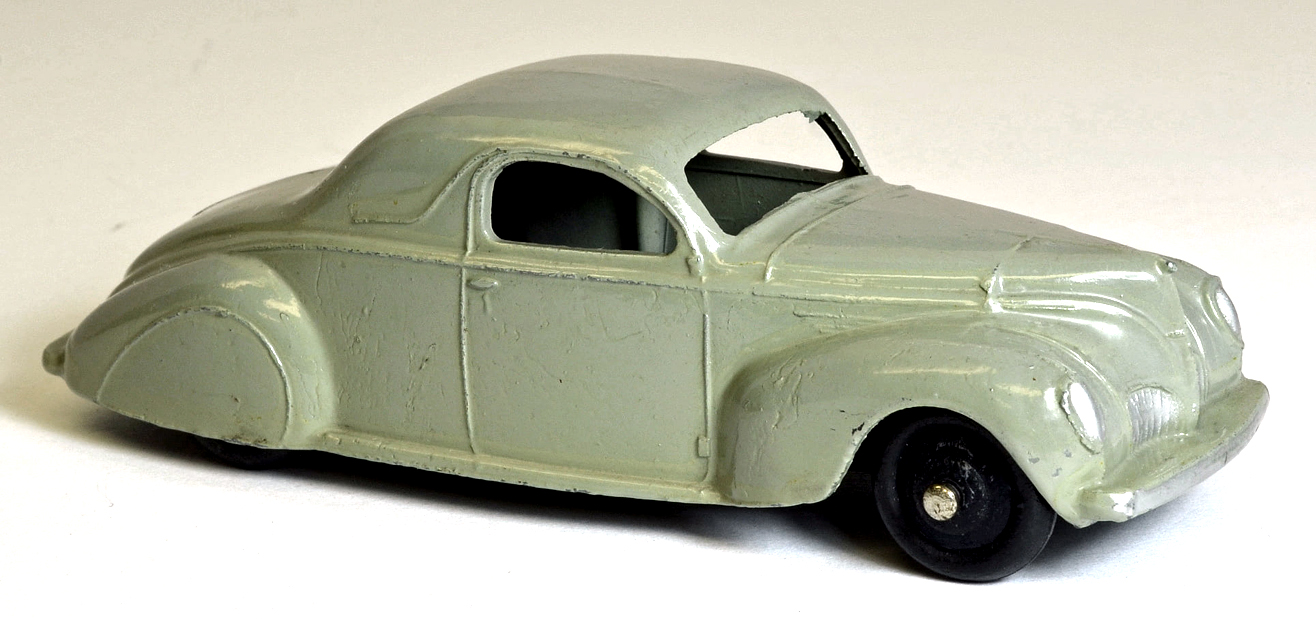
39C Lincoln Zephyr Coupe
A very popular model from the 39 series was the Lincoln Zephyr, a very stylish coupe. I love the graceful fastback design of this model. These vintage models are elegant in their simplicity; sometimes less is more!
39D Buick Viceroy Saloon
My favorite 39 series car is the Buick Viceroy, probably because it was one of my first purchases from H. Hudson Dobson in 1958. Mine is a later one with colored wheels. I have also always been a huge Buick fan. Years after I bought it, I wondered where the model name Viceroy came from, and after some searching I discovered that was an export model name that was never used in the US, which made sense. After 62 years of ownership, this one still has my heart!
Dinky 39D Buick Viceroy
H. Hudson Dobson had quite a few new old stock (NOS) Dinky Toys when my friend and I first contacted them in 1958, including those of the 38 and 39 series, 36 series, 25 series small trucks, and others. I thought it was neat that we were able to buy them, and at their original prices. I think this Buick cost me 75 cents!
39E Chrysler Royal Sedan
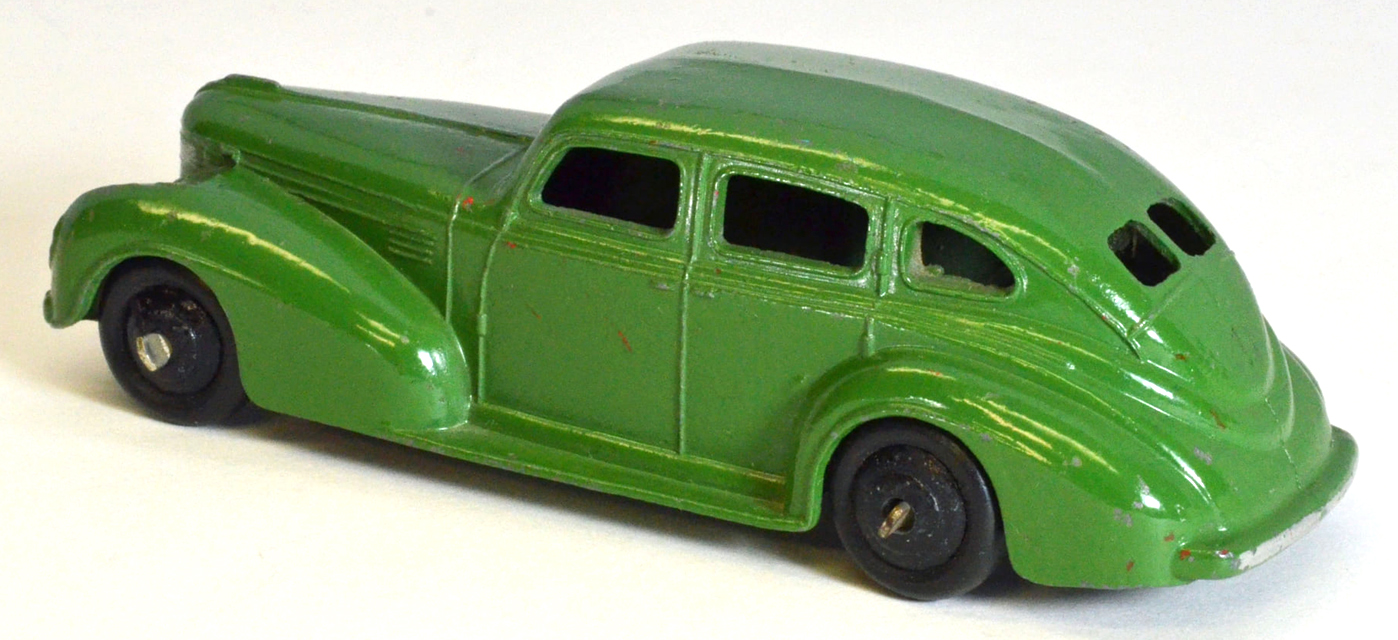
Another of the 39 series that showed some style was the Chrysler Royal sedan. I love the 3/4 rear view that shows the sweeping lines. It’s such a classic car and also a very classic model that Dinky produced early on.
This is another one I was fortunate enough to buy still new in 1958, my second acquisition from H. Hudson Dobson, the US distributor. They had been discontinued for several years, but H. Hudson Dobson had leftover NOS (new old stock) models that were sold for just 85 cents. It has stayed nearly pristine for 70 years. What a stylish car it was!
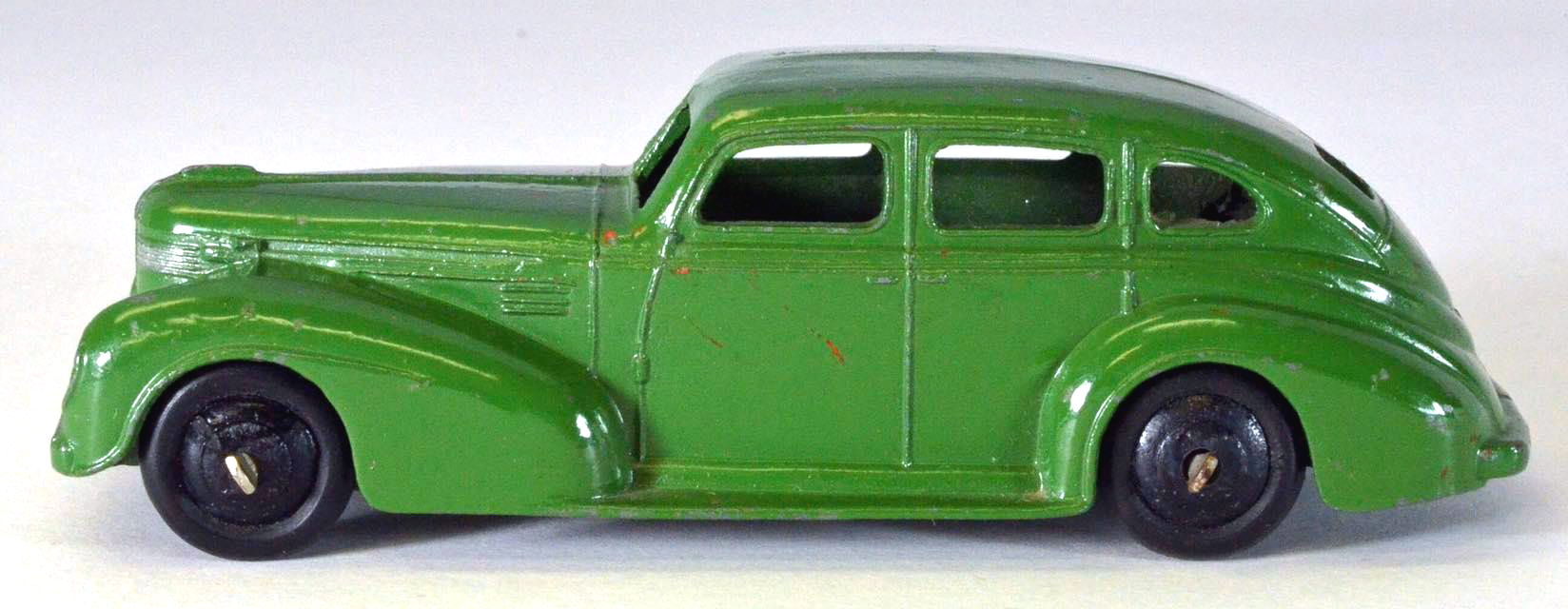
39F Studebaker State Commander Saloon
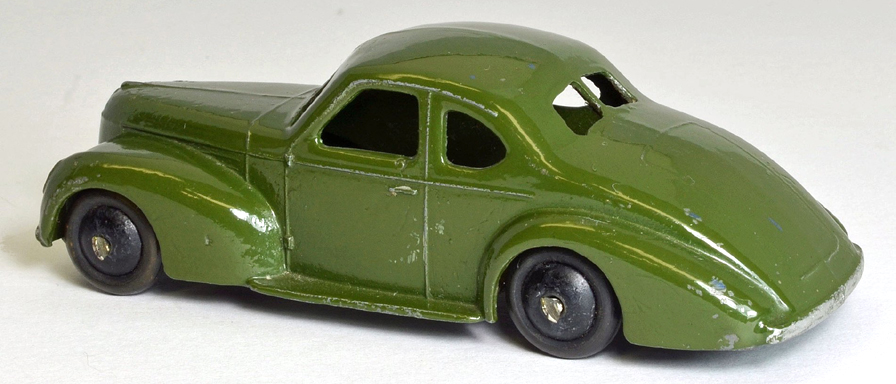
Another member of the wonderful 39 series of Dinky Toys, the Studebaker State Commander, was made briefly before the war during 1939–1941 and then again during 1945–1950. I just have one example: this lovely olive green instance from years ago. It has the smooth, non-ridged wheels, so has to be an early post war model, likely made around 1946.