I’ve been a lifelong heavy commercial and military vehicle enthusiast, but I also like some lightweight commercial vehicles as well: especially the Peugeot J7.
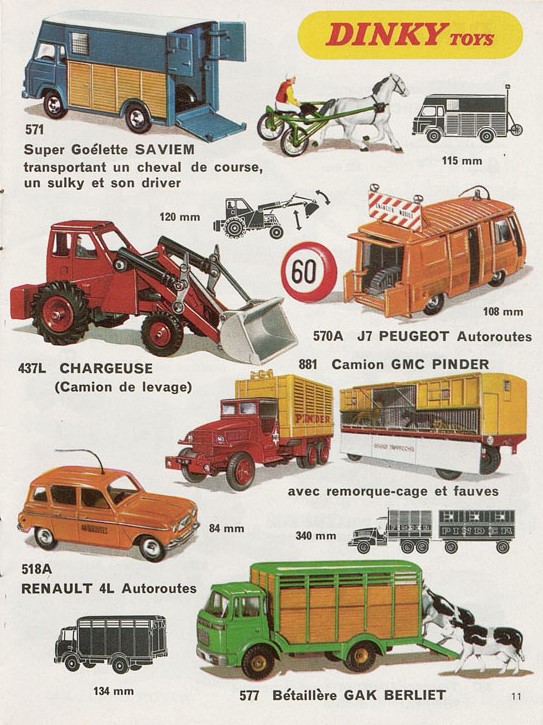
Dinky Toys France did a fantastic job of modeling these very durable and popular front wheel drive vans. As a child of the 1970s, the only J7 models I saw in the toy stores I frequented were made by Solido. I never saw any new old stock French Dinky J7 models in stores here in the USA, and I didn’t even know they existed until I purchased my first Ed Force collector’s book on Dinky toys over 32 years ago. Two of the J7 vans are shown in the catalog pages below.
Dinky Toys France 1970 and 71 catalog pages (source: internet search)
They always have been expensive, especially the Autoroutes and fire department versions and aren’t often found in the USA. However, I was lucky enough to get my hands on the ones shown here. The best examples are almost always to be found at high-end diecast dealers and the big auctions in the UK and Europe. Finding them in crisp boxes (they are heavy models and easily damage the thin card boxes) complete with the leaflets, packing pieces, antenna and number plates in the little wax bag is also challenging. I still enjoy watching these when they do come up for sale to see what they go for.
The 570 J7 trio pictured below were purchased over the past 13 years. The 570A Autoroutes version came from a U.S., one-owner collection and must have been made on a Monday morning or Friday afternoon, as it’s attached the wrong way (the tailgate is supposed to face the workers): the number plates are already applied and the rooftop sign is inside the back of the van. Normally the rooftop sign is in a large bag with the number plates and the antenna. Mine has the normal small packet of the antenna and number plates. It’s also harder to find the last issue version as it contains no bonus sign and no sign artwork on the box.
Dinky was still including the sign leaflet in many of these toys though, despite not including a sign. With this box perhaps it was a last off-the-line model, as it appears to have been thrown oddly together.
The 570 Allo Fret version also came from the US, and is the more common white-roof version. It also has the serrated tab, which is always a nice find. The instructions in this one are currently folded up inside the interior and not pictured. These white-roof versions seem to be still somewhat affordable compared to the harder-to-find blue-roof ones, which I don’t find as attractive as the white roof.
The newest and final addition for me to complete my collection of the J7s was the 570P Fire Department version that I purchased in 2023. After the Autoroutes version, this is the second most valuable of the trio. The side decals on these are quite fragile, and this one is a superb example that came from QDT for what I thought was quite a good deal – despite past high sales of these. The instructions in this one, like the Allo Fret version, are also currently folded up inside and not pictured.
A 1978 Peugeot J7 brochure from my transport sales literature collection complements the models superbly.
As collectors, our beloved die cast toys stand out in our memories for many reasons. The memories could be of the unique functions a particular toy had, the type of vehicle it was, where it was purchased, its colors, or even its size and name. For me, when it comes to the memory of size and name of a toy, my fondest is certainly of the Dinky Honest John missile launcher.
An original 1963 U.S. Army Honest John field manual and promotional water color print from Douglas Aircraft showing a pair of inbound Honest John missiles closing in on an armored column compliment the Dinky Honest John model superbly.
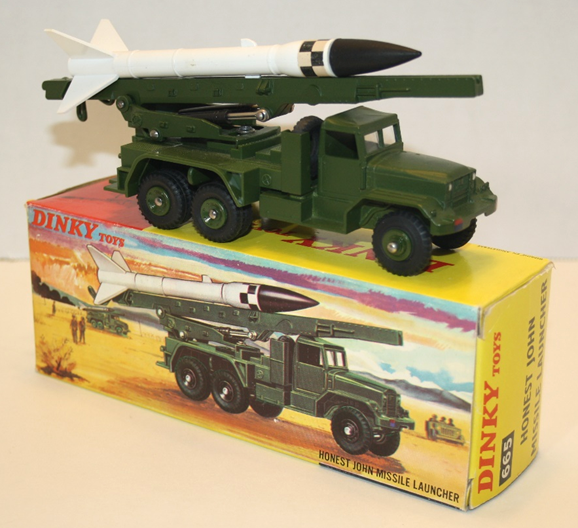
Dinky released the 665 Honest John in 1964, and it was a good seller until it was discontinued in 1975. Military toys were ever present in the Dinky lineup from the start of the company in the 1930s all the way up to its demise in 1979. They would have continued to be good sellers if Dinky had survived into the 1980s, as many toy companies still included military toys in their offerings at that point. The spring-loaded, firing, rubber-tipped missile gave Honest John immense play value on the living room battlefield floor, and since it was a truck-mounted missile launcher it was really two toys in one! A child could still play with the truck after the missile was launched or lost. My own Honest John truck survived my childhood relatively unscathed — even though its missile was fired into oblivion decades ago.
Nicknamed “Dear John” by the troops who operated it, this example was the first type with the large distinctive launch rail and was known as the M289. This photograph was taken at Fort Hood Texas in 1955. Loaded with the missile, it weighed 47,660 pounds and rode on big 14.00 by 20 tires.
The development of the real-life Honest John began in May 1950 at the Redstone Arsenal in Huntsville, Alabama, at the behest of the Army Ordinance Corps. The US Army wanted a simple, large caliber, special purpose field artillery rocket that would carry a nuclear warhead, use solid fuel, and utilize as much off-the-shelf equipment as possible in order to save money and development time. In October 1950, the Santa Monica, California-based Douglas Aircraft Company was under contract for preliminary studies, and later became the primary manufacturing contract. The rocket was designated as Artillery Rocket XM31, a highly-mobile system that would be launched from an International Harvester M139C six-ton truck chassis. (The M139C truck was powered by a 224 horsepower Continental six-cylinder gasoline engine with a four-speed manual transmission.)
“This Big Stick stops trouble before it starts” was a fitting title for this colorful 1956 Douglas Aircraft ad for the Honest John.
Redstone Arsenal Commander, Brigadier General Holger N. Toftoy, explained how Honest John came to have its unique moniker. He said: “Knowing that troops usually come up with their own nicknames for weapons if they didn’t like the official names, we cast about for a catchy easy to remember name. Before the first test launch of the first 762mm rocket there was considerable controversy in the Pentagon as if the system was worthwhile. There was serious consideration in the General Staff that such a large unguided rocket could not have the accuracy to justify further funding. At this time, while on a trip to the White Sands Proving ground in New Mexico, we ran into a Texan making statements that were hard to believe. When his veracity was questioned, he exclaimed, ‘Why, around these parts I’m called Honest John.’ Feeling somewhat like a Texan at the time I felt Honest John would an appropriate nickname.” [Source: U.S. Army Aviation and Missile Life Cycle Management Command]
The Dinky 665 Honest John was modelled on the later updated M386 version with the smaller launch rail. Note the stabilizing jacks emplaced on this truck. October, 1956. Photo courtesy of United States Army Sustainment Command Archives, Rock Island Arsenal.
In September, Honest John received the new designation of M31, and by the end of 1953 the first Army units took delivery of the rockets. In early 1954, they were deployed to US Army units in Europe, where they would serve as a front-line weapon in the face of the then-constant threat of Soviet Russian-backed Warsaw Pact forces. Honest John battalions consisted of two-to-three batteries with two launchers. The rocket was transported in three pieces to the launch-area warhead — motor and fins in an M55 long wheel base cargo truck, with an XM 405 missile-handling trailer. It would then be assembled by the 12-man crew and hoisted onto the launcher by an M62 wrecker. It was aimed much like a cannon and launched in about five minutes. For cold-weather operations, electric blankets made by General Electric were used to warm the solid fuel before launch. 77 degrees was the optimal temperature for a complete burn of the solid rocket fuel.
The outgoing Dinky 667 missile servicing platform was the basis for the Honest John model as it had a very similar 6x6 chassis.
The Honest John was the first nuclear capable surface-to-surface rocket in the United States military arsenal. The 27-foot-long, 762mm unguided rocket was powered by an M6 solid-fuel rocket engine, weighed 5,820 pounds, and was spin stabilized in flight by a pair of M7 spin motors. It carried a W‑7 nuclear warhead with a variable yield of up to 20 kilotons. It could also be fitted with a 1,500-pound, conventional, high-explosive warhead. It was fired from a hydraulic elevated ramp fitted on the rear of the M139C truck with an M‑289 launcher. The initial M31 versions had a range of about 15 miles. Almost 7800 M31 versions were produced between 1952 and 1960.
Dinky advertised the arrival of the 665 Honest John just in time for Easter in the March 1964 issue of Meccano Magazine. What a gift for Easter, a toy tactical nuclear capable missile!
Later versions would see the development of the more powerful M50 designation that gave the missile a shorter length, lighter weight, and smaller squared fins with a maximum range of approximately 30 miles with more accuracy. The M50 carried the W31 nuclear warhead that yielded 2, 10, or 30 kilotons. Over 7000 M50 improved types were made up to 1965—when production ceased. The M289 launcher was later redesigned and designated M386; this is the version on which the Dinky is modeled. The redesign enabled a reduced size and less complicated launch rail that incorporated a semi-rotating launcher base, also exhibited on the Dinky model. These updates gave the truck a considerably smaller battlefield profile. Also greatly improved were the truck’s driving characteristics, as the very long and heavy front overhang of the launch rail was eliminated, along with the big blind spots on both sides of the cab.
M386 versions are being assembled inside the cavernous halls of the U.S. Army Rock Island Arsenal in Rock Island Illinois in March, 1963. Photo courtesy of United States Army Sustainment Command Archives, Rock Island Arsenal.
In the 1960s, a chemical warhead containing 356 sarin nerve gas bomblets was added to the Honest John system. In 1962, both models of the Honest John were given new designation numbers. The M‑31 became the MGR-1A, and the M‑50 became the MGR1‑B. By 1965, M50 production was completed—with over 7000 produced. In 1972, the Honest John was gradually phased out from service by the then-new Lance missile. In 1982, the Honest John was declared obsolete and was retired by the US.
Fresh off the production line, a completed M386 is blocked up and loaded on a rail car destined for Florida’s Eglin AFB in May,1961. Photo courtesy of United States Army Sustainment Command Archives, Rock Island Arsenal.
Besides the US Army and Marines, other operators — nuclear and conventional — included Belgium, Canada, Denmark, France, Germany, Greece, Italy, South Korea, Norway, Netherlands, Taiwan, Turkey, and the United Kingdom. Greece, Turkey, and South Korea operated their conventional warhead units into the 1990s. The Honest John had a longer service life than all other U.S. ballistic missiles except the U.S.A.F. Minuteman ICBM, which is still in service.
Taken in what was then West Germany, this U.S. Army M62 wrecker is towing the M405 missile handling trailer. The long bar fitted to the top of the missile is the M4E1 handling beam and it was used for loading. Too bad Dinky never modelled this great setup.
During the Cold War decades of the 1950s and 1960s, Honest Johns were a common site in North America, Asia, and Western Europe. Dinky capitalized on this, and it would have been hard to find a kid that wouldn’t be interested in a toy that featured a big missile on a truck. When Dinky released the 665 Honest John model in March of 1964, they were able to save on development funds for a completely new model. They modified the already-available Dinky 667 missile-servicing platform vehicle that was based on the real-life U.S. Army M280 five-ton short wheelbase chassis, which was similar to the 6‑ton M139C chassis the Honest John utilized.
This rare photo details the special tools and ancillary equipment that complemented the Honest John. Photo courtesy of United States Army Sustainment Command Archives, Rock Island Arsenal.
The 667 was being discontinued after a four-year run so the rear super-single wheels were replaced by an eight-tire rear bogie, the two stabilizers removed, (though the mounts still remained) and an elongated, detailed plastic rear was fitted to accommodate the semi-rotational, functional, spring-loaded, launch rail and rocket. It was an easy conversion for the Dinky designers. The white plastic missiles were launched by pulling a metal handle back to put tension on the spring, locking it place, and then releasing to fire. The launch rail on the Dinky toy was very long in the rear compared to the actual Honest John due to the launch spring needing extra length while compressed. However, there are some standout casting details on the launch rail that deserve mentioning as the Dinky designers did a fantastic job here, and they could be easily overlooked. There are four large braces present, two on each side, and these were the tie downs for the missile when mounted on the rail. There are also four small steps, two on each side in the middle of the rail. These small steps were the resting points for the legs of the hoist on the M405 missile handling trailer. At the front of the rail, right below the rivet castings, you will find three small bars on both sides of the rail. These replicated the hinge points that made the front section of the real launch rail that extended over the truck’s cab split, and they fold to each side for transport. Simulated hand cranks can also be found under close examination.
In service with the German Bundeswehr, this Honest John was taking part in a military parade in what was then the West German town of Oldenburg during May 1961. Note the front portion of the launch rail folded back for transport just above the drivers. Dinky cast the hinge detail for this feature on the model.
The prominent features that the Dinky toy model lacked compared to an actual Honest John would be the collapsible cab roof, the three under-chassis stabilizers, drivers’ side spare tire mount, and a longer wheelbase.
Up on a ladder, a U.S. Army soldier is manually jacking the missile backwards. Rear views of the Honest John like this are not often seen. October, 1957. Photo courtesy of United States Army Sustainment Command Archives, Rock Island Arsenal.
Both the Dinky version of Honest John and the missiles often shown in photographs were white. White and other bright colors were used for tracking and testing purposes, as was the black “checkerboard” right below the large warhead of the rocket. These were placed near the spin motors that stabilized the rocket. Actual combat rockets were painted olive drab green, but Dinky never made an olive-green version.
From my collection, four of the five box types for the Dinky Honest John are shown here. The plain end flap box is not present and the bubble box version is my model from childhood for which I recently found a box. The export window box on the top right is the rarest box type.
Dinky manufactured the missiles out of white plastic with a rubber warhead tip. Early production missiles had the black checkerboard feature, but this was deleted as a cost-saving measure a few years later. The missile was a good representation of the original, although the small shark fins in the middle of the missile were added by Dinky designers to fit into the launch rail to fire it via the spring when released. I have seen some late issues with a more realistic appearing dark gray rocket.
Early Dinky Honest John models had water slide decals on the bumpers and silver detail on the headlights. To save costs, very late versions, like mine from childhood on the right, had stickers on the bumpers and no silver detail on the headlights.
Dinky finished the trucks in various shades of dark green with green plastic wheels. The plastic rear launcher base and wheels can be found in different shades of green and black, with black being the rarest variant. While these different shades of green, and even black, for the wheels and bodywork offer more versions for the collector to acquire, they do spoil the appearance of what is a very good representation of the only die cast model ever made of the Honest John, as the real-life versions were all dark green, wheels and all.
The Honest John name stood out to me since I was a child and so did its size compared to my other Dinky toys growing up. The scale of the Dinky Honest John was approximately 1/60 which was fairly common for early Dinky military vehicles. By 1975 when it was withdrawn, Dinky toys had grown considerably larger and for comparison, my childhood Honest John easily fits in the back of my childhood Dinky 668 1/42nd scale Foden army truck with the tilt removed.
Wheel melt is a common problem affecting the later issues. Early versions seem to be immune from this, but I do see later models with this problem. Dinky must have used different plastic and rubber suppliers, as not all models are affected. Mine from childhood has none, luckily. First run tires were a large all-terrain type, while final runs were a slightly smaller street type tire and “HEAVY DUTY” molded into a smooth sidewall.
I modelled this diorama on a typical Honest John exercise of the 1950’s and 1960’s era. While Dinky never made a U.S. Army M62 wrecker or the other support vehicles for the Honest John system, the French Dinky Berliet army wrecker used the same American Austin Western crane so it’s quite effective here loading a missile. I made a basic M4E1 handling beam out of a wooden coffee stirrer, some brass wire and black thread to support the missile during loading as on the real missiles. Balancing the missile for this photo was tricky but the end result was satisfactory. Gray tissue paper wrapped around one of the missiles simulates the electric warming blankets that kept the actual missiles’ solid fuel warm in colder temperatures.
Unit markings can be found on the front bumper and rear of the models. Early issues were water slide decals while later models were paper stickers. Headlights were initially painted silver, but later this detail was deleted as a cost-saving measure.
Initial production models came in the very sturdy, colorfully-illustrated, lift-off lid boxes with an instruction sheet with red print. Later instruction sheets had black or blue print. The first end-flap box to be released featured a realistic desert scene similar to a setting at the White Sands, New Mexico missile range. This may be the most attractive box. The US export window box was also utilized, but due to the extremely fragile nature of these boxes, they are very rare. The desert scene box was soon replaced by the end flap box that featured a plain picture with no background. By 1973–74, the bubble boxes were utilized until the model was discontinued in 1975. The bubble boxes, like all the other Dinky toy boxes during this period, had the instructions printed on the base of the box—along with the annoying “do not aim the missile at people” cautionary print for those who lacked common sense. I never aimed any of my firing military toys at anyone when I was a child.
My Honest John was purchased for me by my mom around 1978 from Five Corners Toy and Gift Shop in Westwood, NJ. This was my go-to retailer for Dinky toys and it was often called The Dinky Store. Despite the model being withdrawn in 1975, they could still be found in stores where I lived. As a lifelong commercial and military vehicle enthusiast, it was a toy I enjoyed very much. A few years later, I would read about the real Honest John when I received from my dad Knowledge Through Color: Rockets and Missiles, by John W.R. Taylor, which I still own.
Due to an 11-year production run that overlapped two decades, the models currently are still abundant and affordable for the collector. They are always for sale on eBay and often at auctions, but many are missing the missile. The reproduction missiles are a welcome addition since, like mine, they were often lost and originals were easily broken, especially the fins. The fins on the reproduction missile are considerably thicker.
One has to wonder if any models ever made it to Douglas Aircraft, the US Army, or Marines for display and promotional purposes. I have never seen any evidence of it in my research but perhaps someone can shed some light on this. Since it was the only diecast model ever made of the Honest John, it would have made the perfect promotional piece and been quite at home displayed on a general’s desk.
While there have been some plastic models offered of the Honest John over the past sixty five plus years, Dinky deserves much credit for producing the only die cast model toy ever made of the Honest John. Tekno, which always produced superb die cast toy models, offered a fantasy version of the Honest John that was based on their Scania fire truck chassis, but it bears no resemblance whatsoever to the real Honest John.
I mentioned in the beginning of this article that in addition to the name of the Honest John toy, the size also stood out to me. It always seemed oddly small to me! I never knew why until years later. Kids who, like me in the 1970s, collected Dinky toys were accustomed to their large scale because that’s what Dinky made during the final era of production. I didn’t have or know about small Dinky toys because they were all big by then. Compared to the 1950s and 1960s models, they were huge. When you place the Dinky Honest John next to a model like my childhood 1/42nd scale 668 Foden army truck, it can fit inside the cargo bed. Since it debuted in 1964, it was a good selling carryover from a smaller-scale decade that was long gone by the 1970s in the world of Dinky Toys. It was also the last English Dinky military vehicle made in the smaller approximately 1/60 scale. Nevertheless, it was still one of my favorite military models, and one can only imagine how grand a model it would have been had it been produced in the bigger scales.
This article was a very enjoyable one to write: It’s about a Dinky Toy that’s not often discussed or featured, and I’ve always thoroughly enjoyed the Cold War era that this model was a big part of.
Regarding some of the photos in this article, I wanted unique views to feature, different from what can be found online. I reached out to the U.S. Army at Rock Island Arsenal in Illinois, as I knew that was where the Honest Johns were originally assembled. I was delighted to get a response from a very kind and knowledgeable gentleman named Kaleb Bemis. He sent me some rare and perhaps never seen photos, so I remain very grateful for his assistance.
Writing an article like this is never a one-person endeavor, so very special thanks go to Kaleb Bemis, United States Army Sustainment Command Archives, Rock Island Arsenal; Mark A. Redman; DTCA members Jan Werner, Jonathon Angel and Ravi Bhavnani.
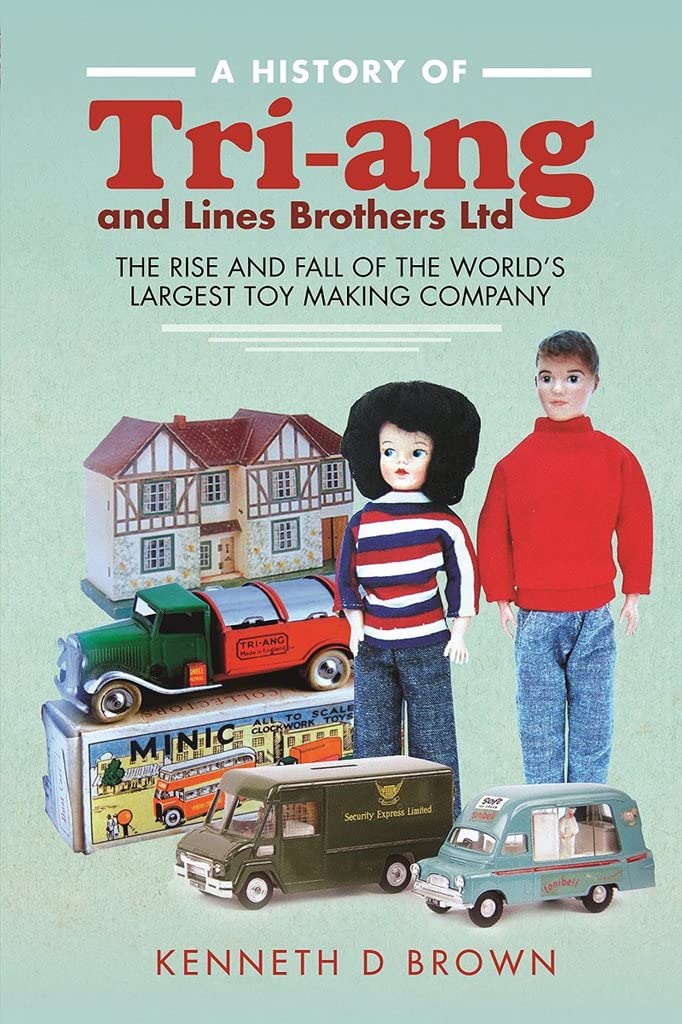
I recently purchased the A History of Tri-ang and Lines Brothers Ltd, published in 2022 by Kenneth Brown, who had earlier written his history of Meccano Ltd. (Factory of Dreams). Although obviously peripheral to Dinky Toys, the book is interesting reading.
As I have shared before, “Lines Brothers” was an epithet to me as a child, partly because I didn’t like the “Visi-Pac” boxes, 1/42nd scale, and other “innovations” they introduced to Dinky. Mostly, though, it is because Dinky distribution became so spotty in the U.S. from the time Lines acquired Meccano in 1964 until Tri-ang went bust in 1971.
As quoted in the Tri-ang book, Graeme Lines wrote in a letter to a British Consul General in December 1964 that Dinky faced “hair-raising” marketing difficulties in the United States. Elsewhere in the book, we read that Lines Brothers did not like to use wholesalers/distributors to sell its toys, preferring to cut on the middlemen. But in my own experience, to call Lines’ U.S. efforts “half-baked” would be rather charitable. Matchbox (via U.S. distributor Fred Bronner) and Corgi (via U.S. distributor Reeves International) were vastly easier to find in American stores during the 1960s.
At the end of 1960, Meccano’s longtime U.S. distributor, H. Hudson Dobson, closed down. As you can read in my article My Collecting History and Ten Favorite Models, five different regional distributors were then appointed for 1961, and later increased to eight nationwide. These regional distributors did a poor job, probably because Dinky was only a minor sideline for most of them. Eventually, in 1963, Meccano Ltd. contracted with A. C. Gilbert to distribute Dinky Toys in the U.S. But Gilbert wasn’t in good health, and that arrangement only lasted a year.
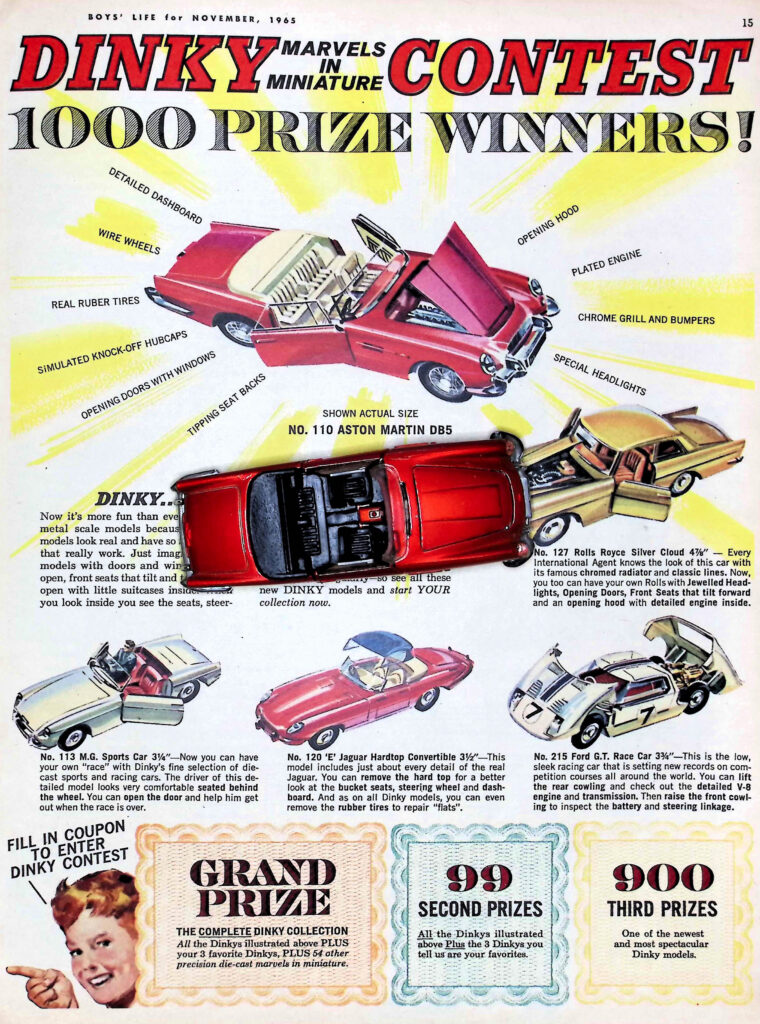
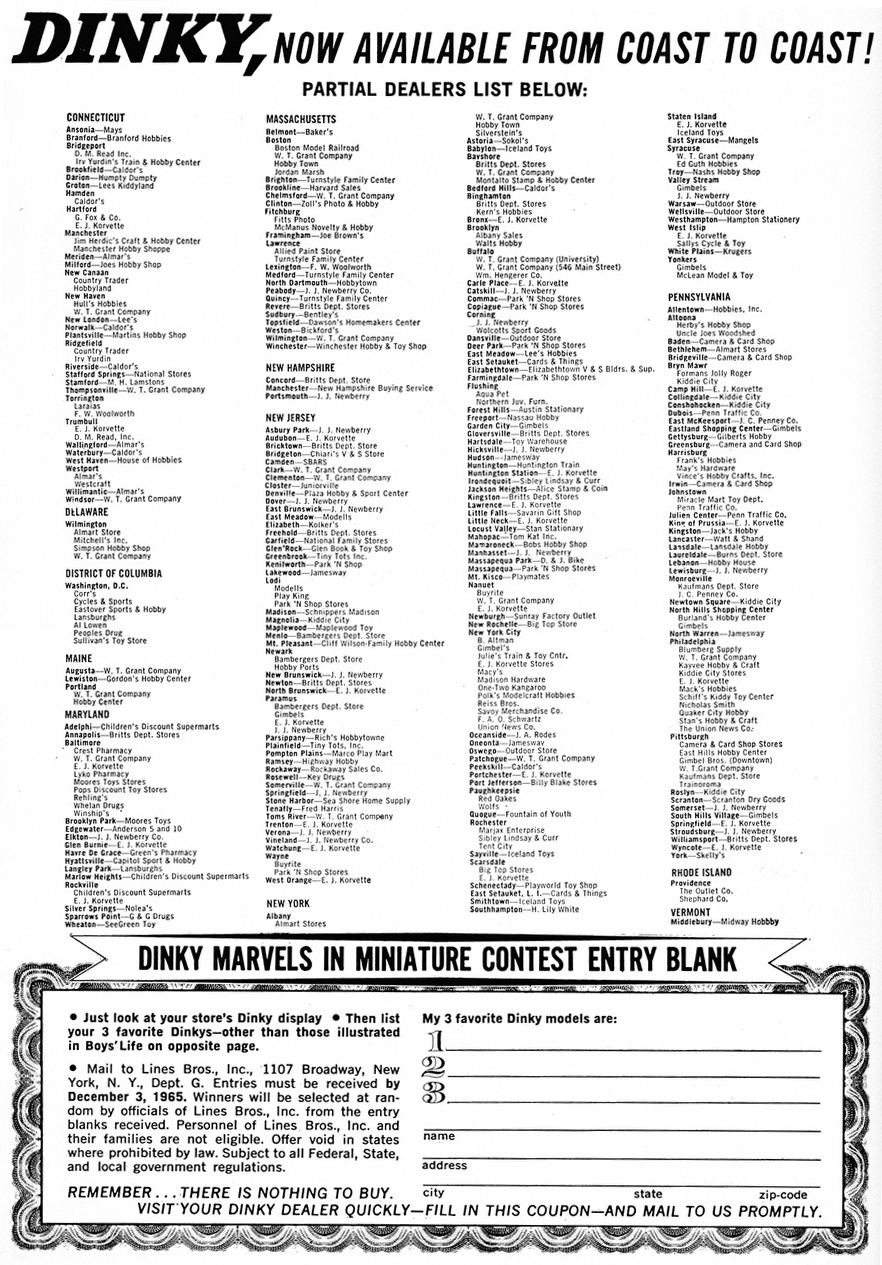
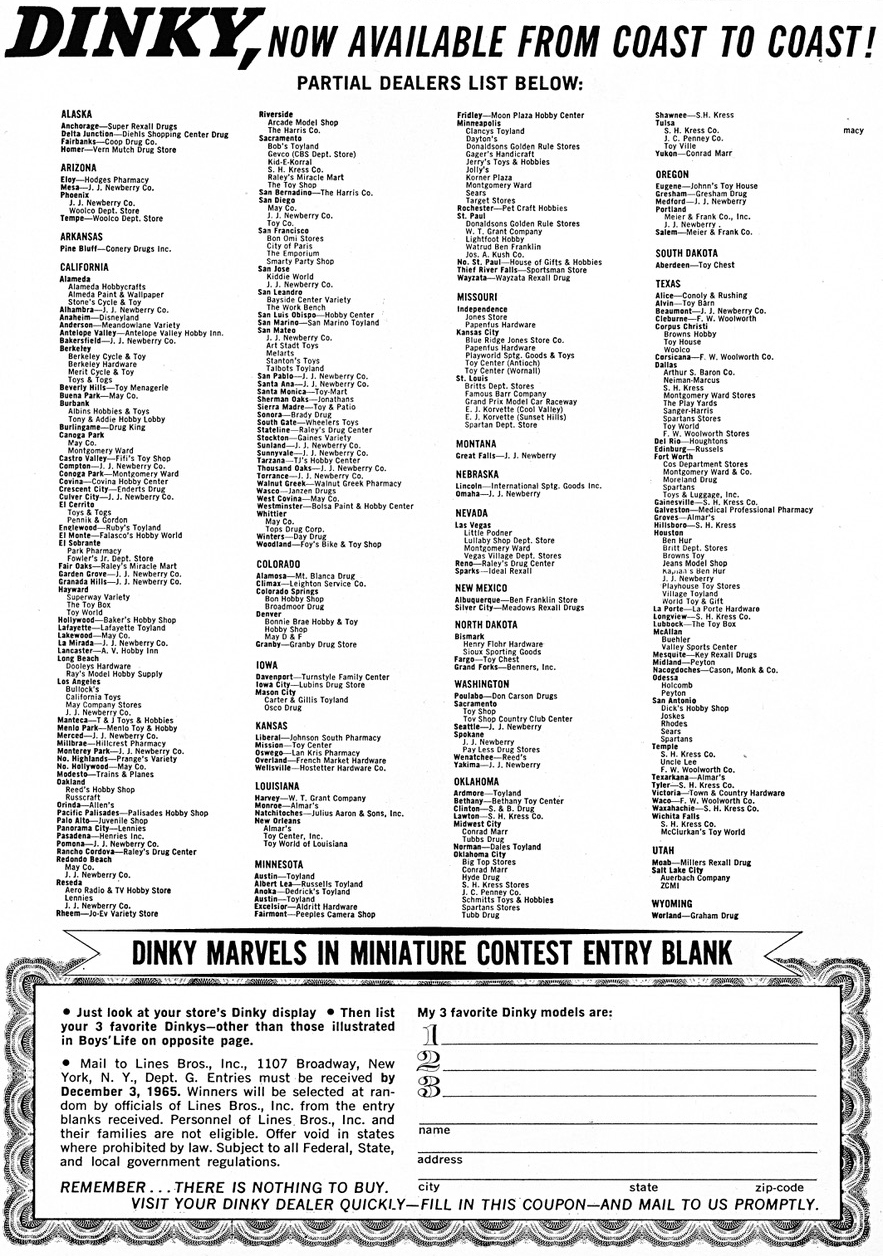
Meanwhile, in the 1950s H. Hudson Dobson had regularly advertised Dinky Toys in Boys Life (the official magazine of the U.S. Boy Scouts) and other publications — in the lead-up to Christmastime, even in general magazines such as the Saturday Evening Post. Lines Brothers advertising was much rarer, but one ad did appear in Boys Life for November 1965. It took up about 1 1/2 pages. The right-hand page had color drawings of some Dinky Toys, while the left-hand page had a black-and-white coupon and a list of stockists.
The first copy of this ad I obtained listed only East Coast dealers. I reasoned that Boys Life must, like most large-circulation magazines of the time, have been published in both an Eastern edition and a Western one. Eventually, I did obtain the latter from eBay, though not without having earlier purchased a copy that just happened to be torn and defaced on the two relevant pages!
I am sharing both copies of the list. Even so, this “partial” list still has omissions. (I don’t see Illinois anywhere, for example.) In the California list, I see some shops I don’t remember, while others I recall having Dinky Toys are not listed. Maybe their stocks had come from H. Hudson Dobson or its interim successors and they were not doing business with Lines Brothers, or not yet by the time this ad appeared.
If one can believe this list, the most reliable source of Dinky Toys nationally was J. J. Newberry, a chain of “variety” stores similar to Woolworth’s. Unfortunately, there were none near my home, so I can neither confirm nor deny it!
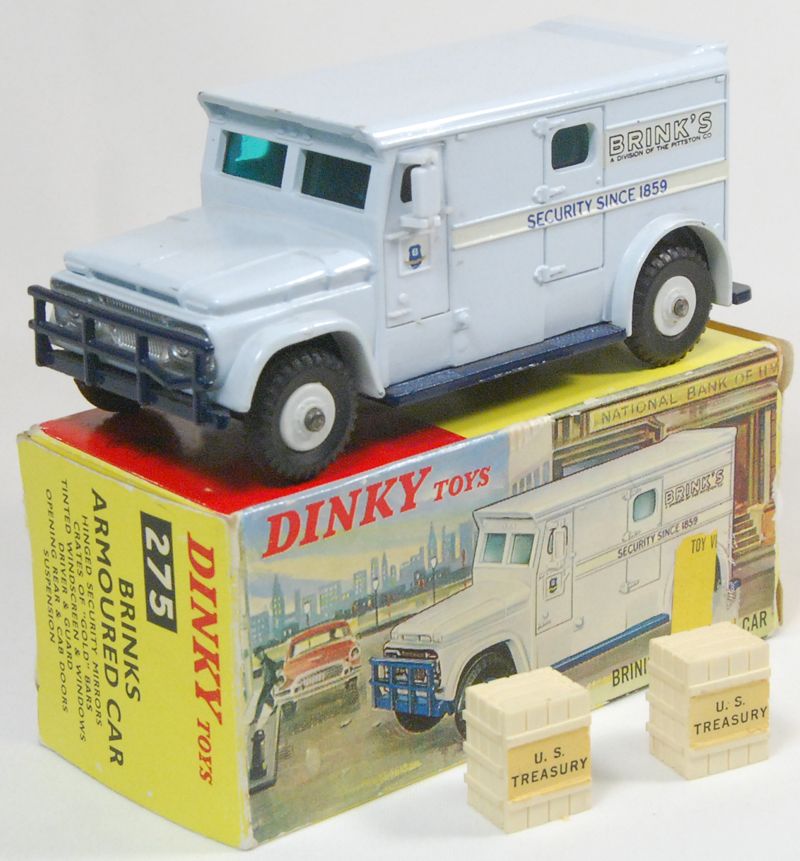
Dinky’s Brinks Truck (275) has been one of my favorite models ever since it was released, both for its accuracy and its “play value.” As I now know, it also has a unique history among Dinky Toys.
Namely, Dinky’s Brinks Truck:
was first issued in 1964, followed several years later by a subtly different promo version;
included accessories made by Meccano France;
got deleted in 1969, then temporarily resurrected as a limited-production Mexican promo in the mid ’70s;
rejoined the Dinky range in 1979, sixteen years after its debut. The last gasp version never made it into any catalog, and was painted and assembled in Texas.
All this was thanks to the Brink’s Company, known for its bullet-resistant armored trucks for transporting money and other valuables. Brink’s was founded in 1859 and boasts of being one of the oldest commercial brands in the world. In the U.S., “Brink’s Truck” is often used as a proprietary eponym for every armored truck, no matter whose name is on them.
Armored trucks make great toys because of their potential for being “robbed.” But it seems that in 1964, no accurate diecast model of one bearing the Brink’s name had ever been made. (There were some crude predecessors, such as a cast-iron Brink’s truck with a coin slot, and a plastic battery-powered Brink’s truck with a remote control.)
Brink’s, which had been acquired in 1959 by Pittston, a transportation and mining conglomerate, apparently decided it was time for a detailed model — one that, while still a toy, could be presented to bankers and other clients without apologies. It agreed to pay Meccano Ltd. for the tooling, also committing to purchase a large quantity of models.
Disclaimer: No records of this deal exist, but given the extensive use Brink’s would make of the resulting Dinky, it seems irrefutable. Besides, the Brink’s name is cast into the toy’s baseplate, sealing the deal and ensuring that the model could not be sold with someone else’s livery. The 275 Brinks Truck was announced in the December 1964 issue of the Meccano Magazine by Chris Jelley, who wrote the following:
Before space runs out on me, I must move on to the very last Dinky Toy due to appear in 1964 — the Brink’s Armoured Car (No. 275). Brink’s are a private security company who do the same sort of job in America that a firm such as Securicor do in Britain. One of their main duties is to transport money and gold for banks or to carry large payrolls for industrial concerns, etc. To do this they use strong armoured vans, and it is one of these, made by General Motors, that we have produced in miniature.
Features of the Dinky model embrace opening cab and rear doors, interior fittings, and windows. Inside the cab ... are a driver and guard in semiofficial uniform. The vehicle is finished in grey, decorated with authentic transfers. The windscreen and windows are tinted, and the model comes complete with two opening chests, each containing eight ‘gold’ ingots.
A small picture of the prototype truck appeared in the Meccano Magazine article. An artist’s rendition of the Dinky, meanwhile, was in an advertisement on the back cover.
The Brinks prototype in the Meccano Magazine.
The Dinky Brinks Truck advertised on the back cover of the Meccano Magazine, December 1964.
Two things are notable in Jelley’s writeup. First, he obviously was not sure where to put the apostrophe in Brink’s. Dinky would solve that conundrum by dropping the apostrophe entirely on the model’s boxes and all subsequent publicity! (In this article, I have followed their lead, using the apostrophe when referring to the company and omitting it when referring to the Dinky itself.)
The second is his mention of General Motors (GMC). The 275 Brinks Truck is a detailed model of a GMC vehicle, yet the GMC logo is not present and that company would never again be mentioned by Meccano.
It’s possible there were licensing difficulties with GMC. Previously in 1961, Meccano had modeled a GMC “Cannonball” tractor for its 948 Tractor-Trailer McLean, known to have been financed by the trucking company. In that case too, the GMC label did not appear on the toy and was nowhere referenced.
It’s also possible that Brink’s simply didn’t want to share the spotlight with GMC. After all, it didn’t use only GMC trucks for its armored cars; it also used trucks from Ford and International, as shown below.
Two period Brink’s trucks, GMC (left) and International (right).
In any case, the prototype for Dinky’s armored “car” (as Meccano first called it) was a 1962 or 1963 GMC medium-duty C‑Series, either a 2‑ton 3500 or a 2½-ton 4000 model. It was equipped with a gasoline-powered V‑6 (304.7 cu. in., 5.0L) offering 165 horsepower, or, optionally a 351.2 cu. in. (5.7L) version with 180 horsepower.
Every one of those horses would have been needed to drag the weighty vehicle around. According to the website coachbuilt.com, Brink’s had been the first in the industry to reinforce its cars with armor and weapons. Brink’s vehicles could be equipped with .38 caliber revolvers, .44 caliber repeating rifles, 12-gauge shotguns, gas riot guns, and sub-machine guns.
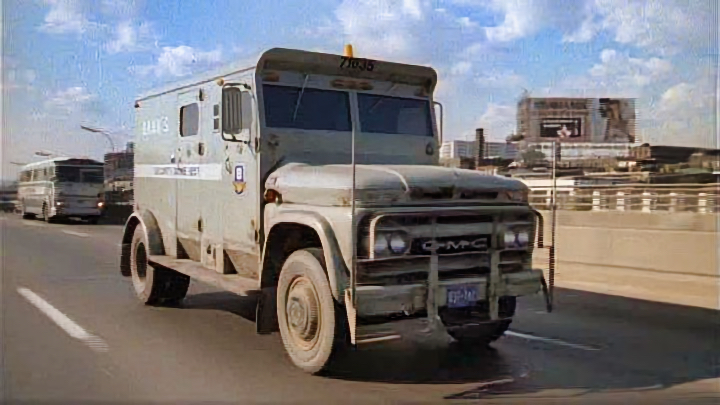
A GMC Brink’s truck in “The Kidnapping of the President” (1980).
The GMCs were sent in the form of a naked chassis with only a front cowl to longtime Brink’s contractor J. Tom Moore and Sons of Memphis, Tennessee, where an armored body was fitted. Exact details of the armor were kept secret, but might have been revealed years after the fact in a 1980 movie, The Kidnapping of the President (starring Hal Holbrook and William Shatner), where a 1962–66 GMC Brinks Truck not only stars but is blown up for art’s sake.
In the movie, a supposed Brink’s official states that the truck’s walls were of sandwich construction: a quarter inch of steel, an inch of cotton batting to stop bullets, and then a second layer of steel. Meanwhile, the truck’s floor was said to be two inches of solid steel.
Brink’s truck armor discussed with William Shatner in “The Kidnapping of the President “(1980).
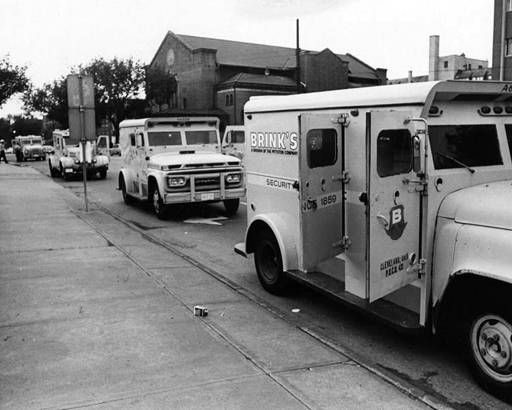
Brink’s Trucks used to shelter police during 1968 riots in Cleveland.
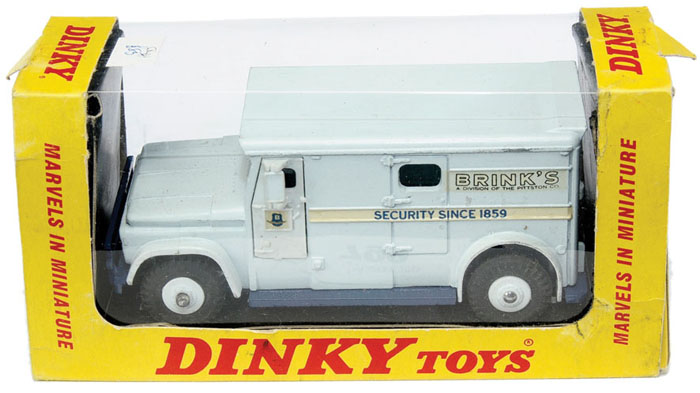
Returning to the Dinky Toy itself, the model was initially released in a Visi-Pac box, priced at 12 shillings 11 pence (65p) in Britain, $2.98 in Canada, and $3.98 in the U.S. After a year or two, Meccano switched to a more-durable picture box, showing a Brink’s truck parked in front of a bank in an obviously American setting.
The first Brinks Truck in a Visi-Pac box.
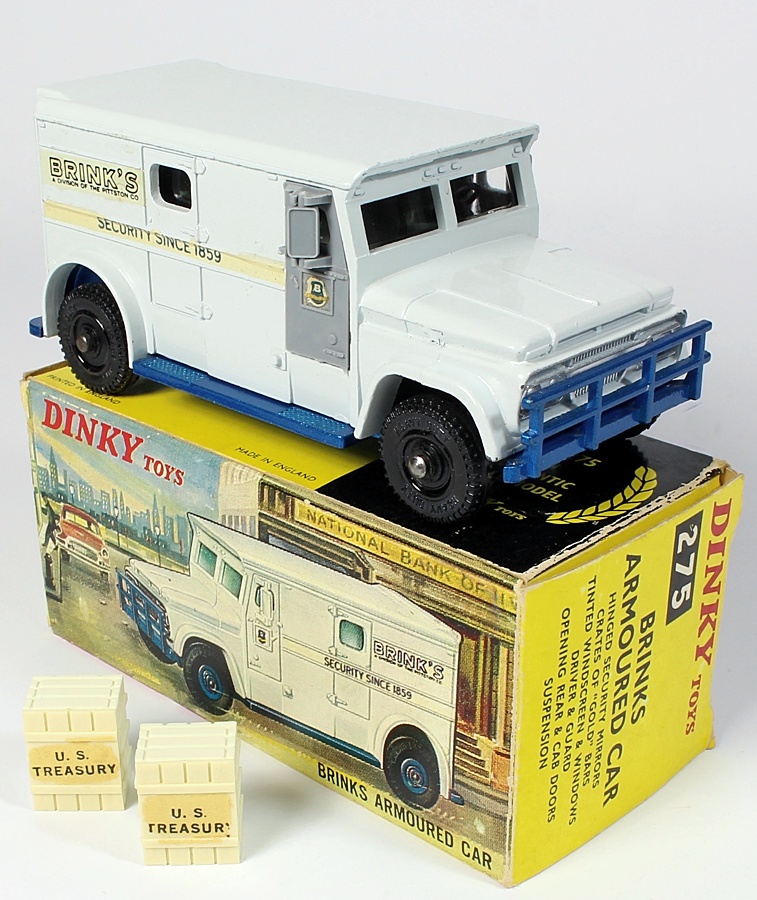
The first Brinks Truck in a picture box.
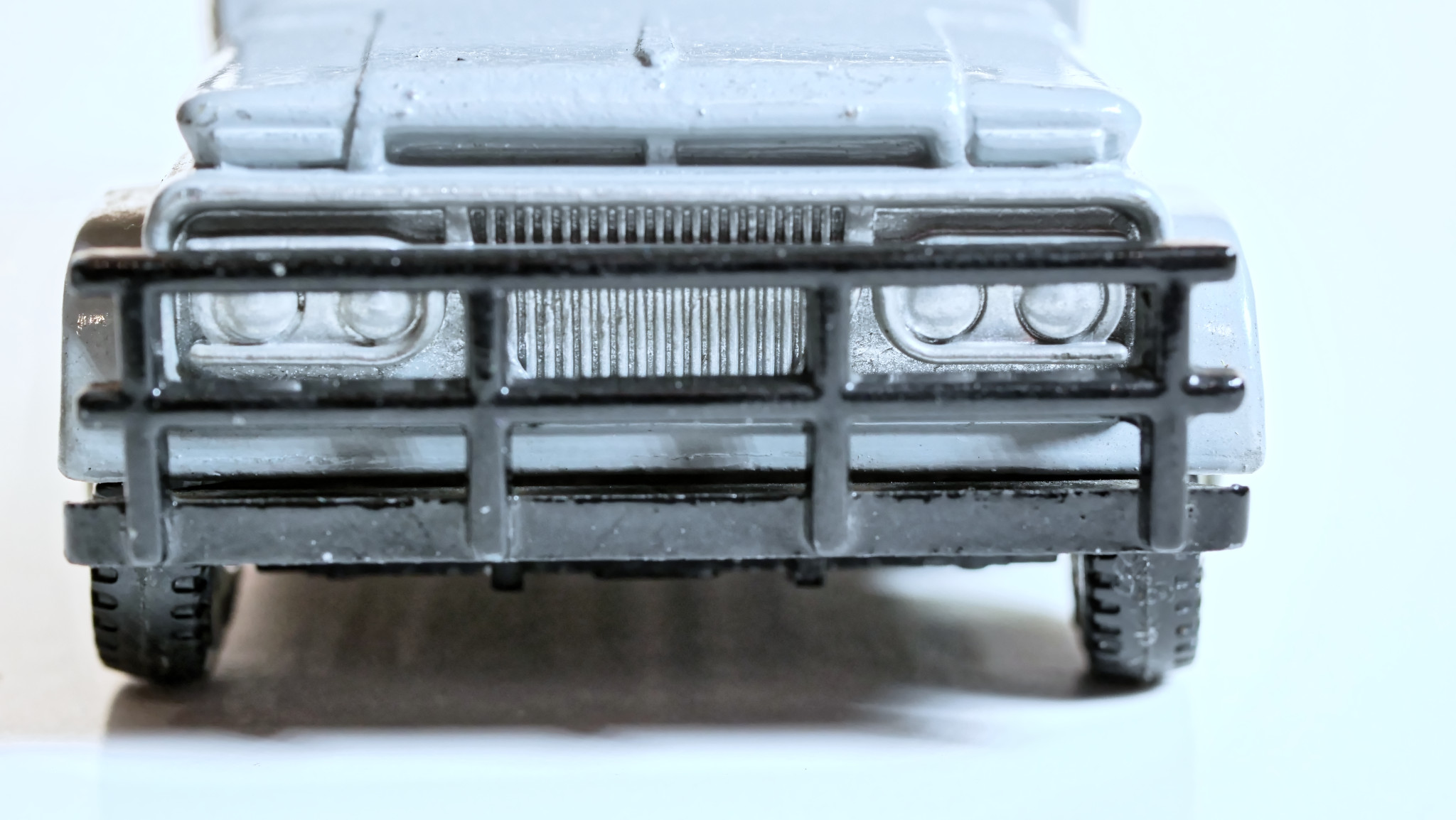
The Dinky is a very faithful replica, except that both the GMC logo and a piece of trim that ran between the headlights have been removed. The doors, which were one of the more intensive uses of plastic in a Dinky to date, are nicely molded but tend to flop open.
GMC trim deleted from the Dinky.
The Brinks Truck’s grille.
The “gold” crates supplied with the model are especially interesting. Apart from their contents, they are identical to the 849 Caisses sold as an accessory by Meccano France since 1959. (One of these crates, containing “radioactive material,” would later be used in the 105 Maximum Security Vehicle too.)
The Brink’s Company likely made use of the standard Dinky Toys, but within a few years it ordered a special run of promo versions. Still supplied with the two crates, the promos are different in that the plastic doors are now a darker grey, the chassis is a brighter blue, and the wheels are black.
The promo version of the first Brinks Truck.
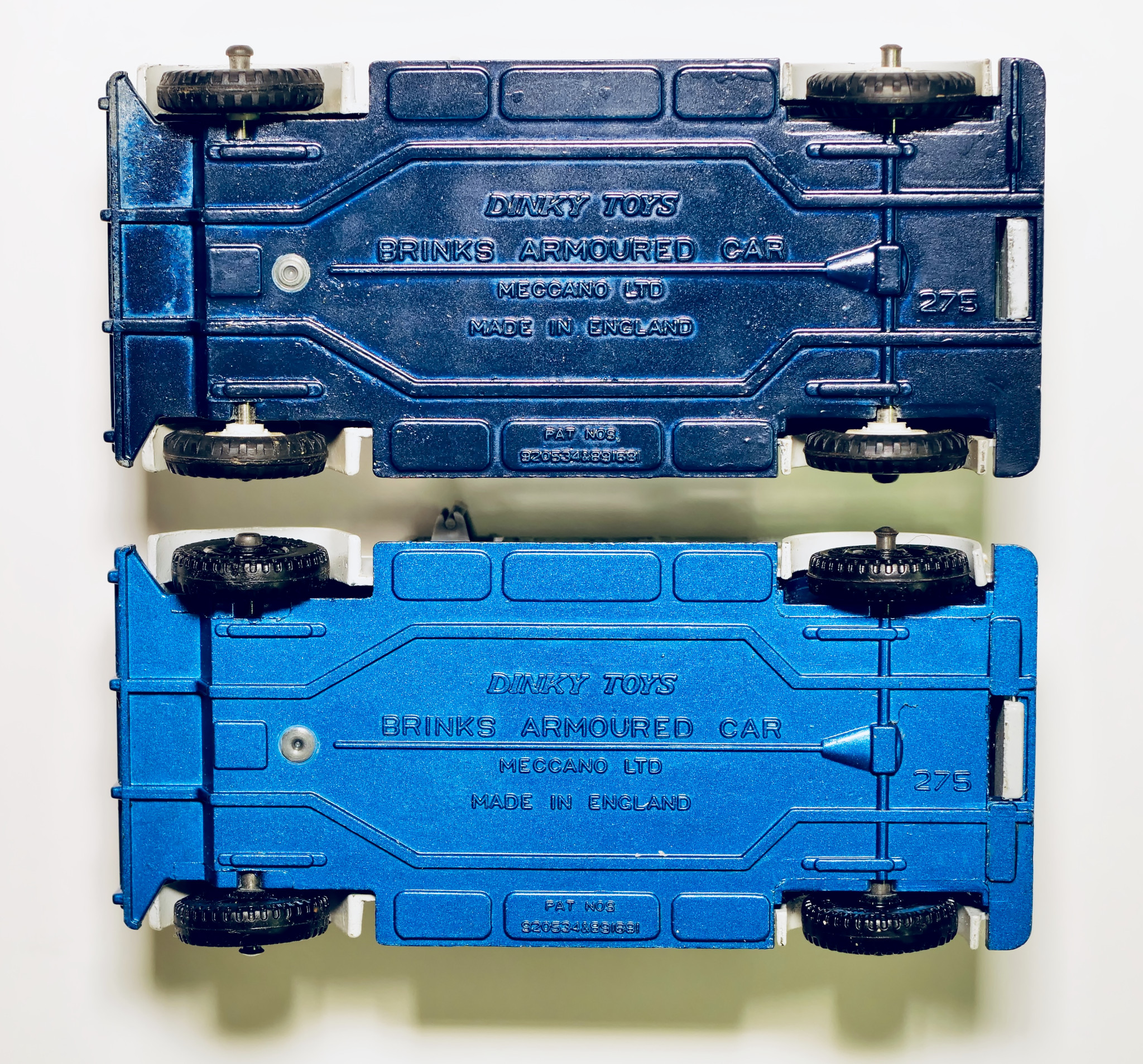
A more subtle change took place beneath. The representation of the exhaust pipe at the truck’s left rear has for some reason been deleted. Also at the rear, two square boxes possibly representing chassis reinforcements have been added. Presumably made at Brink’s behest, these tooling changes were of course permanent.
The exhaust pipe (top right) was deleted on the second version (bottom) for an unknown reason.
Brink’s gave its promo versions to employees — I purchased my sample on eBay from a retired Brinks guard — and prospective clients. It appears that most came in the standard picture box.
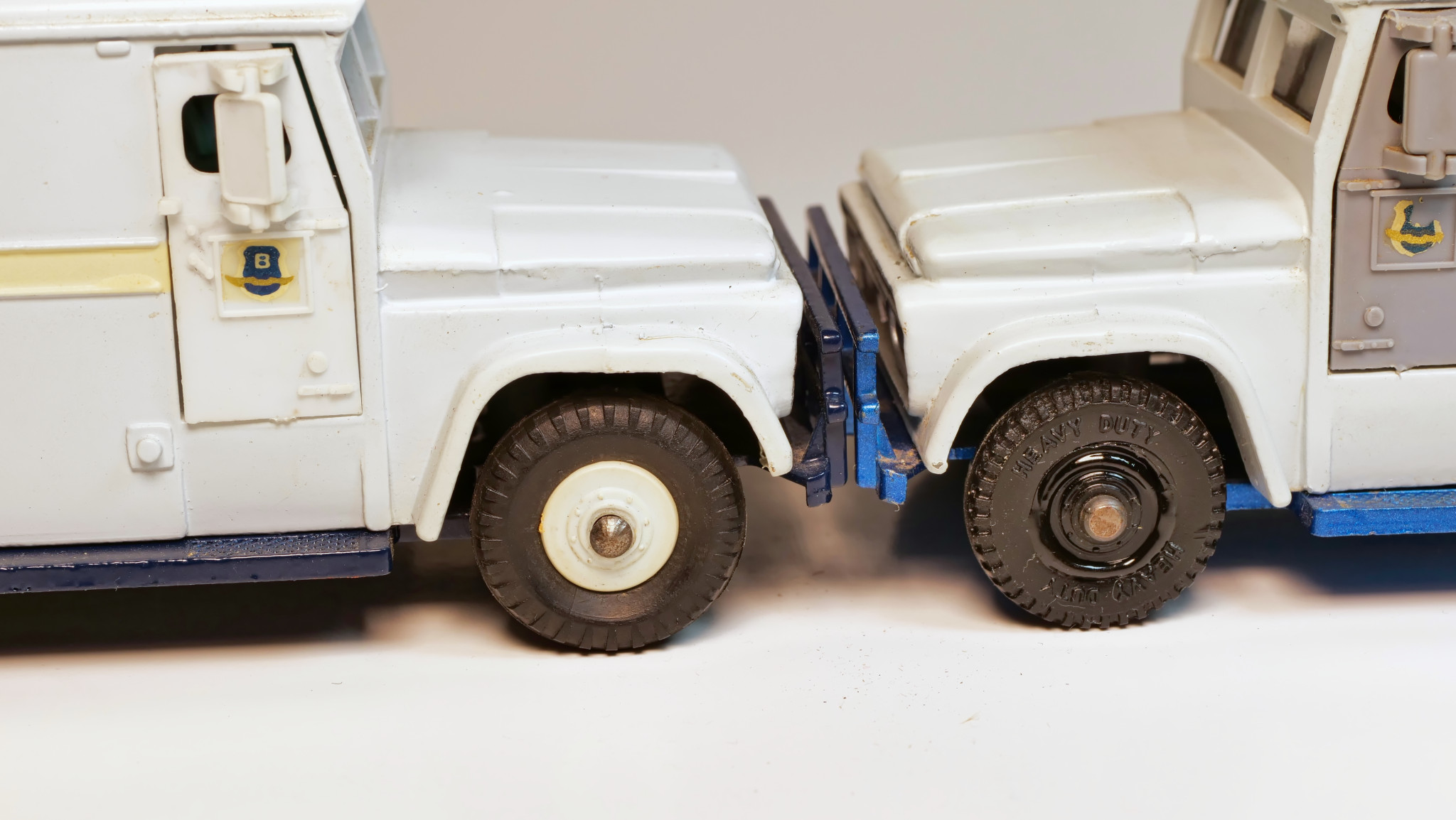
Tires and wheels on the first Brinks Truck (left) and the promo version (right).
I have never seen a definite date for this first promo version, but it always sports the plastic tires labeled Heavy Duty that started appearing on Dinkys around 1968, so it cannot be earlier. Meanwhile, the standard version appeared in a catalog for the last time in 1969. However, that was far from the end of the model!
In approximately 1976 (no definite date is documented), a limited quantity of Dinky trucks was ordered from Liverpool by a Mexican company, Servicio Pan Americano de Proteccion (SPP). At the time, Brink’s owned a 21% stake in SPP; it acquired the rest of that company in 2010.
Supplied in an unmarked white box, the Pan Americano Dinky is finished in a darker all-over grey with a black base, and no longer includes the crates or figures of previous versions. Unfortunately, the plastic tires almost always have glued themselves to the plastic wheels via a messy chemical reaction.
The Pan Americano version.
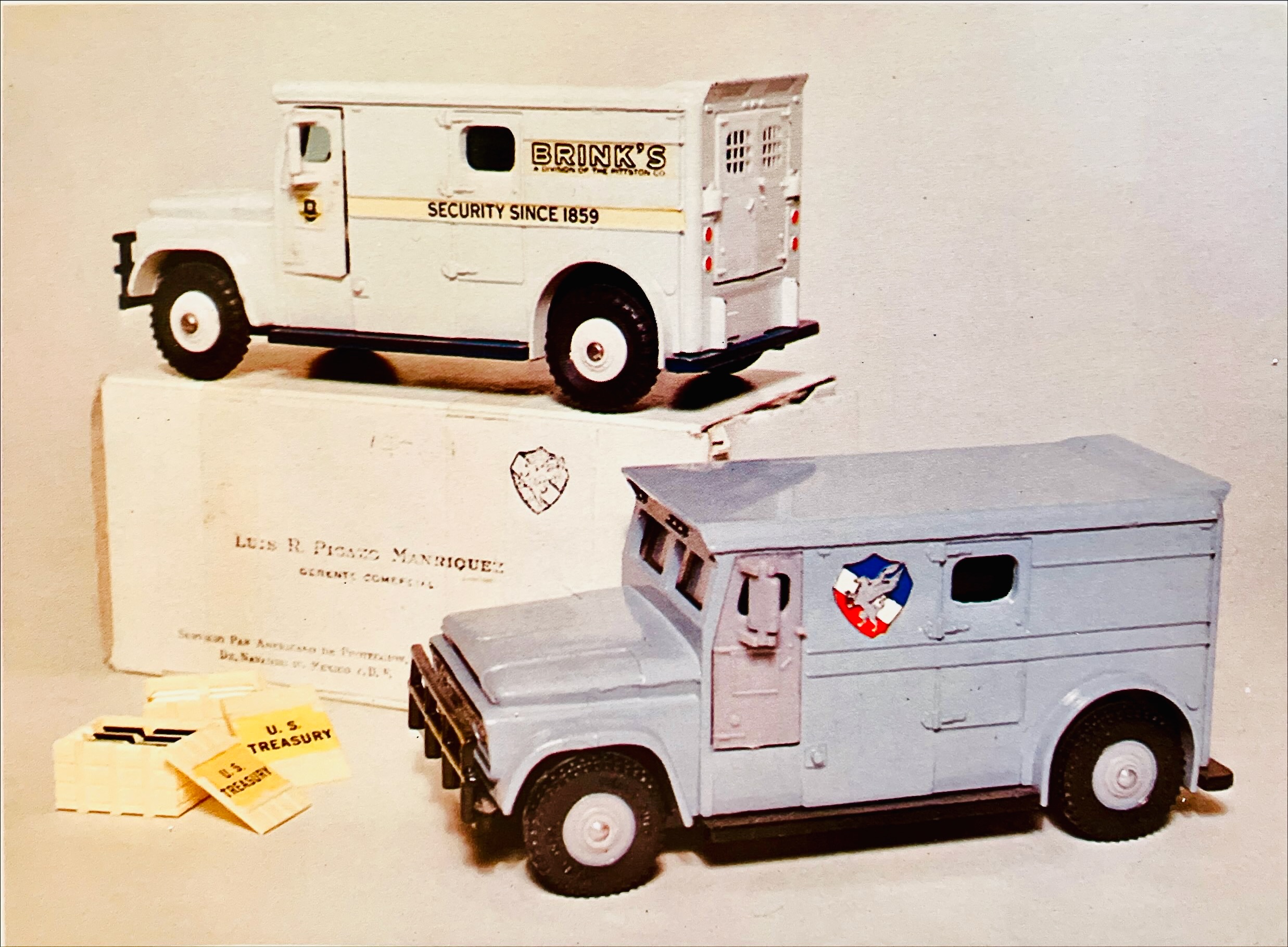
Incidentally some price guides refer to the Pan Americano Dinky as the “Luis R. Picaso Manriquez” truck. This is a misconception picked up from a photo that appeared in Mike and Sue Richardson’s history of Dinky Toys. In fact, Sr. Manriquez was a Pan Americano official who might have been responsible for ordering the Dinky. About 20 years ago, I was lucky enough to purchase two of the models directly from a former assistant of his.
These models always sport the flying horse logo of Pan Americano, but a number have turned up in UK auctions without the company name decals. I’m guessing these samples “leaked” to collectors from Binns Road directly, and that the others got decorated with the fiddly name decals in Mexico.
This photo in the Richardsons book led to naming confusion. It shows a sample of the Pan Americano truck without its company name decals.
The end of the story came in 1979, when Brink’s had obviously run out of its stocks of the Dinky truck and wanted more. Unfortunately, Binns Road — soon to be closed — was in disarray. They were having trouble meeting demand for the Dinkys that retailers had already ordered. There was little time for production of a “zombie” model that the Americans wanted. What to do?
According to both contemporary accounts and recollections on websites devoted to plastic kits, Meccano owner Airfix had made a series of increasing investments in AVA International, its U.S. distributor. Some time in 1979, AVA’s name was changed to USAirfix. Since the main business of Airfix was plastic kits, tooling was imported from England and sent to an injection-molding facility in Dallas. Imported kits were also placed into larger U.S.-specific boxes “for greater shelf appeal.”
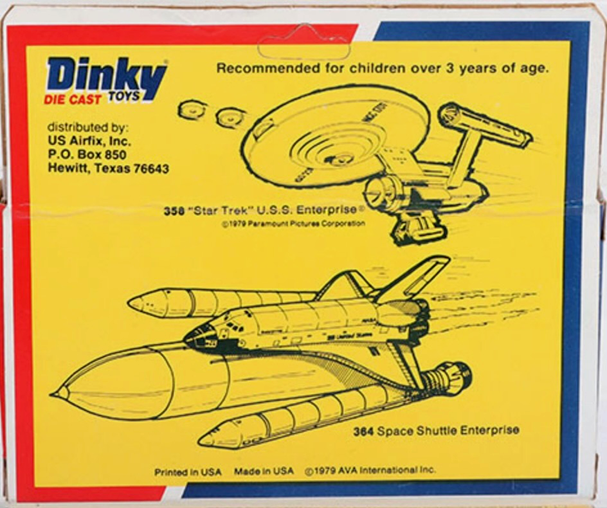
The Americans were apparently not set up for die casting, so when the order came for a “repop” of the Brinks Truck, there was only one solution. Cast the model at Binns Road, then send the naked parts to Texas for painting, assembly, and packaging. (The same was also done with Dinky’s pocket-size Star Trek models, the 802 Klingon Cruiser and 803 Enterprise.)
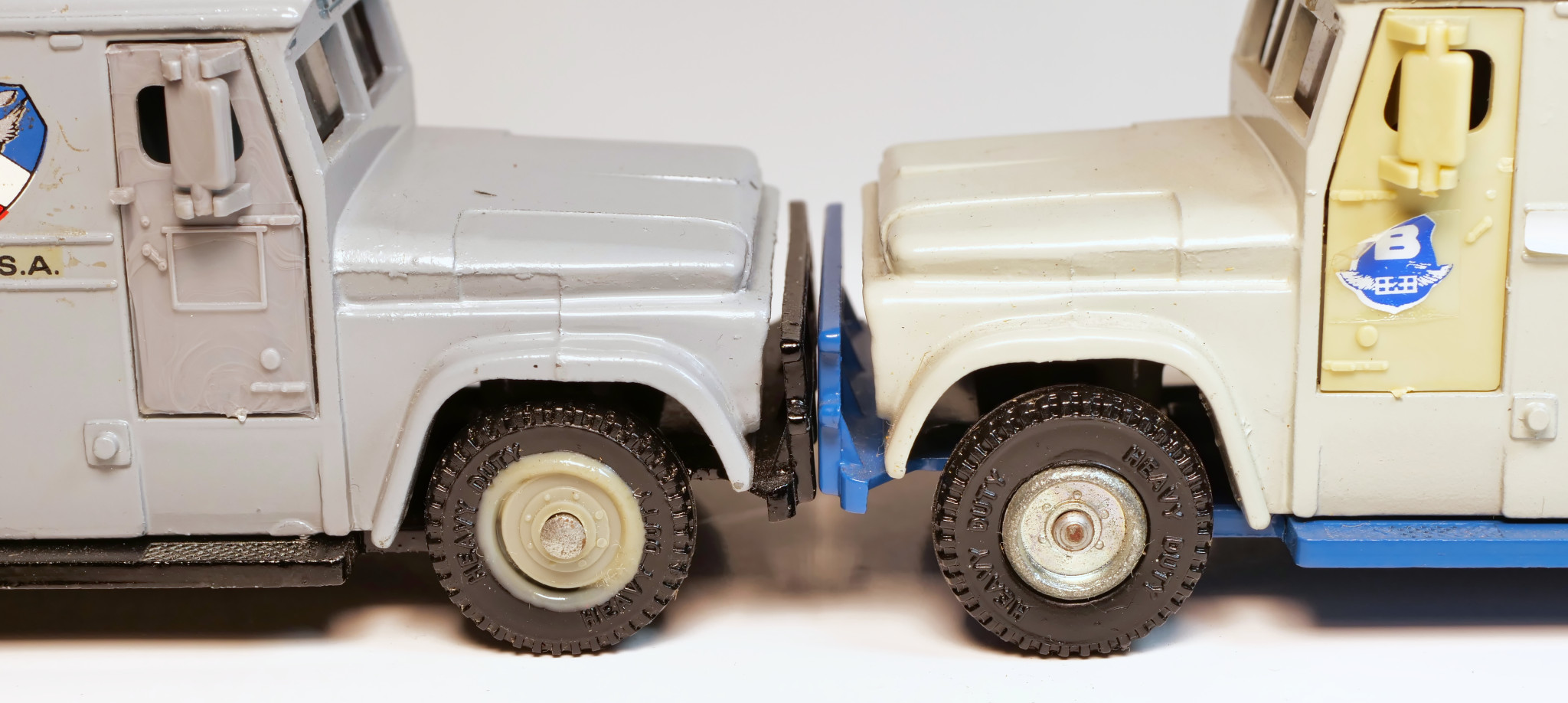
The finish on the U.S. Brinks Truck has been criticized (it is even worse on the 802 and 803) but the model did have one improvement compared to the Pan Americano version: metal wheels which no longer react with the tires. The finish is now gray for the body and doors, blue for the chassis, and white for the roof. The roof color is not sufficiently distinct from the body and stands out only in the most sympathetic light. Hardly worth the trouble.
The U.S.-assembled Brinks Truck.
The Brink’s labels are similar to before, but unfortunately they are now stickers rather than decals. Binns Road could not or would not alter the casting, so the ribs on the sides of the truck that had helped line up decals now meant that the stickers don’t stay in place. With its injection-molding capabilities, USAirfix did remove ribs from the plastic doors in order to accommodate a larger Brink’s label, but these don’t adhere well either.
Wheels on the Pan Americano truck (left) compared to those on the final U.S. version (right).
For years, I thought U.S. assembly of the final 275 Brinks Truck had to be a myth, because the model is so commonly found on U.K. auction sites. But now I know that not only was it U.S.-finished, it was also (re)imported and sold in Britain. In those innocent days before bar codes, the unaltered American packaging was employed, complete with AVA and USAirfix mentions on the back.
The U.S.-assembled Brinks Truck came in a hanging window box (left) that mentioned both AVA and USAirfix on the back (right).
The versions supplied to Brink’s were no different from those sold in stores, but Brink’s printed its own box, featuring a lift-off lid and a Brink’s logo. Particularly favored customers also received a set of branded cufflinks and a book called “The Money Movers” which had first been published in 1959.
Brink’s gave out the final version in a white box with lift-off lid.
Having Brinks Truck castings cross the Atlantic twice seems an inefficient way of doing business. But in that fraught year of 1979, Airfix also experimented by having the 180 Rover 3500 and 219 Big Cat Jaguar made in Hong Kong, and the 122 Volvo Estate and 361 Missile Firing War Chariot made in Italy.
Anyhow, U.K. purchasers of the Brinks Truck helped defray shipping costs. When I queried several Facebook groups devoted to Dinky Toys, two different users recalled paying £5 apiece for the trucks at their local toy shops. That was a high price for a Dinky at the time. The well-known toy store Hamley’s of London charged even more: £7.25!
Hamley’s marked the final Brink Truck up to £7.25.
Today, the final version of the Brinks Truck is easy to find from both U.S. and U.K. sellers for around $50. In 1983, one could have gotten one for free by writing Brink’s, which the first image below can attest to!
Brink’s still had Dinky trucks in stock in 1983.
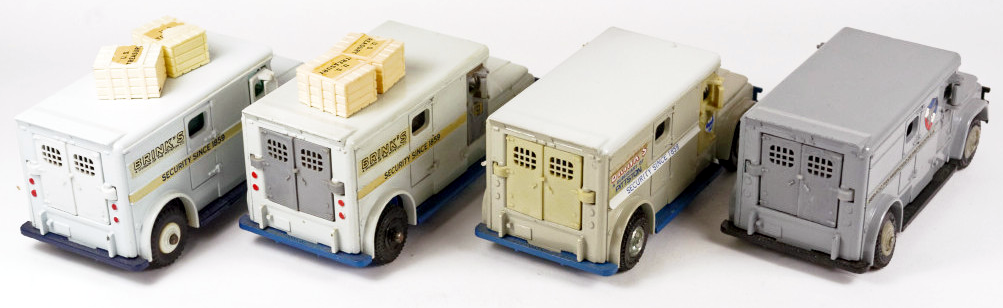
All four Dinky Brinks Trucks.
Only the first two Brinks Trucks had painted taillights.
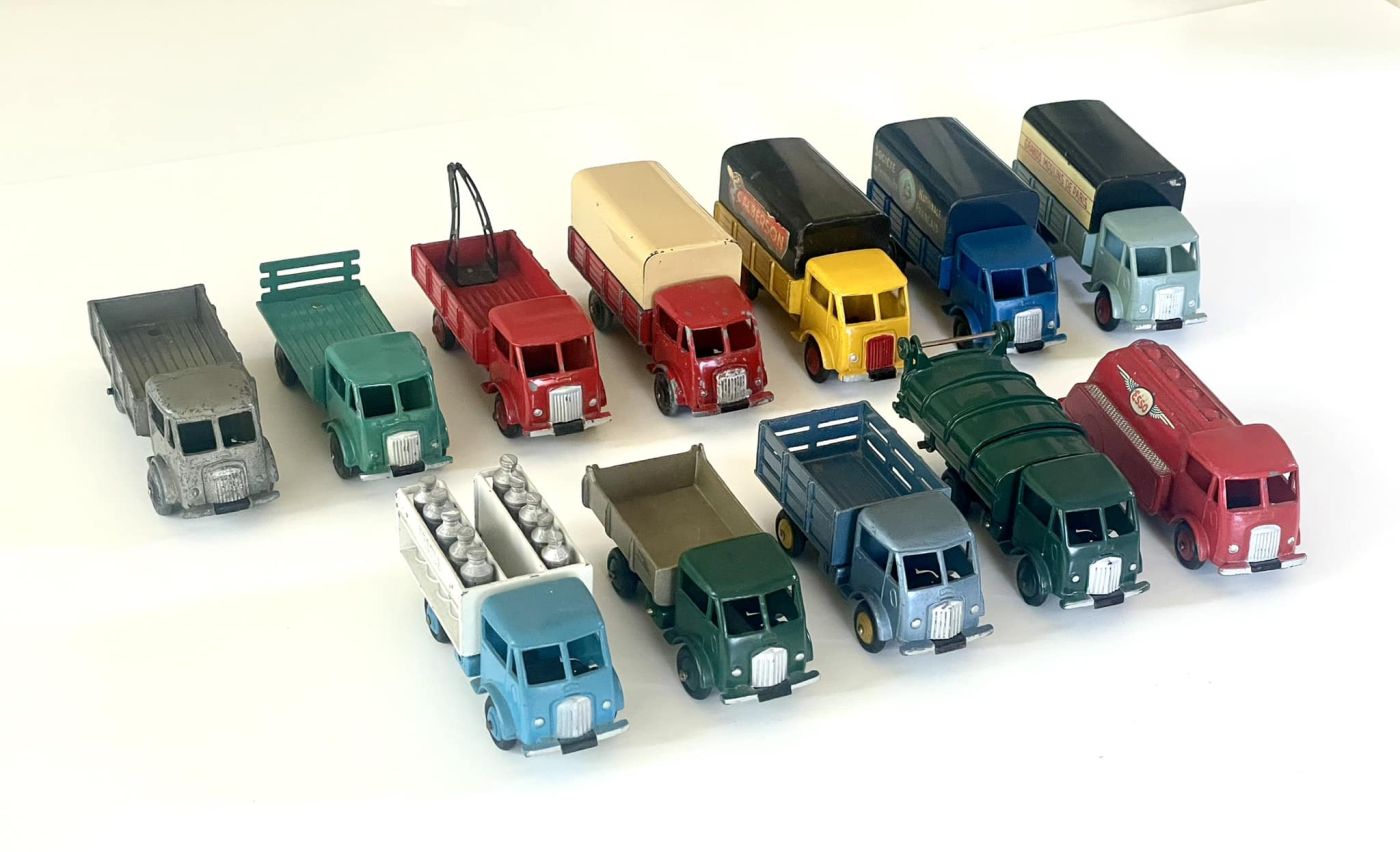
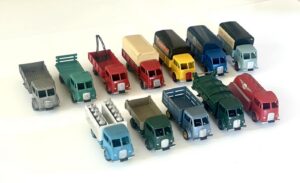
The French factory for Dinky Toys made a nice French Ford truck, the 25 series, in twelve different versions from 1949 to 1955. Here are two photos of eleven of them before I found the twelfth one.
The very first version of the French Ford Covered Wagon truck was plain, without a livery. Only made in 1949 – 1950, with all metal (diecast) tires and wheels, and quickly superseded by later versions with advertising on the side. Very difficult to find now. This truck was also called a Ford “Poissy” 5‑ton covered truck. Poissy was the historic Ford France plant established in 1938.
The plain version was quickly replaced by the Calberson and SNCF versions in 1950.
The other early French commercial truck with advertising, the Ford covered van in Grands Moulins livery, is shown below. From about 1953, this one is now rare and not easy to find near mint. Of the three 25 series Covered Wagon trucks, this Grands Moulins de Paris is my favorite. For those of you unfamiliar with the 1950’s French Dinky Toys, look carefully at the tires, and see the ‘M’ embossed on them. For many years this was a hallmark of the French made tires, not sure why they needed to include that, as their English cousins never did, but the French did several Dinky things their own way.
The photo on the left below is the Farmer’s Truck, made from late 1940’s until 1952. I really like the light metallic blue that the French factory used on many models in the 1950’s. On the right is the End Tipper.
The French Dinky Toys 25H Ford Beverage Truck was only made for a few years in the early 1950’s, and is an interesting model. It’s basically a flat truck with a tailboard, but instead of making it diecast, it was simply made of tinplate and tabbed into slots at the rear of the truck. It worked and certainly looks great, but in reality, the tinplate is not very strong, and easily bent, so many of these have lost the tailboard over the years.
Also of interest are the diecast tire/wheels. During the Indochina War from 1946–54 (in Cambodia, Laos and Vietnam), Indochina was the main supply of rubber for France; thus, the war drastically reduced the supply of rubber to France, hence the Dinky Toys solid diecast wheels. (Jacques Dujardin). So Meccano solved it by using a diecast tire/wheel and painting it black.
This next one is a Ford Open Truck, made around 1949. Another French Dinky of that era with solid metal wheels.
A purchase a while ago satisfied a long quest to find a mint and boxed French Dinky Toys 25O Ford “Nestle” milk truck. These were made at various times from around 1950 through 1955, and have two very nice features: one are the 10 separate milk cans, carried in the rear loading area; and the other is the unique box it was supplied in: designed to properly house those loose 10 milk cans.
The French Dinky Toys factory made two distinct versions of the Nestle milk truck: the first was on the earlier Studebaker chassis, up to around 1954, then adapted to the French Ford Poissy chassis for another couple of years. Many of these are missing some or all of the milk cans, but re-made replacements are available. As a young boy, I always liked these.
Here are both versions of the 25O “Nestle” Milk Truck: the Ford is on the left and the Studebaker on the right. Both were made between 1950 and 1955, and shared the same model number. Notice the different tampo Nestle lettering.
Dinky Toys made lots of trucks with Esso advertising; here are three. From left, the Panhard Esso Tanker, the French Ford Small Esso Tanker and the Trojan Esso Van. All are from the early to mid 1950’s.
The 25R French Ford Tow Truck was created out of slightly modifying the the rear cargo area of the open wagon truck. Since they needed to add the lettering on the rear, via tampo application, they had to have a smooth surface, and the regular wagon had simulated slats on the rear. So the die was modified to allow it to be smooth. And by the way, this is one of the few Dinky Toys offered for sale, but never listed in a catalog. It was only made for 1955, and was soon replaced by the larger Citroen Tow Truck. And this Ford, in turn, replaced the earlier Studebaker tow truck.
What probably happened was that the tools for the Studebaker failed or wore out while the Citroën was been developed. Therefore, the Ford filled a ten-month gap until the Citroën could be issued. The Ford appeared only in the Meccano catalogue of 1954. (Jacques Dujardin) Both the Ford and Studebaker (long nose) are shown below.
The French Ford Refuse Truck, or Trash Truck, is such a jewel that I covered it in a separate article Dinky Toys French Ford Trash Truck.
Very early, first type front end of the iconic and very well loved 25 series Ford trucks, dating to 1949, is on the left, then compared to the later casting from the mid-1950’s, on the right. If you look carefully, you can see the many changes that occurred.
The 1951 French catalog has a nice illustration on the front cover; several Ford trucks can be seen there.
This 25 series of French Dinky Fords is so charming that I am glad that I have this opportunity to share them with you. Here are two views of all twelve together in one place!
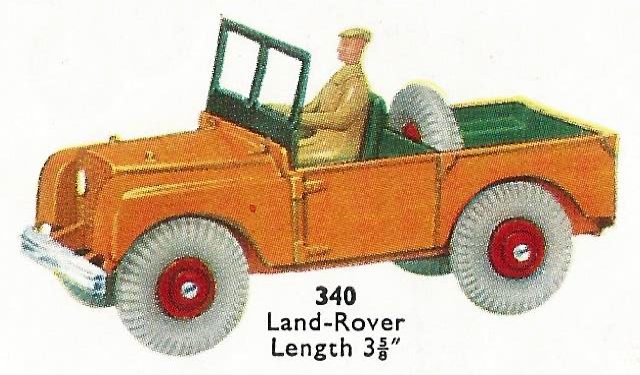
The legendary Dinky Toys Land Rover made its debut in the April 1950 issue of Meccano Magazine.
It was originally part of the 27 Series, dedicated to agricultural models, and carried the model number 27D. In 1954, it was renumbered to 340, a reference it kept until the end of its production in 1971. With a remarkable 21 year run, the Land Rover was one of the longest lasting models in the Dinky Toys lineup.
The Boxes: From Retail Packs to Collectable Treasures
When the Land Rover was first released in 1950, it was packaged in simple yellow or plain trade boxes. Each box held four vehicles and was marked with the 27D reference number.
Image: Vectis Auctions
Image: Vectis Auctions
In 1954, when Dinky Toys introduced a new numbering system, these trade boxes began showing both 27D and 340 numbers during the transitional phase.
Image: Lacy Scott & Knight Auctioneers
But then came a game-changer: Dinky realized that individual packaging would appeal more to buyers — and sales soared. The now iconic yellow individual boxes were introduced, each featuring a charming illustration of the Land Rover on the box. A colored dot on the top of the lid of the box identified the color of the car inside, a small but clever detail.
Image: Vectis Auctions
During the transition from 27D to 340, both numbers were printed on the individual boxes (around 1954). However, once the original 27D stock was phased out, Dinky shifted to using just the 340 reference on the packaging — likely around 1955.
At the end of the model’s production, only the red/orange Land Rover was made and the dot was on the box but uncolored. Eventually the dot was removed.
Images: Vectis Auctions
Ministry of Agriculture promotional version
A promotional version of the Land Rover made in very small numbers for the Ministry of Agriculture and given to sales reps who visited farms and promoted the real vehicle. You can read more about the MOA promotional version in Vincent Espinasse’s article Land Rover Dinky Toys promotionnelle.
Image: Phil Silvester (Diecast Gems)
The model was finished in dark gloss olive green with a standard deep beige interior and had an early brown metal driver. It was enhanced at the factory with silver highlights to the front and rear bumpers and also to the windscreen, top edges, bonnet hinges and door handles and hinges. The model had matching ridged wheels, grey ST tires and spare, and an unpainted rear tow hook.