To supplement the limited number of French models available at the time, Meccano Paris imported the UK Dinky Toys 14C, 27A, 27C, 561, 562, and 571 into France between 1950 and 1951. Very little has been published about the release of these models.
The French Meccano Magazine wasn’t published again until October 1953, but thanks to Jean-Michel Roulet’s book Histoire des Dinky Toys Français 1933–1978, I know these models were released during 1950–1951. Because I own three of these models, namely 27AC, 14C and 571, I searched for information regarding their release in France, but that wasn’t easy. Fortunately, I came across some important French Meccano publications from the period 1950–1952, which provide more clarity and confirm that these models came to the French market during that time.
However, these publications also reveal that these models were only available in very limited quantities and were released only for a very short time. Consequently, they have become highly sought after collectors’ items and are difficult to find. In retrospect, unfortunately these six models imported from the UK did little to help Meccano Paris.
I think it’s interesting to review these publications to better understand the release of the imported UK models. It is known that these UK models were released by Meccano Paris in a French box, but there’s something special about these French boxes, which I’ll explain at the end of this article. I will first show the imported UK models with their French boxes in question.
The Six Imported UK Dinky Toys with Their French Boxes (1950–1951)
Dinky 27AC is the only one of the six imported models shown in the French 1950 catalog, with its luxury box identified as “nouveauté”. The other models don’t appear in any French catalog. The 1950 catalog announced that the Dinky 27AC would be available in June 1950.
French luxury red box 27AC with UK models 27A and 27C. Note the round red French control stamp on the lid of the box.
French 27AC with luxury French box in the 1950 French catalog with the mention “Available in June”.
It was released in a completely French red, plasticized cardboard box with a yellow French label bearing the French name ‘Tracteur “Massey-Harris” et remorque epandeur d’engrais’, as shown in the photo above. The inner cardboard packaging contains the original UK models 27A Massey-Harris tractor and 27C Massey-Harris Manure Spreader with a British baseplate. One flexible side wall can be bent outward to store the models in the cardboard inner packaging, which has holes cut out for the wheels.
The catalog doesn’t mention the British origin of these models. Because the 27A and 27C weren’t released as a combination in a box in the UK, Meccano Paris had to design a box for this pair. As a result, the French box is unique and has become a collector’s item.
The first issue luxury red French box 14C Chariot a Fourche containing a 1950 UK 14C.
According to Roulet, the 14C was issued in France in 1950 in a luxurious red, plasticized cardboard box with a yellow French label “Chariot A Fourche” like the 27 AC, and later in 1951 in an orange cardboard box with an orange and white label, similar to the British 14 C box, but with the French orange and white label “Chariot a Fourche”.
The second issue French box 14C Chariot a Fourche containing a 1951 UK 14C.
Both boxes contain inner packaging for storing the model. The original French boxes of the 27AC and the first issue of the 14C contain a round red French quality control stamp.
The French box of the 571 Grue Roulante containing a 1950 UK 571 and a French instruction leaflet.
Shown above is the French box for the 571 Dinky Supertoys Grue Roulante with a beautifully illustrated French label featuring a crane on the blue cardboard box. The box is complete with inner packaging and a French instruction leaflet.
Illegible British control stamp on the interior lid of the box.
The model on the box is the original UK model 571 Coles Mobile Crane with a UK baseplate. The box has an illegible British inspection stamp on the inside lid and was also issued in 1950.
I don’t own the French 561 and 562 imported by Meccano Paris. These imported UK models were also released in France by Meccano Paris with a French box in 1951, which are shown in the pictures below. All box labels state “c’est une fabrication MECCANO.”
The 1951 French box of the 561 Bulldozer containing a UK 561 and a French instruction leaflet. The green tracks are replacement tracks. Image: Ivoire France Auctions.
French box of the 562 Dumper Basculeur Automoteur containing a 1951 UK 562 Muir-Hill Dumper Truck. Image: Ivoire France Auctions.
Baseplate of the 1951 UK 562 Muir-Hill Dumper Truck. Image: Ivoire France Auctions.
The French Meccano Dinky Toys Publications
French Meccano Dinky Toys order form (April 1950).
The French Meccano Dinky Toys order form of April 1950 shown above listed the 27AC without a price and available in June, but the French Meccano Trade catalog of April 1950 (shown below) with an image of the 27AC mentions it as being available in July. The release date of the 27AC is therefore unclear.
French Meccano Trade Catalog, April 1950. Image: eBay France.
L: French Meccano Dinky Toys leaflet (Sep 1950) R: French Meccano Dinky Toys price list (2 Nov 1950)
The French Meccano Dinky Toys leaflet of September 1950 shown above lists the 14C, 27AC, and 571 being available for the first time, but without the mention of a price. The French Meccano Dinky Toys price list of 2 November 1950 lists all three imported models, the 14C Chariot a Fourche, the 27AC Tracteur agricole et remorque and the 571 Dinky Supertoy Grue Mobile with their prices. However, “temporarily exhausted” is noted alongside the 14C and 571. This indicates there was already a shortage of models 14C and 571 soon after their release in September 1950. The 27AC was apparently produced in larger quantities, as it’s not listed as being temporarily exhausted. No other models imported from the UK appear in the French order forms of 1951 and 1952.
The Meccano promotional trade catalog of March 1951 titled “Fiftieth Anniversary Sales Campaign” shown above lists the 14C, 27AC and 571 again with prices, but preceded by an asterisk with the explanation “Special items 14C, 27AC, and 571, marked with an asterisk, are available in limited quantities. We cannot guarantee restocking.” None of these three models are listed in the French catalogs or leaflets of 1951 and 1952.
I could find only one other Meccano publication mentioning the UK imported 561 Blaw-Knox Bulldozer and 562 Muir-Hill Dump Truck. Jacques Dujardin’s Dinky Toys Encyclopedia depicts a 1952 French Meccano Trade catalog in which the models 14C, 27AC, 561, 562, and 571 are no longer listed. But below the list of Dinky Toys. the following comment appears:
“The special import items 14C — 27AC — 561 — 562 — 571 that we were able to supply to you last year will probably not be available this year because we cannot obtain the necessary import licenses.”
In the promotional trade catalog of March 1951 shown above, models 561 and 562 aren’t listed, leading to the conclusion that they first were issued after March 1951 making them extremely scarce. Because no more import licenses could be obtained, no more new UK Dinky Toys models could be imported into France after 1951.
Conclusion
Based on the Meccano France publications, it can be concluded that all six imported UK models were released in France in 1951. Model 561 and 562 were first released after March 1951. Models 14C, 27AC, and 571 had already been released in France since September 1950. Only limited quantities could be imported and restocking of these items wasn’t guaranteed. The stock of the imported British models were quickly exhausted, making them very scarce.
The So-Called “French” Boxes
Brian Salter wrote an excellent article about these models in the June 2006 issue of Model Collector. He writes the following about the 14C, 561, 562 and 571:
“Despite the fact that they left Liverpool exactly as they would for the UK market, they were repackaged by the French in similar boxes but with locally produced labels. These were on sale for just one year.”
“All these four French labels were printed just a shade wider than their UK counterparts, and then neatly applied over the originals, so perhaps the local printing was a late decision. Whatever, these lasted just a single year as well, so are also not easy to find today.”
The French Dinky Toys box labels of the imported UK models with the French model name, along with the text “c’est une fabrication Meccano” suggests that the models and boxes were manufactured by Meccano Paris, as this text is stated on every original French box. But as shown, this isn’t the case with the models imported from the UK. The French label is the “French” aspect of these Dinky Toys models and boxes, as explained by Brian Salter in his article.
A comparison of the British and French boxes of the Dinky 562 Muir Hill Dumper Truck. Image: Jan Werner
A DTCA forum entry on the 562 contains an image comparing the British and French boxes of the 562. The label of the French box clearly shows it obscuring the British label beneath. This picture, along with the photo of the British inspection stamp on the French 571 box verifies Brian Salter’s statement (mentioned earlier in this article) that the French boxes are in fact original British boxes on which French labels have been applied, with the exception of boxes of the 27AC and the first issue 14C, which were produced entirely in France.
In 1938, Meccano Ltd. was reveling in its rapid rise in popularity and success of its new line called Dinky Toys, conceived in 1934. There were many series of models, both automotive and commercial, that were quickly introduced over a short period of time, all using the relatively limited die-casting techniques then available.
Sometime in 1938, a decision was made that would prove fateful: two new series of motorcars would be designed and produced for the burgeoning toy market, and they would be unlike anything that Meccano had previously produced. Thus was born the 38 Series of English Touring saloons, and the 39 Series of American sedans. This article will focus on the 38 Series.
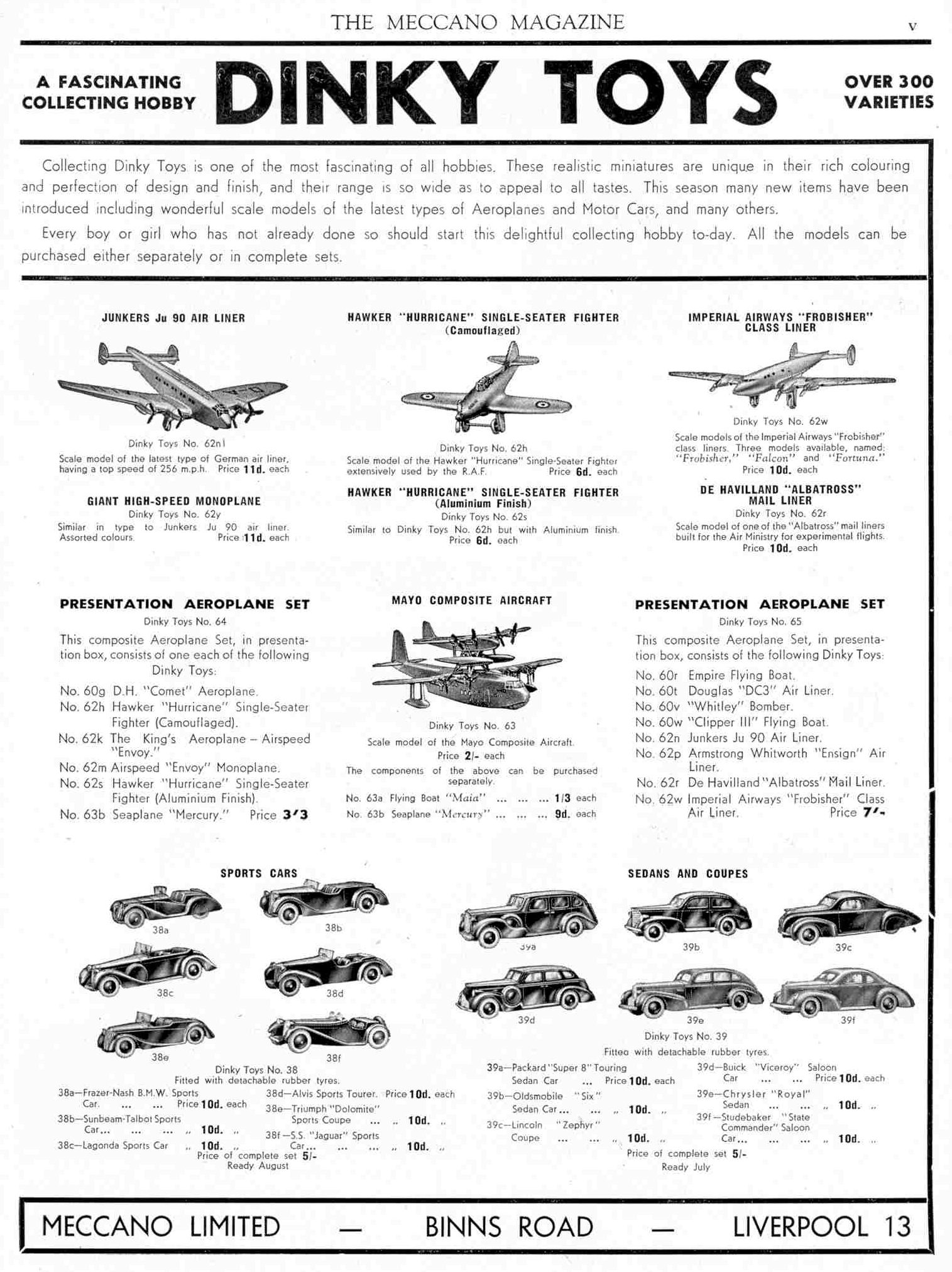
The first mention of the 38 Series was in the June 1939 issue of Meccano Magazine, which optimistically declared them to be “ready in August”. But that was not to be. The impending war and uncertainty of what lay ahead was partly to blame. But Meccano was also developing the sister 39 Series, which had been started earlier and was further along.
For some reason, only these three of the intended six Series 38 models were released in June 1940:
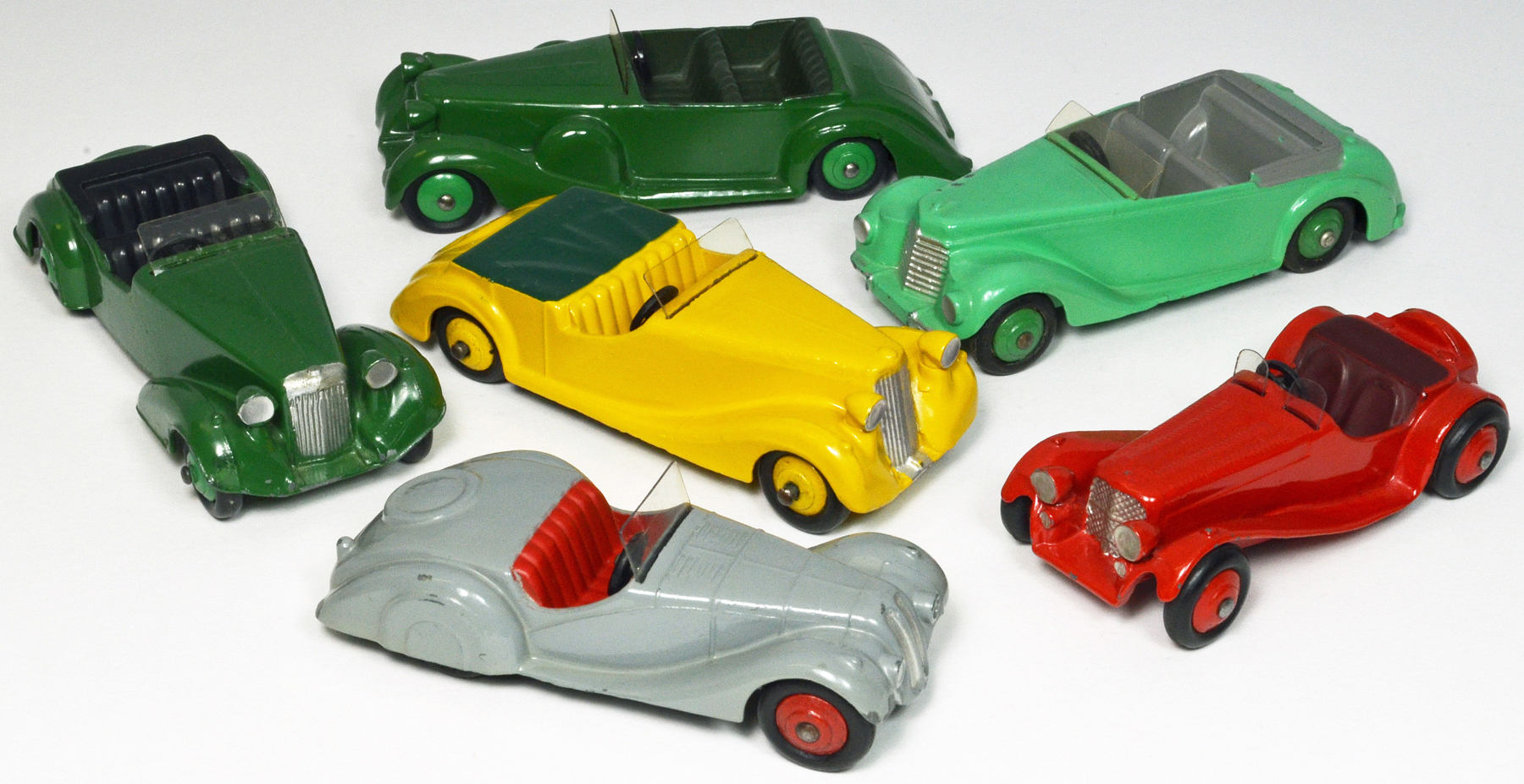
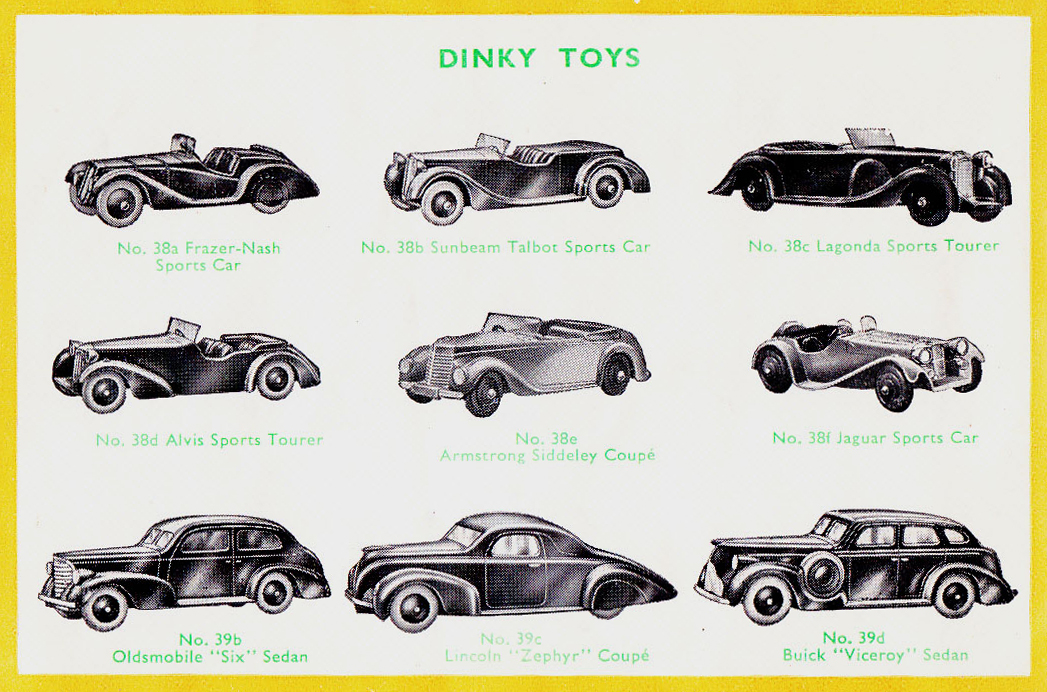
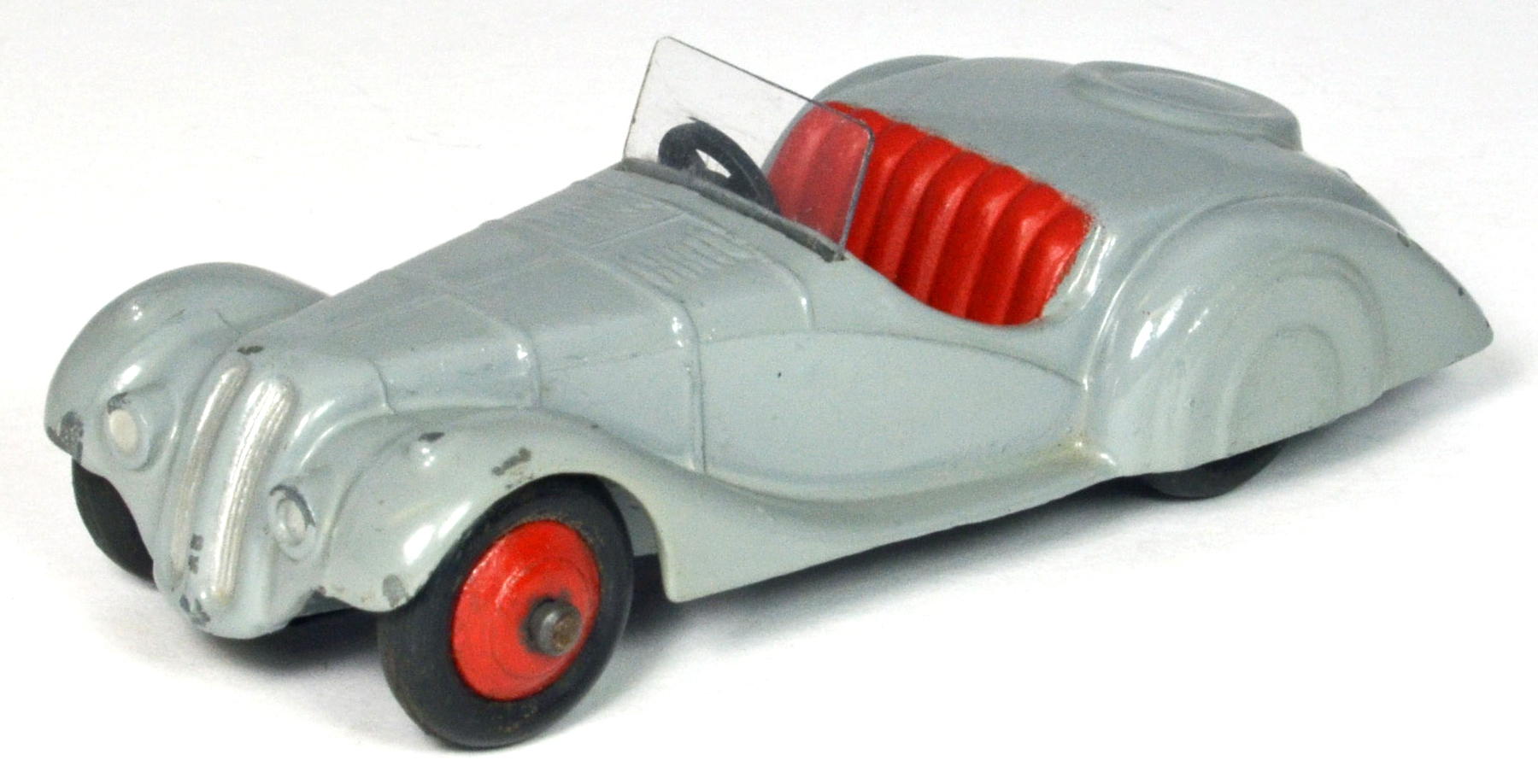
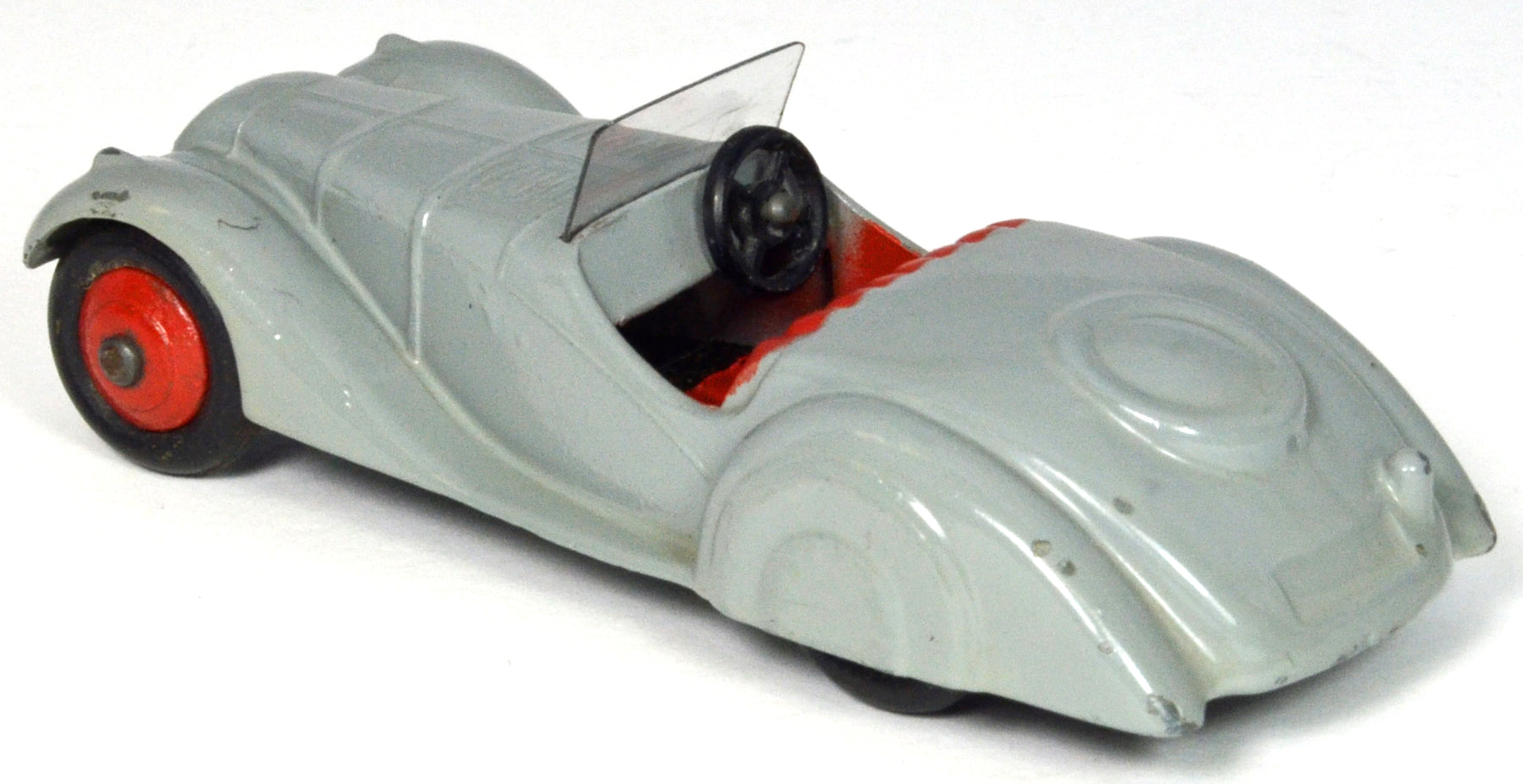
38A Frazer-Nash BMW Sports
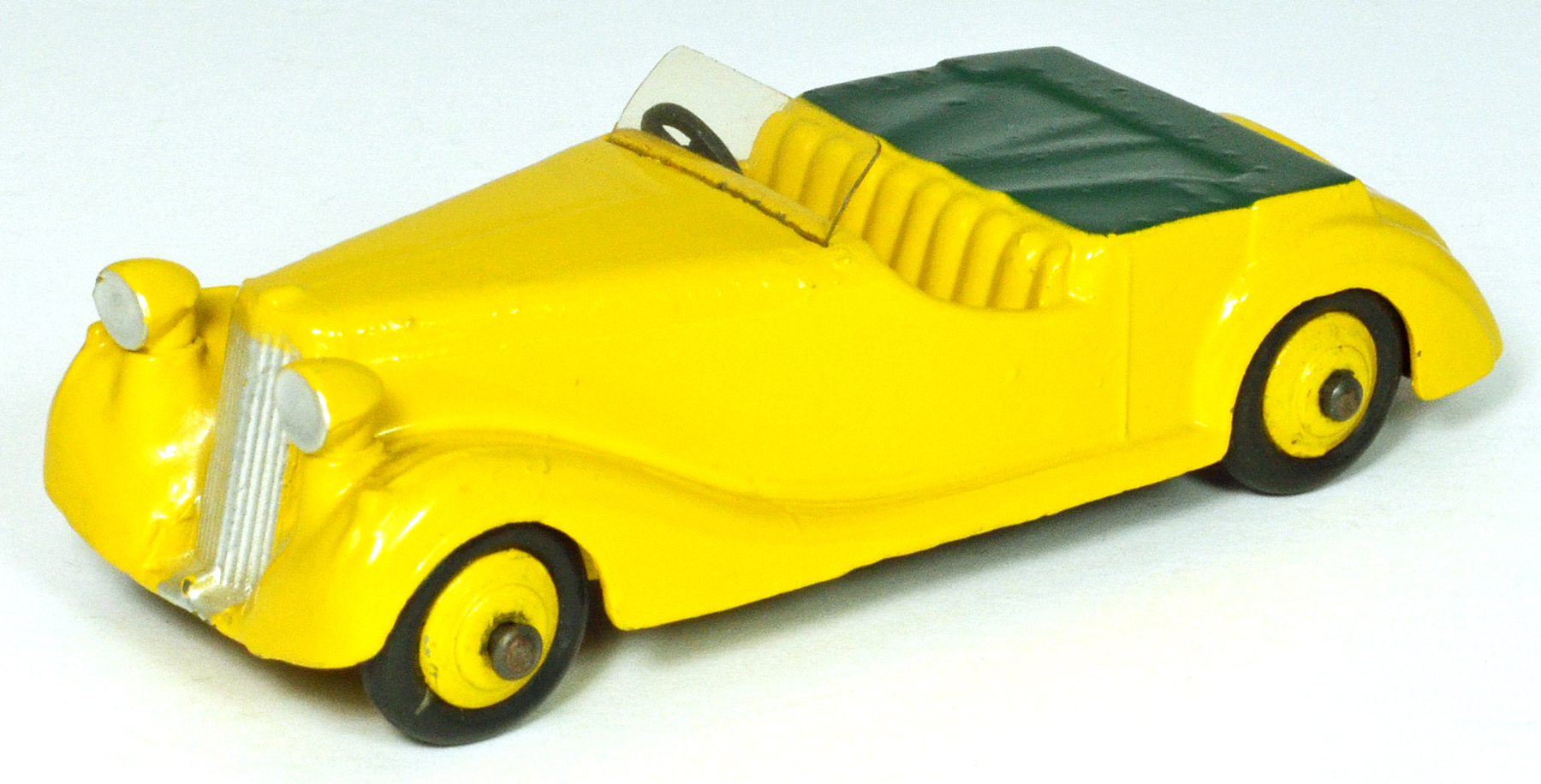
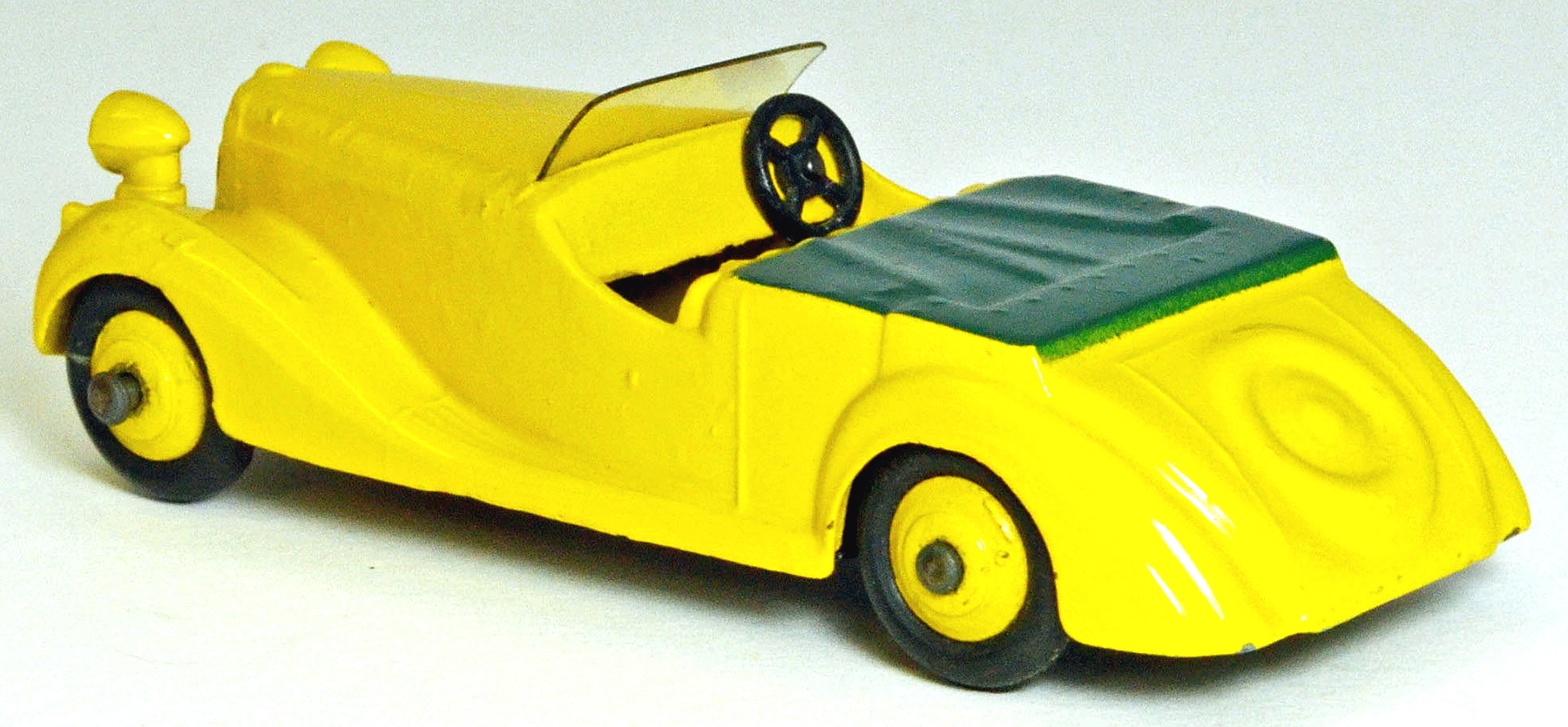
38B Sunbeam Talbot Sports
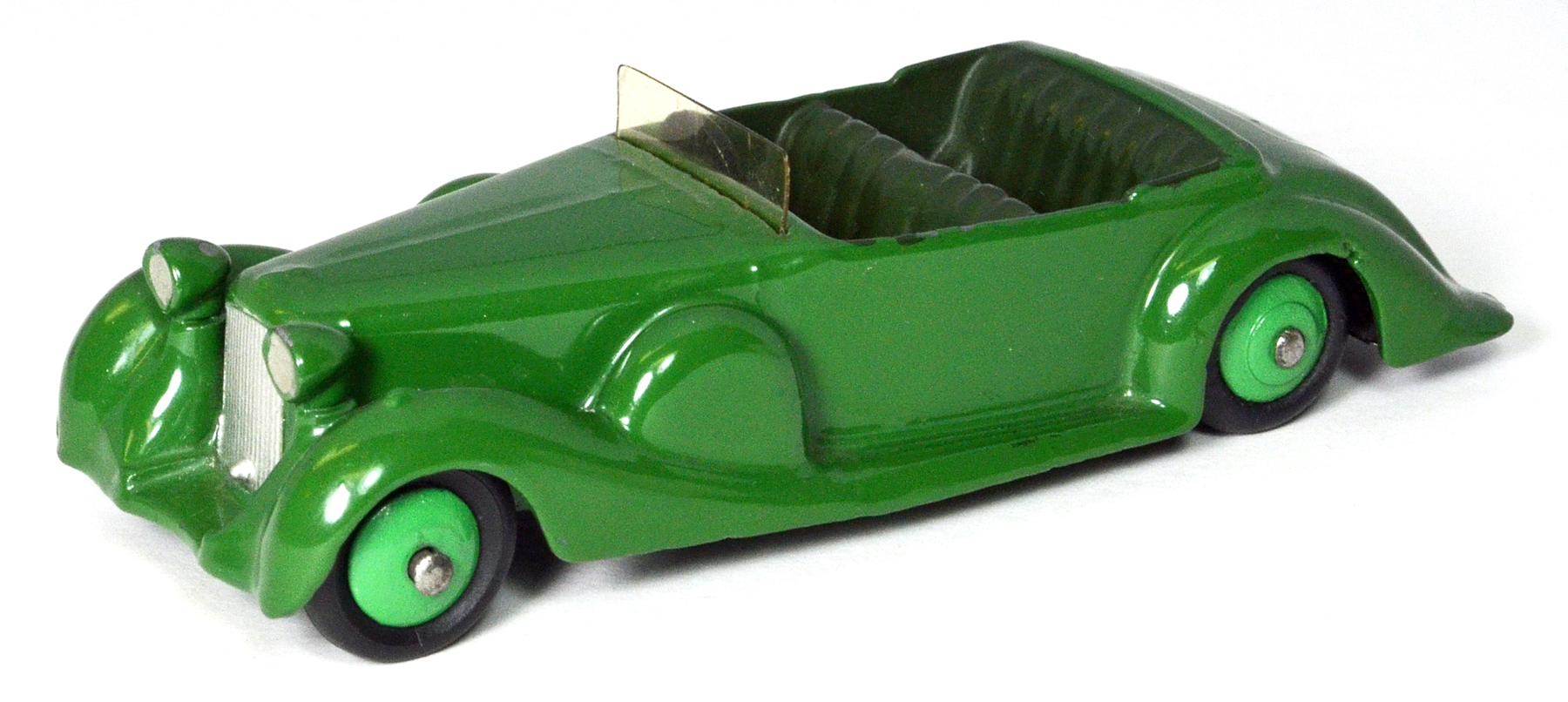
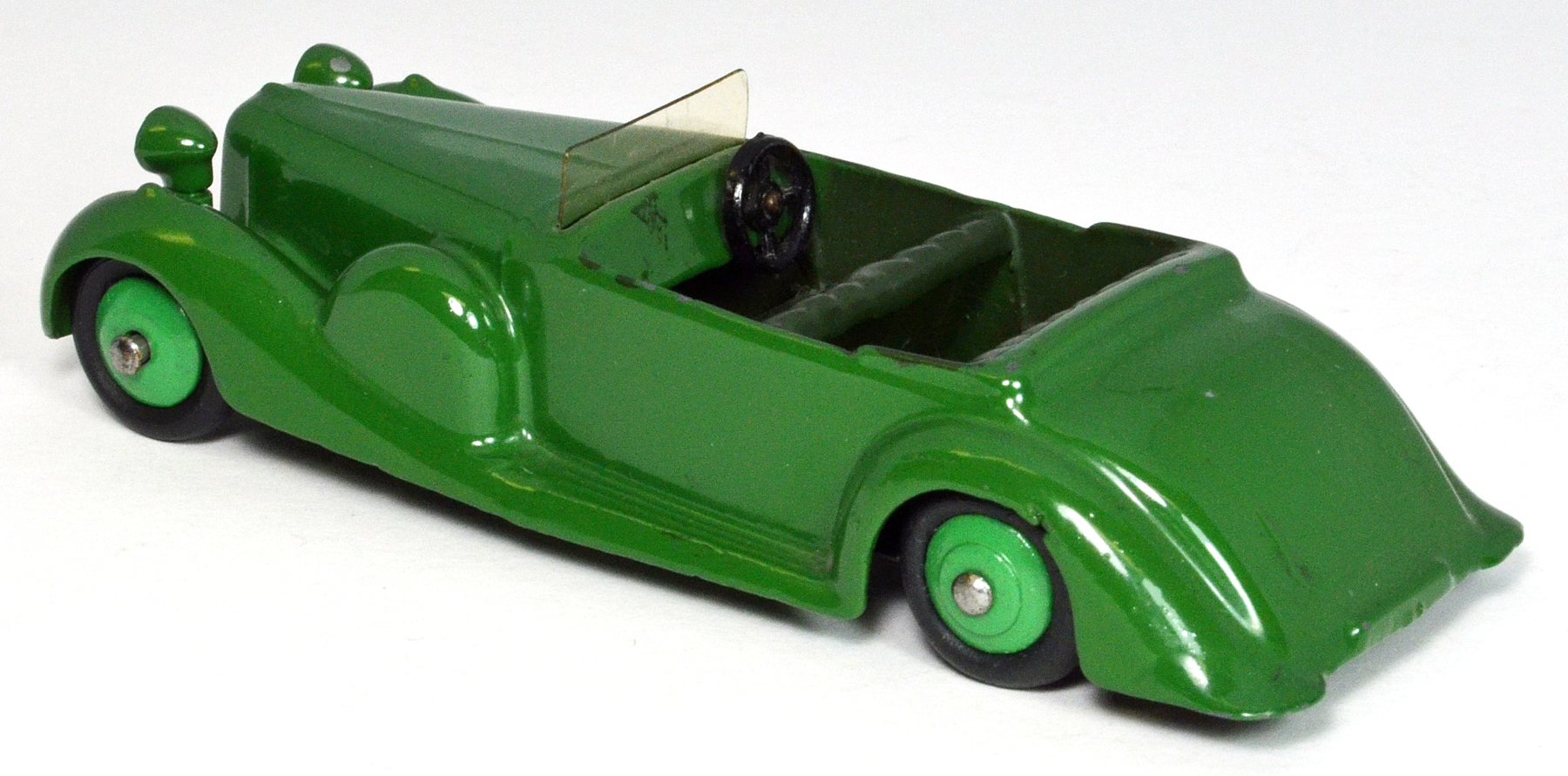
38C Alvis Tourer
These three models were only made for a short time, and all production was halted in 1941. These pre-war models are distinguished by their lacquered, silver colored baseplates, thin pre-war axles, and solid steering wheels. Meanwhile, the entirety of the companion 39 series was released.
Following the war, the three were reintroduced, along with the remainder of the Series 38 models, all in 1946. The 38C Lagonda Coupe came first, followed by the 38F Jaguar Sports Car and finally the 38E Armstrong-Siddeley Coupe. The release of the Armstrong-Siddeley raises questions, as model number 38E was first assigned to the Triumph Dolomite Sport Coupe.
All that remains of the Triumph Dolomite is a factory drawing, complete with later modifications that were completed as late as 1946. But for some unknown reason, this model was shelved and there is no evidence that a die or mold was ever completed, let alone a prototype casting made. Since it was a very late replacement, the Armstrong-Siddeley was the only post-war designed automobile to be modeled in this series.
Post-war Dinky Toys all had thicker axles, black baseplates, smooth, then ridged black wheels, and thick celluloid windscreens, often with silver detailing around the edge, replicating a windshield frame. These were made in a variety of colors, with the body being of one color and the seats or tonneau covers in another contrasting color. The series remained in the UK catalogs until 1950, when it was dropped.
However, the series was continued for the export markets for several more years, last appearing in the US 1954/1955 catalog. These later export versions differed slightly: the nice, thicker windscreens were replaced by thin flexible versions that didn’t work as well. Over time, they would tend to bend downward, resulting in an unrealistic look. However, one nice touch to the models was the use of colored wheels, instead of the plain black variety.
Most Dinky reference books give the 38 and 39 Series lots of credit for being innovative in the late 1930’s. Prior to their release, most models were composed of at least two castings, sometimes more, as die casting for a one piece body was difficult. The prior Dinky Toys 30 Series and 36 Series demonstrate the use of two separate castings: one for the body proper and another for the chassis and fenders.
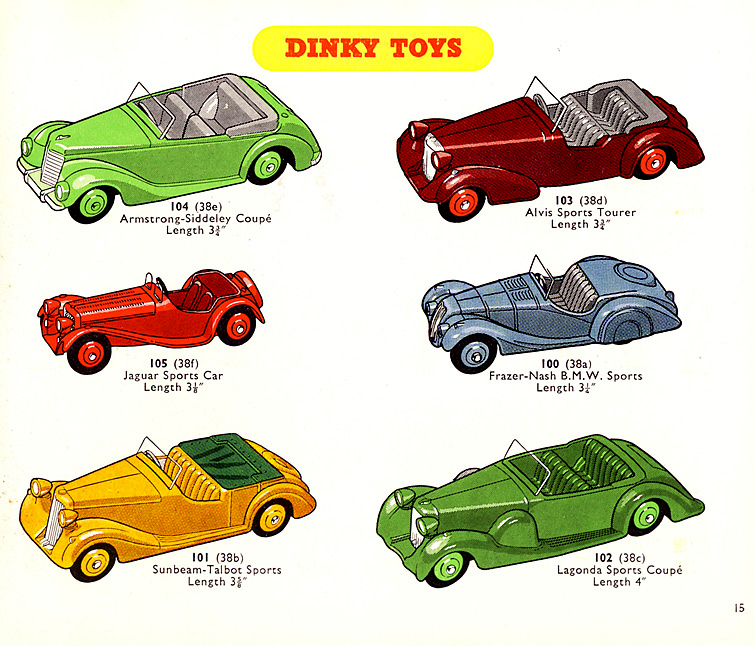
These new castings now featured one piece diecast bodies with flowing lines and were accurate models of the real cars, not just representations with vague recognition. These were also among the first to utilize tinplate baseplates holding the axles in place, as well as having the actual name of the car stamped there. It should be noted that in 1954 Dinky briefly renumbered these models to the 100 Series.
Although not completely accurate models of the real cars they represented, they are very close approximations, recognizable, and rather attractive. Over the years, much has been made about the lack of proper door lines on this series, and that is true. Not only were the doors absent, but the sides of the louvered hoods also went missing. No one has ever been able to determine why this was the case, but it is consistent with each of the six models. An explanation I heard years ago from someone familiar with die casting techniques was that it had to do with releasing the molds after casting. Whatever the reason, the series remains most attractive, and is a must for serious Dinky Toys collectors. The models are a lovely example of a bygone era, for both cars and the model hobby.
The real motor cars they replicated
Here I’ll offer a brief description of the actual English touring cars that served as models and inspiration for the 38 Series.
Frazer-Nash BMW Sports Car This was modeled after the famous and very successful BMW 328 Sports Car, that was produced during 1936–1940. These revolutionary cars utilized a 2.0 liter 6 cylinder engine and were very successful in various competitions, including many after the war. Sometimes they were re-bodied by different coach builders. In all, 426 were made. The Frazer-Nash connection is interesting, and results from them being licensed as the sole importers and sales agents for Great Britain in 1934. This lasted until 1939, when war with Germany changed everything. 328’s that were sold in England were sent there, converted to right hand drive, and re-badged as Frazer-Nash BMW’s.
Sunbeam Talbot Sports This was modeled after the Sunbeam Talbot 3 liter Tourer made during 1938–1940. There were a total of 1266 chassis produced, but only 21 were built as a Sports Tourer. These were considered to be very nice cars and were quite desirable.
Lagonda Sports Coupe This model has always been a bit difficult to properly identify as to which real car it was designed from. Some think it represents the storied Lagonda V‑12 from around 1938, while others suggest it is closer to the Lagonda LG 6 or LG 45, made during 1936–1940. Upon closer inspection, with both the Dinky Toys model and several period photos, I’m convinced that it’s modeled after the LG 45. Which makes sense, as it featured a nice 6 cylinder engine and was far less expensive than the vaulted V‑12. In any event, the Lagonda was close to the epitome of automotive excellence then, and made a most handsome model; one of the nicest in my eyes.
Alvis Tourer This one is a little easier to identify after looking at several Alvis photos. The front fenders or “wings” as the English call them are quite distinctive, and it appears this was modeled after the Alvis 4.3 liter Short Chassis Vanden Plas Tourer. This was another very well regarded English touring car that performed well. It was produced during 1938–1939.
Armstrong-Siddeley Coupe Another model that was quite easy to identify, this one replicates the Armstrong-Siddeley Hurricane Coupe that was made during 1946–1953. Originally equipped with a 2.0 liter 6 cylinder engine, it was later enlarged to 2.3 liters. Some Dinky collectors regard this as the least attractive of the 38 series, with not much of an endearing style.
Jaguar Sports Car Another very recognizable car, this was modeled after the very iconic Jaguar SS100 Sports Car that was produced during 1936–1940. First built with a smaller 2.5 liter engine, and then equipped with the much more powerful 3.5 liter power plant in 1938, it was a formidable performer and was able to reach a speed of 100 mph, no small feat in 1938. It was a very popular rally and trial car and is very collectible today, commanding very high prices. The Dinky Toys model is a quite accurate representation and was very popular over the years.
My Dinky Toys 38 Series models
My 38 series collection are all later export versions, with colored wheels and the flimsy celluloid windscreens. These Dinky models received new 100 series numbers in 1954, when they were made for export only.
38A/100 Frazer-Nash BMW Sports
This is a nice attractive model, but not very accurate. It was finished in various shades of blue or grey, with seats in fawn and grey. Another variation appeared in grey with red seats and wheels.
38B/101 Sunbeam Talbot Sports
This is a very nice rendition of the actual car which was advertised as “one of the finest sports car on the road”. Dinky released this model in several different colors: blue, grey, red, brown, green, yellow and maroon. The tonneau cover was painted in matt grey, fawn, blue, green, or maroon. My particular model was purchased in downtown San Diego in 1958 at Marston’s Department store, and has remained remarkably mint all these years.
38C/102 Lagonda Sports Coupe
This is a beautiful although not entirely accurate model of a classic and very well known English touring car. The swooping lines and elegance of the fender mounter spares are just lovely. The model was finished in maroon, grey, or dark green, with seats in blue, green, grey, black or maroon.
38D/103 Alvis Sports Tourer
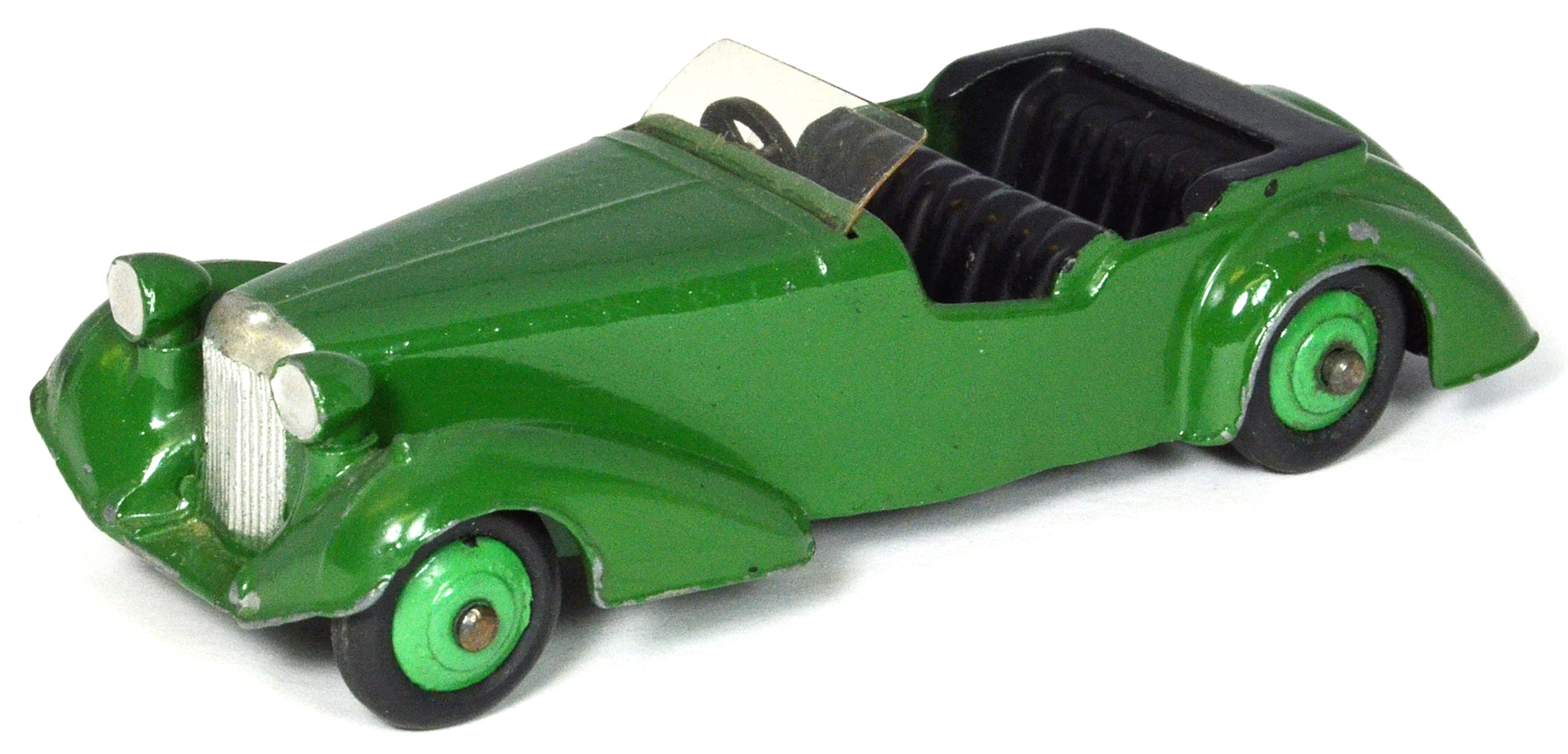
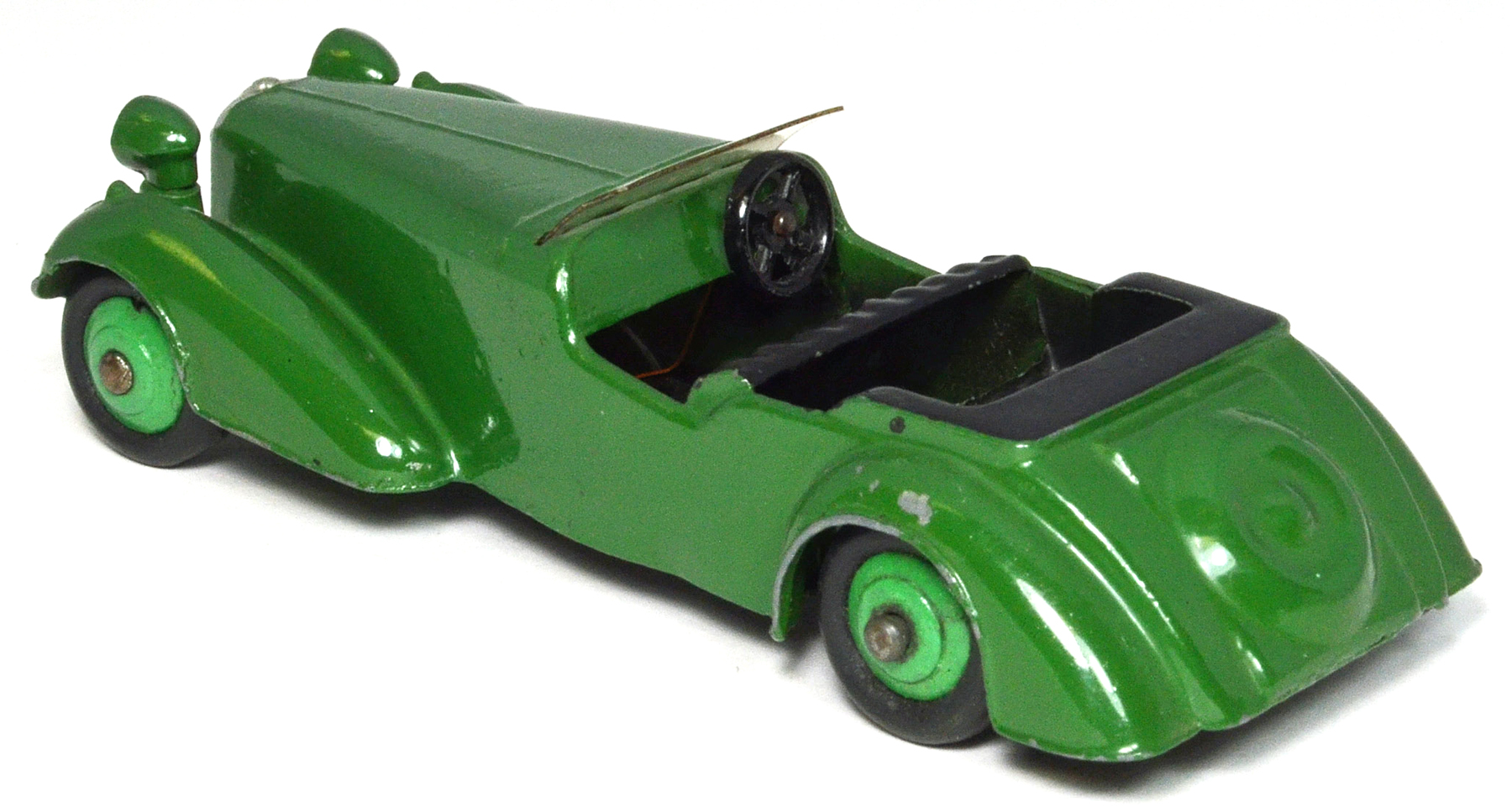
Described as “a model of a popular luxury car of the sports type”, this another of the 38 Series that was done particularly well and is quite accurate. It was offered in green, maroon, or blue, with seats and folded hood in grey, red, brown, blue, green, or black.
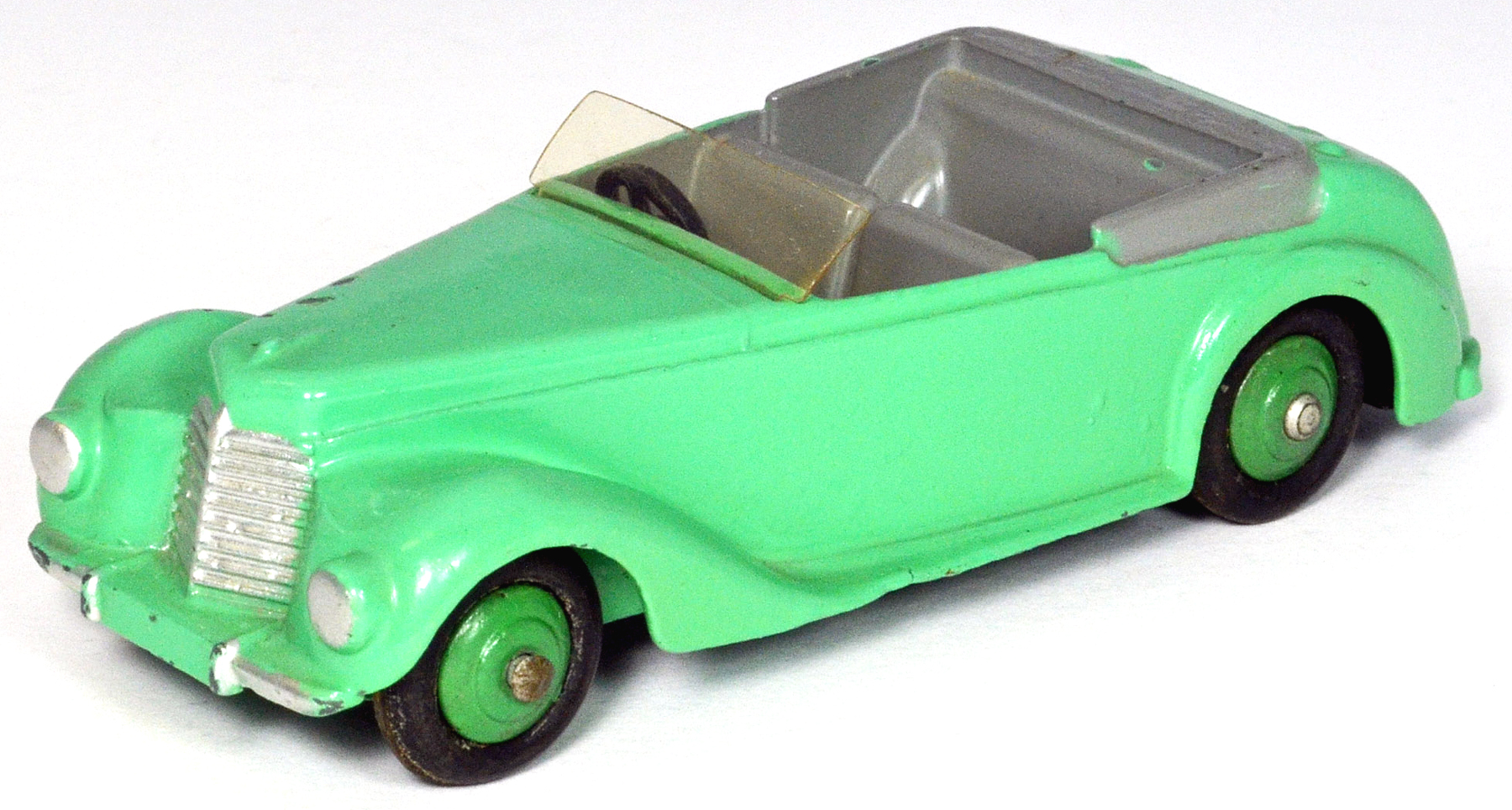
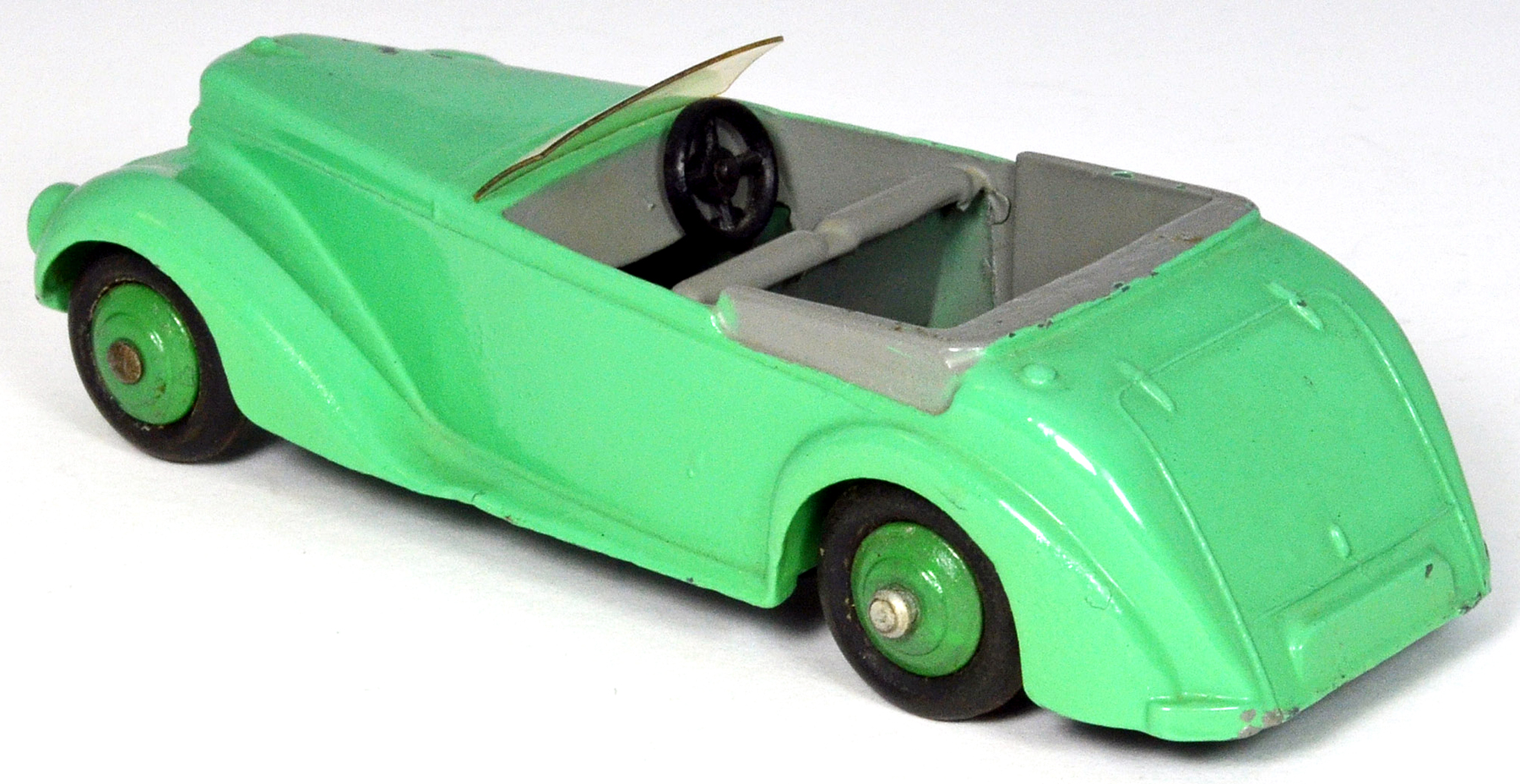
38E/104 Armstrong Siddeley Coupe
As mentioned earlier, this is the only car in the 38 Series that was modeled after a post war car, and many feel it is somewhat plain in comparison. But nonetheless it’s a nicely done model. It was available in cream, grey, green, or red body, with grey, green, maroon, or blue seats.
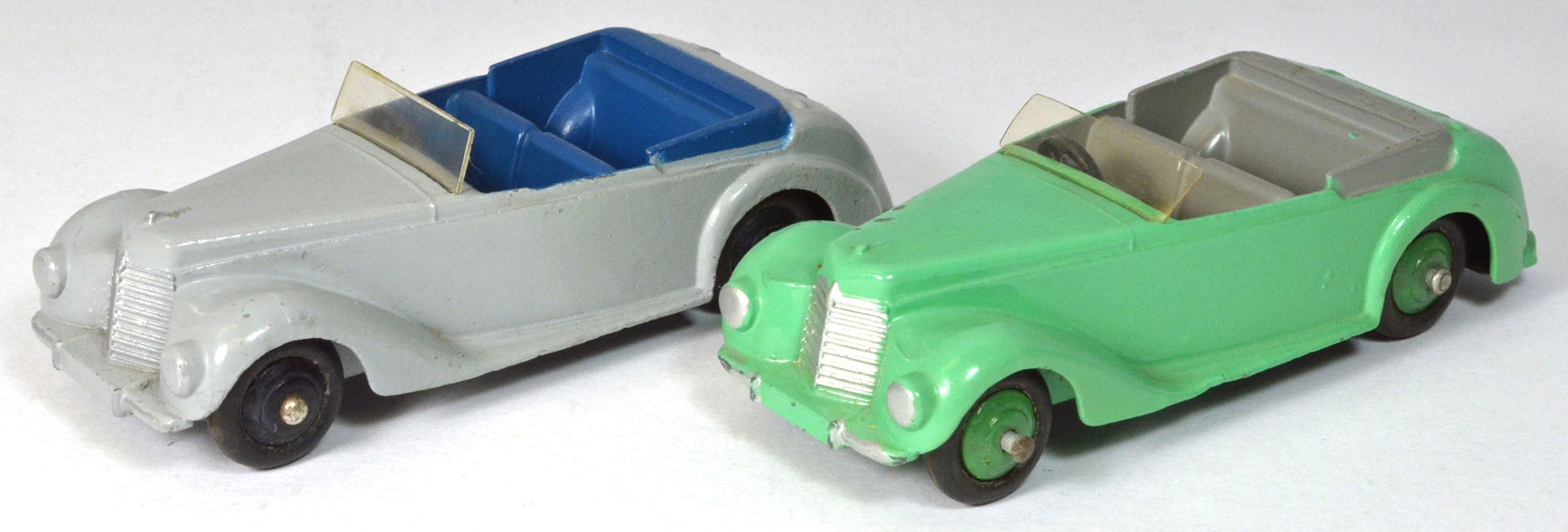
Here is another earlier version of the 38E Armstrong Siddeley Coupe, from around 1950. Notice that this earlier version shows the black wheels and thicker windscreen, with traces of silver paint to simulate a metal frame. As one can see, the earlier thicker celluloid windscreens are much more realistic. Shown below are the two versions in comparison.
38F/105 Jaguar Sports Car
Undoubtedly the most popular of the 38 Series, this is a very well done replica of the actual vehicle, capturing the rakish lines of this iconic sports car, complete with the twin aero windscreens. It was finished in blue, grey, red, and brown, with seats and tonneau in blue, grey, maroon, and black.
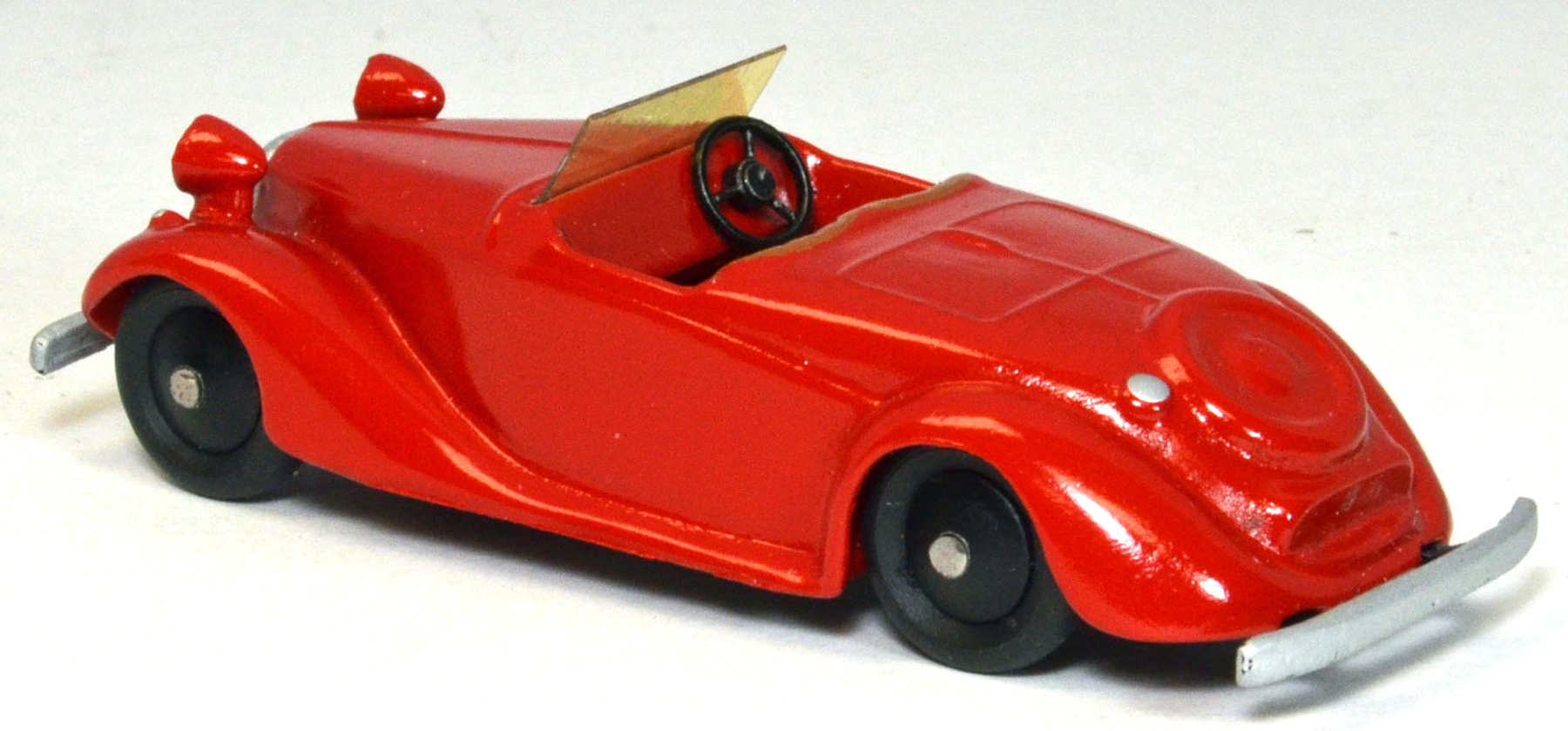
38E Triumph Dolomite
And finally, the 38 Series member that never was, the proposed 38E Triumph Dolomite which was considered for production but never materialized. Although a drawing of this model was commissioned in 1939, there is no evidence that a die was ever made or a model cast, and the reasons for abandoning it are not known.
Several model makers over the years have made likenesses of this car. Here is one that was issued by the Dinky Toys Collectors Association several years ago. It appears to blend well with the others, but this one has bumpers added, which the other members of the 38 Series lacked.
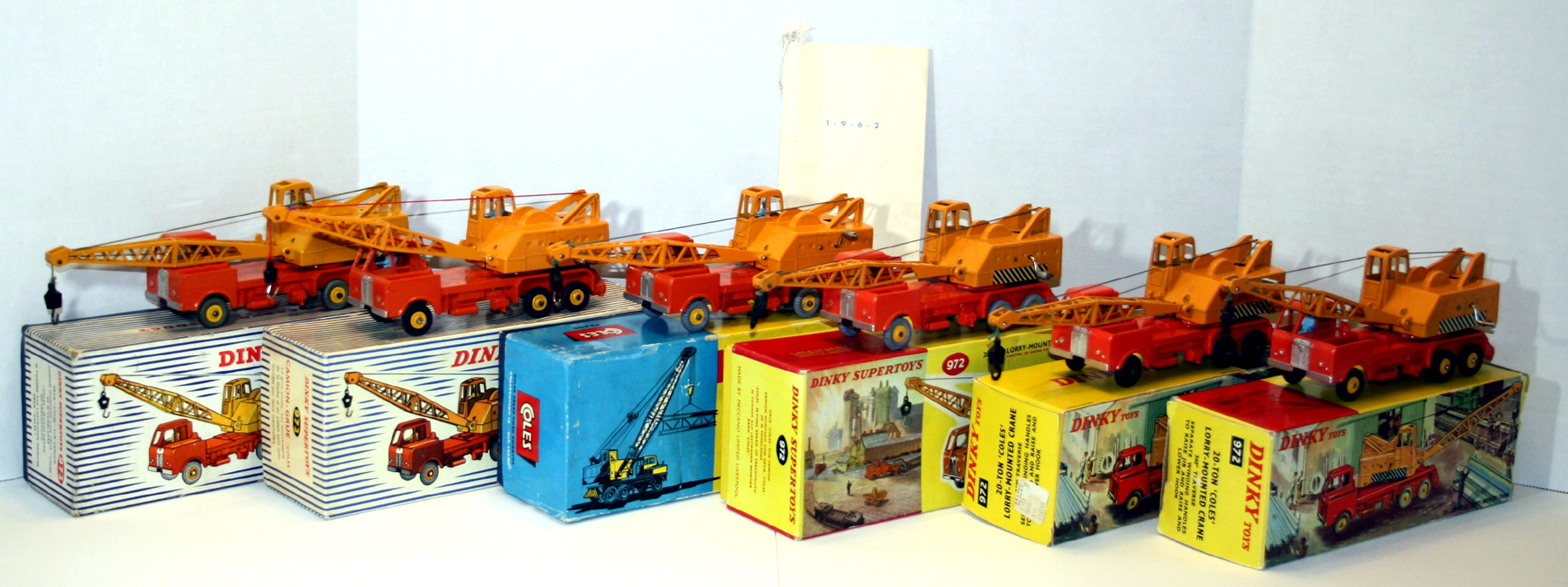
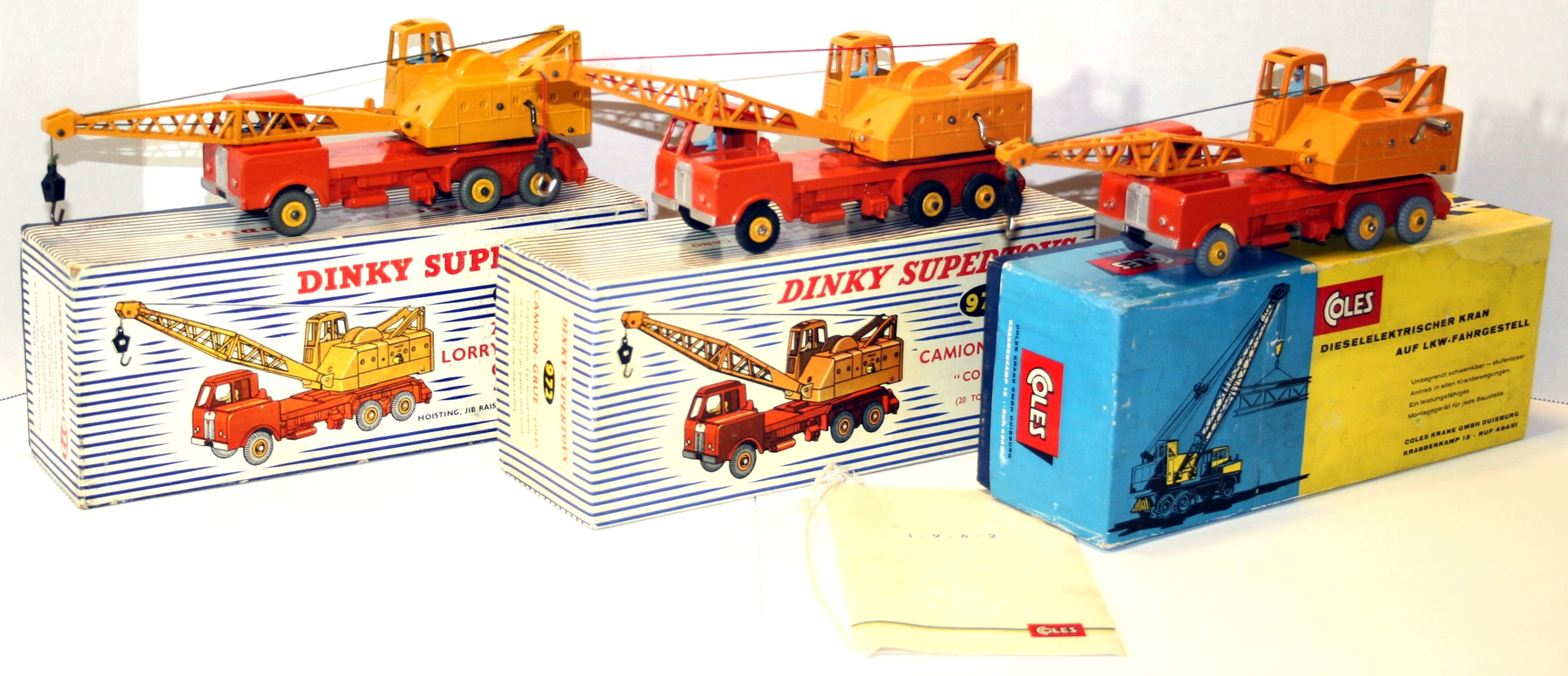
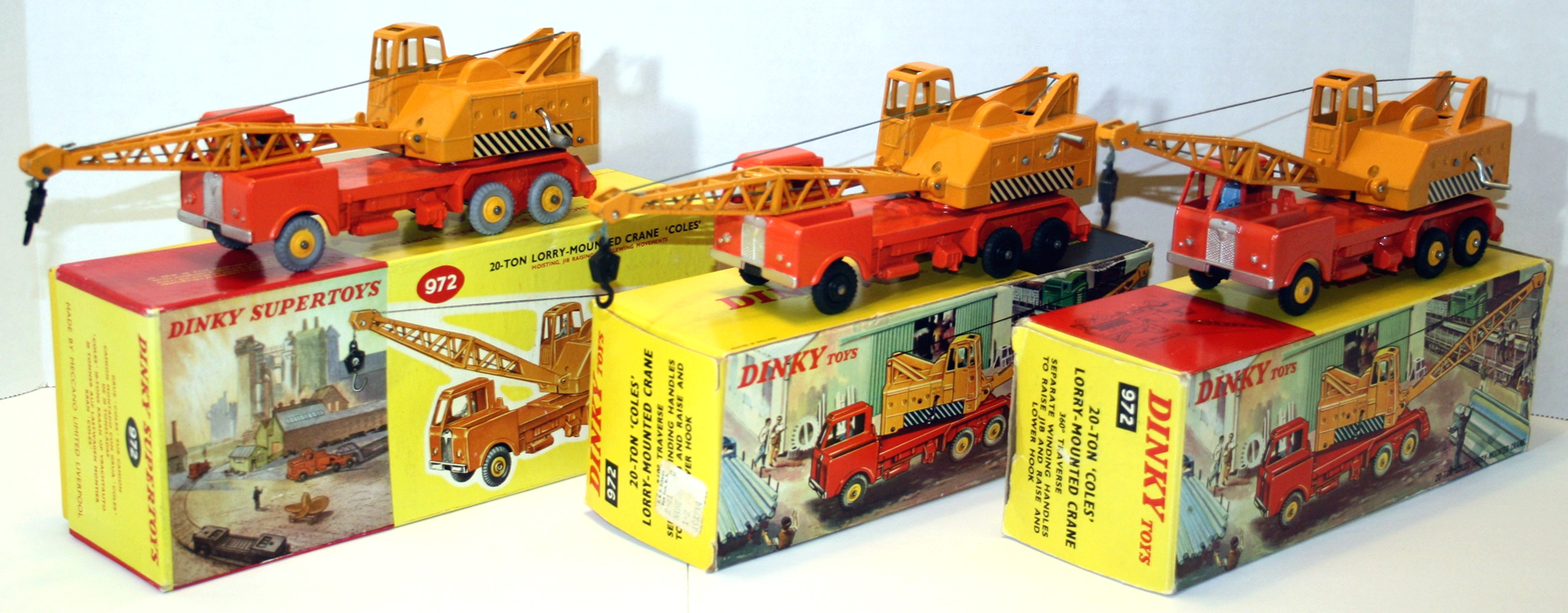
After a suggestion by fellow collector Jan Werner for a group photo of my recently completed collection of Dinky 972 Coles Crane variants, I decided to share one by writing this article. The 972 was introduced in May 1955 and its arrival was advertised by a full page ad in that month’s issue of Meccano Magazine.
Although other sub variants of these very popular models exist, I chose to collect the obvious ones when it comes to wheel and box types, so these six complete my collection. Because I don’t have the space to display my entire collection of diecast models, group photos like these are a treat for me to view and I suspect for other Dinky Toys fans as well.
My collection of Dinky 972 Cole Crane models.
From left to right:
My first 972 purchased in 1990 from Unique Collections in the UK. It was also my first Golden Age Dinky Toy.
The French issue was bought on eBay France in 2004.
The German Coles Crane promotional came from my crane collector friend Hubert Moller in Germany in 2021. It also includes the unique Coles Cranes Germany leaflet.
The illustrated lift-off lid box version came from a one owner California collection in 2025. There’s great artwork on this box which features the Mighty Antar with propeller. The model and box are virtually new.
The last issue all-card end flap box with black plastic wheels came from a one owner collection that was purchased new in 1969 and 1970 from FAO Schwarz in New York City. The owner lived in Paterson, NJ and his nephew was selling the collection on eBay in 2024.
The last issue all-card end flap box version with yellow plastic wheels came from my crane collector friend Hubert Moller in Germany in 2015. The 972 is my favorite Golden Age Dinky Toy and I’ve always been a fan of real truck cranes too.
Here are close up pictures of the models, which represent thirty five years of seeking out the nicest examples I could find and afford. They are also complete with all the correct inner packaging, which is a must for me.
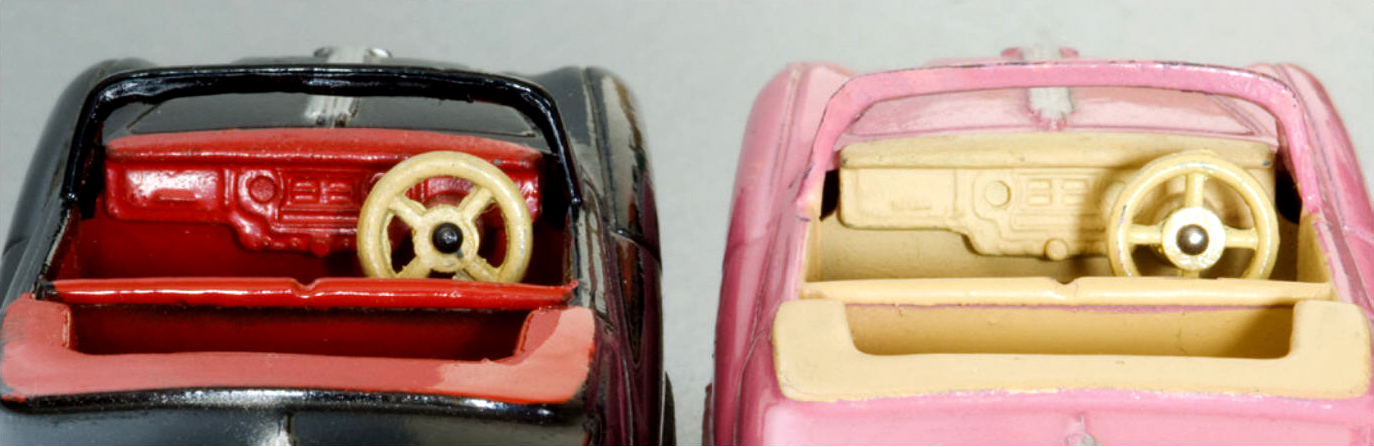
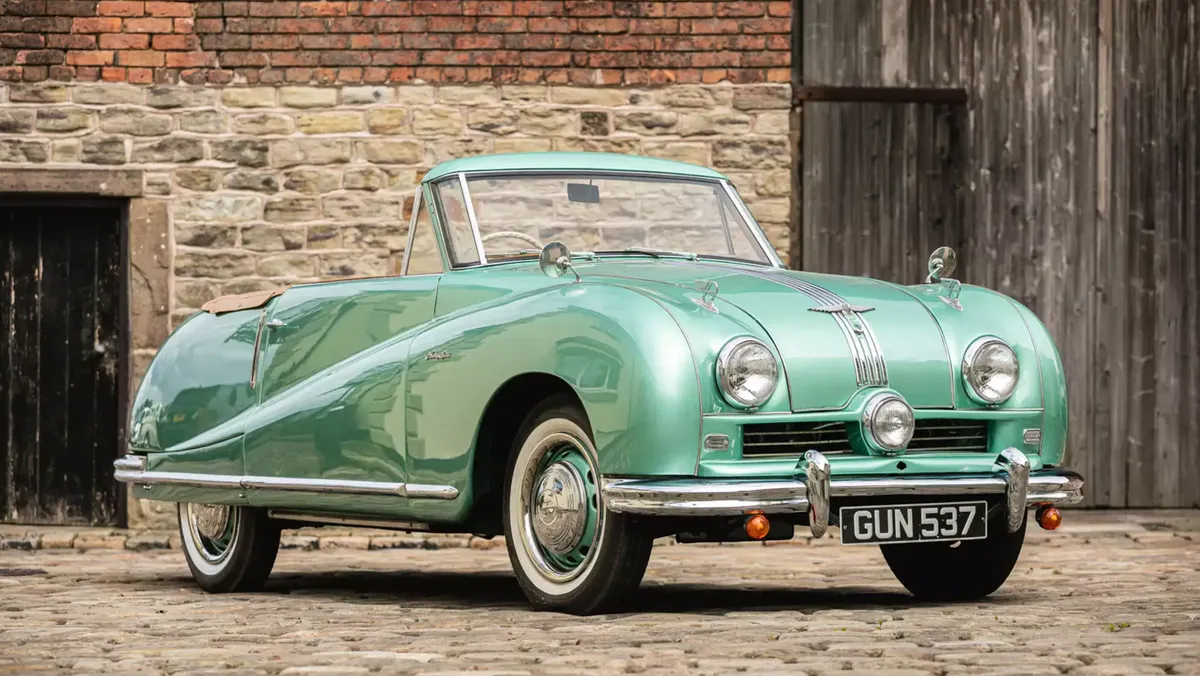
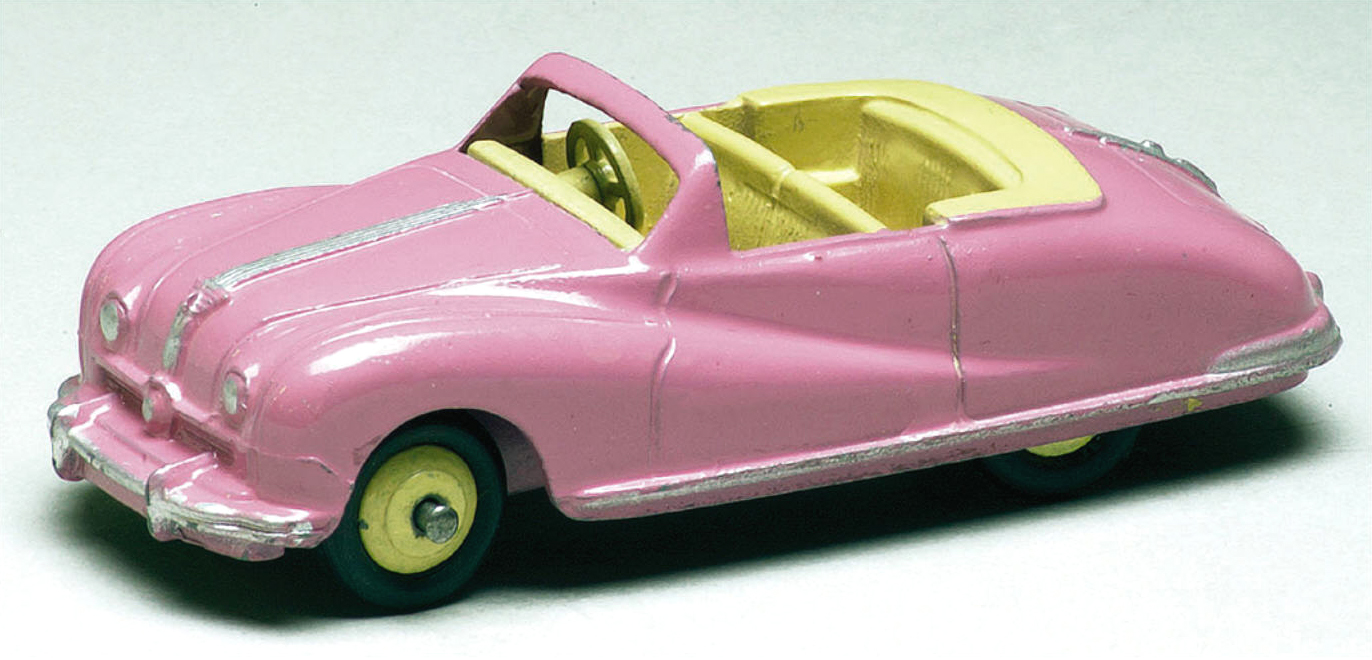
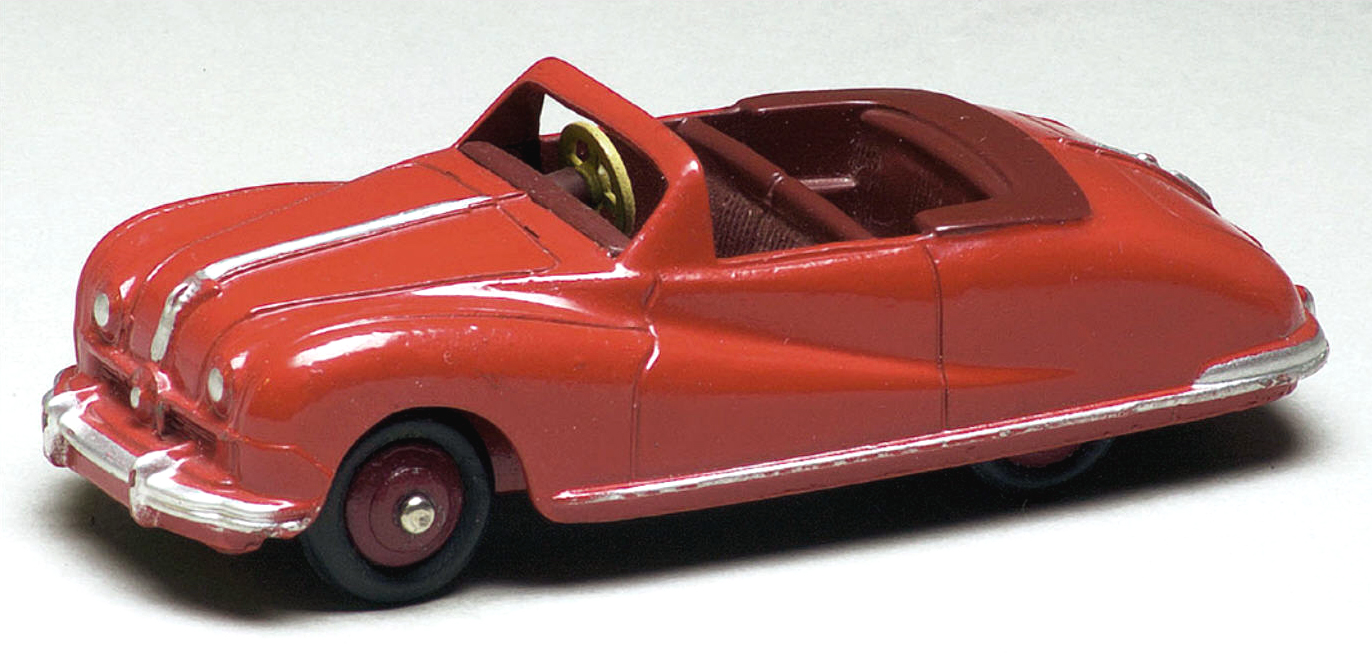
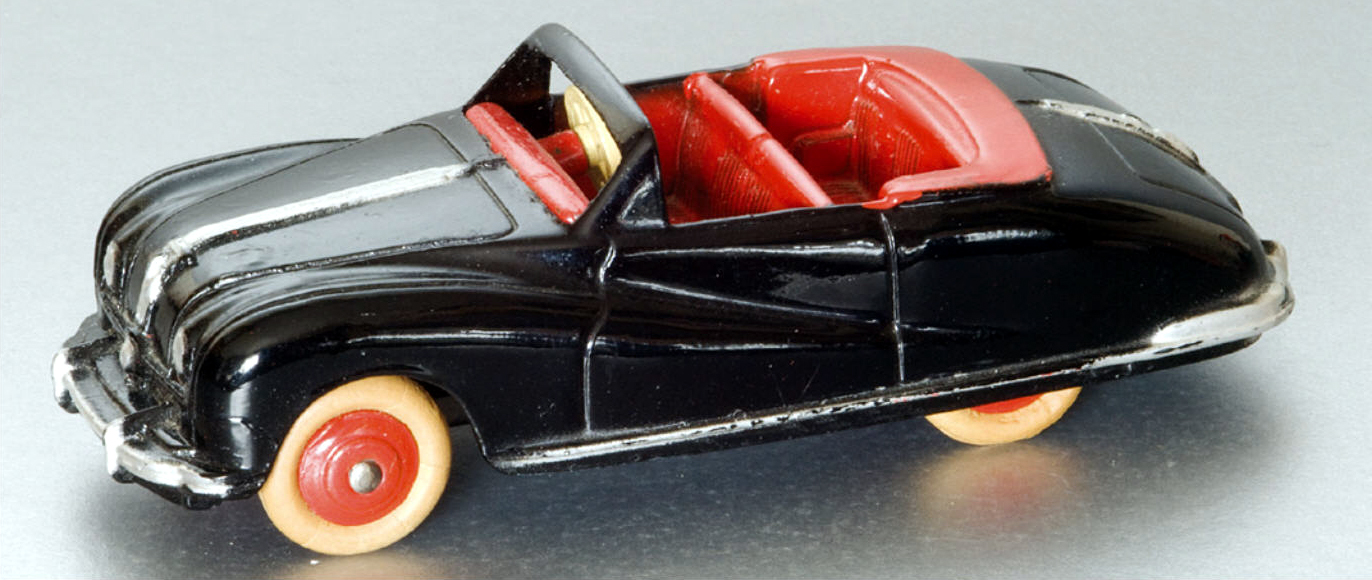
As is well documented, Meccano modeled the the Austin A90 Atlantic Sports Car at ¼ inch to a foot. This was a streamlined model of the real car that was produced in the UK from September 1948 to June 1952.
“Export or Die!”
In a desperate attempt to earn foreign currency to pay off enormous war loans, the British Labor government turned to the motor industry to provide cash. Sir Stafford Cripps issued the chilling dictate to CEOs: “Export or die!”
For many companies, exporting meant pumping cars out to countries with preferential trade status like Australia, New Zealand, South Africa, etc. But it was the U.S. dollar the government really had in mind, by tapping what they felt was a lucrative American market. It was perhaps a bit naïve to expect Americans to want to buy “quaint”, out-of-date and expensive British motor cars when they had a perfectly good motor industry of their own that catered better to their needs, and could reliably provide spare parts and service. Nonetheless, British manufacturers — desperate to achieve their quotas — made the attempt.
Enter the Austin A90
One of the first problems encountered was the resistance to conservative British styling. So a specially styled model to appeal to American tastes became the ‘idee fixe’ of company chairmen. A new generation of motor cars was born: “Americo-Anglican”. Of all the British companies that participated, Austin was probably the most vigorous exponent of streamlined styling, and the Austin A90 was their best attempt.
One concern of the American public was reliability. They also had to overcome prejudice against a 4 cylinder car competing in a 6 and 8 cylinder market. Journalist, driver and broadcaster Alan Hess, then in charge of Austin publicity, had the idea of combining the sales drive with an attempt to break American Stock Car records in order to attract attention to the new model.
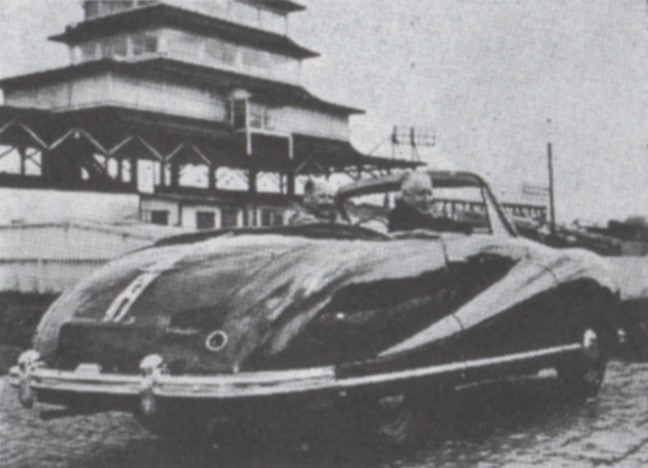
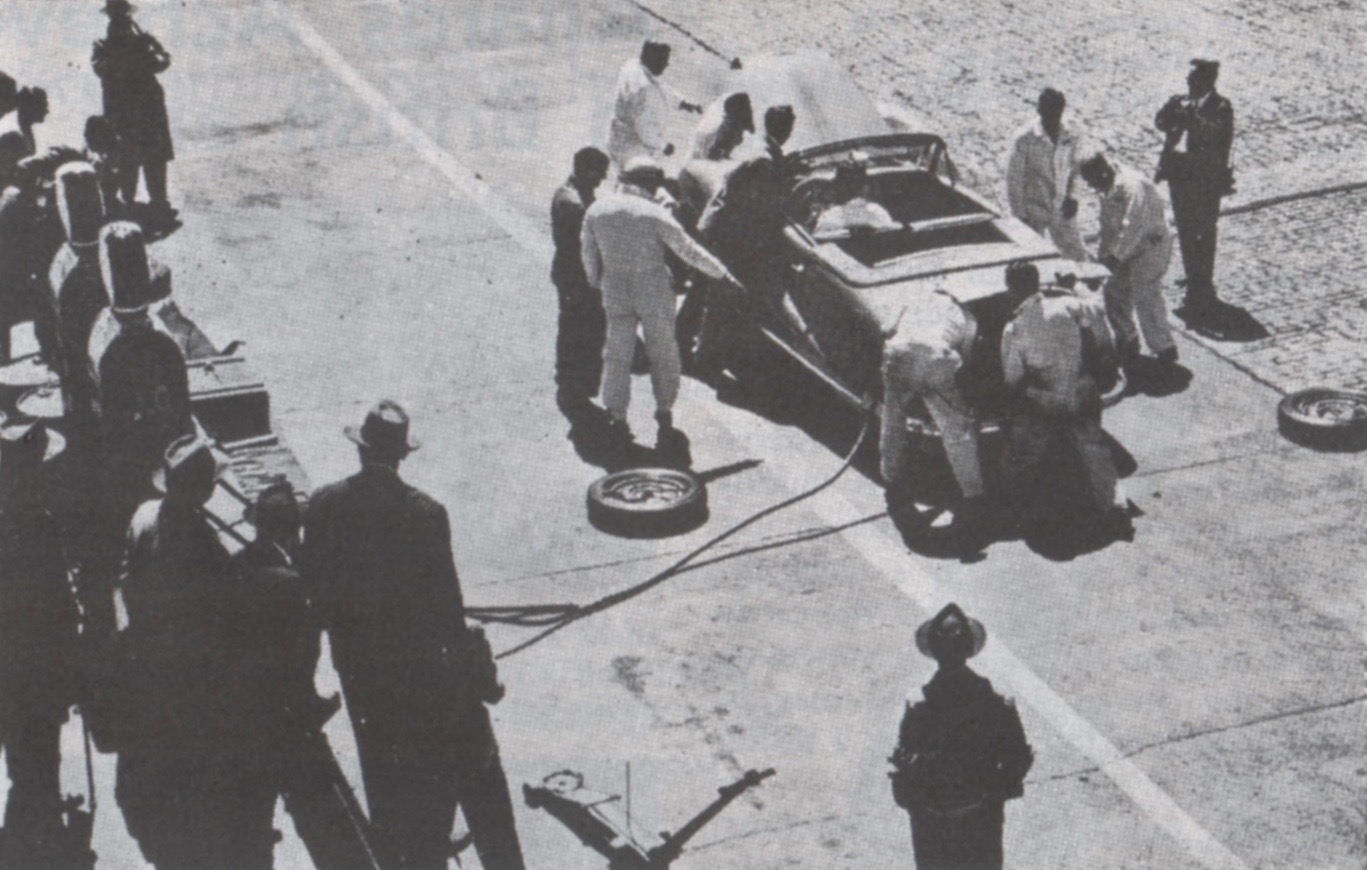
Racing driver Alan Hess (left) takes Arthur H. Marlow, the British Consul General at Chicago, for a ride in the high-speed Austin Atlantic at the Indianapolis Speedway, USA, 19th April 1949. Image: Keystone/Hulton Archive/Getty Images
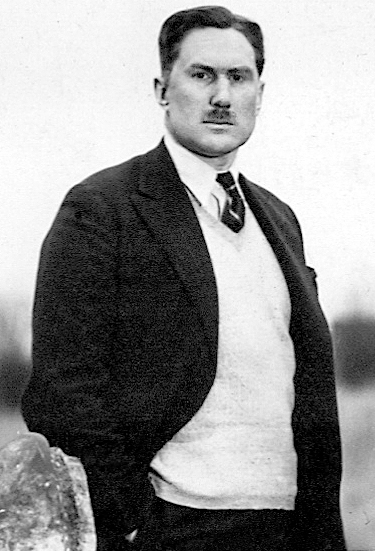
There were only two Austin Atlantic prototypes in the USA at the time and they were used for dealer evaluation. Well known automobile speed record breaker George Eyston travelled to America and convinced the AAA (American Automobile Association) to accept a standard production A90 Atlantic convertible as an entry by the Austin team to attempt a speed record at the Indianapolis Speedway during 12–19 April 1949.
George Eyston , circa 1931. Image: Palmes family of Naburn.
A Record Breaking Performance
After seven days and nights of constant driving at an average speed of 70.54 mph, the record was beaten of any open car at any capacity. Hess and his team had collected no less than 63 records, completing 11,875 punishing high-speed miles.
Alan Hess, with helmet, replacing Charles Goodacre, who has just finished three hours of driving. Image: simanaitissays.com
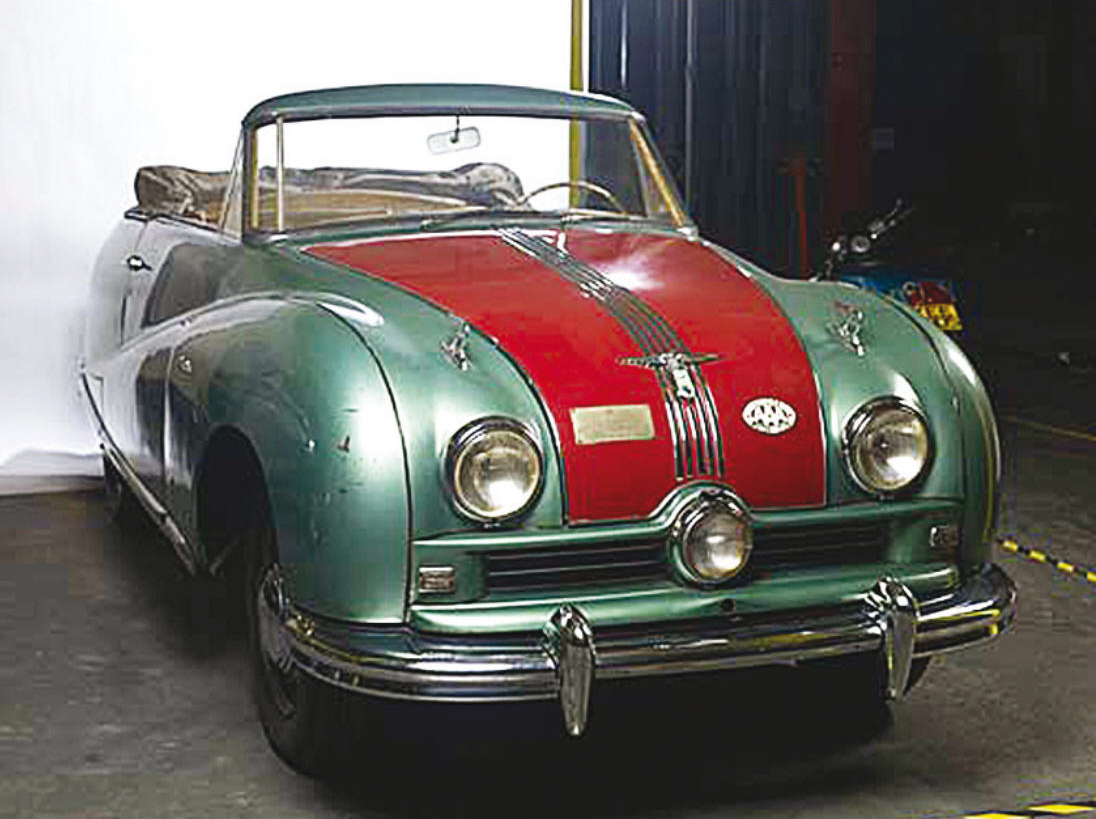
This record breaking now car resides in the Birmingham City Museum. The achievement was significant and Austin got the publicity they wanted.
The Austin Atlantic A90 driven by Hess and his team. Image: Birmingham City Museum.
Colorful Advertising
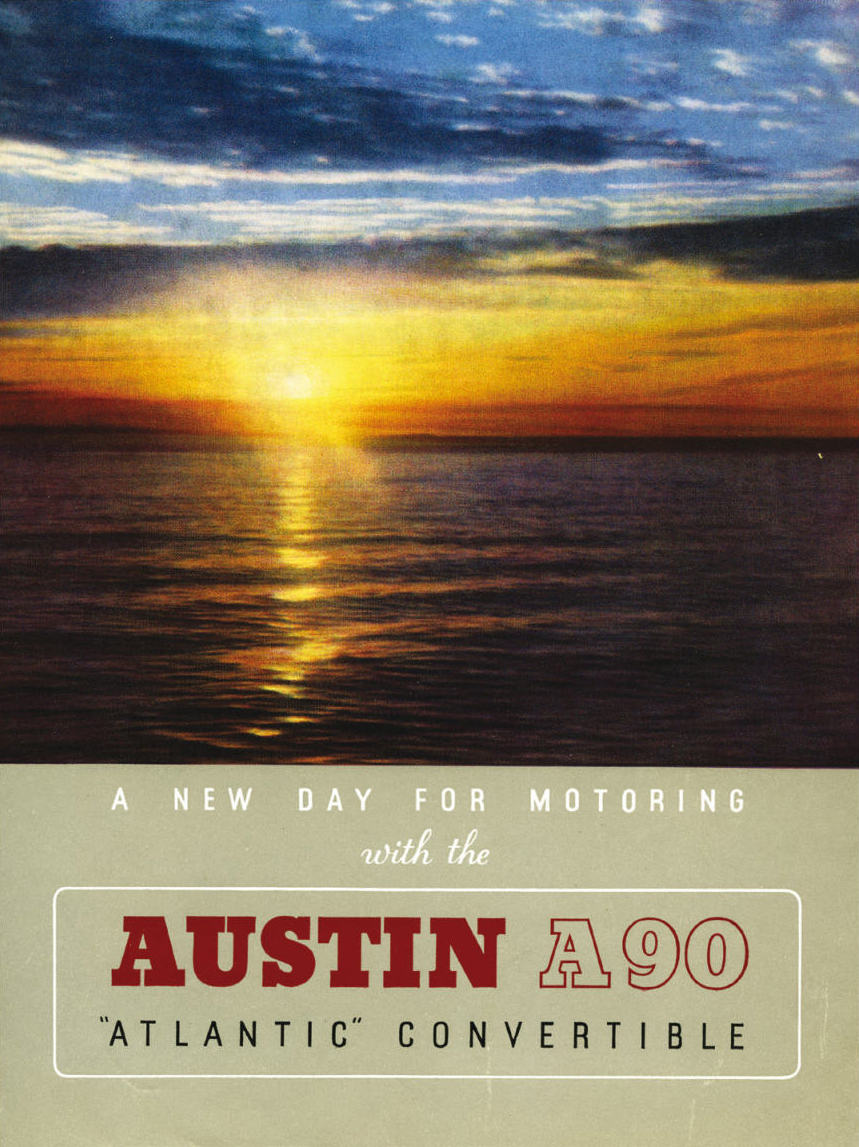
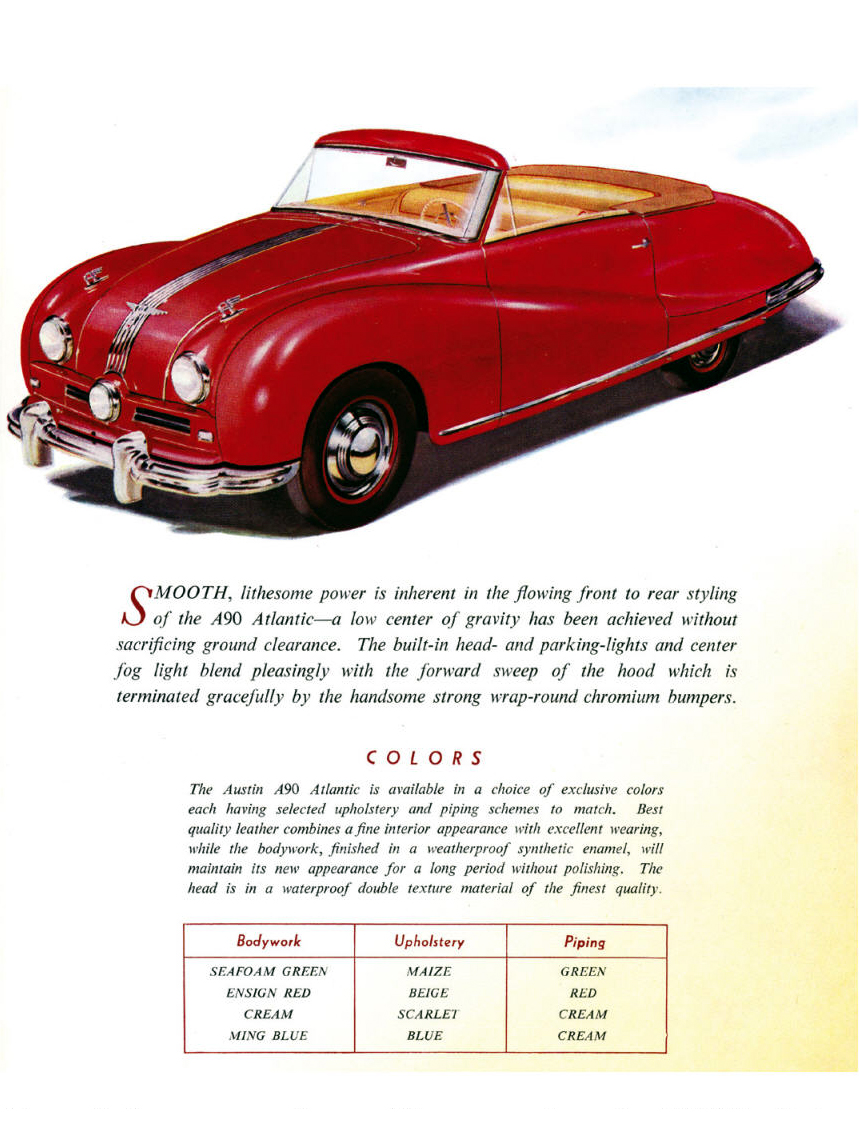
The American market was flooded with advertisements and brochures for the Austin Atlantic from 1949 to 1952, including the last known catalog shown in the pictures below. The asking price at the time was $2,995, which was largely out of reach for the average consumer.
It’s interesting to note that the colors offered were:
Sea foam green with maize upholstery
Ensign red with red beige upholstery
Cream with scarlet upholstery
Ming blue with blue upholstery
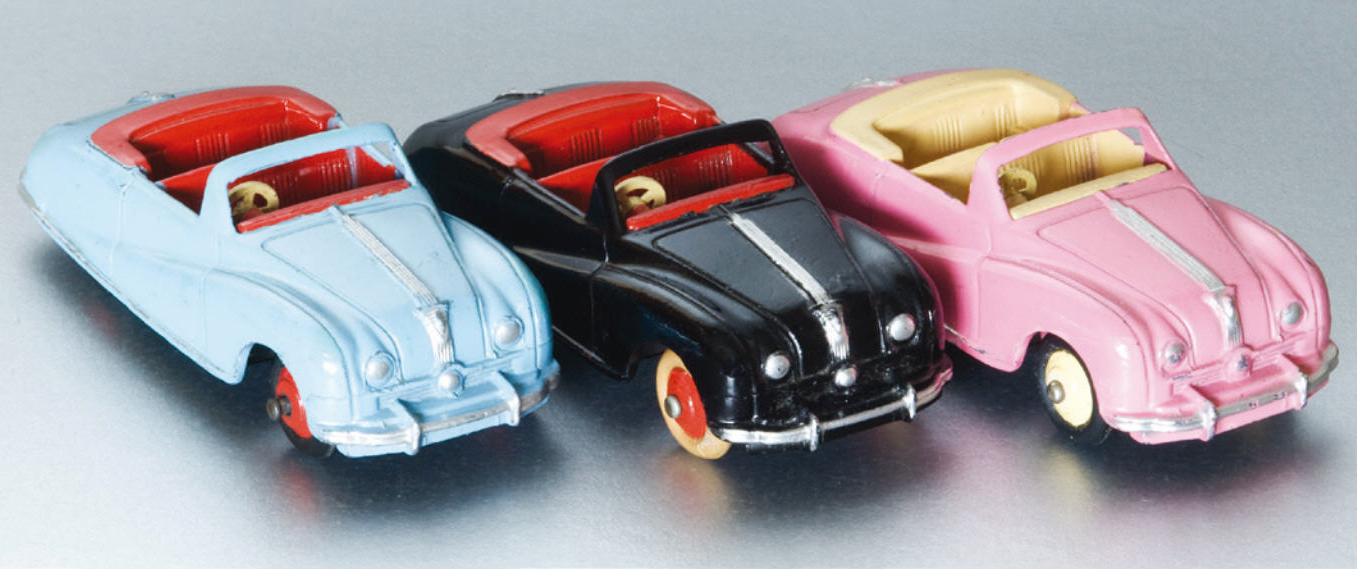
This likely explains why Meccano produced a limited batch of toys for two of these color schemes, red and turquoise blue, both very rare and hard to find, for export to the American market along with the real car, perhaps to be offered by dealers to potential buyers as a promotion. These colors can be seen in the brochure above.
It was customary in the USA for auto dealers to offer a “promo” scale model of the real car to customers as giveaways to their children. TootsieToy 1/43 models of the La Salle sedan were given away in the early forties; and later, plastic 1/24 scale cars in the fifties and sixties.
Missing the Mark
But the Atlantic failed to take America by storm, despite a $1000 USD price cut. A meager 350 units found their way stateside, and no more than 3,500 cars left the UK during its production period. It was estimated that between five to ten thousand units were produced in the four years of existence, although the official number stands at 7,981.
When Autocar tested the Austin Atlantic convertible in August 1949, it was described as one of the ‘star cars produced after the war’, of outstanding merit and appeal. The Atlantic was certainly value for the money at 952 GBP, which included a power-operated hood and electrically operated door windows. The four cylinder, overhead valve engine was largely unbreakable and propelled the car to a dizzying 96 mph. Unfortunately, due to poor sales, the convertible ceased production in January 1951. A fixed head coupe that was introduced in 1950 was cancelled in 1952. Cars continued to be sold until 1953, when the stock eventually depleted.
Coincidentally, a relative of mine bought one in Peru in 1953 — a luxury at the time — and used it to enter a beginner’s rally in Lima. Unfortunately he crashed and suffered grave injuries, but survived despite the car rolling out of control on a curve.
My Dinky Austin Atlantic Models
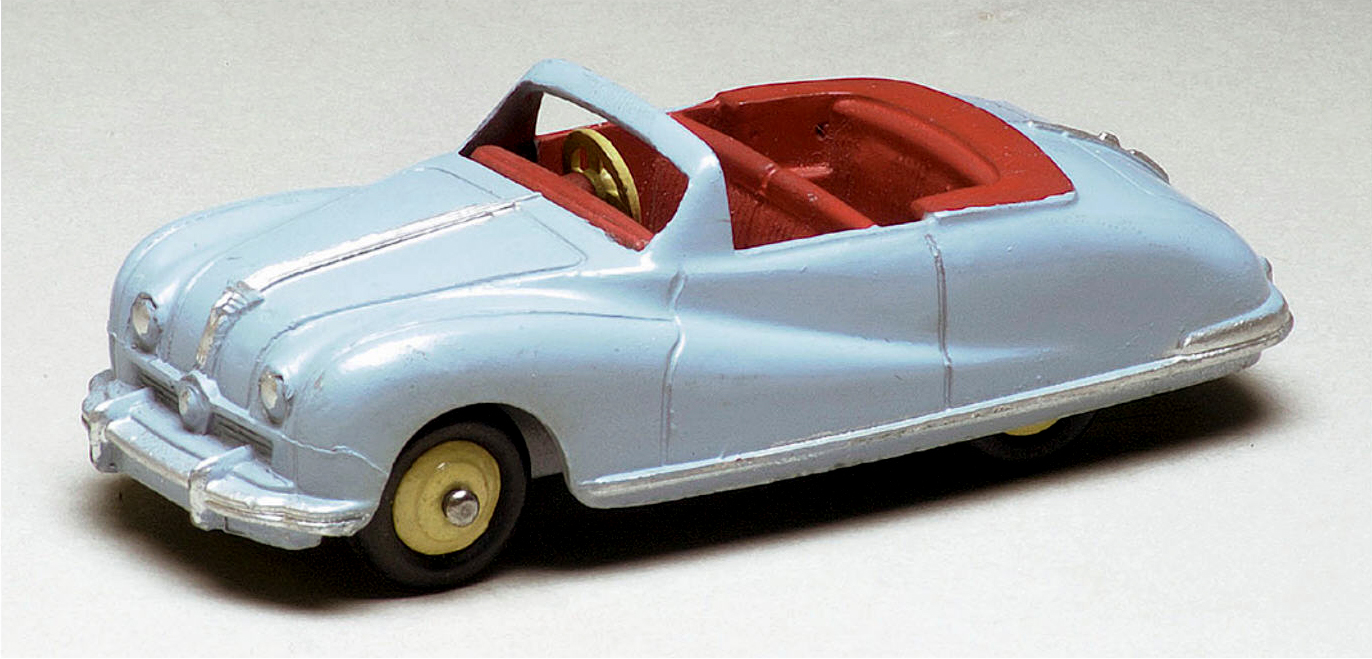
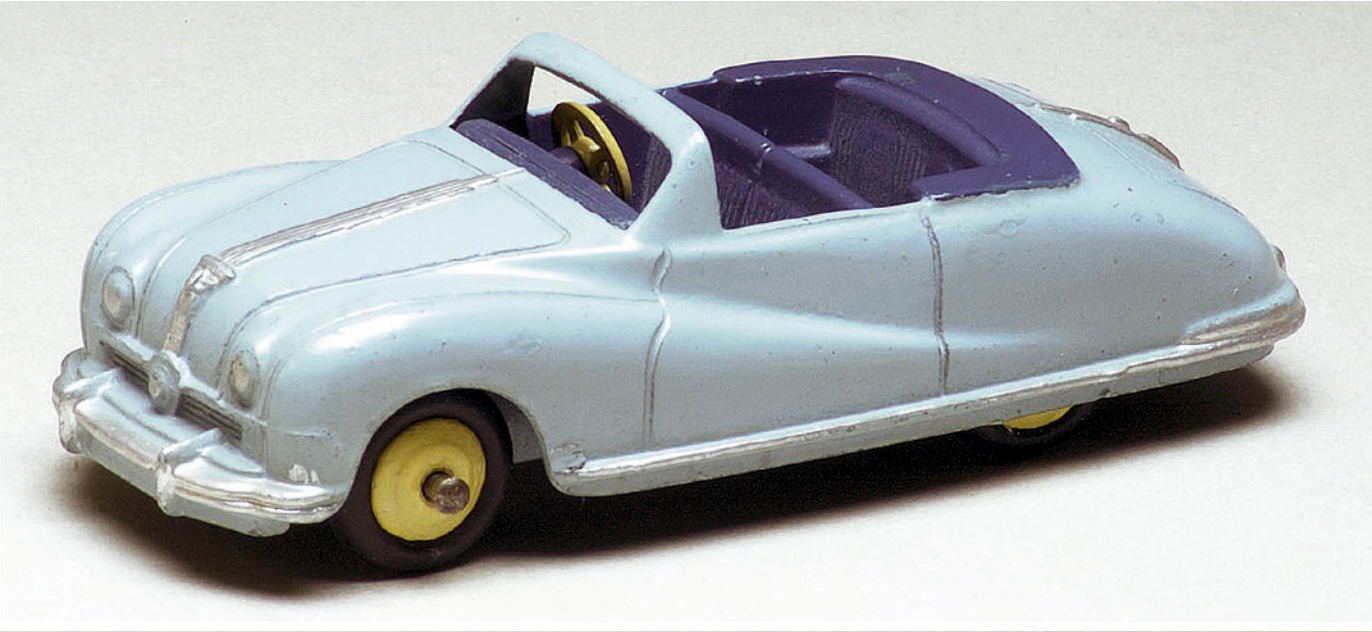
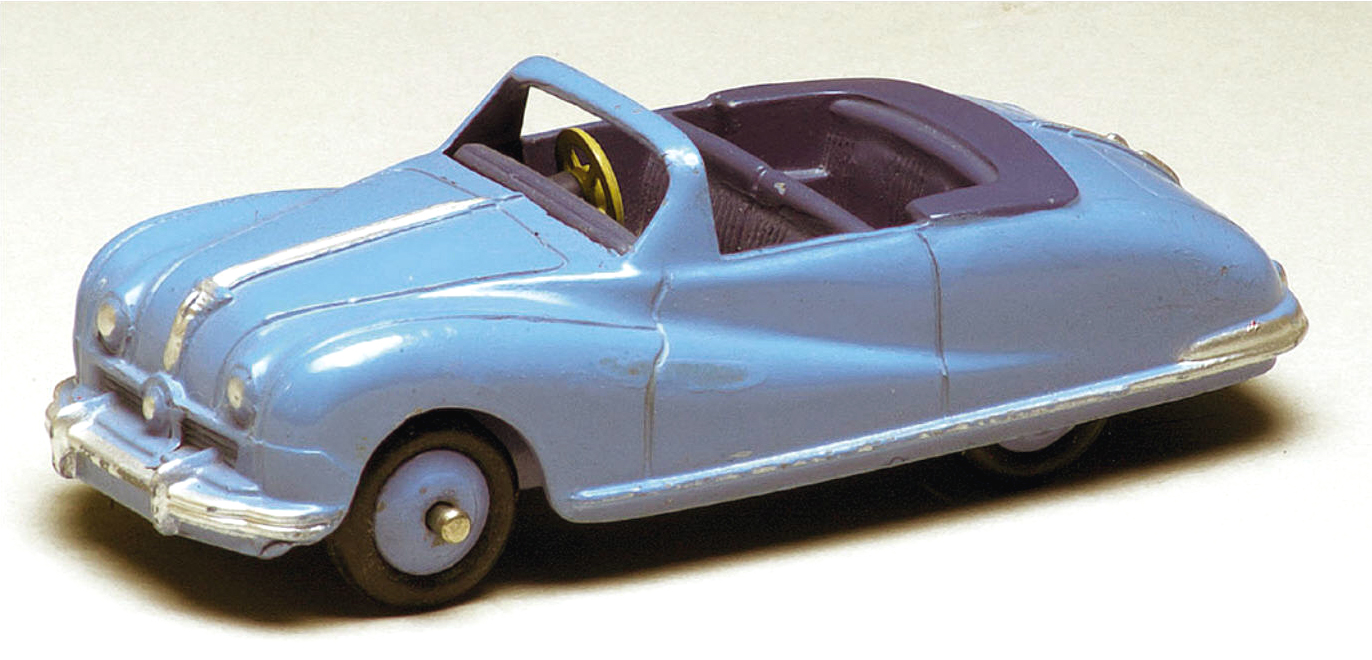
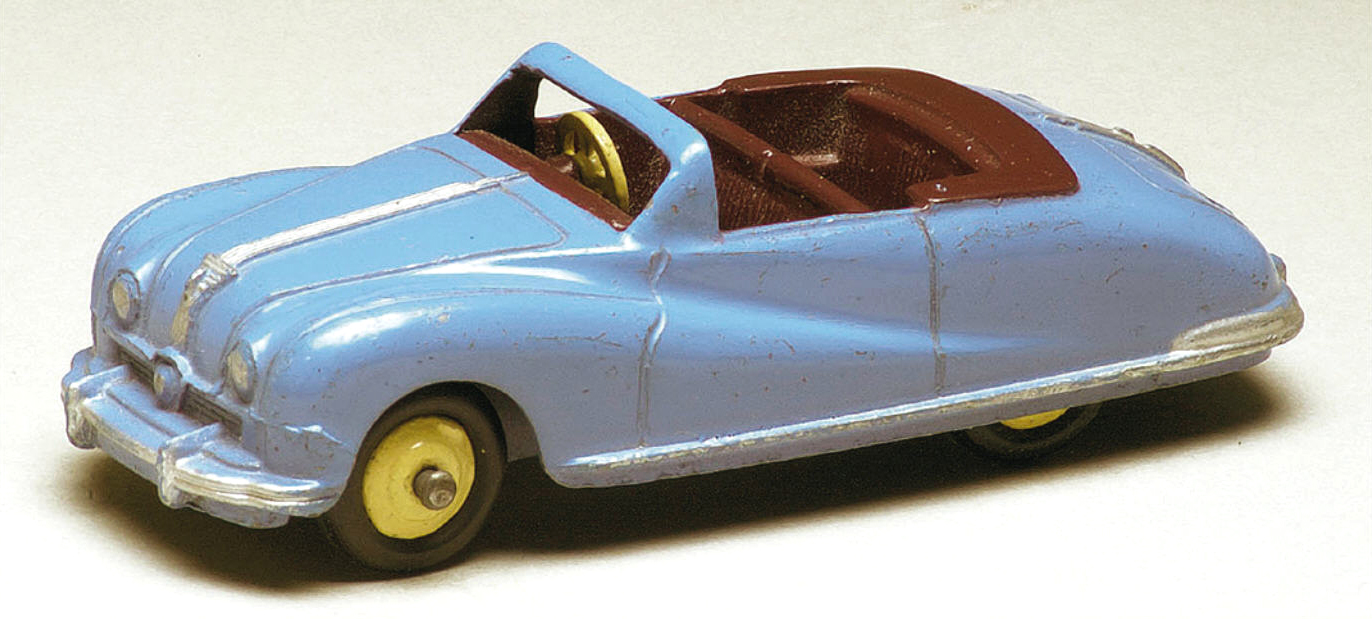
The overall length of the Austin Atlantic was 177”, and compared to the Dinky Toys model of 3.75” which was scaled to 1/47.32, or roughly 1/48. Produced by Meccano from 1951 to 1958, first as 140A, then changing to 106 in 1954, the toy outlasted the real car. By its streamlined design, the Austin Atlantic Convertible is one of the nicest British Dinky Toys, and sought after.
Here are my Dinky 106/140A Austin Atlantic models.
Acknowledgement
This article was written by Jose Heraud and our late friend Dave Busfield and first appeared in the July 2012 issue of the Journal of the Dinky Toys Collectors’ Association.
Dublo Dinky Toys were announced by Meccano Ltd. in late 1957, and appeared in stores in 1958. The series were in 1:76 scale and were intended to work with 00-gauge Hornby Dublo railways. This article describes the three versions of the Dinky Dublo 066 Bedford Truck and the two different boxes in which they came.
Production run
Dinky/Meccano started planning the Dublo range in late 1954, but it was not until late 1957 that the first three in the range were released: the 064 Austin Lorry, the 065 Morris Pick-Up and the 066 Bedford Flat Truck, which were advertised on the back cover of the December 1957 issue of Meccano Magazine.
Dublo Dinky Toys debut in the December 1957 issue of Meccano Magazine.
The Dublo Bedford Flat Truck didn’t have a long life. Its production lasted just under three years, with its last appearance being in the 1959 Dinky Toys catalog.
Dublo Dinky Toys in the 1959 Dinky Toys (UK) catalog.
Although the Dublo range continued to expand in 1960, I find it strange that Dinky dropped this truck from its line up, being that it seemed to be a popular toy and it’s one of the most common Dublo models in existence.
Dublo Dinky Toys in the 1960 Dinky Toys (UK) catalog.
Versions
The three versions of the Dublo Dinky 066 Bedford Flat Truck are:
With smooth grey plastic tires.
With treaded grey plastic tires.
With treaded grey plastic tires and an added tow hook.
The three versions of the Dublo Dinky Toys 066 Bedford Flat Truck (front view).
The three versions of the Dublo Dinky Toys 066 Bedford Flat Truck (rear view).
The three versions of the Dublo Dinky Toys 066 Bedford Flat Truck (bottom view).
The addition of the tow hook is a bit of a mystery as there wasn’t anything in the Dublo range for the truck to tow. Further, it was a late addition. From what can be gleaned from the factory drawing, it was added around October 1959, just before this model was deleted from the range. This does make the version with the tow hook quite rare.
Factory drawing of the Dublo Dinky Toys 066 Bedford Flat Truck.
A draft illustration of the model for the Dinky Toys 1959 UK catalog seems to imply the Bedford Flat Truck wasn’t just designed to work alongside Hornby Dublo model railways, but was also designed to be able to carry Dublo railway shipping containers.
Draft illustration of the Dublo Dinky Toys 066 Bedford Flat Truckfor the 1959 Dinky Toys (UK) catalog. Image: Brighton Toy & Model Museum.
Despite being a model ship enthusiast, I wasn’t aware of the Dinky 51D Empress of Britain until I made its acquaintance as a 1:1800 scale diecast model, one of the six passenger liners in the pre-war No. 51 Meccano Dinky Toys Famous Liners Set.
The No. 51 Meccano Dinky Toys Famous Liners Set.
The Empress of Britain (1931–1940) was a huge ocean liner and cruise ship of 42,348 GRT (gross registered tonnage) that sailed the northern trans-Atlantic route from England to Quebec in Canada for the Canadian Pacific Line (of the Canadian Pacific Railway Company, C.P.R.). When seen from the front she looked rather square, but appeared gracious when viewed from the side, with her white hull and impressive superstructure crowned by three huge but well proportioned funnels.
The Empress of Britain. circa 1931. Image: Stewart Bale, New Zealand Maritime Museum.
The Empress of Britain was the largest, fastest, and most luxurious ship sailing between England and Canada and was just as new as the other ships represented in the Dinky 51 Famous Liners Set. She was laid down in 1928, just before the big crisis struck the world’s economy, and was entered into service in 1931. With an up-to-the-waterline reinforced stem and bow, she could easily resist any incidental ice encountered on her route.
Because the Saint Lawrence River isn’t navigable during winter, the Empress of Britain was annually converted to a first class luxury cruise ship, making cruises in warmer Mediterranean and tropical waters. Hence the all-white finish. The three yellow ochre funnels of the vessel were enormous; about 20 meters high and 10 meters in diameter. Like so many other liners, the Empress of Britain was often portrayed in art deco style travel posters.
Period travel posters showing the Empress of Britain.
Like the real ship, the Dinky 51D model is the third longest in the 51 series at 130 mm, Europa being the longest at 165 mm, followed by Rex at 152 mm. However, in reality the Rex had the largest gross tonnage. The model’s hull and superstructure are all white, like the impressive liner. The sides of the life boats are accentuated with manually applied dashes of dark brown paint. The deck hatch covers, wheelhouse roof and wire masts are painted mid-brown, and the air intakes are touched up with dots of red paint. Apparently it wasn’t feasible for Meccano to apply the tricky slim green line all along the hull and the more appropriate green tops to the life boats.
I was delighted to recently find a larger M 548 Mercator 1:1250 representation of this ship, which clearly shows the differences between the Dinky Toy and the Mercator model. Even after taking the 50% larger size and greater detail of the Mercator into account, the Dinky model appears considerably less ambitious. More details have been omitted from the Dinky model than the inevitable generalization of the model’s features for the 1:1800 scale would have demanded. The Dinky was initially sold as a relatively inexpensive and compact diecast toy, whereas the Mercator rendition is a heavier, vulnerable and more expensive collector’s model made out of white metal.
Mercator RMS Empress Of Britain 1931 Liner Model 1:1250 M‑548. Image: Boat House Collectables.
The Dinky Empress of Britain introduced under the initial early Meccano Dinky Toys brand in 1934, is best known as part of the contents of the No. 51 Dinky Toys Famous Liners Set box, which had several variations over the course of the 1930s. A separate model, however, was also available. They were sold by the retailer from trade boxes containing twelve models, which seem considerably scarcer nowadays than the full set presentation boxes.
Like the Italian liner Rex, the Empress of Britain didn’t survive World War II. She was attacked by a German long-range bomber and subsequently torpedoed by a submarine on 26 October 1940 and finally sank on 28 October, making it the largest allied liner lost during World War II, fortunately with only few casualties. I believe many Dinky models of this ship have also perished, though less from enemy action than metal fatigue.
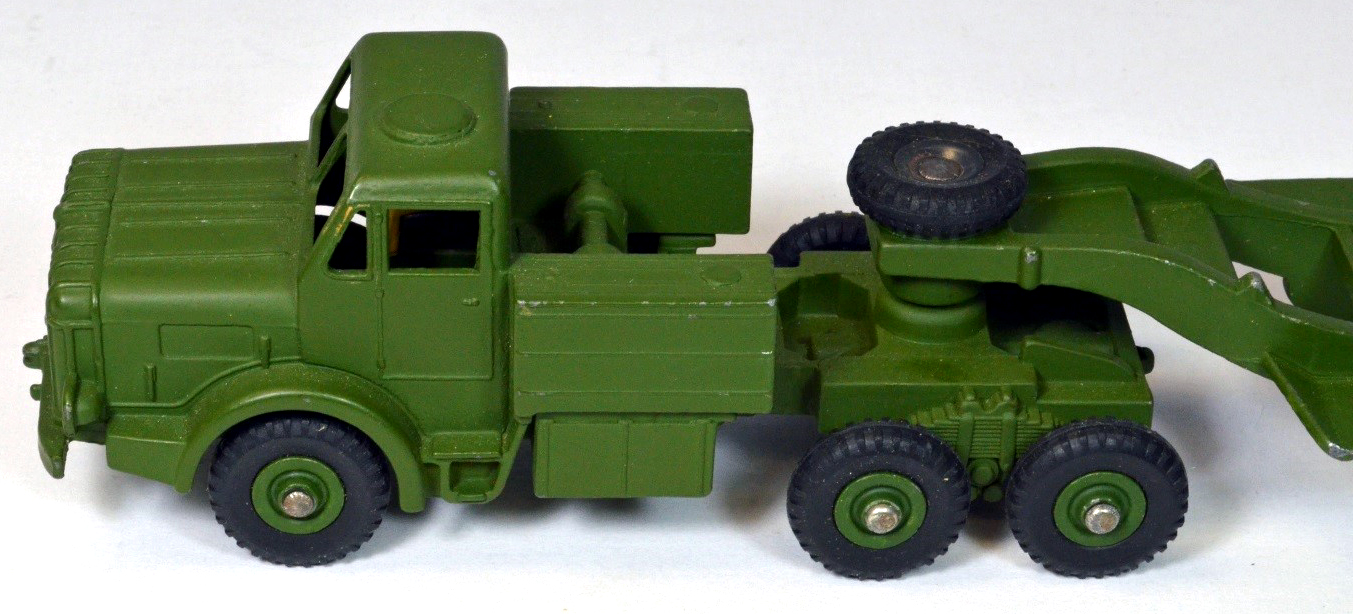
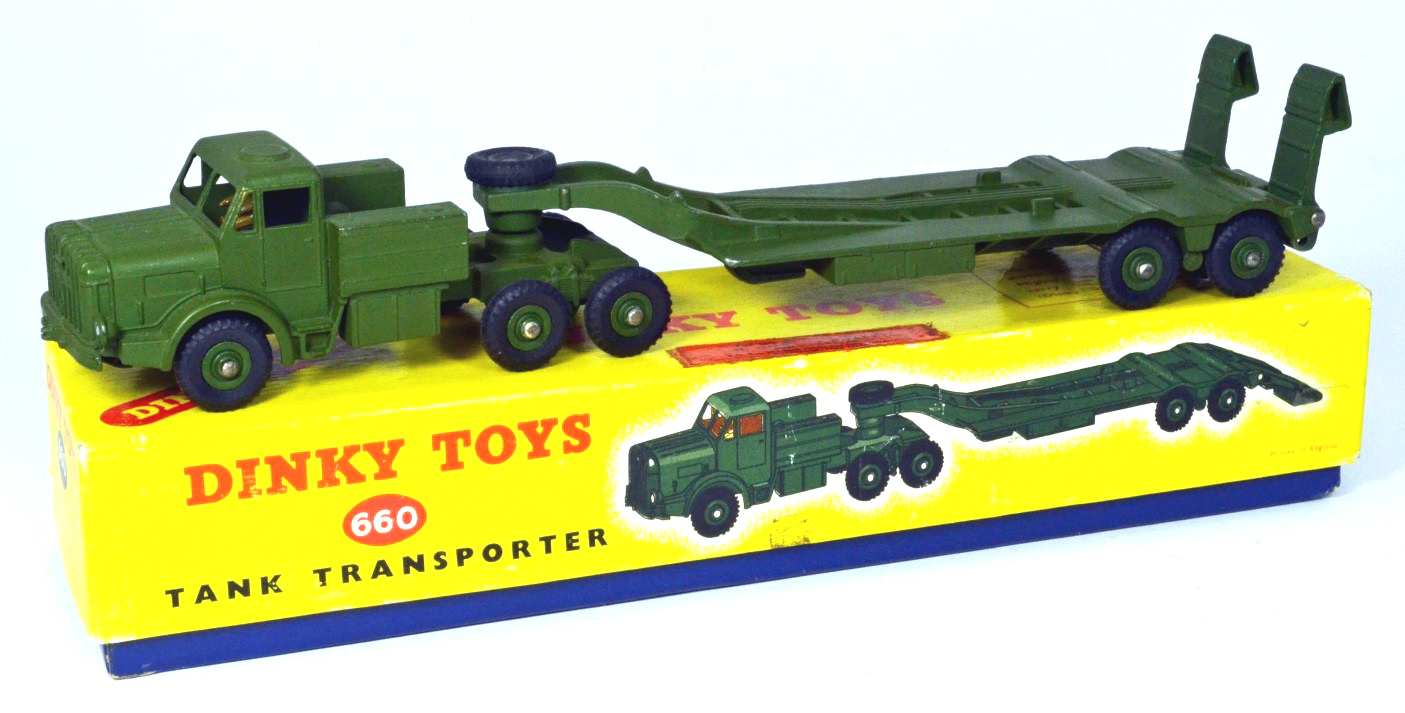
The 1950’s were fun times for many young boys, and most were fascinated with military models. Meccano saw that interest develop with the start of World War II, and was quick to bring out several Dinky Toys models that became very popular, both right before and right after the war. By the early 1950’s, the old pre-war style military vehicles were obsolete, so starting in 1954, several new models were introduced. But the really big play for Meccano was unveiling the new Dinky Supertoys660 Tank Transporter in May-June 1956. Based on the very large Thorneycroft Mighty Antar truck, this was a most imposing model for that era, measuring over 13” with its rear ramps down, and loaded with play value.
In spite of its high sales price of $4.50 in the US (very expensive in 1956), it was a must-have for many boys, and, from all indications, Dinky amped up production and made these by the thousands. This is a story about the original Mighty Antar vehicle and the three versions that Dinky made over a period of 8 years.
The Thorneycroft Mighty Antar
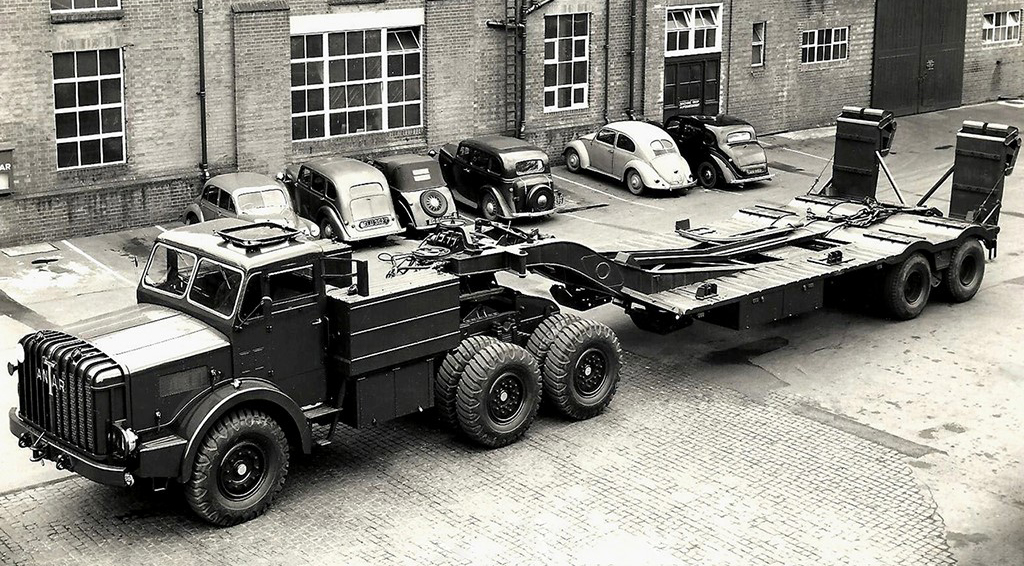
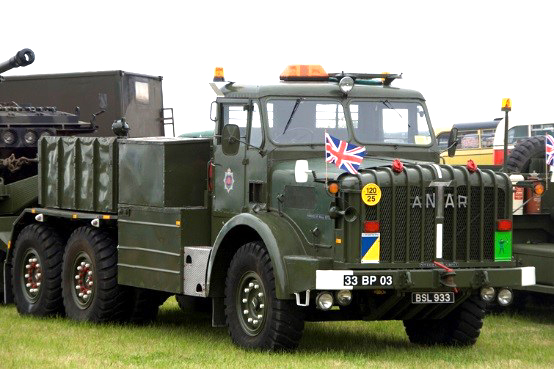
Development of this oversize truck really began in the late 1940’s, as a vehicle suitable for working in oil fields, capable of transporting oversize pipe hundreds of miles in the desert. This called for a vehicle to be able to traverse rough, unpaved terrain, climb mountainous grades, and haul large loads. So the chassis was designed as a 6×4 layout, with power provided by a large V‑8 engine. The engine, designed by Rolls-Royce, was a scaled down version of the V‑12 used in tanks, and was called the Meteorite. This engine displaced 18 liters and ran on gasoline. Rover ended up making these engines to Rolls-Royce specifications. Later in production, a diesel version was developed.
A rare photo of a civilian version of the Mighty Antar being used in the desert in Libya. Image: From internet.
Thornycroft Antar Sandmaster hauling an 80 ton load in the Libyan desert. Image: Original press photo (negative 5071) from the Richard Stanier collection.
The first customer, and whom the truck was really designed for, was the Anglo-Persian Oil Company. That is significant when one considers the name, Mighty Antar. The name Antar was a reference to Antar Ibn Shaddad, a pre-Islamic poet-warrior, so using that name was very flattering.
An early Mighty Antar Tank Transporter, virtually identical to the Dinky Supertoys model. Image: From internet.
Shortly after the initial trucks were produced, it was quickly considered to be ideal as a tank transporter, to carry the then somewhat new British CenturionTanks, and this is where it garnered most of its fame and use.
A closeup view of the Mighty Antar Tractor. Image: www.talkmodeltoys.com
Specifications
Production
1951–1964
Weight of the tractor
44,220 lbs
Length of the tractor
27’
Width
9.25′
Height
10.25′
Trailer capacity
50–60 tons
Engine
Rolls-Royce designed Meteorite, V‑8, 18 liters
Top speed
28 mph
Transmission
4 speed, with a 3 speed transfer case
Versions
MK 1, MK 2, MK 3 (the Dinkys are the MK 1)
The Dinky Supertoys 660 Tank Transporters
Introduced in May-June of 1956 with much fanfare, this was the first of the three Mighty Antar versions produced by Meccano, and remained in production until 1964. When first made, it featured a driver, an attached trailer, no windows, and was made to a scale of about 1:51. In many ways, this is a very accurate model of the real vehicle, with a couple of exceptions: in the 1950’s, Meccano insisted on using single rear tires and wheels, when many trucks had duals. It wasn’t until the 1960’s that they finally came around on this detail, which would have looked much better on this model. The other slight error was using the same size tire and wheel for the trailer. The photo of the original clearly shows the trailer wheels and tires being of a smaller size than the tractor.
The first announcement of the new Mighty Antar Transporter in the June 1956issue of Meccano Magazine.
Around 1959, Dinky Toys decided to allow the trailer to be detached from the tractor unit. Originally it was pinned in place. And in March 1961, windows were finally added. In 1957, Meccano wisely decided to offer the Tank Transporter together with the 651 Centurion Tank in Gift Set 698 which sold for $6.95 in the US. This was produced until 1965.
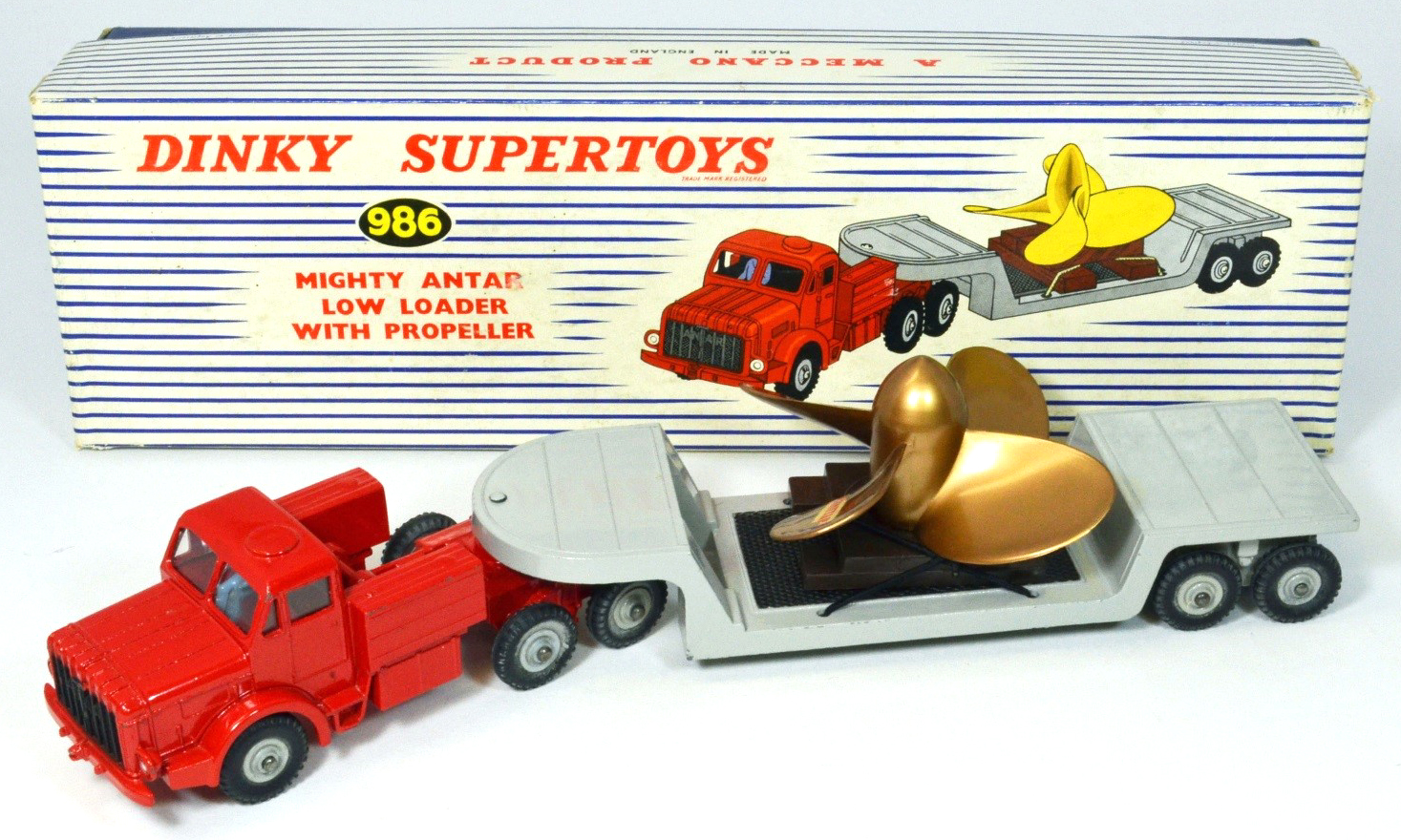
The Dinky Supertoys 986 Mighty Antar Low Loader with Propeller
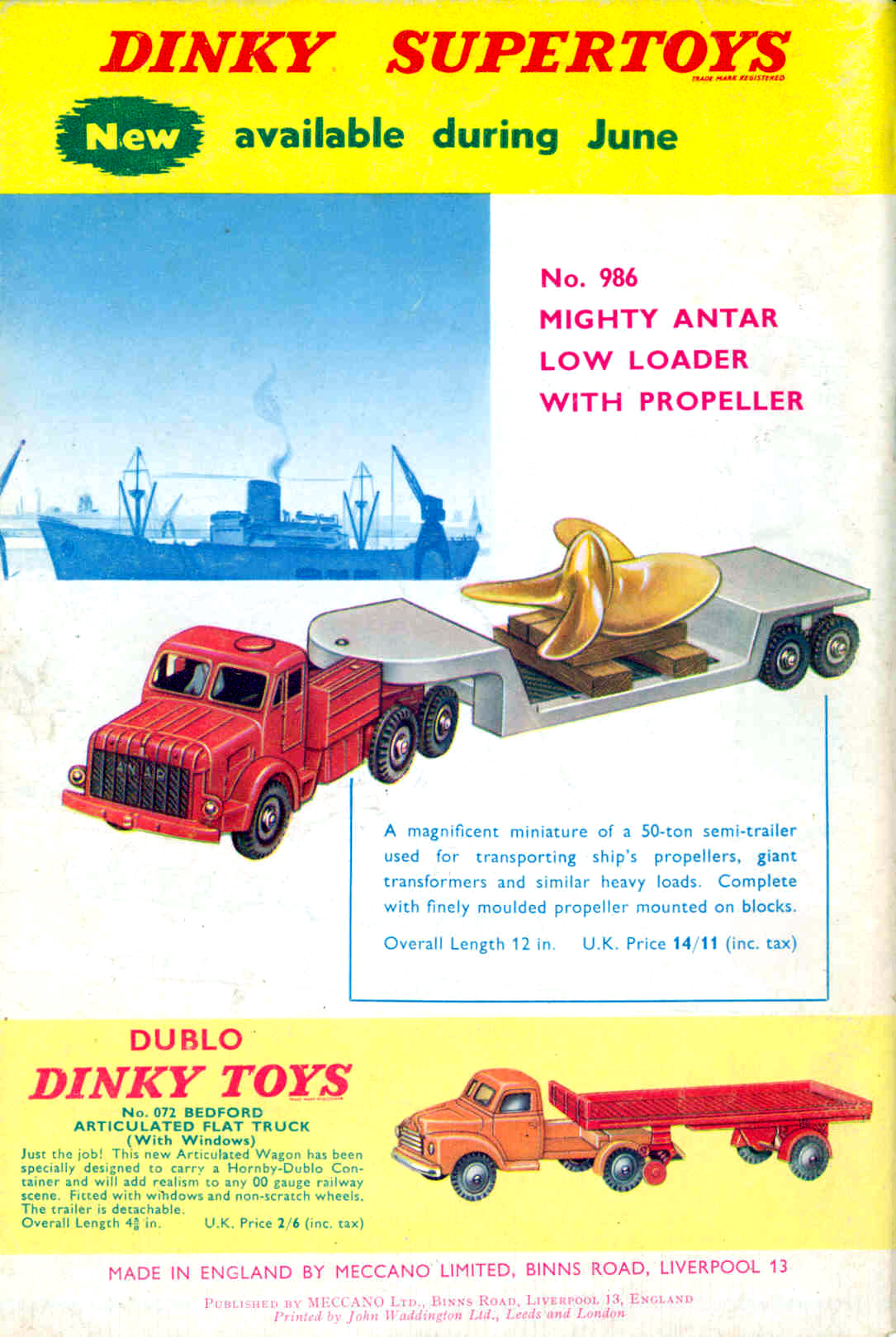
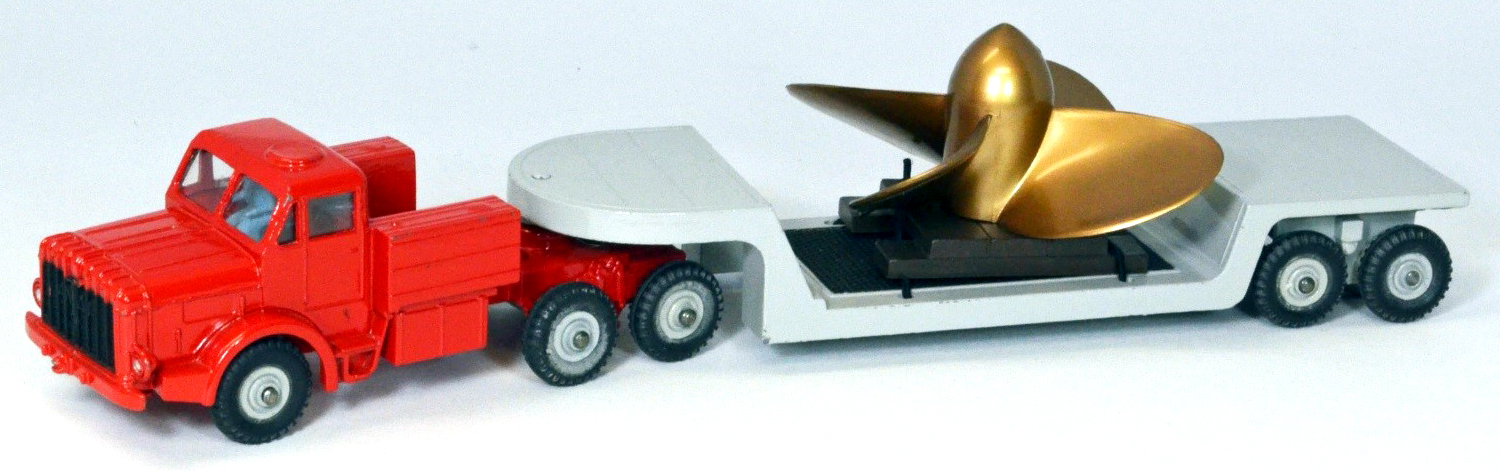
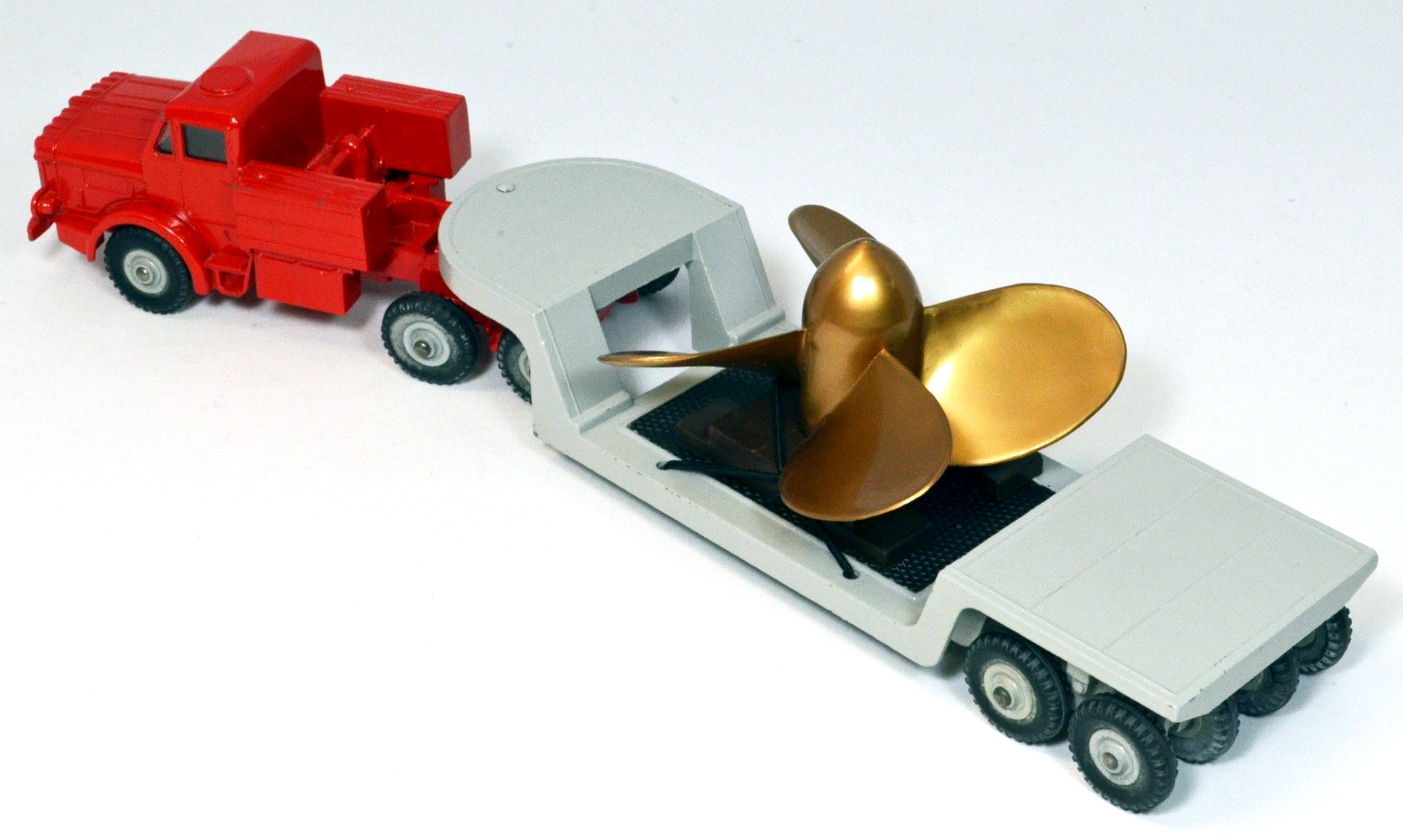
Following on the great success of the Tank Transporter, Meccano saw an opportunity to get some more mileage out of its Mighty Antar unit, and in June 1959 introduced the Low Loader with Propeller version. This used the same Mighty Antar tractor unit but was now paired with a new low loader type of trailer, upon which rested a realistic model of a large brass ship’s propeller. As was common with Dinky Toys in the 1950’s, this model was painted in bright colors that appealed to young boys. The cab was finished in red and the trailer in grey.
Early versions had the trailer permanently attached to the tractor unit, and lacked windows. But by 1961, it had both. I believe this was the very first Dinky Toy to use plastic in some form, as the propeller was made of polystyrene and has the word “Scimitar” on a decal, referring to the manufacturer. When introduced, this model was also sold at $4.50, making it somewhat out of reach as an ordinary toy, but a fine Christmas gift. While not as popular as the tank transporter, it still sold quite well, and was eventually discontinued in 1964.
The Dinky Supertoys 908 Mighty Antar with Transformer
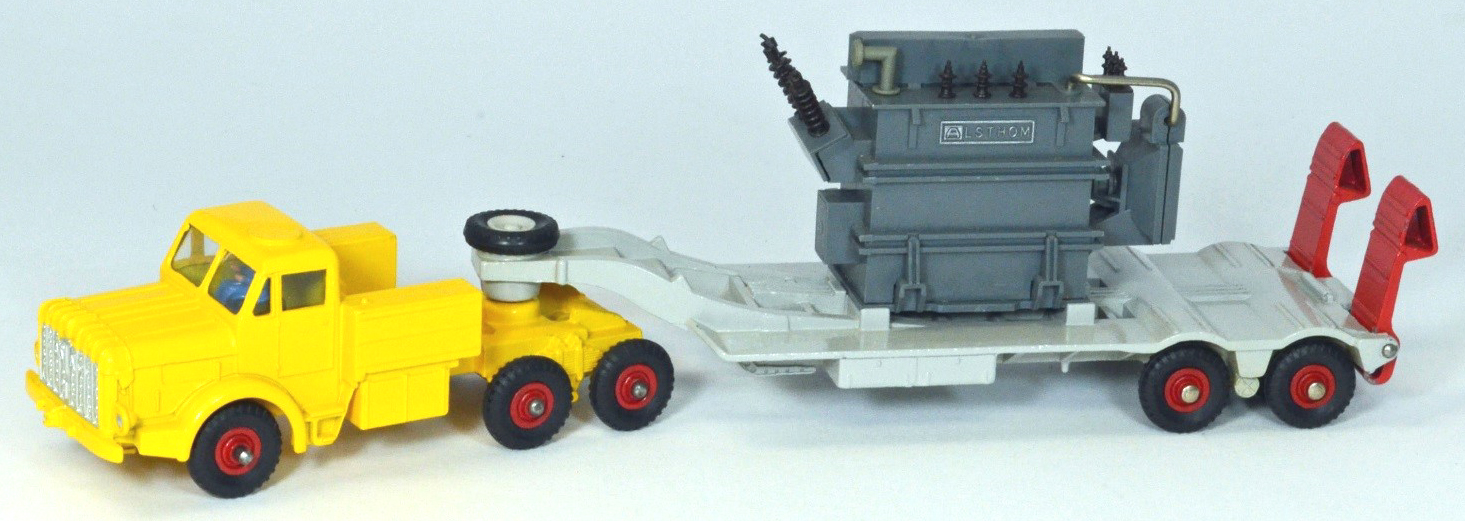
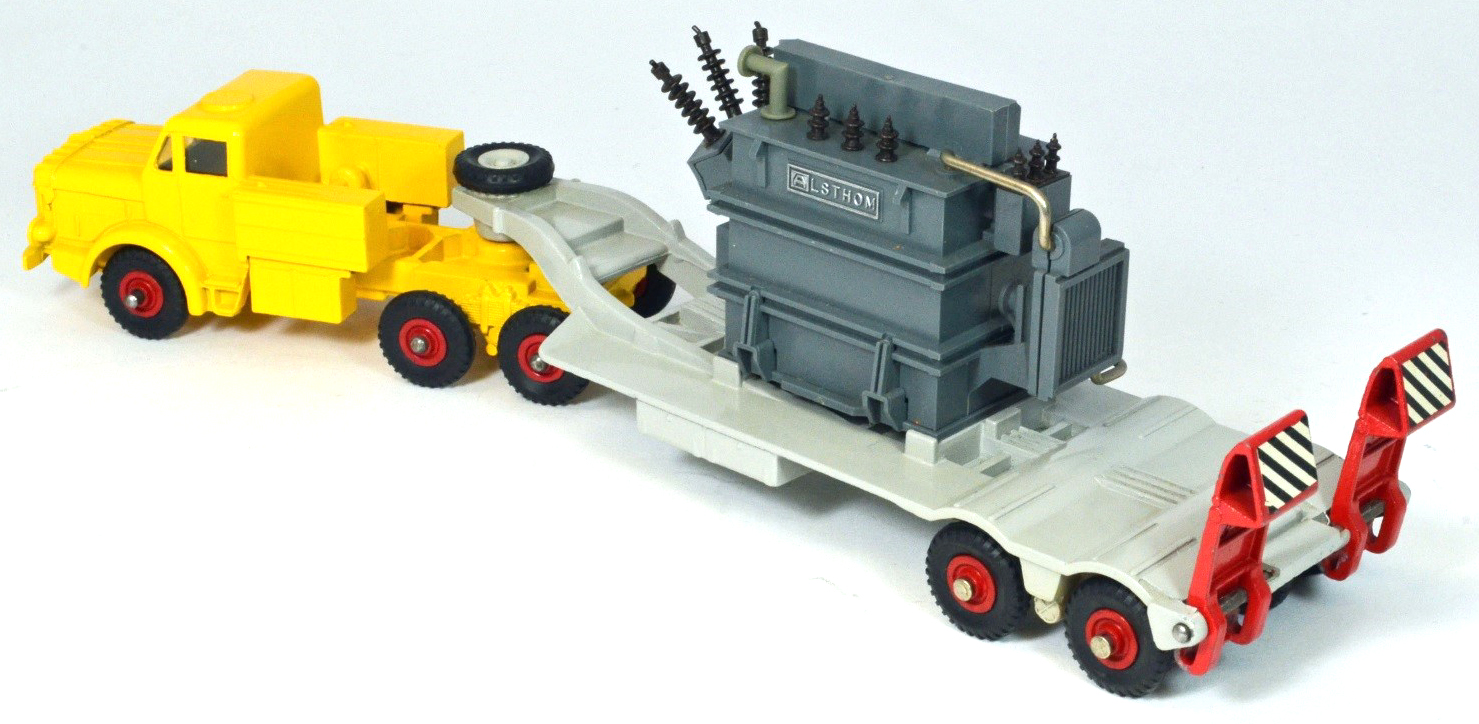
By 1962, the Mighty Antar model which had been around for some time began to lose some of its allure. So it was probably a bit surprising when Meccano announced that they would make one more version of this iconic model. They would revert back to the original military version, with its tank trailer, but would convert it to civilian livery, and add a somewhat unique load — a very large 5,000 KVA transformer. What’s interesting about this is that the French Meccano factory was also re-purposing its Berliet Tank Transporter to a similar version, carrying the very same transformer. This transformer was another early use of plastic, and was actually made in France. It was included with the model in a plastic bag and needed assembly.
Since the tank was quite heavy and could easily sit on the trailer, Meccano engineers had to design some way to keep the much lighter transformer from sliding around during play. So they wisely decided to add some mounting brackets or flanges to the bed of the trailer, and the transformer fits snugly in those. The French did not do this for their version, so the transformer does in fact slide around.
By the time this was introduced, the market for toys was rapidly changing, with much more competition. This look also began to appear quite dated by 1962, so this model was never a big seller, and Meccano discontinued it in 1964. All of these came with both windows and the detachable trailer, and since they were never a big seller, are now quite hard to find and expensive for mint copies.
By the early 1960’s, Meccano Ltd was in serious trouble, with mounting debt, out of control costs, and rising competition on many fronts. By 1964 things had deteriorated so badly that the company was forced to accept a bid by Lines Brothers to take over the company, and so over half a century ownership by the Hornby family ceased.
Post-Meccano Versions
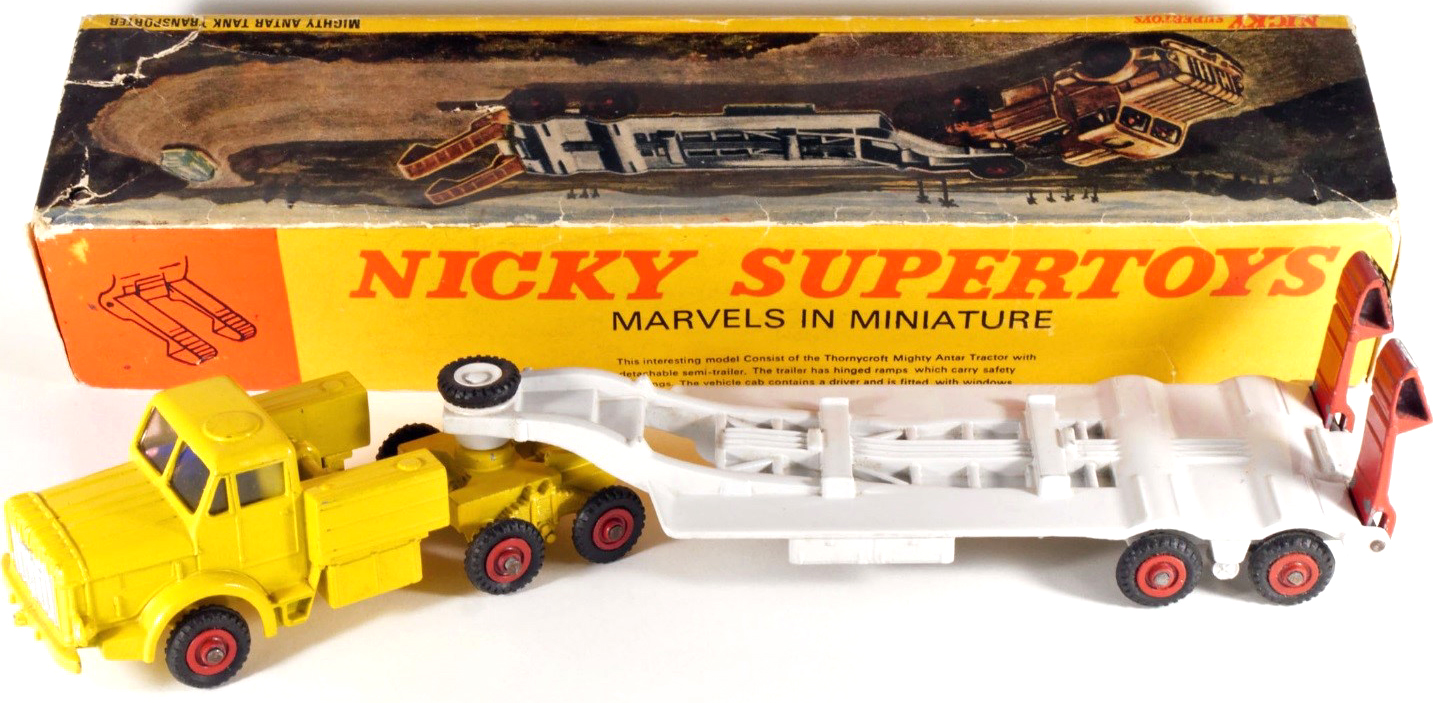
By 1968, things had worsened even more, and the company decided to sell off some of its die making and tooling equipment, especially on some of the older, obsolete models. In 1968, a quantity of tooling and dies were sold to the Indian firm S. Kumar and Company, trading as Atamco Private Ltd. in Calcutta, along with a license to use them. But subsequent quality control was so poor that Meccano, upon seeing the work, insisted that the names Dinky Toys be removed from the baseplates, and new boxes designed and used. These were then named Nicky Toys, and were sold for some time.
These toys used the original Meccano Dinky Toys dies, but were assembled, painted and packaged by others, to different standards, so they are considered to be a subset of real Dinky Toys, but are nonetheless collected by hobbyists. One of the more striking examples was their reissue of the Mighty Antar Transporter, finished in a similar color scheme used on the Meccano Transformer version, but now without the transformer.
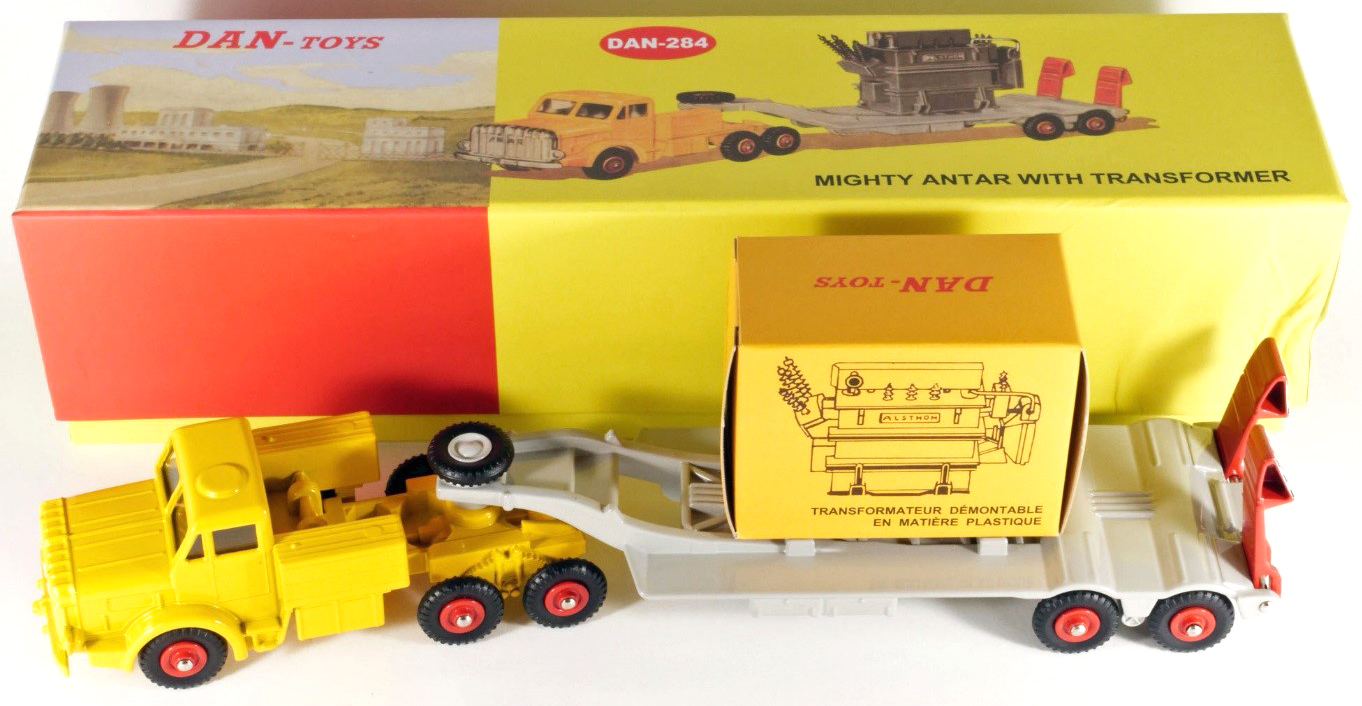
More recently, French based DAN Toys has reproduced several of the Dinky Toys models, from their factory in China. These are pretty well made and very closely match the original Dinky Toys. Because they employ new technology and techniques that weren’t available in the 1950’s and 1960’s, they always appear to be finished to a higher standard; some would argue too nice. To date, they have made copies of both the Mighty Antar Low Loader with Propeller and the Mighty Antar Transporter with Transformer. Below is a photo of the latter, with its transformer still boxed and unassembled.
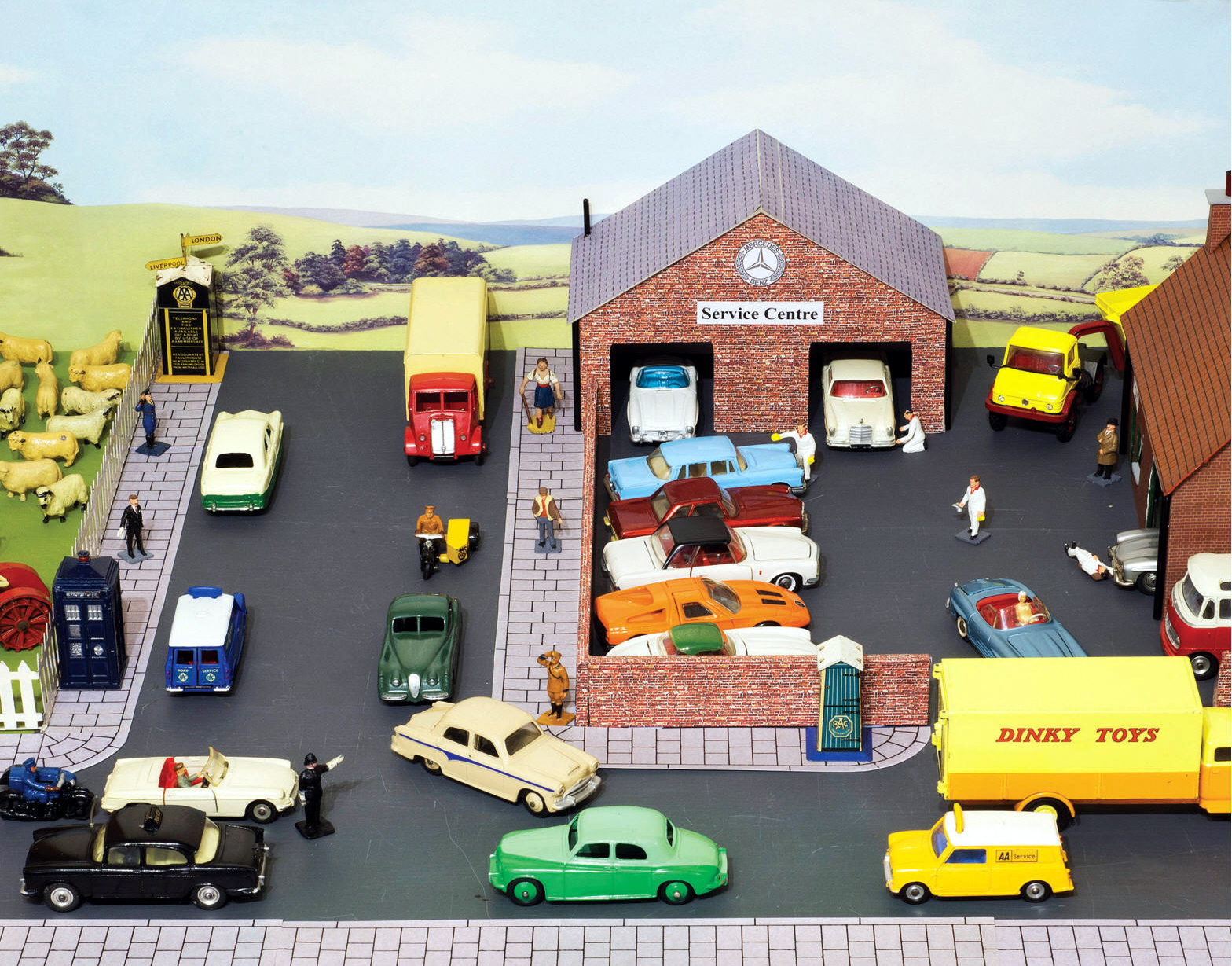
The first part of this article concerns two influential motoring organizations with very different backgrounds and fascinating histories, followed by a look at law enforcement officers and some of their vehicles.
The Automobile Association (AA) was founded in 1905, originally with a membership of just 90, which has now grown to 15 million. They started using bicycles followed by motorcycle combination patrols, then moved on to cars and now use sophisticated vans. Initially the business focused on breakdown cover which continues to this day. However they have since diversified significantly and nowadays offer finance, driving lessons, motoring maps, insurance, leisure and lifestyle services. The AA employs over 7,400 people and is headquartered at Fanum House, Basingstoke.
The Royal Automobile Club (RAC) was founded in 1897 as a private social and athletic club. In the early 1900s it was influential in working with the government to amend out-of-date speed limits and advise on other issues. They organized the first British Grand Prix at Brooklands in 1926 also the first RAC Rally, now Rally GB, in 1932 and were influential in many more motorsport events. They remained a respected voice in the development of government policy for roads and motor transport.
In 1901 an associate section (RAC Motoring Services) was formed and had uniformed mobile patrols using Matchless motorcycle combinations. The sidecars contained a tool kit, fan belts, hoses and cans of spare petrol. Initially they used to park up in laybys and alongside major road junctions, and from 1957 were supplied with two-way radios which significantly helped getting to stranded motorists. In 1978 the RAC Motoring Services was split off from the parent company to form the RAC Motoring Services Ltd. which was sold to Lex Services in 1999. After a number of other changes it is now RAC plc with its headquarters in Walsall, West Midlands and employs 3700 staff.
Both the AA and the RAC used to operate their own very distinctive roadside telephone boxes for use by their members in the event of a breakdown or an emergency. There was some cooperation between the two organizations, with the access keys to all these boxes having a common key pattern.
The AA Patrolmen
Dinky Toys and Somerville Models AA patrolmen.
Two designs of AA guides were made by Dinky Toys; the 44C figure who was directing traffic and the 44D figure who was saluting. They were introduced in the October 1935 edition of Meccano Magazine priced at 3d (pence) each and remained in the range until 1940. Both figures are 36mm high and sport a brown uniform with a black sash, brown peaked caps and black knee length boots. The 44C has white gloves while the 44D has no gloves. Neither of these figures were released again by Meccano after the war.
It was the practice in the early days of the AA for patrolmen to salute a passing motorist who was displaying their membership badge on the front of their vehicle. The other Dinky figure shows a patrolman directing traffic. This was showed to very good effect during the coronation of Queen Elizabeth II; the police concentrated on security and the AA were called upon to manage temporary road signing, parking facilities and traffic control.
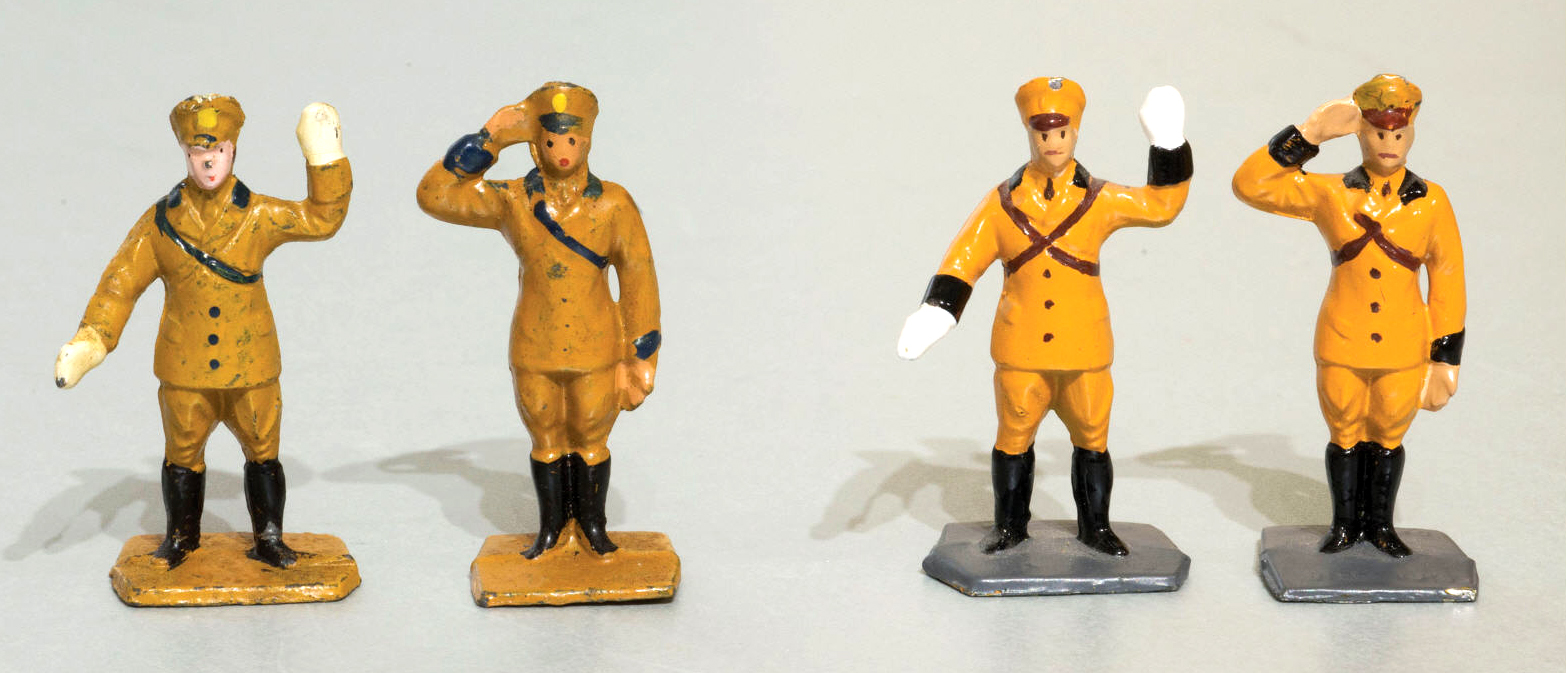
Doug McHard was the Editor of Meccano Magazine in the early 1970s and later the Marketing Director of the Meccano and Dinky Toys ranges. When he left Meccano he was allowed to take a number of molds of Hornby/Dinky figures with him. In 1978 he set up Somerville Models in Lincolnshire and specialized in producing low-volume, high-quality diecast model cars.
He did some test casts of the figures with a view to possibly selling them but these plans never materialized. Two of the castings he acquired were of the pre-war AA patrolmen and two examples which were recently sold at auction are shown above. For some reason these never went into production and the two figures shown here are test castings.
The painting of the Somerville figures has a slightly higher level of detail, and the uniforms are of a brighter color. From memory I believe that the color of the Dinky versions is more accurate to the original AA uniforms.
The AA Roadside Telephone Box was introduced in October 1935 and remained available until 1940. It’s a lovely model made from tinplate and was never reissued after the war. The design is exquisite and comprises a beige chamfered base. The box body is colored yellow, black and white and the roof is white. A wire flagpole is located on the top and supports three tinplate direction signs; one for London, one for Glasgow and one for Liverpool. Being tinplate it is prone to rust and these are hard to find in any condition.
The AA roadside telephone box.
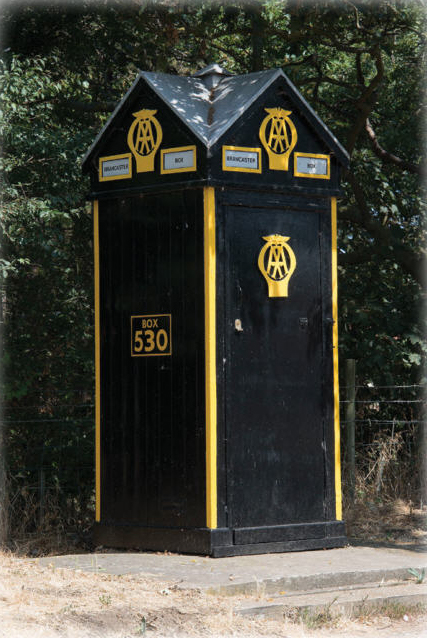
A preserved AA box at Brancaster.
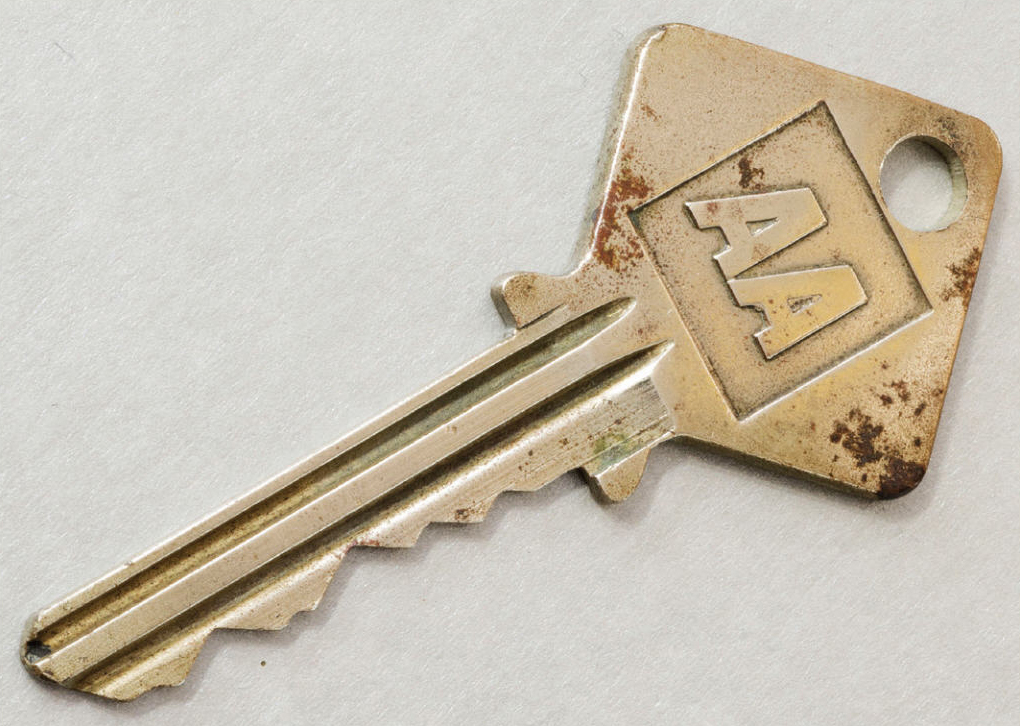
The AA first introduced roadside boxes in 1912. They were intended for use as shelters by the Patrolmen, but were soon equipped with telephones. The new larger boxes were introduced in 1925. They were illuminated by lamps on the roof and incorporated a telephone and include a fire extinguisher for use by members and Patrolmen. Each box was numbered and the AA website lists a total of 862 in use by 1962 throughout Great Britain. In 1947, AA and RAC box keys were made interchangeable. Now only 19 boxes survive, eight of these are listed buildings. The one shown above is in a lay-by and is number 530 at Brancaster, Norfolk, on the A149 (Hunstanton-Wells) around 300 yards west of the junction with Common Lane, Brancaster Staithe. My old AA key is shown below but I doubt if it will now fit the box at Brancaster.
A key for AA and RAC roadside boxes.
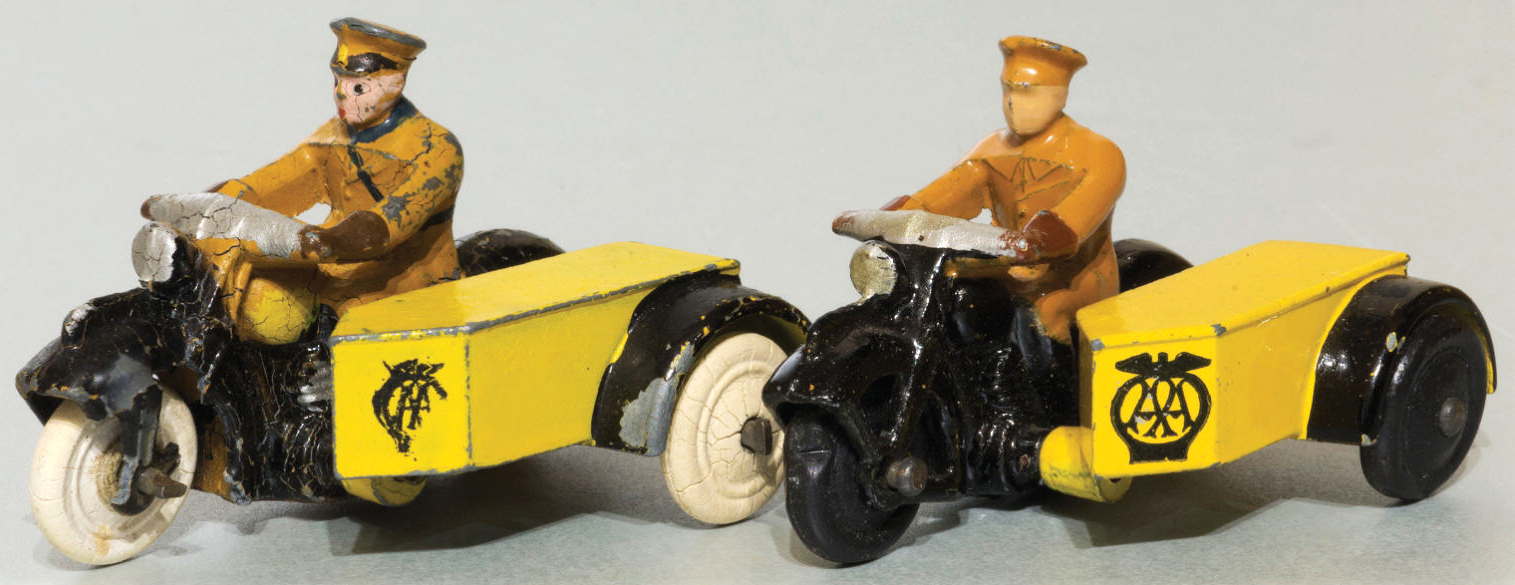
Dinky 44B AA motorcycle combinations.
Dinky 270 AA Motor Cycle Patrol trade box.
Different versions of the AA logo over a period of 25 years.
When the AA was formed in 1905 the Patrolmen used bicycles but everything changed in the 1920s when motorcycle and sidecar combinations were introduced. This meant a more rapid response and enabled tools and spares to be carried in the sidecar. The AA motorcycle was a 2.5hp Chater Lea, who had a factory in Banner Street, London EC1. These were later superseded by Triumph and BSA models.
The Dinky Toys AA Motorcycle Patrol was introduced in 1935 as catalogue number 44B. The advent of WWII caused this model to be discontinued in 1940. The motorcycle is 45mm long. The first versions were fitted with solid white rubber tires and they were reintroduced in 1946 with black rubber tires until 1950. All the Dinky motorcycles are made to a generic design and the AA version incorporates a rider in a tan uniform. The motorcycle is black and the sidecar is yellow with an AA sign on the front.
The combination was reintroduced in 1959 as catalog number 270 and remained in the range until 1962. Some had black rubber wheels that were later replaced with grey plastic wheels. The AA updated their logo on a number of occasions and the Motorcycle Patrol can be found with four different versions between 1935 and the 1960s. For more details of the AA logo history see the article A sign of membership at the AA website.
This model was available individually and was sold out of a dealer trade box which would have initially contained 6 models. In addition to the AA version there were two other variants available for export markets only. They were the number 271 “TS” (Touring Secours) for the Belgian market and the number 272 “ANWB” (Algemene Nederlandse Wielrijdersbond) for the Netherlands market. These are quite rare in the UK.
Different versions of the AA logo over a period of 25 years.
Before the war all the AA models were available in the number 44 AA Box, Motor Cycle Patrol and Guides Gift Set (shown above) which was available from 1935 to 1941. This comprised the 44A AA Box, the 44B Motor Cycle Patrol, the 44C and the 44D AA Guides. These were set against a very attractive pictorial box insert.
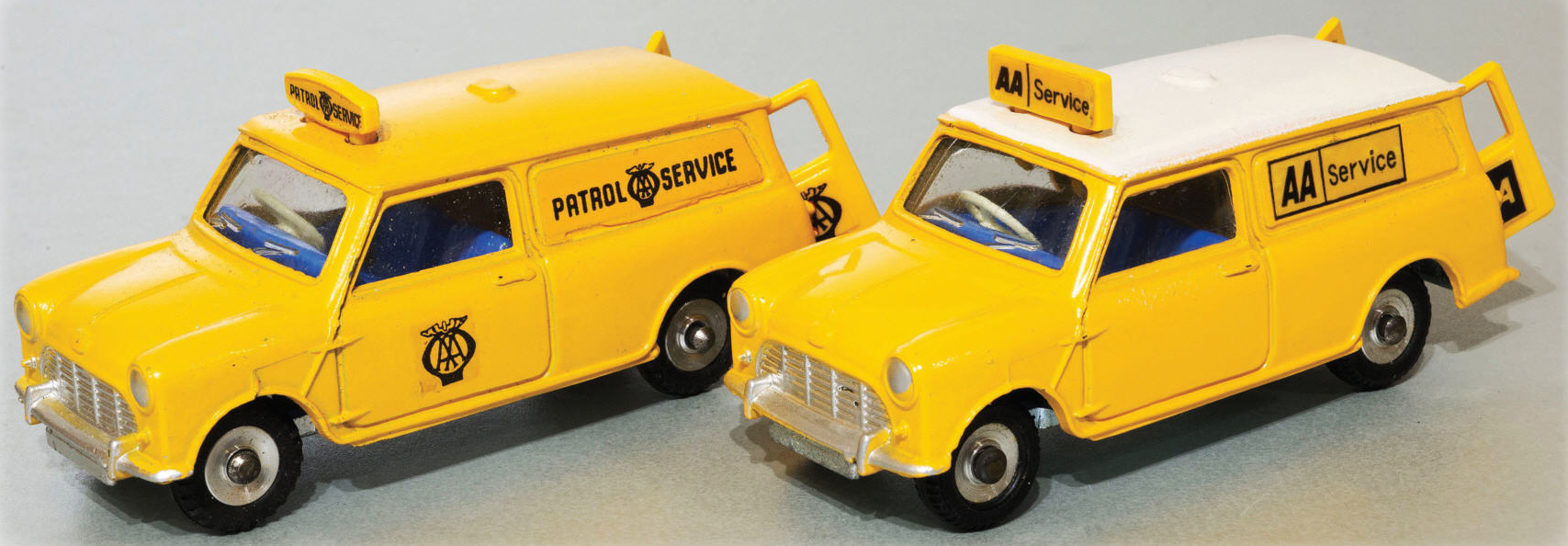
Dinky AA Mini Vans: early version on the left and the later one on the right.
In 1962 Mini Vans started to replace the motor cycle combinations and were soon seen throughout England. Scotland had a fleet of Land Rovers. I’m sure these would have been very well received by the Patrolmen, especially during the winter months.
The Austin and Morris Mini Vans were introduced in 1960 and these very popular vehicles remained available until 1983. The van was renamed to just Mini Van in 1978. During the 23 years of production over 520,000 were made. It had a 4 cylinder 848cc engine, independent suspension and front wheel drive. It was built on the longer Mini Traveller chassis and had a carrying capacity of ¼ ton and a maximum speed of 73mph. The first 200 vans were handed over to the AA on 26 March 1964.
The earlier motorcycle and sidecar combinations carried 29 items of equipment, including two red flags. The mini van carried 97 items of equipment, including two red flags. The number 274 Dinky Mini Van was introduced in July 1964 and remained in the range until 1970. This truly is a delightful model with many excellent details. These include a detailed diecast base plate, accurate yellow paintwork (later yellow with a white roof), a pair of opening rear doors, a roof sign, a roof ventilator, window glazing, an interior including seats and a steering wheel, spun alloy wheels, spring suspension and steerable front wheels. The interior seats can be either red or blue. On a model that is only 3” (78mm) long this is diecasting at its absolute best.
The RAC Patrolmen
Dinky Toys and Somerville Models RAC patrolmen.
Two designs of RAC guides were made by Dinky Toys using the same molds as the AA figures; the 43C figure who was directing traffic and the 43D figure who was saluting. They were introduced in the October 1935 edition of the Meccano Magazine priced at 3d (pence) each, and remained in the range until 1940. Both figures are 36mm high, have a blue uniform with a red sash, blue peaked caps and black knee length boots. The 43C has white gloves whereas the 43D has no gloves. Neither of these figures were released again by Meccano after the war. Somerville Models also reproduced these two figures, details as per the AA patrolmen covered above.
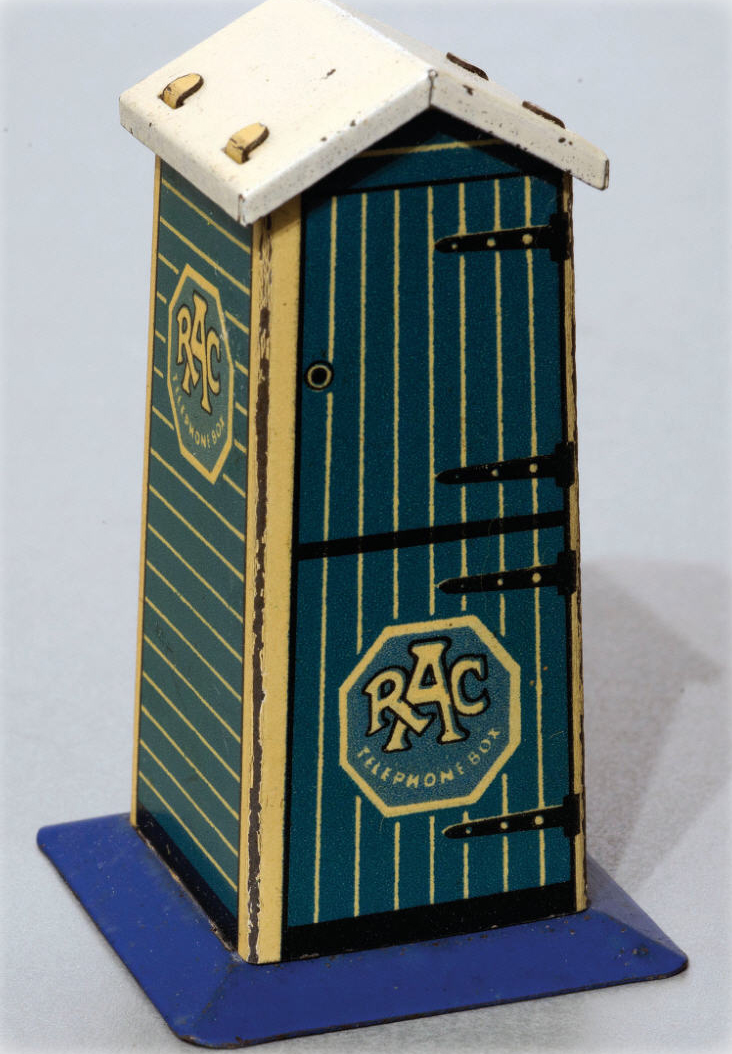
The RAC roadside telephone box.
The 43A RAC Telephone Box was introduced in October 1935 and remained in the range until 1941. It is made from tinplate and is a lot more simple than the AA version. Standing on a blue base, it is printed blue and cream with black hinges and has a white roof. The base is 30mm x 30mm and the box is 51mm in overall height. Like the AA Box, being tinplate it is prone to rust and these also are hard to find in any condition.
The RAC Boxes started to appear in 1912 and initially were shelters for patrolmen to be used in poor weather. The boxes fitted with telephones appeared around 1930 and members were issued with keys to gain access in case of a problem. At their height there were approximately 500 boxes throughout the country. Their demise was caused by the rapid uptake of mobile phones.
The boxes were made from timber with a two-part stable door. The location of the box was clearly shown and they were provided with first-aid kits and petrol cans. The only surviving RAC Boxes are to be found in Heritage museums; there is one located in the East Anglia Transport Museum at Carlton Colville, Lowestoft, Suffolk.
Pre-war and post-war Dinky 43B RAC motorcycle combinations.
RAC Motor Cycle Patrol trade box.
The 43B RAC Motor Cycle Patrol was introduced in 1935 and discontinued in 1940. The motor cycle was painted black and the sidecar was dark blue. This was a different design from the AA sidecar and the tires are usually solid white rubber. The motor cycle is 45mm long. Oddly, the Dinky RAC sidecar is plain blue with no RAC logo. In real life all of them were clearly marked as RAC vehicles. It’s not known why Meccano made this surprising omission. The combination was re-released after the war between 1946 and 1949. The level of painting detail of the driver is much greater on the pre-war vehicle than the later version and the tires are solid black rubber. When sold individually the RAC motor cycle was delivered to dealers in a trade box initially containing six models.
RAC Gift Set. Image: Vectis Auctions
Before the war all the RAC models were available in the number 43 RAC Box, Motor Cycle Patrol and Guides Gift Set which was available from 1935 to 1941. This comprised the 43A RAC Box, the 43B Motor Cycle Patrol, and the 43C and 43D RAC Guides. These were set against a very attractive pictorial box insert. The RAC gift sets seem much rarer than the AA versions and quite hard to find.
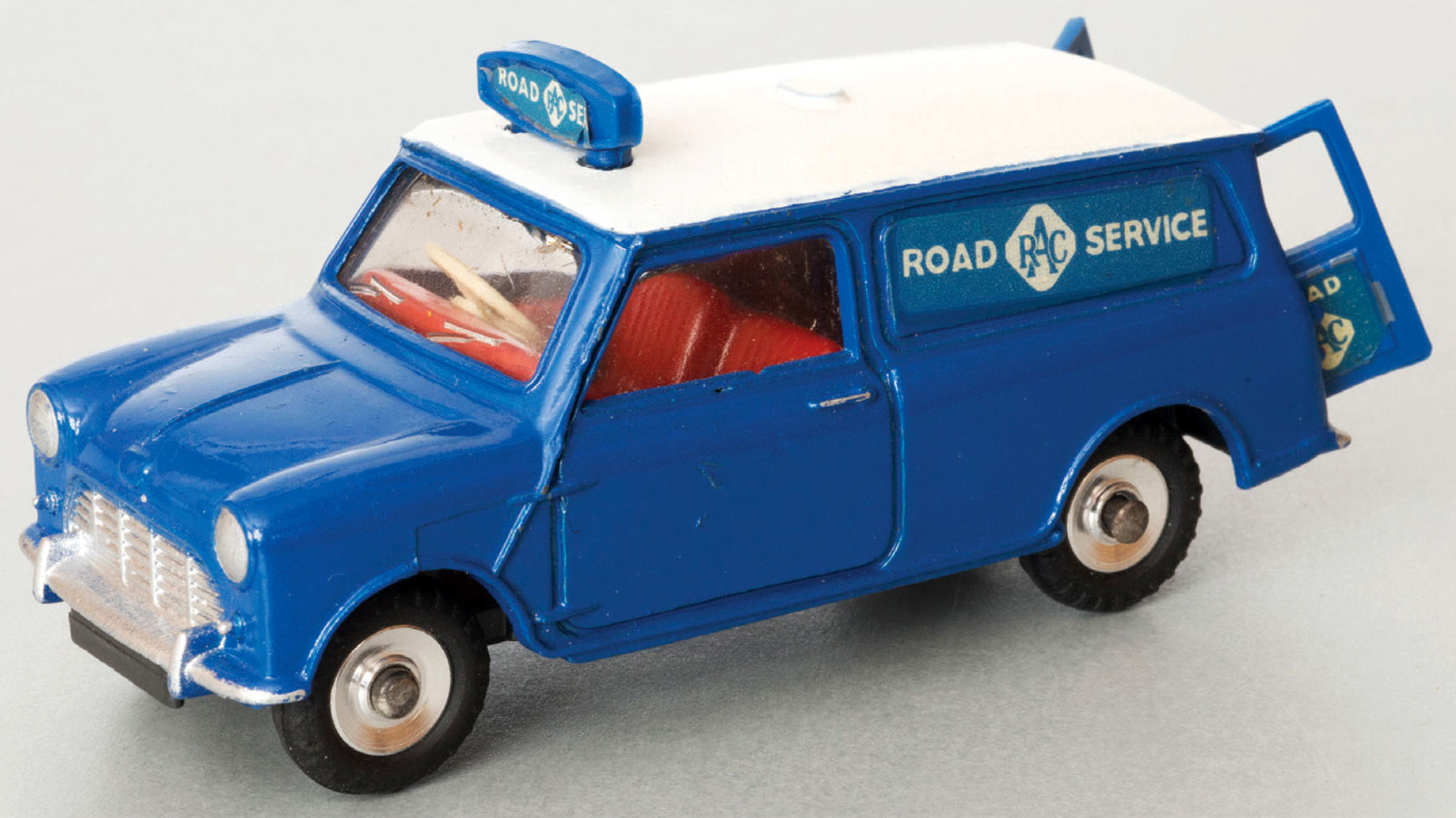
RAC Mini Van.
The 273 Mini Minor Van RAC was introduced in December 1965 and remained in the range until 1970. It is an identical casting to the 274 AA van described earlier.
The differences are that it is painted dark blue with a white roof and a blue roof sign and has RAC markings on the roof sign, rear panel and rear doors. The interior seats can be either red or blue. The style of the RAC logo and markings did not change throughout the lifetime of the model.
Policemen and Police Cars
The range of Dinky policemen and accessories was first announced in the July 1936 edition of the Meccano Magazine and the advert is shown below. In those days, for Dinky Toys there was no specific promotion, new items were simply added in to the existing range with no fanfare whatsoever.
Advertisement in the July 1936 issue of Meccano Magazine announcing the police related models.
There were two different designs of Policemen made by Dinky, both of them were on point duty (traffic control). The number 42c is in a white coat with a blue helmet and trousers with an overall height of 42mm. The number 42d is in a blue uniform, blue helmet and long white gloves which reach down to the elbows, he is 40mm high. Both figures were new in July 1936 and discontinued in 1941. Neither of these figures reappeared after the war. Modern versions of the policemen were trialed by Somerville Models and these are shown below.
Dinky policemen: on the left three Dinky figures, on the right two Somerville figures.
The Police Box or Hut was introduced in July 1936 as catalog number 42a and was discontinued in 1941. It was released again after the war from 1948 to 1960 with the catalogue number changing to 751 in 1954. It has an overall height of 54mm.
The Dinky Police Hut and the dealer trade box. By the mid 1960s, thanks to Dr. Who, these police boxes became known as the Tardisfigures.
This is probably the best known Dinky Toy of all as it has become synonymous with the extremely popular BBC series ‘Dr. Who’ and his time machine the Tardis.
The Box is painted dark blue with silvered windows and a ‘Police’ sign at the top on all four sides. On top of the roof is a light, this is sometimes painted blue and sometimes red.
Under the left hand window on the front is a hinged panel, behind this is a telephone for use by the public. Underneath this is a panel containing instructions for use and alongside this is a ventilator. These three features are silvered.
The Police Box that the Dinky model is based on was designed by The Dinky Police Hut and the dealer trade box. By the mid 1960s, thanks to Dr. Who, these Police boxes became known as the Tardis Gilbert MacKenzie Trench and was in use from the late 1920s until the late 1960s. Not all the boxes were painted blue, some were green and some red.
The public could use the box to contact the police via a hinged panel which revealed a telephone. A policeman could physically enter the box which was in fact a miniature police station, there he could read and write reports, contact the station and take meal breaks in private.
The box contained a first aid kit and a fire extinguisher, if the light on the roof was flashing this alerted a policeman that he was required to contact his station immediately.
At one time there were thousands of these boxes but with the advent of modern communications they have all now sadly disappeared from our streets. There are some preserved boxes in museums.
The police motorcycles.
Shown in the image above are the 37B Police Motor Cyclist, the pre-war 42B Police Motor Cycle Patrol and the 42 post-war Police Motor Cycle Patrol.
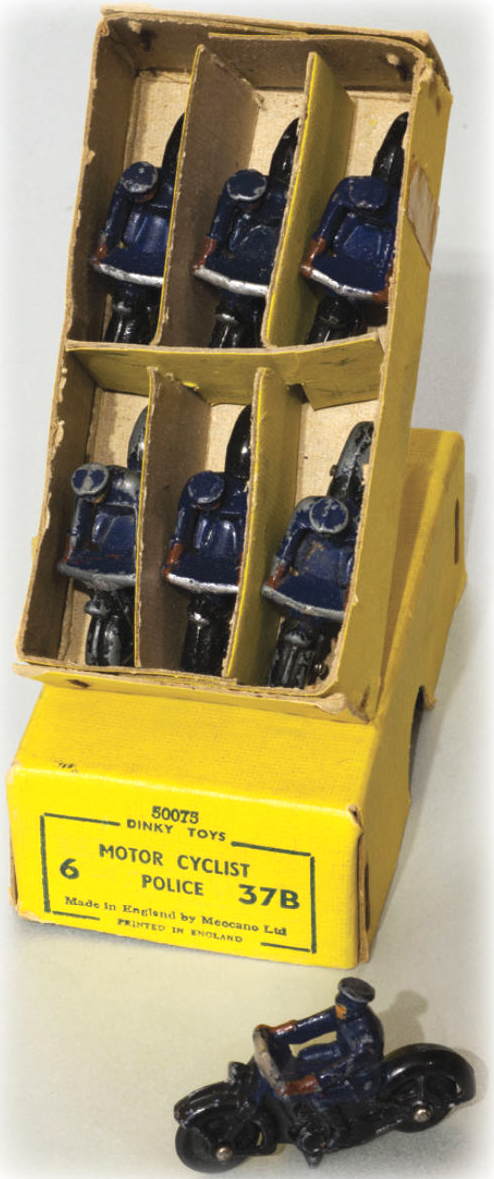
Police motorcycles trade box.
The 37B was new in November 1937 and discontinued in 1941. It was reissued after the war in 1948 until 1954 but only as an export item for the U.S. market. The motorcycle is black with silver handlebars and the rider is in a blue uniform with brown gauntlets. The overall length is 45mm. This casting was used for all the motorcycles in the Dinky range with only a minor change to accommodate the sidecars when used as a combination. The 37B was only sold from a dealer trade box containing six models.
The pre-war number 42b Police Motor Cycle Patrol was introduced in 1935 and remained available until 1940. The motorcycle is painted black with a silver exhaust and the rider and passenger are both in dark blue uniforms with detailed painting of the faces. The sidecar is painted green and some have white rubber wheels while later models sport black wheels. This model was reissued after the war between 1948 and 1954 as an export only item to the United States. This had simplified paintwork, no silver on the exhaust and no detailing in the faces. It was fitted with black rubber wheels.
Number 42 Police Gift Set.
The No. 42 “Police Box, Motor Cycle Patrol and Policemen” Gift Set was introduced in 1935 and remained available until 1940, it was never reissued after the war. It contained the 42A Police Box, the 42B Police Motor Cycle Patrol and the two Policemen 42C and 42D. It was contained in a blue lift-off lid box and the models were shown against an attractive display card in the box base.
Number 42 Police Gift Set.
The Dinky Toy range from the early 1930s always contained an ambulance and a fire engine but very surprisingly they never featured a police car until 1955. This was an amazing omission as all the other diecast toy manufacturers in the UK featured one in their ranges. Dinky had no shortage of suitable saloon cars in their catalogue which could have easily been offered as police vehicles with a simple alternative color scheme. I’m sure that such a vehicle would have been a good seller.
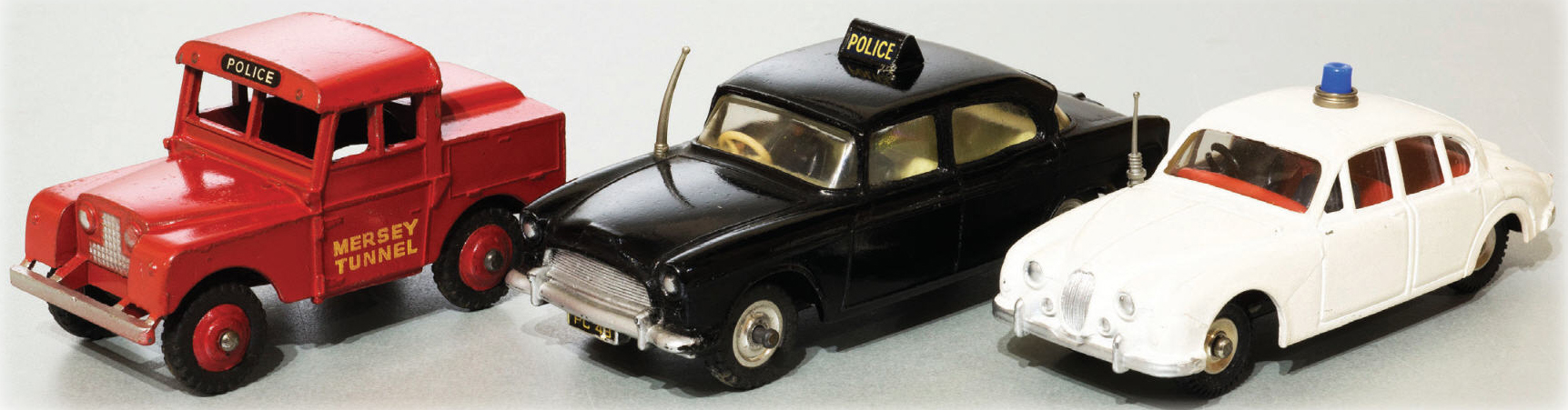
The first such Dinky vehicle was the number 255 Mersey Tunnel Police Van which was new in September 1955 and available until 1961. This iconic vehicle, painted bright red, was based on a short wheelbase Land Rover (Series 1) and would have been familiar to young boys from Liverpool and other visitors to the city. Even though the real vehicle would never have been seen by the vast number of boys in other parts of the country, it was still a very popular model and a firm favorite of mine at the time. This was the only unique casting of a police vehicle made by Dinky. All the other examples are modifications of existing cars in the range.
The next model was the number 256 Humber Hawk Police Car, new in December 1960 and available until 1964. This was a lovely model painted black and included a roof sign, an antenna, spring suspension and glazed windows. It also had interior seating, a steering wheel plus a driver and policeman passenger. The Humber Hawk was a substantial vehicle made by the Roots Group and an excellent choice for an emergency vehicle.
Britain’s motorway network commenced in 1958 with the Preston Bypass (M6), and the first part of the M1 was opened in 1959. This presented the police with a problem as there were no speed restrictions in the early days and the bad guys would use fast cars to get away from the law. The response was the introduction of specialist faster police vehicles and Dinky announced the number 269 Jaguar Motorway Police Car in April 1962, which remained available until 1966. This is painted white and features an antenna, a roof mounted blue light, a ‘Police’ sign on the boot lid, steering and suspension, window glazing, seating, steering wheel and a driver and policeman passenger. Some of these vehicles are painted using gloss white paint and some with matt paint.
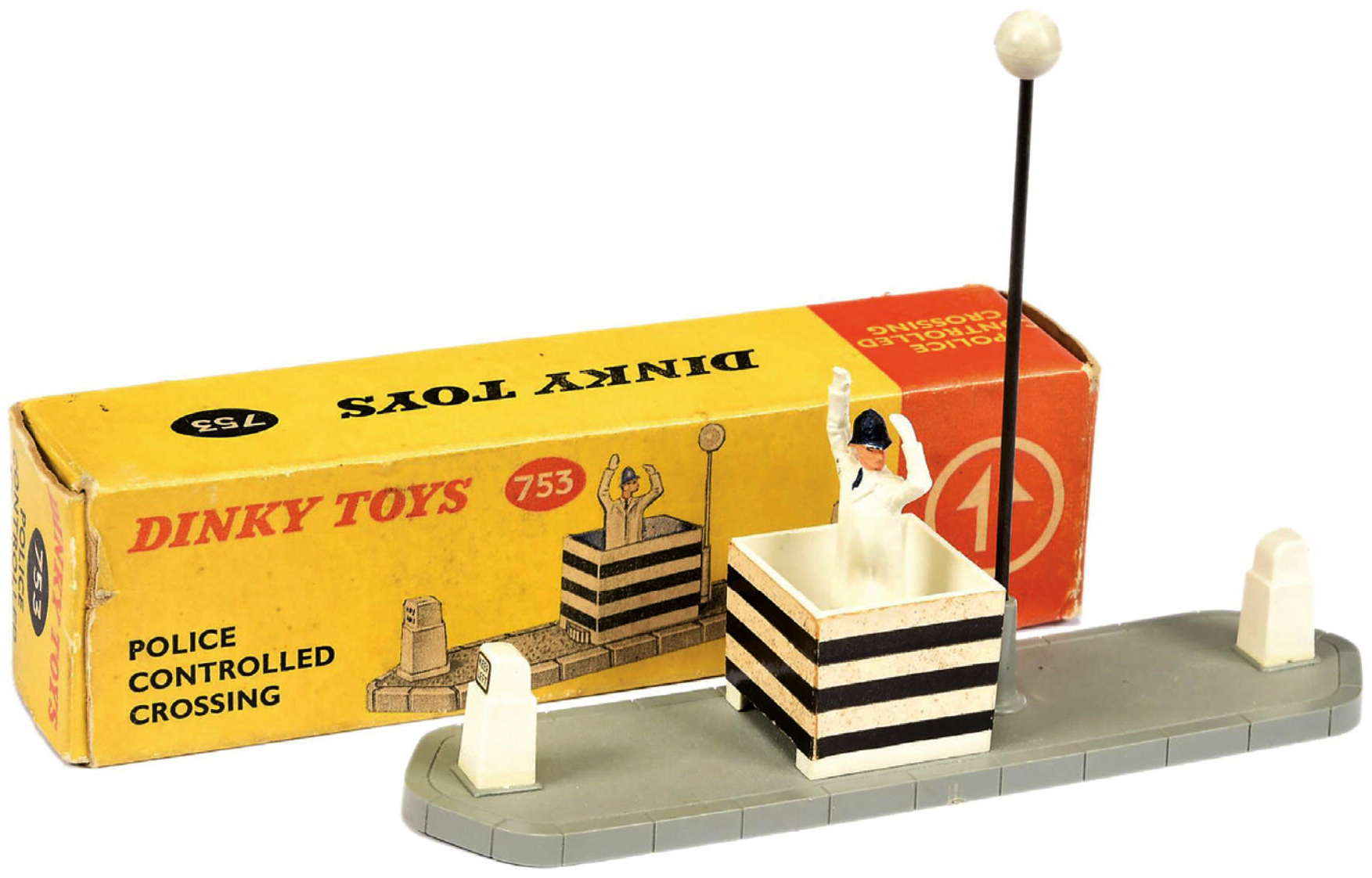
We started this part of the article with two policemen on point duty and we now finish with the last Dinky Toy to offer a very similar function but using a completely different design. The number 753 Police Controlled Crossing was new in November 1962 and stayed in the range until 1967. I quote from the November 1962 issue of Meccano Magazine:
This delightful little miniature, manufactured from high-impact polystyrene, has a policeman who can be turned around in his box by means of a knurled knob protruding at the base of the box. It is available in kit form with the lamp standard, policeman and his box being supplied separated from the base. These are easy to fix, and if required, can be glued permanently in place. A must for your layout!
The Police Controlled Crossing. Image: Vectis Auctions
This article concerns figures which are suitable for use with Hornby O gauge model railways and I have also included directly associated Dinky vehicles. As Hornby O gauge was discontinued in the early 1960s I have only included the Dinky vehicles made between the 1930s and the early 1960s. The Dublo Dinky range never incorporated a police car, so sadly the Hornby Dublo boys had to look elsewhere to achieve law enforcement on their layouts.
Acknowledgement
This article by our late friend Dave Busfield first appeared in the April 2020 issue of Hornby Railway Collectors’ Association Journal.