In early 1964, Spot-On were designing six new models for their range, all based on contemporary U.S. cars; unfortunately at the same time, Tri-ang, the parent company of Spot-On, were in negotiations with Meccano for a buy out. The deal was accepted and by the end of February 1964, Meccano was now part of the huge Tri-ang Toys company who now had Dinky Toys, the “jewel in their crown”.
The change of ownership from Dinky’s point of view wasn’t a problem; they would continue to benefit from a cash injection from their new parent. For Spot-On however, their future wasn’t so clear, but they continued with their usual production program in Northern Ireland by introducing ten to twelve new models each year until 1967. However, they lost the six new US car models to Dinky. I heard that Dinky shipped them over to a plant in Hong Kong for new baseplates and final finishing, at the same factory that Tri-ang used and where it would soon make six British sports cars for Scalextric.
However, the Industrial History of Hong Kong Group reported at their website (Farmer, 2019a, 2019b) that Hong Kong Industrial (HKI) made the six Dinkys from scratch during 1965 and 1967. HKI was owned by Loh Te Sing and located in Smithfield, Hong Kong Island. They made toys for both Lines Bros, Ltd. (Tri-ang) and Meccano Ltd. (Dinky). In 1966, Mattelbought HKI for Barbie doll production and later started tooling for their Hot Wheels product introduction, with sales starting in 1968.
In 1967, Mattel stopped Dinky Toy production at HKI to make room for Hot Wheels, but around the same time (1967 or 1968) Dinky started manufacturing their new Mini Dinky range at HKI to compete with the “Matchbox” 1–75 series models. (See The Mini Dinky Story)
Catalogs
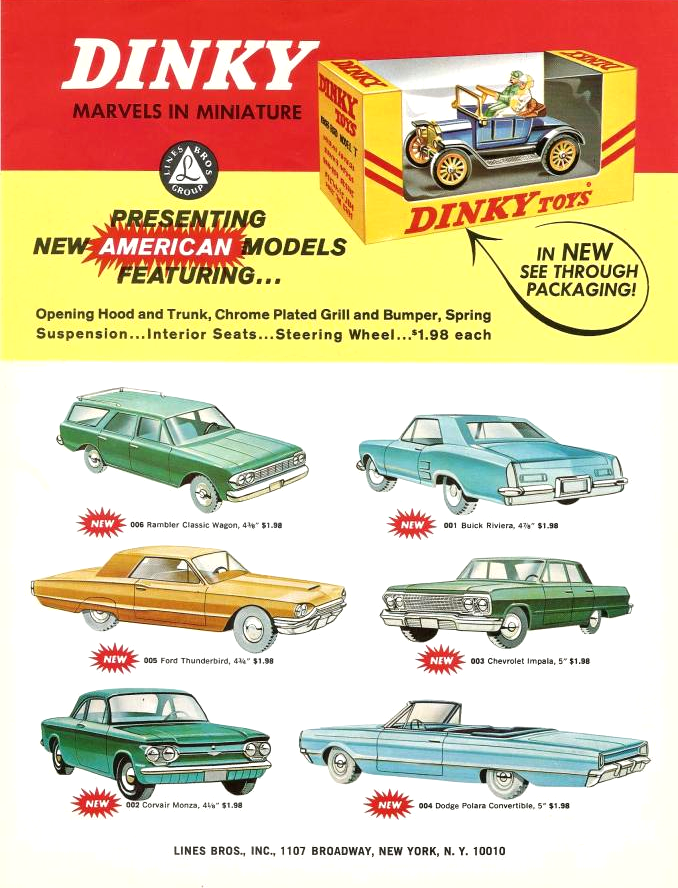
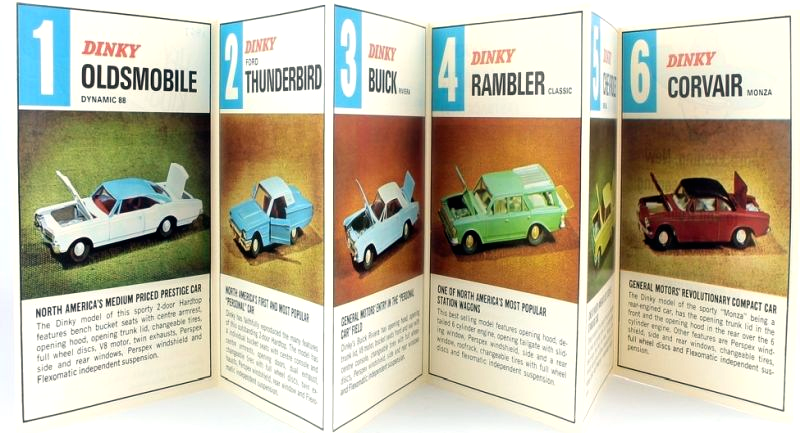
To introduce the new models as Dinky Toys, all six models were shown on a flyer for Canada in 1964. The following year, four models were introduced in Canada and North America, and finally in 1966 the last two models were released.
Mike and Sue Richardson (1981) said that these six cars had quality and manufacturing issues, so production only lasted from 1965 to 1967. Dinky tried again in 1978 and 1979 with the No. 180 Rover 3500 with production issues again, they report (see Two Dinky Police Cars from 1979). All six cars were shown in the 1965 US catalog but only 001 and 003 appeared in the 1966 UK catalog. It’s not clear how many of the six were actually sold in the UK.
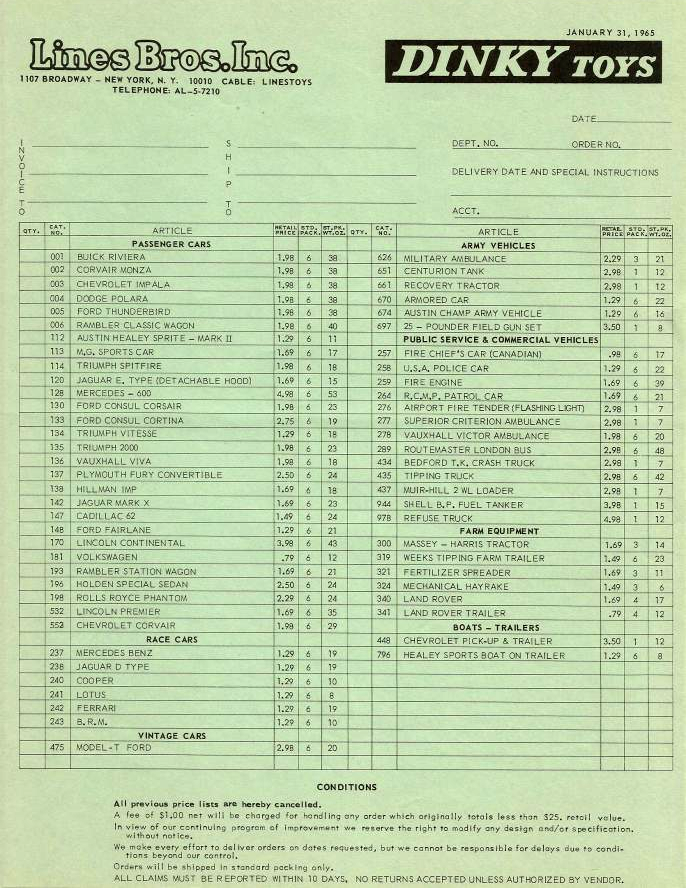
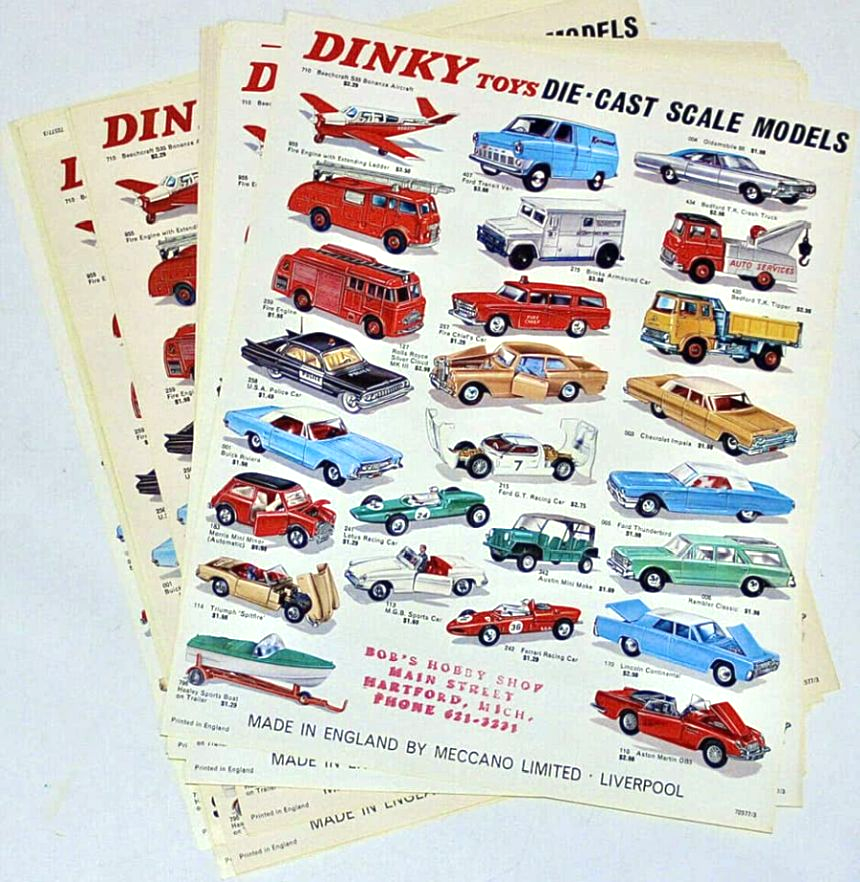
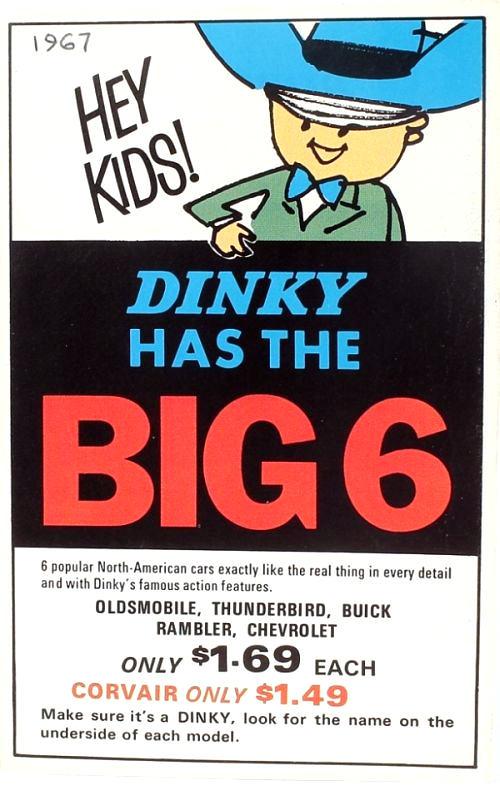
Three leaflets or flyers have been seen for the US market along with a price list. I assume the oldest one used color drawings of the original cars before any prototypes were ready to photograph. The green US price list is dated January 1965. Both are marked Lines Bros. Ltd. and show 004 as a Dodge Polara convertible which was replaced by the Oldsmobile 88, perhaps being easier to manufacture than a convertible. Trademarks might not have been such a stumbling block in the 1960s but that may have been an issue as well. The third picture below shows the back of a 1967 leaflet for the US. Lines Bros. isn’t mentioned in this one.
Images: Jonathan Angel, Jan Oldenhuis, Jonathan Angel
The small accordion-fold one pager shown below shows the “Big 6” cars. This copy is pencil dated 1967 but may have been published earlier.
Images: Chris Turner
The Hong Kong Six
The six models listed below have distinctive chromed bumpers and grill components introduced by Spot-On as a major new feature for 1961, and also sport “spun alloy” wheel rims with large section nylon based tires. Dinky adopted these for some of their models. All the baseplates are marked “1/42 scale” and “Made for Meccano Ltd. in Hong Kong”.
57/001 Buick Riviera
57/002 Chevrolet Corvair Monza
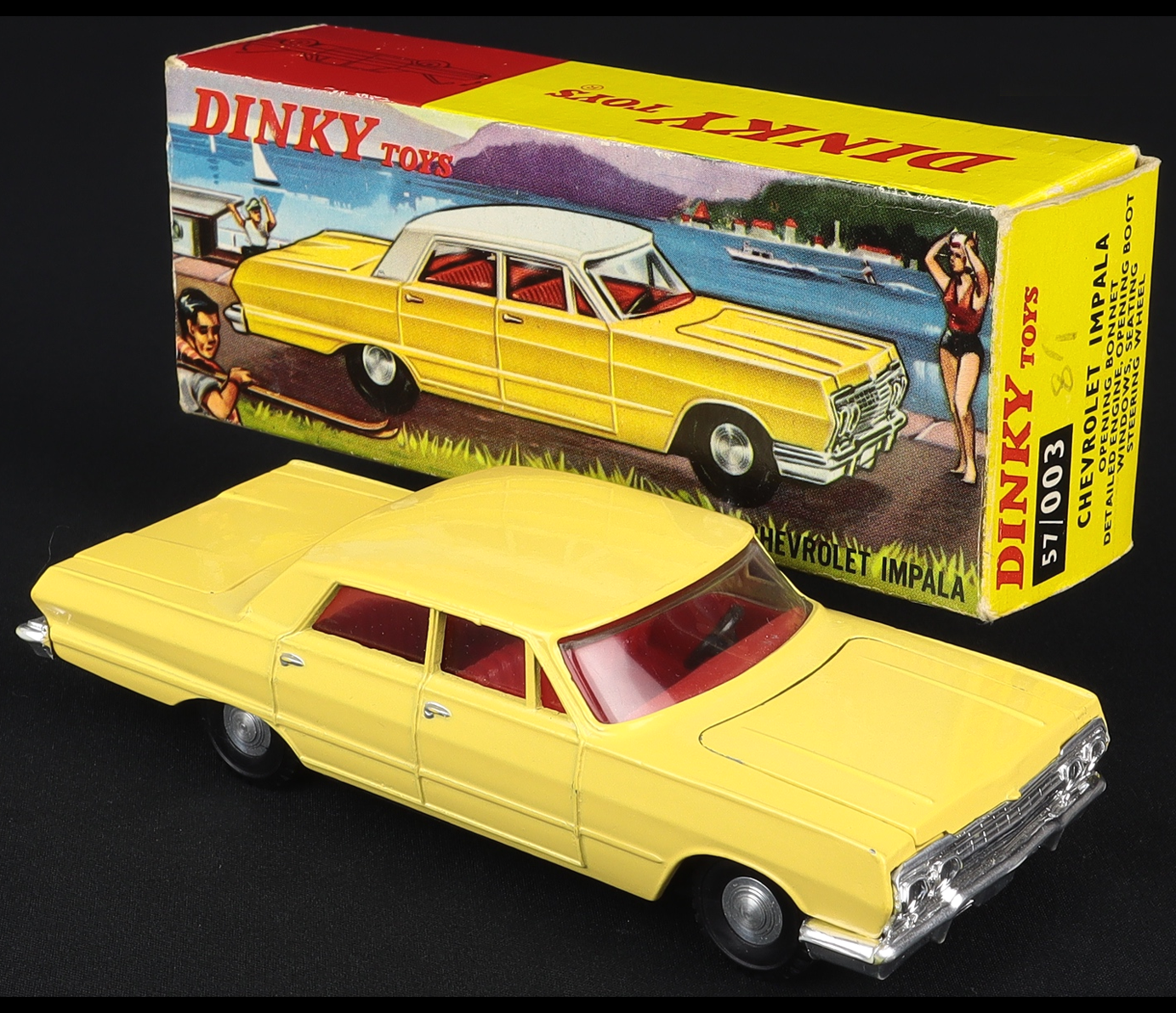
57/003 Chevrolet Impala
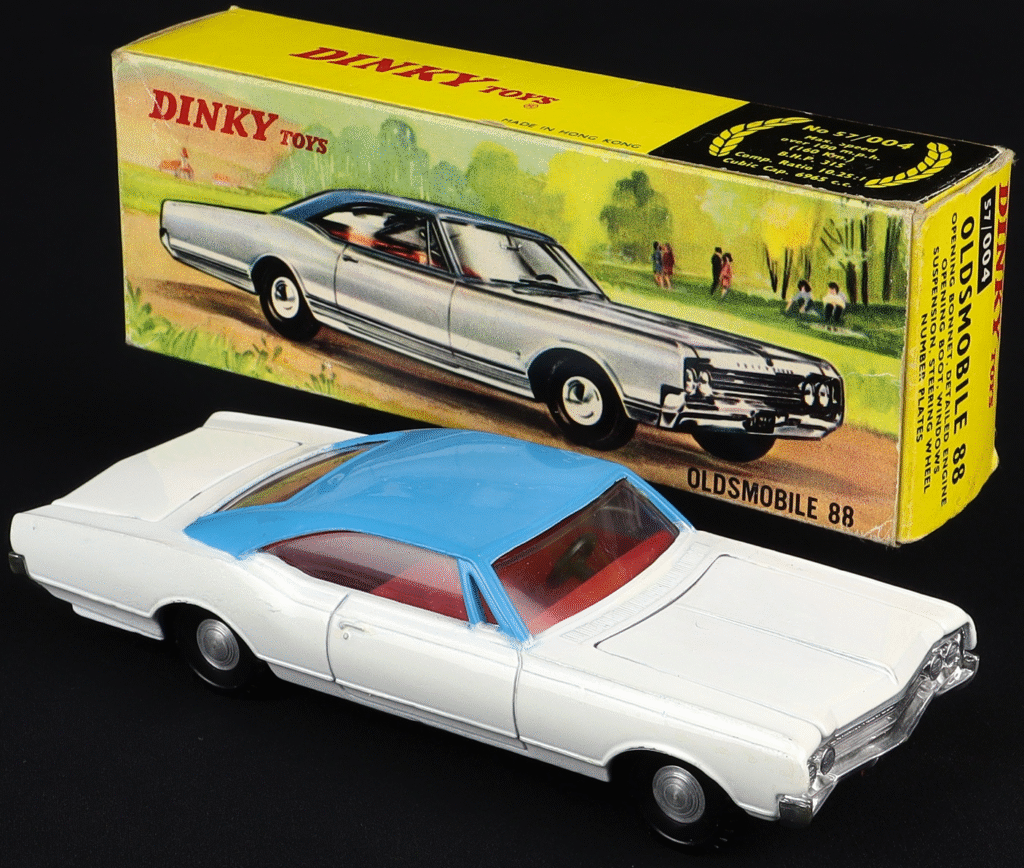
57/004 Oldsmobile 88
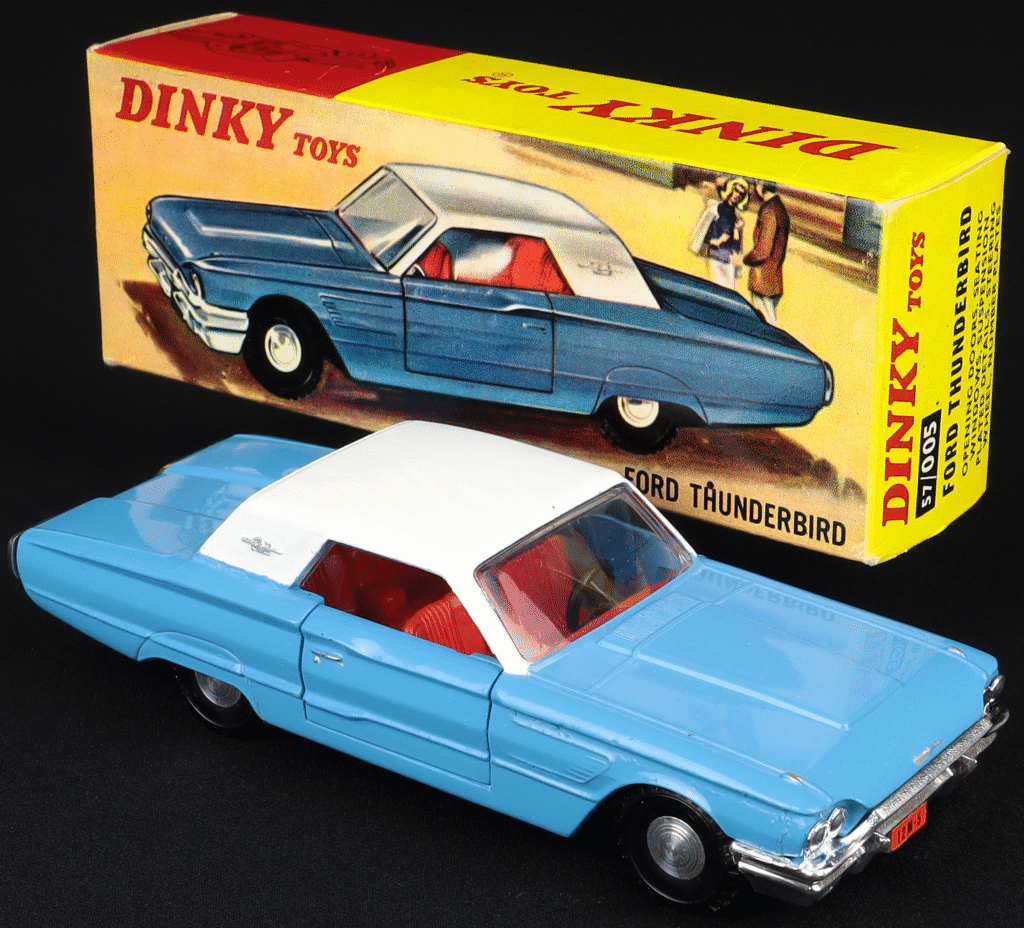
57/005 Ford Thunderbird
57/006 Rambler Classic
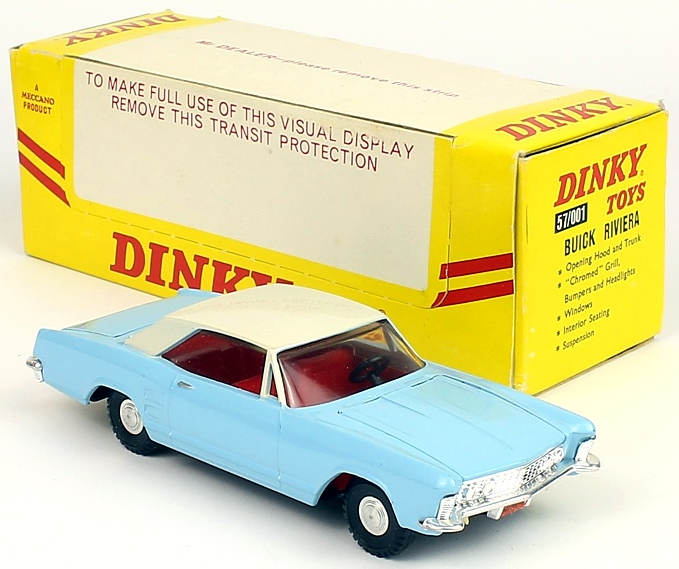
During 1964, Dinky introduced a new “Visi-Pac” box: it was a double “window” box in yellow with red text. For 1965, this was modified by adding some extra red angled stripes on each side of the viewing window. These boxes proved to be too delicate, so a new fully closed picture box was designed for the 1966 season.
The six Hong Kong Dinkys have been found in both the 1965 red-striped “window” box (shown in the 1965 US catalog) and in a fully closed picture box in 1966.
Since then, none of the models have turned up in another company’s range and I believe they were scrapped along with a lot of the original Dinky tools and several sets of Spot-On tools. In 2008, the French company Norevreintroduced some Spot-On models (as Spot-On branded models in Spot-On boxes) to the retail market, but none of the Hong Kong Six were reproduced and their range lasted only a few years.
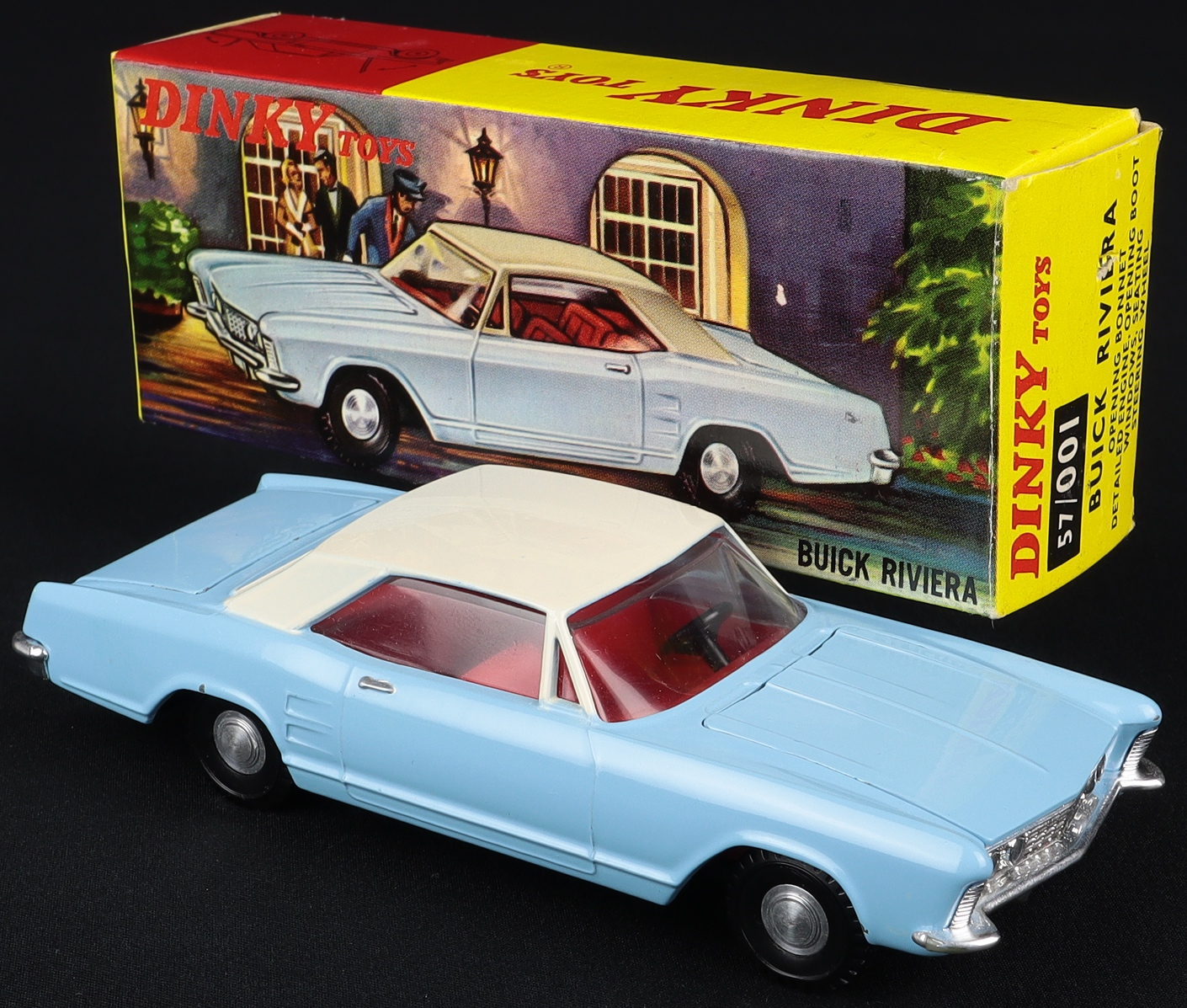
57/001 Buick Riviera
This is quite a common model within the range and there seems to be a good number of these in circulation. This model was shown in the 1966 UK catalog and presumably sold in England and is based on the 1963 Riviera model year.
Image: Quality Diecast Toys
Shown below is the 1965 red striped “window” box, essentially the same as the 1964 version, but with the angled red stripes added to each side of the viewing window. All six models were probably available in this box for the US market, but when three models came to the UK in 1966, they were packaged in the fully closed picture box. The three models for the UK were probably the Buick Riviera, the Chevrolet Impala and the Nash Rambler.
Image: Quality Diecast Toys
57/002 Chevrolet Corvair Monza
The Chevrolet Corvair Monza isn’t as common as the Buick Riviera and appears to have not been offered in the UK. It also exhibits some “artistic license” in that it seems to be a cross between a 1963 and a 1964 model. The panel shut-lines on this model stand proud from the body surface, but the overall shape doesn’t seem to be very representative of the actual car from either year.
Image: Quality Diecast Toys
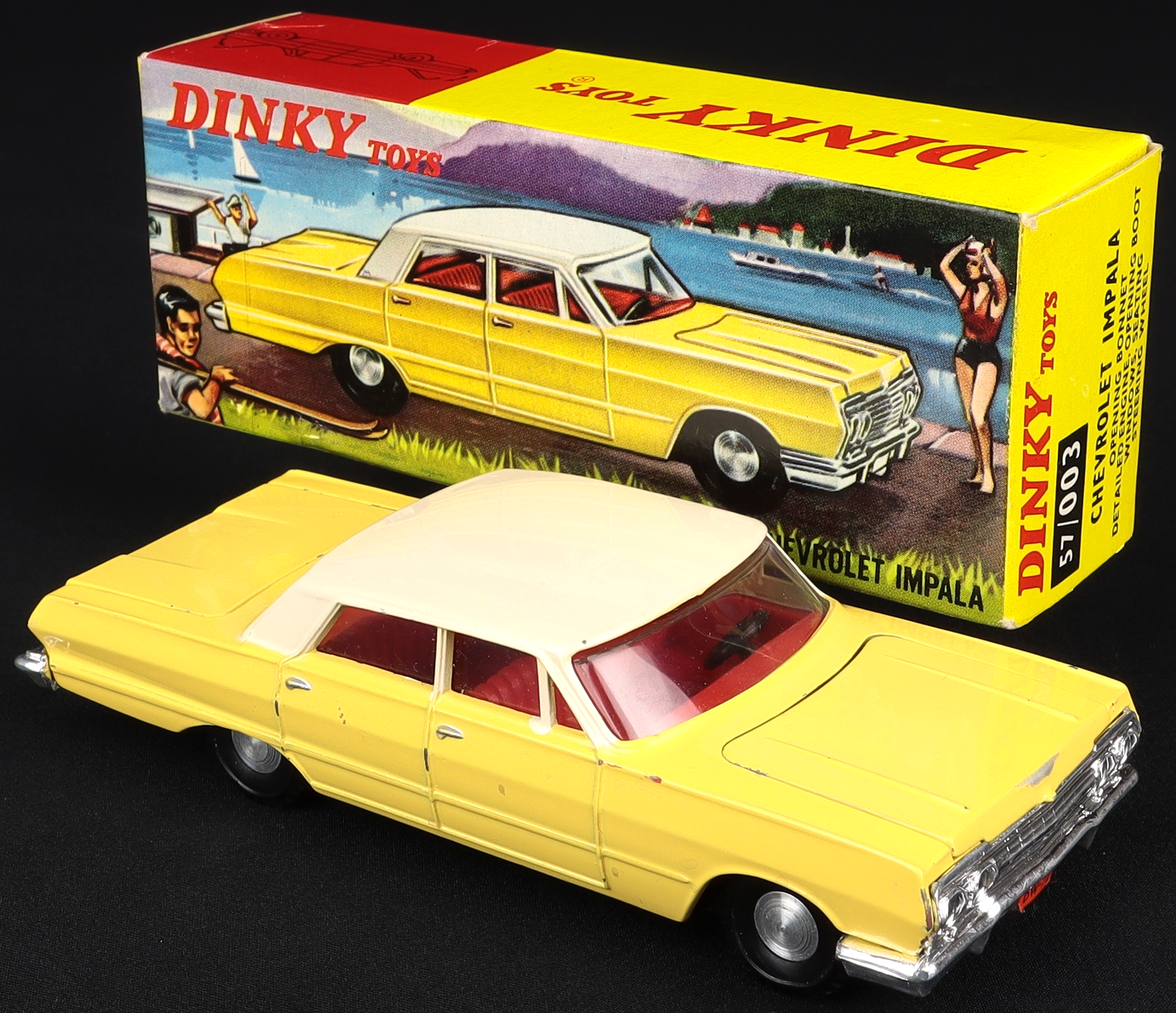
57/003 Chevrolet Impala
The Chevrolet Impala is another uncommon model, yet is shown in the 1966 UK catalog. Two versions of this model exist: one with a white roof and the other in all yellow. I don’t remember which one was destined for the UK market and which for the US market, but that was probably the reason for the two versions. This model is also a little difficult to identify fully; it has details from both a 1963 and a 1964 car and like the Corvair, the panel shut-lines are proud.
Images: Quality Diecast Toys
57/004 Oldsmobile 88
The Oldsmobile 88 is based on the 1963 Oldsmobile Delta 88 two door coupe. Although another model that seems to be freely available, it wasn’t included in the 1966 UK catalog.
Image: Quality Diecast Toys
57/005 Ford Thunderbird
A fine model based on the 1964 Ford Thunderbird two door coupe, this was also missing from the 1966 UK catalog. With opening doors, the overall look is spoiled if the doors are pushed in too far when closed. This model can be quite hard to find.
Image: Quality Diecast Toys
57/006 Rambler Classic
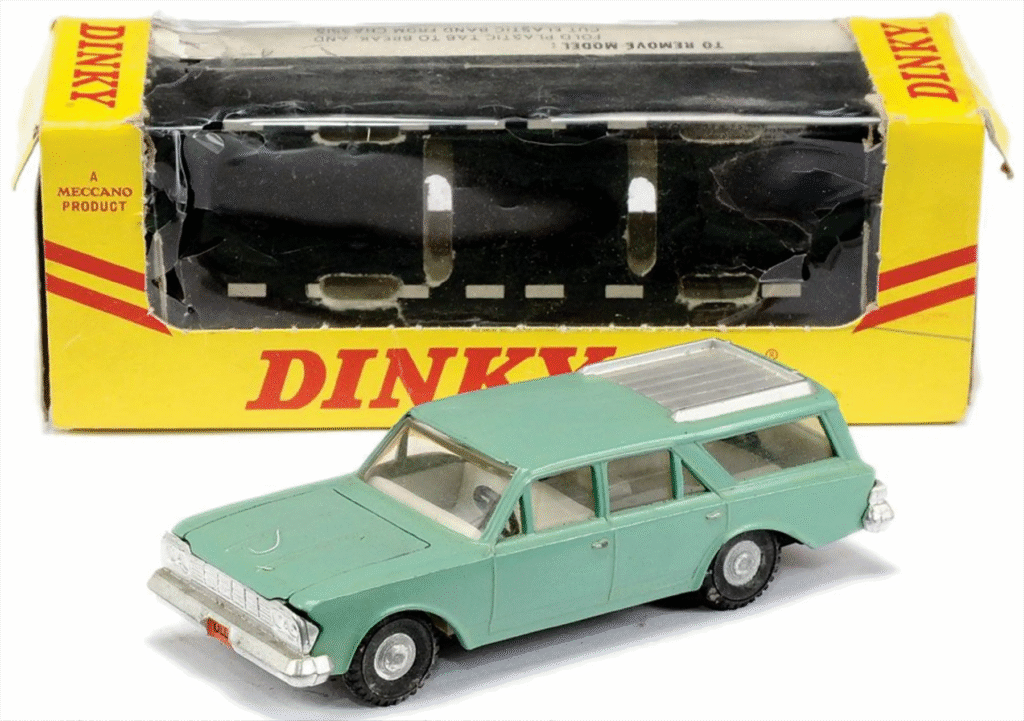
The 1964 Nash Rambler is the last model in this range and also appeared in the 1966 UK catalog. The example below is sitting in front of its 1965 red striped “window” box and you can see how fragile this design was.
Image: Vectis Auctions
It’s not surprising that Dinky introduced the fully closed box for the 1966 model range. This model also has the panel shut-lines standing proud of the body. It is based on the Rambler Classic 770 Station Wagon and is hard to find.
Image: Quality Diecast Toys
When new, this model wasn’t very popular but it has since become quite collectible and as of this writing has sold for as high as GBP 400.
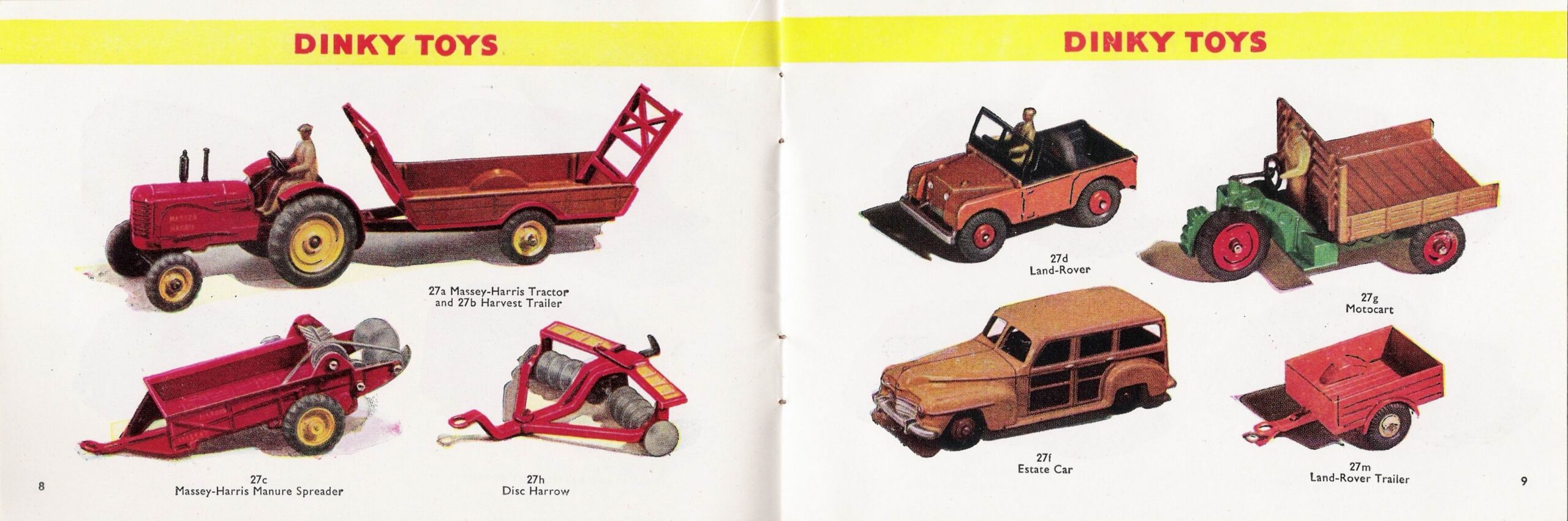
Shortly after World War II, production of a group of agricultural models began, later grouped together under the name “Farm Equipment”. It became a beloved series of agricultural models that were very popular with children and appeared in catalogs from 1948 to 1973. Every Dinky child owned some models from this series to play with for hours. The models are virtually indestructible and are still widely available today, a testament to the quality of Meccano Liverpool’s production.
In 1948 Meccano Liverpool started production of series 27 agricultural models first referred to in the 1955 USA catalog as “Farm Equipment”. It consisted of 13 models in total. 27A Massey-Harris Tractor is part of series 27 Farm Equipment and was the first model issued from June 1948 till 1966. From 1966 to 1971 the model continued under the name Massey-Ferguson Tractor and was renumbered 300. It is one of the most produced models in terms of numbers made by Meccano Liverpool.
I’ve collected all the models in this series including all dual numbered boxes which will be seen in this article. From the beginning, they were my favorites that reflected my childhood in the countryside. In this article, I describe the characteristics of the 27A Massey-Harris and 300 Massey-Ferguson tractors, which I have researched extensively. This article was created thanks to contributions to the DTCA forums and information from Mike and Sue Richardson’s Great Book of Dinky Toys.
The 27A in the Dinky Toys 1952 international color catalog.
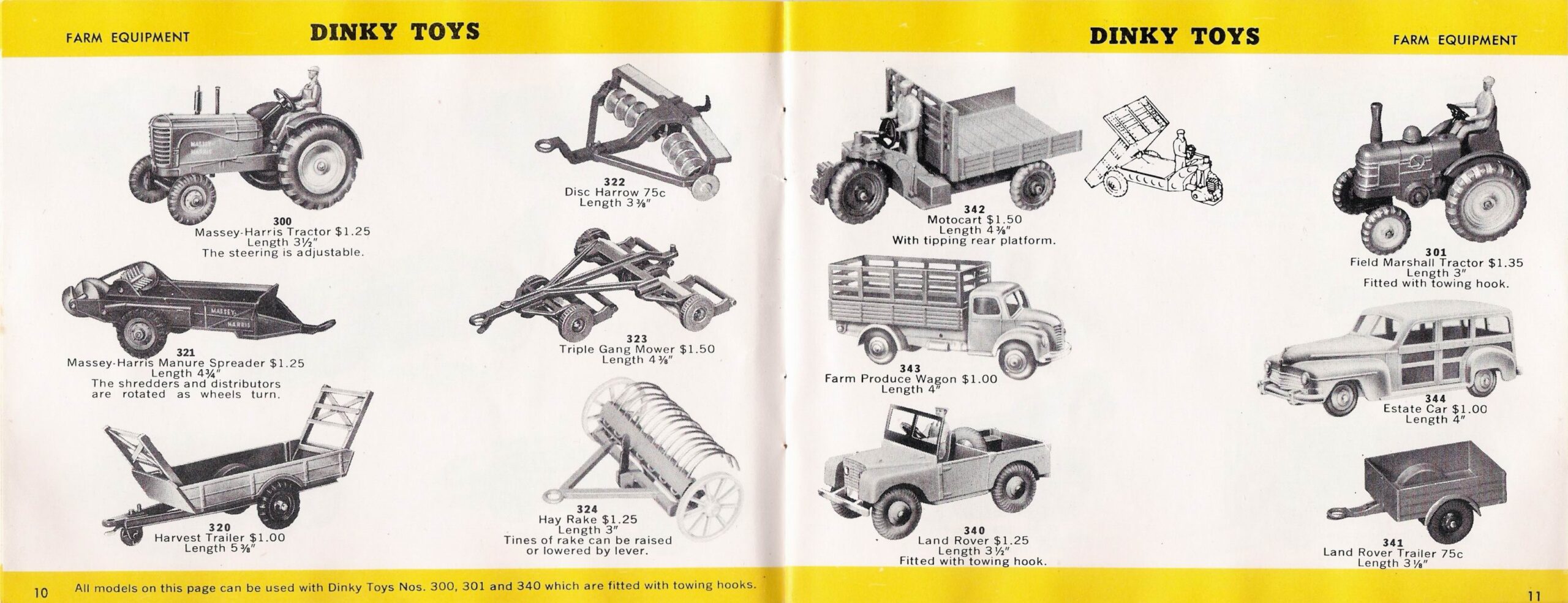
Farm equipment in the Dinky Toys 1955 USA catalog.
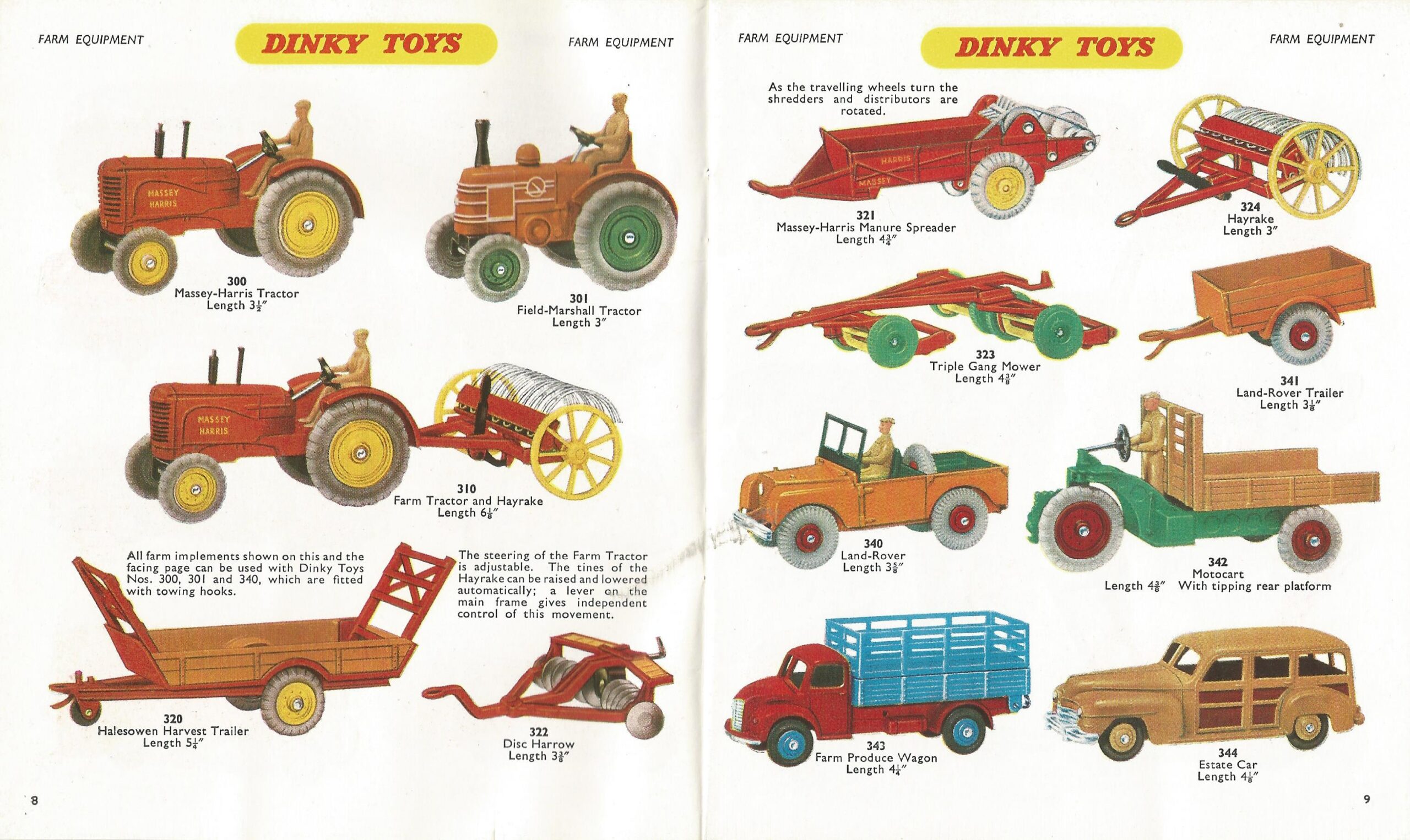
Farm equipment in the Dinky Toys 1957 UK catalog.
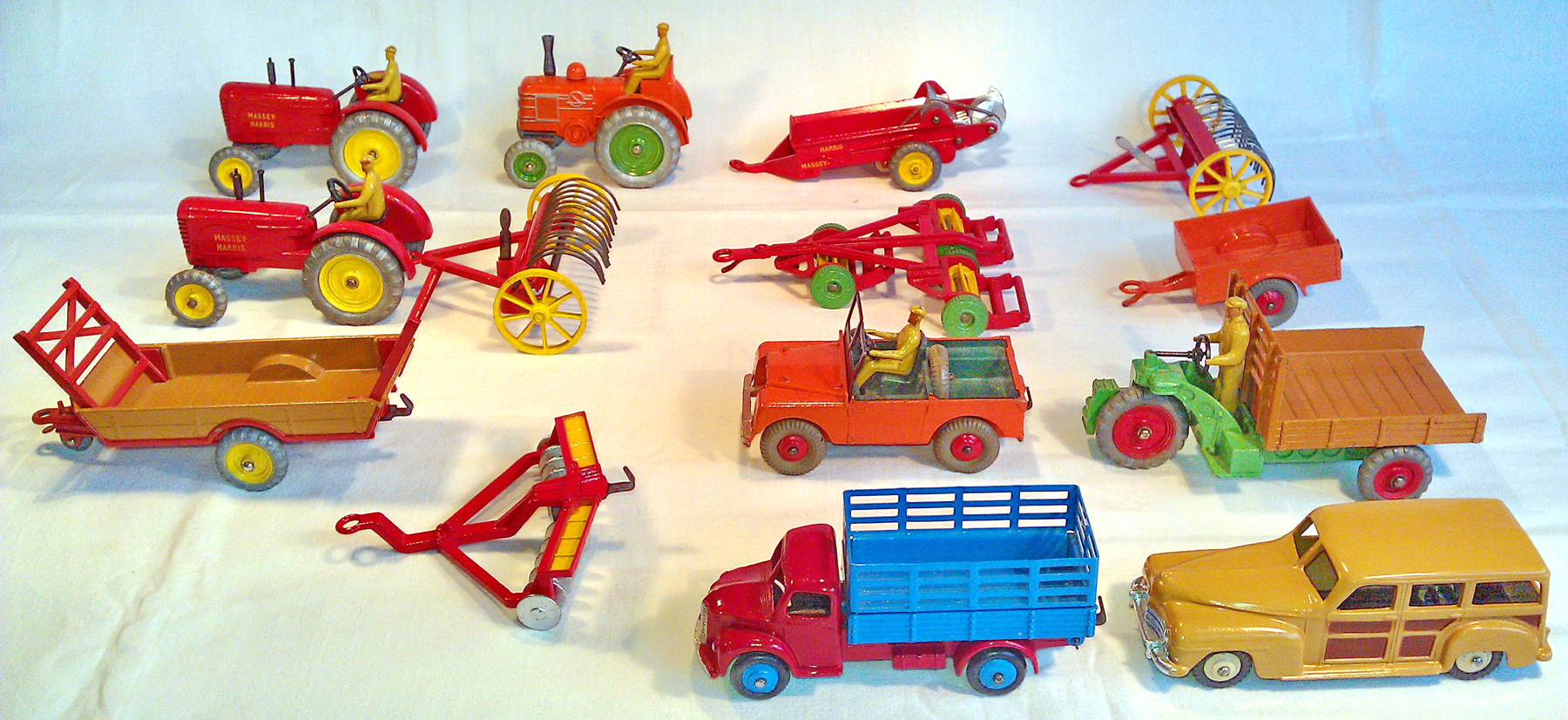
Farm equipment models arranged as in the Dinky Toys 1957 UK catalog above.
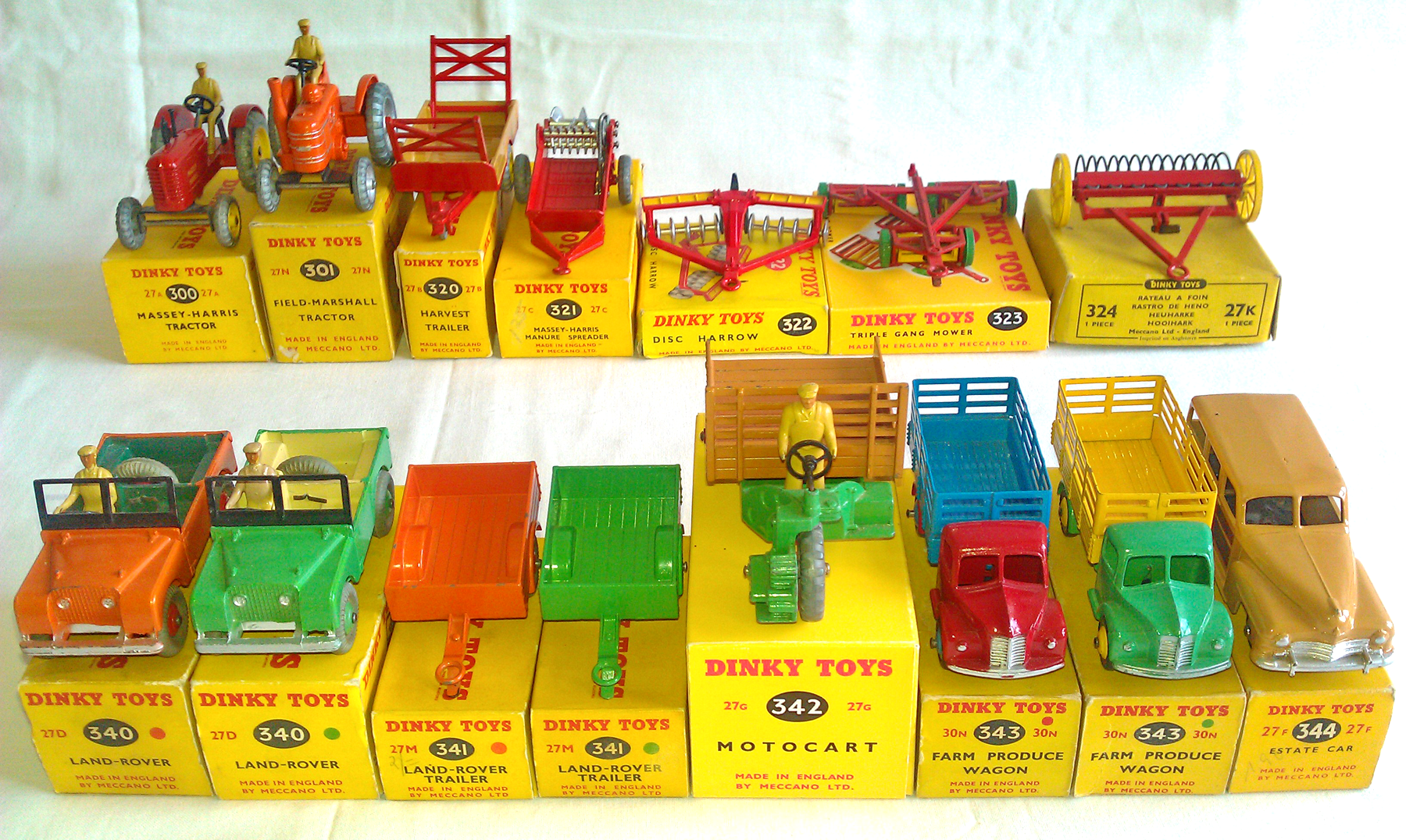
Series 27 farm equipment with dual numbered boxes, including 30N/343.
The series 27 started in 1948 and grew to 13 models until 1973. A renumbering occurred in 1954. The series is comprised of the following models:
27A (300) Massey-Harris Tractor — June 1948–1971
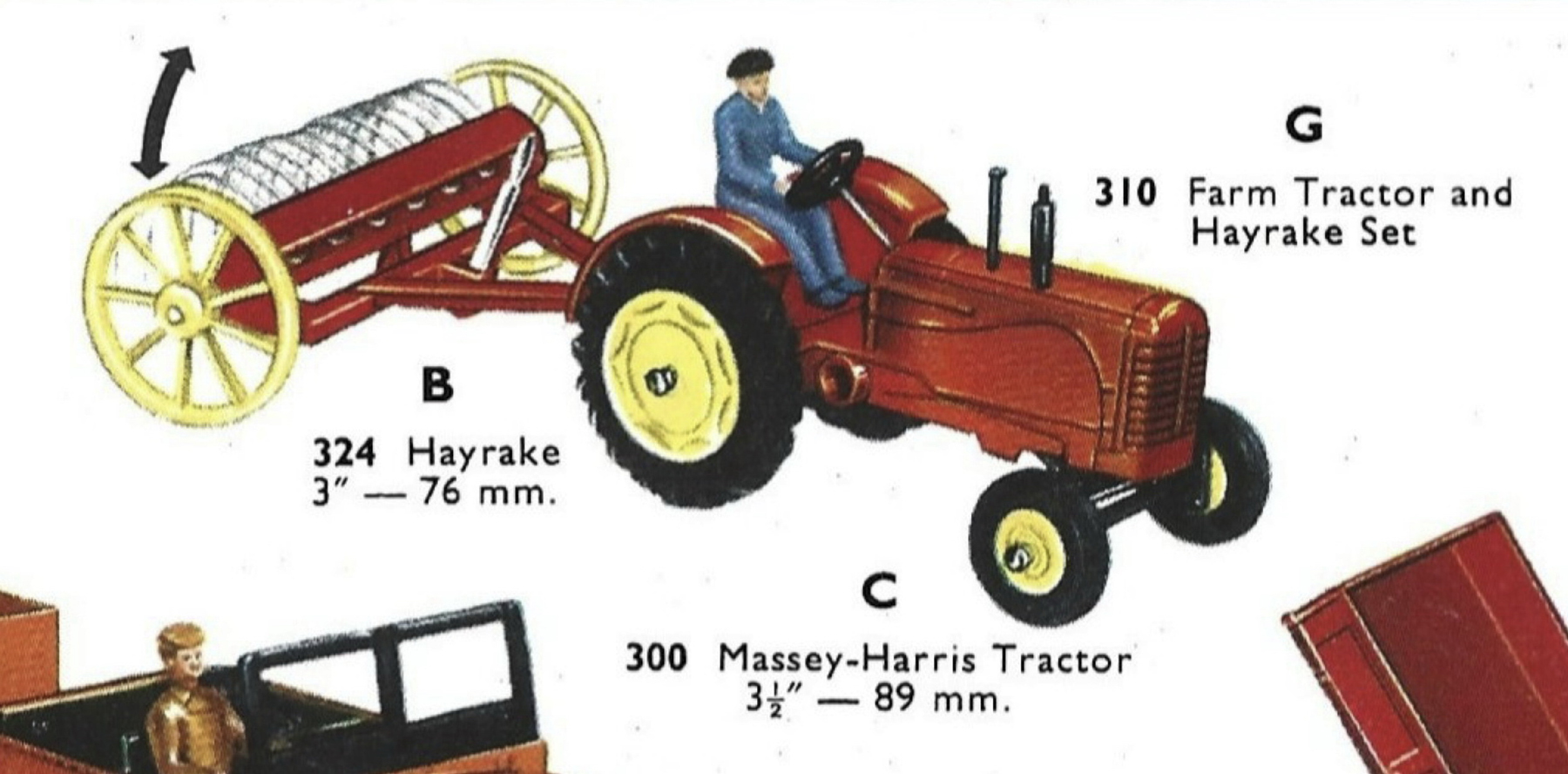
27AK (310) Farm Tractor and Hay Rake — March 1953–1965
27B (320) Halesowen Harvest Trailer — June 1949–1971
27N (301) Field Marshall Farm Tractor — October 1953–1966
30N (343) Farm Produce Wagon — May 1950–1964
The Massey-Harris Tractor
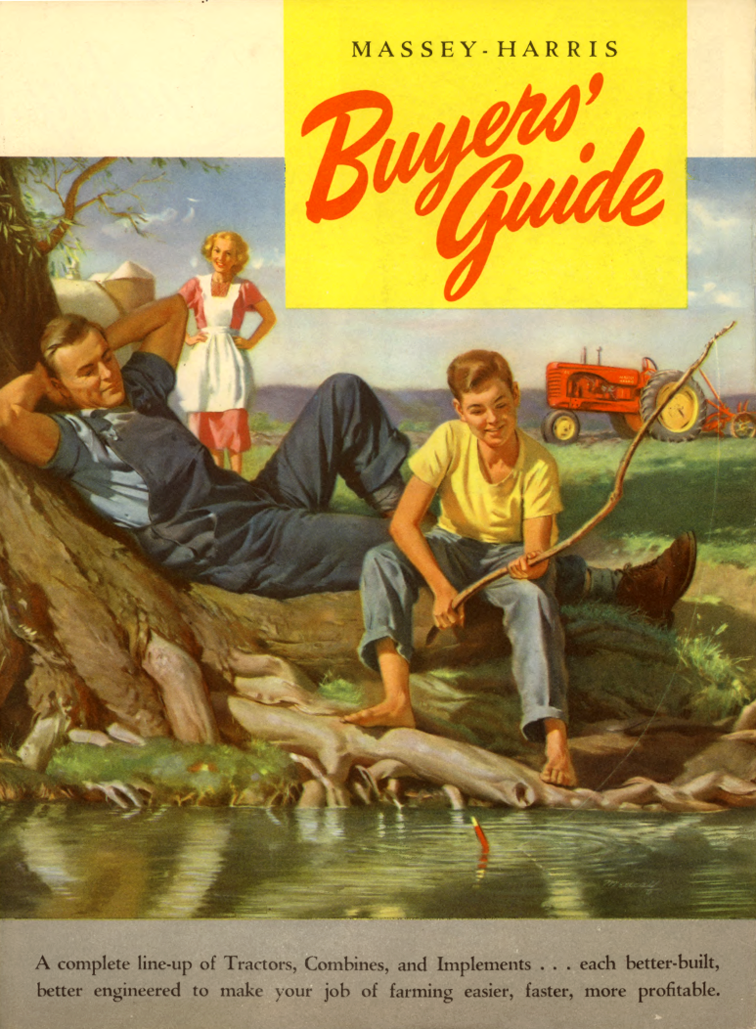
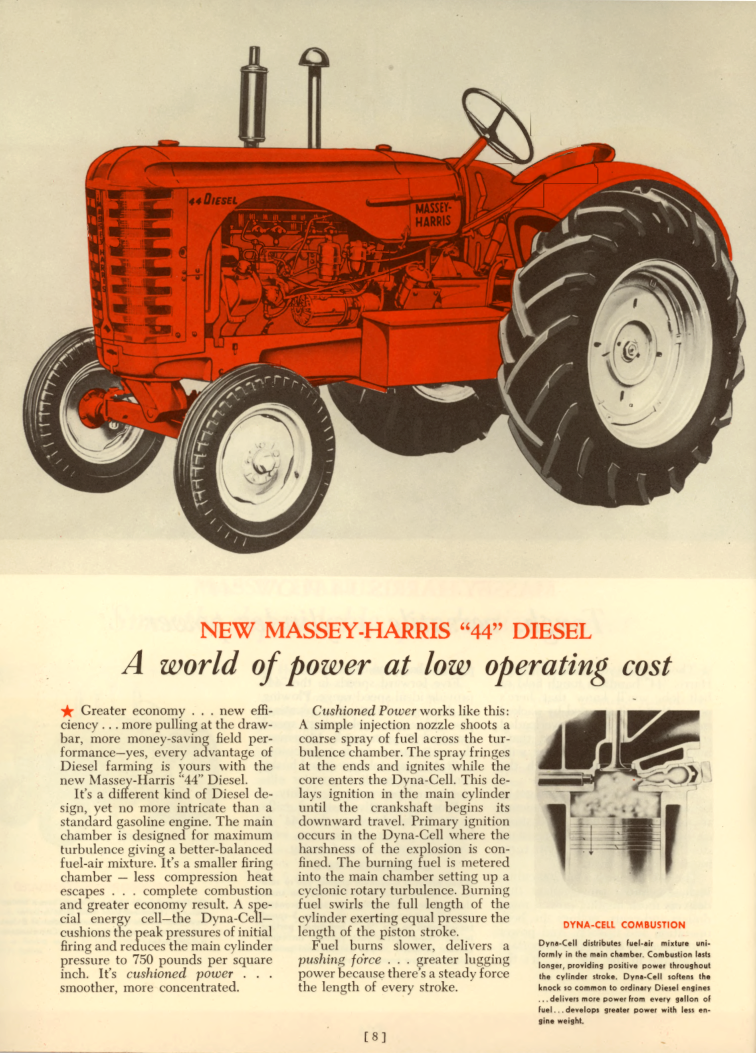
Cover and page from circa 1948 Massey-Harris Buyers’ Guide showing the Massey-Harris 44 tractor.
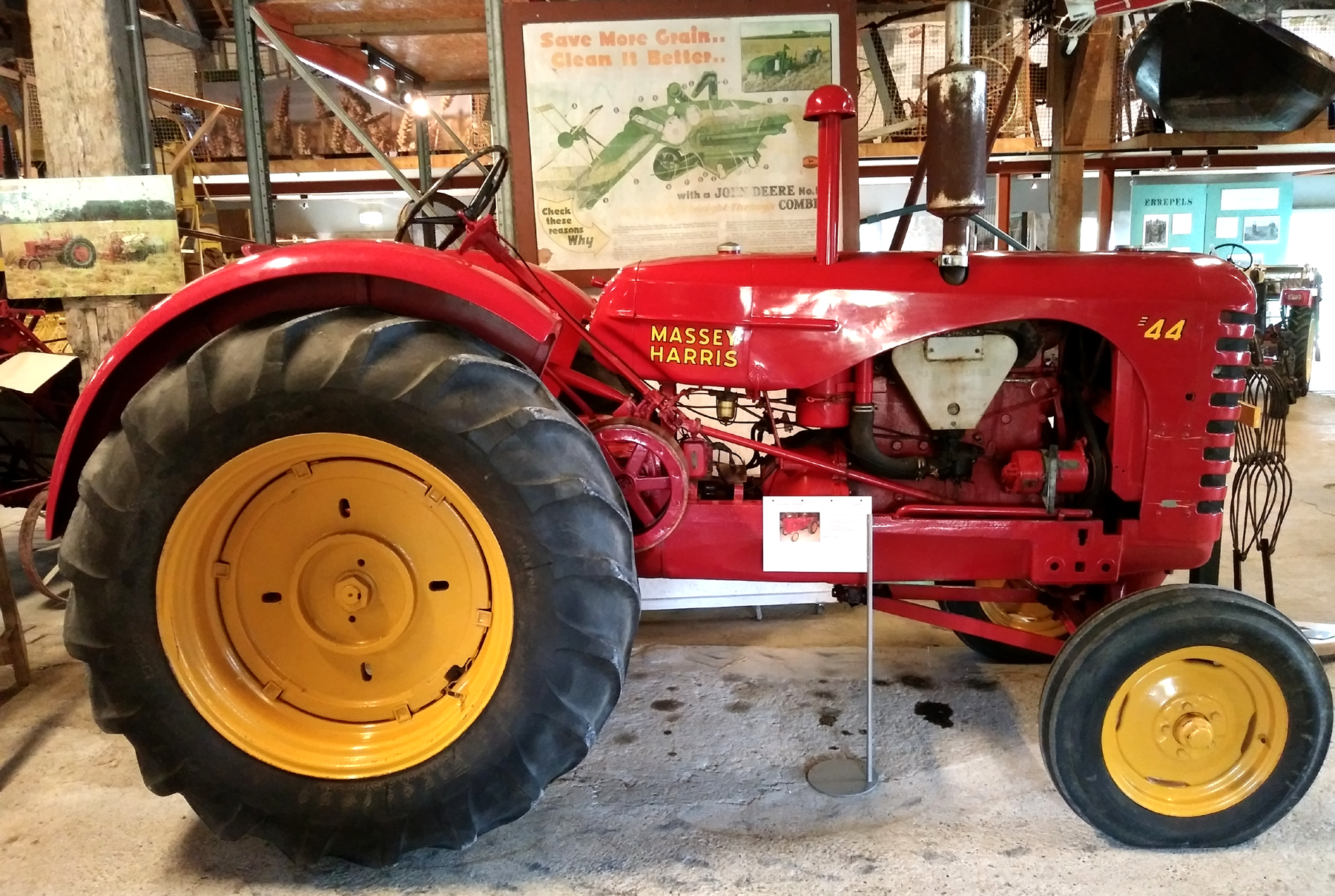
The Massey-Harris 44 in the Landbouwmuseum Tiengemeten.
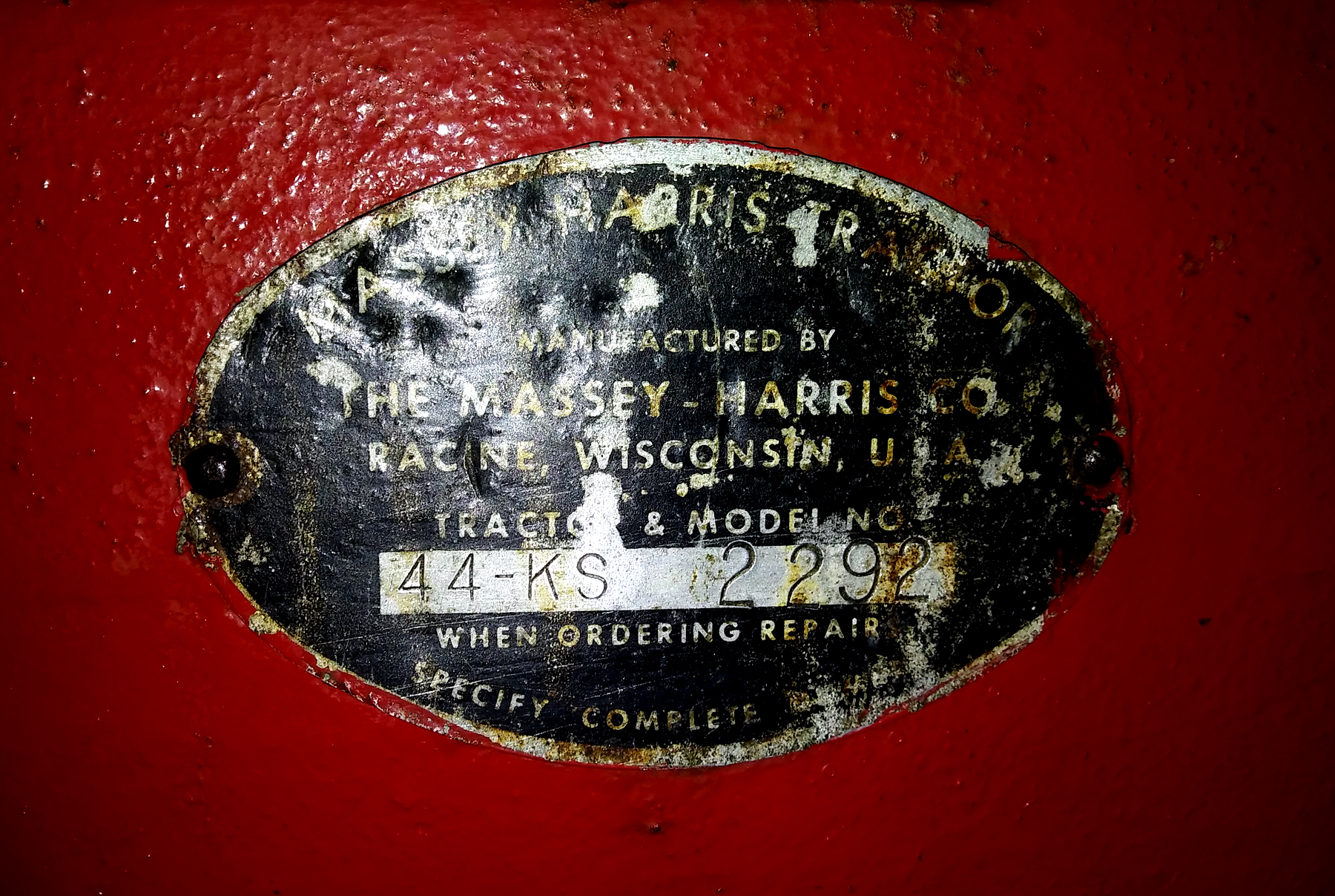
The model number of the Massey-Harris 44 showing the KS suffix.
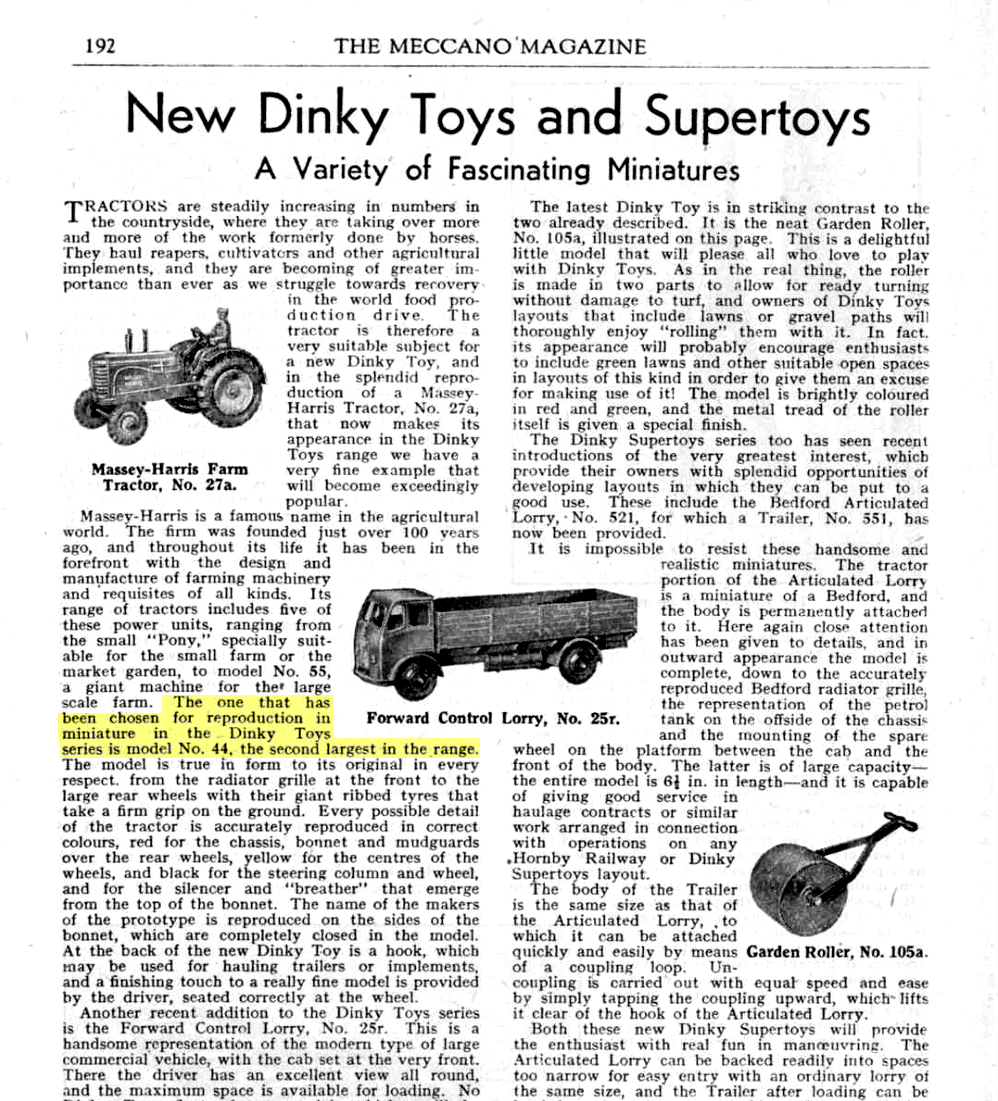
According to the 1948 issue of Meccano Magazine, the prototype of the Dinky 27A is the Massey-Harris 44 tractor that was produced in Racine, Wisconsin (USA) from 1946 to 1953. This tractor is the model 44 KS (K = kerosene, S = standard) that was introduced in 1948 and is exhibited in the Landbouwmuseum Tiengemeten, an agricultural museum in Tiengemeten in the Netherlands. It was financed by the Marshall Plan of 1948 to rebuild the economy of Western Europe that was severely damaged during WW II.
The engine is a kerosene version. Although the tractor starts on gasoline, it needs to be switched over to kerosene or distillate (called petroleum in the Netherlands) when the engine warms up. At the time, kerosene (petroleum) was the cheapest fuel in the Netherlands. This is for clarification, as the brochure shows a picture of a Massey-Harris 44 Diesel. The brochure does show the same model as the one in the museum, but with a different engine.
It’s a pity that Meccano Liverpool chose to produce a closed engine compartment for its Massey-Harris tractor model, rendering the engine’s contours invisible. Later, an open engine compartment was reproduced for the Dinky 305 David Brown Tractor (1965–1975) and the Dinky 308 Leyland 384 Tractor (1971–1979).
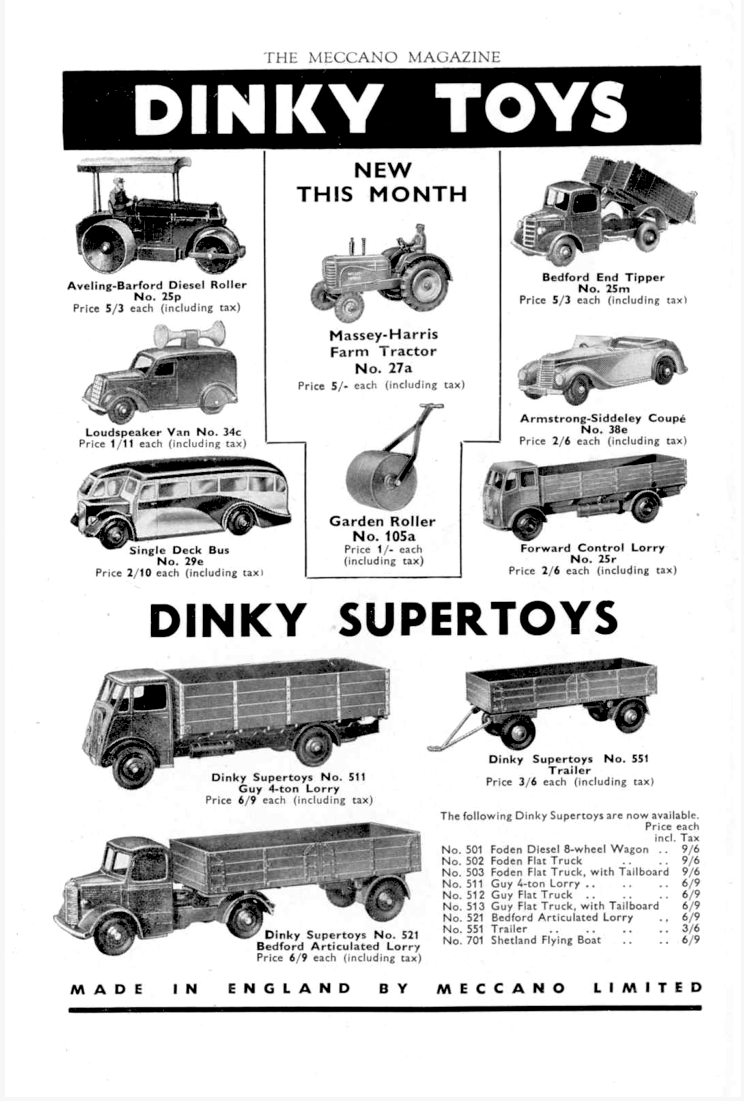
The Dinky 27A Massey-Harris Farm Tractor introduced in the June 1948 issue of Meccano Magazine.
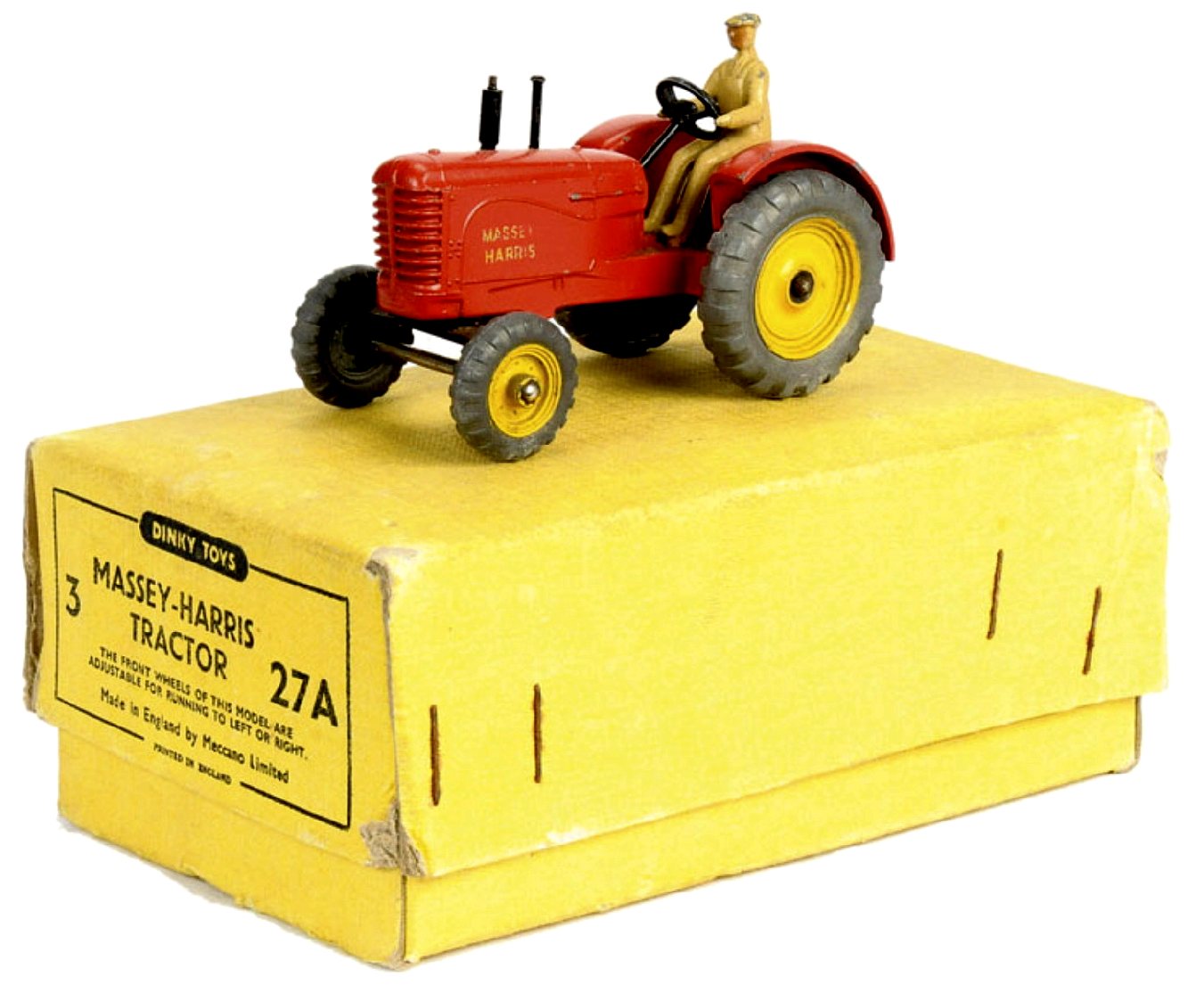
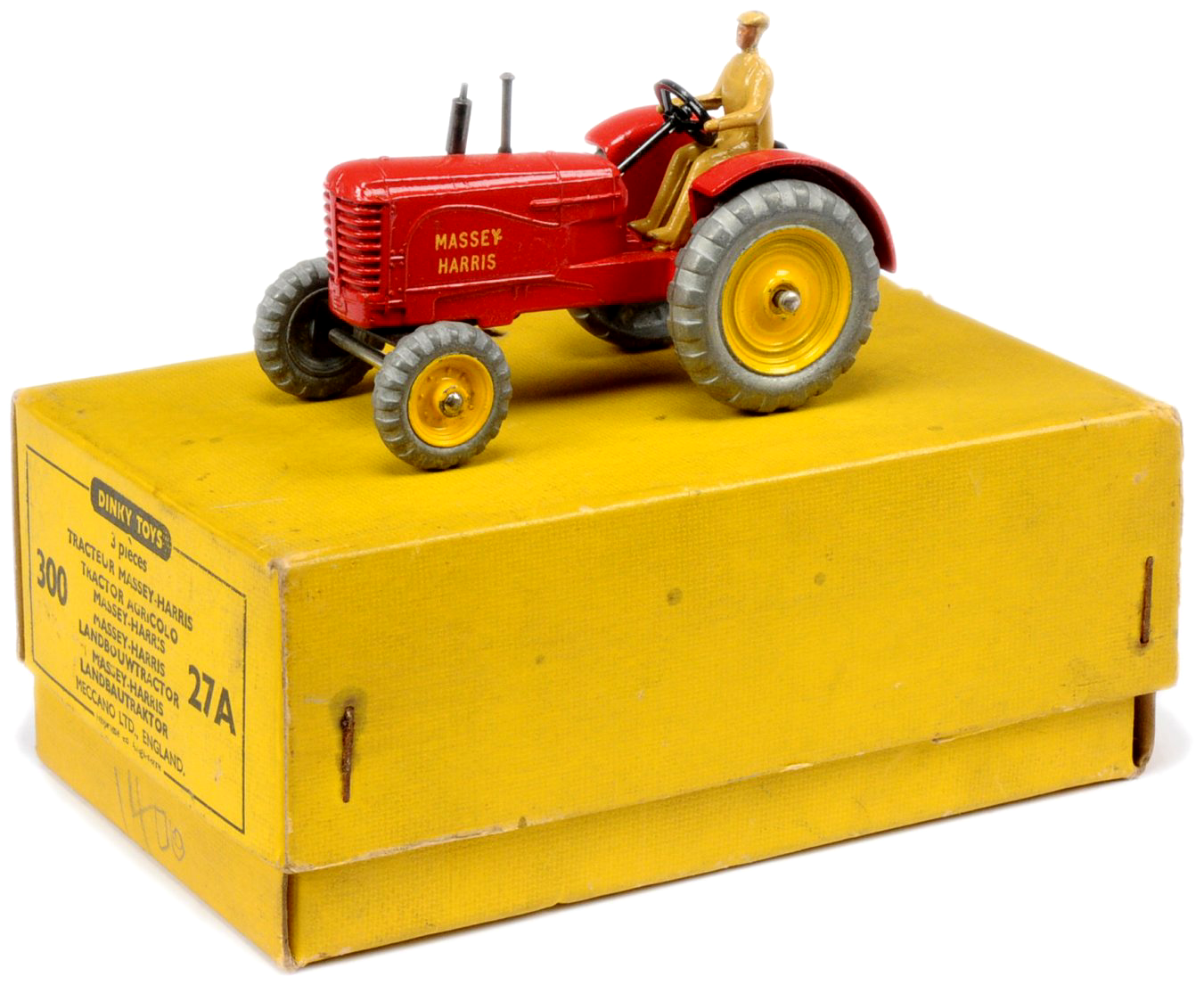
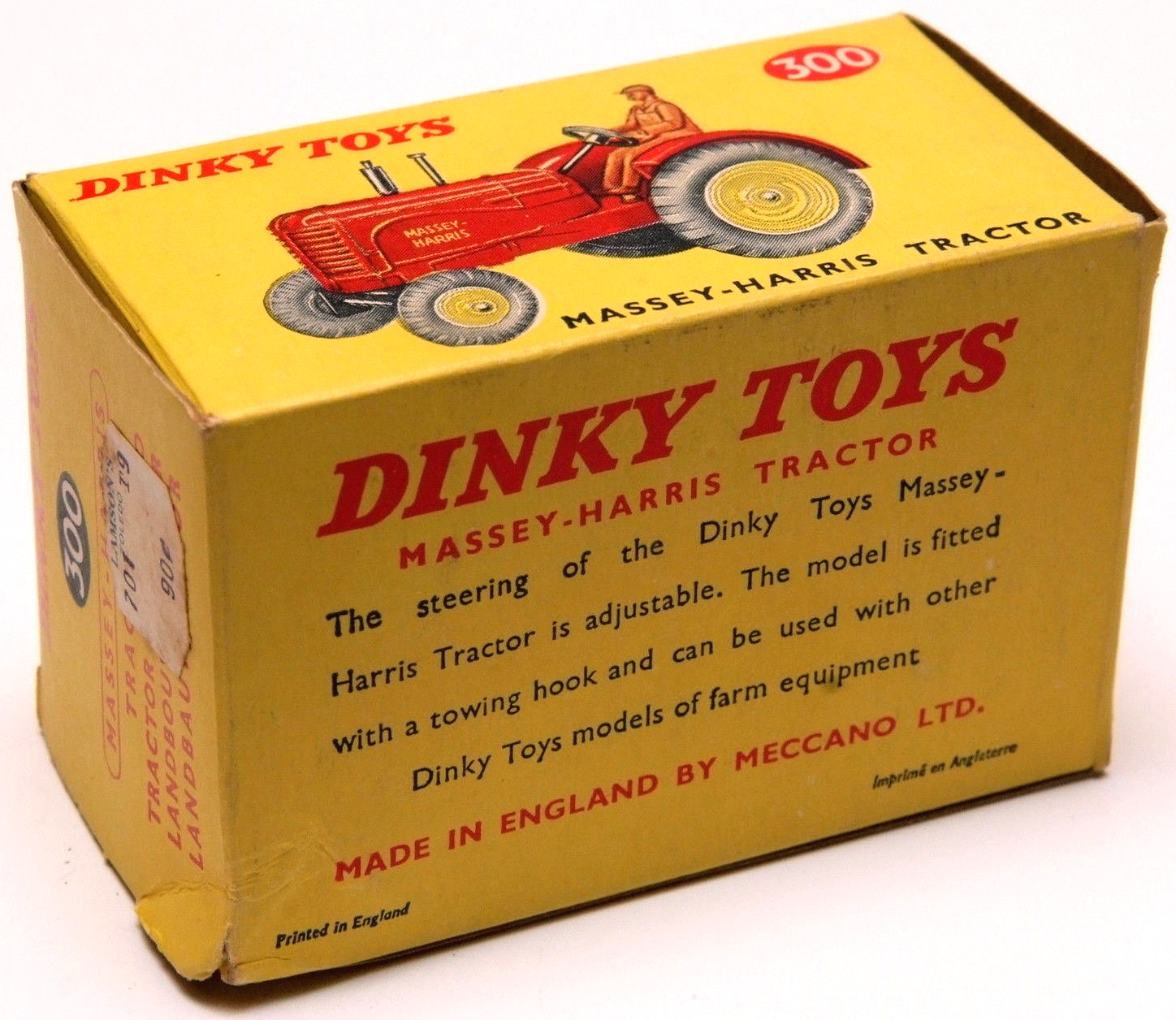
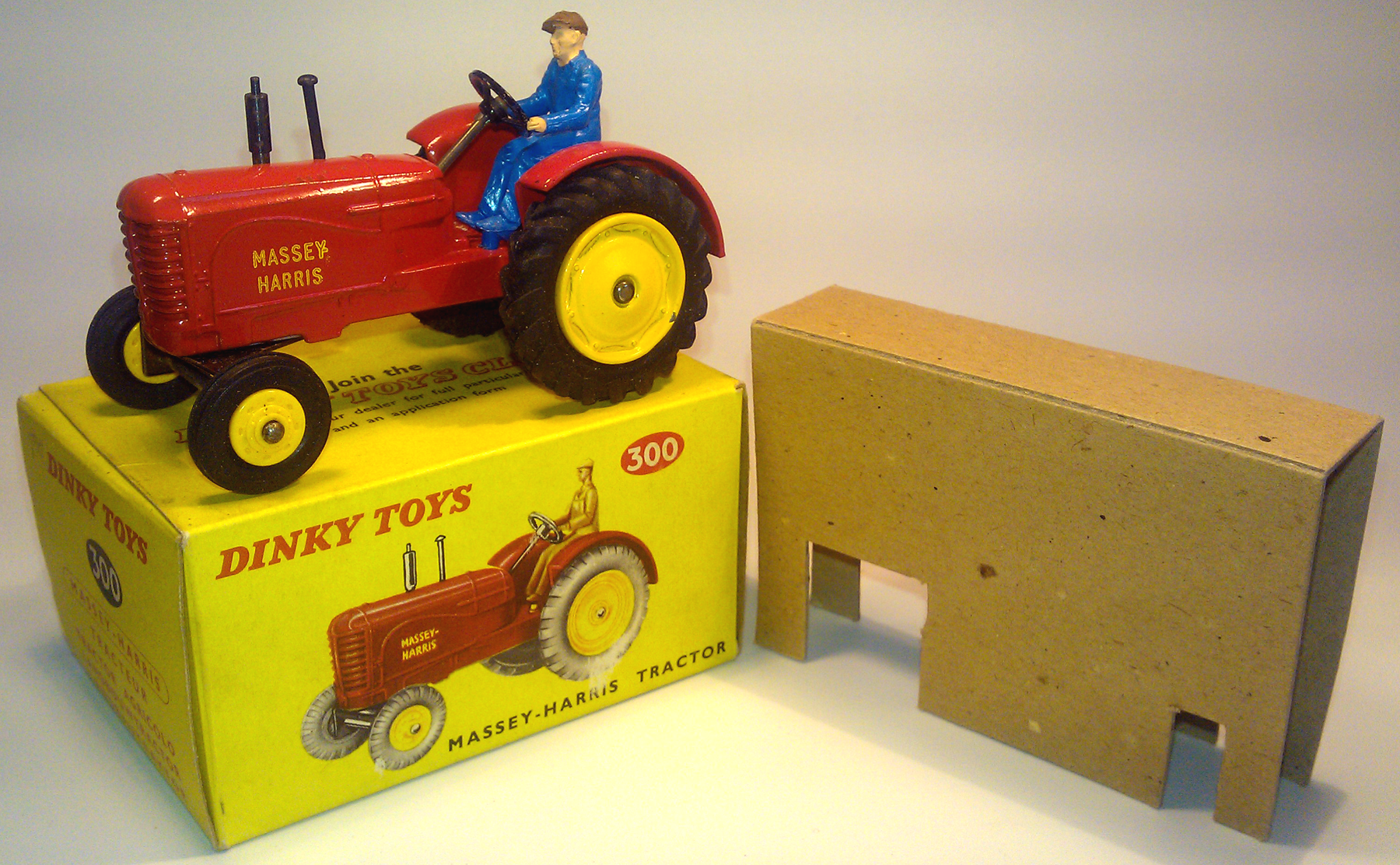
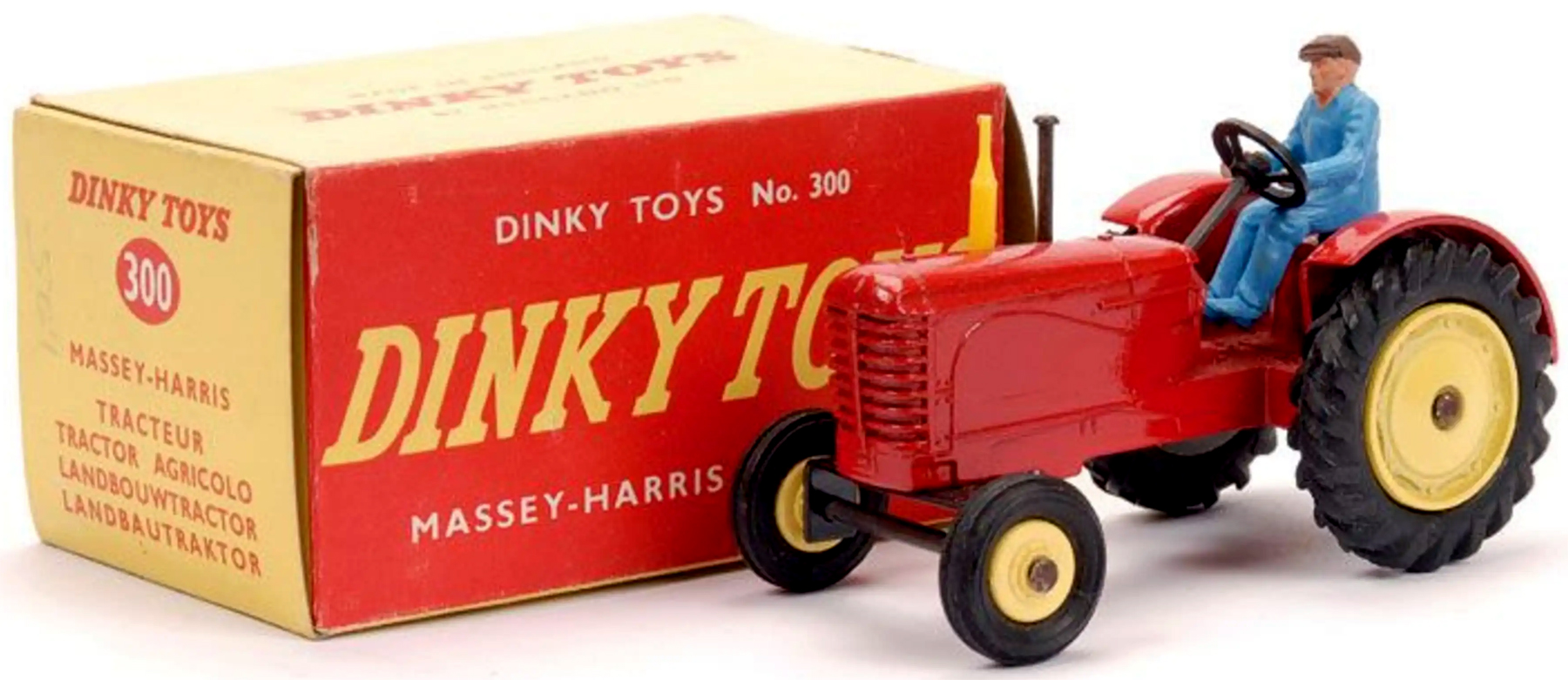
Trade boxes of the Dinky 27A and Dinky 300 Massey-Harris Farm Tractor. Images: Vectis Auctions
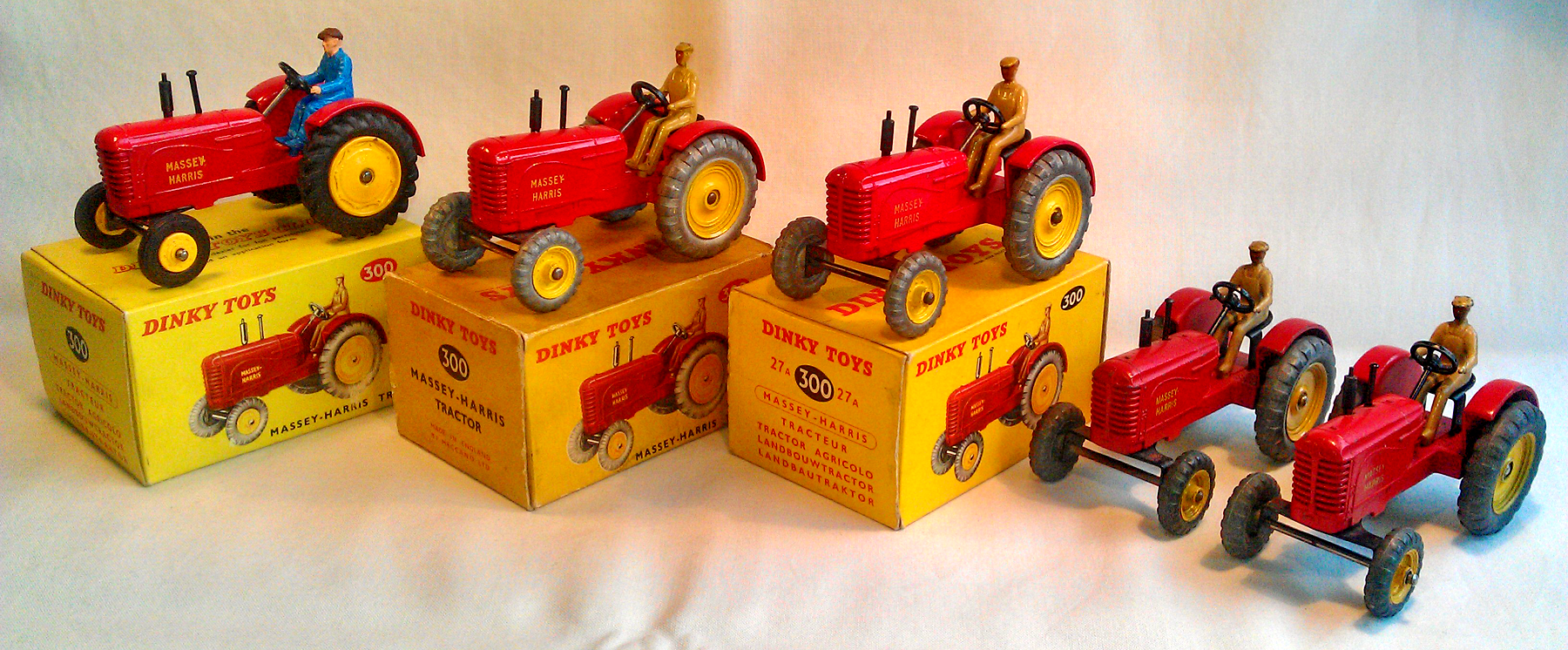
My collection of Dinky Toys Massey-Harris Farm Tractors.
The steering of the Dinky Toys Massey-Harris Tractor is adjustable.
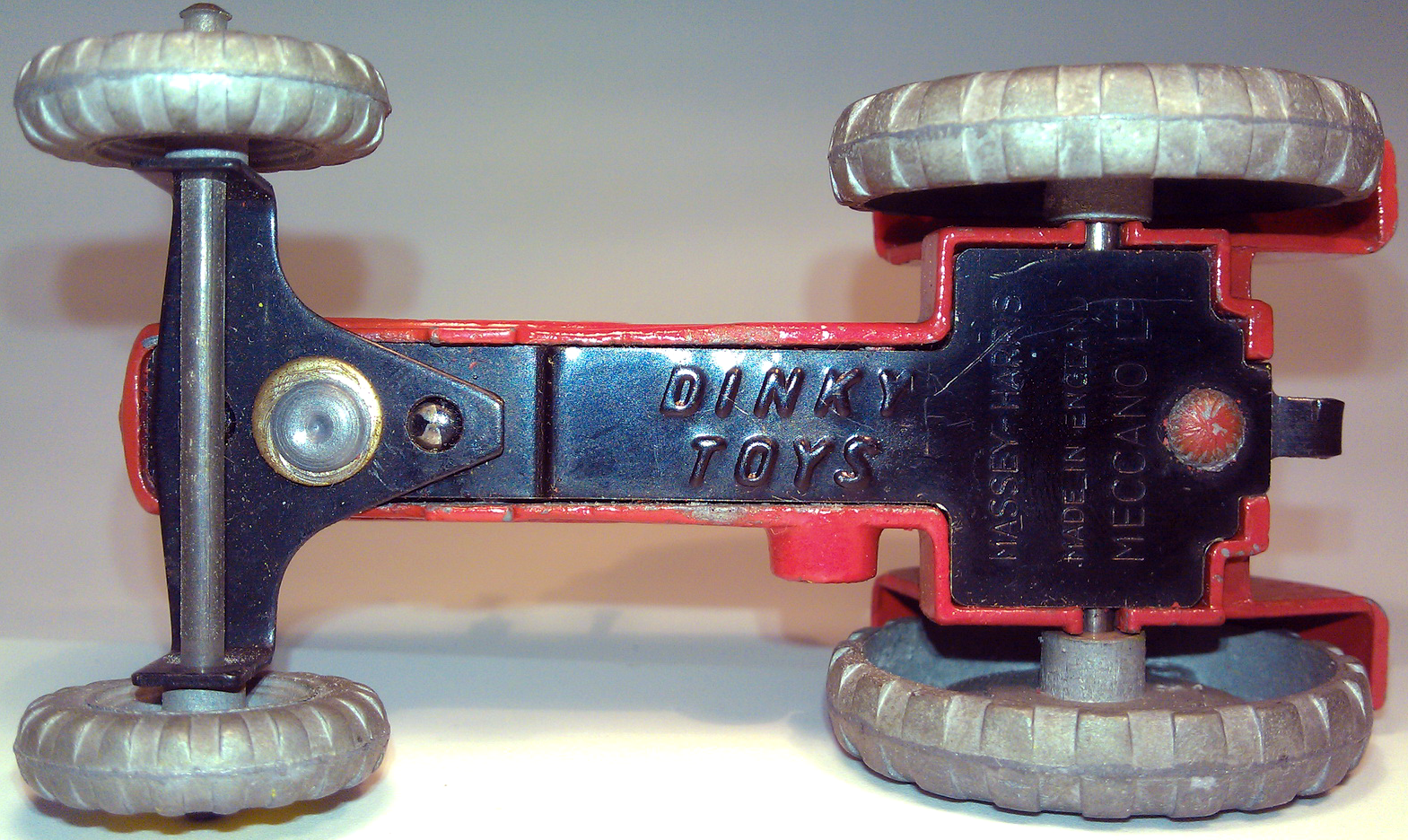
The baseplate of the Massey-Harris Tractor showing the adjustable front steering.
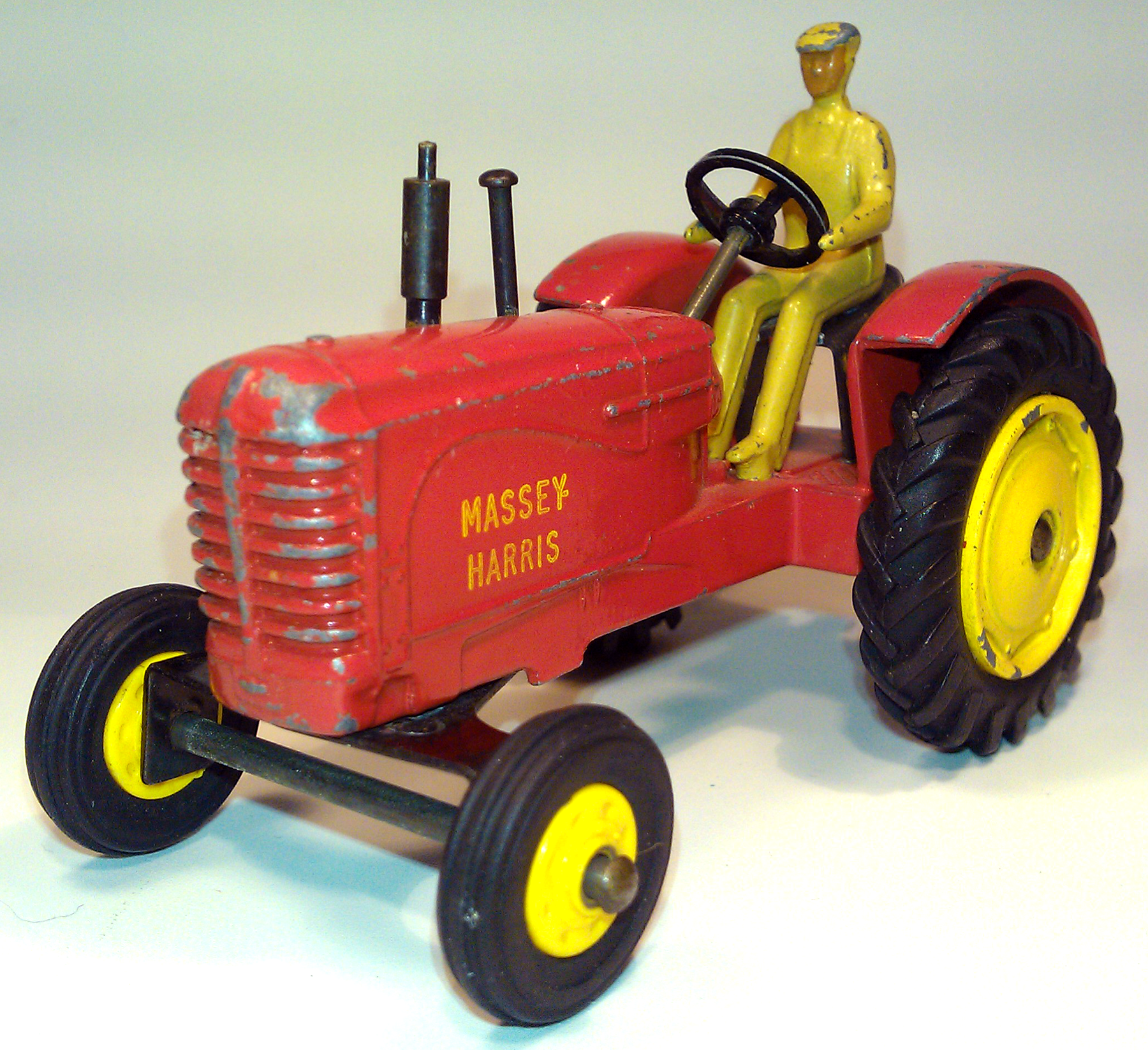
The first version of the Dinky 27A Massey-Harris Tractor.
The general characteristics of the Massey Harris tractor are:
red closed body
grey metal wheels with yellow hubs
black metal exhaust and air pipe
tan cast driver on open black metal chair
metal towing hook
adjustable front steering
“Massey-Harris” brand name in yellow on either side. Note the driver’s left foot which is secured with a plug in a hole in the chassis.
In 1962, production of the Dinky Toys Massey-Harris Tractor switched to using black rubber tires with a different tread pattern.
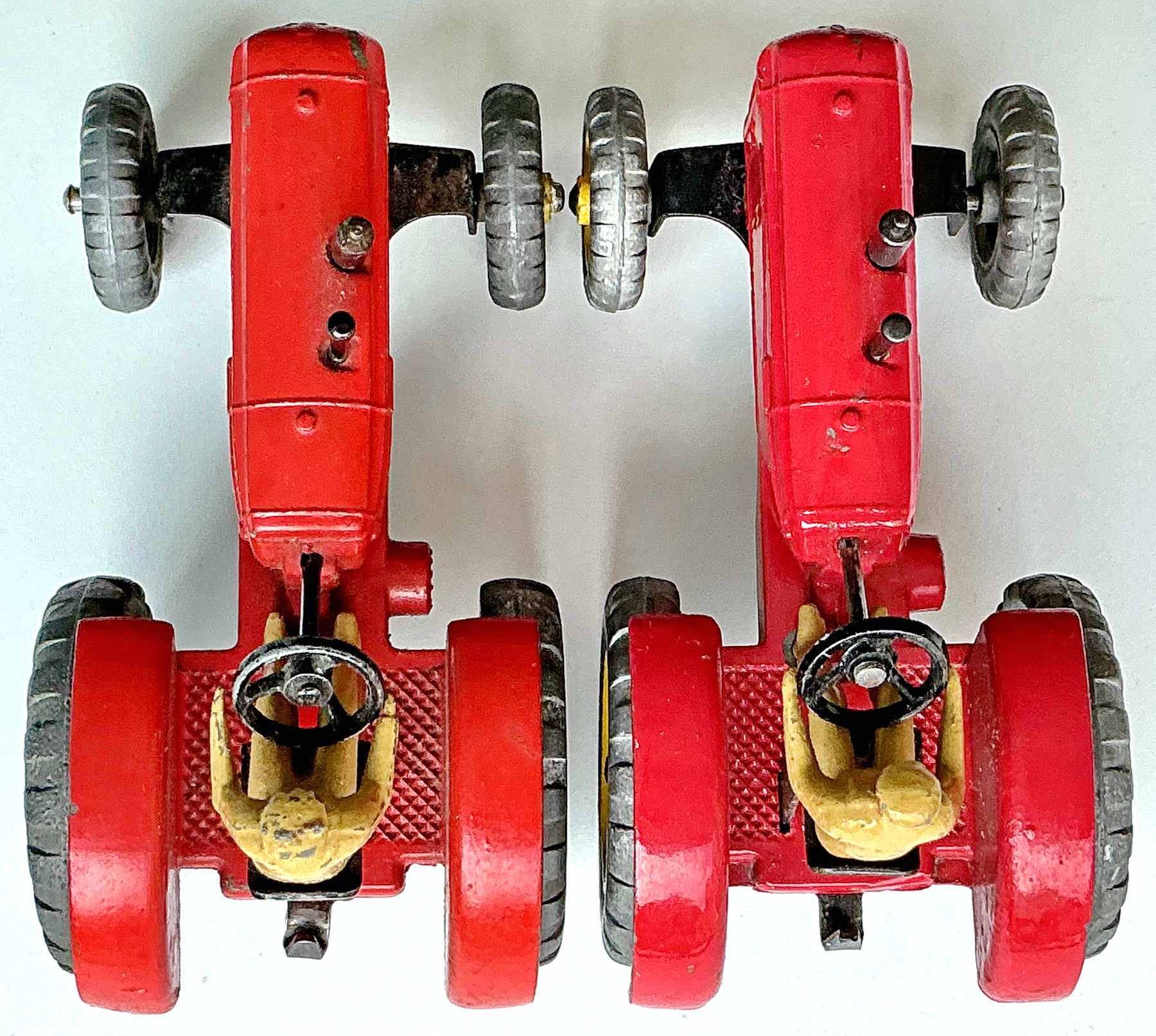
L: First version of the Dinky 27A with black steering wheel and steering rod. R: Second version with black steering wheel and chrome steering rod.
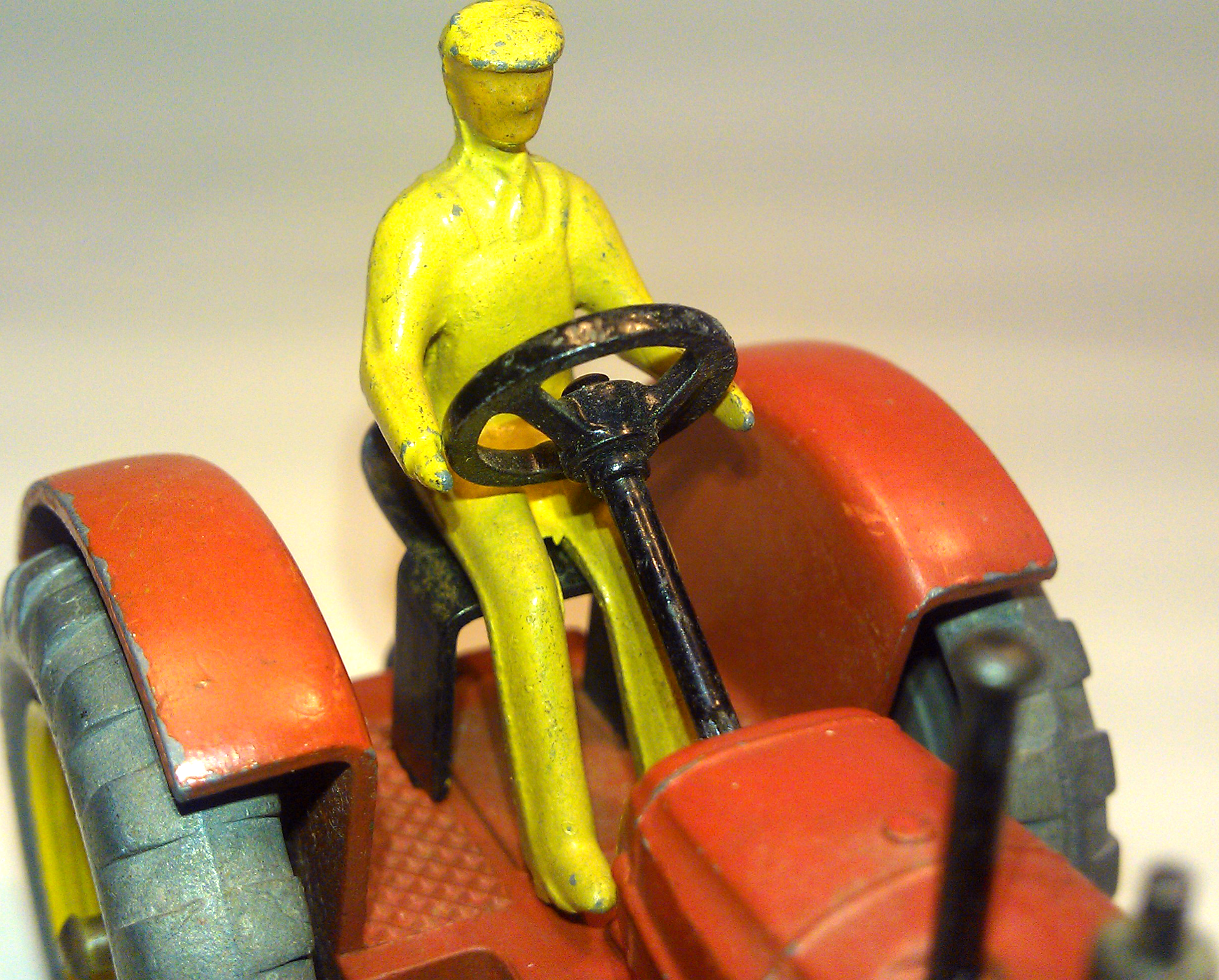
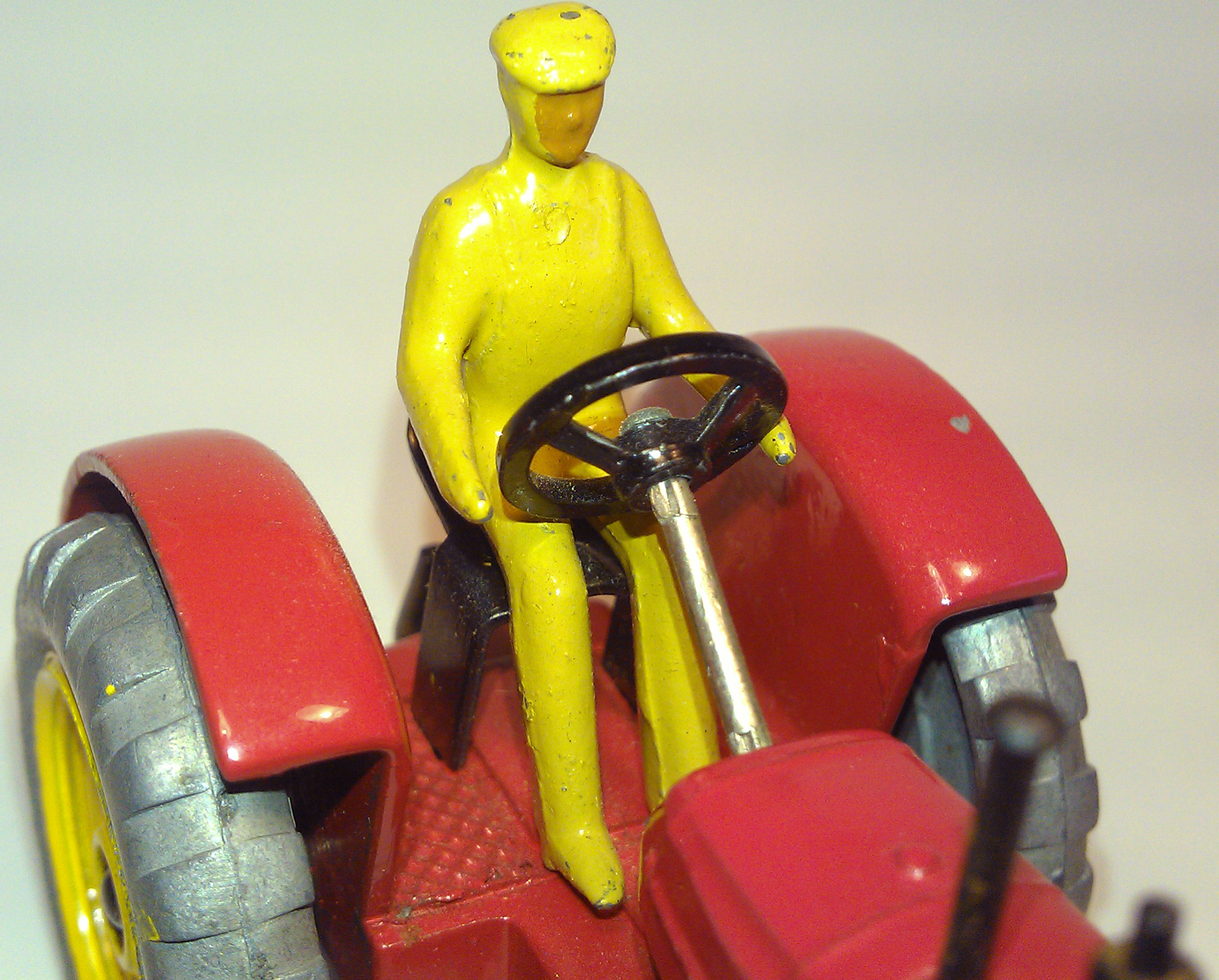
A first version 27A can be recognized by the absence of reinforcement on either side of the rear platform between the platform (above the tow hook) and the mudguards, together with a black steering wheel with a black steering rod. Only the earliest versions have these characteristics. This is clearly visible in the pictures above. On the left is an early version 27A without reinforcement and on the right, a second version 27A with reinforcement.
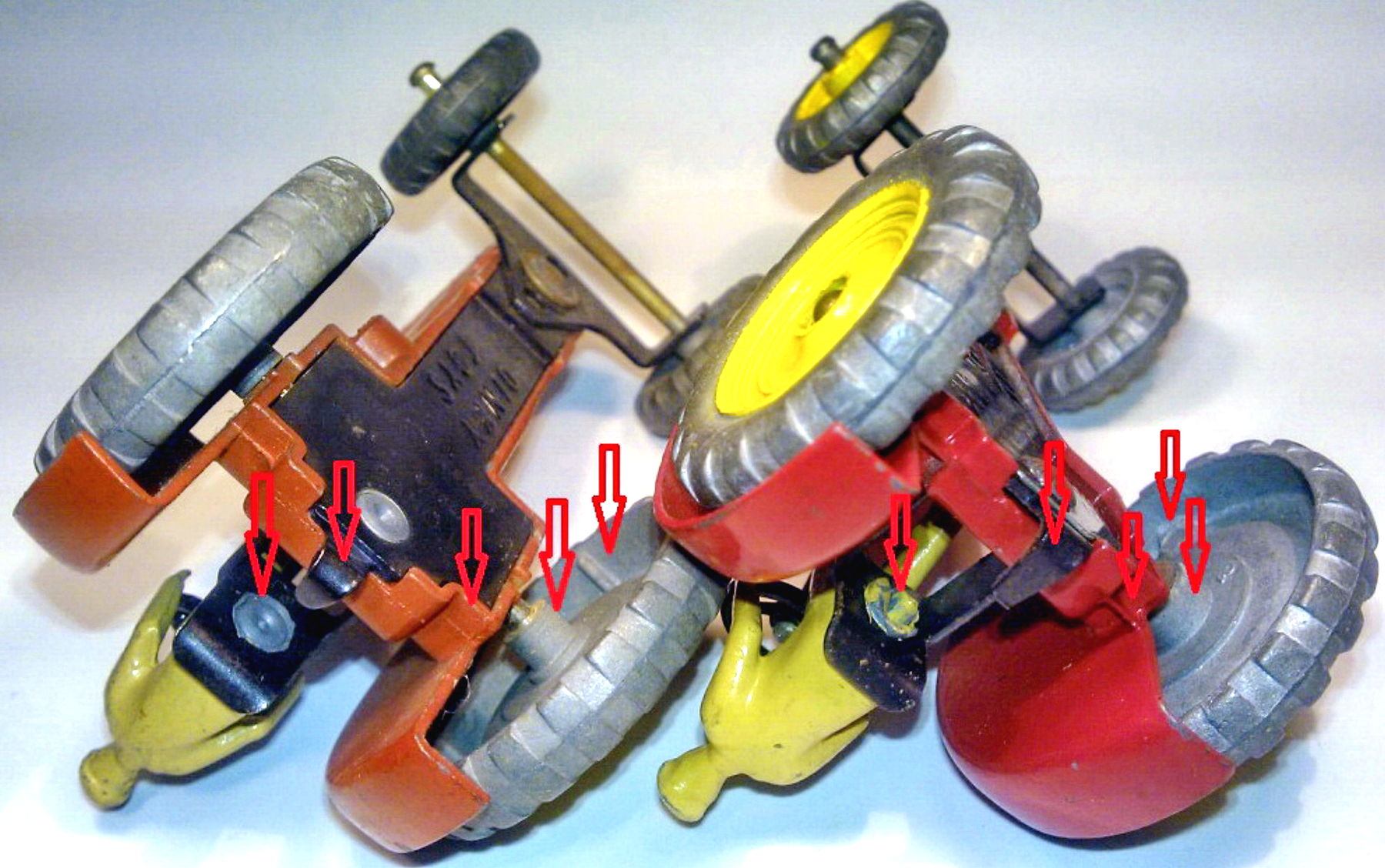
Casting differences between the first version (L) and second version ®, indicated by red arrows.
The casting differences are:
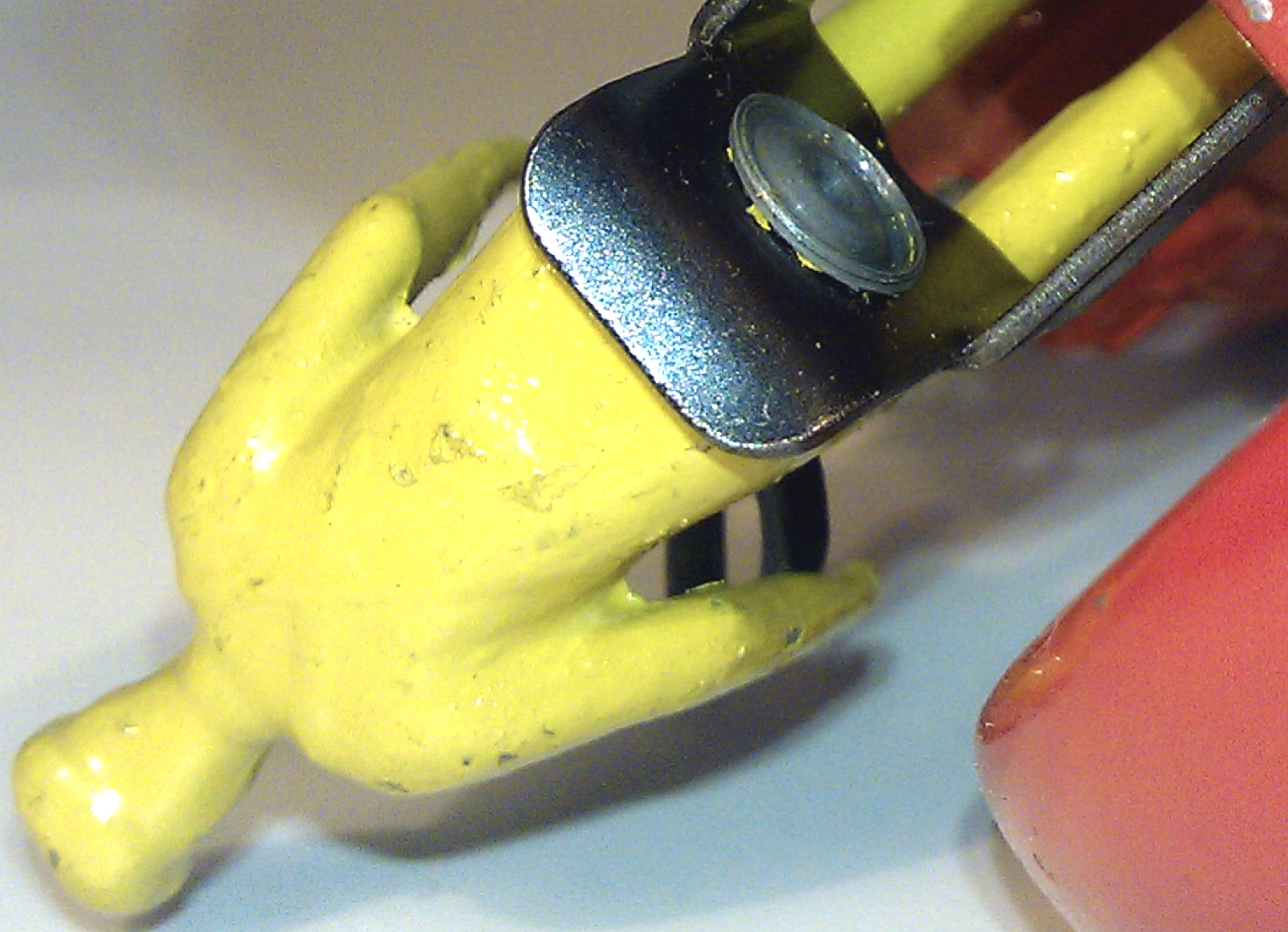
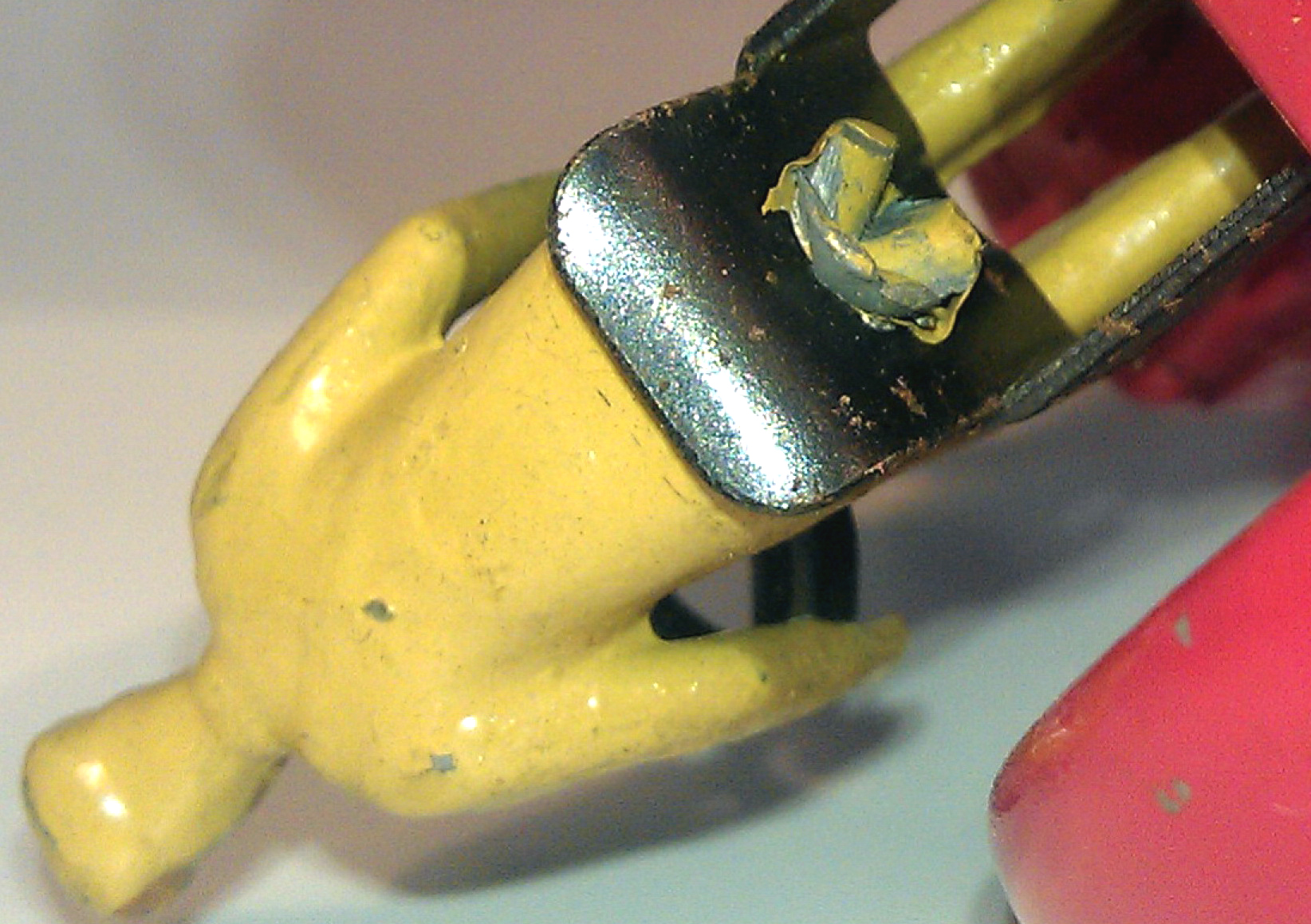
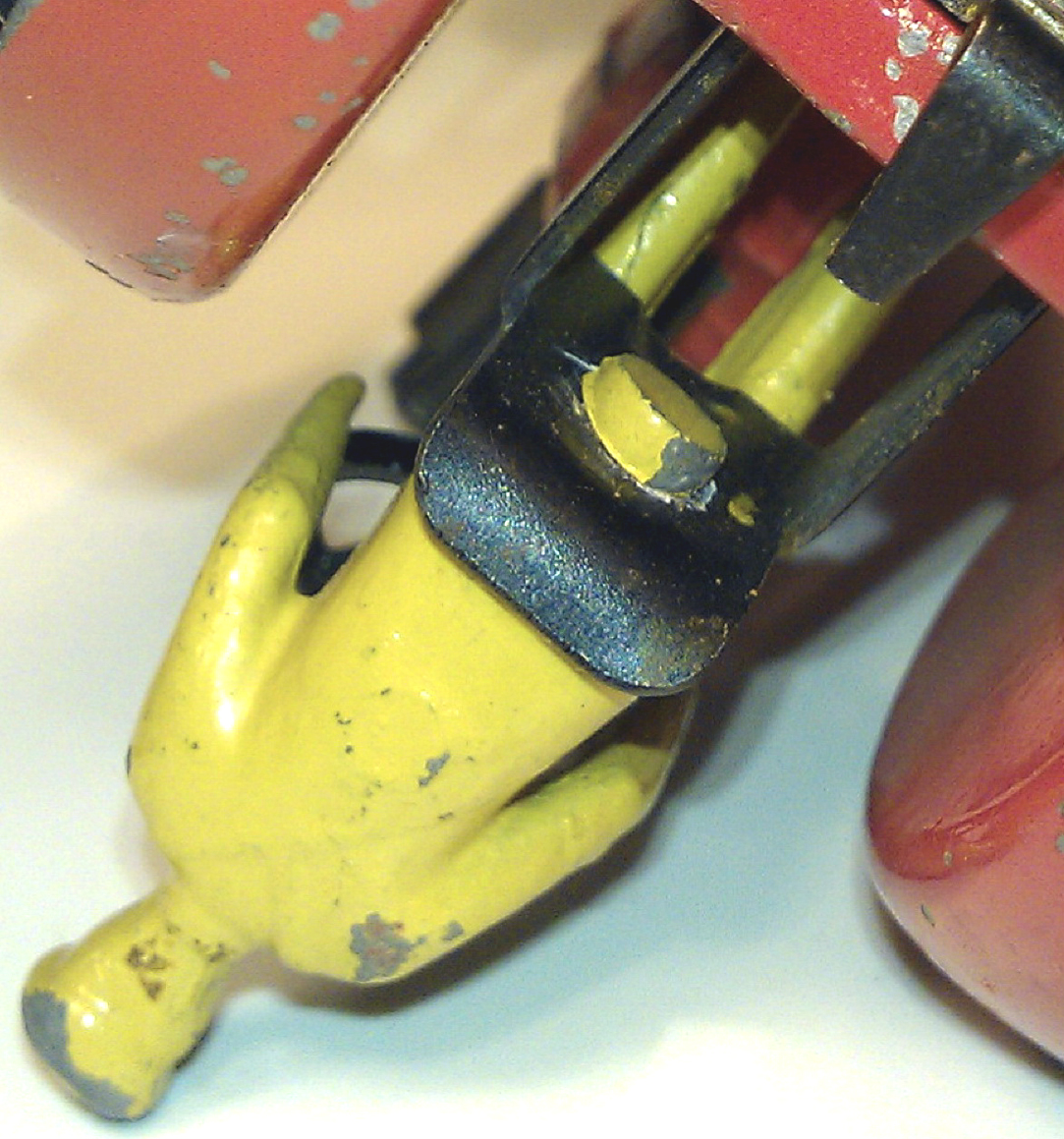
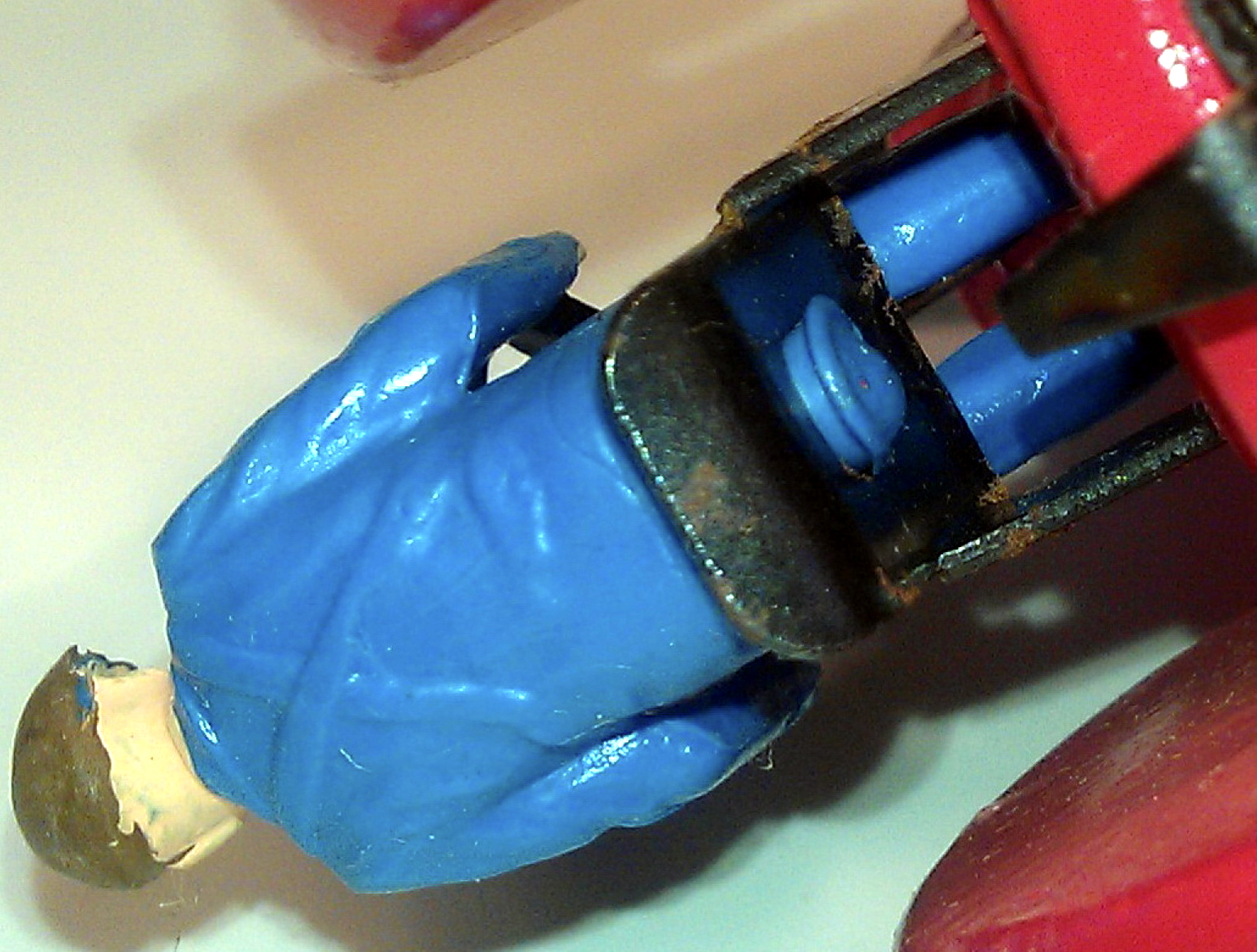
Left: driver attached to seat with rivet. Right: driver attached to the seat with crossed plug.
Left: small tow bar. Right: large tow bar.
Left: no reinforcement on both sides of platform. Right: reinforcement on both sides of platform.
A better view of the differences in wheel hubs. R: first version, L: second version.
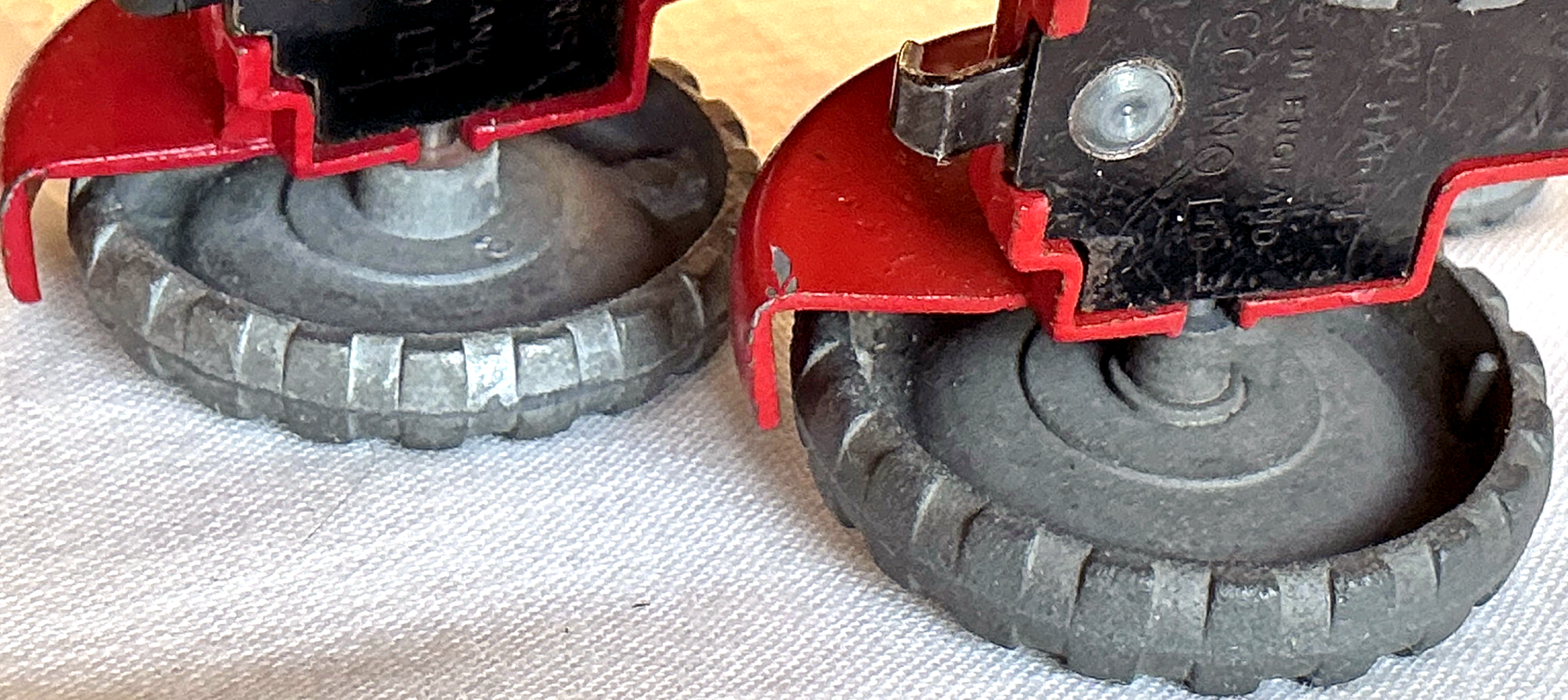
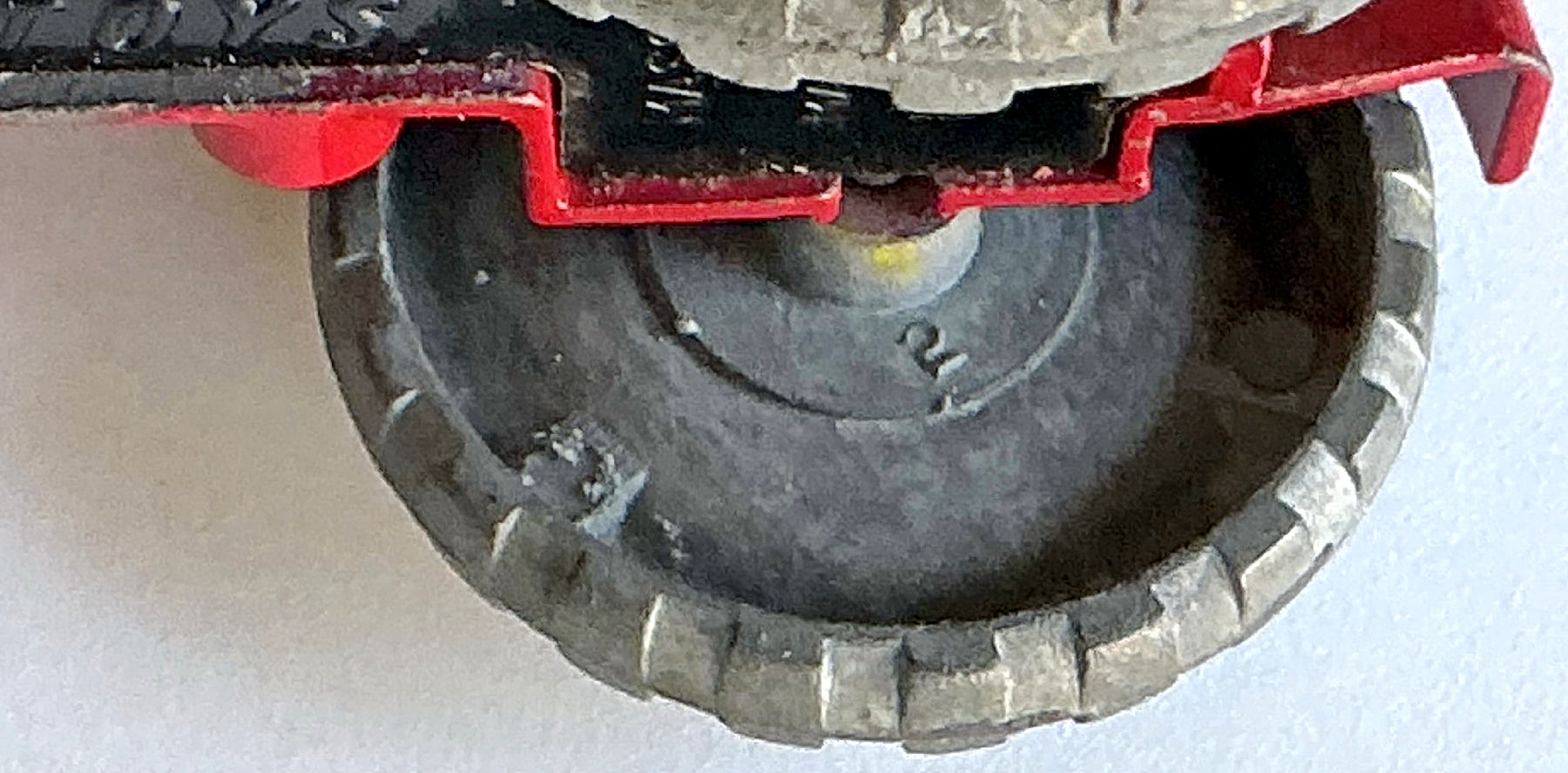
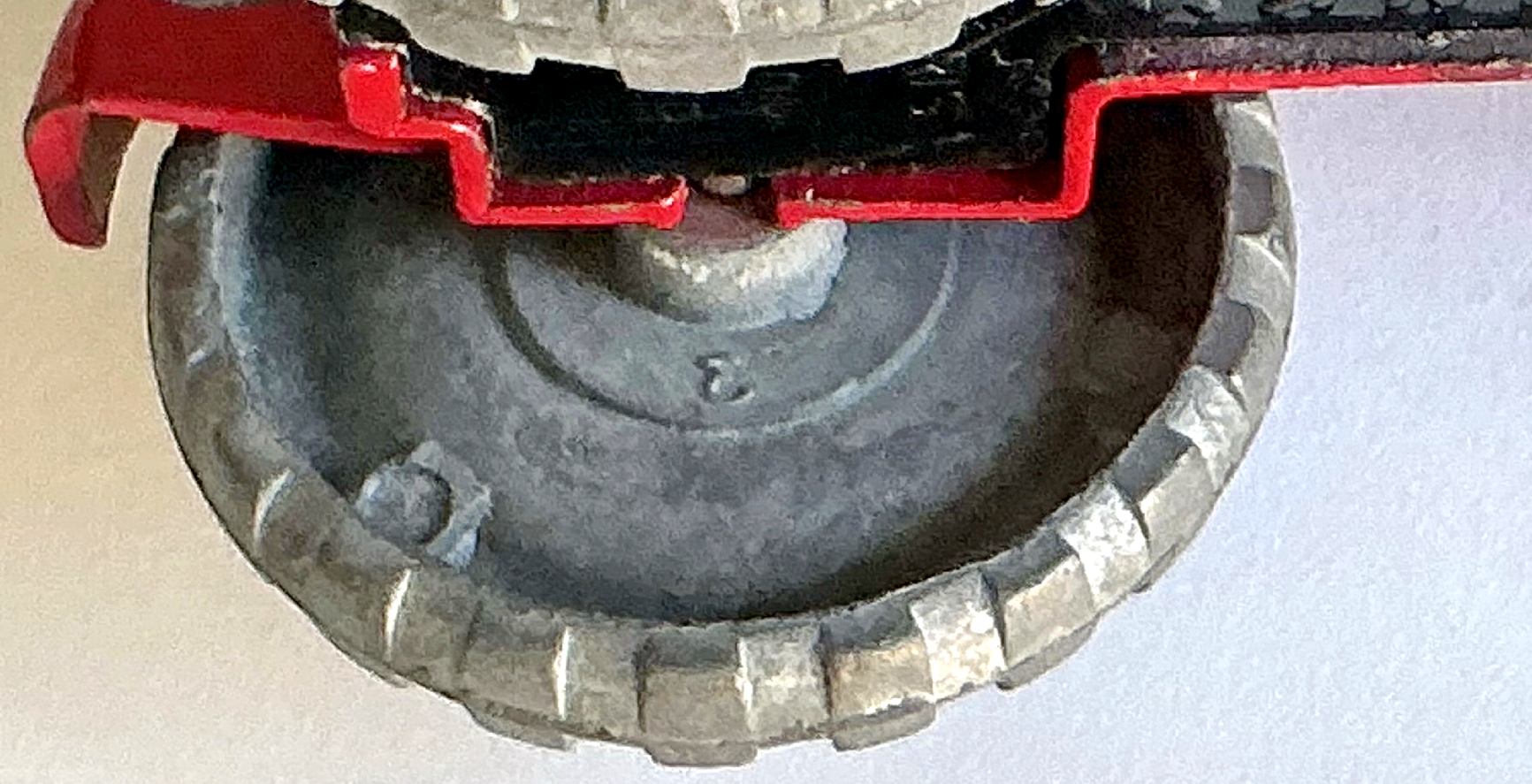
Another peculiarity of the second version of the 27A is that the inside of the rear wheels features a small cast number near the wheel hub. One rear wheel bears the number 2 and the other the number 3 as shown in the pictures below. The first version of the 27A doesn’t have these cast numbers.
Dinky Toys 27A second version rear wheel with cast numbers 2 and 3.
The same numbers are also found on the inside of the rear wheels of Dinky 301 Field Marshall Tractor with grey hubs, but the one with green hubs bears the numbers 1 and 4. Perhaps there are more such findings, for example with the Dinky 562 Muir-Hill Dumper Truck which shares the wheels of the Dinky 27A.
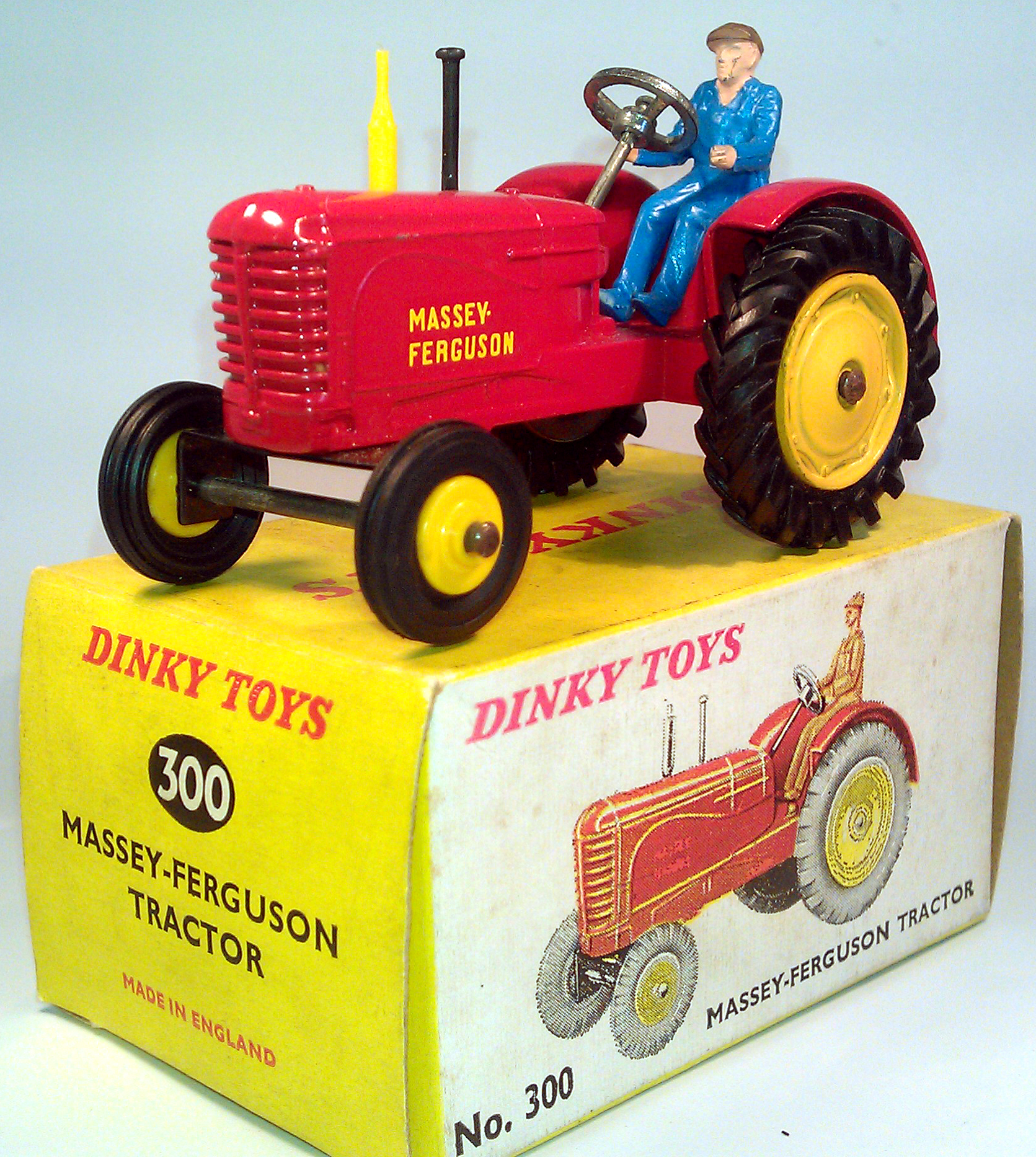
Shown above is the third and last version of the Dinky Massey-Harris Tractor with the “Massey-Harris” brand name on the model, black rubber tires, a blue plastic driver on an open black metal chair and black metal exhaust and air pipe, in a Dinky 300 Massey-Harris picture box with inner packaging.
The Switch from Massey-Harris to Massey-Ferguson
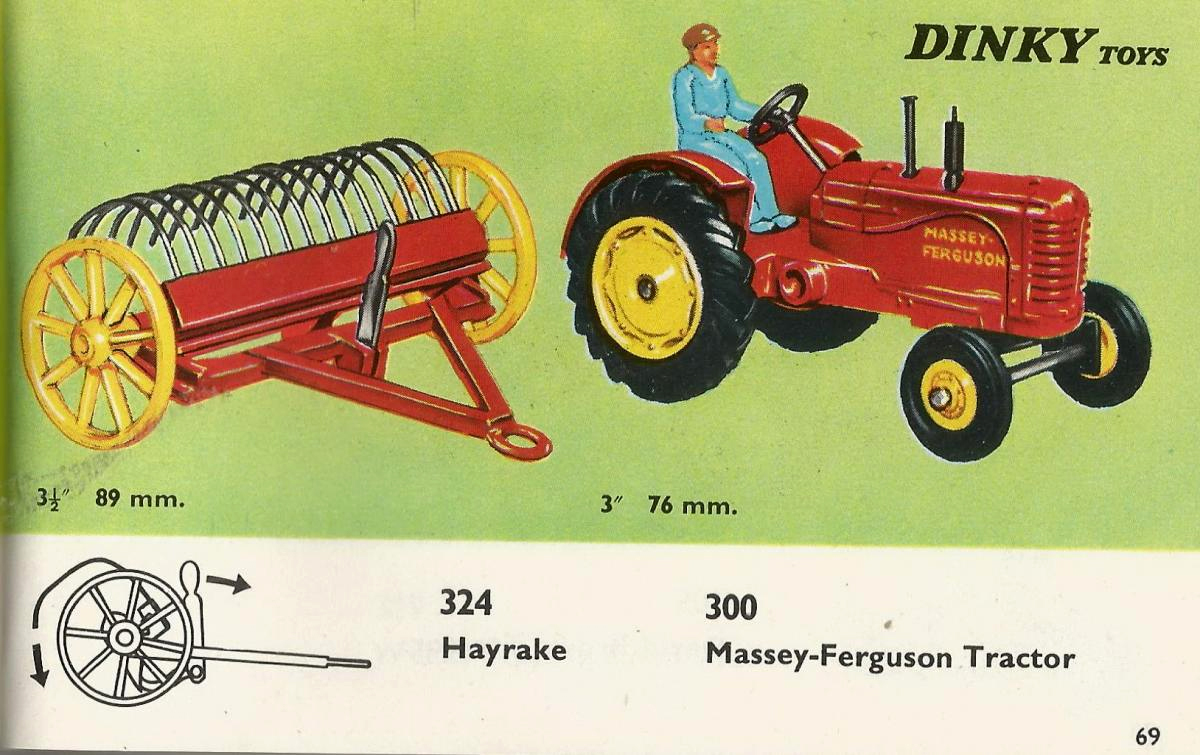
The change of the brand name Massey-Harris to Massey-Ferguson on the models is quite remarkable. According to The Great Book of Dinky Toys (page 83), the Massey-Harris tractor brand name changed to Massey-Ferguson in 1966. This only affected the brand name designation on the Dinky Toys models. In practice, the merger of Massey-Harris with Ferguson took place in 1953 and continued under the name Massey-Harris-Ferguson. It wasn’t until 1958 that it changed to the current name Massey-Ferguson, but the brand name change in Dinky Toys catalogs and models was not made by Meccano Liverpool until 1966.
The Massey-Harris Tractor brand name was used by Meccano Liverpool up to and including the 1965 catalog. In 1964 and 1965, Massey-Harris tractors were shown in catalogs with the name Massey-Harris Tractor, but without the brand name on the model. Perhaps Meccano Liverpool didn’t yet have permission to use the new brand name Massey-Ferguson and this was not arranged until 1966, when the models and catalogs started appearing with the Massey-Ferguson brand name. During this transitional period 1964–1965, Massey-Harris tractor models were issued without the brand name on the model.
The Massey-Harris Tractor shown in the Dinky Toys 1964 and 1965 catalogs without the brand name on the model.
The 1964–1965 Massey-Harris Tractor without the brand name on a model with black rubber tires, blue plastic driver on cast-in red seat with black steering wheel and yellow plastic exhaust pipe in a plain 300 Massey-Harris box without the model image. Image: Vectis Auctions
The Massey-Ferguson brand name appeared on the model for the first time in the 1966 catalog.
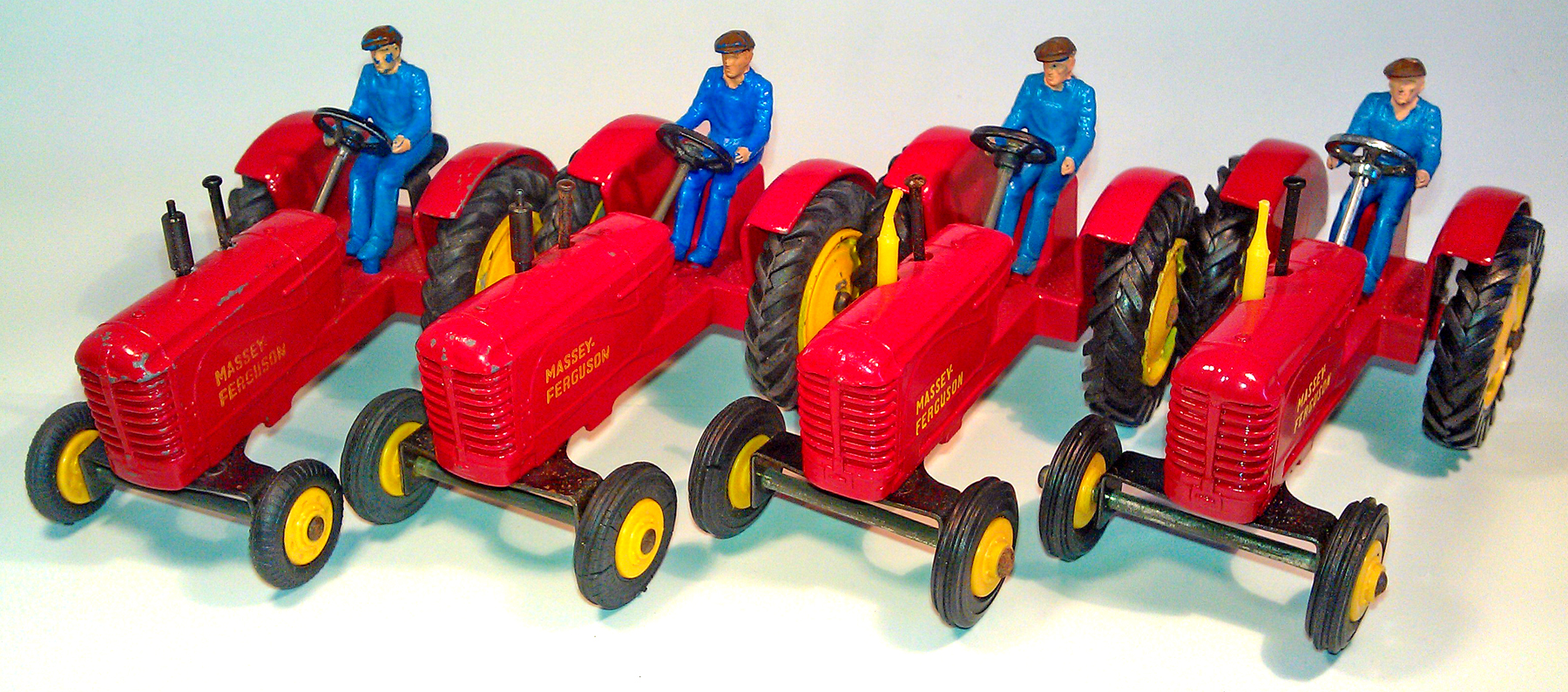
My Massey-Ferguson collection (front view).
My Massey-Ferguson collection shows the change to a cast-in red colored seat and a yellow plastic exhaust pipe. On the far left a driver sits on an open black metal seat. All Massey-Fergusons are fitted with black rubber tires.
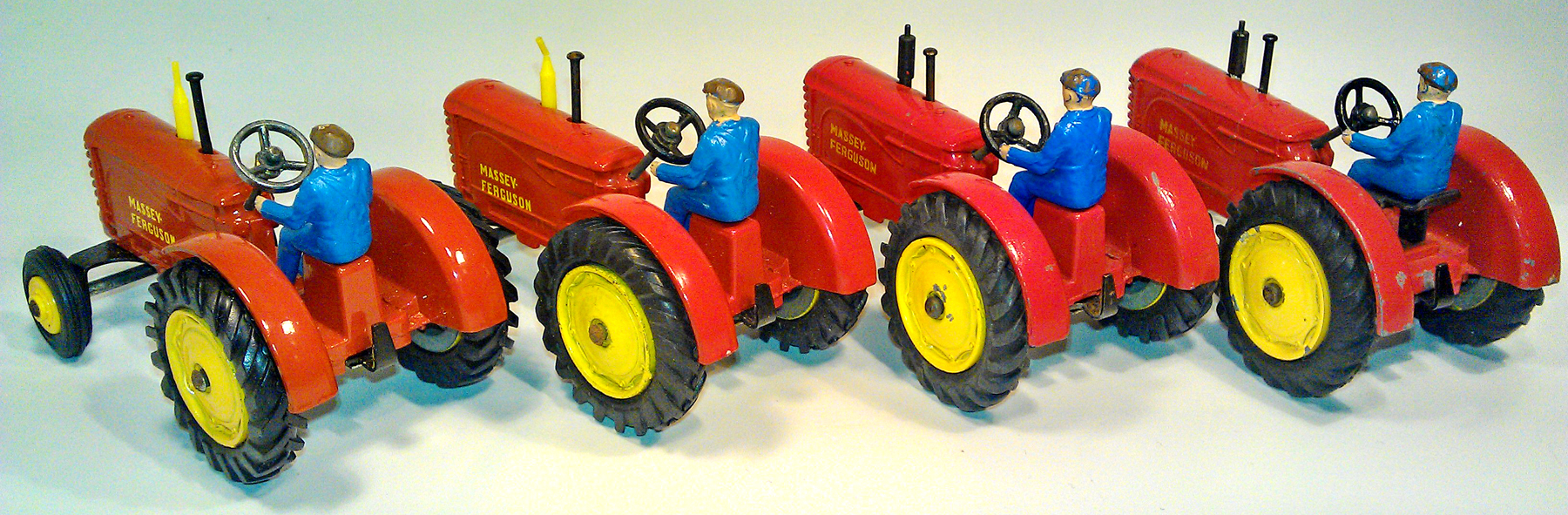
My Massey-Ferguson collection (rear view).
As can be seen in the model on the far right in the above picture, the driver sits on an open black metal seat. The seat changed to a closed cast-in red one and the black exhaust pipe to a yellow one.
The three versions of the Massey-Ferguson tractor.
There are three versions of the Massey-Ferguson tractor.
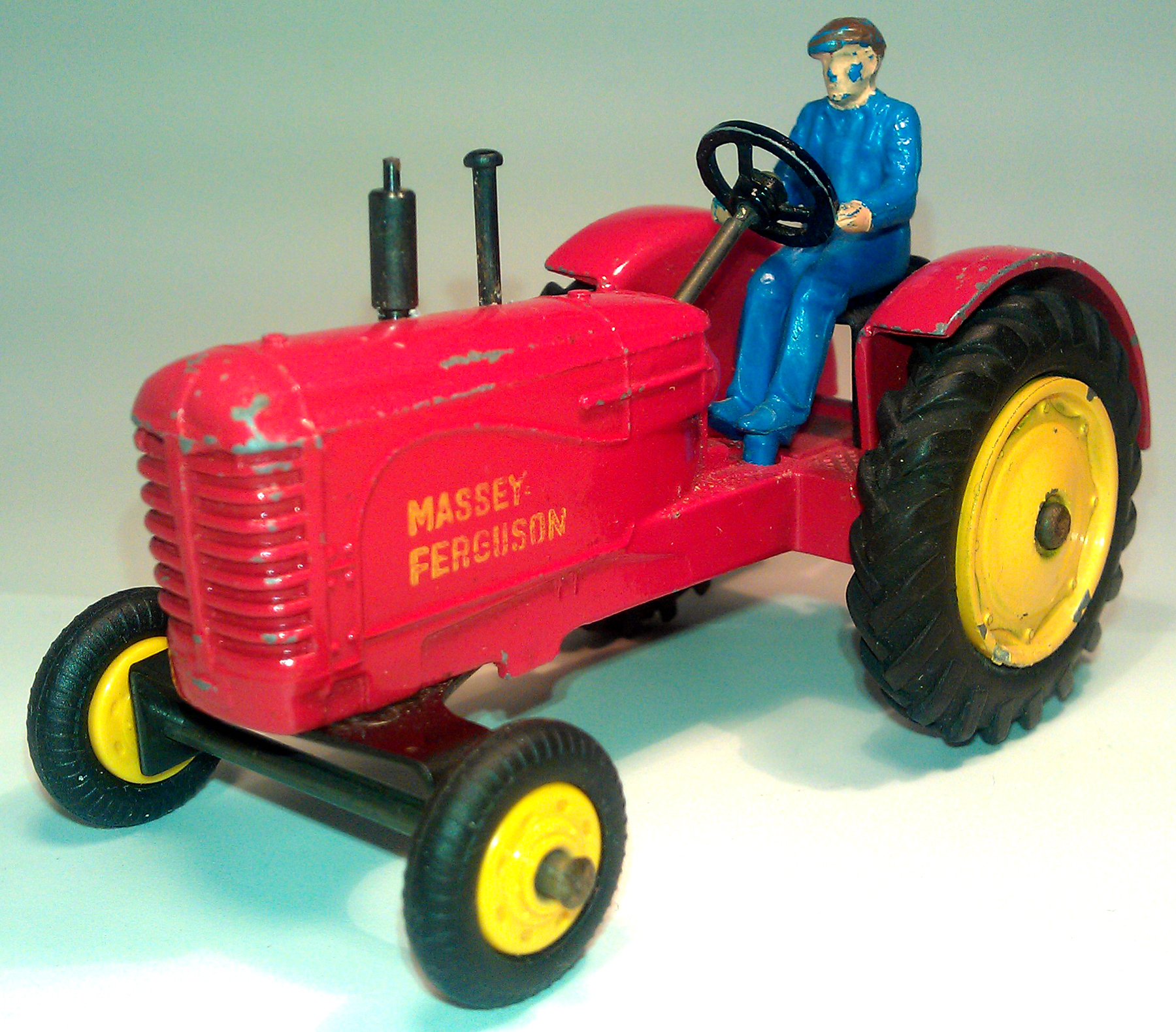
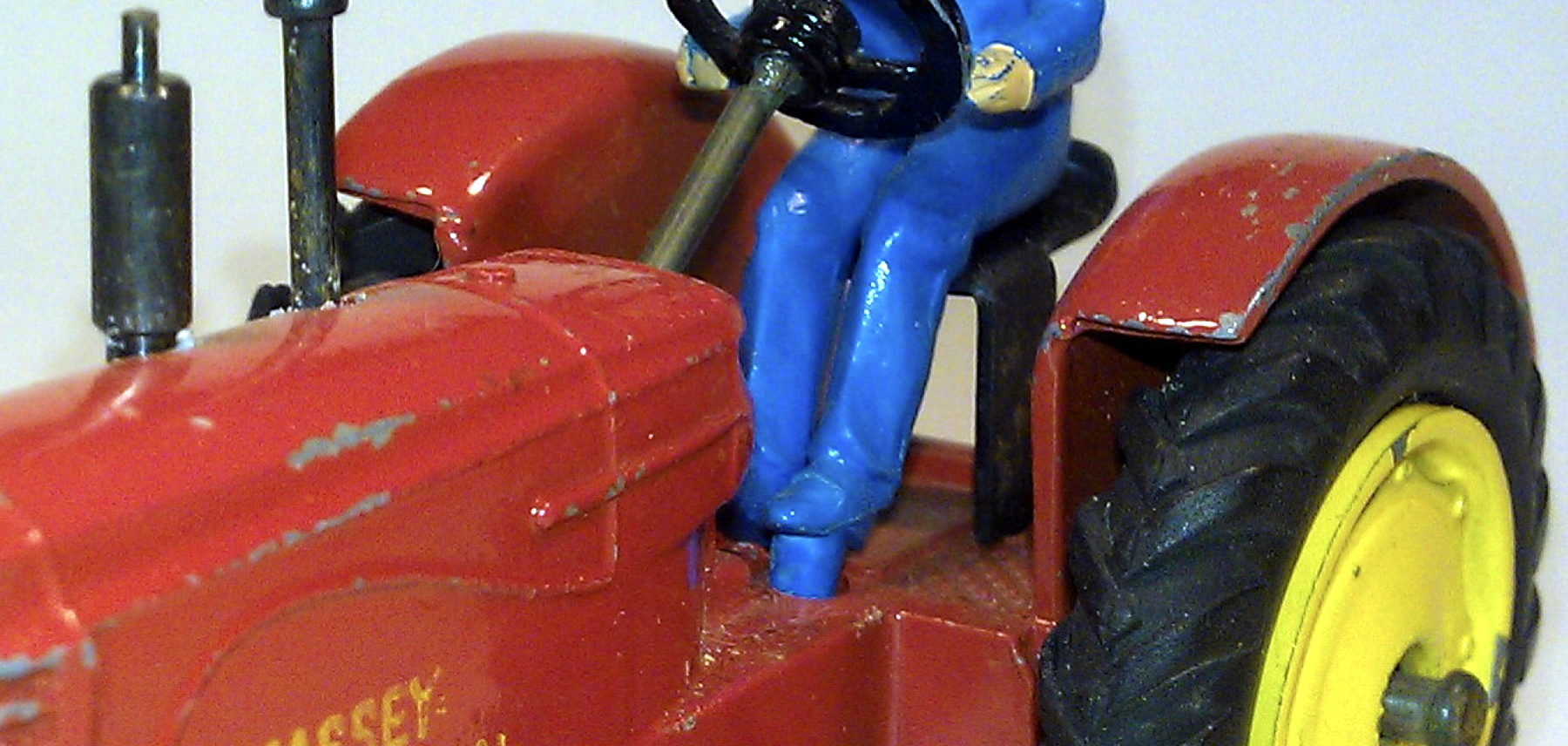
The first version has the driver sitting on a black open seat, a black metal exhaust, a black steering wheel and a plug under the driver’s left foot.
The second version has the driver perched on a closed cast-in red seat, a black metal exhaust, a black steering wheel and no plug under the driver’s left foot.
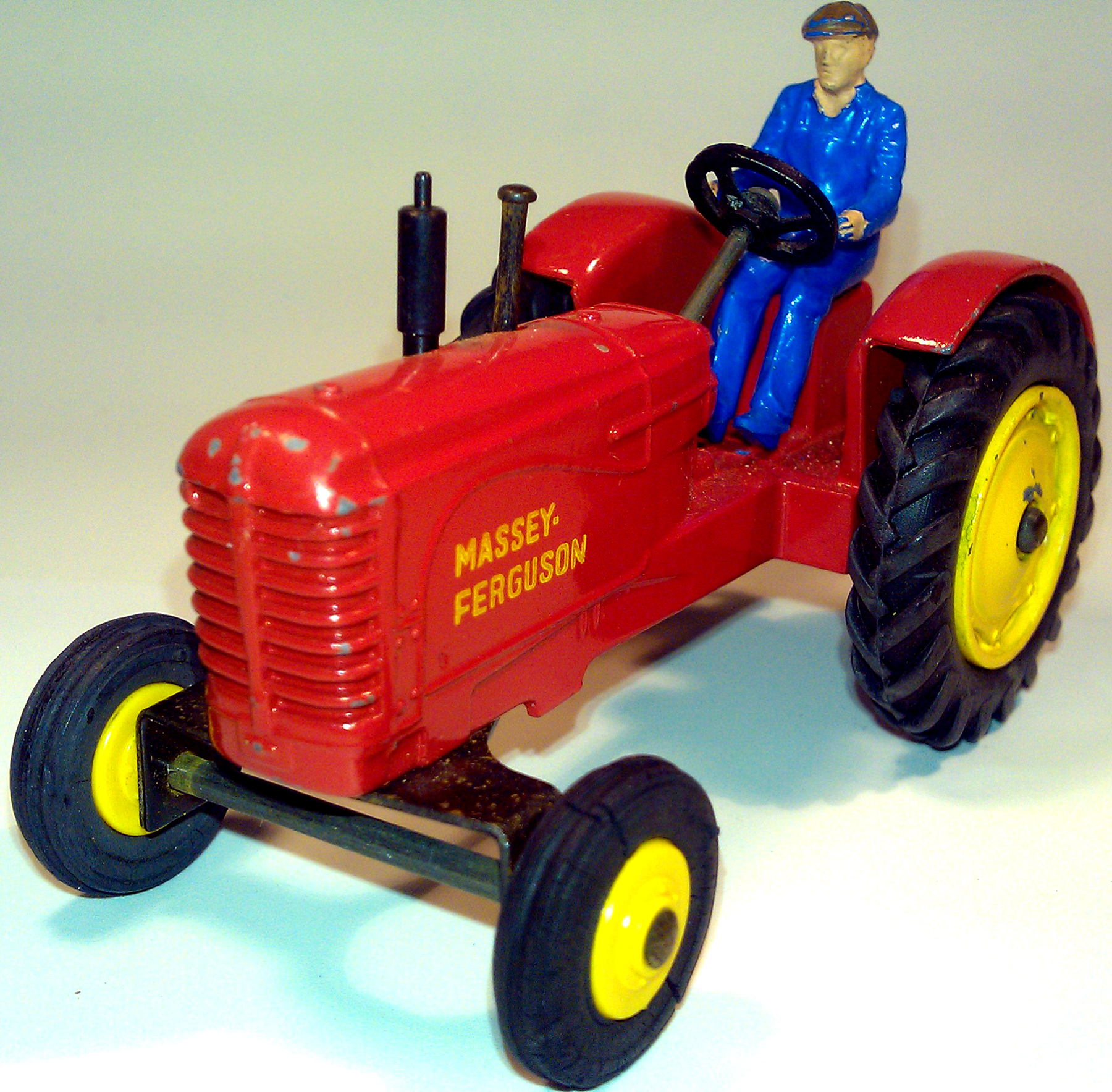
The last version has the driver sitting on a closed cast-in red seat, a yellow plastic exhaust, an unpainted steering wheel and no plug under the driver’s left foot.
L: Massey-Ferguson driver with a plug under his left foot secured in a hole in the chassis. R: Massey-Ferguson driver without a plug under his left foot and without a hole in the chassis.
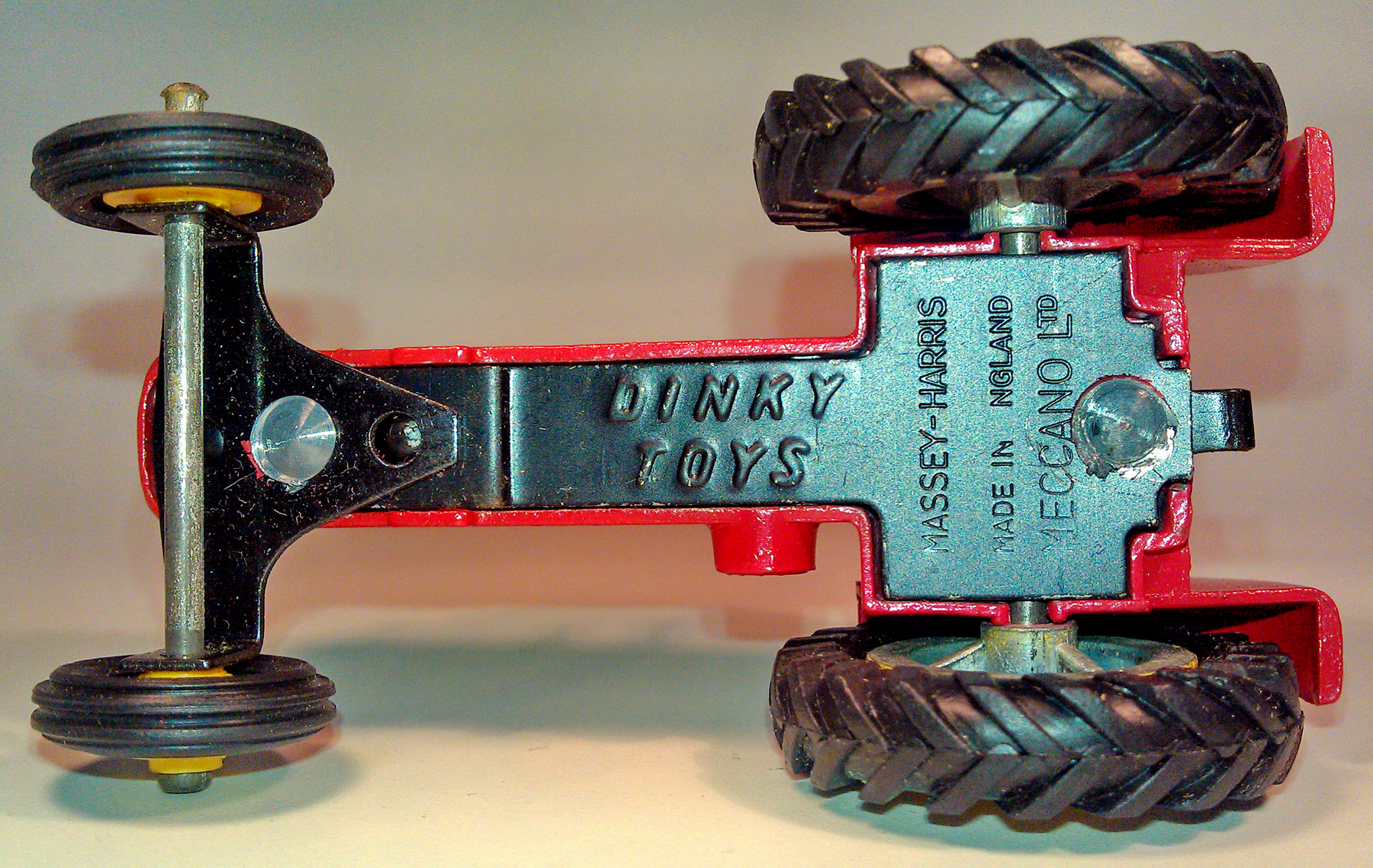
Base plate of the Massey-Ferguson tractor that continues to show the name “Massey-Harris”.
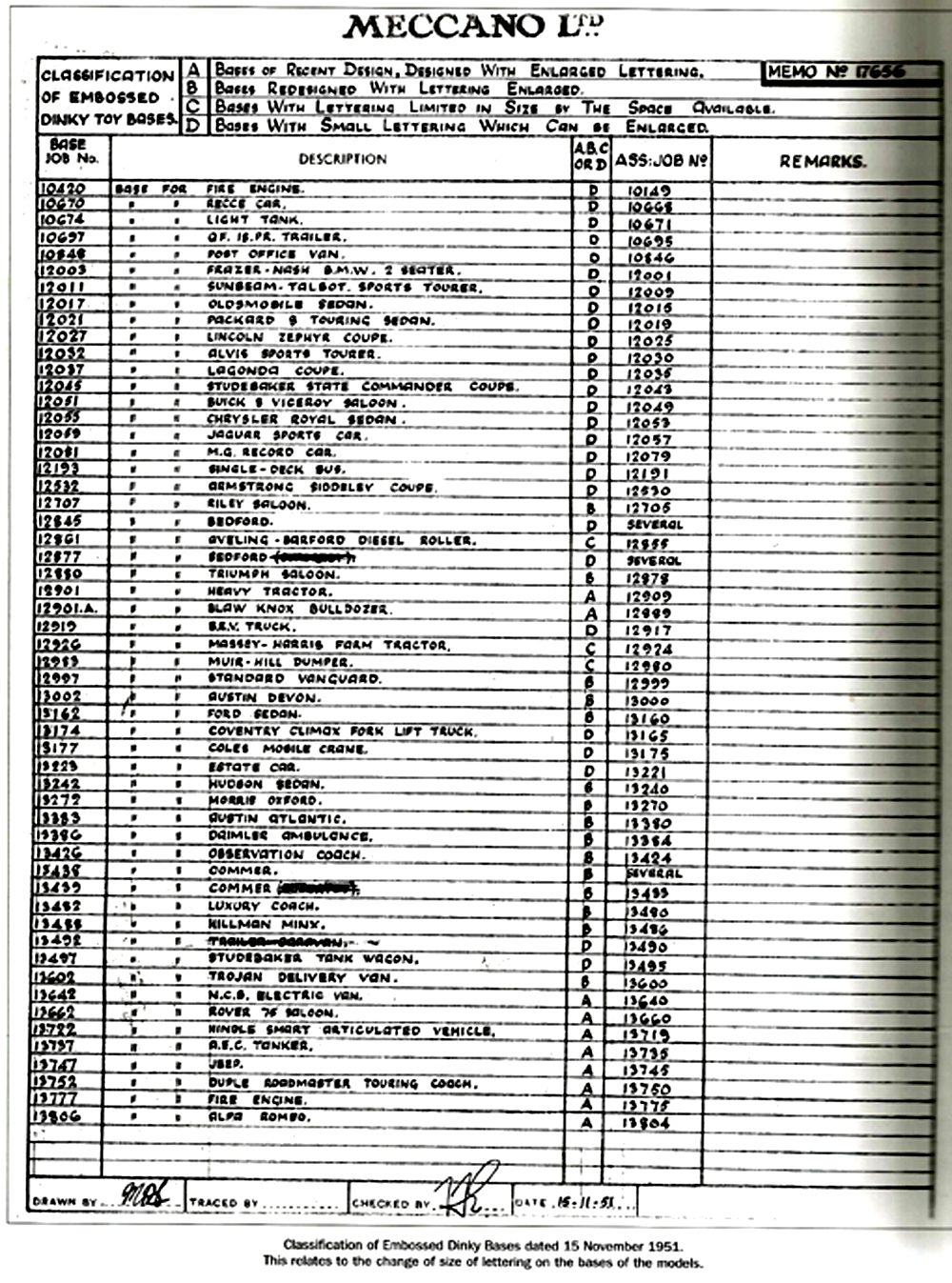
The baseplate of the Massey-Harris and Massey-Ferguson tractors are the same and sans model number. The text is partly engraved and partly embossed and the front steering is adjustable. According to the Meccano classification list of embossed Dinky Toys bases in The Great Book of Dinky Toys (page 218) there wasn’t enough space available for embossing or engraving the model number.
Meccano classification list of embossed Dinky Toys bases. Image: The Great Book of Dinky Toys (page 218).
The Massey-Ferguson tractor appeared for the last time in the 1971 Dinky Toys catalog.
There were four variations in how the driver was fastened to the seat:
Driver riveted to seat.
Driver fastened to seat with cross plug.
Driver fastened to seat with rounded plug.
Blue driver fastened to seat with rounded plug.
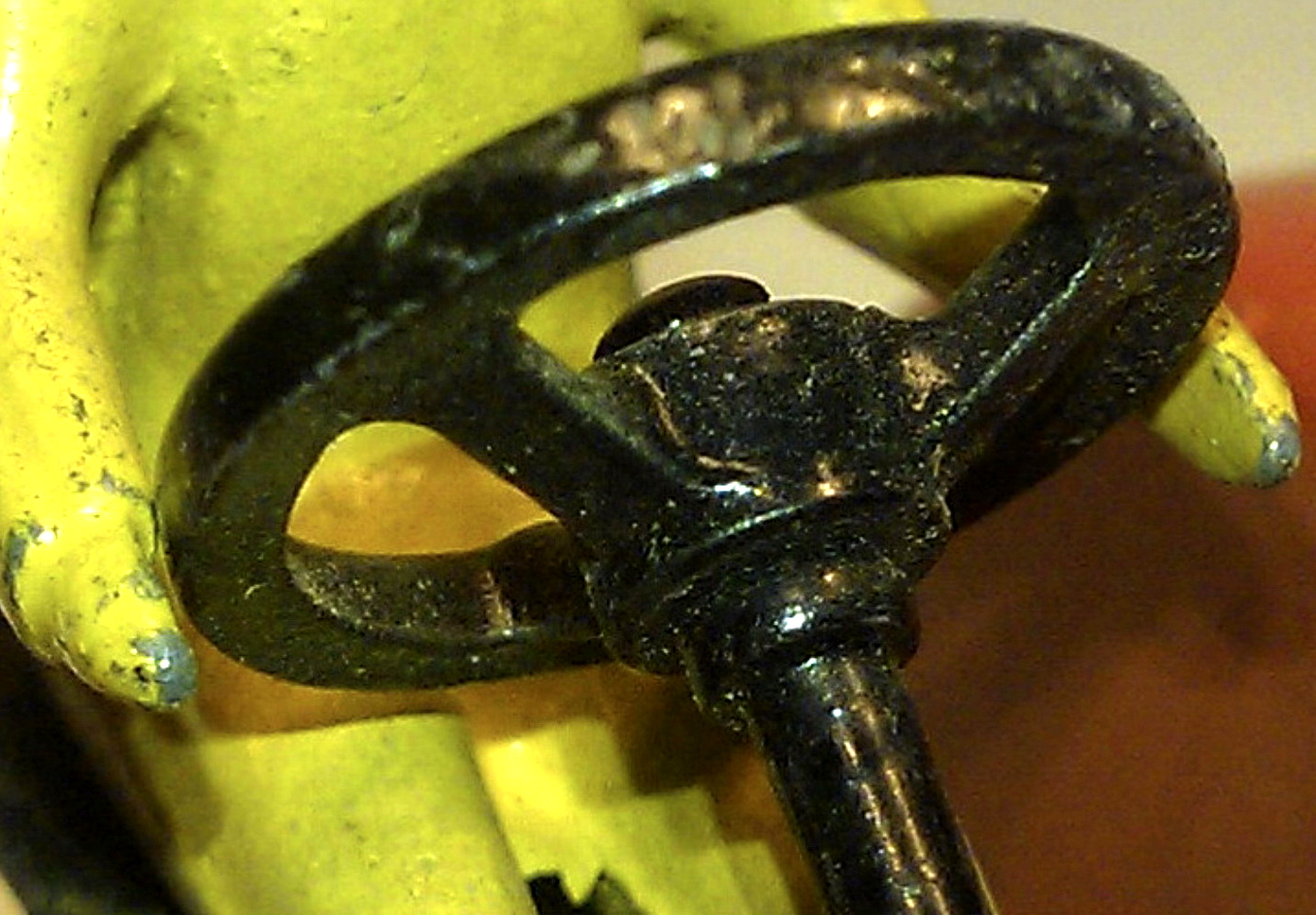
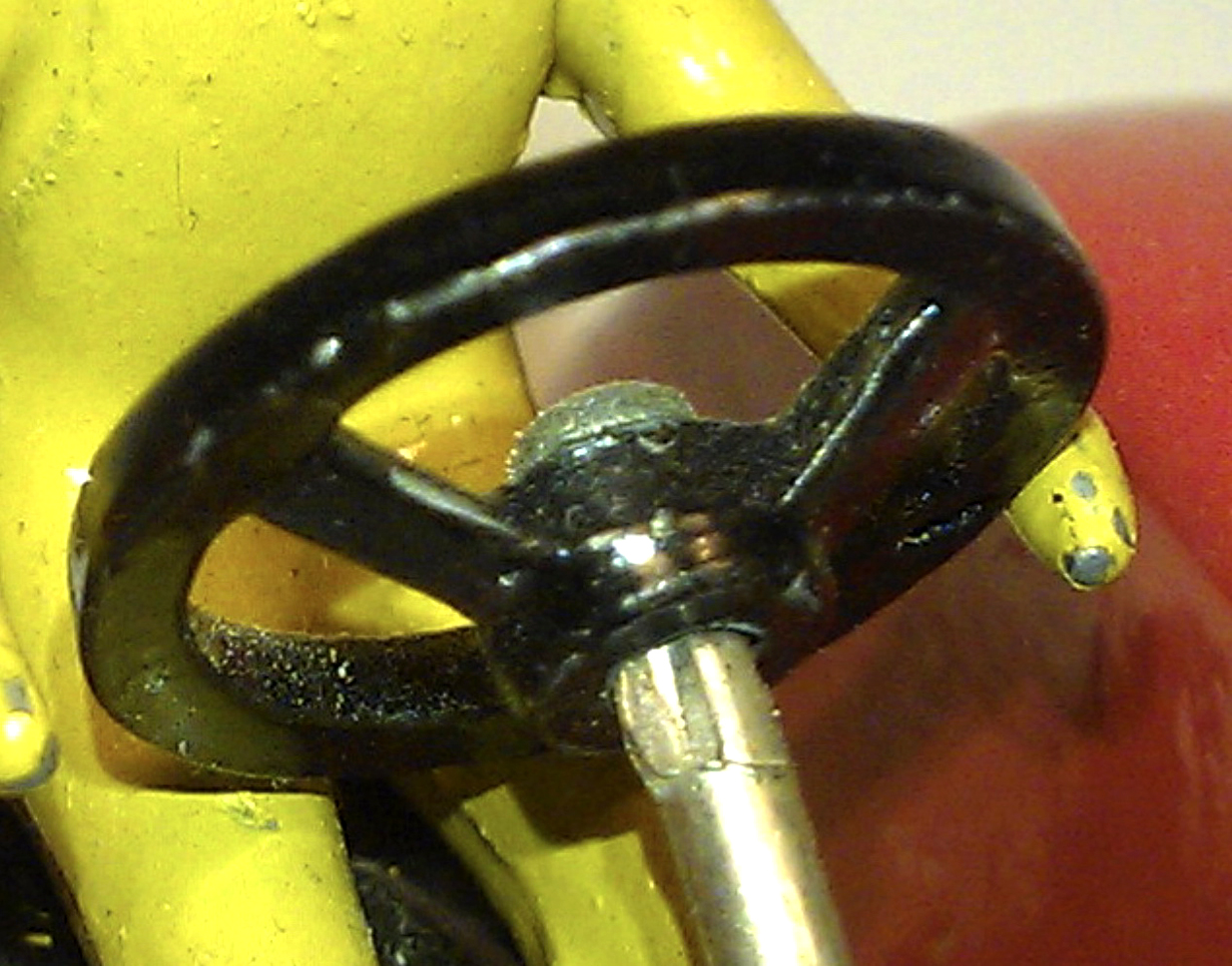
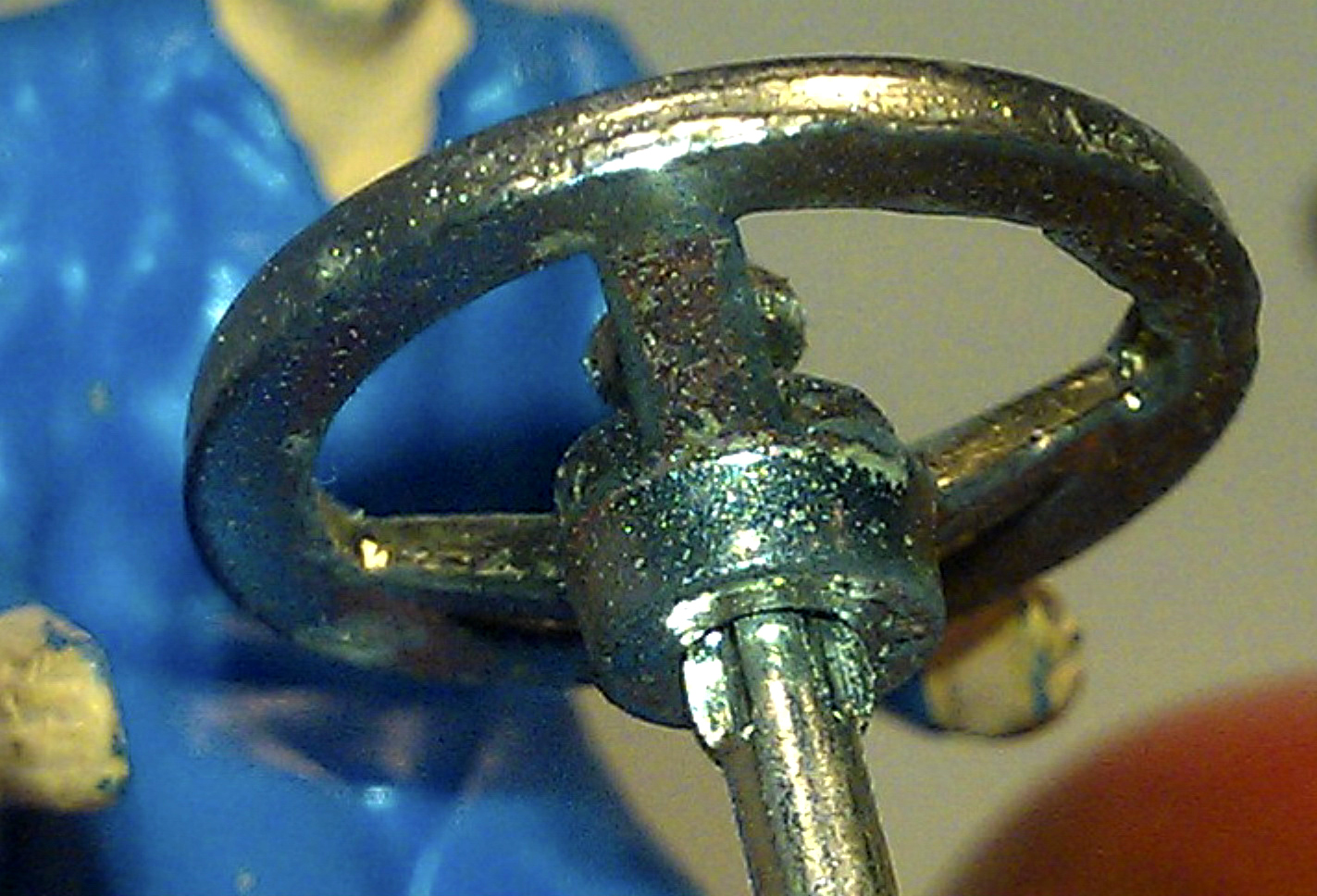
There were three versions of the steering wheel assembly:
Black steering wheel and rod.
Black steering wheel and chrome rod.
Chrome steering wheel and rod.
Special Releases
Finally, here are pictures of some special releases that were issued.
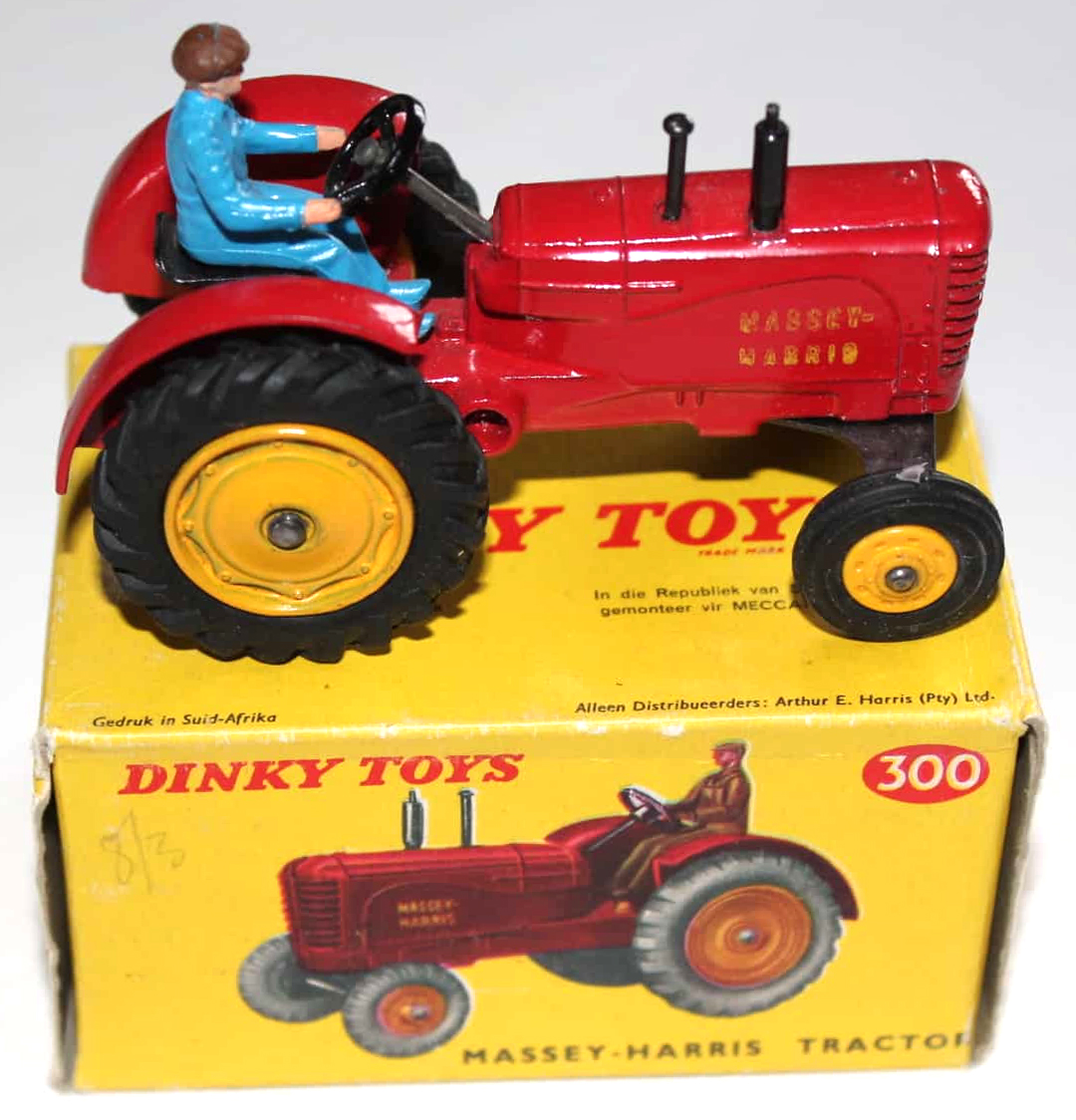
The Dinky 300 Massey-Harris Tractor assembled and sold in South Africa by distributor Arthur E. Harris. Box printed in South Africa with text in English and Afrikaans. Image: Diecast Gems.
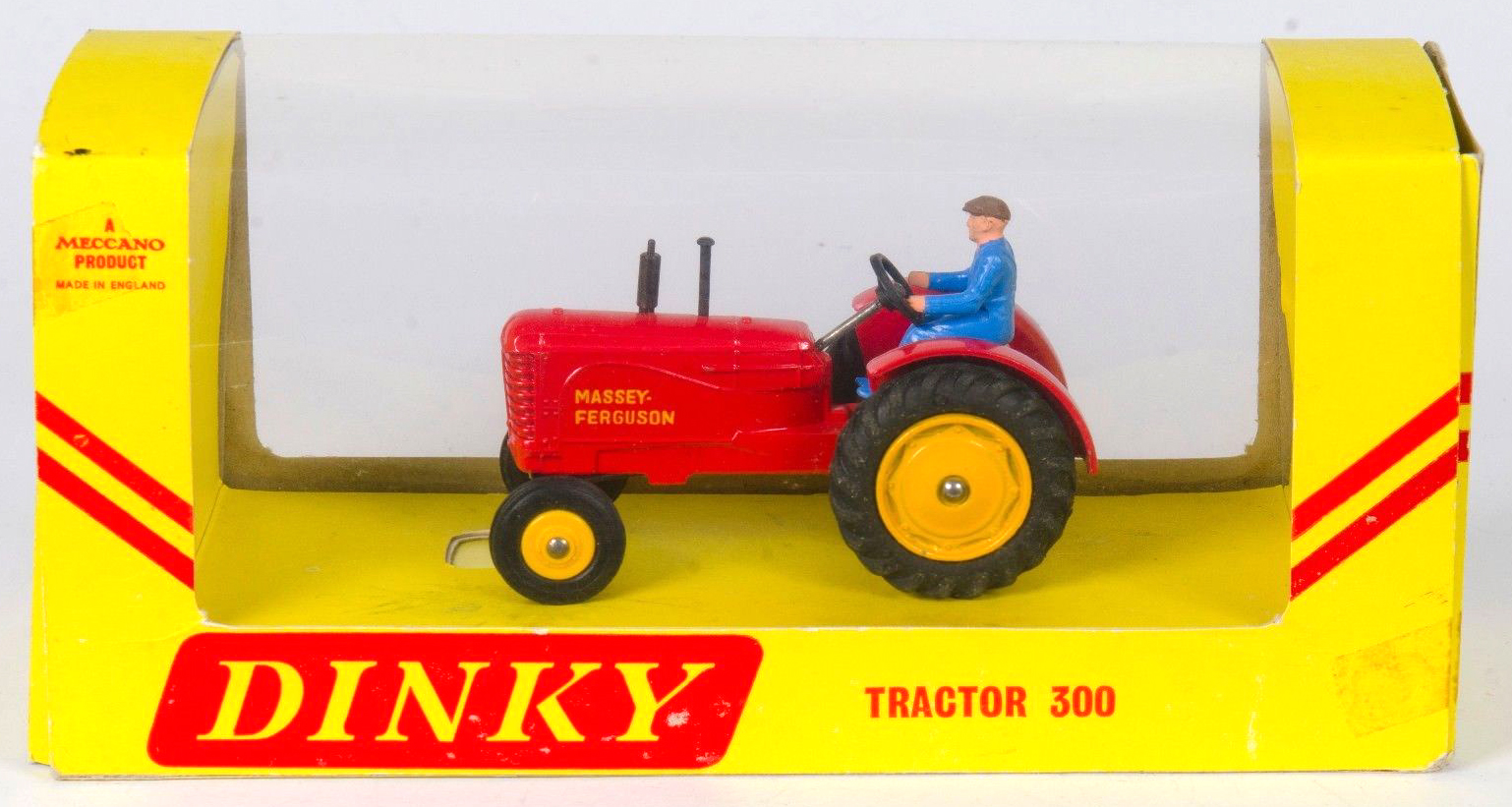
Dinky 300 Massey-Ferguson in USA export window box. Image: abbeytoys
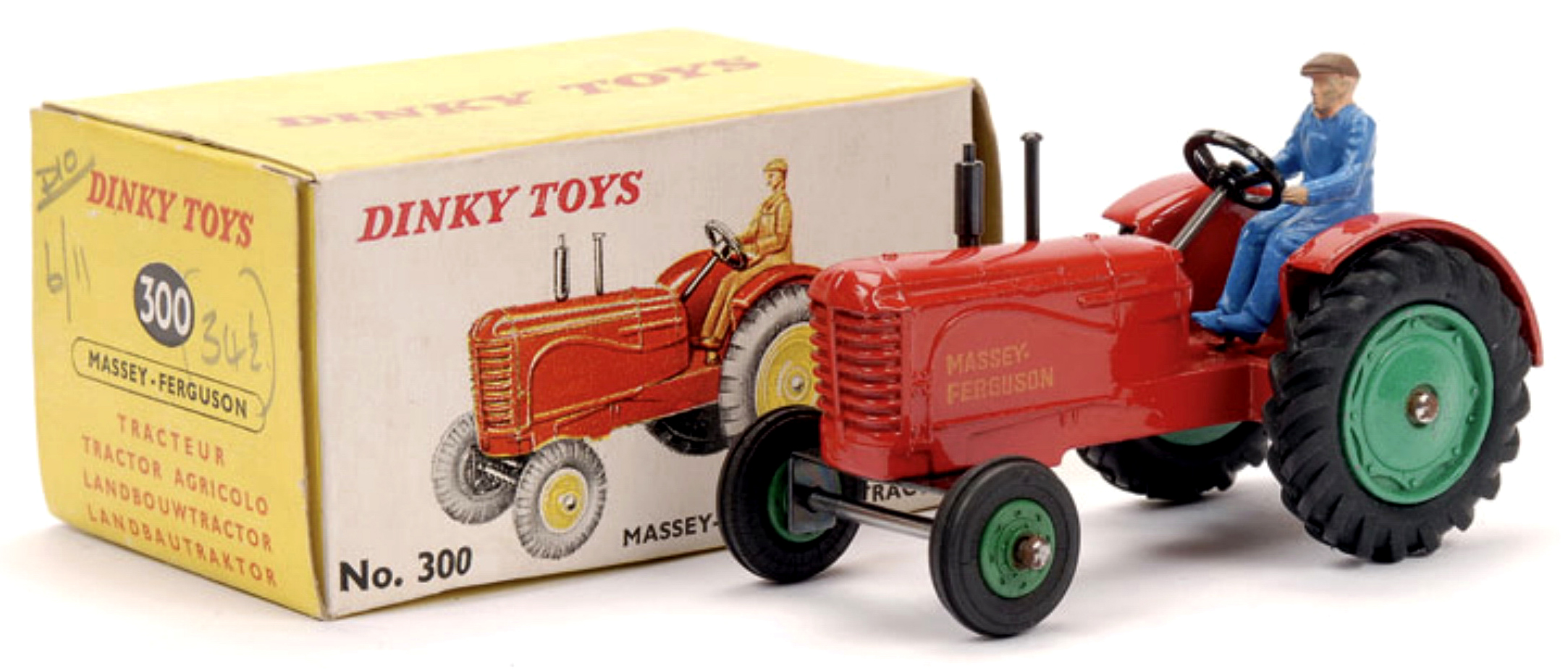
A very scarce Dinky 300 Massey-Ferguson Tractor with green hubs. Image: Vectis Auctions
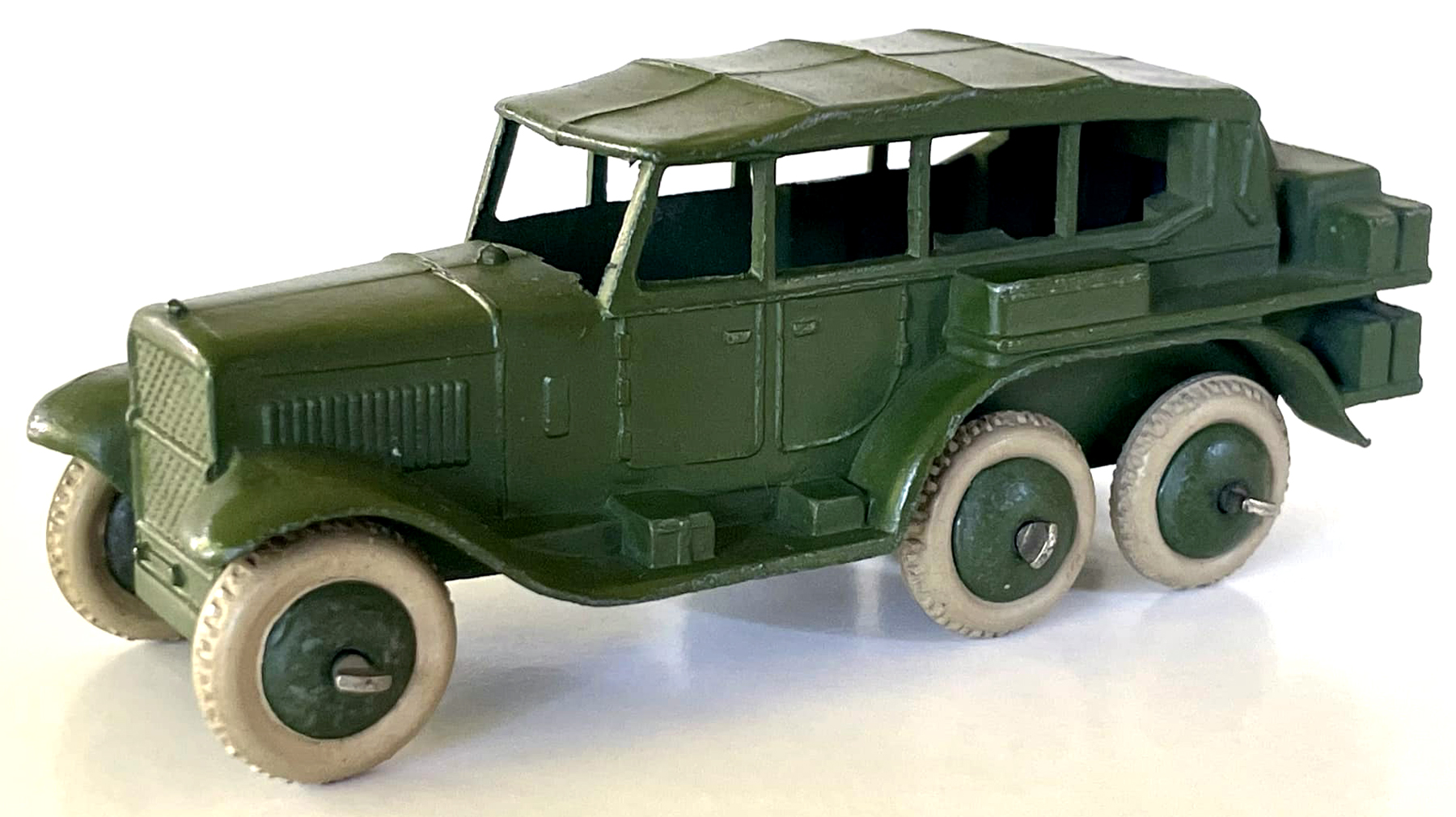
The Dinky Toys 152B Reconnaissance Car was originally designed and produced by Meccano Ltd. in the pre-war years and reintroduced in 1946 for several more years. It was a wonderful casting, full of great detail, and a favorite among young collectors.
One of my first five Dinky Toys I owned as a child included the Reconnaissance Car. Truth be told, it has since been one of my all time favorite models. As a very young boy, I reveled in the style and level of detail of this exquisite model. With its unusual six wheels, simulated canvas top, running boards, hood louvers and numerous exterior storage boxes, there was a lot to like.
And remember, this was originally a pre-war model, introduced way back in 1937 as model 152B. Compared to other models produced by Dinky in that era, the execution and level of detail in this model is — to me — unmatched. And unlike other Dinky Toys trucks of that era, this one was modeled after a real vehicle made by Morris Commercial. The Dinky is amazingly accurate, save for the absence of headlights which they were lacking the diecasting ability to include at that time.
I have a couple of other models of this Dinky, but a while back I had the chance to acquire a somewhat rare and unusual very early post-war version that features smooth non-ridged wheels and the finely treaded white tires used very briefly in pre-war versions. It has the thicker post-war axles, so it’s a kind of interim hybrid model that bridges pre-war elements with post-war.
I hope you enjoy these two examples of the Dinky 152B Reconnaissance Car as much as I do.
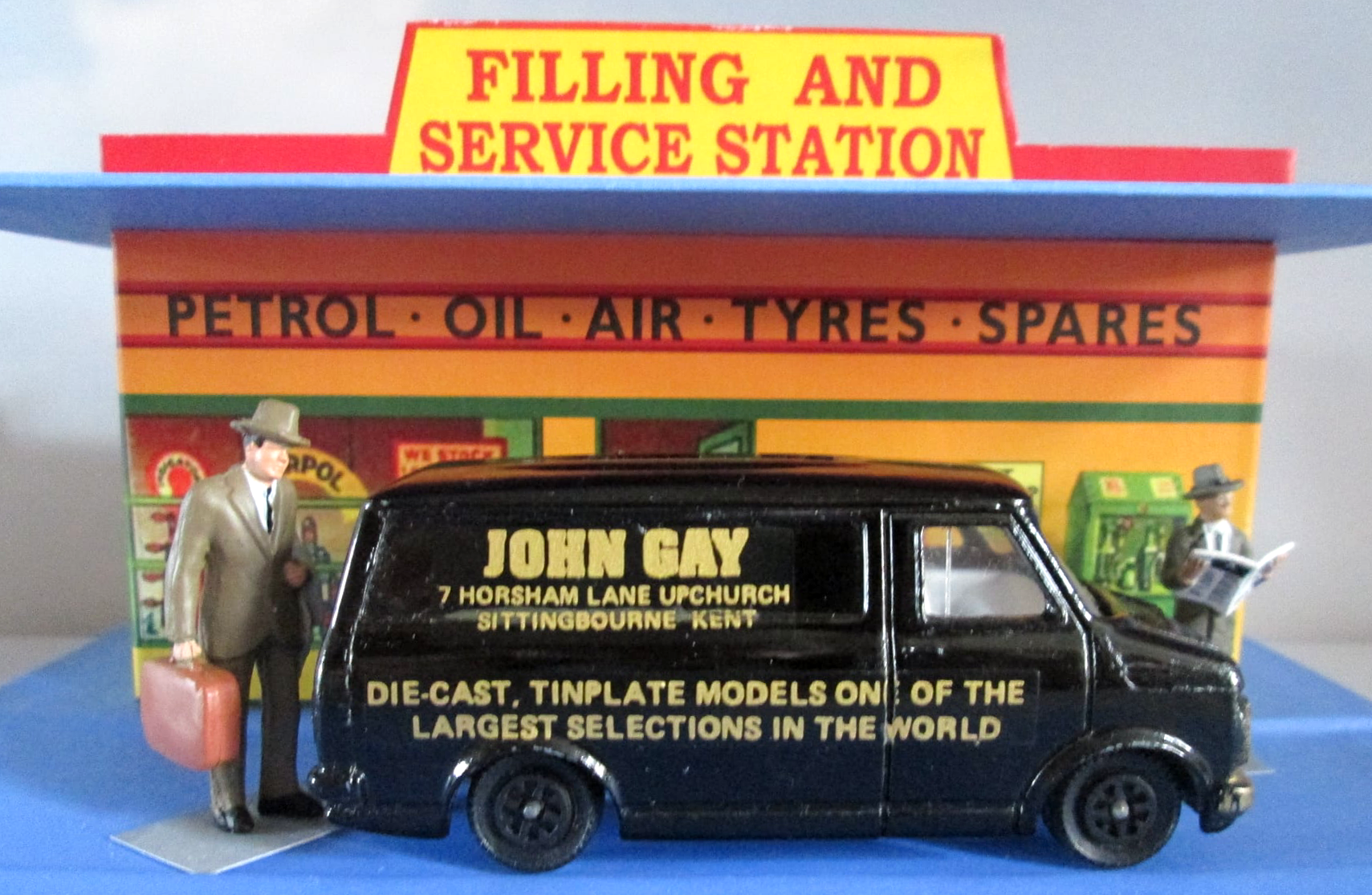
John Gay was a career commodity broker who moved into Dinky Toys in 1975. Up to its closure in 1979, he had a strong trading relationship with the Dinky factory in Liverpool and is also alleged to have bought stock directly from the receivers.
Although dismissed by many Dinky Toy collectors as being Code 2 items altered with permission after leaving the factory, in truth, all of John’s models were painted by Dinky and over half of the 400 items he issued were completely finished in the Binns Road factory. More accurately, they are Dinky Toys marketed exclusively by John Gay.
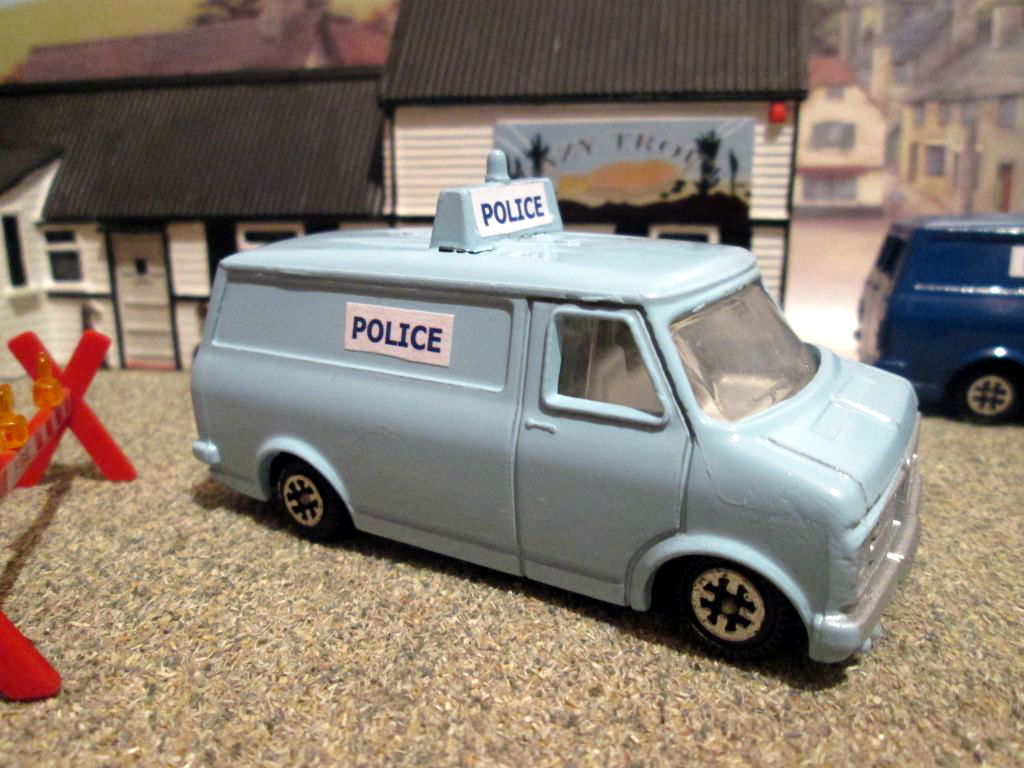
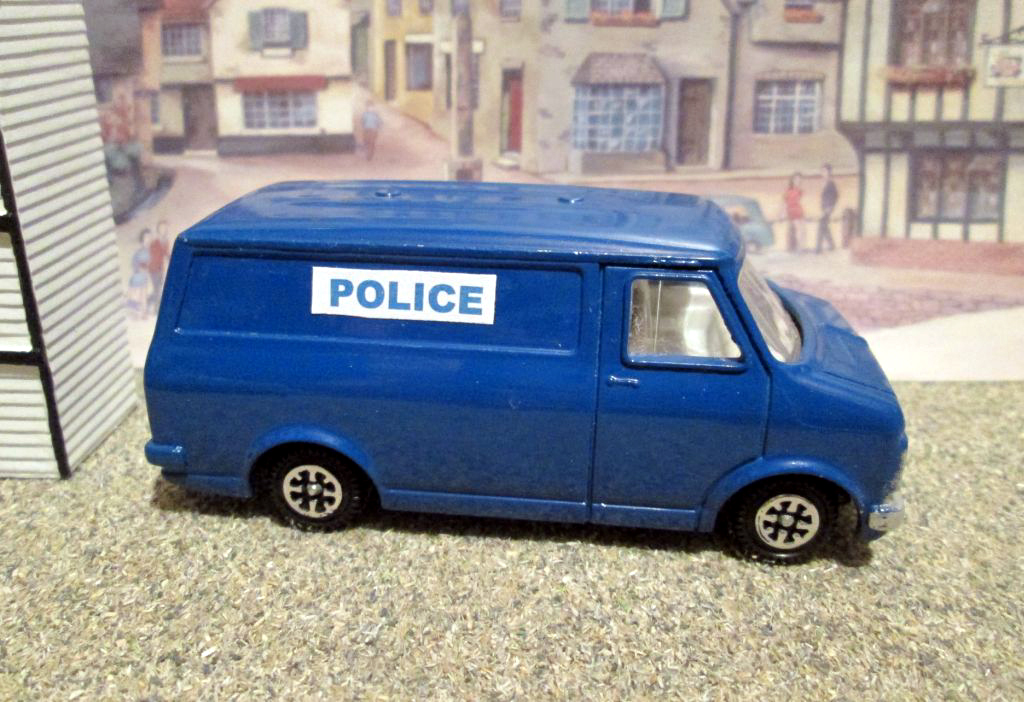
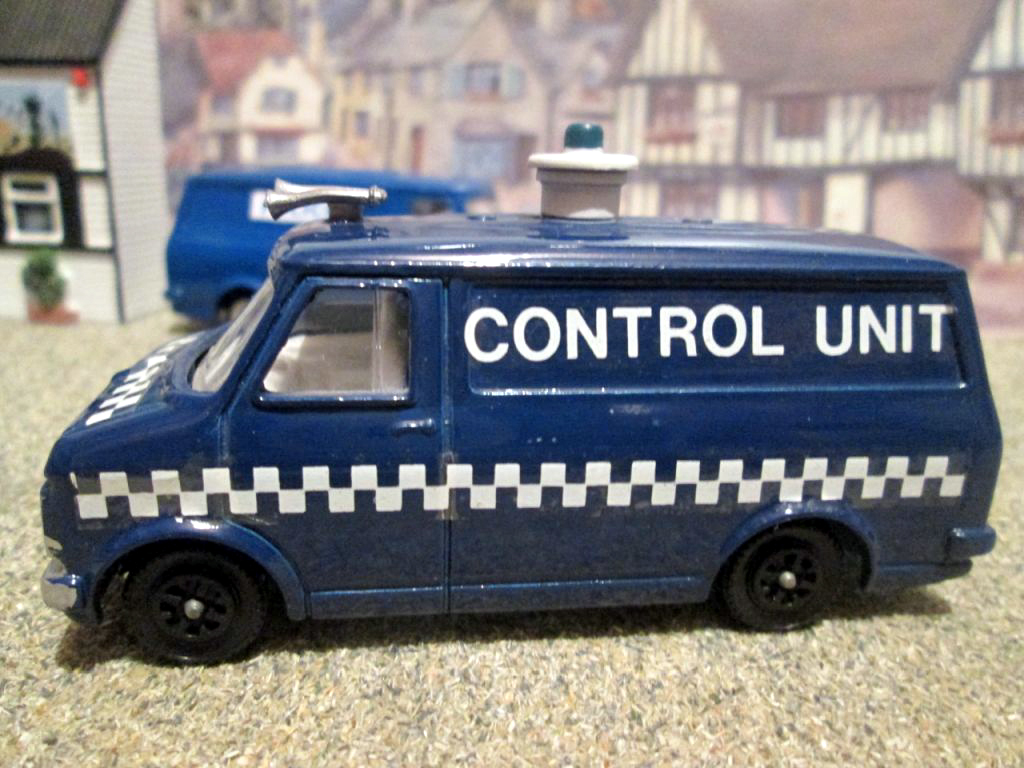
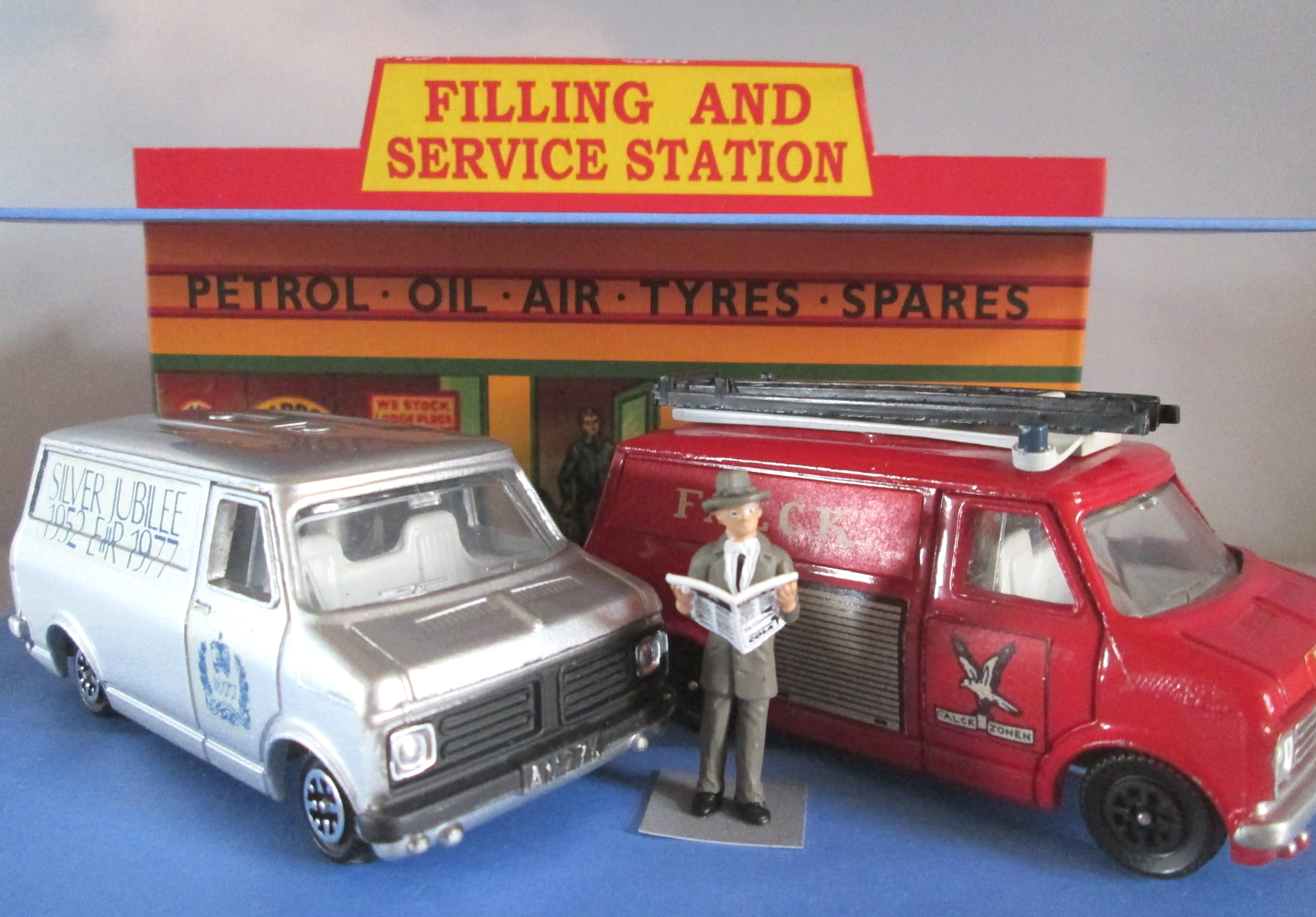
These three were all painted and made by Dinky as you can see by the rivetted roof attached on the Control Unit. John Gay applied the Police decals and packaged them in his own boxes.
John Gay Dinkys were never cheap, being aimed from the outset at adult collectors. As a commodities man who understood the value of scarcity, John priced them accordingly. A Dinky from a run of 200 might be GBP 20 whereas one from a run of only 50 would be GBP 50. John Gay Dinkys were mostly Bedford CF Vans but also included Atlantean and Routemaster buses. All the buses came in regular Dinky packaging.
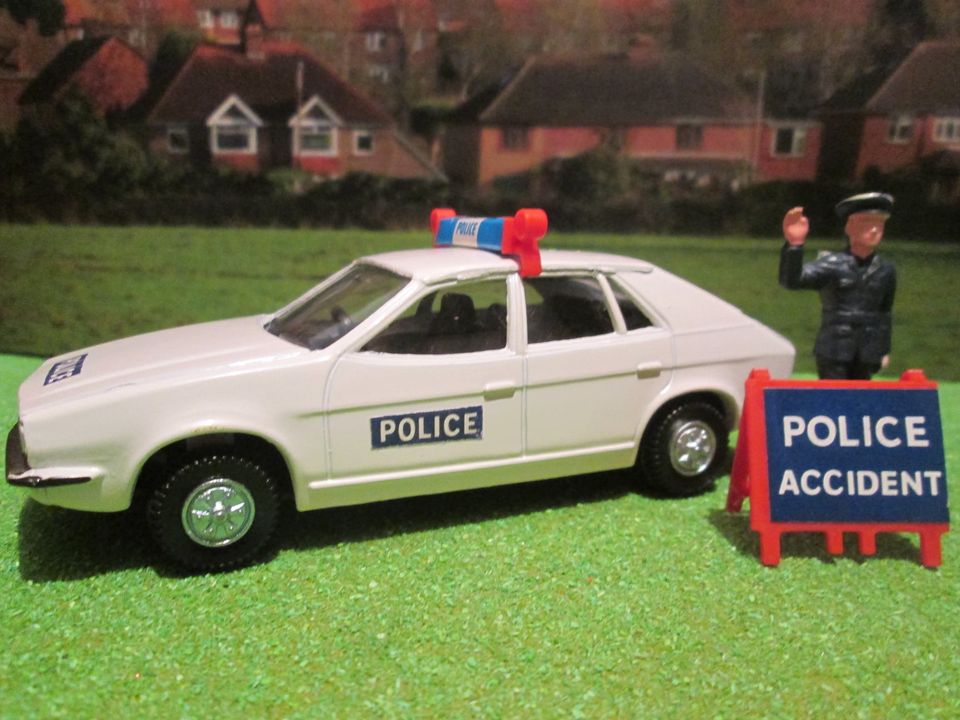
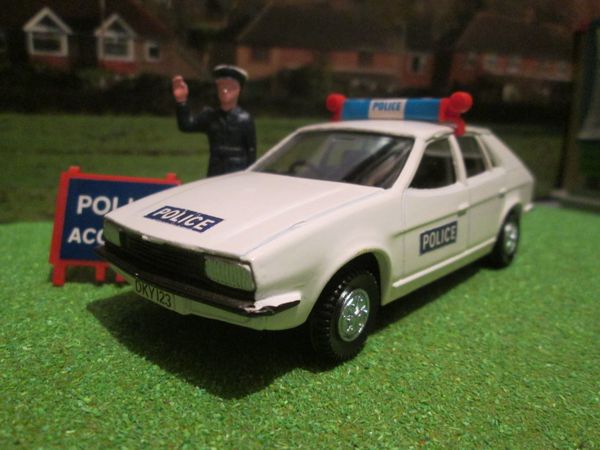
He also sold a ‘tray’ of cancelled Austin Princess Police cars which came with either white or black roofs. These prototypes were manufactured in 1977 and known as number 123P. They came packed in a sealed cellophane bag inside a plain cardboard box.
In those pre-Internet days, John sold via mail order, often advertised in Collectors Gazette (for whom he did a CF van), Model Collector magazine, and Model Auto Review. You bought a paper list for GBP 4 and ordered via post, although you were well advised to phone ahead first.
Although no more Dinky Toys were made in the UK after 1979, John continued selling them well into the 2000s. By this point, it was largely the same list with sold out items scored through. He hadn’t always altered prices, and GBP 20 Dinkys suddenly didn’t look too expensive. This is when I bought most of mine. I wish I’d kept his old lists, but I did at least have a few interesting phone conversations with him over the years.
I’ve read lots of articles about the packaging styles used on John Gay Dinkys, but my experience was that there was little consistency, even sometimes on the same model. Whilst John used bespoke John Gay yellow boxes for some models (notably Bedford CF vans), sometimes they came in plain white boxes and sometimes in (incorrect) standard Dinky boxes. And if you bought several together, they would often arrive collated in old shoe boxes. I honestly don’t believe he gave much thought to the boxes beyond providing some form of packaging.
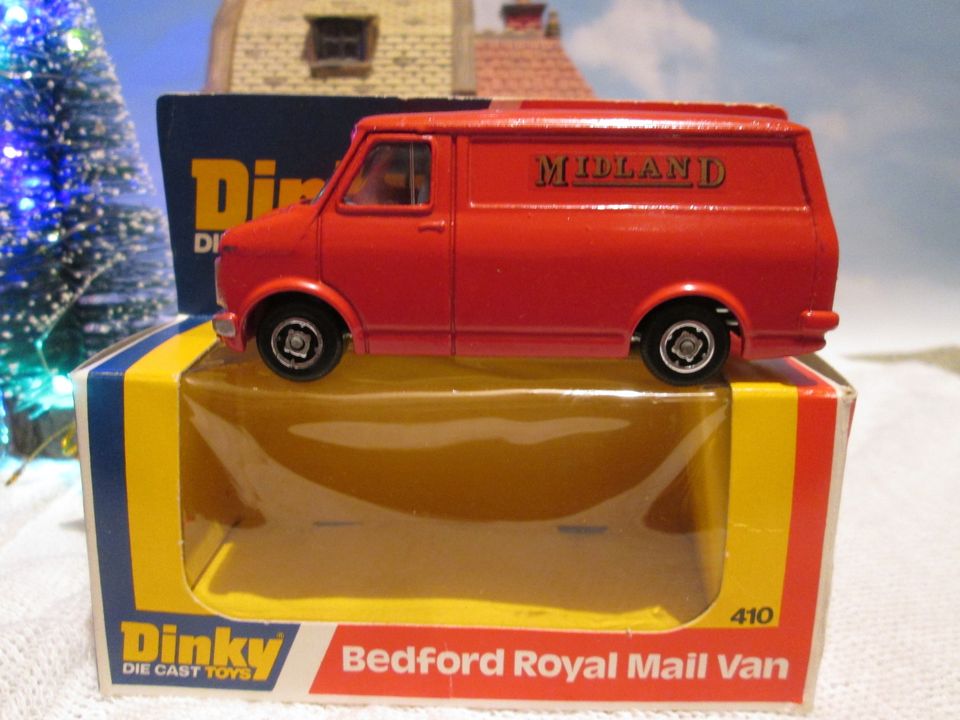
This Midland Red Bedford CF van is one of John Gay’s Code 2 models. Sometimes they came in Dinky boxes (like this one) or sometimes in his own bespoke packaging.
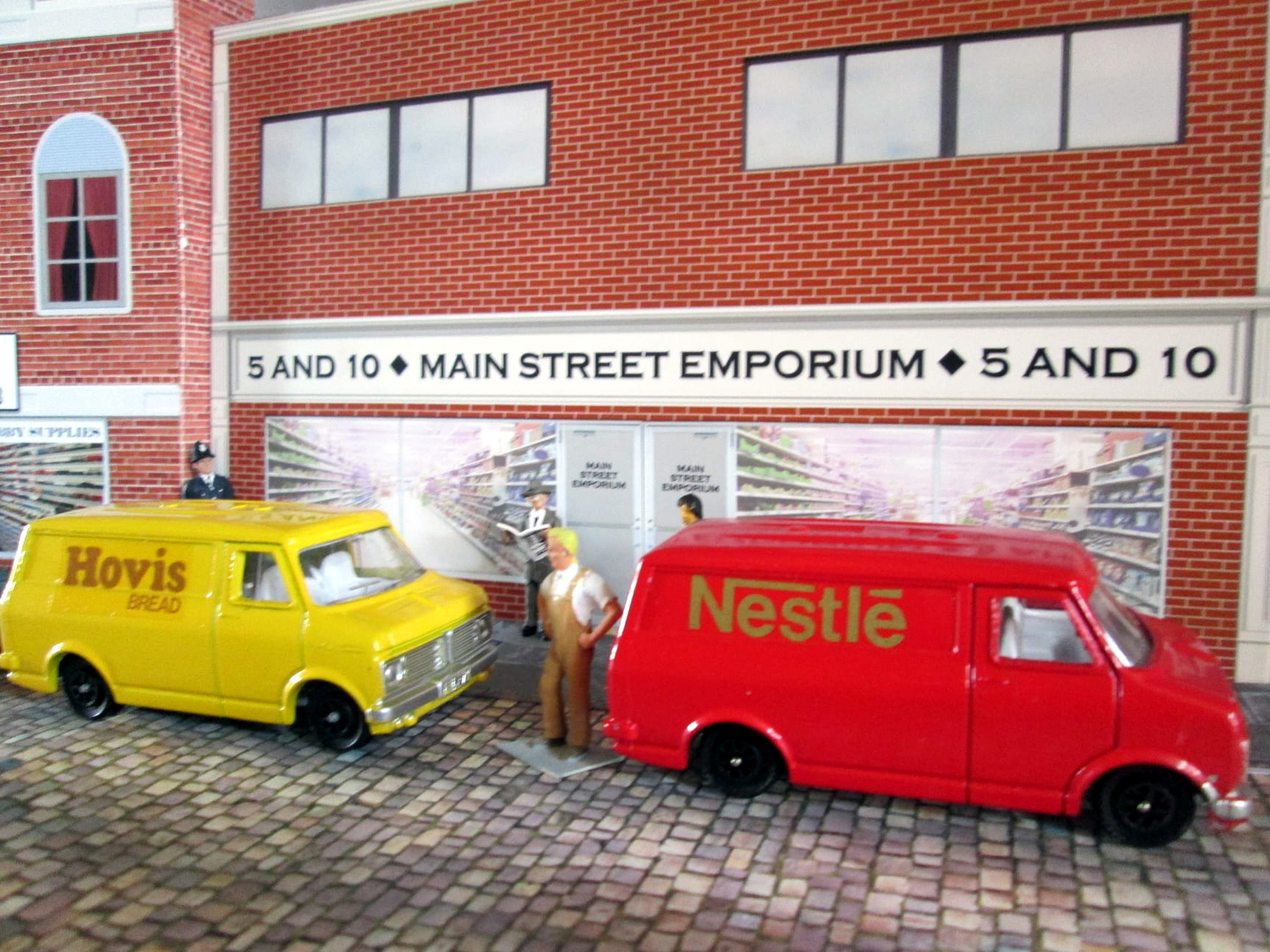
Next are two more Dinky Bedford CF vans from 1973 (according to their number plates) making deliveries. Again, these are Code 2 models.
By my math, John Gay Dinky Toys account for around a fifth of all Dinky Toys types made at Binns Road. I think the production runs varied between 50 (e.g. Queens Silver Jubilee Bedford CF van) and 200–250 for the others.
Because they were intentionally made in small runs for adults, I believe many Dinky Toys collectors struggle to work out how they fit into a range of toys that ended in 1979. All this uncertainty has made their value variable and volatile. But as something ‘different’, I find them fascinating.
It was late September 1935. Crowds gathered along the railway lines in Britain, hoping to catch a glimpse of a revolutionary new train, the “Silver Link”. This sleek, streamlined steam locomotive built for the London and North Eastern Railway (LNER) made its debut journey from London’s King’s Cross to Newcastle. Not long after, it set a new speed record for steam trains — an astonishing 112 miles per hour. It was a marvel of engineering and elegance.
That same year, King George V celebrated his Silver Jubilee. To mark the occasion, the new train was given a name as grand as its appearance: the “Silver Jubilee Express”. With seven silver colored coaches trailing behind, the train remained in service until well into the 1960s.
Such an iconic train didn’t go unnoticed. In February 1937, Meccano Magazine published an in-depth article on this groundbreaking locomotive.
And soon after, the inevitable happened: Dinky Toys released a scale model. The first sets went on sale in 1936, and in July 1937, the train made its first official appearance in the Dinky Toys catalog.
Originally listed as Dinky Toys No. 16, and later renumbered as model 798, the train set remained in production for an impressive 23 years before being retired in 1959. But although it disappeared from store shelves, it never left the hearts of collectors.
Which brings me to my own passion. In addition to restoring diecast models, I also recreate the original boxes in which these miniatures were once sold. A fellow collector approached me with a request: could I make a reproduction of the box for the Silver Jubilee train set?
It turned out to be quite a challenge. The interior of the box is cleverly constructed, and recreating the original typography was particularly time consuming. I began with a font that closely resembled the original, then carefully adjusted each letter using a vector design program. It was meticulous, detailed work — but in the end, it brought the spirit of the 1930s back to life.
Because sometimes a train is more than just a train. It’s a piece of history in miniature form.
With special thanks to an American collector who shared the measurements of the box with me.
Golden Slumbers fill my eyes – when dreaming about my now 75 year old favorite, the Guy Van “Slumberland” of December 1949.
When you ask a Dinky Toys enthusiast to choose a favorite from the great 1950s Guy vans, the answer will likely be the “Lyons” or “Weetabix” vans, and often the one with “Golden Shred” livery. The “Slumberland” van will usually be rated lower. This may be because a “Slumberland”, if it has lost its original bright red factory fresh finish or if its transfers have faded or been damaged, often loses much of its glory and appeal.
But if it has retained its fresh appearance, this 75 year old red and gold beauty is my unassailable favorite among the Guy vans. And in this respect I’m in good company with the well respected late Cecil Gibson who, in his “History of British Dinky Toys” wrote “This van appeared later in various finishes, and re-numberings, but I find this the most attractive...” Indeed, the “Slumberland” offered the first opportunity to make acquaintance with what was to become the respectable and famous family of Guy vans. Not only was it the first Guy van to be issued, it was also the first regular post-war van with advertising. Many additional decorated vans like the other Guys (5), the Big Bedford (1), the smaller Trojans (6), the Austins (3) and the Bedfords (3) were to follow in the golden decade of the 1950s.
The proud Guy Van “Slumberland” in bright red, adorned with majestic golden lettering.
“NEW, ready during the month” in the December 1949 issue of Meccano Magazine.
It was a brand new and expensive Dinky Supertoy of the early post-war years! The “Slumberland” van was advertised in Meccano Magazine of the festive presents month of December 1949 for the first time: “Ready during the month” and with “Large capacity van body”. It was subsequently reviewed in next year’s January issue along with the Coles Mobile Crane, a firm classic with high play value, and the odd three-wheeled Motocart.
Motocart, Coles Mobile Crane and “Slumberland” van, the new Dinky models that were reviewed simultaneously in the January 1950 issue of Meccano Magazine.
Surprisingly, the comment that accompanies this new lovely van was modest compared to the often long-winded elaborate comments of newly introduced Dinky Toys.
Our third new product this month is the Guy Van, Dinky Supertoys no. 514. The basis of this is the now well-known Dinky Supertoys Guy chassis, on which a van body of large dimensions with rear opening doors, has been fitted. Each van will bear the name of some well-known British firm, and the result is a really beautiful miniature road vehicle.
The January 1950 issue of Meccano Magazine, double review page.
These mere 60 to 70 words appear to have been included at the last minute, in the midst of virtually endless praise about the Motocart and especially the Coles Mobile Crane, which dominate the illustrated double text page. The neutral caption “Guy Van”, that accompanies the “Slumberland” illustration in both the December and January issues, seems to allow for any livery. As implied in the text, Meccano had definite plans to not limit the production to a single van, but instead intended produce several sponsored liveries right from the start. One can assume that’s why the catalog number wasn’t cast or embossed on the model itself, even though the first vans all shared the same reference number: 514. They were more precisely defined by the addition of the letters “S” (Slumberland), “L” (Lyons) and “W” (Weetabix) on their respective boxes. The “Slumberland” simply happened to be the first issue, and the specific picture of that model was accordingly selected for inclusion in the review by Meccano Magazine.
The “COMPLETE” drawing (job 13010) of five Guy van liveries dating from 4 October 1948, with later additions (Christie’s South Kensington).
In internal factory documents, the Guy van was also known as “Guy Covered Van” or “Guy 4‑ton Truck Van”. Designed on the 1:48 scale cab/chassis combination of one of the first Dinky Supertoys types of August 1947, it had an unprecedented size and complexity, compared to previous vans. The general (i.e. complete) assembly drawing for all Guy vans was job number 13010, dated 4 October 1948 and signed by “D.L.M.” On the drawing, the letters “A” to “E” were attributed to the transfers of the various subsequent liveries: “A” for “Lyons” and “B” for “Slumberland”. In November 1954, the following jobs were added: “C” for “Weetabix”, “D” for “Spratts” and “E” for “Exide Batteries”. “F” for “Golden Shred” was still missing, apparently not yet envisaged in this, the surviving final stage of the drawing. With this letter sequence in mind, the “Lyons” variant may have been meant to be issued first in the initial production. Regardless, the “Slumberland” and “Lyons” vans may be thought to have been close contemporaries, issued at virtually the same time in late 1949 or early 1950.
The scarcer “Slumberland” van’s contemporary: Guy Van “Lyons”, ca. 1951–52 (former Rob van der Hoort Collection).
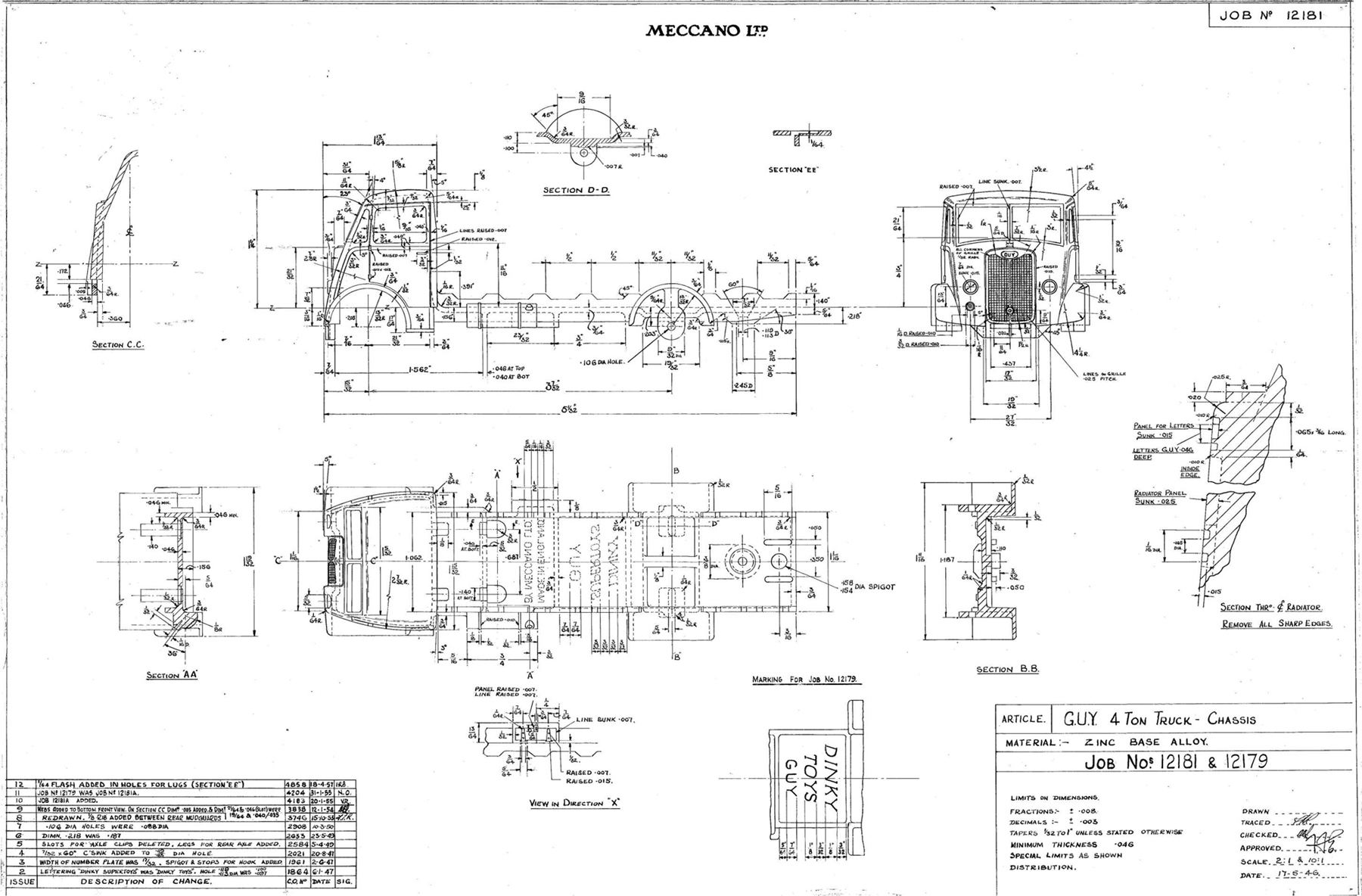
Cab and chassis drawing, jobs 12181 and 12179 (former Peter Golden Collection).
New large scale design drawings weren’t necessary for the creation of the cab and chassis casting of this van. This basic component had already been drawn at an earlier stage in May 1946, developed for the three Guy truck versions.
Body drawing, job 13011 (former Peter Golden Collection).
The body of course was new and its design was approved on 28th January 1948. It had its own tinplate floor. The two rear doors could be opened and closed and they could be unlocked by lifting them slightly using the door handles. Early Guy vans have straight door handles while later ones have them angled downwards at 50 degrees.
Guy van doors drawing, jobs 13012 and 13013, with detail showing the downward angled handles, as applied on 6th March 1952 (former Peter Golden Collection).
The adjustment to the actual door handles: 1950 “Slumberland” (straight), 1953 “Spratt’s” (angled downwards).
This change of 6th March 1952 is documented in the drawing of the doors, comprising job numbers 13012 and 13013. This modification, a bending action to be performed after casting, is one of the many interesting and subtle detail changes that weren’t recorded by Mike & Sue Richardson as a “significant change” in their Great Book of Dinky Toys. As a novelty, the movable doors were held in place by hinges of thin wire, thinner than regular wheel axles, and crimped at the lower ends only. This construction was used repeatedly in the 1950s, for instance by the Big Bedford Van, the Military Ambulance, the Pallet Jekta Van and others. The towing hook, present on Guy trucks, was omitted.
The early square versus later triangle shaped details in the front license plate area.
Being the first one, the “Slumberland” van’s components had all the technical characteristics of the early trucks: the first version of the die (with the square lower front line edges instead of the later triangle shaped supports next to the registration plate), the early rear axle clamps, and the early ridged “Dinky Toys” hubs.
Washer for chassis and spare wheel mounting in the “Slumberland” van’s body.
By comparing the mounting of the spare wheel with an early version of the Guy Lorry No. 511, it will be noticed that no screw or nut were used to attach the spare wheel of the van; instead a small washer was used. This solution was probably chosen because the top of a bolt, inside the van body, would be inaccessible for assembly with a conventional screwdriver.
The magnified details of the “Slumberland” van’s lettering showing their hand written origin.
I’m particularly struck by those splendid golden letters, especially in an undamaged, shiny model. Even through the eyes of a foreigner, the “Golden Slumbers” legend is very attractive, unique and characteristic for British typography on vehicles of this period. A magnifying glass or high resolution scan reveals several minute details: the smaller black letters turn out to have been designed by drawing them manually. Although irregular, they don’t appear to be so when observed with the naked eye. The overall typography is tasteful and crisp.
The model’s box, marked “S” for “Slumberland”.
Whereas the ‘Slumberland’, ‘Lyons’ and ‘Weetabix’ vans share the same catalog number, the model shown on the box was – though small and in grey-scale – not generic. It was definitely the ‘Slumberland’ van. It is remarkable that the ‘Slumberland’, like the ‘Lyons’, unfortunately has never been advertised in color, neither on the box, nor in any catalog or in other advertising material. In contrast to their contents, and compared with the later bright blue striped lid boxes with colorful pictures of the models inside, the boxes of this early trio were uniform and dull. They were all blue with two-tone black and orange labels pasted over the lid. The matt blue of this period is very susceptible to fading due to its high sensitivity to light.
At first glance, it seems the “Slumberland” van didn’t have any variations in casting or finish. The only difference that’s mentioned is in the the shine of the gold lettering. This may have been caused by variations in the printing of transfers and also the effect of exposure to the elements over time, thereby affecting the resulting look. Despite the seemingly stable general layout outlined above, there are some lesser known and seldom observed subtle differences in the appearance of the “Slumberland” van to which I’d like to draw attention. My 11th edition of Ramsay’s British Diecast Model Toys Catalog and several other reference works mention the existence of a first type cab only which I concede. But they also mention a “ridged” (Dinky Toys) hubs only model whose existence I challenge.
The scarcer later grooved hub version on the right (former Rob van der Hoort collection).
Although scarce, there are also “Slumberland” vans with “grooved” Dinky Supertoys hubs in existence. These may have been overlooked because they appear to not have been sold in the U.K. and many other countries to which Dinky Toys were commonly exported. This complies with the commonly mentioned final year of 1951 for this livery, because this change in hubs didn’t occur before 1952. My 1951 Dutch catalog shows the “Slumberland”, followed by the “Weetabix” picture and caption in 1952. The same goes for the British catalog of 1952, which neither shows nor mentions the “Slumberland”. However, the “Weetabix” is presented there. 1952 is often referred as the final year of the “Slumberland”. The first mentioned year is justified more or less by the familiar catalogs. But almost all of the very few “Slumberland” examples with grooved hubs that have came up for auction in past decades had a Hudson-Dobson sticker on their boxes, revealing their U.S. provenance. An example from a Vectis “Simply Dinky” auction catalog of 5th November 1997 was qualified by the auction house as “with super toy wheels, this is an extremely scarce item issued for the US market only”.
Still available in the USA: page from the 1952 Hudson-Dobson catalog featuring the “Slumberland” van.
This is confirmed by the 1952 Hudson-Dobson U.S. catalog that indeed includes the “Slumberland”, albeit with an obsolete picture showing ridged hubs! As stated earlier, the grooved Supertoys hubs had been introduced during 1952.
The scarcer grooved hub version of the 1952 mode on its box showing the downward angled door handles and the Hudson-Dobson sticker, along with the more common early issue model in the foreground with the straight handles (former Rob van der Hoort Collection).
Although not recorded in similar auction catalog descriptions, the one of a kind shown here is provided with the new downward angled door handles. So I presume that all instances of the final “grooved hubs” batch of models also sport the later angled door handles. This makes sense and the puzzle starts to fit.
Why were they available in the USA only, and not on the “older side” of the Atlantic, or in British Commonwealth countries? Without access to other documentation, I can only make an educated guess. While the final batch with grooved hubs was in production, probably in the first half of 1952, the “Slumberland” van’s advertising text was suddenly outdated. It likely read “...bedding manufacturers to H.M. the KING”. But meanwhile King George VI had died in February 1952 and there was now a female monarch! This batch could not have been large in number, because the “Lyons” and “Weetabix” models were also available early that year. But what to do with this late, outdated “Slumberland” production run? Although this text may not have been of overwhelming importance, at least not in the eyes of young children, King George’s death may have led to some embarrassment and contributed to the earlier discontinuation of the “Slumberland” van in the U.K. and in countries other than the United States.
In the United States, obsolete Dinky Toys like the present “Slumberland” van with its outdated text, grooved hubs and downward angled rear door handles, found a hospitable market without serious competition. For Meccano, the marketing of the new “Weetabix” van apparently took priority in 1952, as this newcomer appears in the May and September 1952 U.K. catalogs, with no mention of the previous ‘Slumberland’ and under advertised ‘Lyons’ models.
The very rare black hub version, this example (lot 2184) sold at the Vectis “Simply Dinky 15” auction of May 2009, shown along with a pair of contemporary first issue 1948–1949 Bedford Articulated Lorry models with the same black hubs. (Image: Vectis Auctions)
In 2009 another unknown version of the Guy “Slumberland” came to light. The 15th Vectis Simply Dinky auction of May 2009 featured a “Slumberland” van with black painted ridged hubs, a most surprising item in a stunning anonymous “single owner collection”. Contrary to the late version with the grooved hubs, this example must have belonged to the very earliest batch of “Slumberland” vans to leave the Binns Road factory in the latter months of 1949.
Apparently some of the very first Guy vans have surprisingly been fitted with the characteristic satin finished black hubs of the 1940s. Compare, for example, related early Dinky Supertoys of the period, like the Guy trucks and also the Bedford Articulated Lorry with their black hubs. Indeed this hub color change took place at the end of 1949, during the birth of the “Slumberland” van. I’ve never seen a reference to this variant before. But that’s just me; it may be more convincing that Vectis stated in their catalog, “...Extremely rare with black ridged hubs, one that Vectis Auctions has never seen before.’ Isn’t it amazing that even after so many years, never before seen variants of otherwise well known Dinkys still turn up?
The only mystery I haven’t yet discussed is the obvious two or even multi-tone (albeit grey scale) representation of the “Slumberland” van, both in Meccano magazines and on the box as shown above. The front wings seem to be dark or even black, the cab and chassis are of a medium shade, and the body of the van is apparently finished in a brighter color. I can hardly imagine that such a colorful early bird would show up by surprise. It’s more likely that only a provisional mock up was available to the picture artist, a van box with “Slumberland” design mounted on an easily available Guy truck cab/chassis unit, in its early finish with mudguards in contrasting color, and darker or possibly even black hubs.
The Corgi Toys Thames van “Slumberland’.
We conclude our “Slumberland” story by touching for a moment on some modern versions, inspired by or directly based on the Dinky Supertoy. First, the modern Corgi Toys version of the “Slumberland” van that was introduced in 1996. On closer look, it seems Corgi retained the royal coat of arms but left out the “manufacturers to H.M. the KING” (or “Queen”?) text. A safe and timeless solution! Although well done, it’s hard for me to not think that Corgi’s main intent was to satisfy a nostalgic sentiment for the Dinky Toy by almost copying the Dinky model in every respect. The only obvious difference was the choice of a newer 1960s Thames Trader cab truck.
The Promod Commer van “Slumberland’.
This also applies to the Promod model, this time using a Commer C‑series cab. The old “Slumberland” in modern disguise. A dedicated Dinky collector will however see through this and would likely prefer the honest vintage character and solid quality of the one and only real Dinky Guy van “Slumberland”!
The modern DAN-Toys replica.
There’s also the modern replica of the Dinky, the DAN-Toys issue. This is a very nice replacement for those who interested in owning an affordable version of the original, but not in a harder to find and more expensive perfect original Dinky. For them, there’s no objection to the small differences that would annoy a purist Dinky Toys collector: the unjustified triangular supports next to the license plate, the slightly oversized high gloss axle ends, and the overly perfectly produced lettering. But that’s a problem for the nitpicker.
Author’s Note
This article was first published in the Christmas 2009 issue (volume 7, number 5) of The Journal of the DTCA. It has since been extended and brought up-to-date for publication at DinkyFans.com, with the inclusion of several new and higher quality images.
In my opinion one of the nicest automobile castings that Meccano France produced in the 1950’s was the 24 series Dinky Toys Chrysler New Yorker convertible, based on the 1955 model of that well known American car maker. These were finished in red, then yellow, and finally in a lovely shade of metallic blue.
1956 Dinky Toys France catalog. Image: hobbyDB.
This model also features another wonderful example of silver detailing, not only on the intricate front grill, but also on the sweeping side spears.
When introduced in the U.S. they were priced at $1.75, when most other Dinky models cost $1.00-$1.25. So quite expensive at the time, but well worth it!
After the war, Meccano Liverpool resumed production and announced the first new models as quickly as possible. The first new model selected was Dinky Toys Jeep No. 153A. It’s not surprising, really, that this particular model was chosen by Meccano Liverpool immediately after the war. It’s a reproduction of the famous American Army Jeep that played a significant role in WWII. The U.S. Army Jeep is constructed to conform to the USA War Department technical manual TM 9–803 1/4‑Ton 4 x 4 Truck (Willys-Overland model MB and Ford model GPW), simply called “Jeep”. I’ll show you some photos of it in this article. During the war, this Jeep was transported disassembled in crates by ship from America to England, where it was reassembled in various assembly depots. From there, it was later shipped to the coast of Normandy for the D‑Day invasion. England thus played a significant role in assembling and preparing this Jeep for use. I feel it’s important to mention this and therefore want to first focus on the prototype of the Jeep itself.
Willys Jeep MB on a conveyor belt, dismantled in crates for transport overseas.
The Jeep Willys-Overland was shipped overseas in crates from Toledo, Ohio.
Instructions for unpacking and assembly of a boxed Willys Jeep.
The Jeep is a well-known vehicle, made famous by the United States during WWII as the U.S. Army Jeep, with its white U.S. Army star on the hood, which was used extensively by the United States and the Allied Forces. This four-wheel-drive all-terrain vehicle acquired iconic status due to its versatility during the war and played a significant role in its victory. General Dwight D. Eisenhower wrote that the jeep was “one of the six most vital” U.S. vehicles to win the war. This Jeep can still be seen today participating in liberation parades. Well over 600,000 were built to a single standardized design for the United States and the Allied forces in World War II from 1941 to 1945.
There is a long history behind the development of the Jeep before it was finally put into production. The Jeep had to meet a number of strict requirements for the U.S. government to be eligible for military production during World War II. These requirements encompassed a combination of technical specifications, performance, reliability, and production capacity. The vehicle had to have four-wheel drive and be lightweight and compact. A competition developed among manufacturers to meet the U.S. government’s requirements.
Bantam, Ford, and Willys-Overland built prototypes that were fully tested. The Jeep history Amsoil blog states “The final Jeep design was a mashup of the best from each proposal: The Bantam Spicer-sourced four-wheel transmission and differential was mated with the Willys Go-Devil engine and fitted with the bodywork configuration of the Ford Model GP.”
Only Willys-Overland met all the requirements and was the only manufacturer to receive a government permit to produce this ¼‑ton 4x4 truck, the Willys-Overland model MB, starting on 23 July 1941. Because Willys-Overland could not produce sufficient quantities, Ford received a permit to produce the truck under license for Willys-Overland as the Ford model GPW (W = Willys-Overland) starting in October 1941. During World War II, approximately 363,000 Willys MBs and 280,000 Ford GPWs were produced. This 4 x 4 truck was standardized, meaning that all components of the truck were interchangeable. The parts from the Willys-Overland MB fit seamlessly on the Ford GPW and vice versa, which was important for repairs.
The prototype of the Dinky 153A is the Willys-Overland model MB, which is also similar to the Ford model GPW. Both Willys and Ford are mentioned as the manufacturer in technical document TM 9–803, with descriptions and illustrations, as shown below. The document refers to the vehicle as the ¼‑ton 4 x 4 truck (Willys-Overland model MB and Ford model GPW). The generic name “Jeep” had yet to emerge and likely arose from the designation of the Ford model GPW, where GP(W) was pronounced as “Jeep”. Note the handles on the side of the Jeep, indicated by red arrows. When a Jeep was delivered and unpacked in a crate, four handles were first mounted to the chassis to facilitate lifting.
War Department Technical Manual for the Willys-Overland model MB and Ford model GPW – February 1944.
Jeep left front view. The red arrows indicate the handles used to lift the body.
U.S. Army Willys MB at the Virginia War Museum, Newport News, VA. Image: Wikipedia.
Right rear, right and right front views of the Jeep.
Covered Willy’s Jeep (2007). Image: Wikipedia.
Jeep chassis plates.
The Willys and Ford Jeeps have their own nameplates on the dashboard, along with the Caution and Shift plates. The Caution and Shift plates are the same for both models. Only the nameplate reveals whether the vehicle is a Willys or a Ford. Experts can also tell the difference between the models by the grille of the early Jeeps.
Dashboard of a Willys Jeep showing the name, caution and shift plates.
Use of the Willys Jeep by Leaders in WW II
During World War II, the Willys Jeep became an indispensable tool for U.S. Army leaders operating across Europe, prized for its rugged versatility and reliability in challenging conditions. Senior officers used these compact 4x4 vehicles to travel quickly between command posts, inspect front-line positions, and coordinate operations over difficult terrain where larger vehicles could not pass. In war-torn regions of France, Belgium, and Germany, the Jeep’s ability to navigate muddy fields, bomb-damaged roads, and narrow village streets made it an ideal choice for military leadership on the move. More than just transport, the Jeep symbolized mobility, adaptability, and the U.S. Army’s ability to project leadership anywhere it was needed.
President Franklin D. Roosevelt reviewing troops from a Jeep at Casablanca, 1943. Image: Wikimedia.
In the summer of 1944, General Dwight D. Eisenhower wrote the Jeep was “one of the six most vital” U.S. vehicles to win the war. Image: Wikipedia.
General George Patton riding in a Jeep near La Haye-du-Puits, Normandy, July 1944. Image: World War Pictures.
Prime Minister Winston Churchill and General Bernard Montgomery visit the beaches of Normandy, 12 June 1944. Image: Wikimedia.
Dinky Toys 153A Jeep
Meccano Liverpool announced the arrival of the Dinky 153A Jeep along with the Dinky 28C Lagonda Sports Coupe in the April 1946 issue of Meccano Magazine with the statement, “Now ready! Here are the first of the new Dinky Toys for which you have waited so long. Others are coming soon. Watch our announcements.” The 38C Lagonda had already been designed before the war and announced in the June 1939 issue of Meccano Magazine, but hadn’t yet been produced, so it wasn’t entirely new after the war. The description of the 153A Jeep read “A wonderfully realistic miniature of the most famous car of the war. On all fronts, in all countries, the Jeep was ready to go anywhere and do anything.” The models were apparently not yet available for sale, because the announcement “Now ready!” was repeated monthly until September 1946 when 153A Jeep, 38C Lagonda Sports Coupe and 70A Avro “York” Air Liner were announced in Meccano Magazine as “Now available!” This was the start of the new post-war Dinky Toys series, made by Meccano Liverpool.
Advertisements for the Dinky 153A Jeep in the April 1946 (“Now ready!”) and September 1946 (“Now available!”) issues of Meccano Magazine.
Meccano Liverpool used the well known name “Jeep” for model 153A without a brand or model designation. I described the Willys MB as the prototype of the 153A Jeep as depicted in the U.S. War Department Technical Manual TM 9–803, because only Willys-Overland got permission to produce the U.S. Army Jeep, while Ford received a permit to produce the truck under license for Willys-Overland as the Ford model GPW (W = Willys-Overland). However, both models are identical. This makes it in fact impossible for Meccano Liverpool to select a specific brand name for the Dinky Toys model name because the Jeep was manufactured by both companies. According to Mike and Sue Richardson’s Great Book of Dinky Toys, model 153a was produced from 1946 to 1955, but from 1950 onwards only as a U.S. export model. So the production run of the 153A for the U.K. was very short. The last mention of 153A in the U.K. catalogs I found was in the Meccano UK price list from September 1948. The 153A didn’t appear in U.K. catalogs from 1950 onwards.
Dinky 672 U.S. Army Jeep export model
In 1950, Meccano Liverpool changed the name of the 153A to U.S. Army Jeep which was exclusively intended for export to U.S.A. and Canada. This was followed by a similar change of name in catalogs and trade boxes which better describes the real identity of the vehicle. In 1954, model 153A was renumbered to 672, but as mentioned, it was only intended for export to U.S.A. and Canada. Exports were crucial to the survival of large companies after the collapse of the economy caused by World War II. “Export or die!” was the government’s motto. According to Keith Harvie, from 1952–55 a new body casting was released as the export 153A and 672, with modified front inner hood strengthening points and flush casting gates, a raised hood, and a paint ring. Because the Dinky 672 is an export model and the last issue, they are hard to find.
Dinky Toys USA 1951 catalog showing the 25J Civilian Jeep (left) and the 153A U.S. Army Jeep with the U.S. Army star (right).
The 153A U.S. Army Jeep renumbered to 672 in the Dinky Toys USA 1954 catalog.
The Jeep model 153A was also released in civilian versions as model number 25J with the same casting as the 153A. However in this article, I will limit myself to the original military version 153a/672. Many military vehicles ended up in the army dump after the war. Due to a shortage of vehicles after the war, the remaining Jeeps were used for all sorts of civilian purposes. Meccano Liverpool continued to produce the 25Y/405 Universal Jeep with the spare wheel mounted on the right in various civilian versions. Willys-Overland also continued to produce civilian Jeeps after the war.
My Dinky Toys Jeep collection on Keith Harvie’s 1999 “The Binns Road Gazette” magazine, issues 1 to 6.
In a 1999 article in the first issue of the unfortunately short-lived magazine Binns Road Gazette, U.S. publisher and editor Keith Harvie described all the versions of the Dinky Toys Jeep and presented them in black and white photographs that included factory drawings. His description includes the following six versions:
1946: First casting with flat hood and solid steering wheel, no painting ring and smooth hubs.
1947: As above but with open steering wheel and ridged wheel hubs.
1948: As above but with raised ejector marks. (The ejectors were too short or worn.)
1948 — 1952: As above but with circular painting ring.
1952 — 1955: Final U.S. only export issue. As 153A-672 above but with strengthening under the hood, flush ejector marks, crimped or domed axles, blued or regular axles, pointed raised hood in center line, and paint ring.
All issues were sold to dealers in trade boxes of six and didn’t receive an individual box.
Front and rear view of the first issue Dinky 153A trade box of six (1946). Note the closed solid steering wheels. Image: Vectis Auctions.
The first issue 153A (1946) with closed solid steering wheel and smooth hubs, and U.S. Army star on the left rear only.
Front view of the first issue 153A showing the flat hood, grill and sunken headlights.
Top view of the first issue 153A showing the encircled U.S. Army Star on the hood.
Base of the first issue 153A without the painting ring in center. Note the rare metal rings around the axles between the hubs and axle support. Axles of the Jeep usually lacked these metal rings.
My four first issue Jeeps, all with smooth hubs but different tires, and three solid and one open steering wheel.
The final issue Dinky 672/153A U.S. Army Jeep in a U.S. export issue trade box (1952–55). Image: J K Diecast Models.
Dinky 153A/672 U.S. Army Jeep 1952–1955 final issue U.S. export model with strengthened inner hood area, painted insignia, convex raised hood and crimped axle ends.
Left side of the Dinky 153A/672 U.S. Army Jeep export issue. Note the fine cast details of the shovel, handles, windshield, hood latch, top bow front and rear brackets for a canopy, with canvas and side reflector.
Front view of the Dinky 153A/672 U.S. Army Jeep export model showing the grill, sunken headlamps and hood with raised center.
Rear details of the Dinky 153A/672 U.S. Army Jeep export model showing the spare wheel, jerry can, bumpers and reflectors.
Underside of the Dinky 153A/672 U.S. Army Jeep export model showing the reinforced inner hood area and painted central ring. L: Blue crimped axle ends. R: Last issue with regular domed axle ends.
Dinky 153A with raised ejector marks. L: 4th version without painted ring. R: 5th version with painted ring.
Dinky 153A Jeep base with flat ejector marks (L) and raised ejector marks ®.
Evolution of the base of the Dinky 153A, with the oldest to newest shown R to L.
Side view of the evolution of the hood of the Dinky 153A/672, going from flat (earliest version) to raised (latest version) shown R to L.
Front view of the evolution of the hood of the Dinky 153A/672, going from flat (earliest version) to raised (latest version) shown R to L.
L: Dinky 153A first issue with flat hood and crimped axles. R: Dinky 672 last export issue with raised hood and domed axles.
Dinky 672 U.S. Army Jeep final U.S. export issue (1952–55) with raised hood and domed axles (L) and crimped axles ®.