Blog

  • Dinky France GMC CCKWs

    Dinky France GMC CCKWs

    The 881 Pinder circus truck and cage trailer was released in 1968. It was the first GMC model in the four GMC model lineup. The first image shows the original Meccano France ad while the next pair of pictures show two views of the model.

    Mil­i­tary toys were ever-present in the Dinky Toys line­up, from the start of the com­pa­ny in the 1930s all the way up to their demise in 1979. Dinky France also had mil­i­tary toys in their offer­ings, and many of these Dinky France mil­i­tary mod­els were con­sid­er­ably more detailed than their Eng­lish Dinky mil­i­tary cousins — espe­cial­ly when it came to the superb GMC army truck mod­els that first appeared in 1968.

    This is the actual Pinder truck that Meccano modelled.
    Image: Jaap Schroder

    These detailed Dinky France mod­els were based on the leg­endary WWII GMC CCKW 2.5 ton 6x6 trucks which went into ser­vice in 1940. After the Jeep, these trucks are prob­a­bly the most rec­og­nized truck ever made. The 2.5 ton car­go truck was con­sid­ered such an asset that (as Gen­er­al Eisen­how­er wrote) many offi­cers regard­ed it as one of the six most vital vehi­cles to win the war. Over 570,000 were built from 1941 to 1945, and they served in every com­bat the­atre dur­ing WWII with US Forces and the Allies. They were extreme­ly reli­able and very durable vehi­cles.

    After the war, the US left thou­sands of these trucks behind in Europe to assist in the rebuild­ing of the shat­tered post­war infra­struc­ture. Many were rebuilt, some fit­ted with Euro­pean diesel engines and re-bod­ied with unique local­ly sourced cabs that com­plete­ly trans­formed their appear­ance. Espe­cial­ly pop­u­lar in the Nether­lands and France, many were still in oper­a­tion into the 1990’s – in civil­ian and mil­i­tary ser­vice – a tes­ta­ment to their robust con­struc­tion.

    The CCKW name is from GMC mod­el nomen­cla­ture. The first C is for the year 1941, the sec­ond C is for con­ven­tion­al cab, K is all wheel dri­ve and W is tan­dem rear axles. They were pow­ered by GMC’s own 91.5 hp 269.5 inch six cylin­der engine, dri­ven through a Warn­er 5‑speed man­u­al trans­mis­sion with a two-speed trans­fer case.

    The CCKW was built with an almost end­less list of bod­ies. These includ­ed a short wheel­base CCKW-352 and a long wheel­base CCKW-353. Steel closed cabs were offered first but lat­er; to save steel, soft-top cabs became the norm. These long wheel­base trucks were eas­i­ly iden­ti­fied as they had the spare tire mount­ed under the chas­sis on the driver’s side. Many of the trucks were fit­ted with front winch­es sup­plied by Braden and Gar­wood.

    The original U.S. Army Technical Manual sheet of the real thing.

    The CCKW-353 with a soft top cab was mod­elled by Mec­ca­no in 1/43 scale. Dinky France offered these in four ver­sions: a car­go truck, tanker, wreck­er, and a Pin­der Cir­cus truck with trail­er.

    The third GMC released was the cargo truck in 1970. Early versions came with the typical of the era road sign while later versions didn’t. This picture shows the original Meccano ad.

    All the Dinky GMCs shared some com­mon traits. These includ­ed a remov­able plas­tic soft top on the cab, plas­tic sil­ver paint­ed head­lights with guards, rear tow hitch, a very detailed dri­ve­train, under chas­sis spare tire, and an oper­a­ble front winch. The cab and chas­sis were die-cast with met­al wheel hubs and ten rub­ber tires. They were all pack­aged in illus­trat­ed end flap box­es (typ­i­cal of the era) labelled Super Dinky. Unfor­tu­nate­ly, these are flim­sy and prone to dam­age, due to the weight of the mod­els.

    The first mod­el in the GMC line­up was the 881 Pin­der Cir­cus truck with trail­er, released in 1968. This long and col­or­ful mod­el was avail­able until 1971. It fea­tures a high sided yel­low plas­tic car­go body on a red truck with an oper­a­ble tail­gate. It towed a two-axle, three-cage ani­mal trail­er with open­ing cage doors. The trail­er was mold­ed in yel­low plas­tic and had a red diecast chas­sis. Stick­ers were includ­ed along with three ani­mals (a lion, tiger and pan­ther) in a wax­ine bag and – typ­i­cal of the Dinky France era – a road sign with an infor­ma­tive leaflet. The inner pack­ing on this mod­el was a long yel­low card­board base which the truck snug­ly sat in. There was also a yel­low long four-sided card­board pack­ing piece which sat on top of the truck and trail­er.

    Next released was the 353 Mil­i­tary Tanker in 1969. This green truck was the most detailed in the line­up as well as the most frag­ile. The tank body was plas­tic and fea­tured open­ing filler caps. It came with a water slide decal sheet as well as a road sign and infor­ma­tive leaflet. French Army Fuel Ser­vice decals adorn the sides of the tank, and a flam­ma­ble liq­uids decal was fac­to­ry installed at the rear. Despite being mar­ket­ed as a fuel tanker, it was mod­elled on the 700-gal­lon Army water truck. The water tankers had the very dis­tinc­tive elon­gat­ed pair of almost man­hole like filler lids, where­as the fuel tankers did not. When Mec­ca­no sent the mod­el mak­ers out to pho­to­graph the real truck it had been most like­ly con­vert­ed into a fuel tanker by the French army. They did a superb job mod­el­ling the tank body and filler caps as well as repli­cat­ing the small cab­i­net behind the driver’s side cab that on the real truck housed a one cylin­der air cooled motor that could fill or drain the insu­lat­ed and heat­ed tank. The 353 also came with a yel­low low­er box insert like the Pin­der mod­el and a unique upper pack­ing piece that pro­tect­ed the ever so frag­ile filler caps. This truck was with­drawn in 1970.

    Two views of the model.

    The 809 car­go truck was released in 1970 and fea­tured a remov­able plas­tic tilt cov­er­ing a plas­tic car­go body, with oper­a­ble tail­gate and a plas­tic two-piece dri­ver. Despite some of the oth­er GMCs hav­ing a hole in the driver’s seat, this was the only GMC to be fit­ted with a dri­ver. Like the tanker it was army green and includ­ed a water slide decal sheet. It also came with a low­er box insert like the tanker. Ear­ly ver­sions came with a road sign and infor­ma­tive leaflet while lat­er ver­sions did not to save costs. It was with­drawn in 1971.

    The last mod­el in the GMC series came after Mec­ca­no had closed its fac­to­ry in Bobigny and was there­fore pro­duced in Calais. This was the sand-col­ored 808 wreck­er of 1972, with­drawn in 1973. The green ver­sion would fol­low in 1974 and was with­drawn in 1976, mark­ing the end of the GMC series.

    A real CCKW 353 that’s been beautifully restored and is just like the No. 809.
    Image: Mathieu Dumias of Military Classic Vehicle,

    Grandcamp-Maisy, France.

    These iden­ti­cal mod­els fea­tured the plas­tic car­go body from the car­go and cir­cus truck mod­els sans tail­gate. They were fit­ted with num­ber plates and a plas­tic over­head I‑beam frame assem­bly with an oper­a­ble slid­ing hoist with hook. There was an off white cor­ru­gat­ed pack­ing piece to pro­tect the frag­ile boom and no low­er pack­ing piece.

    The road to victory was absolutely grueling so preventative maintenance checks were  crucial for the GMC and the U.S. 1st. Army from the Western Front highlighted the “nine main causes of failures” to watch for in this notification.

    There have been vary­ing opin­ions over the years about this mod­el being a bomb truck rather than a wreck­er and I have detailed the dif­fer­ences here to clar­i­fy this. There was only one CCKW wreck­er in real life and it was known as the Set No. 7. The Set No. 7 truck had a sim­ply designed invert­ed U frame I‑beam hoist sup­port that goes down to con­nect at the front cen­ter of the truck bed, just as the No. 808 does. It also has a pair of tubu­lar sup­ports run­ning from the rear of the hoist frame up to the very end of the hoist rail to pro­vide sup­port, again just as the No. 808 does. How­ev­er, the No. 808 tubu­lar sup­ports don’t go to the end of the hoist; they go to the mid­dle of the rail and grab the top of the rail, which is incor­rect com­pared to the real truck. With Mec­ca­no doing such a fine job repli­cat­ing these mod­els it seems odd that they repli­cat­ed the sup­port incor­rect­ly.

    The No. 808 wrecker, first appearing in sand in 1972 and green in 1974, replacing the sand version were both identical models. It was withdrawn by 1976, ending the GMC series. These models were most likely based in real life on Set No.7 wrecker which was the only CCKW that was a wrecker. This picture shows the original Meccano ad.

    Mean­while, there was only one CCKW bomb ser­vice truck in real life: the M27 and the lat­er M27A1 mod­els. These trucks have a notice­ably dif­fer­ent, taller, more com­plex full length hoist rail with dou­ble slid­ing trol­leys sup­port­ed by two A frames that don’t bend down to con­nect with the truck bed at the front cen­ter like the Dinky GMC and Set No. 7 wreck­er. The oth­er “wreck­er appear­ing” CCKW was the Truck, Chem­i­cal Ser­vice, M1. This truck used the almost iden­ti­cal invert­ed U frame I‑beam hoist as the Set No. 7 truck, but with­out the pair of tubu­lar sup­ports com­ing off the rear to rein­force the rail. These trucks were used for trans­port­ing large chem­i­cal bar­rels.

    Two views of the models.

    These Dinky France GMCs are more mod­el than toy and are the most detailed repli­cas of the CCKW ever pro­duced by a toy com­pa­ny. Mec­ca­no could have been mar­ket­ing these more towards the adult col­lec­tor more than chil­dren, espe­cial­ly con­sid­er­ing all the frag­ile fea­tures. Many “Gold­en Age” Dinky col­lec­tors frown upon these fine trucks due to the high amount of plas­tic used in their con­struc­tion; this is unfor­tu­nate as they are very accu­rate rep­re­sen­ta­tions of the real thing. They are tru­ly in a dif­fer­ent class of mil­i­tary Dinky Toy with the lev­el of detail they offer com­pared to their Gold­en Age coun­ter­parts.

    This 1945 Saturday Evening Post ad is one of the few that General Motors made for the CCKW that featured the later soft top cabs.

    Hav­ing been born in 1970, I nev­er knew these mod­els – or oth­er Dinky France mod­els for that mat­ter – exist­ed until the late 1980’s when I pur­chased my first Dinky Toys col­lec­tors’ book by Dr. Edward Force. As a child I nev­er saw any French Dinky Toys in toy stores because they were not being offi­cial­ly import­ed into the USA like some of the French line­up had been in the past. How­ev­er, Dinky France mod­els were unof­fi­cial­ly import­ed to the USA by sev­er­al firms includ­ing Mem­o­rable Things of Tow­son, Mary­land and Mar­que Prod­ucts, a South­ern Cal­i­for­nia importer of fine toys and diecasts dur­ing the ear­ly 1970s. Fel­low life­long col­lec­tor Jonathan Angel con­firmed this fas­ci­nat­ing part of USA Dinky Toys his­to­ry with me as he pur­chased his French mod­els new back then from these importers.

    The vintage photo is a Set No.7 in Korea with the U.S. Army in 1953. Note the clearly visible rear support which Meccano incorrectly replicated and the cargo load on the real truck. Its view is partially blocked by an WC 52 ¾ ton truck fitted with an A‑frame hoist.

    On the col­lec­tabil­i­ty front, mint/boxed exam­ples of all four of these trucks are get­ting hard­er to find as time march­es on, and they have nev­er been inex­pen­sive. The frag­ile con­struc­tion didn’t help their sur­viv­abil­i­ty, and they didn’t have long pro­duc­tion runs. I’ve been look­ing at prices for years and the Pin­der GMC is the most valu­able with the tanker com­ing in next, but the tanker seems to be the most elu­sive to find and is often bro­ken, where­as the wreck­ers, Pin­der ver­sion and car­go trucks show up more fre­quent­ly.

    Some have suggested that the No. 808 was a bomb truck but the M27 bomb trucks overhead boom assembly is clearly different and more complex than the Set No. 7 wrecker

    The only other “wrecker appearing” CCKW was Truck, Chemical Service, M1. It transported heavy chemical barrels and lacked the rear support brace of the Set No. 7 wrecker.

    The 1976 Meccano France trade catalog featured the wrecker and cargo truck.

    The mod­els shown in this arti­cle and group pho­to rep­re­sent almost 35 years of col­lect­ing for me. I have always strived to get the best and most com­plete exam­ples I could afford, with all the cor­rect pack­ing and acces­sories.

    My tanker and car­go truck came from Andrew Clark in 1993. Both mod­els are near­ly pris­tine and the ever-so-frag­ile tanker caps are intact. The car­go truck is the lat­er issue with­out the road sign.

    My sand wrecker–the more com­mon version–was pur­chased from Car­tel in 1992, and the green wreck­er came from Domin­ion mod­els in 2014.

    Final­ly, my Pin­der truck was pur­chased in 2018, and it came from a South­ern Cal­i­for­nia eBay sell­er who I had pur­chased from in the past. While I always admired this ver­sion, I pre­ferred the army ver­sions over the Pin­der vari­ant and the fact that this truck is always very expen­sive was dis­cour­ag­ing. They are also often incom­plete with miss­ing ani­mals, decals and the inner pack­ing pieces. How­ev­er, this one caught my atten­tion from the auction’s start­ing price and the seller’s descrip­tion which stat­ed it was recent­ly removed from deep stor­age since pur­chased new. I was the only bid­der for what was an afford­able price, and the mod­el and box are as new. It looks like it was made yes­ter­day. The seller/collector was very nice and shared that the orig­i­nal own­er, also from South­ern Cal­i­for­nia, pur­chased hun­dreds of assort­ed new diecasts begin­ning in 1950’s into the 1970’s.

    They were then stored away, nev­er to be seen again until the first owner’s pass­ing. It was an incred­i­ble find and it com­plet­ed my GMC col­lec­tion.

    This was an enjoy­able arti­cle for me to write as I have been a com­mer­cial and mil­i­tary vehi­cles enthu­si­ast since I was a child and I always learn some­thing new when I break out the truck books from my trans­port library!

    Acknowledgement

    Writ­ing an arti­cle like this is nev­er a one-per­son endeav­or so very spe­cial thanks go to Jonathan Angel, Math­ieu Dumias, Jaap Schroder and his great Het tweede lev­en van GMC’s (The sec­ond life of GMC’s) site, Jacques Dujardin and David Doyle.

  • Which Foden is Which?

    Which Foden is Which?

    Many col­lec­tors have some knowl­edge of the two ver­sions of the Dinky Toys Foden trucks, that the Eng­lish Mec­ca­no fac­to­ry made. The first, ear­ly ver­sion was made from 1947 through 1952, and was then replaced by the sec­ond ver­sion, reflect­ing the new­er style cab. Besides the new look, Mec­ca­no also intro­duced sev­er­al oth­er changes: new recessed style Super­toys wheels are very vis­i­ble and obvi­ous, but Mec­ca­no also choose to improve the over­all strength of the mod­els, by also chang­ing the axles and also the way there were sup­port­ed.

    First, they great­ly increased the diam­e­ter of all Super­toys axles, and, sec­ond­ly, they total­ly changed the way the axles were retained to the chas­sis. Instead of uti­liz­ing a sheet met­al clip, they were now insert­ed through a hole drilled in the chas­sis. The pho­to above shows the under­sides of both the first and sec­ond style Foden Flat Trucks with Chains, clear­ly show­ing these impor­tant changes.

    And this pho­to clear­ly shows the dif­fer­ence between the two cabs and the styles of wheels.

    For a more in-depth look, please see these addi­tion­al arti­cles by me:

  • How French Dinky Became Spanish

    How French Dinky Became Spanish

    In 1964, British toy man­u­fac­tur­er Lines Bros was the out­right own­er of both British Mec­ca­no / Dinky Toys and Mec­ca­no France / Dinky Toys. Although there was lim­it­ed shar­ing of com­plet­ed toys and tool­ing, the two com­pa­nies con­tin­ued to oper­ate sep­a­rate­ly in their own mar­kets.

    That changed in 1971 when Lines Bros went into receiver­ship and Dinky was split. The British side was sold to Air­fix; the French to part of US Food con­glom­er­ate Gen­er­al Mills. Both new own­ers had the same busi­ness strat­e­gy: to close the prob­lem­at­ic main fac­to­ry and relo­cate pro­duc­tion to cheap­er sources. Although Air­fix didn’t take action until 1979, Gen­er­al Mills moved quick­ly. The his­toric French Dinky fac­to­ry at Bobigny was closed almost imme­di­ate­ly and much reduced pro­duc­tion (of most­ly mil­i­tary mod­els) relo­cat­ed to anoth­er fac­to­ry in Calais between 1972 and 1973. They then start­ed to nego­ti­ate low­er cost pro­duc­tion else­where.

    In 1974 low­er cost pro­duc­tion of Dinky cars for the French mar­ket start­ed in SPAIN, made by Pilen SA in Ali­cante. All remain­ing Dinky then pro­duc­tion in France end­ed.

    This 011500 French Dinky Citroen 2CV was made in Spain by Pilen of Alicante.

    Accord­ing to Dinky his­to­ri­an Jean-Michel Roulet, the con­tract with Pilen was to run up to 31st Decem­ber 1978 but was extend­ed for three years until the end of 1981. Some of these Span­ish made French Dinky Toys used orig­i­nal French tool­ing while oth­ers were new. Part of the deal allowed Pilen to use the Dinky tool­ing for their own domes­tic Span­ish ranges. This explains why there are iden­ti­cal Pilen ver­sions of some Dinky Toys as well as recol­ors unique to Pilen.

    The Dinky and Pilen versions of the Citroen DS 23.
    Images: Vectis Auctions and Miguel Soto

    Also in 1981, Air­fix went into admin­is­tra­tion and anoth­er part of the Gen­er­al Mills empire bought British Dinky as well, but they clear­ly had no imme­di­ate plans to use the brand.

    Inter­est­ing­ly, Pilen SA were locat­ed along­side sev­er­al oth­er Span­ish diecast man­u­fac­tur­ers in Ali­cante and mod­els very sim­i­lar to some of the French / Span­ish Dinky Toys such as the Ford Fies­ta and Chrysler-Sim­ca 1308 / Alpine (in Spain: Chrysler 150) lat­er turned up in the MIRA range.

    Images: Miguel Soto

    When the con­tract with Dinky end­ed in 1981, Pilen instead turned to their own pro­duc­tion as well as repli­cat­ing old­er Cor­gi, Soli­do and Tekno mod­els with­out license.

    See also

  • Dinky Toys Vacu-Sweep

    Dinky Toys Vacu-Sweep

    The Dinky Toys Vacu-Sweep ver­sion of their 451 John­ston Road Sweep­er was released some­time in 1972 to coin­cide with the intro­duc­tion of the actu­al machine in the US in late 1971. The no park­ing street sweep­ing sign in the above pho­to makes the per­fect com­pan­ion for the mod­el in this pho­to.

    Background of My Interest in Road Sweepers and Dinky Toys

    Com­mer­cial vehi­cles have been a life­long inter­est of mine since I was about three years old. Some of my favorites are munic­i­pal vehi­cles such as garbage trucks, snow removal trucks, and street sweep­ers. This fas­ci­na­tion got me addict­ed to col­lect­ing the toy ver­sions of their real-life coun­ter­parts. The two hob­bies go hand in hand in for me.

    One of the first Dinky Toys I ever received from my mom was the 451 John­ston Road Sweep­er, I was about five years old. It came from Five Cor­ners Toy and Gift shop in West­wood, NJ. This almost mod­el-like toy had immense play val­ue with its func­tion­ing brush­es, open­ing cab doors and catch basin clean­er attach­ment. It swept many miles of imag­i­nary roads and vac­u­umed pre­tend storm drains on my liv­ing room floor when I was a kid. Hav­ing my “own” street sweep­er was a real treat, and if we passed by a real one in action my par­ents would often stop to let me watch it. Dur­ing the fall, sweep­ers would be espe­cial­ly busy with leaf-removal duties, and spring would have them out clear­ing the streets of the sand and grit left over from the win­ter snow.

    The Dinky Vacu-Sweep promotional model was based on the new for 1971 451 Johnston Road Sweeper.  Image: Dinky Toys 1971 catalog.

    Dur­ing the late 1970s and ear­ly 1980s, my child­hood home­town of Emer­son, NJ had a truck-based street sweep­er that looked just like the Dinky John­ston mod­el. What truck-crazed kid wouldn’t like to have a toy ver­sion of the actu­al machine? This truck replaced an old Elgin Pel­i­can mechan­i­cal sweep­er Emer­son had. The truck was con­fus­ing to me, though, and would be for decades. It clear­ly was an Inter­na­tion­al Car­gostar (a very pop­u­lar cab-over engine truck dur­ing the 1960s into the 1990s in North Amer­i­ca), but it had a large black plaque on the front of the cab in place of the Inter­na­tion­al badg­ing that read ECOLOTEC.

    The mud­flaps also had Ecolotec stamped on them as well as VACU-SWEEP. The Emer­son truck had a red cab and white sweep­er body. I saw it in oper­a­tion occa­sion­al­ly and always want­ed to get a pho­to of it.

    Dennis Trucks made this brochure in 1968 to promote what appears to be a Dennis Dominant chassis for use with the Johnston 200 sweeper.

    Lat­er, when I turned 12 in 1982, my Aunt Jill gave me a Kodak disc cam­era that enabled me to take pho­tos of trucks I liked. I had friends that lived near the Emer­son Depart­ment of Pub­lic Works (DPW). The DPW yard was bor­dered by train tracks and woods at the rear. There was a hole in the fence at the back of the yard, and it was fun to run in there and take some pho­tos — and even climb on the trucks. Sneak­ing into the DPW yard was prob­a­bly not the most social­ly cor­rect thing to do, but we nev­er dam­aged any­thing and we had fun. To my dis­ap­point­ment, the sweep­er was nev­er out­side; it was kept in the garage. I could see the big Ecolotec badge through the win­dow panes of the garage doors. The derelict Elgin Pel­i­can it replaced was out­side; I took a pho­to of that machine, but I was nev­er able to get a pho­to of the Ecolotec sweep­er or find out more about why an Inter­na­tion­al had its name replaced with Ecolotec. It was sold around 1987 and replaced by a Tym­co sweep­er.

    Mechanical sweepers like this early 1970’s Elgin Pelican have dominated the American market for decades and still do.  This example was owned by Emerson, NJ and a Vacu-Sweep replaced it in 1977. I photographed it in 1983 when I was 12 years old.

    While at a traf­fic light in the ear­ly 1990s, I saw the sweep­er again. It was in the ser­vice of a paving com­pa­ny; it had bad­ly degrad­ed, and it was very rusty. It was sad to see the truck that had been so sim­i­lar to one of my favorite Dinky toys as a child, and the one that I had always hoped to pho­to­graph, in such poor shape. This truck would always be remem­bered by me as the Inter­na­tion­al that had the strange name on the front.

    Johnston Sweepers, Ecolotec and My Dinky Vacu-Sweep

    Fast for­ward to 2017... One day while perus­ing eBay, I ran across a mint boxed Dinky 451 Vacu-Sweep ver­sion that I nev­er knew exist­ed. While exam­in­ing the pic­tures in the list­ing, I saw that the front of the truck had an Ecolotec decal. I couldn’t believe what I saw; here was the sweep­er with the odd name that had been a mys­tery to me grow­ing up. I was pos­i­tive­ly elat­ed. I won the auc­tion a few days lat­er.

    When it arrived, it was even bet­ter than described. The first issue all-card box was pris­tine, as was the mod­el. It appeared to have been just put away for years. I asked the sell­er if they had back­ground on where it came from, and the only his­to­ry they could pro­vide was the mod­el had come from the estate of an equip­ment deal­er. Things were begin­ning to make sense now regard­ing the basi­cal­ly iden­ti­cal looks of the Ecolotec sweep­er and the Dinky John­ston mod­el I had as a child. The Ecolotec Vacu-Sweep was obvi­ous­ly a John­ston prod­uct, so I emailed Buchen Munic­i­pal (John­ston Sweep­ers) to ask for infor­ma­tion on Ecolotec sweep­ers. To my amaze­ment, I received a reply. It seemed that my email had been bounced around Buchen, as most respon­dents on the email chain replied with ques­tion marks. My inquiry was about a sweep­er that was ancient his­to­ry by 2017, but even­tu­al­ly my email found its way to a knowl­edge­able gen­tle­man named Clive Offley. Clive is the engi­neer­ing direc­tor of truck-mount­ed sweep­ers at Buchen Munic­i­pal and was very kind to share what he knew about Ecolotec.

    Before I dive into the Ecolotec sto­ry, I do have to men­tion the his­to­ry on John­ston Sweep­ers and how Ecolotec was the begin­ning of their mod­ern day North Amer­i­can pres­ence. John­ston, a British com­pa­ny, was found­ed in 1904 by JM John­ston and his two broth­ers. They import­ed Blenheim stone and con­struct­ed roads. As the years pro­gressed, they start­ed pro­duc­ing the relat­ed machin­ery for build­ing and main­tain­ing roads. In 1937 they made their first mechan­i­cal sweep­er, and in 1959 the Dork­ing-based com­pa­ny devel­oped the first truck-mount­ed vac­u­um sweep­er that swept and vac­u­umed. This unique machine was patent­ed, and John­ston became a builder of sweep­ers that were export­ed all over the world. There were deal­ers in the Mid­dle East, Aus­tralia, and Europe. Sales were brisk and the machine was a com­mer­cial suc­cess. In 1968 the advanced Mod­el 200 (the mod­el the Dinky toy was based on) made its debut, and the next 11 years would see 3,956 sold. This sweep­er was also fit­ted with a “wan­der­ing hose,” which was a top-mount­ed, ful­ly-maneu­ver­able (up to 180 degrees hose) that could be used for suc­tion­ing out catch basins and storm drains. It was a state-of-the-art machine for its day.

    Now, onto the Ecolotec sto­ry. In 1971 John­ston want­ed to enter the huge Amer­i­can mar­ket, which at that time was dom­i­nat­ed by mechan­i­cal sweep­ers (non-suc­tion) like the Elgin Pel­i­can and the then-pro­lif­ic Wayne sweep­ers. A joint-ven­ture com­pa­ny, Ecolotec Inc., was estab­lished between John­ston Broth­ers and the Kenil­worth, NJ, based Newark Brush Com­pa­ny to mar­ket the Mod­el 200 under the Vacu-Sweep name. The Newark Brush Com­pa­ny was found­ed in 1894 (still in busi­ness today) as a man­u­fac­tur­er of brush­es for the brew­ing indus­try and then lat­er, of brush­es for the tex­tile, auto­mo­tive, met­al work­ing indus­tries, and for indus­tri­al uses such as street sweep­ing. Through my research—courtesy of the Clark and Newark, NJ Pub­lic Libraries —I dis­cov­ered that Newark Brush was owned by a gen­tle­man named John P. Hor­ton, who also owned Dan­line, which was a line of street sweep­er brush­es. Dan­line opened a fac­to­ry in North Wales in 1964 to serve the UK and Euro­pean mar­kets. I couldn’t con­firm through my research, but I would have to assume that Dan­line was a brush sup­pli­er for John­ston, thus the con­nec­tion with Newark Brush, which was the gen­e­sis for the Ecolotec joint ven­ture.

    Dandy Lion was the sharp-dressed king of the streets and kept Litterbug Lane clean thanks to a Danline sweeper brush. Danline was a Newark Brush brand; it opened a factory in North Wales in 1964 and was most likely the connection with Johnston and Newark Brush. This whimsical ad dates back to 1963.

    The first sweep­er was sent from John­ston to New Jer­sey in Jan­u­ary 1971 for demo pur­pos­es. Clive added that his old boss — and pre­vi­ous tech­ni­cal direc­tor — Antho­ny Duthie was sent to over­see the machine. The sweep­er was the first export skid unit put togeth­er by John­ston that was com­prised of the whole sweep­er body with the brush gear and oth­er ancil­lary equip­ment stowed in the debris hop­per. The body was then mount­ed on an Inter­na­tion­al Car­gostar chas­sis. It had its first pub­lic appear­ance in Philadel­phia, PA at the annu­al Pub­lic Works Con­gress and Equip­ment show in Sep­tem­ber 1971.

    In April 1972 Ecolotec, Inc. filed for three trade­marks. The Ecolotec trade­mark was defined as a vehi­cle for street pol­lu­tion con­trol, equipped with vac­u­um sweep­ers and suc­tion attach­ments. The Vacu-Sweep trade­mark was defined as vehi­cle mount­ed vac­u­um sweep­ers. The Wan­der­lead was defined as a suc­tion attach­ment for vehi­cle mount­ed sweep­ers. In that same year, an assem­bly plant was set up in Clark, NJ, on 45 Wal­nut Avenue and a busi­ness office was shared with the Newark Brush com­pa­ny in near­by Kenil­worth, NJ, on 260 Michi­gan Avenue. We Dinky fans know Kenil­worth as the home of H. Hud­son Dob­son, the famous US importer of Dinky toys.

    The Ecolotec Company’s rotating arrows logo came from the Newark Brush company logo; shown here on a trade show pin.

    The sweep­er bod­ies were export­ed from the UK in groups of three, loaded on spe­cial trail­ers on the then new Roll-on/Roll-off (Ro/Ro) ships. The jour­ney in those days took eight days to reach Port Newark, NJ. The trail­ers would be picked up by a semi-trac­tor for the short ride to the Clark facil­i­ty. They would then be assem­bled, mount­ed on the truck chas­sis, and paint­ed to cus­tomers’ spec­i­fi­ca­tions. It appears that the pre­ferred chas­sis used by Ecolotec was the Inter­na­tion­al Car­gostar though I have seen a Mack Mid Lin­er demo unit. Options includ­ed air con­di­tion­ing and right, left side or dual steer­ing. Most, if not all, were diesel pow­ered and they car­ried approx­i­mate­ly 200 gal­lons of water.

    The Ecolotec prototype in late 1971 and 1972 production models were fitted on the early narrow cab International Cargostar chassis, and from 1973 to 1982 the updated wider cab models were utilized.

    This Vacu Sweep was fitted on a Mack Midliner chassis. It’s the only non ‑International utilized by Ecolotec I have ever seen. It has the Ecolotec demo paint scheme with the stripes and was featured on a Mack calendar.

    More Ecolotec and Johnston Company History

    Through­out the 1970s the machines proved to be a com­mer­cial suc­cess in a mar­ket that was, and still is, dom­i­nat­ed by mechan­i­cal dri­ve sweep­ers. In 1976 Ecolotec com­mis­sioned a study, pub­lished by the Amer­i­can Pub­lic Works Admin­is­tra­tion, enti­tled “Street Clean­ing Effec­tive­ness: Vac­u­um Sweep­ers.” It read, “Tests show that in nor­mal city oper­a­tions over­all removal effec­tive­ness of the dirt and debris frac­tion of street refuse by mechan­i­cal sweep­ing is between 11 and 62 per­cent. The removal effec­tive­ness on the five par­ti­cle sizes (less than 43 microns) is high­ly inef­fec­tive. A syn­thet­ic type of street debris was devel­oped and eval­u­a­tion tests were con­duct­ed using an Ecolotec Mark IV Vacu-Sweep. Three dif­fer­ent sim­u­lant load­ings were test­ed and the results showed that any sweep­ing speed from 1 to 6mph, over­all dirt removal effec­tive­ness over the test area was at least over 90 per­cent. The removal of fine par­ti­cles (less than 43 microns) exceed­ed 75 per­cent in all cas­es and could be as high as 90 per­cent with heav­ier dirt load­ings.”

    The Smithtown NY highway department purchased this 1973 Vacu Sweep used for $15,936 in 1974. It’s shown here being inspected by town officials and the man holding the roll of paper is highway superintendent James Dowling. The Ecolotec ID plaque is clearly visible on the rear.

    After this arti­cle was pub­lished, Ecolotec used these find­ings in their adver­tis­ing to pro­mote the then-new 400 series machines as one that “Out­cleans, Out­speeds and Out­per­forms” any sweep­er.

    One of the first advertisements for the Vacu Sweep dating from 1972. Note the early model Cargostar shown.

    By 1977 over 5,000 machines had been sold. Deal­ers were quick­ly being estab­lished all over the US, and by the late 1970s there was at least one deal­er in all 50 states. By the ear­ly 1980s Ecolotec became a whol­ly-owned sub­sidiary of John­ston and was renamed John­ston Envi­ron­men­tal, Inc. (JEI).

    The cobblestone streets along the Mississippi river waterfront in Memphis Tennessee were being swept by this 1973 Vacu Sweep which was one of three machines owned by the city.  Cobblestone roads are notoriously difficult to sweep clean due to the crevices and uneven nature of the stones. The suction of the Vacu Sweep made them ideal for this task.  Memphis would purchase additional units in later years as well.

    In 1987 they had out­grown the Clark facil­i­ty and leased 25,000 square feet of space in near­by Spring­field, NJ. They also opened a Cana­di­an divi­sion in Mis­sis­sauga near Toron­to, and that was called John­ston Envi­ron­men­tal Equip­ment.

    “Proven Best from East to West” was a novel catchphrase ad that listed cities that were operating the machines.

    Around 1992 John­ston acquired the assets of the Cal­i­for­nia-based FMC sweep­er com­pa­ny. With this acqui­si­tion the com­pa­ny closed the two East Coast oper­a­tions and moved pro­duc­tion to a new facil­i­ty in Chi­no, CA. This new com­pa­ny was called the John­ston Sweep­er Com­pa­ny. In 2000 the acqui­si­tion of Mad­vac, a sweep­er com­pa­ny in Mon­tre­al, Cana­da had all oper­a­tions move to that facil­i­ty. A man­age­ment buy­out occurred in 2005, and the com­pa­ny ceased trad­ing in 2011.

    This rare photo taken was taken sometime in the 1970’s at a trade show in New Orleans, Louisiana. Note the optional air conditioner.  Photo courtesy of Clive Offley and Buchen Municipal.

    John­ston then set up a new com­pa­ny, John­ston North Amer­i­ca, locat­ed in Mooresville, NC, where it remains today. John­ston is cur­rent­ly owned by the Swiss Com­pa­ny Buch­er Inter­na­tion­al. What start­ed in 1971 to enter the lucra­tive Amer­i­can mar­ket as a joint ven­ture to man­u­fac­ture export­ed Mod­el 200 sweep­ers for Ecolotec Vacu-Sweep has evolved tremen­dous­ly over the past 51 plus years for John­ston (Buchen Munic­i­pal).

    This 1976 model was owned by the Alyeska Pipeline Company in Anchorage, Alaska. It was photographed in 2015 at auction when it was being sold.  Note the Ecolotec ID plaque at the rear.

    Details on my Dinky Vacu-Sweep Promo Model

    The Vacu-Sweep pro­mo­tion­al mod­els made for Ecolotec had per­fect tim­ing with the release of the 451 Dinky John­ston Road sweep­er in 1971. With Ecolotec in oper­a­tion by 1972, the Vacu-Sweep ver­sions were sup­plied as pro­mo­tion­al mod­els to the then new expand­ing com­pa­ny. The British Ford D mod­el truck chas­sis that the Dinky was based on was not sold in North Amer­i­ca, but this was nev­er an issue as it bore a very sim­i­lar resem­blance to the Inter­na­tion­al Car­gostar chas­sis used by Ecolotec.

    Note the Ecolotec decal on the license plate area of the front bumper on my example. The placement is incorrect as the real machines had the Ecolotec badging right below the wind shield of the cab.

    My 451 in the all-card box is a good exam­ple of one of the ear­ly ver­sions that were giv­en out when the com­pa­ny was start­ed. The Vacu-Sweep mod­els were easy mod­els to pro­duce for Dinky as they are in the same pro­mo­tion­al yel­low I recall that was used for the oth­er two pro­mo­tion­al 451 sweep­ers, the John­ston ver­sion and the Go Plant Ltd ver­sion. Most of the Vacu-Sweep mod­els appear to have sil­ver grills, though I have seen one in white. Some had yel­low plas­tic sweep­ing gear and Wan­der­lead instead of the more com­mon black.

    Side views of the model.

    It’s not known who applied the unique Vacu-Sweep and Ecolotec decals. The John­ston ver­sions were shipped to John­ston by Dinky and appar­ent­ly had the decals applied by John­ston employ­ees. It is pos­si­ble the Vacu-Sweep mod­el decals were also installed by John­ston employ­ees since it was a John­ston prod­uct or, per­haps shipped to Ecolotec in NJ and the decals installed there. The exam­ple I have has the Ecolotec decal placed on the front low­er area of the bumper where a license plate would be, but it is not the same as the loca­tion on the real machines. The actu­al vehi­cles had the large, black cast alu­minum Ecolotec plaque on the front of the cab below the cab’s wind­shield. I have seen oth­er Vacu-Sweep mod­els with this decal in this cor­rect area and one with­out any decal. This paper stick­er is very small and per­haps some were nev­er applied or lost with age, as the small area of adhe­sive back­ing dries up over time.

    The brushes were operated by pushing the model and were driven with a cable from the rear axle. Lots of play value here!

    Out of the sev­en or so boxed exam­ples I have seen when I start­ed my research on this mod­el, all were in the last issue hang­ing box. One of the hang­ing box­es had a unique Vacu Sweep decal on the box. The 1973 and up bub­ble type box­es must have been uti­lized as well, but I have nev­er seen one for a Vacu Sweep ver­sion. I have also nev­er seen the cost cut­ting non-open­ing cab doors 449 ver­sion uti­lized for Vacu Sweep but they cer­tain­ty could exist. Though, I have seen the 449 num­bered box with the 451 mod­el inside on some. It’s also unknown how many Vacu Sweep mod­els were ever pro­duced and when pro­duc­tion ceased.

    With the Wanderlead and extension out, the Vacu-Sweep is ready for some catch basin cleaning. 

    Since join­ing the DTCA and read­ing the posts on the Vacu-Sweep ver­sion, there were ques­tions about who and what Vacu-Sweep was just as it was to me since I was child. Even one of the auc­tion hous­es had mis­tak­en­ly described it as pos­si­bly a pro­mo­tion­al made for a Chica­go based sweep­ing firm some years back. The lack of heavy inter­est most Dinky col­lec­tors have for the final decade of Dinky toy pro­duc­tion has con­tributed to the lack of knowl­edge on this unique mod­el. If it had been pro­duced in the gold­en era of the 1950’s and ear­ly 1960’s, I bet this sto­ry would have been told a long time ago.

    This last issue hanging box has a unique Vacu Sweep decal. Note the yellow Wanderlead and sweeper gear in place of the usual black. Dinky also must have exhausted the supply of 451 boxes as this model comes with a 449 box. Photo courtesy of Vectis Auctions.

    With regard to the 451 John­ston Road sweep­er Dinky Toy on which the Vacu-Sweep pro­mo­tion­al was based, this was a very detailed mod­el for its time, per­haps the best ever die cast toy made of a truck-based sweep­er. The func­tion­ing brush­es, open­ing cab doors and move­able Wan­der­lead with catch basin hose exten­sion real­ly set the stan­dard for a street sweep­er mod­el in 1971, and it had great play val­ue. Let’s not for­get this was a toy before it was a pro­mo­tion­al, and Dinky was first and fore­most in the busi­ness of sell­ing toys. The only fea­tures it lacked was a tip­ping mech­a­nism to eject the sweep­ing debris, and a tilt cab. Its large scale and hefty all die cast met­al con­struc­tion nat­u­ral­ly lent itself to being a pro­mo­tion­al mod­el for a rough and dirty busi­ness.

    Conclusions and Acknowlegments

    Since dis­cov­er­ing this ver­sion in 2017, I have been try­ing to obtain some fac­to­ry lit­er­a­ture and pho­tos on Ecolotec and would have liked to fea­ture it here, but they are appar­ent­ly extreme­ly uncom­mon. I also reached out to the Newark Brush Com­pa­ny hop­ing for archival mate­r­i­al to include in the arti­cle, but I nev­er received a reply. I had also want­ed to include pho­tos of the Clark Ecolotec facil­i­ty, but the prop­er­ty has since been rede­vel­oped into high den­si­ty hous­ing.

    1982 would be the last year for Ecolotec advertising as going forward all machines would be Johnston badged.

    How­ev­er, I was very for­tu­nate to find the large iden­ti­fi­ca­tion plaque that was fit­ted to upper right-side rear of all Vacu-Sweep machines. These cast alu­minum plaques mea­sure about 22 inch­es by 7 inch­es and weigh almost six pounds. Can you imag­ine a plaque this heavy being fit­ted today to a mod­ern truck?

    Weighing over six pounds, these large cast aluminum plaques were fitted to the rear of all Vacu-Sweep machines. My example shown here was painted red, white, and blue and could have been used for trade show décor during the 1976 bicentennial. Note the serial and model numbers were never stamped.


    This arti­cle is a spe­cial one for me as it explained all the unan­swered ques­tions behind the real Ecolotec Vacu-Sweep machine I remem­ber fond­ly from my child­hood, and the 451 John­ston it was based on was one of the first Dinky toys I received as a child that gave me much enjoy­ment.

    My terrific 451 trio. The first model sans doors and other pieces but well-loved is what remains of my childhood Johnston, the middle model is a mint/boxed example that was acquired from Memorable Things in 1990 and my Vacu-Sweep promotional.

    Writ­ing an arti­cle like this is nev­er a one-per­son endeav­or so very spe­cial thanks go Clive Offley of Buchen Munic­i­pal, David Fly­nn, Mark A. Red­man, The Amer­i­can Pub­lic Works Admin­is­tra­tion, Per­ry Soli­man­do, Super­in­ten­dent, Emer­son NJ DPW, The Newark NJ Pub­lic Library, The Newark Star Ledger, and Robert Mar­tinez San Juan of the Clark NJ Pub­lic Library.

  • The Last Dinky Fodens

    The Last Dinky Fodens

    When Dinky col­lec­tors, espe­cial­ly those who col­lect com­mer­cial vehi­cles, hear the words “Dinky Foden”, they like­ly imme­di­ate­ly think of the four-axle, eight-wheel Foden trucks that debuted in 1947. These gold­en-age mod­els were the first Dinky Super­toys; they sold very well right up to 1964. They are still incred­i­bly pop­u­lar after all these years, and some vari­ants are extreme­ly valu­able. The real-life Foden trucks on which they were based were instru­men­tal in the rebuild­ing of post-war Eng­land and were export­ed all over the world.

    By con­trast, when a Dinky col­lec­tor like me — who was born in 1970 and was lucky to enjoy the last decade of Dinky toys’ pro­duc­tion — hears the word “Foden”, I only think of the big 1/42 scale 432 S90 dump truck, 668 army truck, and 950 tanker mod­els that were first released in 1976. These robust mod­els all shared the same cab that fea­tured crisp cast­ing details of the Foden kite grill emblem, mark­er and head­lights, open­ing doors that showed off a detailed inte­ri­or, and real­is­tic plas­tic wheels with rub­ber tires. These were all typ­i­cal fea­tures of 1970s Dinky toy vehi­cles and offered great play val­ue to kids. The orig­i­nal, gold­en era Dinky Foden mod­els nev­er cross my mind when I think of a Dinky Foden, nor do I have any in my col­lec­tion.


    432 Foden Dump Truck

    The last Dinky Fodens were mod­elled on the new Foden S90 Uni­ver­sal range of trucks. The real Foden S90 was a heavy cabover or for­ward con­trol truck that fea­tured a steel tilt cab that was man­u­fac­tured by Motor Pan­els of Coven­try for Foden. This cab was unique­ly craft­ed to com­ple­ment Foden’s then all new Uni­ver­sal range that was designed for the Euro­pean and over­seas export mar­ket. It shared the same dis­tinc­tive, large 11-inch Lucas head­lights as the Foden S80 and 83 mod­els. The lights were road legal in the UK but not in many export mar­kets, so when export­ed they were fit­ted with a larg­er steel bumper fit­ted with four small­er head­lights.  It was first shown in Feb­ru­ary 1974 at the Ams­ter­dam Com­mer­cial Vehi­cle Show. 

    The show star of the three Dinky Foden mod­els was the 432 Foden dump truck that was released in 1976. It was a 6x4 chas­sis that fea­tured a func­tion­ing tip­per and tail­gate, red cab inte­ri­or, black twin air intakes and a semi-artic­u­lat­ed rear axle that gave some real­is­tic wheel trav­el. It was based on the actu­al 1974 Ams­ter­dam show truck and has a fas­ci­nat­ing sto­ry that most Dinky fans are unaware of.

    The Dinky Foden 432 dump truck is shown here with the Foden Universal brochure which pictures the S90 Universal dump truck that Dinky modelled the 432 from. The actual truck was first shown at the 1974 Amsterdam Commercial vehicle show. It was designated as RC33/26 Universal, powered by a Cummins NTC335 engine and was fitted with a German Meiller three way tipper which is also shown here in a vintage Meiller brochure.

    Two more views of the 1974 show truck. This first photo clearly shows the underside of the Meiller three-way tipper and side tipper hinges which Dinky captured in the 432 casting.
    Image: Brian Lomas and Chris Wallwork of the Foden Society.

    This next photo is the truck on display in Amsterdam with the dump body up. Foden show trucks at this time were painted in eye-catching yellow, blue and white.
    Image: Brian Lomas and Chris Wallwork of the Foden Society.

    The Dinky retailer poster and 1977 catalog picture for the 432 showed an early mockup illustration. Note the super single cast wheels on the rear and absence of the export bumper.

    The show truck was designed for the export mar­ket, and it was a right hand dri­ve mod­el.  Most inter­est­ing was the tip­per body. It was a Ger­man-made Meiller three-way tip­per, which was very com­mon in the Ger­man and Dutch mar­kets. Due to weight laws, these tip­pers are not seen in the UK. The 432 tipped to the rear only for obvi­ous cost rea­sons, but the Dinky mod­el mak­ers did man­age to cap­ture the unique cast­ing detail of the Meiller body. Three-way tip­pers have hinge points on both sides of the tip­per; Dinky bril­liant­ly repro­duced these. There is also a large gap between the top of the rear wheels and the bot­tom of the tip­per body; this enables the side of the tip­per to have clear­ance when the load is dis­charged on either side. Dinky repli­cat­ed this as well. I have owned my 432 since child­hood, and as a kid I nev­er knew what the extra cast­ing detail was for. I found the gap between the tip­per body and the rear wheels strange when com­pared to my oth­er dump truck mod­els. It would be many years before I real­ized the basis for this Dinky tip­per.

    Despite the economizing that was in full effect at Dinky then, this corrugated card step demonstrates the impressive for a toy wheel travel on the forward axle of the rear tandem bogie. The 668 army truck chassis shared the same feature. None of my other diecast dump truck toys as a child had this much wheel travel.

    The show truck didn’t have the export bumper, but the mod­el did. One must assume that when the Dinky mod­el mak­ers went to pho­to­graph and study the actu­al truck for pro­duc­tion, they must have been told by Foden it was an export mod­el; thus the bumper being fit­ted to the 432.

    The only variants on the dump trucks were the wheel and cab colors and the colors of the dump body hydraulic piston sleeve. The sleeves seen here are grey and black, with black being the most common. The yellow wheels with white cab is very common while the model with white wheels is a harder to find version. The red cab is very rare and shared with the tanker tractor. Note the black interior and silver headlights visible behind the export bumper.

    The 668 Army Truck

    The 668 Army truck was also released in 1976 is pictured here with a Foden military vehicle brochure and issue 146 of the1974 Foden news showing a medium mobility military S90 on the cover.

    The next Foden S90 mod­el, also released in 1976, was the 668 army truck. Mec­ca­no uti­lized the same 6x4 chas­sis as the 432 tip­per for the 668. It was fit­ted with a crisply diecast, low-side car­go body with a remove­able plas­tic tilt, black cab inte­ri­or, rear tow hook, OD green wheels, and an oper­at­ing tail­gate. The cab was fit­ted with a large mil­i­tary winch type front bumper with head­lights under­neath.  A spare tire and extra fuel can were fit­ted in place of the twin air intakes on the tip­per. The exhaust on this mil­i­tary mod­el was mount­ed below in the chas­sis as on the real truck.  A decal sheet with fic­ti­tious mil­i­tary mark­ings was includ­ed as well. Like the dump truck, the Dinky mod­el mak­ers did a great job repli­cat­ing this mod­el from the real truck, the S90 low mobil­i­ty.  With a 6x4 dri­ve­train, these trucks were not designed for seri­ous cross coun­try off road trav­el, thus the low mobil­i­ty des­ig­na­tion. Over 1,200 dif­fer­ent ver­sions were pro­duced.

    The 668 was based on the real Foden 6x4 army truck which can be seen in the last below photo. Note the good casting detail on the three section drop down sides of the cargo bed on the Dinky compared to the actual truck. The real truck was designated 46K023R2209 and powered by a Rolls-Royce 220Mk3 engine. The drop side cargo beds were supplied by Marshalls of Cambridge. Note the two-piece windscreen which was only found on military S90 cabs.  This example dates from 1978. Photo courtesy of Wobbe Reitsma.

    The Dinky dealer poster for the 668.

    Inter­est­ing­ly, in 1975, Dinky made a pro­to­type mod­el of the Foden Medi­um Mobil­i­ty 6x6 Gun Trac­tor which uses the chas­sis of the 668. Plans were made for the then new MH70 how­itzer it was designed to tow in real life.  With such detailed mod­els, obvi­ous­ly the cost was going to be extreme and so they nev­er entered pro­duc­tion. But they would have been fab­u­lous mod­els with lots of work­ing fea­tures and large super sin­gle wheels. As a child, I would hook up my Dinky 88mm gun to the 668 and tow it.

    This French market Foden ad featured the Foden gun tractor which also utilized the S90 cab on a 6x6 medium mobility chassis.

    In 1975 Dinky proposed a model of this truck and the FH 70 howitzer it towed. A basic prototype of the gun tractor was made but due to the high production costs involved both models were never released. The functioning Atlas crane, outriggers and removeable ammunition pallets would have made it a fantastic toy with lots of play value. The prototype model shown here was sold at auction in the 1990’s.  Plans and prototype photos courtesy of Jacques Dujardin’s Dinky Toys Encyclopedia.

    For 1980, Dinky planned a civil­ian ver­sion of the 668 with a yel­low plas­tic tilt liv­er­ied for Chris Hud­son, a truck­ing com­pa­ny that was locat­ed near the Binns Road fac­to­ry.  A crude­ly fin­ished pro­to­type exists with slop­pi­ly hand paint­ed yel­low chas­sis and wheels. It was fin­ished in metal­lic green, the same awful shade as the Dinky Eagle Trans­porter and UFO Inter­cep­tor mod­els.


    The 950 Fuel Tanker

    The tanker models were the last to be released in 1978 and Dinky did a superb job modelling the S90 tractor. The exposed headlights and cast in chassis bumper give the model a very different look when compared to the dump and army truck models. Both versions are shown here along with a Foden tractor brochure.

    In 1978, the last Dinky Foden S90 to be intro­duced was the 950 fuel tanker; it was offered in two liv­er­ies, Burmah and Shell. Mec­ca­no mod­elled the tanker trac­tor on the pro­to­type that was first shown by Foden at London’s Earls Court Com­mer­cial Vehi­cle Show in 1974. The most com­mon ver­sion, the Burmah, was released first. The Shell ver­sion would fol­low lat­er; it is the scarcest. The Dinky 6x4 chas­sis was short­ened to an attrac­tive S90 Uni­ver­sal 4x2 trac­tor. The accu­rate­ly cast large head­lights were exposed, and a con­ven­tion­al bumper was fit­ted as part of the chas­sis cast­ing. The hand­some trac­tor shared the twin air intakes with the 432-dump truck, had a black cab inte­ri­or, and pulled the famil­iar tanker trail­er from the recent­ly with­drawn 945 AEC Esso tanker.

    The last runs of the old­er 945 Esso tanker had plas­tic tank bod­ies. These were car­ried over to the Foden’s trail­er, as were the Esso tankers’ func­tion­ing trail­er land­ing gear, open­ing filler caps, and a pair of remov­able hoses. A very sim­ple fifth wheel for trail­er hook up was cast into the trac­tor, and there was a great deal of play val­ue with this mod­el. The wheels and tires on these 1/42 scale Fodens were big­ger than the old wheels on the 945, so the trail­er bogie area was enlarged on the chas­sis to accom­mo­date them. This trail­er was a fine exam­ple of Dinky recy­cling the old for a new mod­el.

    The real S90 4x2 tractor prototype was a 38-ton AR22/38 Universal model, powered by a Rolls Royce 220 engine. It’s seen here on test pulling a heavy load of concrete blocks. Note the Hella driving lights.
    Image: Wobbe Reitsma

    The 1977 Dinky catalog showed a unique pre production Burmah tanker tractor that featured the export bumper and a black chassis.

    The 1978 Meccano trade catalog had an attractive motorway scene cover with a Burmah tanker along with Meccano building kits that mimicked tall buildings. Note all the black chassis tractor just like the pre production model.

    Accord­ing to the late David Bus­field, short­ly before the 950 tankers entered pro­duc­tion in 1978, some plas­tic copies were made as sam­ples and sent to Par­o­di, the long time Genoa, Italy based Ital­ian dis­trib­u­tor of Mec­ca­no prod­ucts. Mount­ed on attrac­tive wood­en plinths, there was a Burmah tanker which he owned and an attrac­tive army ver­sion that almost made it to pro­duc­tion. Both mod­els were sold in 2017 by C&T Auc­tion­eers for the Par­o­di fam­i­ly.

    Planned for 1980, this impressive prototype military version of the tanker was sent as a sample to Parodi, the long time Italian Meccano distributor. It was sold by C&T auctioneers in 2017.
    Image: The late David Busfield.

    As col­lectibles, all three mod­els are still quite afford­able.  I have seen the dump and army trucks in mint/boxed con­di­tion sell for as lit­tle as US $30. Both are for sale reg­u­lar­ly on eBay in the USA. The tankers rarely show up in the USA but are com­mon­ly seen for sale in the UK and Europe. The Burmah liv­ery is usu­al­ly around US $50 in mint boxed con­di­tion and the Shell ver­sion is high­er priced. All three mod­els were only offered in the last issue, hang­ing type win­dow box­es and there were no cast­ing vari­ants.

    As nice as these trucks are, due to their large size scale and numer­ous oper­at­ing fea­tures, most Dinky col­lec­tors shun them, as they many 1970s Dinky toys. This is lam­en­ta­ble, as they rep­re­sent three of the most real­is­tic Dinky com­mer­cial vehi­cles ever made, even in a time of seri­ous cost cut­ting.

    Dinky had many firsts in its long his­to­ry of toy­mak­ing, and it was the first and only toy mak­er to ever make a mass pro­duced toy mod­el of the Foden S90. As such, I asked Chris Wall­work of the Foden Soci­ety if any of the Dinky mod­els were used for pro­mo­tion­al pur­pos­es by Foden. He shared that after check­ing with some of the for­mer Foden employ­ees, no one could recall.

    The only variants of the tankers were wheel, cab, filler cap and hose colors. The filler caps were silver or black and hoses can be yellow, black or grey. Besides the usual white wheels they were also yellow and red which are harder to find. A very attractive variant is the rare white dump truck cab version.

    The last time the Foden tanker and dump truck were ever seen together was in the 1980 Airfix Dinky catalog, the very last Dinky catalog. Most interesting was the painted details on the grill and ancillary lighting on the Shell tanker tractor.

    The trade pack for the 950 tanker came in a group of four shrink wrapped models which makes for a large and quite heavy package. Few collectors post or talk about this final era of Dinky shrink wrapped trade packs.

    This arti­cle was first pub­lished in the Jan­u­ary 2025 issue of the DTCA Jour­nal. The three Dinky S90 mod­els that have been dis­cussed here (the 432 and the 668) were nev­er writ­ten about before in the Jour­nal.

    In addi­tion to the gun trac­tor and civil­ian pro­to­type ver­sions of the 668, there were oth­er pro­to­type ver­sions made and planned of the 950 tankers which are not dis­cussed here. These were pre­vi­ous­ly cov­ered in detail by Michael Forbes in the Jan­u­ary 2018 issue of the Jour­nal. If you like these Foden mod­els as much as I do, I sug­gest read­ing Michael’s Jour­nal tanker arti­cle as well as his arti­cle in the Jan­u­ary 2013 issue of Mod­el Col­lec­tor Mag­a­zine, which cov­ers even more pro­to­types. Regard­ing real Fodens, Wobbe Reitsma’s books, Foden Export Vehi­cles and Foden Spe­cial Vehi­cles, are the defin­i­tive works on Foden. I high­ly rec­om­mend­ed them, and they are the go-to Foden books in my com­mer­cial vehi­cle library.

    This arti­cle was a spe­cial one for me. As a life­long com­mer­cial vehi­cle enthu­si­ast, the lat­er Foden trucks have always been one of my favorite Eng­lish trucks, and I have owned my 432 Tip­per and 668 Army Truck (shown in this arti­cle) since I was 9 years old. To be writ­ing about them decades lat­er and have them pic­tured with the rest of my Dinky Foden col­lec­tion in this arti­cle is a real treat.

    Foden went out of busi­ness in 1980, a year after Dinky. Sad­ly, while there was no sav­ior for Dinky, Foden got a new lease on life when it was pur­chased by the Amer­i­can Pac­car com­pa­ny (Pacif­ic Car and Foundry), the own­ers of Ken­worth, Peter­bilt and DAF.  Foden would sol­dier on until 2006 when due to a shrink­ing mar­ket the brand was unfor­tu­nate­ly dis­con­tin­ued. Its lega­cy con­tin­ues, sup­port­ed by a loy­al base of fans and the Foden Soci­ety much like the world wide group of Dinky col­lec­tors.


    Acknowledgement

    Writ­ing an arti­cle like this is nev­er a one per­son endeav­or and spe­cial thanks go to Wobbe Reits­ma, Chris Wall­work and Bri­an Lomas of the Foden Soci­ety, the late David Bus­field, Jacques Dujardin, and Jonathan Angel.

  • Dinky Toys and H. Hudson Dobson (1891–1975)

    Dinky Toys and H. Hudson Dobson (1891–1975)

    Most Amer­i­can boys who col­lect­ed Dinky Toys in the 1950’s had seen the name H. Hud­son Dob­son Inc., either on the front of cat­a­logs, or print­ed on the side of Dinky Toys box­es. Many prob­a­bly just assumed that was the name of a com­pa­ny, with­out any regard of who H. Hud­son Dob­son real­ly was. There are two H. Hud­son Dobson’s: the com­pa­ny, last locat­ed in Kenil­worth, New Jer­sey, and the man it was found­ed and named for, also H. Hud­son Dob­son.

    Try­ing to find out much about either the com­pa­ny or the man is some­what dif­fi­cult, both due to the pas­sage of time, but also just the fact that scant infor­ma­tion sur­vives. For some­one who had a his­to­ry with the par­ent com­pa­ny, Mec­ca­no Ltd., of Liv­er­pool, Eng­land, for about 40 years, it is both odd and strange almost noth­ing of him is even men­tioned in books writ­ten about Dinky Toys, leav­ing us to piece togeth­er the his­to­ry from extant records and doc­u­ments that sur­vive.

    From England to New Jersey

    Hen­ry Hud­son Dob­son was born on April 9, 1891, in Liv­er­pool, Eng­land. His father passed away when he was a young boy, and by the 1911 British Cen­sus, he is list­ed as work­ing as a “ledger clerk” for a pho­tog­ra­phy sup­pli­er (like­ly East­man Kodak, as was lat­er learned). The very next record of him is arriv­ing on a ship in 1913, in New York City, as a “com­mer­cial trav­el­er”. This is fol­lowed by anoth­er arrival in New York City in Sept. 1914, also list­ed as a trav­el­er, but with a des­ti­na­tion of Chica­go. Then, a big break, as in August 1916, he again arrives, but this time his occu­pa­tion is list­ed as “Sec­re­tary”. I was then left to won­der what “Sec­re­tary” meant for a young man?

    Then anoth­er clue came when in June of 1917, he reg­is­tered for the U.S. mil­i­tary draft, due to World War I. This doc­u­ment asks for much more spe­cif­ic infor­ma­tion on each indi­vid­ual, so now he lists his occu­pa­tion as “Secretary/Treasurer”, and his employ­er as “Mec­ca­no Incor­po­rat­ed”. So now we know he has been work­ing for Mec­ca­no Ltd. since at least 1916, and Sec­re­tary or Secretary/Treasurer is nor­mal­ly an offi­cer posi­tion with­in a com­pa­ny... inter­est­ing!

    A brief inter­lude from his employ­ment at Mec­ca­no Ltd., was his enlist­ment in the Roy­al Fly­ing Corps, in Toron­to, Cana­da, on Octo­ber 2, 1917. He was then dis­charged on May 22, 1918, to accept a com­mis­sion in the Roy­al Air Force. No oth­er infor­ma­tion was found on his ser­vice, and World War I end­ed on Novem­ber 11, 1918, so would assume he left the ser­vice around that time.

    In the 1920 U.S. Cen­sus, he is list­ed as liv­ing in New York City, sin­gle, and work­ing as a “Sales Man­ag­er for Toys”. Short­ly after this, he mar­ries Helen Fowler, an Amer­i­can born woman, work­ing as a sec­re­tary. Did he mar­ry some­one from their office?

    H. Hudson Dobson with wife Helen

    Then, in short order, he starts a fam­i­ly, with son Hen­ry Hud­son Dob­son Jr. born in 1921, fol­lowed by daugh­ter Mar­i­an Bar­bara Dob­son in 1923, and final­ly son James Dob­son, born in 1935. All of the chil­dren were born in New Jer­sey, so he has moved from New York, to New Jer­sey by 1921.

    H. Hudson Dobson with son Henry Hudson Jr. and daughter Marian Barbara holding brother James Lane

    Meccano and the Start of Dinky Toys

    In the mean­time, I have found out that the Mec­ca­no Com­pa­ny of Amer­i­ca Inc. was formed in 1913, in New York, but not pro­duc­ing any­thing, just an office and ware­house that also import­ed Mec­ca­no Con­struc­tion sets (Mec­ca­no Con­struc­tion sets are very sim­i­lar in design and pur­pose to the Amer­i­can Erec­tor Sets). Then in 1922, Mec­ca­no set up a fac­to­ry in Eliz­a­beth, New Jer­sey, for the express pur­pose of man­u­fac­tur­ing Mec­ca­no con­struc­tion sets in Amer­i­ca. So it now appears that H. Hud­son Dob­son was ini­tial­ly involved with the New York office, then like­ly was instru­men­tal in set­ting up and man­ag­ing the fac­to­ry in New Jer­sey, and this also explains his move from New York to New Jer­sey. Around 1928, Frank Horn­by (founder and own­er of Mec­ca­no Ltd.) made a deci­sion to sell or trans­fer the Amer­i­can pro­duc­tion rights for Mec­ca­no to A.C. Gilbert (the Amer­i­can man­u­fac­tur­er of Erec­tor Sets, and lat­er, Amer­i­can Fly­er trains), so that plant was not used by Mec­ca­no after that, but Gilbert did for some time, then moved his oper­a­tion to Con­necti­cut.

    This like­ly explains why the 1930 U.S. Cen­sus shows H. Hud­son Dob­son as Pres­i­dent of a pot­tery works named Fleu­ron Pot­tery, locat­ed in Tonawan­da, New York. A news­pa­per arti­cle from North Tonawan­da in 1933 states that his fam­i­ly is now mov­ing back to New Jer­sey, where appar­ent­ly he is once again either work­ing for or rep­re­sent­ing Mec­ca­no Ltd. Dur­ing this peri­od from 1928 to 1933, there were no Dinky Toys yet, and Mec­ca­no con­struc­tion sets were no longer being man­u­fac­tured there, so appar­ent­ly, he had to tem­porar­i­ly find employ­ment else­where. In 1937, he again sails to Eng­land, now list­ed as Toy Man­u­fac­tur­er. Since Dinky Toys were intro­duced around 1934–1935, it would be nat­ur­al for him to man­age the imports to the U.S.

    The first record­ed instance of there being an H. Hud­son Dob­son Co., is in the 1938 Mec­ca­no cat­a­log, where that name is shown on the front cov­er, but my assump­tion is he was back with Mec­ca­no Ltd around 1933, as new prod­ucts were being rapid­ly devel­oped, and they would need his ser­vices again. So I am also guess­ing that around that time, he ceased being just an employ­ee of Mec­ca­no, and start­ed his dis­tri­b­u­tion com­pa­ny, H. Hud­son Dob­son, based in New York City. A news­pa­per arti­cle from May, 1939, states that, as a mem­ber of the Vol­un­teer Speaker’s Com­mit­tee of the New York World’s Fair, he will speak before the Rochester Ad Club, his top­ic “The World’s Fair—Its inner sig­nif­i­cance”. This arti­cle also states that he was edu­cat­ed at Stony­hurst Col­lege, in Black­burn, Eng­land, and had pre­vi­ous busi­ness expe­ri­ence with East­man Kodak Com­pa­ny in Lon­don, and Mec­ca­no Ltd. in Liv­er­pool, and had served in the Roy­al Air Corp in Eng­land.

    Between 1940 through 1959, he made sev­en trips by ship and one by air­plane, to vis­it Liv­er­pool, Eng­land, pre­sum­ably to vis­it Mec­ca­no Ltd. and dis­cuss or plan busi­ness oper­a­tions. On one of those trips, in 1956, he took his wife along, but nor­mal­ly he trav­eled alone, and was gone 4–6 weeks each time. His very last record­ed trip to Eng­land was in Jan­u­ary, 1959, and by then, Mec­ca­no was already begin­ning to expe­ri­ence sales prob­lems with all of their prod­ucts, includ­ing Dinky Toys, Horn­by mod­el trains, and the Mec­ca­no Con­struc­tion sets, which ulti­mate­ly led to their demise only a few years lat­er. At this time, Hen­ry Dob­son was about 68 years old, and for those times, an old man indeed. We can only guess that this trip was like­ly about him wind­ing down his busi­ness with Mec­ca­no and retir­ing, but there is no writ­ten record of what actu­al­ly tran­spired as to clos­ing his busi­ness.

    H. Hudson Dobson aboard the Queen Elizabeth

    There are sur­viv­ing let­ters from his firm dat­ed in mid to late 1960, so my guess is that H. Hud­son Dob­son, Inc., ceased to exist by the end of 1960. Fur­ther proof of this is the fact that the 1959 U.S. Dinky Toys cat­a­log was the last one list­ing him as the dis­trib­u­tor. Just a few years lat­er, in 1963, the A.C. Gilbert Com­pa­ny is briefly list­ed as the new dis­trib­u­tor. But we do not real­ly know exact­ly when the busi­ness was closed, or the exact rea­son. Anoth­er news­pa­per clip­ping con­cern­ing his old­est son, H. Hud­son Dob­son, Jr., men­tions that he “ran” his dad’s com­pa­ny from 1951 to 1960, which leads one to won­der why this son did not con­tin­ue the com­pa­ny, even if his father was ready to retire. A pos­si­ble rea­son was that H. Hud­son Dob­son, Inc., with declin­ing Dinky Toys sales, real­ly was not doing that well by the end of 1960, and clos­ing it the only option. One anoth­er note, we also do not real­ly know the exact rela­tion­ship between Hen­ry Dob­son and Mec­ca­no Ltd. It is very pos­si­ble that Mec­ca­no Ltd. owned part of H. Hud­son Dob­son, Inc., mean­ing deci­sions could have come from Liv­er­pool, Eng­land and not just New Jer­sey.

    Timeline

    Hen­ry and Helen Dob­son lived out their remain­ing years in Eliz­a­beth, New Jer­sey, with Helen pass­ing away in Sep­tem­ber, 1967, fol­lowed by Hen­ry Dob­son in Sep­tem­ber 1975, and thus the end of a long era. Hen­ry Hud­son Dobson’s long asso­ci­a­tion with Mec­ca­no stretched for near­ly 47 years. I also not­ed that on one of the U.S. Cen­sus forms, it asked when he immi­grat­ed to the U.S. He answered in 1913, the same year that Mec­ca­no set up an office in the U.S. So here is my over­all assump­tion and sum­ma­ry of his career with Mec­ca­no Ltd.:

    • 1913 He is hired by Mec­ca­no Ltd. on the pre­tense of agree­ing to immi­grate to the U.S. to open up and run an import office, which will be locat­ed in New York City. He appar­ent­ly lives in New York until around 1921, when he relo­cates, with his fam­i­ly, to Eliz­a­beth, New Jer­sey.
    • 1917 Hen­ry Dob­son enlists in the Roy­al Fly­ing Corps, in Toron­to, Cana­da, on Octo­ber 2, 1917
    • 1918 Hen­ry Dob­son is dis­charged from the Roy­al Fly­ing Corps, to accept a tem­po­rary com­mis­sion in the Roy­al Air Force, on May 22, 1918. No oth­er infor­ma­tion, but WWI is over on Novem­ber 11, 1918, so would assume he left the ser­vice around that time.
    • 1922 Mec­ca­no Ltd. has decid­ed to open up an man­u­fac­tur­ing facil­i­ty in the Unit­ed States for the pur­pose of fab­ri­cat­ing Mec­ca­no Con­struc­tion sets, in Eliz­a­beth, New Jer­sey. Why New Jer­sey we do not know, as their office was in New York. By then, Hen­ry is mar­ried and has start­ed his fam­i­ly, and he has already moved to New Jer­sey and is involved in the oper­a­tion there.
    • 1928 Mec­ca­no Ltd. made a deci­sion to sell or trans­fer the U.S. rights to the Mec­ca­no sets to the A.C. Gilbert Com­pa­ny, and aban­dons mak­ing the prod­uct in the U.S. Hen­ry Dob­son has a fam­i­ly to sup­port, so short­ly after finds employ­ment as Pres­i­dent of the Fleu­ron Pot­tery com­pa­ny, in North Tonawan­da, New York. It is pos­si­ble that he is still rep­re­sent­ing Mec­ca­no Ltd. in some less­er capac­i­ty.
    • 1931 Hen­ry Dob­son applies for Nat­u­ral­iza­tion, in New York, in 1931.
    • 1933 Hen­ry Dob­son and his fam­i­ly leave North Tonawan­da, New York, and return to Eliz­a­beth, New Jer­sey, pre­sum­ably to return work­ing full­time for Mec­ca­no Ltd., who are ready to intro­duce a new line of toys (Mod­elled Minia­tures, and short­ly lat­er, Dinky Toys).
    • 1935 Mec­ca­no Ltd. intro­duces Dinky Toys and they already have an office in New York City, called the Mec­ca­no Com­pa­ny of Amer­i­ca, Inc. At least by 1933, H. Hud­son Dob­son has been back work­ing for them, in the office in New York City, which is now import­ing the new toy lines. In 1937 he sails once again to Eng­land to meet with Mec­ca­no staff.
    • 1938 or ear­li­er. A deci­sion has been made for Hen­ry Dob­son to form the H. Hud­son Dob­son Com­pa­ny, for the express pur­pose of being the sole U.S. dis­trib­u­tor for Mec­ca­no Ltd. and Dinky Toys. It is not clear if Hen­ry Dob­son financed this ven­ture him­self, or if Mec­ca­no Ltd. owned a piece of it. Hav­ing a sep­a­rate import agent will like­ly allow Mec­ca­no a wider dis­tri­b­u­tion of Dinky Toys through­out the U.S. and also with some­one who under­stand the retail mar­ket­ing there. At some point in time, I am guess­ing after WWII, H. Hud­son Dob­son became a cor­po­ra­tion.
    • 1941–1945 Dur­ing these war years, Mec­ca­no Ltd., and vir­tu­al­ly all oth­er toy man­u­fac­tur­ers cease pro­duc­tion, and instead, help with pro­duc­ing items vital for the war effort. There will be few toys to even sell. We have no idea what H. Hud­son Dob­son does dur­ing this time frame, or what his ongo­ing rela­tion­ship with Mec­ca­no Ltd. con­sist­ed of.
    • 1938 (or earlier)-1950 H. Hud­son Dob­son, Inc., is locat­ed in New York, New York.
    • 1951–1952 H. Hud­son Dob­son, Inc., is locat­ed in Eliz­a­beth, New Jer­sey.
    • 1953–1960 H. Hud­son Dob­son, Inc. is locat­ed in Kenil­worth, New Jer­sey.
    • 1946–1959 The post war years were gen­er­al­ly very good ones for Mec­ca­no Ltd. and H. Hud­son Dob­son, with sales par­tic­u­lar­ly very good in the mid-1950’s. But by 1959, the mar­ket has changed con­sid­er­ably, with increased com­pe­ti­tion from many oth­er toy man­u­fac­tur­ers and Mec­ca­no is increas­ing­ly unable to adapt, and their mar­ket share and prof­it drops dra­mat­i­cal­ly. Some toy stores in the U.S. are not sell­ing Dinky Toys any longer and sell­ing off their exist­ing stock. Hen­ry Hud­son Dob­son is now 68 years old, and his Dinky Toys import­ing busi­ness has fall­en off the last two years. He sails to Liv­er­pool one last time in Jan­u­ary, to dis­cuss wind­ing down his affairs with Mec­ca­no Ltd. This will be the last year he is list­ed on the U.S. cat­a­log, and my last piece of cor­re­spon­dence with H. Hud­son Dob­son is dat­ed May, 1960.

    So it appears that some­time in the lat­ter part of 1960 his busi­ness rela­tion­ship with Mec­ca­no Ltd. ends, and H. Hud­son Dob­son, Inc. ceas­es to exist.

    Some final thoughts

    The big sur­prise to me, at least, is that appar­ent­ly he worked for or had an asso­ci­a­tion with Mec­ca­no Ltd. for well over twen­ty years before Dinky Toys were even intro­duced. He also made four­teen trips by ship and one by air­plane, to Eng­land, dur­ing his life­time. I do not think many peo­ple in the Dinky Toys com­mu­ni­ty had any knowl­edge of these facts.

    Very telling is that Hen­ry Dob­son does not make any trips from New York to Liv­er­pool between 1926 and 1937. This is a strong indi­ca­tion that after the Mec­ca­no oper­a­tion closed in New Jer­sey, he had at best a min­i­mal posi­tion with Mec­ca­no, and had to aug­ment his income by work­ing else­where from 1928 until 1933.

    In addi­tion to research­ing Hen­ry Dob­son, I also decid­ed to take anoth­er look at the founder of Mec­ca­no Ltd., Frank Horn­by. In doing so, I was astound­ed to dis­cov­er that he also made many sail­ing trips to New York, start­ing in 1912 with the last being in 1930. There was anoth­er trip sched­uled for 1935, but was can­celled, I am sure due to ill health, as he died short­ly after. In all, Frank Horn­by made six­teen trips to New York, most­ly by him­self, with his wife on a few, and son Roland on only one.

    In prepar­ing this, I was able to track down a descen­dent of Hen­ry Dob­son, a grand nephew, liv­ing in the U.S. He and oth­ers of his age knew of Hen­ry Dob­son and had vis­it­ed at his home in New Jer­sey as a child, but knew noth­ing of the busi­ness, oth­er than he had import­ed Dinky Toys. Sad­ly, only the one pic­ture of him remains. Henry’s old­est son, Hen­ry Hud­son Dob­son Jr., appears to have worked in some capac­i­ty in his father’s com­pa­ny, from 1951–1960, and lat­er moved to Texas, where he died in 1999. The younger son, James Dob­son, was list­ed in a New Jer­sey direc­to­ry in the 1950’s as a sales­man for H. Hud­son Dob­son, Inc. He died in 1975, and did not appear to be much of a fac­tor in the busi­ness. Sad­ly, none of Hen­ry Dobson’s three chil­dren are liv­ing to help uncov­er more of this sto­ry.

    Most of this, the time­line por­tion, is based on known facts, but what exact­ly hap­pened and why is based on assump­tions that make sense to me. It would be great if oth­ers have facts or infor­ma­tion to either add to or refute what I have found. Oth­er cat­a­log ref­er­ences or pre-war box­es that can add infor­ma­tion to this are most wel­come. The Dinky Toys or Mec­ca­no archives in Liv­er­pool would be won­der­ful to research to see if there is any men­tion of H. Hud­son Dob­son and his role with Mec­ca­no. For a man who spent most of his life asso­ci­at­ed with the com­pa­ny, there is pre­cious lit­tle left to share.

    Sources and Acknowledgments

    • Ancestry.com U.S. World War I Draft Reg­is­tra­tion Cards, 1917–1918. Pro­vo, UT., USA. Ancestry.com Oper­a­tions Inc., 2005
    • Ancestry.com 1920 Unit­ed States Fed­er­al Cen­sus. Pro­vo, UT., USA. Ancestry.com Oper­a­tions Inc., 2012
    • Ancestry.com 1930 Unit­ed States Fed­er­al Cen­sus. Pro­vo, UT., USA. Ancestry.com Oper­a­tions Inc., 2012
    • Ancestry.com 1940 Unit­ed States Fed­er­al Cen­sus. Pro­vo, UT., USA. Ancestry.com Oper­a­tions Inc., 2012
    • Ancestry.com New York Pas­sen­ger Lists, 1820–1960. Pro­vo, UT., USA. Ancestry.com Oper­a­tions Inc., 2010
    • Ancestry.com 1911 Eng­land Cen­sus. Pro­vo, UT., USA. Ancestry.com Oper­a­tions Inc., 2011
    • Ancestry.com U.S. City Direc­to­ries, 1822–1995. Pro­vo, UT., USA. Ancestry.com Oper­a­tions Inc., 2011
    • Ancestry.com U.S. Social Secu­ri­ty Death Index, 1935–2014. Pro­vo, UT., USA. Ancestry.com Oper­a­tions Inc., 2011
    • usmeccano.com web­site titled “Mec­ca­no in the Unit­ed States”
    • Dinky Toys cat­a­logs and orig­i­nal H. Hud­son Dob­son cor­re­spon­dence from the per­son­al col­lec­tion of Ter­ry Hard­grave
    • Fold3.com U.K., Roy­al Air Force Air­men Records 1918–1940
    • Fold3.com New York West­ern-Nat­u­ral­iza­tion Index
    • Sev­er­al news­pa­per clip­pings dis­cov­ered on the inter­net by Skip John­son and myself, relat­ed to Hen­ry Hud­son Dob­son. Thanks for any and all con­tri­bu­tions.
  • Dinky Small Auto Set

    Dinky Small Auto Set

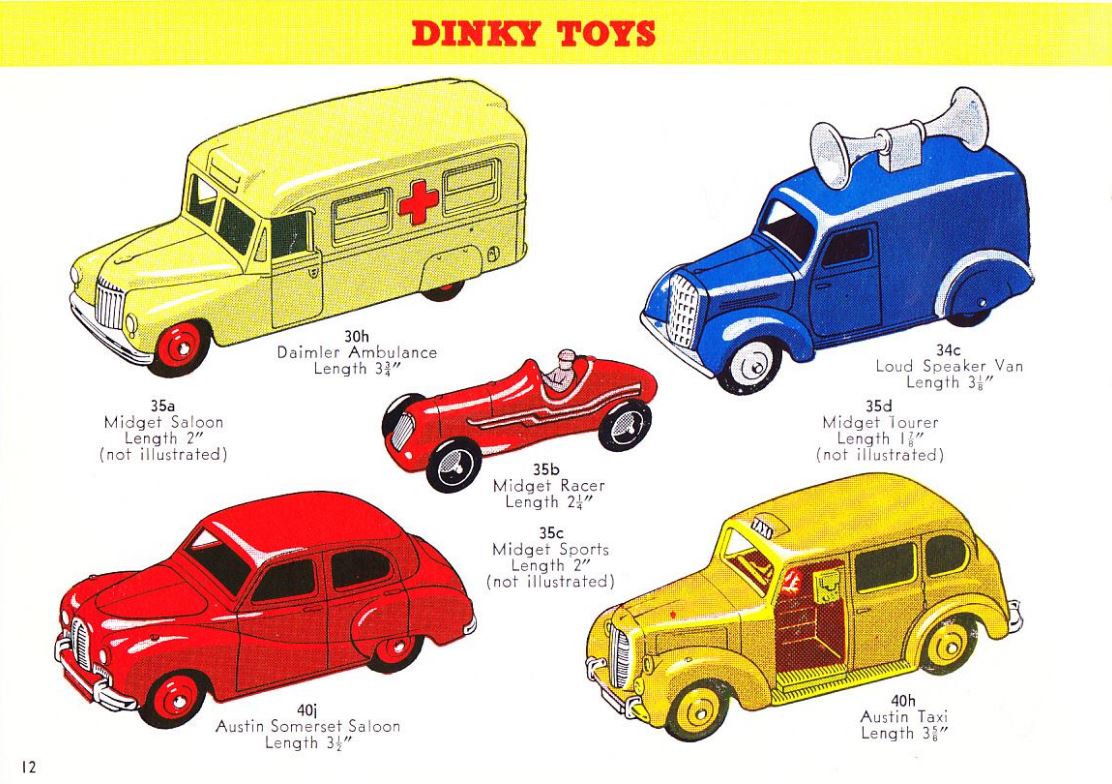
    The 1953 US Dinky Toys cat­a­log pic­tures a small red rac­ing car that many col­lec­tors might not have seen before.

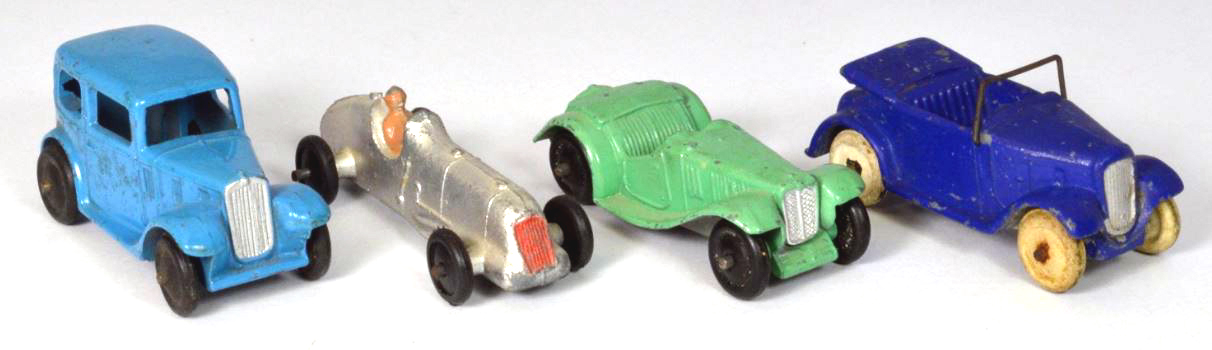
    In fact there are oth­er cars in a lit­tle set. These were orig­i­nal­ly intro­duced in 1936 and called the Small Auto Set, and num­bered 35a, 35b, 35c, and 35d. There­fore, some col­lec­tors call them the  35 series. They were tiny, only a lit­tle over 1″ long, and made to OO scale. All of these were dis­con­tin­ued in 1941, due to the war, then re-intro­duced in 1946.

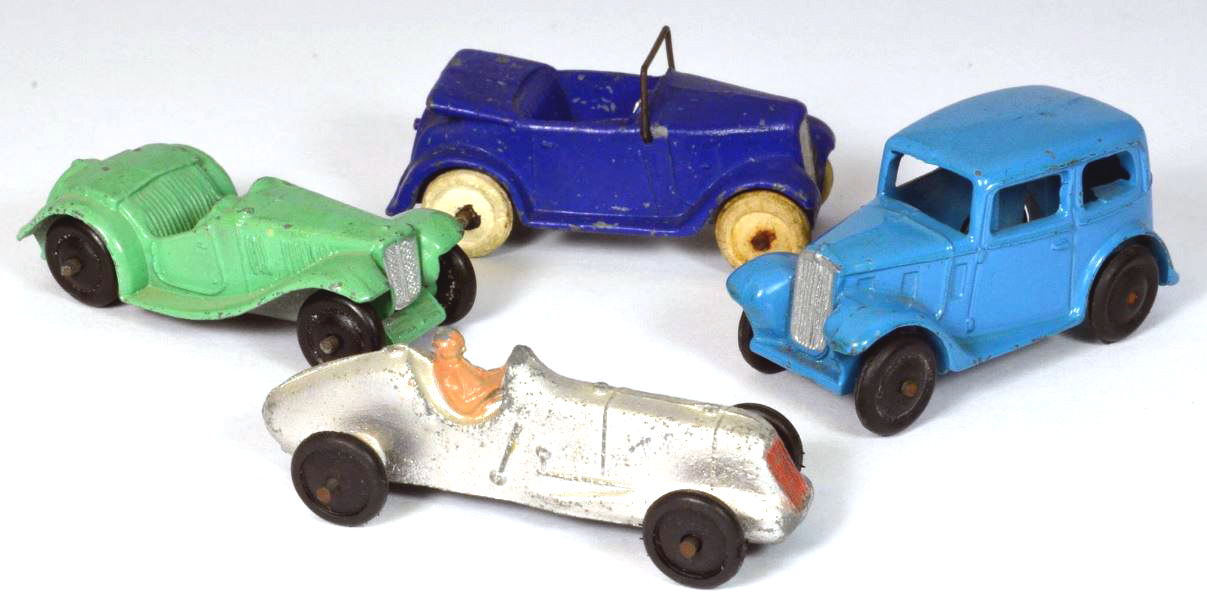
    35a is called the Saloon Car and has the appear­ance of an ear­ly Tri­umph. It was made until 1952. 35b is the Midget Car Rac­er and is mod­eled after an MG Type R race car, and was the longest made, being delet­ed in 1957. 35c is the MG Sports Car and based on the MG Midget or Type P. This was delet­ed in 1952.  35d is the Austin 7 car, mod­eled on the Austin 7 Opal 2‑seat tour­ing car. One source says it was delet­ed in 1948, but it appears in the 1951 US Dinky Toys cat­a­log.

    The pre-war 35d mod­els were fit­ted with a wire wind­screen; how­ev­er, this was delet­ed when the mod­el was re-intro­duced dur­ing the post-war years.  My exam­ple, shown below on the right, is the only pre-war mod­el of this set that I have, and it also shows the pre-war style white tires and thin­ner axles.

    The price lists from the ear­ly 1950’s cat­a­logs show these as being priced at $0.35 each, and they always came in trade box­es of 6. Here is anoth­er pho­to of this lit­tle, very anti­quat­ed set of tiny Dinky cars!

  • Old Dinky Toy Lorries

    Old Dinky Toy Lorries

    In the pre-WWII days of diecast­ing, many Dinky Toys, espe­cial­ly trucks, were a blend of sev­er­al makes that result­ing in nice look­ing mod­els. How­ev­er, these were impos­si­ble to link to a par­tic­u­lar man­u­fac­tur­er.

    My first exam­ple of this is the 22c Motor Truck, first made around 1936, dis­con­tin­ued in 1941, then re-intro­duced in 1946 for a few more years.

    Many ardent col­lec­tors have tried search­ing for a match­ing pro­to­type, such as a Bed­ford, to no avail. Head­lights, which were sep­a­rate fix­tures in those days, were espe­cial­ly dif­fi­cult to mod­el, so in some cas­es, Mec­ca­no sim­ply left them off. This par­tic­u­lar mod­el is a very, very ear­ly 1946 issue, as it is still using the pre-war style white tires, the smooth, non-ridged black wheels, and the use of black fend­ers.

    The next one is anoth­er very ear­ly post-war mod­el from around 1945, of the 25s 6 Wheeled Cov­ered Wag­on. This mod­el was first intro­duced around 1938, in a mil­i­tary ver­sion as the 151b Trans­port Wag­on, and is a some­what gener­ic design, based on a cou­ple of Eng­lish trucks from that era. The rea­son I know it is from 1945:  the smooth, non-ridged black wheels, and the very light­ly tread­ed tires… a pre-war item. They used up left­over stock for a very short time after pro­duc­tion resumed in 1945.

    About the ear­li­er mil­i­tary ver­sion, one of the 1938 issues of the “Mec­ca­no Mag­a­zine”  stat­ed that this mod­el was “based on sev­er­al vehi­cles made in the 6 wheel con­fig­u­ra­tion for the gov­ern­ment”.  Dinky col­lec­tors have found many dif­fer­ent pho­tos of sim­i­lar mil­i­tary trans­port wag­ons of that era.  Two of the clos­est may be a Ley­land Ter­ri­er (pho­to) or a Cross­ley FWD Air­field crash ten­der (pho­to).

    Even though these lit­tle mod­els have no true iden­ti­ty, I still love the look and charm of a bygone era.